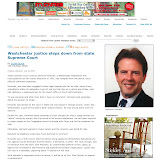
Judicial “Intervention”
The Westchester Guardian by Catherine Wilson
A visit to the web site for the New York State Unified Court System these days reveals a significant obstruction of justice and misuse of taxpayers’ funds. Plastered across the top of this web site is a banner announcing the “Judicial Compensation Lawsuit”. Our local judges are currently embroiled in a battle with Albany over their salaries. The judges are whining that they should be compensated commensurate to attorneys in private practice. However, a fact blatantly omitted from the arguments from our local judges in favor of their pay increases is the part-time nature of their positions, a mere 35 or less hours a week with six weeks paid vacation time and an additional two weeks of holidays and unlimited sick time, compared to the 70+ hour work week with limited time off for attorneys in private practice. The part-time nature of judicial employment is clearly evident from the amount of time our judges had on their hands to place volumes of materials related to their personal lawsuit on the courts’ web site! Given the fact that our courts have tremendous backlogs, why are the judges wasting precious court time advertising their lawsuit on taxpayer funded web sites?
The “Judicial Compensation Lawsuit” banner is more than just a notice. It denotes a link to an entire section of the courts web site dedicated to the judges’ court filings on this matter. The judges kindly provide a scanned copy of their full one hundred and twelve (112!) page court motion filed in July against the Albany legislature (not counting the numerous copies needed for each judge and legislator – how many trees were slaughtered for this filing alone? And what did it cost the taxpayers?). The judges also provide scanned copies of all fifty-four (54) pages of the additional lawsuit filed by the head of the court system, Judge Judith Kaye. The judges even go so far as to provide copies of four letters they signed related to this issue – another twenty-two (22) pages worth (no one ever accused the legal mind of being brief, pun intended!).
The courts have spent taxpayers’ funds to file duplicate court motions and lawsuits on this matter. They then spent even more taxpayer funds to set up this section of the court web site and to scan and link all one hundred and eighty-eight pages onto the taxpayers’ web site to publicize their demands at taxpayers’ expense. Nowhere on this site do the judges reveal the cost to the New York State taxpayers for their personal use of this web site. If indeed the judges felt the need to “get the word out” on this issue, why didn’t each judge personally chip in a portion of their current $160,000+ base (i.e. starting) salaries to fund what amounts to nothing more than a one-sided campaign smear job? If the job of the courts is to provide equal access and fair representation to all, then why haven’t the judges provided the legislative response to their lawsuits for the taxpayers benefit? Whose benefit does such a one-sided posting really serve here? Why was this skewed posting done at taxpayers’ expense in defiance of the budgetary, contractual, and legislative rules prohibiting the use of taxpayers’ systems for personal benefit? No one but the judges will benefit from an increase in judicial salaries. Therefore, no one but the judges should bear the burden of the expenses incurred in seeking those increases. And it should not be too much for the taxpayers of New York State to expect our judges to obey the laws that they enforce in the courts. And to provide us with both sides of the issue, or none at all.
This abuse of NYS taxpayers’ systems becomes even more incredulous when the Judicial Compensation Lawsuit section of the web site is compared to the information provided to litigants who must navigate the murky waters of our “justice” system alone (Pro Bono/Pro Se litigants). The web site for our local Westchester Courts does not provide any information whatsoever for “Pro Bono” help. The Westchester court site does provide a direct line for criminals to contact the court (914-995-4323) but no such information is available for law-abiding citizens of our county. Contrast that to the assistance provided to litigants in other counties: the Syracuse courts provide a full address, email contact, direct phone number, a toll free number, and both a local and 800 number for TTY lines for speech and hearing impaired litigants. If Syracuse courts and the surrounding counties upstate can provide full contact information to Pro Bono and handicapped litigants, why can’t Westchester? Why isn’t Judge Nicolai (the administrative judge of the Westchester courts) providing our residents with at least equal treatment?
The only assistance Westchester Courts will provide a frightened taxpayer facing a legal maze alone is given by their clerk’s office. But that advice is extremely limited. According to the NYS court web site:
You can find help at the Clerk's Office at any courthouse. BUT...
Workers in the Clerk's Office can't take sides or give legal advice.
They Can:
•Explain court rules and procedures.
•Explain available options for your case or problem.
•Provide past case rulings.
•Provide cites to, or copies of, the law.
•Explain public court operations and jobs.
•Describe court records and their availability.
•Provide public case information.
•Tell you how to make a complaint.
•Refer you to other offices or persons.
•Provide forms with instructions.
But They Can't:
•Suggest the procedures you should follow.
•Provide opinions about which option to chose.
•Predict what the court will do.
•Analyze the law based on the specifics of your case.
•Provide information derived from the decision-making process.
•Provide access to sealed or confidential case records.
•Provide confidential case information.
•Give opinions about your complaint.
•Make referrals based on personal preference.
•Provide or suggest the information to enter on forms.
Compare that to the Judicial section on their salary lawsuit which provides full details of the lawsuits and all letters and communications. A law-abiding litigant cannot be shown how to fill out the plethora of convoluted court forms and must struggle on unassisted, but the judges have been provided, at taxpayer expense, with complete scanned copies of the fully-drafted court motions file by the court administration to ‘cut and paste’ into their own personal lawsuits.
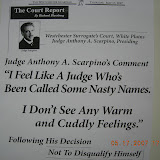
Such preferential treatment is not only limited to judges in our courts. Attorneys receive personal benefits at taxpayers’ expense. This reporter made a trip to Surrogate’s Court in White Plains this week and uncovered blatant evidence of the discrimination between attorneys and litigants in our local courts. Posted on the door of the Surrogate’s Court for Judge Anthony Scarpino was a notice inviting the attorneys who practice before the judge to a free continuing education seminar hosted by Scarpino personally. In short, a ‘meet and greet’ to smooze with the judge. At taxpayers’ expense.
Attorneys practicing in New York State must complete 24 hours of continuing education every two years. A typical 2-credit course offered by Pace Law School in White Plains costs $87.50 for an online course, other offerings are as little as $20 per credit. And unlike other professions who must pay exorbitant prices for their continuing education, many local bar associations, agencies, and law firms offer CLE courses for free. So why are our local courts offering free CLE credits to attorneys who can obtain similar information, at a similar ‘cost’, elsewhere? Since attorneys may not practice in New York State if they do not complete their required CLE training, obtaining this training is essential for them to be able to earn a living. So why are our courts providing what amounts to a personal benefit to local attorneys at taxpayer expense? Why are tax dollars and court time being used for a seminar that is clearly nothing more than a thinly disguised opportunity for the court to smooze with the attorneys who finance judicial campaigns (and for the attorneys to smooze in turn with the judge who decides their cases – an opportunity denied Pro Se litigants and therefore a violation of ‘equal access’ laws)? Plus, given the backlog of cases in Surrogates’ Court, why is Judge Scarpino dedicating his time, his court, and his staff to this endeavor? What is the cost of his staff’s time to develop, advertise, and host this ‘seminar’, the cost of court computers and copies for the materials needed, the cost of the paper and ink used, the cost for the courthouse and security staff for this event, and the facilities cost for lighting and heating? Given our budget deficit, why are we taxpayers’ paying a dime for an event that clearly is not ‘free’ at all, at least not to us? Why are we expected to subsidize overpaid attorneys with our tax dollars for their personal training? And where can the rest of us sign up to get equal face time with our local judges? With refreshments! (Judge – I like my coffee with skim milk and one Splenda).
The CLE flyer which was posted in plain site on the door of the courtroom boasts that it is not only being offered ‘free of charge’ but that the attorneys can also look forward to ‘free refreshments’. The CLE flyer also clearly notes the name of the court staff member assigned to assist them with this event (Joe Accetta), and his full contact information including address, fax number, and direct phone line (914-824-5655).
Contrast that with a flyer posted in an obscure hallway on the Surrogate’s floor for ‘Pro Bono’ help. This reporter has contacted Judge Frank Nicolai, the Administrative Judge of the Westchester courts, on several occasions about the lack of pro bono assistance available. On one occasion, this reporter contacted Judge Nicolai to inform him that the Pro Bono phone number provided nothing more to litigants than a recording which said ‘this number is out of service’! On every occasion, Judge Nicolai refused to address this reporter’s concerns. Yet on Monday, August 4, while I sat at the end of a hallway, around the corner from Surrogate’s Court and out of the line of sight of both the courtroom and the lobby, I observed Judge Scarpino’s secretary, Janet Siciliano, post a flyer for ‘Pro Bono NY’ on a door facing me, and only on that door. She walked out of her office next to Judge Scarpino’s chambers, dramatically posted the Pro Bono flyer immediately in my line of sight, and just as immediately returned to her office. Why were several flyers for freebies for attorneys posted in the lobby where they could be easily seen, yet only one solitary flyer for Pro Bono litigant’s was posted and that flyer was displayed in an area where few litigants would dare to tread? And why was that flyer only posted there (and nowhere else) only after I was seen and acknowledged by court employees? Was that for my benefit? To prove that the court really does provide Pro Bono help? If so, the court failed to convince me.
The Pro Bono ‘notice’ (shown, insert) was a pathetic attempt at providing information, especially when contrasted with the flyers distributed for the attorneys. Local attorneys who charge between $300 and $450 an hour, thereby earning revenues between $600,000 and $900,000 a year, are provided with free training and free refreshments and complete contact info, yet local taxpayers who cannot afford an attorney and who may be struggling on $40,000 a year, a fraction of the over-priced attorneys earnings, are not even entitled to get a phone number of who to call for help? Is this a joke? If so, the joke is on us, the taxpayers. For the discrimination practiced by our courts goes even deeper.
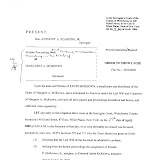
I attended Judge Scarpino’s court on August 4th out of curiosity. Judge Scarpino is the Surrogate judge for Westchester County. Surrogates, as it is commonly called, is a specialized court that handles only cases concerning the distribution of a deceased persons' estate. Surrogate courts hand out judicial appointments to greedy attorneys like candy since the litigants involved, i.e. the dead people, can’t complain. Anyone familiar with Charles Dickens’ “Bleak House” can readily see the comparisons in Westchester County Surrogate Court’s handling of the Carvel estate: by the time the attorneys are through fighting, there will be nothing left for any family member or charity to inherit. Yet in addition to his plethora of opportunities for political appointments within Surrogates, Judge Scarpino has also been appointed head of the Matrimonial Courts in Westchester County. It was a matrimonial case that drew me to his court. I was curious when I saw that Judge Scarpino was personally handling the divorce of the head of security for Westchester Community College, a divorce case (Allyson v Allyson) previously handled by disgraced Matrimonial Court referee James Montagnino.
As Guardian readers’ will recall, the Allyson case has a long history. The divorce decree was rendered by disgraced referee James Montagnino whose appointment to this particular case remains the focus of investigative attention since there was never any record of his appointment! The Appellate Courts have already noted that they found no order appointing Montagnino, in violation of New York State court proceedings. So if the referee’s appointment is non-existent, how can any order that referee issued be valid since he had no legal authority to issue the orders to begin with? Upon further investigation, former referee Montagnino resigned under suspicious circumstances and now resides in Saratoga Springs where he can do no further damage to hard-working Westchester families. In 2007, the New York Post reported that Montagnino gave the following warning in a CLE seminar he was hosting for attorneys at Pace Law School:
'beware of the 10583 Syndrome,' (a reference to posh Scarsdale's ZIP code). 'The 10583 mentality...says that 'I'm entitled and I ought to be able to get the house, I ought to be able to get support... I ought to be able to live with my son's drum instructor happily ever after and it all should be on his dime.'"
Such remarks are clear evidence of the influence judges and court referees can have on local attorneys and why such individuals should not be conducting thinly disguised CLE seminars for local attorneys which are nothing more than vehicles for them to influence those attorneys to their way of thinking. Yet despite the past horrors suffered by Montagnino’s victims, his cases are now being resurrected in Surrogates’ court by a judge who is following in Montagnino’s footsteps in more ways than one. One wonders what ‘advice’ Judge Scarpino will be offering local attorneys at his ‘meet and greet’ CLE seminar on September 17. Will it be more of the ‘beware the 10583 syndrome’ variety’? The mere presence of this reporter in his courtroom apparently made Judge Scarpino nervous since he took the unusual step of asking, on the record, ‘who was in the courtroom’? Nervous judges or not, the Guardian will continue to monitor the behavior of our local courts and their preferential treatment of attorneys and discriminatory treatment of litigants. We will continue to keep an eye on Surrogates and other courts and the Allyson case in particular. Illegal orders from disgraced court referees should not be resurrected to induce further harm upon innocent victims. And our local judges and courts may not use their positions to as an opportunity to intervene with local attorneys and personal issues or to interject their personal agendas.
Thursday, August 21, 2008


The NY Post: JUSTICE STINKS AT BRONX COURT
JUSTICE STINKS AT BX. COURT
The New York Post by DENISE BUFFA - August 21,2008
Some people were s--- out of luck when it came to doing their business yesterday at the Bronx Hall of Justice. A broken sewer line caused raw sewage to back up into the new glass courthouse at 265 E. 161st St., forcing authorities to close bathrooms, courtrooms and prison cells. "We're working on getting it fixed," said Mark Daly, a spokesman for the Department of Citywide Administrative Services, which runs the building. "We see no chance that the entire thing is going to have to be shut down." Reports of a horrible stench and some flooding in and around courtrooms, bathrooms and locker rooms led to the discovery of a broken sewer pipe - 30 feet from the building and 12 feet underground. Authorities closed down half the plumbing lines of the $421 million courthouse, which officially opened in January. While 200 prisoners slated to see judges were not allowed in because they couldn't use toilets, other male visitors were directed to ladies' rooms.
Wednesday, August 20, 2008
Press Release: PCAC Calls for Congressional Corruption Hearings
PCAC Founded to Prohibit Corruption And Cronyism
PUBLIC COMMITTEE ON ATTORNEY CONDUCT
ORGANIZING COMMITTEE
Tel: 347-632-9775 - Fax: 206-339-3784
PUBLIC COMMITTEE ON ATTORNEY CONDUCT
ORGANIZING COMMITTEE
Tel: 347-632-9775 - Fax: 206-339-3784
email: pcacinformation@gmail.com
Web: www.pcac.8k.com
PRESS RELEASE
For Immediate Release
Public Committee on Attorney Conduct Asks Immediate Congressional Hearings into Actions of Federal Judges Blocking Series of Cases Against New York Bar Disciplinary Committee
PCAC Calls Actions of Federal District Court Judges Shira Sheindlin and Thomas P. Griesa Derailing Series of Citizen Lawsuits Against New York Bar Review Committee Blatant Attempts to Cover-Up Official Corruption
New York, NY. Public Committee on Attorney Conduct (PCAC) has issued an immediate call for Congressional Hearings to review the concerted actions of federal District Court judges designed to shut down lawsuits charging New York Appellate Division Bar Disciplinary Committee with official corruption.
John T. Whitely
Chairman Executive Search Committee
Public Committee on Attorney Conduct
515 Madison Avenue
New York, New York 10022
Telephone 347-632-9775
E-mail: pcacinformation@gmail.com
Web: pcac.8k.com
Expose Corrupt Courts
Email:corruptcourt@gmail.com
Web: www.exposecorruptcourts.blogspot.com
William J. Hallenbeck
Executive Director
Litigation Recovery Trust
515 Madison Avenue
New York, New York 10022
Telephone 6462019269
E-mail: lrtinformation@gmail.com
Web: litigationrecoverytrust.8k.com
Frank Brady
www.IntegrityintheCourts.wordpress.com
Email: integrityinthecourts@gmail.com
About Public Committee on Attorney Conduct
The newly formed Public Committee On Attorney Conduct will review both past and present cases brought before the New York State grievance committees to provide an independent review and analysis of the facts, and issue proposed findings. With respect to past cases, the committee will hear from persons who maintain that they have been treated unfairly and unjustly by the state disciplinary committees. As part of its initial efforts, the new committee is actively seeking documentation of all complaints against any attorneys dating to January 1, 1988. Public Committee On Attorney Conduct will include as members individuals, who through their personal and professional lives have established a reputation of responsibility and fairness. While attorneys will be available to the PCAC as advisers, all voting members issuing formal reports and decisions will be non attorneys. PCAC is the first such lawyer conduct review organization in the U.S. to be controlled solely by non attorneys.
About Litigation Recovery Trust
Founded in 1995, Litigation Recovery Trust is a New York based claims and rights administration organization. LRT pursues claims and causes of action worldwide, and processes single and group litigation claims, as well as general rights fees and awards. LRT also participates in legislative and administrative initiatives designed to protect or advance individual claims and rights.
About Integrity in the Courts Blog
Integrity in the Courts is a daily Internet blog, which focuses on ethical and legal issues related to the administration of justice nationwide. Issues impacting both the judiciary and the bar are examined, including compliance with codes of judicial conduct, and codes of professional responsibility. Violations of law and failure to abide by codes of conduct are monitored, together with actions leading to disciplinary rulings, including attorney admonishments, reprimands, censures, suspensions and court ordered losses of licenses to practice law.
About Expose Corrupt Courts
Since beginning publication in March 2007, Expose Corrupt Courts has become one of the leading sources of both public and inside information concerning bench and bar misconduct. While the blog focuses primary attention on the court system of New York State, it regularly covers stories of interest throughout the U.S. Expose Corrupt Courts has led coverage of the massive corruption charges that have been filed against the attorney grievance committees in New York resulting in the filing of over a dozen law suits with the federal district court in Manhattan.
PRESS RELEASE
For Immediate Release
Public Committee on Attorney Conduct Asks Immediate Congressional Hearings into Actions of Federal Judges Blocking Series of Cases Against New York Bar Disciplinary Committee
PCAC Calls Actions of Federal District Court Judges Shira Sheindlin and Thomas P. Griesa Derailing Series of Citizen Lawsuits Against New York Bar Review Committee Blatant Attempts to Cover-Up Official Corruption
New York, NY. Public Committee on Attorney Conduct (PCAC) has issued an immediate call for Congressional Hearings to review the concerted actions of federal District Court judges designed to shut down lawsuits charging New York Appellate Division Bar Disciplinary Committee with official corruption.
PCAC was recently established through the combined efforts of Litigation Recovery Trust (LRT), a New York based rights administration organization, and Integrity in the Courts, and Expose Corrupt Courts, two Internet blogs focused on judicial and attorney disciplinary processes and procedures. The objective of the new organization is to assist in replacing the existing New York State Attorney Grievance Committees with a body controlled by non-attorneys . The PCAC is headquartered in New York City.
PCAC has issued the following statement in response to the recent federal court actions:
Public Committee on Attorney Conduct (PCAC) requests that the United States Senate and House Judiciary Committees and the U.S. Judicial Conference undertake an immediate review of the actions of Federal District Court Judges Thomas P. Griesa and Shira Sheindlin in blocking a series of citizen lawsuits charging the New York State Bar Disciplinary Committee with official corruption. The series of court actions showed clear evidence of corruption of the Departmental Disciplinary Committee in covering up the criminal and ethical violations of attorneys by disregarding allegations ranging from concealment of evidence, obstruction of justice, sexual assault by attorneys, pilfering of estates by attorneys, abuse of power, conspiracy and repeated violations of Constitutional rights. The judges in question halted the series of citizen lawsuits without benefit of hearing, and in some cases without reviewing the plaintiffs’ pleadings.
PCAC asks the Senate and House Judiciary Committees to call immediate hearings to review the actions of federal judges in New York designed to frustrate citizen efforts to hold court officials to account for a continuing pattern of corruption and illegal activities.
In announcing the issuance of the Committee’s statement, John T. Whitely, Chairman of the PCAC Organizing Committee, stated, “We now see that the bench-bar power structure in New York State is hard at work drawing up the wagons to defeat citizen efforts seeking a wide ranging reform that is long overdue. The most recent actions of federal judges using their authority to deny plaintiffs their day in court seeking to expose a continuing pattern of official corruption cannot be permitted. It is now time for the Congress to get involved in this critical court reform process.“
In announcing the issuance of the Committee’s statement, John T. Whitely, Chairman of the PCAC Organizing Committee, stated, “We now see that the bench-bar power structure in New York State is hard at work drawing up the wagons to defeat citizen efforts seeking a wide ranging reform that is long overdue. The most recent actions of federal judges using their authority to deny plaintiffs their day in court seeking to expose a continuing pattern of official corruption cannot be permitted. It is now time for the Congress to get involved in this critical court reform process.“
Full statements of the PCAC founding members will be made available at www.pcac.8k.com.
Public Committee on Attorney Conduct has been organized to review both past and present cases brought before the New York State grievance committees to provide an independent review and analysis of attorney complaints, and issue proposed findings. With respect to past cases, the PCAC is particularly interested in hearing from persons who maintain that they have been treated unfairly and unjustly by the disciplinary committees. As part of its initial efforts, the new committee is seeking documentation of all complaints against attorneys dating to January 1,1988.
Public Committee on Attorney Conduct has been organized to review both past and present cases brought before the New York State grievance committees to provide an independent review and analysis of attorney complaints, and issue proposed findings. With respect to past cases, the PCAC is particularly interested in hearing from persons who maintain that they have been treated unfairly and unjustly by the disciplinary committees. As part of its initial efforts, the new committee is seeking documentation of all complaints against attorneys dating to January 1,1988.
PCAC represents the first bar review mechanism in the United States made up entirely of non-attorneys. Since news of the formation of the PCAC was first made public on June 17, 2008, individual complainants have begun submitting requests to the committee to review both past and current matters before the New York State grievance committees. Requests and documents are being received by PCAC at its email address: pcacinformation@gmail.com. Telephone inquiries can be directed to 347-632-9775. For additional information, contact the PCAC website at www.pcac.8k.com.
For additional information please contact:
####30####
John T. Whitely
Chairman Executive Search Committee
Public Committee on Attorney Conduct
515 Madison Avenue
New York, New York 10022
Telephone 347-632-9775
E-mail: pcacinformation@gmail.com
Web: pcac.8k.com
Expose Corrupt Courts
Email:corruptcourt@gmail.com
Web: www.exposecorruptcourts.blogspot.com
William J. Hallenbeck
Executive Director
Litigation Recovery Trust
515 Madison Avenue
New York, New York 10022
Telephone 6462019269
E-mail: lrtinformation@gmail.com
Web: litigationrecoverytrust.8k.com
Frank Brady
www.IntegrityintheCourts.wordpress.com
Email: integrityinthecourts@gmail.com
About Public Committee on Attorney Conduct
The newly formed Public Committee On Attorney Conduct will review both past and present cases brought before the New York State grievance committees to provide an independent review and analysis of the facts, and issue proposed findings. With respect to past cases, the committee will hear from persons who maintain that they have been treated unfairly and unjustly by the state disciplinary committees. As part of its initial efforts, the new committee is actively seeking documentation of all complaints against any attorneys dating to January 1, 1988. Public Committee On Attorney Conduct will include as members individuals, who through their personal and professional lives have established a reputation of responsibility and fairness. While attorneys will be available to the PCAC as advisers, all voting members issuing formal reports and decisions will be non attorneys. PCAC is the first such lawyer conduct review organization in the U.S. to be controlled solely by non attorneys.
About Litigation Recovery Trust
Founded in 1995, Litigation Recovery Trust is a New York based claims and rights administration organization. LRT pursues claims and causes of action worldwide, and processes single and group litigation claims, as well as general rights fees and awards. LRT also participates in legislative and administrative initiatives designed to protect or advance individual claims and rights.
About Integrity in the Courts Blog
Integrity in the Courts is a daily Internet blog, which focuses on ethical and legal issues related to the administration of justice nationwide. Issues impacting both the judiciary and the bar are examined, including compliance with codes of judicial conduct, and codes of professional responsibility. Violations of law and failure to abide by codes of conduct are monitored, together with actions leading to disciplinary rulings, including attorney admonishments, reprimands, censures, suspensions and court ordered losses of licenses to practice law.
About Expose Corrupt Courts
Since beginning publication in March 2007, Expose Corrupt Courts has become one of the leading sources of both public and inside information concerning bench and bar misconduct. While the blog focuses primary attention on the court system of New York State, it regularly covers stories of interest throughout the U.S. Expose Corrupt Courts has led coverage of the massive corruption charges that have been filed against the attorney grievance committees in New York resulting in the filing of over a dozen law suits with the federal district court in Manhattan.
Tuesday, August 19, 2008
Judge Stands Up to Judicial Commission Shenanigans
NY Judge Changes Mind, Won't Resign Over Allegations
The New York Law Journal by Mark Fass - August 19, 2008
A town justice who agreed to step down from office in the face of allegations of misconduct has changed his mind. According to a complaint by the Commission on Judicial Conduct, the misdeeds of Hudson Falls Village Court Justice Michael M. Feeder included flagging down a motorist for speeding through a yield sign and then presiding over the early stages of that same motorist's trial.
Under a stipulation with the commission, Mr. Feeder agreed to resign and never again seek judicial office in New York. Friday was scheduled to be his last day. However, according to the Glen Falls Post Star, Justice Feeder has decided not to resign, citing an oral agreement to keep the conduct case private that the commission purportedly broke by releasing information to the media. "They [the commission] said, 'Sure, great…it can all be done quietly,'" the judge's attorney, Lee Kindlon, of Kindlon & Shanks in Albany, told the Post Star. "Then the commission turned around and made it public." The commission's counsel and administrator, Robert H. Tembeckjian, denied the existence of any such agreement. "No member of the staff said any such thing to the judge or to his counsel or to anyone else representing the judge," Mr. Tembeckjian said. Mr. Kindlon could not be reached for comment.
Summertime Hypocrisy from Appellate Division
Rejecting Special Referee's Report, N.Y. Court Suspends Attorney
The New York Law Journal by Mark Fass by August 19, 2008
A former senior attorney for the New York Fire Department who visited his cousin in a psychiatric unit in order to complete the paperwork needed to purchase the cousin's house has been suspended from practicing law for five years. In barring David Clinton, the former chief legal counsel for the Fire Department Bureau of Legal Affairs, from practicing law until September 2013, the Appellate Division, 2nd Department, took the unusual step of rejecting a special referee's report, which had found that Clinton had not violated any ethics rules.
To the contrary, the "evidence reveals that the respondent, without following the requisite protocol, set forth in the regulations of the New York State Department of Mental Hygiene" approached his cousin, Rubin J., with a "deed to execute while [Rubin] was confined to a psychiatric ward ... in a delusional state of mind," the unanimous panel concluded in Matter of Clinton, 2006-00152. "Rubin's vulnerability was patent. The respondent filed and recorded the deed despite being told that he could not obtain signatures on legal documents from patients in psychiatric wards without following accepted procedures." The house at the center of the dispute is located at 237 Decatur St. in Bedford-Stuyvesant, Brooklyn, and shares a backyard with the home directly behind it. The complainant, Rubin J., grew up at 237 Decatur; his cousin, the respondent Clinton, in the other house. Their fathers were brothers and the families used the shared outdoor area.
Rubin J. inherited his father's house in about 1982, according to the referee's report. In roughly 2002, Rubin J. suffered a psychological breakdown, apparently spurred by his regrets over selling family property in Barbados. Although court records do not provide a specific diagnosis of the psychosis, Rubin J. testified that it was a form of depression and paranoia that manifested in fears that people were attempting to infect him with the AIDS virus. While Rubin J. was hospitalized, Clinton visited him and, in exchange for $175,000, secured the transfer of the property's deed. Although Rubin J. and Clinton disagree over whether Clinton was motivated by a desire to help Rubin J. to protect the property from his wife and keep the property in the family or rather to take advantage of Rubin J.'s weakened state, Supreme Court Justice Melvin S. Barasch later found the conveyance "null and void" on the grounds that Rubin J. was not of sound mind when he signed the papers. Rubin J. then initiated the present complaint against his cousin.
OBJECTIVE STANDARD
In reviewing the issue of whether, in addition to voiding the transfer Clinton should be punished, Special Referee George Friedman found it was essential to determine Clinton's "state of mind" in obtaining his cousin's signature. "The gravamen of the within charge is that Respondent acted in a manner which evinces dishonesty, fraud, deceit and misrepresentation and that his conduct adversely reflects on his fitness to practice law," Friedman wrote. The referee concluded that Clinton had acted ethically as he believed his cousin was not too ill to sign the papers. "Mr. Clinton ... believed in good faith that [Rubin J.] had the legal capacity to execute the deed," Friedman wrote. "It is ... clear that neither Justice Barasch nor this Court made any finding ... which would establish any fraud, deceit dishonesty misrepresentation or any hint of venality or even wrong doing on the part of Respondent." In his July 2007 report, therefore, the referee recommended against affirming the charges. Clinton then moved to have the referee's report confirmed. On Thursday, the Appellate Division rejected Clinton's motion and the referee's report, and suspended Clinton for five years. The panel said the referee's report adopted the wrong standard in measuring Clinton's actions.
"The respondent's defense is based on his own nonexpert diagnosis ... that Rubin was of sound mind and was competent to cede ownership of his property without consideration and without the advice of an independent attorney. The respondent's counsel posits a subjective standard, based on what was purportedly in the respondent's mind at the time he had [Rubin J.] execute the deed, notwithstanding the objective facts. That standard was adopted by the Special Referee, and factored prominently in his assessment of the witnesses' credibility," the panel wrote.
"The respondent's position disregards the protection afforded by the New York State Department of Mental Hygiene, the advice of family members, the rules of professional conduct, and rulings by both the Supreme Court and the Appellate Division. " Clinton went to work for the fire department in 1990 and left in 2004 to go into private practice. The panel cited Clinton's "unblemished disciplinary history" and character evidence, including a letter of support from former Fire Commissioner Howard Safir, in opting to suspend, rather than disbar, Clinton.
Presiding Justice A. Gail Prudenti and Justices William F. Mastro, Reinaldo E. Rivera, Robert A. Spolzino and Peter B. Skelos sat on the panel. Hal R. Lieberman of Hinshaw & Culbertson represented Clinton. Lieberman declined to comment. Myron C. Martynetz represented the Grievance Committee for the 2nd and 11th Judicial Districts. Martynetz could not be reached for comment.
Sunday, August 17, 2008
New York's Secret Court
As seen in NYC's OUR TOWN newspaper - August 14, 2008
The Secret Court - Surrogate's race draws big political guns- but not much interest from voters
by Susan Camprielo (SEE: http://www.susancampriello.com)
Intense race to replace Surrogate
Posted by admin under News, Print Clips - Sunday, August 17, 2008
As seen in City Hall.
Race this year draws big political guns, but still not much interest from voters In New York, sometimes standing out in a crowd can be difficult. On the corner of Broadway and West 96th streets one humid evening, John Reddy, Jr., a candidate for New York County Surrogate’s Court, competed for attention with a pair of people promoting a paint sale and a scattering of MTA employees advising commuters that a station entrance was closed. In his khakis, blue shirt and red striped tie, Reddy might have blended in with the passing New Yorkers. But he was standing still, and two staffers formed a wall of campaign signs behind him. “Hi, Manhattan Democrat?” he chirped, roughly 30 times a minute, while shaking hand with and passing campaign flyers to anyone who stopped.
One man stopped for a brief chat, expressing frustration at what he perceives as corruption on the Surrogate’s Court. Reddy is running on a platform of ideas to change the way the court was run. He tried to make his case to the man, but did not appear to succeed. “There’s nothing you can do about it, John,” he said. “I’ll see what I can do,” Reddy called after him. Reddy is not the only candidate talking change in the race to succeed Judge Renee Roth, who is aging off the court at 70 this year. The Surrogate’s Court settles matters concerning adoptions, guardians, estates and wills of the deceased, but once again this year, the debate about its future is a lively one. And like the Upper West Side corner, the race is crowded, with Judge Milton Tingling and Nora Anderson also vying for the Democratic nomination in the Sept. 9 primary.
Surrogate laws and practices are idiosyncratic. The three candidates agree that the general public is unfamiliar with the court, and that lawyers who practice in court are not always well informed either. The candidates also hope to speed up litigation time. The primary race has already drawn more attention than normal due to the number of big names in local politics it has drawn. John Reddy has hired The Parkside Group as his consultant. Chung Seto, and Kevin Wardally of Bill Lynch Associates are overseeing Tingling’s fundraising and campaigning. Former Mayor David Dinkins (D) and Rep. Charles Rangel (D-Manhattan) are among Tingling’s most public supporters. Nora Anderson has Michael Oliva managing her campaign and Lisa Hernandez Gioia of The Esler Group doing her fundraising. The morning after Reddy argued with the man about corruption on the court, Tingling, who has been a Manhattan Supreme Court justice for seven years, met voters along 135th Street. Council Member Inez Dickens (D-Manhattan) stood next to Tingling, announcing his presence to the people trickling into the subway station.
“Good morning, good morning! This is Judge Tingling, he’s running for Surrogate’s Court. Please support him, he’s from my community,” she shouted, nearly drowning out buses and trucks on Lenox Avenue. Behind her, staff from a consulting firm handed flyers to commuters. Tingling greeted people more intimately, turning every handshake into an elongated arm grasp. One woman stopped, looking confused. The candidate approached asking slowly, “No habla Inglés?” When she shook her head, Tingling turned his flyer over, revealing his qualifications written in Spanish. Translators, Tingling said, are just part of the two-pronged approach to making the court more accessible to Manhattan’s diverse population. Translators could not only assist those involved with cases in the court, but can help teach people about wills and estates. Such meetings could take place in the satellite court offices Tingling said he hopes to open as part of this plan.
Most people know little about the Surrogate’s Court beyond being familiar with celebrity cases, like those of Woody Allen, Brooke Astor and J. Seward Johnson, or when they land in the court themselves. Tingling hopes to enhance the court’s presence in the public consciousness so that the first experience the average New Yorker has with the court is not as a litigant. “There are cases going on there, there are people being affected all the time, but nobody knows,” he said. “It’s basically a secret court.” Reddy hopes to open the court by making it more friendly and welcoming to those unfamiliar with Surrogate’s practices. As more lawyers become familiar with the court, the court will become less of a mystery to litigants, he said. Reddy said his 13 years as counsel to the public administrator of New York County has prepared him for the bench. Fewer than three years after being hired, Reddy had closed over 2,000 cases full of vague language or instructions that had been open for at least four years, he said. He is hopeful that he will be able to close Surrogate cases, some of which have been open even longer.
Anderson, who was a clerk in the court under former Surrogate Eve Preminger for nearly five years and has litigated in the court, has a different idea for speeding up the court process. If elected, she would rotate pro se clerks around the court so that they would learn to master all areas of the court and better assist litigants who may be unfamiliar with the court’s proceedings. Rotating existing staff would eliminate the need to hire, and pay, more clerks, she said. Moving clerks around departments would force clerks to become familiar with all aspects of the court, making them generally more familiar with practices than they currently are.
Plus, she said she would use her position as judge to educate people in an effort to keep them from having to come to court in the first place, since all court proceedings can become expensive, time consuming and stressful for litigants. She has cut back her hours with the Brooklyn law firm Seth Rubenstein, P.C. in order to spend time campaigning at green markets, street fairs and on sidewalks, such as the one along Eighth Avenue between 22nd and 23rd streets where, one recent evening, she hopped, teetered and pirouetted in heels, dodging and followed potential voters. Wearing a tailored black suit over a sleeveless knit zebra-print top, she tried to stop pedestrian traffic. “Hi, I’m running for Surrogate Court, and I need your support,” she said. “Hi, I’m running to be a judge. I’ve got a great website.” She spent a lot of the time telling people how to register as Democrats so they could vote. She spent just as much time giving shouted-out summaries of what the court does and what she would do as judge if they voted for her. “A large part of this campaign,” she said, “has been education.”
(Also, see: www.Manhttanmedia.com)
Friday, August 15, 2008
Federal Order on New York Court Corruption
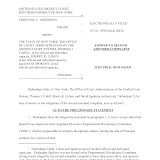
To see the August 8, 2008 dated federal court order of the Hon. Shira A. Scheindlin, CLICK HERE.... MORE COMING SOON.....
Thursday, August 14, 2008
Executive Order by Governor to Ensure High Quality of Judges
New York State Executive Chamber | Governor Eliot Spitzer
Press Releases | Speeches | Executive Orders | Proclamations
EXECUTIVE ORDER
No 4: ESTABLISHING JUDICIAL SCREENING COMMITTEES TO ENSURE THAT JUDICIAL OFFICER APPOINTMENTS ARE OF THE HIGHEST QUALITY
WHEREAS, under the Constitution and Laws of the State of New York the Governor is entrusted with the responsibility of appointing judicial officers to the offices of Judge and Presiding Judge of the Court of Claims; designating Justices of the Supreme Court to the offices of Justice, Temporary Justice, and Presiding Justice of the Appellate Division of the Supreme Court; and appointing judicial officers to fill vacancies in the offices of Justice of the Supreme Court, Judge of the County Court, Judge of the Surrogate=s Court, and Judge of the Family Court outside the City of New York; and
WHEREAS, a fair, impartial, independent, highly qualified, and diverse judiciary is essential to ensuring justice for all who come before New York=s courts and to fostering public confidence in the integrity of the judicial process; and
WHEREAS, a fair, impartial, independent, highly qualified, and diverse judiciary is cultivated by:
1. encouraging highly qualified candidates from all parts of the State, with diverse backgrounds and experiences, to apply for judicial offices;
2. reviewing candidates for judicial office without regard to political beliefs or party affiliation; and
3. selecting judicial officers who reflect the diverse backgrounds and experiences of the residents of this State, based on their integrity, independence, intellect, judgment, temperament, and experience; and
WHEREAS, the highest quality of judicial appointments can best be assured with the assistance of credible, impartial and non-partisan judicial screening committees;
NOW THEREFORE, I, Eliot Spitzer, Governor of the State of New York, by virtue of the authority vested in me by the Constitution and Laws of the State of New York, do hereby order as follows:
A. Purpose and Duties
1. Judicial Screening Committees are hereby established to evaluate the qualifications of candidates for appointment or designation to judicial office throughout the State, and to recommend to the Governor those persons who are highly qualified to hold judicial office.
2. Each Judicial Screening Committee shall:
a. Actively recruit candidates for appointment or designation to the judicial offices within the committee=s jurisdiction. In recruiting candidates, the Judicial Screening Committees shall strive to find candidates that reflect the diverse backgrounds and experiences of the citizens of this State;
b. Review and evaluate the qualifications of all candidates for appointment or designation. In reviewing and evaluating the qualifications of candidates, each committee member shall give primary consideration to each candidate=s integrity, independence, intellect, judgment, temperament and experience, and shall not give any consideration to the age, creed, color, national origin, sexual orientation, military status, sex, disability, predisposing genetic characteristics, marital status or political party affiliation of the candidate;
c. Recommend for appointment or designation only those candidates who, as determined by a majority vote of all members of the committee, are highly qualified for the judicial office for which they are being considered. No committee shall pass on the qualifications of any candidate until after a thorough inquiry has been made by the committee and its staff;
d. Prepare written reports on the qualifications of each candidate it determines to be highly qualified and recommends to the Governor. Committee reports shall be made available to the public upon the announcement by the Governor of an appointment. All other records and deliberations of, and all communications to, any Judicial Screening Committee with respect to a candidate shall be held in confidence and shall not be disclosed to anyone other than the Governor, Counsel to the Governor, or their designees. Notwithstanding the foregoing, information submitted to any Judicial Screening Committee relating to an appointee may be disclosed to the Senate when necessary for confirmation of the appointee, and information submitted to a Judicial Screening Committee may be disclosed to any other person or organization if disclosure is required in connection with disciplinary proceedings or is otherwise required by law.
B. State Judicial Screening Committee
1. A State Judicial Screening Committee is hereby established.
2. The State Judicial Screening Committee shall consist of thirteen members: two individuals selected by the Governor; the Chairperson of each of the Departmental Judicial Screening Committees established by Section C of this Executive Order; one of the other members of each of the Departmental Judicial Screening Committees, who shall be selected by the Governor; two persons selected by the Chief Judge of the Court of Appeals; and one person selected by the Attorney General. The chairperson of the State Judicial Screening Committee shall be appointed by the Governor from among the members of the Committee.
3. The term of office of any member of the State Judicial Screening Committee who is a member of a Departmental Screening Committee shall expire at the same time as the member=s term of office on the Departmental Screening Committee expires.
4. The State Judicial Screening Committee shall have jurisdiction to consider the qualifications of candidates for appointment to the offices of Judge and Presiding Judge of the Court of Claims, and to recommend to the Governor all persons whom it finds highly qualified for those judicial offices.
5. When exercising the power to designate the Presiding Judge of the Court of Claims pursuant to section 2(6) of the Court of Claims Act; or the power to appoint a Judge of the Court of Claims pursuant to section 9 of Article VI of the Constitution and section 2(2) and 2(4) of the Court of Claims Act; or the power to fill a vacancy in the office of Judge of the Court of Claims pursuant to section 21(b) of Article VI of the Constitution, the Governor shall appoint or designate only persons who have been recommended by the State Judicial Screening Committee as highly qualified for the judicial office to which the appointment or designation is to be made.
6. The State Judicial Screening Committee shall promulgate appropriate rules and regulations to govern its proceedings and those of the Departmental and County Judicial Screening Committees established by this Order. The rules and regulations shall include standards and procedures for ensuring, to the extent possible, uniformity of criteria for evaluating the qualifications of candidates for appointment or designation to judicial office throughout the State.
C. Departmental Judicial Screening Committees
1. A Departmental Judicial Screening Committee is hereby established in each judicial department of the State.
2. Each Departmental Judicial Screening Committee shall consist of thirteen members: five members shall be selected by the Governor; two members shall be selected by the Chief Judge of the Court of Appeals; two members shall be selected by the Attorney General; one member shall be selected by the Presiding Justice of the Appellate Division for that department; one member shall be selected jointly by the Speaker of the Assembly and the Minority Leader of the Senate; one member shall be selected jointly by the Majority Leader of the Senate and the Minority Leader of the Assembly; and one member shall be selected by the President of the New York State Bar Association. The Chairperson of each Departmental Screening Committee shall be appointed by the Governor from among the members of the Committee. Each member of the Committee shall be a resident of, have an office in, or work in the judicial department in which he or she is to serve.
3. Each Departmental Judicial Screening Committee shall have jurisdiction to consider the qualifications of candidates for designation to the offices of Justice, Additional Justice, Temporary Justice and Presiding Justice of the Appellate Division of the Supreme Court for such department, and candidates for appointment to the office of Supreme Court Justice within such department, and to recommend to the Governor all persons whom it finds highly qualified for those judicial offices.
4. When exercising the power to designate the Presiding Justice of each Appellate Division pursuant to section 4(c) of Article VI of the Constitution; or the power to designate other Justices of any Appellate Division pursuant to sections 4(c) and 4(d) of Article VI of the Constitution; or the power to designate Additional Justices of any Appellate Division pursuant to section 4(e) of Article VI of the Constitution; or the power to fill a vacancy in the office of Justice of the Supreme Court pursuant to section 21(a) of Article VI of the Constitution, the Governor shall appoint or designate only persons who have been recommended by a Departmental Judicial Screening Committee as highly qualified for the judicial office to which the appointment is to be made.
5. A candidate recommended as highly qualified for the office of Justice or Additional Justice of the Appellate Division of the Supreme Court by a Departmental Screening Committee shall be eligible for appointment or designation by the Governor to such office in any judicial department. Notwithstanding the foregoing, a person serving as a Justice of the Appellate Division of the Supreme Court may be designated by the Governor to serve as an Additional Justice, and a person serving as an Additional Justice of the Appellate Division of the Supreme Court may be designated by the Governor to serve as a Justice, of the same or a different judicial department without the recommendation of a Departmental Screening Committee.
D. County Judicial Screening Committees
1. A County Judicial Screening Committee is hereby established in each county of the State, consisting of the members of the Departmental Judicial Screening Committee for the department in which the county is located plus one additional person who shall be resident of, have an office in, or work in the county in which he or she is to serve, to be selected by the chief executive officer of the county. The Chairman of the Departmental Judicial Screening Committee shall also serve as Chairman of the County Judicial Screening Committee. As used herein, the term "chief executive officer" for the county shall mean the appointed or elected county executive, as the case may be, or if there be no such office, the chairman of the governing body of the county; provided, however, that for counties within the City of New York, the term "chief executive officer" for the county shall mean the Mayor of the City of New York.
2. Each County Judicial Screening Committee shall have jurisdiction to consider the qualifications of candidates for appointment to the offices of Judge of the County Court, Judge of the Surrogate=s Court, and Judge of the Family Court outside of the City of New York, for such county, and to recommend to the Governor all persons whom it finds highly qualified for those judicial offices. When exercising the power of appointment to fill a vacancy in the office of Judge of the County Court, Judge of the Surrogate's Court, or of Judge of the Family Court outside of the City of New York, pursuant to section 21(a) of Article VI of the Constitution, the Governor shall appoint only persons who have been recommended by the appropriate County Judicial Screening Committee as highly qualified for the judicial office to which the appointment is to be made.
E. General Provisions
1. The terms of office of the members of the Judicial Screening Committees established by this Executive Order shall be for a term of three years, except that with respect to the Departmental Screening Committees: one member first selected by the Governor shall serve for a term of one year; two members first selected by the Governor shall serve for a term of two years; one member first selected by the Chief Judge of the Court of Appeals shall serve for a term of two years; and one member first selected by the Attorney General shall serve for a term of two years. The terms of office of the members of the Judicial Screening Committees established by this Executive Order are subject to the provisions of section 5 of the Public Officers Law.
2. Vacancies shall be filled in the same manner as initial appointments, and a person appointed to fill a vacancy shall serve for the remainder of the unexpired term. No member shall be removed during his or her term by the Governor except for cause.
3. No member of a Judicial Screening Committee shall hold any judicial or elected public office for which he shall receive compensation during his period of service, nor shall he hold any office in any political party. No member of a Judicial Screening Committee shall be eligible for appointment to any judicial office within the jurisdiction of the Judicial Screening Committee on which the member serves during the member=s period of service or within one year thereafter.
4. Members of Judicial Screening Committees shall receive no compensation for their service, but shall be entitled to reimbursement for any necessary expenses incurred by them in connection with the performance of their duties. Each judicial screening committee shall have a paid staff available to it sufficient to enable the committee to carry out properly its responsibilities including adequate investigations into all matters relevant to the qualifications of candidates for appointment to judicial office.
5. Except as may be necessary or appropriate prior to the time the Judicial Screening Committees established by this Executive Order are fully operational, the power to fill a vacancy in a judicial office will be exercised by the Governor in accordance with the provisions of this Executive Order.
G I V E N under my hand and the Privy Seal of the State in the City of Albany this first day of January in the year two thousand seven.
Eliot Spitzer, Governor
Richard Baum, Secretary to the Governor
NY Daily News on Corrupt Surrogate Courts
To clean up corrupt Surrogate Courts, wake up and vote
The New York Daily News Errol Louis - August 14th 2008
Every couple of years, like clockwork, scandal hits New York's Surrogate Courts, which sort out the estates of people who die without a will or leave a will that's unclear or contested. In the wrong hands, the system lends itself to abuse. The elected surrogates have the power to appoint private attorneys to look after large sums of money. A rogues' gallery of chiselers and crooks has flocked to the courts over the years, running up bills and draining money that rightfully belongs to the heirs and descendants of the dead. That's why Manhattan Democrats need to pay attention to the upcoming primary for surrogate.
Most people don't think about the court until the headlines report high-profile cases like Brooke Astor's $132 million estate or the late Leona Helmsley's nutty attempt to leave $12 million to her dog. But the reality is much less glamorous than those headlines. Last month, Daily News investigative reporter Nancie Katz uncovered a mess in the Bronx, where Surrogate Lee Holzman allowed politically connected lawyers to run up more than $2 million in fees while 37 heirs waited - some for more than a decade - and collected nothing. To make matters worse, some of the Bronx estate money was improperly placed in risky investments that tanked. Taxpayers may end up covering the $20 million loss. And then there's Brooklyn, where ex-Surrogate Michael Feinberg was removed from office in 2005 for improperly allowing one of his pals to take excessively high fees from estates of the dead.
The scandals are nothing new. As far back as the 1930s, corruption problems led the city Bar Association to call for the Surrogate's Court to be folded into the general court system - an idea still worth considering. Sen. Robert Kennedy mounted his own reform effort in the 1960s. And 40 years after his death we're still trying to protect widows, orphans and the dead from predatory pols and lawyers. Which brings us to the Democratic primary for a 14-year term as Manhattan surrogate. All three candidates for the office describe themselves as reformers, although none has a clear claim to that title.
John Reddy, who has worked in the Surrogate's Court for 29 years, was the protégé of a lawyer who got mixed up in a court scandal, but claims he was part of making things better and says "a pro-active surrogate who knows the system can make the court run better."
Nora Anderson, an attorney in private practice, has been running a spirited campaign with the help of campaign manager Michael Oliva, a savvy strategist who has won several insurgent judicial races in recent years. But Anderson's outsider/reform credentials have taken a serious and perhaps fatal hit in the form of a $225,000 campaign loan from Seth Rubenstein, a Brooklyn trust and estate lawyer with deep family ties to the business (his father served as Brooklyn surrogate in the 1950s, and his grandfather worked in the same court). Anderson will have to work hard to prove that, if elected, she will not be politically and financially indebted to Rubenstein.
The third candidate, Milton Tingling, is a Supreme Court justice endorsed by Harlem powerbrokers like ex-Mayor David Dinkins and Manhattan Democratic boss Denny Farrell. Tingling also snagged Gary Tilzer, a longtime gadfly and reformer, as a campaign strategist. "The two other candidates represent firms that have controlled the court for the past 50 years," said Tilzer, who has campaigned against court corruption for decades. "It's not Tammany Hall controlling the Surrogate's Court, it's families and connected friends." Actually, it's the people who have ultimate control in a democracy. All the more reason Manhattan Dems should think long and hard before picking the leader of a court that has eluded reform for generations. elouis@nydailynews.com
Wednesday, August 13, 2008
Attorney in Milberg Case Draws Two-Month Prison Term
The National Law Journal - August 13, 2008
LOS ANGELES - A federal judge has sentenced Richard Purtich, a Los Angeles lawyer who pleaded guilty in the government's criminal kickback case against Milberg, to two months in prison, despite requests from his lawyer and federal prosecutors to give him probation. On Monday, U.S. District Judge John Walter of the Central District of California sentenced Purtich to prison time, plus an additional year of supervised release, and ordered him to pay a $50,000 fine. Purtich pleaded guilty two years ago to a tax charge, admitting that he failed to report to the Internal Revenue Service about $900,000 he received from Milberg and passed on to Steve Cooperman, a lead plaintiff in several of the firm's cases. In the case, prosecutors claimed that Cooperman, who pleaded guilty to a federal conspiracy charge last year, received payments from William Lerach--a former partner at Milberg, formerly known as Milberg Weiss--who pleaded guilty last year to a federal conspiracy charge and is serving a sentence of two years in prison. In a sentencing memorandum, prosecutors had recommended that Purtich receive one year probation, with no home confinement, given his extensive cooperation in the case. They also noted that Purtich lost his license to practice law about two years ago. They recommended a $50,000 fine. Thom Mrozek, a spokesman for the U.S. Attorney's Office, for the Central District of California, declined to comment. Purtich's lawyer, William Genego, a partner at Santa Monica, Calif.-based Nasatir Hirsch Podberesky and Genego, did not return a call for comment. In a sentencing memorandum, Genego had recommended that Purtich receive probation. Under the advisory Federal Sentencing Guidelines, Purtich could have faced 21 to 27 months in prison. The probation office had recommended a $200,000 fine.
LOS ANGELES - A federal judge has sentenced Richard Purtich, a Los Angeles lawyer who pleaded guilty in the government's criminal kickback case against Milberg, to two months in prison, despite requests from his lawyer and federal prosecutors to give him probation. On Monday, U.S. District Judge John Walter of the Central District of California sentenced Purtich to prison time, plus an additional year of supervised release, and ordered him to pay a $50,000 fine. Purtich pleaded guilty two years ago to a tax charge, admitting that he failed to report to the Internal Revenue Service about $900,000 he received from Milberg and passed on to Steve Cooperman, a lead plaintiff in several of the firm's cases. In the case, prosecutors claimed that Cooperman, who pleaded guilty to a federal conspiracy charge last year, received payments from William Lerach--a former partner at Milberg, formerly known as Milberg Weiss--who pleaded guilty last year to a federal conspiracy charge and is serving a sentence of two years in prison. In a sentencing memorandum, prosecutors had recommended that Purtich receive one year probation, with no home confinement, given his extensive cooperation in the case. They also noted that Purtich lost his license to practice law about two years ago. They recommended a $50,000 fine. Thom Mrozek, a spokesman for the U.S. Attorney's Office, for the Central District of California, declined to comment. Purtich's lawyer, William Genego, a partner at Santa Monica, Calif.-based Nasatir Hirsch Podberesky and Genego, did not return a call for comment. In a sentencing memorandum, Genego had recommended that Purtich receive probation. Under the advisory Federal Sentencing Guidelines, Purtich could have faced 21 to 27 months in prison. The probation office had recommended a $200,000 fine.
Tuesday, August 12, 2008
Federal Judge OK's Statewide Ethics Corruption
Attorney Disciplinary Body Immune From Claims of "Whitewashing," Judge Finds
New York Law Journal by Daniel Wise - August 12, 2008
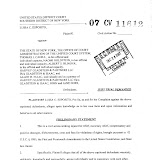
Southern District Judge Shira Scheindlin last week dismissed six lawsuits filed by pro se litigants claiming the disciplinary committee of the Appellate Division, First Department, had "whitewashed" complaints against lawyers. Judge Scheindlin had previously accepted all six cases as related to a $10-million damages action brought against the committee by a lawyer who claimed she was fired after working for the committee for six years after she alleged her superiors had a "practice" of "whitewashing" complaints against "certain select attorneys."
Judge Scheindlin dismissed the six related cases brought by litigants with complaints against their lawyers because the committee, and lawyers working for it, are entitled to immunity. Discovery in the lawsuit brought by Christine Anderson, the lawyer who was fired in June 2007, is scheduled to be completed by the end of the month. With last week's ruling in Esposito v. State of New York, 07 Civ. 11612, all the cases that had been accepted as related to Ms. Anderson's have been dismissed. The First Department's disciplinary committee handles ethics complaints filed against lawyers practicing in Manhattan and the Bronx.
Jail and Fines Given to Solo Who Withheld Down Payment
Jail and Fines Given to Solo Who Withheld Down Payment
The New York Law Journal by Mark Fass - August 12, 2008
A Brooklyn attorney who refused for more than two years to return a $30,000 down payment in a failed real-estate deal, even after her client died and his estate engaged new counsel, has been sanctioned $10,000 and ordered to pay more than $40,000 in costs. Solo-practitioner Regina Felton eventually returned the $30,000, as well as more than $6,000 in interest, in April 2008, after spending 11 days of a six-month sentence on Riker's Island for civil contempt of court. Last week, Brooklyn Supreme Court Justice Arthur M. Schack (See Profile) issued a written decision adding costs and imposing the maximum sanction for Ms. Felton's "frivolous conduct." "Clearly, the pattern of defendant Felton's conduct in the instant action is subject to costs and sanctions," he held in Astrada v. Archer, 34401/05. The decision will be published Thursday.
"Ms. Felton's intransigent conduct, demonstrated by her refusal to return the down payment with the accrued and statutory interest to plaintiff, compelled plaintiff to commence the instant action and motion practice." Ms. Felton declined yesterday to discuss this specific decision, though she said she already had other appeals pending in the same matter. The present dispute dates to a failed 2005 real-estate contract between plaintiff Faith Astrada and Ms. Felton's then-client, Hulbert Archer, for Mr. Archer's Clinton Hill, Brooklyn, home.
According to Justice Schack's decision, that deal fell apart for several reasons, all attributable to Ms. Felton. Primarily, the transaction was needlessly stretched out for 18 months as Ms. Felton pursued a "certificate of no harassment" on the errant belief that the building was registered as a single-room occupancy. That delay led to the expiration of Ms. Astrada's mortgage commitment. Ms. Felton also failed to adequately address a lis pendens filed against the property, instead submitting to the court a "total and complete fabrication" on the issue, Justice Schack wrote. Namely, Ms. Felton claimed to have secured a stipulation that the debt would be paid out of the proceeds of the closing, although she attached in her papers only an unsigned, unexecuted proposal for a stipulation. Ms. Felton also filed a complaint against Ms. Astrada's original attorney for communicating directly with her client and his wife, even though the allegedly improper letter was required under the "inartfully drafted contract and rider" composed by Ms. Felton.
Ms. Felton refused to return the payment despite numerous orders. At an April 7 hearing, she finally brought a check for the $30,000 payment, though it only included the actual interest of $438, rather than the statutory interest of $6,608. When Ms. Felton said she would not produce the additional funds if given an hour to do so, Justice Schack ordered her to jail. Not wanting to miss an opportunity to collect the $30,438, Ms. Astrada's attorney, James T. Gerardi of East Northport, asked the judge during the hearing to retrieve the check before sending Ms. Felton to Rikers. "Your Honor, may I ask the Court to compel Ms. Felton to deliver the [check] she has put in her pocket?" Mr. Gerardi asked, according to the hearing transcript. "The money is here." "Ms. Felton, will you be willing to hand over the $30,438.81 check?" Justice Schack asked. "No," Ms. Felton answered, "I am not." The judge declined to forcibly compel her to remove the check from her pocket and hand it to Mr. Gerardi. On April 18, she made the full payment, including an additional 11 days' interest, and was released from jail.
Sanctions Justified
In a 32-page decision handed down last week, Justice Schack ruled that, all told, Ms. Felton's actions merited the highest sanction permitted for "frivolous conduct" under 22 NYCRR Sec. 130-1:1(c). "In the instant action, a reasonable attorney would have refunded plaintiff her down payment after the real estate contract was unable to close," Justice Schack wrote. "Further, a reasonable attorney would not make material misrepresentations to the Court, comply with Court orders that are not stayed, and not subject the reasonable attorney from being found in contempt for willful failure to comply with Court orders. It is clear that Ms. Felton's course of conduct in the instant action is not reasonable." In addition to the $10,000 sanction, Justice Schack also calculated costs of $40,600, including the approximately $24,682 in legal fees Ms. Astrada accrued attempting to recover her $30,000. The decision marks the second time this summer that Justice Schack has ordered Ms. Felton to pay an adversary five-figure costs.
In July, he ordered her to pay defendant United Equities Inc., $13,000 for refusing to discontinue a real-estate action even though it was "crystal clear" she had sued the wrong entity. (NYLJ, July 8.) "Obviously this judge has some vendetta against me," Ms. Felton said yesterday, noting that no other judge has deemed her "frivolous" in her 30-year career. "This is a judge who has an ax to grind." Justice Schack declined yesterday to discuss the matter. Ms. Astrada's attorney, Mr. Gerardi, could not be reached for comment. Mr. Archer's estate finally sold his home in December 2007 for $480,000, according to the Web site Trulia.com. Citing confidentiality, the Committee on Character and Fitness for Admission declined to state whether any complaints have been filed against Ms. Felton. A representative for the Appellate Division, Second Department, said that Ms. Felton is in good standing and has never been suspended or publicly censured. - Mark.Fass@incisivemedia.com
Saturday, August 9, 2008
Law Makers, Lawyers, Laws and Lawlessness
SHELLY RIPPED FOR 50G LAW LOAN
By FREDRIC U. DICKER - August 7, 2008
ALBANY - A political rival yesterday blasted closed-mouthed Assembly Speaker Sheldon Silver for lending $50,000 to a small company that funds personal-injury lawsuits and could be hurt by efforts to limit lucrative awards to trial lawyers - including those at Silver's law firm. "You have Sheldon Silver putting the interests of [law firm] Weitz & Luxenberg and the Tria Lawyers Association above that of New Yorkers," charged Paul Newell, who is challenging him in the Democratic primary. "Silver is employed by Weitz & Luxenberg for an undisclosed salary for undisclosed work on behalf of undisclosed clients, and if that wasn't bad enough, he now is personally investing in companies that have business before the state." Silver has lent at least $50,000 to Counsel Financial Services, an Upstate company that finances small law firms specializing in personal-injury cases, The New York Times said yesterday. Silver, who has blocked efforts to cap payouts in such cases, refused to comment.
Friday, August 8, 2008
Coordinating Public Interest or Public Cover Up?
With New Hire, Pace Law Launches Public Interest Center
The New York Law Journal by Thomas Adcock - August 08, 2008
On Monday, Jennifer Friedman will report to work at Pace Law School as director of the Public Interest Law Center, an initiative long in the talking stage among faculty and students at the White Plains campus and now finally made real by Dean Michelle Simon. "We need to bring under a single roof all the various public interest activities already going on, and expand into areas that are not strong at the moment," said Ms. Friedman, an attorney with the nonprofit Sanctuary for Families for the past 10 years.
At Sanctuary, Ms. Friedman was founding director of the Courtroom Advocates Project, which brokered pro bono representation for victims of domestic violence in New York City's Family Courts and 10 other jurisdictions around the state. The project trained some 6,200 law students and private firm summer associates at 45 Manhattan firms in advocating for battered women. Ms. Friedman's portfolio at Pace Law is "wide open," said Dean Simon. She said Ms. Friedman was hired over 100 other applicants in large part because "she's built these kinds of things before." Rachel Littman, an attorney and assistant dean for career development at Pace Law, credited Ms. Simon, a longtime faculty member who became dean in May after serving as interim dean since last August, with giving the final push needed to establish the Public Interest Law Center. "Ideas about it had been batted around for years, but for whatever reason we never consolidated a center," said Ms. Littman. "Dean Simon picked up the reins and pulled everything together." The absence of what Ms. Friedman terms a "clearinghouse" for public interest law, which exists in one way or another at New York state's other 14 law campuses, was "just a gap that always seemed to be there," according to Ms. Simon, who promoted the matter as a priority.
"When I became interim dean and gained a little power - not much, but a little - I started talking seriously with the faculty and students, and I managed to find the money," said Ms. Simon. "The idea was there, so it didn't take my convincing people. Like many things, it just took somebody to make it happen." For the moment, the new center's budget encompasses only Ms. Friedman's salary, described by Ms. Littman as "less than a first-year associate at a major firm." Eventually, there will be additional salaries to pay, as well as stipends for summer internships and a loan forgiveness program for graduates entering low-paying public service jobs. Students at Pace Law represent clients through faculty-supervised clinics and field externship programs in environmental litigation, disability law, criminal defense, investor rights and immigration law - as well as special Pace Law programs in environmental law, land use and real estate law and women's justice. Ms. Friedman indicated one of the big areas of pro bono legal help she might add to the school's existing agenda.
"One of the huge legal needs now in Westchester County is related to the mortgage crisis," she said. "There are people in danger of losing their homes, people whose only equity was their house. They can't sell their homes for as much as they borrowed. These are people just a step away from poverty, and we should keep that from happening." She added, "There are a number of social ills that follow from losing a home. Families go into a downward spiral, which is extremely destabilizing. It's not in society's interest to have that happen." In addition to formulating the new center's mission and individual initiatives as its inaugural director, Ms. Friedman will serve as associate director for public interest counseling and placement at Pace Law's Center for Career Development. She will also serve as Pace Law's liaison to the Westchester County Pro Bono Local Action Committee, co-chaired by Francis A. Nicolai, administrative judge of the Ninth Judicial District; Westchester County Surrogate Anthony A. Scarpino Jr.; and Erin Noelle Guven, pro bono coordinator for Legal Services of the Hudson Valley. - Thomas.Adcock@incisivemedia.com
Wednesday, August 6, 2008
Time for AG Cuomo to Remove State-Financed Dirty-Dealing Hacks
Records fill in details of Spitzer-Bruno feud
Albany County Clerk's office makes public records of 'Troopergate' scandal investigation
The Albany Times Union by ROBERT GAVIN and IRENE JAY LIU, Staff writers - July 5, 2008
ALBANY -- Thousands of once-secret documents released Tuesday included an e-mail exchange in which former Gov. Eliot Spitzer and his aides discussed how to make Senate Majority Joseph Bruno look "crazy" as the feud between the two men heated up. At the same time, the records show Spitzer vehemently telling investigators he never ordered State Police to surveil his nemesis.
The four boxes of documents -- totaling 8,562 pages of records -- reveal Spitzer and top aides repeatedly exchanged e-mails touching upon everything from politics to their opinon of newspaper coverage. The records tell the story of two investigations by District Attorney David Soares into allegations that Spitzer aides misused State Police to collect damaging information on Bruno as part of a political smear campaign. More than 8,500 pages of records of Soares' investigations into the travel records scandal were made public Tuesday by the Albany County Clerk's office. The clerk's office released four boxes worth of photocopied documents following requests from newspapers across the state into the scandal, which surfaced after Bruno, R-Brunswick, accused Spitzer, a Democrat, of launching a smear campaign.
The controversy erupted following a July 1, 2007, Times Union story on Bruno and other state officials' taxpayer-funded travel last July. Later that month, State Attorney General Andrew Cuomo found top gubernatorial aides wrongly used State Police to re-create from memory Bruno's use of state aircraft and police drivers to travel to New York City on days when he had political fundraisers. Cuomo found nothing illegal, but that police were wrongly drawn into a political dispute. Soares' first report found no wrongdoing by Spitzer. A second report later concluded Spitzer was, in fact, involved despite stating he did not know what his aides were doing. The documents released contain personal information that was redacted or completely blacked out by Soares' office. The documents were released at 10 a.m.
Tuesday, August 5, 2008
Officers of Court Now Stealing Crippled Kids' Money
Brooklyn lawyer couple eyed in guardian scams
The New York Daily News by NANCIE KATZ, BARBARA ROSS AND DAVE GOLDINER - August 4, 2008
Prosecutors are investigating a politically connected Brooklyn lawyer and his wife for allegedly siphoning off "potentially millions" of dollars from unwitting clients, including crippled kids, sources said. Steven Rondos, 43, and his lawyer wife, Camille Raia, 47, are suspected of stealing the money from so-called guardianship accounts set up for victims of medical malpractice and personal injury cases. A source close to the case said many of the victims are children who suffered serious injuries in car crashes or other accidents. The couple manages accounts worth up to $50 million. Rondos and Raia have an office in Bay Ridge and own a $1.4 million home in leafy Ridgewood, N.J. They have not been charged, and the Manhattan district attorney's office refused to comment on the alleged scam, which sources said may have gone on for years. Judges in several boroughs and counties have started removing Rondos and Raia from their positions of authority over the accounts. "[Officials] are in the process of petitioning to remove Rondos," said David Bookstaver, a spokesman for the city Office of Court Administration. Rondos and Raia did not return calls for comment. The alleged scam started unfolding when officials at brokerage firm Smith Barney, which manages several of the accounts, noticed unusual withdrawals. nkatz@nydailynews.com
Monday, August 4, 2008
More Ineptness from State Attorneys' Character and Fitness Committees
DA DUO 'BARRED'
The New York Post by LARRY CELONA and JENNIFER FERMINO - August 4, 2008
Two prosecutors in the Brooklyn District Attorney's Office have been suspended after an internal investigation showed they were never admitted to the New York State Bar, The Post has learned. Damani Sims and Charles Coleman both passed the grueling legal exam but didn't go through with the final step for bar admittance, a spokesman at the DA's office confirmed. Sims works in the rackets division, while Coleman was stationed in the gang unit after a stint as a grand-jury prosecutor.
Their status with the state bar will not jeopardize any of the cases they worked on, said Jerry Schmetterer, a spokesman for Brooklyn DA Charles Hynes. "It doesn't mean their cases are going to have to be reviewed," he said. "There's no law that says the defendant has the right to be prosecuted by a lawyer." Both of the lawyers will be welcomed back at their jobs when they clear up the necessary paperwork, he said. Sims started with the DA's office over a year ago, and Coleman began his career with them three years ago. They were hired under the condition that they needed to appear before the state bar's character and fitness committee - a standard practice for new lawyers. But neither of them made the routine appearance.
Hynes honored Coleman at the Law Enforcement Appreciation Awards last year for saving a man having a seizure at Modell's on Fulton Street. Coleman spotted the man beneath a sweatshirt rack and slid a ballpoint pen into his mouth to keep him from swallowing his own tongue. He could not be reached for comment yesterday. Sims, who went to Duke University and Brooklyn Law School, declined comment outside his Harlem apartment yesterday. In 1989, the Brooklyn DA's Office discovered one of their veteran prosecutors who'd handled hundreds of cases over 15 years had never passed the bar exam. Daniel Penofsky - who worked as an assistant at the city's Special Narcotics Office - was fired and ended up pleading guilty to practicing law without a license. The appeals court consistently upheld his convictions. larry.celona@nypost.com
Time for Statewide Overhaul of Lawyers Committees on Character and Fitness. CLICK HERE TO SEE prior story on Manhattan and Bronx Committee Scandal
Federal Judge Checks Greedy 9/11 Lawyers
Judge Alvin Hellerstein does right by 9/11 families and rescue workers
The New York Daily News EDITORIAL - July 27, 2008
Isn't it nice when a judge strikes a blow for justice? Congratulations go to Judge Alvin Hellerstein of Manhattan Federal Court, who is shielding 9/11 victims' families from lawyers with dollar signs in their eyes. Bonus: Hellerstein's act could likewise shield thousands of sick rescue and recovery workers now seeking fair compensation for their suffering. The judge, who is overseeing all the 9/11-related litigation, rejected a settlement for the families of four Pentagon victims who chose to sue the airlines rather than join the September 11th Victim Compensation Fund.
While he had previously approved payments to the plaintiffs of $5.5 million, $7 million and two for $8 million, he stopped the clock when told the Maryland law firm of Azrael, Gann & Franz was going to collect 25%, or $7.125 million. While a 25% fee for legal work is typical, the judge ruled that this is "not an ordinary case." The obvious obviously needed to be stated. Hellerstein believes that 15% is enough and should be the limit in any 9/11 case. Repeat: Any 9/11 case. Regarding the Maryland firm, the judge wrote: "Azrael's entire strategy seems to have been to coast on the work of others, and to wait for last position before entering into any meaningful settlement discussions with respect to his clients."
And he hammered on: "Azrael's strategy made little contribution to the progress of the cases before me, or to the settlements that largely have resolved this litigation; indeed, his strategy is now an affront to the hard work that others contributed in the belief that they would not be prejudiced in comparison to later settlers." By law, to ensure consistent treatment of all parties, every 9/11 case will be handled by a single court, Manhattan Federal. And Hellerstein will preside. His ruling should be a caution to the attorneys heading up the case on behalf of the WTC sick. The lawyers have been dreaming of reaping as much as 40% of the $1 billion pie Congress set aside for claims. If a $7.125 million payday is thought out of bounds, a $400 million jackpot should have no chance. None of this is anti-attorneys. It is simply pro-plaintiffs - plaintiffs who were victimized in the worst terror attack on the United States.
Sunday, August 3, 2008
Election Fraud, Exhibit "A": NYS Supreme Court Judicial Elections
When Selection Trumps Election
The Institute for Judicial Studies by Leah Nelson
lnelson@judicialstudies.com - Posted 07-30-08
Nearly half the members of the State Supreme Court are Acting Justices who received their seats by an appointment process that is practically invisible. In its February 2007 report, Chief Judge Judith Kaye’s Special Commission on the Future of New York State Courts concluded, “New York State has the most archaic and bizarrely convoluted court structure in the country.” Among the many manifestations of that reality, consider the opaque, mysterious, and possibly unconstitutional process by which New York City’s “Acting” Supreme Court Justices are selected.
New York’s Constitution allots one elected Supreme Court Justice per 50,000 residents of a Judicial District, a number far below demand. Only a Constitutional amendment would change this outdated ratio. (Don’t hold your breath.) But the Unified Court System routinely makes an end run around this limitation. New York’s Constitution allows for the “temporary” appointment of Acting Supreme Court Justices, and the Court System drives a convoy of trucks through this loophole on a regular basis. Some 137 (44 percent) of the five Boroughs’ 308 Supreme Court Justices sit under acting appointments, with 41 of them having held those posts for more than 10 years (the length of a single term for a lower court judge). Thirteen in Manhattan alone have held their “temporary” positions since the 1980’s — longer than a single term (14 years) in the Supreme Court, and far longer than a term in a lower court. What’s more, though administrators of the process describe a careful vetting process, it is largely informal and completely invisible to outsiders.
STANDARD BARING
Acting Justices have powers identical to their elected brethren, and although their performance is reviewed yearly by the Office of Court Administration, they are almost never sent back down to lower court. How does the Court system pick candidates for these prestigious, borderline Constitutional positions?
Many of them aren’t picked at all: Instead, they come automatically from the gubernatorially-appointed and legislatively approved judges of the Court of Claims. To increase the number of Supreme Court Justices quickly, the Legislature in 1973 added a new category of Court of Claims Judges who are appointed Acting Supreme Court Justices by the Chief Administrative Judge immediately after their confirmation, according to Chief Clerk Bob DeCataldo. As of Spring 2008, 47 of Manhattan’s 84 Supreme Court Justices are Acting, 10 from the Court of Claims. All other Acting Justices are appointed by the Chief Administrative Judge from the three lower courts — Civil, Criminal, and Family.
How does she know whom to pick?
According to a spokesperson for the Office of Court Administration, “Acting Supreme Court Justices are appointed based on workload and the operational needs of the court. Legal scholarship, seniority, and other qualifications are also taken into account.” Asked to expand on how this account-taking is accomplished, official court spokesman David Bookstaver said, “Part 121 of the [Administrative] Rules is quite clear on how the decision-making process is conducted, and the Rule speaks for itself.” The formal rule requires that a specific lineup of administrative judges “take into account productivity, scholarship, temperament, and work ethic.” Sounds logical and appropriate, as far as it goes. But almost none of it is accounted for in any publicly accessible way.
WHAT REALLY HAPPENS
A longtime court insider who has been part of the selection process, but who requested anonymity, was able to fill in some of the more gaping holes in these explanations. These days, he said, Acting Justices are rarely appointed from the lower courts with the expectation that they will stay for long. Felony filings have fallen substantially in recent years, while filings in the Supreme Courts’s Civil Term have remained “flat.” Most Acting Justices appointed from the lower courts are only substituting for Supreme Court Justices out on extended medical leave or otherwise will not be away for long. There’s a great need for judges in the lower courts, and Acting Justices now come up from them “with the understanding that it’s temporary,” the insider said: “They call it a ‘pop-up Acting.’ ” He also noted that, despite this need for lower court judges, Chief Administrative Judge Ann Pfau does not want to kick any of the long-serving Acting Justices back down to the lower court to which they were elected or appointed, where they would be forced to work on less exciting cases and earn less money doing it. Judge Pfau’s office said she was unavailable to comment for this article.
As to selection, said the bureaucratic veteran, “It’s a really informal process at this point. Like, ‘We need an Acting Justice in Queens for five months; who’s it going to be?’ ” Among the things that come into play in choosing Acting Justices are “hours, the number of days you work. . . . If someone has a reputation for abusing staff, that would come up,” the insider said. For “people who are going to be chosen [as] ‘Actings’ now, generally the review is, ‘Do they work hard, are there any temperament problems?’ . . . If someone has bad work habits, we’re not going to make them an Acting,” the insider said. “We keep productivity statistics just like every other system, and those are the points that are debated.” Debated within administrative chambers, perhaps, but not without. To decide, the Chief Administrative Judge consults with the Administrative Judge of the Supreme Court Term that needs a temporary substitute, the Presiding Judge of the Appellate Division, the Supervising Judge of the Lower Court from which the Acting Justice is to be drawn, and the Deputy Chief Administrative Judge for the region.
SENIORITY RULES
Joan Carey, Deputy Chief Administrative Judge for New York City, has helped vet many potential Acting Justices. “Seniority is pretty much the lynchpin” of the selection process, she said. “We obviously look at the person’s scholarship and temperament, but let’s say you have six judges and they’re all pretty much equal,” then, “all things being equal,” the one who has been at the bench longest will get the promotion.
Of course, things are not always equal.
“If somebody’s been reversed 500 times by the appellate terms, then you don’t want them because they don’t know the law,” Carey said. (The veteran judge vetter who requested anonymity disagreed, saying it is extremely rare for someone’s legal proclivities to affect appointment. He noted that Edward McLaughlin, who has been an Acting Justice in Manhattan’s Criminal Term since 1986 and has been reversed more than once for ad-libbing instructions to the jury — which has not affected his status — and the insider quickly made it clear that he admires McLaughlin’s intellect and temperament.) “Being reversed is between the Appellate Division and him,” he said. Unfortunately, there is no information available about whether McLaughlin had the same tendencies when he was a Criminal Court Judge, before his elevation to Acting Justice in 1986.
And, again: neither the Office of Court Administration nor the appellate courts maintain reversal records on jurists. So that standard represents more of an impression than a metric — at least to outside observers. Beyond track records, the Court’s needs also play a role in determining appointments: Specialized parts need specialized judges, so when the vacancy is in an Integrated Domestic Violence Part, for instance, “Then we might go outside the seniority aspect of it,” said Carey. To identify the best candidate for the job, Judy Harris Kluger, Deputy Chief Judge for Operations and Planning in New York State, who is responsible for finding judges to fill empty spots in New York City’s specialized courts, “will probably go out into the legal community and find out who would be best with that,” Carey said. “She looks for a judge who has that kind of social worker background or mentality.”
Carey herself is the product of the appointment system, never having been elected.
When Carey is looking for someone to fill a more general spot, lower courts’ Supervising Judges play a key role in evaluating candidates, maintaining records of credible complaints by lawyers and litigants, monitoring absenteeism, and generally keeping track of the habits and reputations of the judges the oversee.
More than 40 percent of Manhattan’s Acting Supreme Court Justices are former Civil Court Judges, so Justice Martin Shulman, Supervising Judge of Manhattan’s Civil Court, is often asked for his opinion. Shulman, an elected Supreme Court Justice, emphasized that his role is small and that Chief Administrative Judge Ann Pfau (also never elected — click here to check out her complicated resums) makes the final decision about who will be elevated. When asked his opinion, however, Shulman was expansive: “The qualities [I look for] would be temperament, good work ethic, feedback if I manage to get that from the bar, someone who takes on complicated cases; [what] is that judge’s ability to navigate the shoals and so forth,” Shulman said. “Qualities that I expect from myself.” And not everyone deserves a promotion, he said. “I’ll say, ‘Well, that person has more than average absenteeism; when assignments are made that person complained.” Such judges, Shulman said, “are few and far between. I have some wonderful judges here.”
MERITRICIOUS?
Taken together, the whole system for appointing Acting Supreme Court Justices sounds an awful lot as if it’s merit-based — strange, because of the many things that New York’s judicial selection process has been called, “merit-based” is explicitly not among them. The Fund for Modern Courts supports an appointive system but has no official position on Acting Supreme Court Justices. Executive Director Dennis Hawkins, however, said “in a general sense,” the system for appointing them “has the elements of what we believe.”
(Click here for a detailed description of the process the Fund advocates.)
But of the various ways in which a seat at the New York State Supreme Court bench can be achieved in New York City, Hawkins said, the path taken by Acting Supreme Court Justices appointed to the Criminal Court by the Mayor is most similar to what the Fund for Modern Courts advocates. For each open Criminal Court seat, the Mayor’s Advisory Committee on the Judiciary nominates three candidates, and the mayor appoints his choice from among that group, a spokesperson from City Hall explained. Hawkins was pleased to hear that there is some kind of qualifications check, however informal, for Acting Supreme Court Justices. “It isn’t a traditional merit system,” he said. But it’s “a good thing [that] they’re looking at what their track record is.” If only the rest of us could see that record as well.
For previous musings on Acting Justices’ roles in New York State’s “archaic and bizarrely convoluted court structure” from Judicial Reports, click here and here.
Subscribe to:
Posts (Atom)


 Posts