Expose Corrupt Courts

MLK said: "Injustice Anywhere is a Threat to Justice Everywhere"

End Corruption in the Courts!

Court employee, judge or citizen - Report Corruption in any Court Today !! As of November 8, 2009, we've received over 84,200 tips...KEEP THEM COMING !! CorruptCourts@gmail.com
Westchester Braces for Onslaught of Federal Corruption Indictments


Informed sources have revealed that Westchester County, along with parts of Rockland, Bronx and Manhattan Counties, are about to rocked by a series of corruption indictments. Federal Investigators have been working for nearly three years on the ever-growing and wide-spread list of charges, says the source. "The extent of public corruption in Westchester is staggering- a panoply of crime yet uncovered in the United States. The indictments will hit many of New York's most influential in politics, finance and the legal community." Starting October 29, 2009, we'll be highlighting some of the involved issues........ View "Westchester Keeping Feds Busy" (on the right)


Tuesday, November 10, 2009

Courthouse Goes to the Dogs

Judge in the Doghouse for Bringing Her Pups to Courthouse
The Associated Press - November 10, 2009

CHARLESTON, S.C. — A South Carolina courthouse has gone to the dogs — the judge's dogs to be exact. The Post and Courier of Charleston reported Tuesday that some members of Dorchester County Council want Circuit Judge Diane Goodstein (to stop bringing her two spaniels and Airedale to work. The council has asked the county attorney to write a letter asking that only service animals be allowed in the building. Goodstein says her dogs are housebroken, trained and haven't soiled the courthouse. She thinks rumors about the dogs' accidents started after she got down on her hands and knees one day to clean mud tracks left by a construction worker.

Monday, November 9, 2009

Former NYC SEC Attorney Pleads Guilty in Dreier Scam

Attorney Pleads Guilty to Aiding in Marc Dreier's Fraud
The New York Law Journal by Mark Hamblett - November 10, 2009

A lawyer pleaded guilty this morning to impersonating representatives of both a hedge fund and a pension fund in order to assist attorney Marc Dreier in selling a phony promissory note. Robert L. Miller, a former enforcement lawyer with the Securities and Exchange Commission (SEC), said he helped Mr. Dreier, currently in prison for 20 years, pitch a $44.7 million note to two investment funds. "In summary, I agreed with Marc Dreier that I would make misrepresentations to two hedge funds to induce them to buy notes," Mr. Miller told Southern District Magistrate Judge Ronald L. Ellis. "I knew that what I was doing was wrong and I deeply regret what I did." Mr. Miller, 52, said he was paid $100,000 for two phone sessions in which he impersonated a representative of a Canadian pension fund and then a representative of a hedge fund, and claimed he was heavily coached by Mr. Dreier on what to say.

Mr. Miller pleaded guilty to conspiracy to commit securities fraud and securities fraud pursuant to a plea agreement and is cooperating with Assistant U.S. Attorney Jonathan R. Streeter in the hopes of getting a break when he is sentenced by Judge Kimba Wood. Mr. Miller declined to speak after leaving the magistrate judge's court with his attorney, Jacob Laufer. "He's made a mistake," Mr. Laufer said. "He's confronting the consequences of it. He's a decent man." Mr. Miller, a resident of Englewood, N.J., was with the SEC between 1983 and 1986. According to the cooperation agreement, he and Mr. Dreier managed an investment fund together from 1999 to 2008. Mr. Dreier, the sole equity partner in Dreier LLP, pleaded guilty to selling more than $700 million in bogus real estate and pension plan notes to investors. Mr. Miller became the third person to plead in the Dreier case.

Like Mr. Miller, Dreier ally Kosta Kovachev did some impersonation as part of Mr. Dreier's scheme to defraud hedge funds of hundreds of millions of dollars. Mr. Kovachev pleaded guilty Nov. 2 to conspiracy to commit securities fraud for pretending to be chief executive officer of Solow Realty & Development Co.—once Mr. Dreier's biggest client, and the company whose identity he hijacked to sell fictitious notes to gullible hedge funds. Mr. Kovachev also posed as an accountant for the company on another occasion. Mr. Dreier on May 11 pleaded to one count of conspiracy to commit securities fraud and wire fraud, one count of money laundering, one count of securities fraud and five counts of wire fraud. Mr. Laufer said Mr. Miller is currently unemployed. His name does not appear on the roster of the now-defunct firm Dreier LLP, which declared bankruptcy on Dec. 16, 2008, just weeks after Mr. Dreier surrendered to authorities. Mr. Laufer declined to comment on what, if any role, Mr. Miller may have played at the firm. Mr. Miller is scheduled to appear before Judge Wood on Feb. 5. No date has been set for sentencing. Assistant U.S. Attorney Anna Arreola is also handling the prosecution. Mark Hamblett can be reached at mhamblett@alm.com.

Judge Denies Buying Sex, Only Visited Sex Shop For Tasty Chicken Soup

Trial: On witness stand, judge says he never paid for sex, threatened anyone
The News Tribune by Adam Lynn - November 4, 2009

Tacoma, Washington- Superior Court Judge Michael Hecht spent the better part of five days listening as witnesses in his trial on charges of felony harassment and patronizing a prostitute talked about him, his character and his actions. On Monday, Hecht spoke for himself. Taking the witness stand in his own defense, Hecht emphatically denied ever buying sex from or threatening to kill anyone. The Pierce County judge testified that he’d never even seen two of the men who said they exchanged sex for cash – John Marx and Edward Smith – until they showed up in court to say that they had. Both gave similar accounts about what had happened between them and Hecht: Picked up downtown, taken to his law office for sex acts, paid and dropped back off. “Until he walked in here to testify, I had never seen John Marx, ever,” Hecht said in response to a question from his attorney, Wayne Fricke. He gave a similar response when Fricke asked him about Smith.

The judge admitted he confronted a young heroin addict in a downtown Tacoma alley in late August 2008 and asked the man, “Are you talking shit about me?” But he denied threatening to kill Joseph John Hesketh IV as Hesketh testified earlier in the trial. The clash with Hesketh is the basis for the harassment charge. “Never, ever,” Hecht said when Fricke asked whether he’d threatened Hesketh in any way that day. And he described his relationship with another male prostitute as platonic, not sexual as portrayed by assistant attorney general John Hillman, who is prosecuting the case. Hecht described himself as the “helpful grandpa type” in his dealings with Joseph Pfeiffer, giving the young homeless man socks, money for food and advice about how to better his lot in life. The judge testified that he never picked up Pfeiffer after dark, drove him to a North End law office and engaged in sex on the floor.

Hecht’s relationship with Pfeiffer is the basis of the patronizing a prostitute charge. “Isn’t it true that Joe Pfeiffer would often call you after business hours for you to come pick him up downtown?” Hillman asked during a contentious cross-examination. “No,” the judge replied. All told, Hecht testified for about two hours and 40 minutes. Observers jammed the courtroom – including an investigator from the state Commission on Judicial Conduct – and the temperature quickly rose to uncomfortable levels. The 14 jurors watched his every move, sometimes taking notes when he answered a question. His wife and three grown children sat in the front row and listened intently as Hillman asked questions meant to paint the judge as a liar or lecherous. At one point, Hillman asked Hecht about more than 200 phone calls during a six-month period between the judge and a man who police believe charges a fee to set up clients with younger men known to pose for nude photos. The judge responded that he talked to Patrick Graham for a variety of reasons, none of them related to sex. “He’s sort of a needy guy,” Hecht said of Graham, whom he met downtown some years ago. “If he burped, he’d call me and tell me he burped.”

Hecht occasionally mopped his brow with a tissue as the questioning went on and on. He explained away the perspiration as a symptom of his diabetes. Through it all, he stuck to his story. He never bought sex from the four men who testified previously that they sold it to him, and he never threatened to kill Hesketh to stop him from talking about their previous sexual relationship. That relationship never occurred, the judge added. Hecht said he never told his friends to tell Pfeiffer to leave town so the prostitution charge would go away, even though Hillman presented cell phone records that appeared to show a pattern that could suggest so. The judge admitted he knew some of his friends had been talking to Pfeiffer, who disappeared from Tacoma as the original trial date approached and finally was arrested on a material-witness warrant, but never told King County Superior Court Judge James Cayce about it. His frequent reply to questions from Hillman was, “No, I did not” and at one point he asked the assistant attorney general “How many times are you going to ask that?” when Hillman returned to the question about whether Hecht had ever paid for sex. The judge also found himself answering many questions about his association with the Antique Row area of downtown and his relationship with the homeless men who hang out there. Hecht testified that he has dabbled in antiques his entire adult life and worked as an upholsterer before becoming an attorney in 1988. He has many friends and business associates along Antique Row, he testified.

The judge said he visited the former Mecca adult theater and bookstore hundreds of times over the years to buy the chicken soup from a vending machine there – “it’s very good chicken soup,” he testified – and once in a while consulted with the Mecca owner about police raids on the theater and whether they were legal. Hecht also said he frequently hands out cash, clothes, food and his cell phone number to homeless people. He even hired some of them to work on his campaign for judge, he said. Hecht said he lives by a philosophy. “It’s real, real simple. I cannot change your life, but I can change your moment,” he testified. “And if I can change your moment, I feel that I have that obligation to do it. When I do that, I feel good.” Hillman would try to turn those words against him later. “You testified that people like … Joseph Pfeiffer, you helped them out because it makes you feel good, correct?” the assistant attorney general said. “Correct,” Hecht said. “Did you ever require anything from them that would make you feel good?” Hillman continued. “No,” Hecht said. About 3:45 p.m., the questions ended, and Hecht walked slowly back to the defense table. He gave his wife and kids a wan smile and sat down. His part in the trial was over. Fricke and Hillman will make their closing arguments today. Then the jurors will get their say. Even then, Hecht’s troubles won’t be over, regardless of the outcome of the trial. The Commission on Judicial Conduct also has brought the judge up on charges of violating the code of judicial conduct. A hearing on those charges, originally set for November, now is scheduled for February 2010. Adam Lynn: 253-597-8644 - adam.lynn@thenewstribune.com

Sunday, November 8, 2009

Disbarred Lawyer to Assist Incoming Manhattan DA

Disbarred Tawana Brawley lawyer C. Vernon Mason aids Manhattan District Attorney-elect Cy Vance
The New York Daily News by Melissa Grace - EXCLUSIVE - November 7, 2009

Disbarred lawyer C. Vernon Mason - a civil rights leader at the heart of the Tawana Brawley case - is on the transition team for Manhattan District Attorney-elect Cy Vance. Mason, who lost his law license for mistreating poor clients, is among 35 advisers who will help shape policy and prosecutions. "C. Vernon Mason is a well-respected clergy member who cares deeply about his community and the criminal justice issues faced by youth and adults," said Michael Cherasky, head of Vance's prep team. Vance declined to comment. Mason, a deacon at Harlem's Abyssinian Baptist Church and a faculty member at the New York Theological Seminary, did not return calls for comment. A longtime civil rights advocate, Mason is best known for his ties to the polarizing Brawley case. He and the Rev. Al Sharpton advised the black teenager, who claimed she was kidnapped and raped by six white cops upstate in 1987. A grand jury later concluded Brawley fabricated the story. In 1998, Mason, Sharpton and activist Alton Maddox lost a defamation suit brought by prosecutor Stephen Pagones, whom they falsely accused in the Brawley case. Mason was ordered to pay $185,000 in damages, a debt that has not been paid, said Pagones, 48, who runs a private investigation firm. Asked about Mason's appointment to the transition team, Pagones said, "That would pose concern to anybody with common sense." Mason, who cultivated a reputation as a fierce advocate for the oppressed, was disbarred by a state appeals court in 1995 after being found guilty of 66 misconduct charges, included fee gouging, theft and the neglect of his clients. In 1985, Mason tried to unseat Manhattan District Attorney Robert Morgenthau in a primary bid. Morgenthau, who endorsed Vance as his successor, said Mason's disbarment and involvement with Brawley are a nonissue. "That's all ancient history," he said. "He's well-respected." mgrace@nydailynews.com

Saturday, November 7, 2009

A New York Dose of Defrauding the Public of Honest Services

A Dose of Albany Fraud from Tony Seminerio
The Village Voice by Tom Robbins - November 3, 2009

Anthony Seminerio, former Queens assemblyman, limped through the federal courthouse on Pearl Street last week, a sagging wreck of a man. It was morning, but his collar was already wilted against an extra-wide neck. Up on the 21st floor, he sat at the defense table, slumped forward and eyes closed. He has already pleaded guilty to a fraud charge: neglecting to let his constituents know that one way to obtain his help was to pay him something extra on the side. This is known as defrauding the public of honest services. It is the same offense pending against former Republican State Senate majority leader Joe Bruno, whose own federal trial is now under way in Albany. With a little digging, prosecutors could probably win indictments on this count against a third of the legislature's members. Those who do regular business in the state capital say that this means the law is too broad and unfair. Actually, it means that the laws have simply gone unenforced for years. In Seminerio's case, the only question left for Judge Naomi Buchwald to decide is his punishment. For two and a half days, the defendant sat in courtroom 21A as lawyers argued about the severity of his crime. The assemblyman's able attorney, Pery Krinsky, insisted that, except for a single instance of poor judgment, his client had properly steered clear of state officials when representing his paying clients. The proper penalty, he said, is no more than six months of detention, preferably served at home. Assistant U.S. attorney William Harrington countered that Seminerio engaged in a decade-long crime spree and thus owes the government between 11 and 14 years in prison. Seminerio's only contribution was to give his brow an occasional deep-tissue muscle rub. The more they talked, the farther he slumped. According to letters submitted by his doctor, his ailments include coronary artery disease, hypertension, and morbid obesity. Such disorders grow more extreme in direct proportion to the amount of prison time a defendant faces. But to look at Tony Seminerio is to finally understand what Jimmy Breslin, also from Queens, means when he calls someone a busted valise. Seminerio, 74 years old, must be as busted as any valise ever made.

It is a dramatic switch from the boisterous politician heard on FBI wiretaps played in court as he sat rubbing his brow. "I talk to Bruno like I talk to you," he bragged to one of his clients, the head of a local hospital, about his ties to the Senate boss: "Like I say, 'Come on, Joe. What, are you breaking my balls? You know I need this.' And he laughs . . . So that, that kind of relationship you can't buy for a million dollars." Another audiotape had him complaining to a top state official about another hospital executive who had rebuffed Seminerio's demands for a monthly retainer: "On my mother's grave," he barked. "You know me, you know, I'm a street guy. This guy never went for three cents out of his own pocket." He was heard ranting at Assembly Speaker Sheldon Silver about pending health cuts and the milder budget trims aimed at schools: "I mean, Shelly, for Christ's sake. You, you know something? Honest to God, if I'm wrong, say, 'Tony, you're wrong.' You know it. I don't give a fuck how educated you are, if you're not in good health, what good is it gonna do you? . . . People's education, my ass. You, you, you walking the street a cripple and you're not being treated, go tell me about your education." A day later, his concerns had narrowed to his own domain and he was heard boasting to a lobbyist how he had told off the Speaker: "And I told him, 'Shelly, I don't give a fuck ya close every hospital in the city. You leave my hospitals alone.'" After they're used in his criminal case, the FBI tapes of Seminerio's phone calls and the ramblings picked up on a bug placed in his district office should be presented as an exhibit in the Queens Museum. They capture, just as effectively as any archivist wandering rural America in search of authentic folk music, exactly how politics is still played and sounds in certain corners of New York.

This is how Tony Seminerio talked for 30 years, full of bluster and blarney as he strutted the halls of Albany. If many people knew he was often full of hot air, it never dimmed his political fortunes. "I always ask for the whole loaf," he explained in the late '80s. "That way, whatever piece of bread I get is a score." His first lessons came as a corrections officer at Rikers Island for 15 years, where he was active in his union and where he saw how politicians were courted. Elected to the assembly in 1978, he was nominally a Democrat but regularly won the Republican, Conservative, and Independence party nominations as well. He habitually crossed party lines to endorse Republicans like Al D'Amato for the U.S. Senate, and Rudy Giuliani for City Hall. He was so secure in his job that one day, in 1992, he stood and heckled the governor, right in the middle of a State of the State speech—the legislature's single most formal occasion. The moment came just as Mario Cuomo had warned that a stalled state budget could stall legislative paychecks as well. "Don't tell me I won't get paid for my work!" boomed Seminerio from the floor. "We're here everyday, 14 or 15 hours a day." "Tony, you vote against it," responded Cuomo, another Queens neighbor and wise to the assemblyman's frequent naps at his Assembly desk. "At least this way we'll get a vote out of you." But all of that bluster started seeping out of Tony Seminerio like air from a punctured tire on the day last year that the FBI knocked on his door to ask about the side business he ran as a consultant. How was it, they wanted to know, that an elected official received hundreds of thousands of dollars in fees from local institutions—a college, a couple hospitals, and a medical benefits firm among them—that depended on his support in Albany? What exactly was the difference, they asked, between his legislative duties and the tasks he performed for his paying clients? Agents Brian Fitzpatrick and Christopher Kelly duly recorded his answer: "I don't charge my constituents," the assemblyman said as if he were cutting them a price break. He thought of himself as "The Godfather," he told the agents. People come to him, he said, and he tries to help. As for the routine passing of legislation, he confessed it was over his head. "Eighty percent of the bills I vote for, I don't know what the hell it is," the agents quoted him as saying. This exchange proves that Seminerio deserves the maximum sentence for dumb comments to federal officials. But there was also truth to his lawyer's claim that he often extended himself to those in need. One such was Brian McLaughlin, the ex–labor leader, a good friend who served with Seminerio in the Assembly. McLaughlin's own indictment for massive thefts was almost a year old when he met Seminerio at the Atlantic Diner in Richmond Hill in September 2007. Seminerio thought he was there to help an old pal and he casually explained how he ran his consulting business. McLaughlin, wearing a wire for the feds, was there to help himself. Outside court last week, Seminerio was asked what he'd been thinking. "What can I tell you?" he said. "I'm a sucker for a loser." trobbins@villagevoice.com

Friday, November 6, 2009

U.S. Supreme Court Expands Transparency

Supreme Court Database To Be Expanded
The Connecticut Law Tribune - November 6, 2009

A group of law schools will help expand an online U.S. Supreme Court database so that it reaches back to the court's first recorded decision in 1792. The schools received an $874,000 National Science Foundation grant in September to begin the four-year project, which will add 19,675 cases to a database that now extends from 1953 through 2008, said Lee Epstein, a professor at Northwestern University School of Law. The group will post 4,400 cases by next summer and add more in installments each year. “There's a lot of interest in the history of the court and lots of people write about the court, and now they're going to have an empirical foundation,” Epstein said. Harold Spaeth, professor emeritus at Michigan State University, created the database during the 1980s for scholarly research. The schools redesigned it last year with updated technology to make it more user-friendly for non-academics. CLICK HERE TO SEE THE DATABASE or CLICK HERE

Thursday, November 5, 2009

Kerik Pleads Guilty in Corruption Case

Kerik Pleads Guilty in Corruption Case
The New York Times by SAM DOLNICK - November 5, 2009 (12:45pm)
Manuel Balce Ceneta/Associated Press

Bernard B. Kerik, a former New York police commissioner, pleaded guilty to eight felonies in a Federal District Court in White Plains on Thursday morning. Mr. Kerik, who will be sentenced in February, faces 27 to 33 months in prison. Wearing a blue suit and a red tie, Mr. Kerik, with a subdued expression, appeared in the packed courtroom and said, “Guilty, your honor,” as each of the charges were read by Judge Stephen C. Robinson. Throughout the 90-minute proceeding, Mr. Kerik’s lawyer, Michael F. Bachner, rubbed the defendant’s back in support. Mr. Kerik, 54, pleaded guilty to two counts of tax fraud, one count of making a false statement on a loan application — the most serious — and five separate counts of making false statements to the federal government. These last charges stemmed from statements Mr. Kerik made to the White House during the vetting process after the Bush administration nominated him to lead the Department of Homeland Security. He later withdrew his name. The loan application charge could have resulted in a maximum of 30 years in prison. As part of Mr. Kerik’s plea deal, prosecutors requested far less time behind bars for Mr. Kerik, who had also been commissioner of the city’s Correction Department. One charge that had been expected, depriving the public of his honest services as a government official, was not addressed. Judge Robinson asked Mr. Kerik a series questions to be sure he was aware of his rights. Mr. Kerik, who was jailed in October, had been planning to fight the charges in court. Sentencing was set for Feb. 18. Mr. Bachner said he would ask that Mr. Kerik be freed on bail prior to that, and the judge said he would be receptive to such a request. “I think you had a very full life,” Judge Robinson told Mr. Kerik, saying he would take the good with the bad as he mulled sentencing. “There is much good in that full life, I believe.” The case against Mr. Kerik centered on claims that a construction company suspected of having ties to organized crime paid for much of the renovation work at Mr. Kerik’s home in Riverdale, in the Bronx, in the hope that he would help the company obtain a city license. One of the tax charges is directly related to the renovation case.

Wednesday, November 4, 2009

U.S. Congress Focuses on Judicial Recusal Duty

Congress Set to Take Aim at Judicial Recusals
House Judiciary Committee's interest marks the first time Congress has flirted with recusal guidelines since a 2004 scrap between congressional Democrats and Justice Scalia
The National Law Journal by David Ingram - November 2, 2009

Congress is preparing to wade into one of the most sensitive of issues for the federal judiciary: when a judge should step aside in a case and who should make that decision.

The House Judiciary Committee, led by Rep. John Conyers, D-Mich., is planning a hearing on federal recusal guidelines amid controversies that have swept through state court systems in recent years, culminating in a U.S. Supreme Court decision five months ago that tightened the recusal requirements for elected state judges. The Judiciary Committee's interest marks the first time Congress has flirted with recusal guidelines since a high-profile scrap in 2004 between congressional Democrats and Justice Antonin Scalia. In a debate that broke along partisan lines, Democrats said that Scalia should have recused in a case involving then-Vice President Dick Cheney because he and Cheney were part of a group that went duck hunting in Louisiana while the case was pending. Nonprofits seeking records from Cheney's energy task force eventually lost, 7-2. Under the current system, federal judges get to decide on their own whether to disqualify themselves from cases. Among the proposals being discussed are requiring a second judge to rule on a recusal motion -- rather than leaving the motion to the "targeted" judge -- and making substitution automatic if any party to a case swears an affidavit alleging prejudice. Some lawmakers, including Conyers, have also said in the past that they want a system to review recusal decisions by U.S. Supreme Court justices. In interviews last week, several federal judges raised concerns about how a new system would work and whether there are any problems now that need addressing. "We're very sensitive to the whole area and have tried to address it," said Judge J. Harvey Wilkinson III of the 4th U.S. Circuit Court of Appeals. A former chief judge, Wilkinson said he had no opinion yet on possible changes but would watch the issue closely.

WHEN TO STEP ASIDE

Federal law, judicial canons and advisory opinions from the Judicial Conference all guide the recusal process. Court computers, for example, are programmed not to assign a case to a judge who owns stock in one of the parties. In general, judges must also recuse if they've worked on the case in the past as a lawyer or if a close relative is involved. But the decision can become much more complicated, especially after a motion that a judge's impartiality "might reasonably be questioned." In 1992, television companies sought the disqualification of Judge Richard Posner of the 7th Circuit in a case involving Federal Communications Commission rules about financial interest and syndication. The companies cited the fact that, while a law professor 15 years earlier, Posner gave expert testimony on behalf of CBS. Parties submitted briefs, and Posner issued an usual 2,800-word defense of his decision to remain on the case. A petition to review his decision en banc failed. The latest congressional attention was sparked by Caperton v. A.T. Massey Coal Co. In Caperton, West Virginia, Chief Justice Brent Benjamin refused to step aside even though a major campaign contributor to the judge's election campaign was the chief executive of A.T. Massey. In June, the Supreme Court, in a 5-4 decision, found that the U.S. Constitution's due process clause required Benjamin's recusal. Even though federal judges are appointed by the president, those pushing for changes said cases like Caperton threaten the public's confidence in the entire judiciary. "These big recusal cases serve as exclamation points for the idea that judges are people, too," said Charles Geyh, a professor at Indiana University Maurer School of Law -- Bloomington who directed a recent American Bar Association study on recusals. Geyh was scheduled to testify before the House Judiciary Committee on Oct. 20 about recusals, but the hearing is being rescheduled. One senior Democratic aide to the House Judiciary Committee said the lawmakers want to examine "whether there is a need to change several substantive and procedural aspects of federal judicial recusal laws so as to promote greater transparency to the public and within the judicial branch." The aide was not authorized to speak on the record and requested anonymity to discuss the committee's plans. The time is right, Geyh argues, to think about changes. Nineteen states allow litigants to disqualify a judge without even having to state a reason. Eight states require that a second judge be the one to rule on a disqualification motion. "There's something weirdly paradoxical that a judge gets to rule on whether he's too partial to rule in a case," Geyh said. "If it becomes a contested matter, why not transfer it to another judge and increase the confidence level in the process?" Those who favor an overhaul of the recusal process claim overwhelming public support. Justice at Stake, a D.C. nonprofit that advocates for judicial independence, released a poll this year in which 81 percent of respondents said that judges should not decide motions asking them to step aside.

MORE JUDGE-SHOPPING?

Finding support among judges isn't so easy. "I think, by and large, our system works fairly well," said Judge Reggie Walton of the U.S. District Court for the District of Columbia. Asked about a system where a judge automatically steps aside when asked, Walton said it could leave the door open to abuse by overzealous litigants looking for an extra advantage. "That becomes particularly problematic, because you don't want parties to judge-shop," he said. According a 2008 ABA report on recusals, states that have an automatic recusal system use a variety of methods to deter judge-shopping. Alaska and South Dakota require parties to swear affidavits alleging bias. Other states limit challenges to one per side, while Montana permits sanctions against lawyers who file improper disqualification motions. Chief Judge Edith Jones of the 5th U.S. Circuit Court of Appeals said moving the recusal decision to another judge will only waste time because such decisions are already reviewable by higher courts. "I really think this is a solution in search of a problem. There are other problems that the judiciary has that Congress may want to take a look at, such as the cost and delays in litigation," Jones said. In recent years, judges have resisted legislative mandates about how the federal court system operates. They beat back a proposal by Rep. Jim Sensenbrenner, R-Wis., to create an inspector general for the judiciary. And, after Scalia's decision not to recuse in the Cheney case, then-Chief Justice William Rehnquist rejected a request from Conyers and Rep. Henry Waxman, D-Calif., to set up a system to review justices' recusal decisions. In a letter to two senators, Rehnquist also wrote that questions about Scalia's reasoning were "ill considered." Still, congressional inquiries sometimes prompt action within the judiciary. In March, the Judicial Conference adopted revisions to its ethics code, in the latest response to recommendations from a committee led by Justice Stephen Breyer. The committee was set up in response to pressure from Capitol Hill.

'DEAD LETTER' LAW

The federal law setting out a standard for when a judge must recuse has remained largely the same since 1974, when it was modeled on an ABA proposal. A separate law that dates to 1949 says that a judge "shall proceed no further" in a case if a party files an affidavit alleging bias. But that's not how the system works in practice, and Geyh said the judiciary has found enough ways around the law that it's a "dead letter." "You have statutes that set forth general standards. ... The question for Congress is: Do they think the courts have done a bad job interpreting them?" said Mayer Brown partner Andrew Frey, who represented A.T. Massey in the Caperton case. Other procedural questions linger for Congress and the courts. If a federal judge refuses to step aside, should the standard on appeal be whether he abused his discretion, as it is in 28 states, or should it be lower? And should judges be encouraged, after ruling, to make a greater effort to explain their reasoning? Any changes within the judiciary would go through the Judicial Conference's Committee on Codes of Conduct. Its chairwoman is Judge M. Margaret McKeown of the 9th Circuit, and she was scheduled to testify before Congress on the issue. McKeown declined an interview request. In a statement, she noted that the Committee on Codes of Conduct "provides ethics advice and training that includes issuance of more than 100 advisory opinions annually and response to nearly 1,000 informal requests for ethics advice." James Sample, an associate professor at Hofstra University School of Law and a recusal expert, said the Caperton ruling is giving momentum to those who want to see more. The case, he said, "provides a compelling narrative of the risks that are posed when fairness -- or the perception of fairness -- suffers, whatever the source of the perceived unfairness may be. And Congress certainly has an interest in that."

Tuesday, November 3, 2009

Ethics Law on Trial

Ethics laws on trial
Statutes will get scrutiny in Bruno case opening today
The Albany Times Union by JAMES M. ODATO - November 2, 2009

As the trial of former Senate Majority Leader Joseph L. Bruno begins today, state ethics laws, as much as the powerful Republican leader himself, will be on trial. Prosecutors have shown they intend to dissect New York's public officers law and disclosure laws, and many onlookers are eager to see the weaknesses in those laws laid bare. "I always felt the disclosure laws were lacking in transparency and given the rules on outside employment ... you needed the corresponding disclosure into those relationships," said Michael Garcia, who stepped down at the end of 2008 as U.S. attorney for the Southern District of New York. His office became the most aggressive to prosecute Albany lawmakers in corruption cases in years and won convictions through guilty pleas. Garcia said the Bruno case will be a positive thing for Albany. "I always felt we were close to reform -- one more case, one more event would quite possibly put it over the edge to real reform," Garcia said. "None of those cases ever went to trial. Maybe a public airing of the rules and facts will cause people to re-engage in the reform debate."

New York's ethics codes aren't the worst.

The state received a "C" grade in an analysis by the Center for Public Integrity of standards required of state lawmakers nationwide. The state's history suggests public outrage over corruption scandals can propel action on ethics laws. After exposure of Democratic Party racketeering in the 1980s, state lawmakers created the integrity laws now in place after voters and leaders pushed for change. With the passage of time showing those laws to be inadequate, many lawmakers, public policy experts and government reform advocates are focusing on the Bruno trial to spark meaningful reform. The use of the federal honest services statute against New York elected officials already caused a rethinking of financial disclosure laws this legislative session. A plan passed in the Assembly stalled and compromises are under negotiation. Bruno, 80, of Brunswick, is a 32-year Senate veteran who rose to lead the chamber from 1995 to 2008. He gave up his powerful post and quit amid a federal investigation of his outside business interests. He is charged with not fully disclosing his consulting activities and representation of investment companies that involved people and groups having business before the state. His activities made him millions of dollars for barely doing any work, according to federal investigators, and the income did not have to be disclosed on financial forms lawmakers must fill out every year.

Indeed, New York does not require disclosure of business clients, sums of money earned privately, or even how the money is earned. Some states require such disclosure. A few require lawmakers, even lawyers, to name clients. This summer, lawmakers began attempts to update the Ethics in Government Act of 1987. The 22-year-old legislation was a response to scandals that rocked the Democratic Party and climaxed with the suicide of Donald Manes, the Queens borough president under investigation in a kickback scheme. The dramatic Manes story became national news. Well-known Syracuse Mayor Lee Alexander was under investigation for his own kickback scheme and pleaded guilty to charges in 1987. Assemblyman G. Oliver Koppell, who later was appointed attorney general, led a committee that recommended the ethics legislation that became the backbone of the "landmark" laws governing public officials. Koppell, now a New York councilman, also is a lawyer with an outside business practice. He said he would want to protect client identities but doesn't mind if income from law practices becomes a disclosable detail. "It's good to review things in light of experience and problems that may have evidenced themselves," he said. His bill more than two decades ago arose when the public, Gov. Mario M. Cuomo and newspaper editorials demanded reform. It passed in both houses easily, causing some lawmakers to weep at its substance. Yet Cuomo vetoed it, saying the rules didn't go far enough. After negotiation, lawmakers worked out a compromise. They persuaded him to agree to a separation-of-powers argument. Cuomo instituted a tougher ethics program for executive branch officials policed by an ethics commission. The Legislature set up its own regulator, a Legislature-controlled body.

"The Legislature's ethics agency is a toady agency, a disaster," said Blair Horner, legislative director for the New York Public Interest Research Group. The commission and the in-house ethics panel set up by the Legislature has shown little evidence of policing members, although its operations are mostly confidential. Horner said it has been too easy for lawmakers to go afoul: "If you're based on an honor system and you see others gaming the system, you say: 'Why can't I go one more step beyond what is allowed?' It's the Wild West without U.S. marshals, it's the lawlessness of state ethics where state officials wittingly or unwittingly break the law." Attempts to create new laws broke down in September when the Senate squabbled over passing a plan advanced by Assembly Speaker Sheldon Silver and co-sponsored by Assembly Minority Leader Brian Kolb, R-Canandaigua. The measure calls for revealing ranges of income of lawmakers. It would require lobbyists and clients of lobbyists to disclose business relationships with public officials and set up a new executive branch ethics commission and new lobbying commission. Gov. David Paterson is pushing for what he calls a better plan. The Senate failed to pass the bill after Sen. John Sampson proposed an amendment that included tougher campaign finance enforcement. Missing from the legislation is the broad disclosure of the special interest group relationships and clients of lawyers, such as Silver, who is a practicing attorney. "Are we going to require that lawyers and real estate brokers disclose their clients? How far do we go? And accountants having to disclose their clients?" said Assemblywoman RoAnn Destito, D-Rome. "Then this is no longer going to be a legislature that allows outside clients. That would have a monumental impact on whether we remain a part-time legislature or if we transition into a full-time legislature." Lawyer Mark Davies, who runs New York City's Conflicts of Interest Board, said the disclosure requirements need a major overhaul, such as rewriting disclosure forms so they solicit more details that point out the potential for conflicts. Many doubt whether the Legislature has the will to make heavy revisions. Barbara Grumet, a veteran ethics professor who worked at Russell Sage College, is now a conflict-of-interest watchdog at a City University of New York technology college. "I think we need more disclosure, but it's politicians who decide on changing the rules and setting up the mechanisms for changing the rules," she said. "I'm not optimistic we're going to get greater disclosure." James M. Odato can be reached at 454-5083 or jodato@timesunion.com.

Trial facts

When: The trial is scheduled to start at 9 a.m. Monday, 1st floor courtroom, U.S. District Court, 445 Broadway, just north of the bottom of State Street, Albany.Best bet: Arrive by 8:30 a.m. First-come, first-served seating for about four dozen. Tip: Leave cell phones, computers, cameras and recording devices at home. Be ready to pass through metal detectors at the door and hand over most electronic devices to security personnel for safe-keeping. Parking: Either bring plenty of quarters for on-street meter spaces or find lots such as Columbia Street Garage at Columbia Street between Broadway and Water Street. -- James M. Odato

Feds Closer to Kerik's Outing of Westchester and Manhattan DA Corruption

At 11:15 am on October 30, 2009, we posted "Kerik Offered 'Get out of Jail' Card" that advised that a knowledgeable source had advised that former NYPD Commissioner Bernard Kerik had been offered a deal of a lifetime- that he could walk out of jail, and that all pending criminal charges against him would be dropped for his complete cooperation and testimony involving widespread public corruption in New York. While we note the New York Daily News story below, dated November 3, 2009, we stand by our original information. We have been further informed that the 3-year deal was a counter-offer. The original deal to Kerik stands: "Talk and Walk." Informed sources believe, firmly, that Bernie can blow the lid off corruption in New York, and specifically inside the Westchester and Manhattan District Attorneys' offices involving former Westchester DA Jeannine Pirro and the recent criminal prosecution of Brooke Astor's son, Robert Marshall. Stay tuned...... more to follow..........

Here's Today's New York Daily News article on Kerik's 'half-deal':

Three for the price of one: Kerik offered deal of less than 36 months jail for impending cases

The New York Daily News by Robert Gearty In White Plains, N.Y. and Greg B. Smith - November 3, 2009

On the eve of his corruption trial ex-NYPD top cop Bernard Kerik was offered a plea deal that would get him out of jail in under three years, the Daily News has learned. Kerik faces three federal trials, the first on charges he got $255,000 in apartment renovations from a mob-linked contractor seeking a city permit. The second trial, also in White Plains, involves charges of hiding more than $300,000 book fees, royalties and free rent from the IRS. A third case filed in Washington federal court charges the former NYPD commissioner with making false statements on his application when President George W. Bush tapped him to be Homeland Secretary. Under the proposed deal, the cases would be consolidated and Kerik would face a possible sentence of 27 to 33 months, a source familiar with the ongoing talks said. Kerik could be sentenced to 20 years if convicted.

As of yesterday, Kerik had not formally accepted the offer and could, in the end, decide to go forward with the first of three criminal trials starting next Monday in White Plains Federal Court. Defense lawyer Barry Berke did not return calls seeking comment. A spokesman for Manhattan U.S. Attorney Preet Bharara declined to comment. The deal would let Kerik plead to lesser charges in the corruption case, sources said. He would only have to admit to conspiracy to deprive the city of honest services. In turn, the feds would drop mail and wire fraud charges which carry potential five-year sentences, the source said. The former appointee of Mayor Rudy Giuliani would also have to plead guilty to some charges in the tax evasion case, as well as admit to filing false statements. Pressure has mounted on Kerik to resolve his outstanding legal issues since Oct. 20, when prosecutors claimed Kerik was involved in trying to sway potential jurors on the eve of his trial. White Plains Federal Judge Stephen Robinson threw him into the Westchester County jail. He was segregated from other inmates because of his law enforcement background. Two days after he arrived he was placed in the psychiatric unit after displaying certain unspecified "symptoms" in lockup. A letter from Dr. Robert Mahler released yesterday said Kerik was placed there "for observational purposes and psychiatric assessment in the context of psychosocial stressors." Kerik was discharged from the unit after doctors determined he "poses no risk to himself or others due to any psychiatric illness." Kerik is charged with getting a mob-linked contractor to pay for $255,000 in renovations to his apartment. At the time, the contractor was seeking a city permit. Kerik, then the city's corrections commissioner, vouched for the contractor, prosecutors say. rgearty@nydailynews.com

Monday, November 2, 2009

New York: The Land of "Honest Services" Theft

Feds: Bruno “exploited” power, public’s trust
The Albany Times Union by Robert Gavin - November 2, 2009

A federal prosecutor today cast former state Senate Majority Leader Joseph L. Bruno as a scheming state leader who skated by New York’s ethics rules, deceptively solicited unions with business before the state and reeled in hundreds of thousands of dollars while betraying the public’s trust in a shroud of secrecy. “He exploited his position,” said Assistant U.S. Attorney Elizabeth Coombe as the trial of Bruno began before Judge Gary Sharpe in U.S. District Court on Broadway in downtown Albany. An eight-count indictment accuses Bruno, 80, who had been the Legislature’s most powerful Republican for more than 14 years, of mail and wire fraud in an alleged scheme to defraud the public of “honest services.” The silver-haired Bruno, of Brunswick, sat with his hands folded as the prosecutor repeatedly told a jury of seven women and five men of upcoming evidence they would hear to show his guilt. While many parties were “constantly bombarded” by investor representatives, “Senator Bruno’s calls were different,” she said. She told jurors Bruno approached 15 unions on behalf of the Milford, Conn.-based Wright Investor Services and 11 later invested with the outfit, which had paid the senator $1.3 million. She noted Bruno also received $630,000 from the locally based McGinn-Smith and Company between 1993 and 2005. She highlighted the alleged “mixing of Senator Bruno’s private interests and public duties.” She told jurors they would hear from the likes of union officials, as well as Loudonville businessman Jared Abbruzzese, who she said paid Bruno $360,000 in 2004 and 2005 – and then exchanged a horse when the payments stopped. Coombe said Bruno did not inform a legislative-controlled ethics committee he would be contacting labor unions – which deal with the state – when he approached the panel.

And the prosecutor said while Bruno sat atop the Senate leadership, some bills passed and some would not that “directly affected the unions.” She also alleged the senator had “empty shell” entities, identified as Business Consulting Inc. and Capital Business Consultants, within the alleged scheme. While Coombe spoke for less than 30 or so minutes, defense attorney Abbe Lowell doubled that time, questioning what proof existed to his client’s guilt. The high-profile lawyer began his opening arguments addressing those in court, with special mention to “members of the Bruno family.” He painted Bruno as a self-made business success story who was repeatedly re-elected 16 times – and hardly conducted his dealings secretly. Rather, he told jurors, Bruno did not as much as violate a state ethic rule, let alone a federal felony. Lowell scrawled words on a paper board to illustrate his points. He said Bruno never had any exchange, applied no pressure to anyone, paid off no one and showed “no hiding of anything required in the state of New York.” Not one document, e-mail, check, phone message or witness for that matter would support the government’s case, Lowell said. While Coombe had alleged Bruno hid details of his consultant work to the state legislative ethics panel, Lowell said Bruno repeatedly kept it informed. And he questioned how Bruno could have broken the law when other Senate staffers – who knew of Bruno’s work – have not been charged. “It is wrong for public officials to violate the public’s trust,” he said. “But it is equally wrong when an innocent man is convicted.” Coombe objected twice during Lowell’s lengthy opening. Sharpe rebuked her twice, noting the lawyer was offering arguments and not evidence. While lawyers were meeting to potentially “expedite” the trial, according to Sharpe, Jurors were sent home without any witnesses being called. The trial resumes Tuesday at 9 a.m. (Staff writer James M. Odato contributed to this story)

Sunday, November 1, 2009

NY's Corruption Lets No Penny Go Unstolen

Ex-N.Y. Senate leader faces corruption trial
Bruno accused of accepting commissions, gifts in return for favors

The Associated Press by Michael Virtanen - November 1, 2009

ALBANY, N.Y. -- For more than a decade, state Senate Republican leader Joseph L. Bruno was a top power broker in New York. The backslapping ex-boxer was gruffly unapologetic over the millions in pork projects that he grabbed for his upstate district. On Monday, he faces trial on charges that could tarnish his legacy, send him to prison and serve as a de facto indictment of Albany's oft-criticized political culture. Federal prosecutors accuse Bruno of collecting $3.2 million in commissions and gifts over 13 years in return for using his state influence to benefit a dozen labor unions and three private businessmen. He has pleaded not guilty and denounced the eight-count January indictment as a politically motivated fishing expedition. The trial is expected to last weeks.

The charges against Bruno, 80, are the latest in a line of corruption cases against New York officials over the past two decades. Assembly Speaker Mel Miller was convicted of fraud in 1991 and Sen. Guy Velella went to jail for bribery conspiracy in 2004. Comptroller Alan G. Hevesi -- reelected while under indictment -- was convicted of using state workers to chauffeur his wife in 2006. This year, former health commissioner Antonia Novello, once the U.S. surgeon general, was convicted of using state workers to help her with shopping and other personal business. Lawrence Norden, senior counsel at New York University Law School's Brennan Center for Justice, said oversight has been lacking for a long time, particularly by legislators and partly the result of the concentration of power in three offices: the governor, Senate majority leader and Assembly speaker. By 2008, the Senate Ethics Committee hadn't met in 10 years, he said. The committee held hearings again this year. Norden said he expects the trial to shed light on the "pay-to-play" culture that's still "very much a reality" in the state capital. "I think that's what this prosecution is all about," he said.

Bruno, who grabbed the New York Senate Republican majority's leadership post in a 1994 overthrow, doggedly courted high-tech projects for New York, often in his district. But in many ways, he was an old-time pol, a guy who used phrases like "a man's man," occasionally cursed in news conferences, paused to chat with young female reporters and interns, and seethed when he felt a handshake deal was broken. Bruno resigned in the summer of 2008, only months after Democratic Gov. Eliot L. Spitzer -- the political nemesis Bruno once dismissed as "fancy, dance-y, prance-y" -- fell from power in a prostitution scandal. The three-year federal investigation of Bruno led to charges a few months after that. Free until trial without having to post bail, Bruno declined requests for an interview. In court papers, he acknowledged running a sideline consulting business since 1993 but said he simply got paid for work he did. "I'm looking forward to the justice system and I have a lot of confidence in that and that a jury will decide our innocence," Bruno said after a preliminary hearing last week. Prosecutors allege Bruno sold his favorable influence to union officials, who put their pension funds with the investment company and stock brokerage that paid him commissions. They allege he also helped three private businessmen with state interests, getting large payments in return. The indictment didn't specify what they got, saying only that Bruno "did take discretionary official action on legislative, funding, contract, and regulatory issues" that benefited them. -- Associated Press

Americans for Legal Reform Meeting Set for November 3rd

American for Legal Reform Meeting Annoucement


Our next meeting will be on Tuesday, November 3rd, 7pm at the Plainview Library. There will be a guest speaker and the subject will be consumer debt. Following are directions and a list of future meetings.

ALR MONTHLY MEETINGS

Plainview Library
999 Old Country Rd., Plainview, NY 11803 - 516-938-0077

Directions: Take L.I.E. to exit 48 to Old Country Rd. west
MEETINGS BEGIN AT 7PM

Tuesday, November 3rd, 2009
Tuesday, December 8th, 2009
Tuesday, January 5th, 2010
Tuesday, February 2nd, 2010
Tuesday, March 2nd, 2010
Tuesday, April 6th, 2010
Tuesday, May 4th, 2010

Americans for Legal Reform
PO Box 2679
Huntington Station, NY 11746
631-421-6390
www.americans4legalreform.com

Saturday, October 31, 2009

Judge Drops Most of Criminal Charges Against Judge-Elect

Case Against Surrogate-Elect Survives Dismissal of 8 Charges
The New York Law Journal by Daniel Wise - November 2, 2009

A judge has thrown out eight criminal charges against Manhattan Surrogate-elect Nora Anderson but has retained two felony charges that could send her to prison for up to four years if convicted. Acting Supreme Court Justice Michael J. Obus in Manhattan on Friday dismissed four felony and four misdemeanor counts charging Ms. Anderson and her mentor/former boss, attorney Seth Rubenstein, with masking the source of $250,000 pumped into Ms. Anderson's campaign in the closing days of the 2008 Democratic primary. Ms. Anderson won that primary but was suspended without pay before she could take the bench. Justice Obus cited jurisdictional grounds for his ruling, holding that the charges should have been brought in Brooklyn, where Ms. Anderson's campaign headquarters was located in Mr. Rubinstein's office. He allowed the other two charges to stand because they involved acts in Manhattan: allegedly false filings with the New York City Board of Elections, whose headquarters is located in the borough. At the same time, Justice Obus in People v. Anderson, 5768/08, rejected the defendants' substantive claims that funneling campaign contributions through an intermediary is not a crime. Those arguments, if accepted, would have scuttled the indictment entirely.

The Manhattan Supreme Court decision appears on page 17 of the print edition of today's Law Journal. In court on Friday, Assistant District Attorney Daniel G. Cort told Justice Obus that his office would have to decide which of three options to pursue: appealing; asking Brooklyn District Attorney Charles J. Hynes to pursue the eight dismissed counts; or proceeding on the two remaining counts. In the event Manhattan Disrtict Attorney Robert M. Morgenthau asks for assistance from Brooklyn, there is a possibility the case would be divided with the two counts being tried in Manhattan and the remainder in Brooklyn. Mr. Rubenstein and Ms. Anderson were charged jointly under the 10-count indictment. According to the government, Mr. Rubenstein gave Ms. Anderson $100,000 and loaned her another $150,000. Ms. Anderson was accused of then directing the contribution and loan to her campaign under her name. One count upheld by Justice Obus relates to Mr. Rubenstein's gift of $100,000 to Ms. Anderson on Aug. 12, 2008, and the other to his loan to her of $150,000 two weeks later. Ms. Anderson reported to the Board of Elections that she gave her campaign $100,000 eight days after receiving that amount from Mr. Rubenstein and loaning her campaign $170,000 on Aug. 26, the same day Mr. Rubenstein made the $150,000 loan. New York's Election Law does not limit the amounts candidates may give their own campaigns, but other donors to countywide races in Manhattan were limited to $33,122 in 2008. Loans are required to be repaid by the election date or they are considered contributions. Ms. Anderson, 57, a former chief clerk of the Manhattan Surrogate's Court, had worked with Mr. Rubenstein, 82, in Brooklyn at his 26 Court St. office for nine years before entering the Surrogate's race. The defendants agreed that Manhattan had geographic jurisdiction over the two counts involving the campaign finance filings with the city Board of Election. Instead, they moved to dismiss all 10 counts claiming the state's Election Law does not make it a crime to funnel campaign contributions through an intermediary. Justice Obus rejected those arguments, noting that Election Law §14-120(1) makes it a misdemeanor to make a contribution to a campaign in any name other than one's own. He emphasized that the law bars a donor from "directly or indirectly" concealing the true donor's name.

1977 Ruling Cited

Justice Obus, however, accepted the defendants' argument that jurisdiction in Manhattan over the other eight counts could not be sustained on the strength of the New York Court of Appeals' 1977 ruling in Steingut v. Gold, 42 N.Y. 2d 311. In Steingut, which involved former Assembly Speaker Stanley Steingut, the Court of Appeals ruled that jurisdiction could not be based on the premise that "the voters of [a] county would be called upon to vote in an election allegedly tainted by criminal activity localized in a single county." Mr. Steingut had been accused of illegal activities in Manhattan to advance the election of his son in Brooklyn to the City Council. The two pending charges accuse Ms. Anderson and Mr. Rubenstein of filing false documents (campaign financial disclosure reports) in Manhattan. Four of the dismissed charges carry the same penalty of zero to four years in prison. They relate to filing false campaign disclosure reports with the New York State Board of Elections in Albany and falsifying the reports in the first instance in Brooklyn. The others are misdemeanors punishable by up to one year in jail: two counts of willfully evading the contribution limits in the Election Law and two counts for failing to make contributions in one's own name. Ms. Anderson won the three-way 2008 primary with 48 percent of the vote (NYLJ, Sept. 11, 2008). She raised $613,000, more than either of her two opponents: John R. Reddy, counsel to the Manhattan public administrator, who raised $600,903 and Manhattan Supreme Court Justice Milton A. Tingling, who raised $110,200. Ms. Anderson is represented by Gustave H. Newman and Richard A. Greenberg. Frederick P. Hafetz, of Hafetz & Necheles, represented Mr. Rubenstein. Messrs. Newman and Hafetz both declined to comment. Mr. Cort is the deputy chief of the Manhattan district attorney's rackets bureau. Daniel Wise can be reached at dwise@alm.com.

Friday, October 30, 2009

Judicial "Kids for Cash" UPDATE - "Losing Faith in the Justice System"

Pa. Supreme Court Throws Out Thousands of Juvenile Delinquency Cases
Court Says Cases Tainted by Alleged Kickback Scheme Involving Corrupt Judge
ABC NEWS by FRANK MASTROPOLO, LAUREN PEARLE and GLENN RUPPEL - October 29, 2009

The Pennsylvania Supreme Court ruled late Thursday that almost all juvenile delinquency cases heard by an indicted former judge must be thrown out. The ruling means cases heard by former Luzerne County Judge Mark Ciavarella from Jan. 1, 2003 to May 31, 2008 are in question for fairness and impartiality. Ciavarella faces criminal charges that accuse him of taking millions of dollars in kickbacks from owners of private detention centers in exchange for placing juvenile defendants at their facilities, often for minor crimes. In one reported case, a college-bound high school student served three weeks in juvenile detention for making fun of the school principal on a Web site. The court said that it "cannot have any confidence that Ciavarella decided any Luzerne County juvenile case fairly and impartially while he labored under the specter of his self-interested dealings with the facilities," and called Ciavarella's actions a "travesty of juvenile justice." The decision could impact up to 6,500 Pennsylvania youth, whose juvenile detention records will now be erased and their cases dismissed without the possibility of retrial.

Most of the affected youth have already served their time. In Pennsylvania, juvenile criminal records are not automatically expunged when children turn 18, so Thursday's ruling could give thousands of kids a clean slate, said Marsha Levick, deputy director of the Juvenile Law Center in Philadelphia and an attorney for the children. About 100 Pennsylvania children could now be released from juvenile detention or taken off of probation, according to Levick. "The court's far-reaching order is an exceptional response to the most serious judicial scandal in the history of the United States," Levick told ABC News. The ruling is the latest stunning development in a story of corruption that first shocked Luzerne County residents in January 2009. Federal prosecutors announced that respected county judges Ciavarella and Michael Conahan had pleaded guilty to tax evasion and honest services fraud. However, their plea deal and relatively light sentence were later rejected by a federal judge who ruled that Ciavarella and Conahan had failed to accept responsibility for their crimes. In fact, Ciavarella had previously told "20/20" that "we would never agree that [the kids' sentencing] was improper." Now, the two former judges face much more serious federal racketeering, bribery, and extortion charges. All of this is the result of a lengthy investigation by the Internal Revenue Service and the FBI. Ciavarella and Conahan have pleaded not guilty. "They sold their oath of offices to the highest bidders and engaged in ongoing schemes to defraud the public of honest services that were expected from them," Deron Roberts, chief of the FBI's Scranton office, said at a late January news conference announcing the case. The judges' arrests shed light on a mystery in Luzerne County: Why were so many kids getting sent directly to juvenile detention after seeing Ciavarella in his Wilkes-Barre juvenile court? And why were those kids sent away in such a rush?

'I Had No Clue What to Say'

Eric Stefanski had never been in trouble before he found himself in front of Ciavarella, who took office in 1996. "I was 12 years old when I got locked up. I had no clue what to say when he asked me how do I plead," Stefanski told "20/20" correspondent Jim Avila. "I was 12 years old. I didn't know too much about the court system." His offense? He went joyriding with his mom's car and ran over a barrier, smashing the undercarriage. No one was hurt, not even Stefanski, but in order to get her insurance to pay for the damage, his mom, Linda Donovan, had to file a police report. Donovan even thought an appearance before a judge would be good for her son and give him a little scare. She wasn't prepared for what happened when Eric came before Ciavarella. "He read me my charges and said, 'How do you plead?' And I didn't know what to say, so I looked at my mom, and I guess she didn't know I was looking, and I said, 'Guilty,'" Stefanski said. "That's when I turned around, I looked at my mom and she started crying."

'The Most Egregious Abuse of Power'

Stefanski was locked up for two years. He was not represented by an attorney, his mom said, because she didn't think he needed one. "His first offense, he's so young, I just didn't think that it was necessary," Donovan said. It's not supposed to be like this in juvenile court, where incarceration is considered the last resort, legal experts said. But Levick told ABC News she saw a disturbing trend inside Ciaravella's courtroom. And she had the evidence to back it up, she claimed. "The numbers of children going into placement in Luzerne County tended to be two to three times higher than in other counties," she said. Levick said kids were being locked up for minor infractions. "A child who shoplifted a $4 bottle of nutmeg," she said. "A child who was charged with conspiracy to shoplift because he was present when his friend was shoplifting. A child who put up a MySpace page, taunting her school administrator. "I think what we have here in Luzerne County is probably the most egregious abuse of power in the history of the American legal system," Levick said. Levick turned her findings over to the FBI, and the outcome rocked the Pennsylvania justice system. Ciavarella and Conahan had allegedly devised a plot to use their positions as judges to pad their pockets. They shut down the old county-run juvenile detention center by first refusing to send kids there and, then, by cutting off funds, choking it out of existence. They then replaced the facility with a cash cow -- a privately owned lockup built by the judges' cronies -- and forged a deal for the county to pay $58 million for a 10-year period for its use. At the time, Conahan was serving as president judge of the Luzerne County Common Pleas Court, a position that allowed him to control the county-court budget. Ciavarella was the Luzerne County juvenile court judge. In the judges' original plea deal, they admitted that they took more than $2.6 million in payoffs from the private youth detention center between 2003 and 2006. Prosecutors said the judges attempted to hide their income from the scheme by creating false records and routing payments through intermediaries. The Pennsylvania Supreme Court removed them from their duties after federal prosecutors filed charges Jan. 26. The investigation is ongoing. "The defendants engaged in fraud by taking millions of dollars in connection with the construction, operation and expansion of juvenile detention facilities here in Luzerne County," U.S. Attorney Martin Carlson said. And, according to state statistics, Ciavarella's incarceration rates of juveniles jumped after the privately owned juvenile detention center opened. "The information alleges that the judges ordered juveniles into these detention facilities, the facilities in which they had a financial interest, and on occasion that those orders were done, despite the recommendation of juvenile probation officers that the child not be detained, not be imprisoned," Carlson said. Ciavarella denies having sentenced kids for cash, and told ABC News last spring, "I'm not pleading guilty to anything relative to cash for kids, embezzlement, extortion, quid pro quo. Absolutely not."

Losing Faith in the Justice System

Dave Janoski, projects editor of the Citizens Voice newspaper of Wilkes-Barre, said, "You could see that, at the very moment, when they could make the most money, that's when the number of kids spiked." Many Wilkes-Barre residents exploded with anger when they heard that men they elected, and trusted to judge their children, had profited from their incarceration. "There's been a lot of outrage," said Terrie Morgan-Besecker, staff writer for the Times Leader newspaper in Wilkes-Barre. "I think a lot of them have lost faith in the system of justice ... that they went in there blindly thinking that they were going to talk to the judge, he was going to listen to them and hand down an appropriate punishment ... and they're just yanked away from their parents and put in shackles," she said. "It just left them absolutely stunned and not believing that this could happen." Many people wanted to know who was looking out for the kids as they worked their way through the judicial system. "I think that we had a conspiracy of silence going on in Luzerne County," Levick said. "There were officers of the court, there were members of the district attorney's office, members of probation, private lawyers, public defenders, who were in the courtroom every day. And they had to know what was happening and whether it was by virtue of intimidation or an unwillingness to get involved. The fact remains that nobody stood up." When Ciavarella was asked about families' complaints of his rapid-fire brand of justice and trials that lasted only minutes with even first-time offenders sent to detention centers, he told "20/20," "You take a look at their file and you look to see if this was the first time they had a run-in with the law. It might have been the first time they're in front of me. You may be surprised that it's not going to be as clear-cut as they would like you to think."

'The Judge Is Incorrect'

But Arthur Grim, a Pennsylvania juvenile judge himself, who was assigned to review Ciavarella's cases, said Ciavarella is wrong. "Kids were in there for relatively minor first-time offenses and ended up being placed," Grim said. "The judge is incorrect. "I'm seeing cases which seem to take in the neighborhood of a minute-and-a-half to three minutes. ... That simply is not the way to do business." Chief Justice Ronald Castille of the Pennsylvania Supreme Court told ABC News last spring that "the Supreme Court is committed to righting whatever wrong was perpetrated on Luzerne's juveniles and their families." Thursday, he delivered on that promise.

Kerik Offered "Get out of Jail" card

BREAKING NEWS: A knowledgeable source has advised that disgraced former NYPD Commissioner Bernard Kerik has been offered a deal of a lifetime- he can walk out of jail, and all pending criminal charges against him will be dropped, for his complete cooperation and testimony involving public corruption concerning some of New York's most powerful: financial hotshots, prosecutors, judges and politicians. (October 30, 2009, 11:15am)

Jury Finds Against Anderson Retaliation (UPDATED 5pm)

UPDATED 5PM:

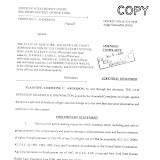
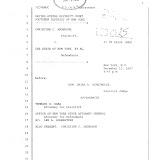
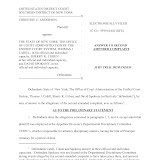
A federal jury found late Thursday, October 29, 2009 that Thomas Cahill, Sherry Cohen and David Spokony had not fired former Manhattan Ethics Committee staff attorney Christine Anderson in retaliation for her exposure of widespread corruption by the "whitewashing" of complaints against attorneys in the Bronx and Manhattan. Earlier in the day, Judge Scheindlin had found that Cahill, Cohen and Spokony were knowledgeable of the "whitewashing," but that ruling was read into the record in open court only after the jury had left the courtroom. Anderson's legal team is reported to be considering a declaratory judgment action in Federal Court to declare that the defense of Cohen, Cahill and Spokony by the New York State Attorney General's office was improper as it raises a series of conflicts and requires that the defendants be provided independent outside counsel.

Ex-Lawyer for NY Attorney Watchdog Loses Suit Over Firing
The New York Law Journal by Daniel Wise - October 30, 2009

A federal jury took barely three hours yesterday to throw out claims from a former staff attorney with the First Department's disciplinary committee that she had been fired in retaliation for the exercise of her First Amendment rights. The unanimous, eight-member Southern District jury rejected the civil rights suit brought by Christine A. Anderson, who claimed she was fired in 2007 because she objected that officials at the committee were "whitewashing" complaints and giving preferential treatment to attorneys with connections. The jury credited the claims of the Office of Court Administration and three individual defendants that Ms. Anderson had been fired for insubordination. The state argued that she had exaggerated her complaints and had spurned numerous opportunities to repair her frayed relationship with her direct supervisor, Sherry K. Cohen, the committee's deputy chief counsel and a defendant in the case. The other two individual defendants were Thomas J. Cahill, who at the time was the committee's chief counsel, and David Spokony, the First Department's deputy clerk. One of Ms. Anderson's lawyers, Rory J. Bellantoni, in his closing statement yesterday morning had asked the jury to award Ms. Anderson $298,000 for lost wages and "substantial" damages for pain and suffering. The jury, which returned a unanimous verdict as required, consisted of five women and three men. Judge Shira A. Scheindlin, who presided over the three-day trial, had dismissed Ms. Anderson's claims that she had been discriminated against on the basis of race and national origin on a motion for summary judgment. Ms. Anderson is Jamaican. Mr. Bellantoni, who left the bench over the summer after six years as County Court judge in Westchester, said after the verdict that Ms. Anderson is "weighing her options." John McConnell, the First Department's clerk, said, "We are delighted with the verdict." The verdict embraced Assistant Attorney General Lee A. Adlerstein's closing argument that Ms. Anderson "resented" Ms. Cohen's detailed style of management and resisted numerous efforts to repair her relationship with Ms. Cohen. In 2001, Ms. Anderson, now 64, was hired as a staff attorney at the committee which is responsible for policing the conduct of attorneys practicing in Manhattan and the Bronx. Ms. Cohen, who had been with the committee since 1993, became deputy chief counsel in 2003. Sometime thereafter, she became Ms. Anderson's supervisor. There was no dispute that the relationship between the two was fraught. Both lawyers testified that in July 2006 a confrontation had occurred in Ms. Anderson's office when Ms. Cohen, with the door closed behind her, refused to accede to Ms. Anderson's demand that she be let out. A panel convened by the First Department's then clerk, Catherine Wolfe, to investigate an "incident report" filed by Ms. Anderson, resulted in a decision that Ms. Cohen should apologize to Ms. Anderson and take a management course. The panel also recommended that Mr. Cahill make it clear that the lines of authority within the office made Ms. Cohen the direct supervisor of Ms. Anderson.

Deteriorating Relationship

Ms. Anderson had testified that her relationship with Ms. Cohen began to deteriorate in August 2005, when the two disagreed over the wording of a private admonition that both agreed should be given to a lawyer. Ms. Cohen wanted references that the attorney had made misrepresentations taken out. When Ms. Anderson refused, Ms. Cohen took the file and rewrote the recommendation, which had to be approved by the committee's policy committee. Prior to Ms. Cohen's revision, Ms. Anderson testified that she had objected that the report had been "whitewashed" and "sanitized" to affect the outcome of the case. As the relationship became increasingly tense, Ms. Anderson testified that she was fearful of Ms. Cohen and refused to meet with her alone. Ms. Wolfe meanwhile counseled Ms. Cohen to take notes of her contacts with Ms. Anderson and to have a second person in the room. Mr. Bellantoni described Ms. Wolfe's advice as designed to develop a paper trail to create a pretext for firing Ms. Anderson. Ms. Anderson testified that in fall 2006 she again clashed with Ms. Cohen over the handling of several other cases. In February 2007, Ms. Anderson stated, she had complained to Mr. Cahill that attorneys with political connections or ties to those on the 64-member disciplinary committee got preferential treatment. The same was true, she said, for lawyers who hired attorneys who had previously worked at the committee. However, Mr. Adlerstein in his closing dismissed claims that Ms. Anderson had complained directly to Mr. Cahill, saying she only had made "general statements" that lacked specifics. Referring to the fact that Mr. Cahill, a former Southern District U.S. attorney, denied that the February 2007 conversation ever took place, Mr. Adlerstein charged Ms. Anderson had made the conversation up "out of whole cloth." Ms. Anderson had "exaggerated" the incident with Ms. Cohen in her office in an effort to get rid of her as her supervisor, Mr. Adlerstein said. Mr. Bellantoni's partner, John Lovett, had delivered the opening statement for Ms. Anderson and handled much of the witness examinations. He was not in court yesterday due to a family medical emergency. Assistant Attorney General Wesley E. Bauman had delivered the opening statement for the four state defendants.

Thursday, October 29, 2009

NY Immigration Lawyer Sentenced to 4 Years

NY Immigration Lawyer Convicted of Fraud Sentenced to 4 Years
The New York Law Journal by Mark Hamblett - October 29, 2009

An immigration attorney was sentenced Monday to serve four years and three months in prison for presenting false documents to immigration officials. Raghubir K. Gupta, 63, who had offices in Brooklyn and Queens, was given the sentence by Southern District Judge Deborah A. Batts. Evidence at his 2008 trial showed that Mr. Gupta, who processed applications under a limited amnesty and legalization program, had clients provide false dates on applications so they could qualify. Charged amidst an increasing crackdown on immigration fraud, Mr. Gupta was convicted of one count each of willfully causing the subscription of an immigration document containing a material false statement and one count of presenting an immigration document containing a material false statement.

Wednesday, October 28, 2009

Brooklyn DA Probes Nassau Wrong-Doing

Brooklyn DA probes wrongful jailing in Nassau
Newsday by SID CASSESE - October 27, 2009

Brooklyn District Attorney Charles Hynes is investigating the actions of Nassau police and prosecutors in a 2005 case that kept a Queens teenager locked up four months for an armed robbery that, the man's lawyer says, officials knew he did not do. Raheem Crews, now 24, had the perfect alibi. He was in jail when the robbery occurred. "All I can say is that we are investigating the Crews case," Jonah Bruno, a Hynes spokesman, said earlier this week. Neither Crews nor his Hempstead lawyer, Fred Brewington, were aware of Hynes' involvement in the case, the lawyer said Tuesday. "Nobody ever talked to us," he said. The Hynes news surfaced following a letter Brewington sent last week to Nassau County District Attorney Kathleen Rice. In it he castigated her for not following up on an earlier request this year for an investigation into the actions of the police and assistant district attorneys in the Crews case. Rice spokesman Eric Phillips, said: "This is [a] very serious allegation . . . and when we received it we promptly referred it [in May 2009] to federal authorities. "When it became clear that prosecutors from this office's former administration could be materially involved . . . we requested [in August] that a special prosecutor be assigned. On August 26, 2009, Nassau's chief judge granted that request and appointed the Kings County district attorney." Det. Sgt. Anthony Repalone, a spokesman for the Nassau Police department, said that after "we did an internal investigation on one member [who was a part of the Crews case], he resigned." Repalone would not identify the officer. Brewington said his client was in jail on some criminal mischief charge when he was locked up from March 24 to 31. The robbery occurred March 25. Crews went back to jail in May 2005 and remained incarcerated until September of that year. sid.cassese@newsday.com

Sneaky, Back-Door Acts, the OCA Way

Is $5,000 stipend boost a back-door pay hike?
Chief judge doubles payment to $10,000 as judiciary still in salary fight with Legislature
The Albany Times Union by IRENE JAY LIU - October 28, 2009

ALBANY, NY -- As the Legislature and governor tackle New York's $3 billion budget deficit, the state's third branch of government has doubled judges' stipends, which will cost an additional $6 million per year. Citing the judges' decade-long lack of a pay raise, Court of Appeals Chief Judge Jonathan Lippman announced during an Oct. 14 webcast that he would double judges' supplemental allowance from $5,000 to $10,000, to cover items such as uncovered medical expenses, robe dry cleaning, travel, judicial license plates and marriage counseling. Lippman said in an interview with the New York Law Journal, which first reported the allowance increase, that he was "pleased to be able to double" the support. "We are not giving judges (added) salary," he said. " …We have finite resources. I think it's an appropriate reimbursement of judges for expenses of all different kinds."

Judges have been locked in a battle with the Legislature over judicial pay, which has been locked at $136,700 for the past 11 years. The Legislature, which must approve judicial pay raises, has historically tied them to their own salary increases -- a practice that the judiciary has called unconstitutional. The Court of Appeals will hear arguments in three separate cases about the issue early next year. Legislative leaders and the governor have been named as defendants in the three lawsuits. Responding to the judges' lack of a pay raise, former Chief Judge Judith Kaye in 2008 created the Judicial Supplemental Support Fund, which would provide full-time judges with a $5,000 annual stipend for "services and goods to support them in the performance of their judicial responsibilities," according to a 2009 bulletin from the state comptroller's office. Judges can receive the stipend in two ways: They can file receipts for reimbursement of expenses, or they can take a lump-sum payment which is taxable as income and does not require judges to file receipts. More than 90 percent of judges take the full $5,000 allowance, according to the Office of Court Administration, costing the state roughly $6 million. Doubling the allowance will cost another $6 million per year, according to OCA spokesman David Bookstaver. The expanded allowance will become effective Nov. 1, but checks reflecting the added funds will not be cut until April 15, 2010. The expansion will be added to next year's budget, said Bookstaver. Bookstaver emphasized that the increased allowance was not in lieu of a raise. "We have to keep the best and the brightest on the bench. And frankly, some of them are leaving because they can't make ends meet," he said. "This is really to make the judges lives slightly more tenable in an untenable situation." Bookstaver added that the judiciary may reconsider the expanded benefit if judges receive a pay raise before April 15. "If the salaries are increased, we'll certainly take a second look at the judicial supplement support fund," he said.

Reaction from state leaders to the judiciary's planned increase was muted, even as Gov. David Paterson, Assembly Speaker Sheldon Silver and Senate Democratic Conference Leader John Sampson tackle the state's estimated $3 billion current-year budget shortfall. "It's our policy not to comment on next year's budget submission until it's formally introduced," said Division of the Budget spokesman Matt Anderson. "New York judges are overworked and underpaid, and while we are in a fiscal crisis, we have to ensure the administration of justice is never compromised," Sampson said. Silver's office declined to comment on the issue. While state leaders have stayed largely silent on the issue, the allowance expansion was met with consternation in some quarters of the legislature. "In the scheme of the larger budget problem, $6 million is symbolic ... but it is indicative of them having too much money to spend. They obviously have the money and they want to spend it," said Assemblyman William Parment, D-Chautauqua County, who has questioned the judiciary's significant budget expansion over the past few years. The judiciary's budget has grown about 45 percent over the past seven years, from $1.7 billion in the 2002-2003 budget to $2.5 billion in the current-year budget. "Is it not symbolic or symptomatic of a larger, more troubling problem within the judiciary?," asked Parment of the stipend expansion, particularly given the state's current economic crisis. Paterson did not propose cuts to the judiciary's $2.5 billion budget in his deficit reduction plan, which proposes cuts in almost every corner of state government in an attempt to save $5 billion over two years. "I don't see how the governor can expect the Legislature to cut school teachers and leave the judicial budget unscathed," Parment said. "The governor does not typically put forward proposed spending reductions for other coequal branches of government when submitting his initial budget recommendations," Anderson said. Irene Jay Liu can be reached at 454-5081 or iliu@timesunion.com.

Tuesday, October 27, 2009

NYCLU Says NY State has Failed the Citizens

"The NYCLU contends the state has "abdicated" its right to provide adequate counsel to criminal defendants."

Charge Is Dismissed Against Lead Figure in Defender Lawsuit
The New York Law Journal by Joel Stashenko - October 27, 2009

ALBANY, NY - An upstate appeals court has dismissed a case against a woman whose claims of shoddy representation from a public defender are at the center of a challenge to New York state's system of providing criminal legal services to indigent defendants. The felony charge against Kimberly Hurrell-Harring for bringing marijuana into a state prison cannot legally stand in light of a state Court of Appeals' determination in People v. Finley, 10 NY3d 647 (2008), that less than 25 grams of marijuana in prison is not dangerous contraband and that possession of smaller amounts of pot is a violation, as it would be outside of prison, the Appellate Division, Third Department, held last week. Although Ms. Hurrell-Harring's guilty plea to first-degree promotion of prison contraband came before the Court of Appeals' ruling in Finley, the high court clarified the meaning of an existing law that was still at issue in her appeal, the Third Department, ruled.

"Thus, applying the law as articulated in People v. Finley…the SCI [superior court information] is jurisdictionally defective because the amount of marijuana that defendant was alleged therein to have brought into the correctional facility was insufficient to constitute 'dangerous contraband' —a material element of the crime," Justice Leslie E. Stein wrote for a unanimous panel in People v. Hurrell-Harring, 101611/102295. "Inasmuch as the act of which defendant is accused does not constitute a crime, the judgment of conviction must be reversed." The Third Department decision appears on page 44 of the print edition of today's Law Journal.
Justices Robert S. Rose, William E. McCarthy and Elizabeth Garry joined the ruling. In Finley and a companion ruling, People v. Salters, the Court of Appeals decided that possessing small amounts of marijuana does not carry with it the "substantial probability" that it would contribute to death or serious injury within state prisons as do knives, razor blades or other potentially lethal weapons (NYLJ, June 11, 2008). Ms. Hurrell-Harring was arrested in 2007 for trying to smuggle marijuana in a condom hidden in her vagina to her husband, an inmate at the Great Meadow Correctional Facility in Washington County. She pleaded guilty to a promoting prison contraband charge and was sentenced to six months in jail and five years' probation by Washington County Court Judge Kelly S. McKeighan. Ms. Hurrell-Harring is one of 20 plaintiffs in Hurrell-Harring v. State of New York, the New York Civil Liberties Union-sponsored legal challenge to the state's legal defense system for indigent criminal defendants (NYLJ, Nov. 9, 2007).

The NYCLU contends the state has "abdicated" its right to provide adequate counsel to criminal defendants. Its complaint alleged that Ms. Hurrell-Harring's public defender took little interest in her case and failed to get her bail reduced despite the fact she had no prior criminal record. Ms. Hurrell-Harring pleaded guilty to the charge because she did not want to stay in jail indefinitely as she remained unable to meet bail, according to the NYCLU's complaint. She also did so on the advice of her public defender, the group said. She has served her jail time. With Ms. Hurrell-Harring now being represented pro bono on appeal by Paul, Weiss, Rifkind, Wharton & Garrison, the woman had her conviction vacated by the Third Department. "This is one of these cases, it is not that often you can say this, unfortunately, where you get the opportunity to do justice like this," said Roberta A. Kaplan of Paul Weiss yesterday. "It just shows what kind of a difference it makes to have counsel who zealously represents their clients' interests and counsel who don't." Ms. Kaplan said Paul Weiss attorneys were researching whether Ms. Hurrell-Harring automatically gets back the nursing license she lost when she pleaded guilty or has to apply to the state for reinstatement. Ms. Kaplan said the NYCLU lawyers working on the suit challenging the indigent defense system asked Paul Weiss attorneys to take Ms. Hurrell-Harring's criminal case for a possible reversal. Michael N. Berger of Paul Weiss argued before the Third Department on Ms. Hurrell-Harring's behalf. He was not available for comment. Washington County District Attorney Kevin C. Kortright did not immediately return a call yesterday. In July 2008, a 3-2 Third Department panel threw out the NYCLU's suit, with the majority ruling that a "massive overhaul" in the public defense system requires legislative action. An appeal of the decision is before the Court of Appeals. The state has until Nov. 13 to file its brief in the case. The NYCLU's brief was filed on Sept. 29. No date has been set for oral arguments, which are expected to take place early next year. Joel Stashenko can be reached at jstashenko@alm.com.

Monday, October 26, 2009

NY Daily News Editorial: Unfit to Judge

Unfit to judge: Scofflaw Pam Fisher belongs in court, but not on the bench
The New York Daily News - EDITORIAL - October 26, 2009

Surprise, surprise. Pamela Fisher, previously identified here as this year's poster person for sleazy judge-making, is a serial ethics violator to boot. Fisher's sole, uh, qualification for the Civil Court is that she is an old friend and political ally of Brooklyn Democratic boss Vito Lopez. Although licensed as a lawyer, she has had virtually no legal experience. And she cannot claim to respect the laws and regulations that govern the conduct of judicial candidates.

Many are her transgressions:
  • Fisher has never filed a personal financial disclosure statement. Court rules say declared candidates for judgeships must reveal personal holdings, assets and liabilities to the public in reports submitted to the court's Ethics Commission. Fisher's statement was due Dec. 30.
  • Fisher never filed a campaign finance report with the city Board of Elections. Her campaign committee was required to submit written reports in January and July detailing its fund-raising and spending.
  • Fisher has not filed a campaign finance report with the state Board of Elections since July, missing mandated submissions Oct. 2 and another on Friday. Penalties for late filing and noncompliance include fines, court judgments and possible jail time.
  • Although she faces no opposition, thanks to maneuvering by Lopez, Fisher's campaign included flyers touting her candidacy jointly with that of Lopez-backed City Council contender Maritza Davila. Would-be judges are strictly prohibited from publicly endorsing or opposing candidates in other races.
Fisher graduated from NYU in 1983 and was soon working for the cornerstone of Lopez's political empire, the Ridgewood Bushwick Senior Citizens Council, a government-funded organization that cares for the homebound, serves meals to the elderly and operates housing. While working for the Lopez organization, she attended Brooklyn Law School at night, graduating in 1990. Fisher ran failed Lopez-backed efforts to win a Queens City Council seat in 1991 and a Queens Assembly seat in 1994. The Assembly campaign included a fraudulent, racially targeted flyer. She also held a patronage post arranged by Lopez at the Housing Authority, working with tenant groups. In more recent years, Fisher listed herself as either a homemaker or unemployed in connection with campaign donations. All of which adds up to negligible work as an attorney. No matter. In January, at Lopez's apparent request, Brooklyn Supreme Court Justice Mark Partnow made Fisher his $85,187-a-year law secretary. The judge failed to respond to queries as to what credentials he considered in hiring Fisher. Deprived of an alternative, Brooklyn voters, led by Lopez's machine troops, will elect Fisher on Nov. 3 for a 10-year term. But maybe she won't last all that long. Her arrogant disdain for the law and the rules must draw the scrutiny of the state Commission on Judicial Conduct, the moment after she is sworn in.

Sunday, October 25, 2009

Multi-Million Dollar Jury Retaliation Verdicts Remind Wrong-Doers

Multi-Million Dollar Jury Verdicts Serve as Reminder to Beware of Retaliation Claims

Summer 2009

In 2006 the Supreme Court’s decision in Burlington N. & Santa Fe Ry. Co. v. White changed the standards for evaluating Title VII retaliation claims. Prior to the White decision, employees in some circuits could recover only when they demonstrated that they suffered an adverse and ultimate employment decision, such as being fired or other actions affecting the terms and conditions of their employment, in retaliation for the employee’s complaint of discrimination (or participation in other protected activity). As a result of the White decision, the scope of actionable conduct under Title VII’s anti-retaliation provision was expanded, allowing employees to recover with evidence of other minor, materially adverse actions as long as such actions would deter a reasonable employee from pursuing a complaint of discrimination. Not surprisingly, the number of retaliation charges filed with the EEOC has increased significantly since White was issued. In fact, the number of retaliation charges rose from 22,555 in 2006 to 26,663 in 2007 (an 18.2% increase), and to 32,690 in 2008 (a 45% increase over claims brought in 2006). These are significant increases compared to the mere 1.2% increase in retaliation charges brought in the year before White was decided. These claims translate to significant awards and settlements by employers. In 2008, the EEOC recovered more than $111 million in connection with retaliation claims (this figure does not include settlements and verdicts obtained through litigation removed from the EEOC). These statistics, along with two recent multi-million dollar jury verdicts, serve as a stark reminder of how retaliation claims can often lead to significant judgments against employers, even in cases where the employees fail to prove their primary discrimination claim.

$4.6 Million Dollar Jury Verdict Allowed to Stand

In Monteiro et al. v. City of Cambridge (a recent Massachusetts state court decision), the defendant city filed a motion for summary judgment as to the various claims brought by the plaintiffs, including for retaliation. The city’s motion was allowed in part and denied in part, based upon the evidence each plaintiff presented and the applicable legal standards for racial discrimination and retaliation claims. Thereafter, the case went to trial on all counts of plaintiff-Monteiro’s complaint, in which she alleged disparate treatment on account of her race and national origin (Cape Verdean), including alleged disparity in pay and refusal to recommend her candidacy to a city affiliated graduate school scholarship program. The jury rendered a verdict in the plaintiff’s favor on the retaliation claim only, finding that the city retaliated against her after she lodged a discrimination complaint in 1998. The jury awarded the plaintiff nearly $4.6 million in compensatory and punitive damages, and the Court awarded her over $600,000 in pre- and post-trial interest, along with attorneys’ fees and costs. The city challenged the jury’s verdict on a motion for judgment notwithstanding the verdict and filed a motion for new trial (or alternatively to reduce the verdict), contending that the jury had no basis to infer causation or animus because five years separated the filing of plaintiff’s discrimination complaint and her termination. Ordinarily, a retaliatory motive may be inferred from temporal proximity alone where the adverse action occurs very shortly after the protected activity. However, the greater the time between the protected activity and the adverse employment action, the more the plaintiff must rely upon other evidence beyond temporal proximity to establish a causal connection between a complaint and a subsequent termination. In Monteiro, the defendant argued that because the jury failed to award the plaintiff damages for any intermediate employment actions between the 1998 complaint and the 2003 discharge, such actions could not be “materially adverse” since they did not produce any injury or harm as required by White. The Court rejected the city’s challenges to the verdict, including the city’s interpretation of the Supreme Court’s holding in White. In doing so, the Court noted that the White decision does not require an evaluation of the level of seriousness to which the injury or harm must rise before liability can attach and damages can be awarded. Rather, according to White, a court must determine whether an action constitutes legally actionable retaliation by evaluating whether the action would dissuade a reasonable worker from making a charge of discrimination. Based upon this analysis, the Court held that because the jury found that the plaintiff endured materially adverse actions between her discrimination complaint and termination, she proved her case of retaliation, despite the fact that the jury did not award her any specific monetary damages for the retaliatory intra-employment actions. These “materially adverse” actions included documenting a complaint against the plaintiff without informing the plaintiff; removing some of the plaintiff’s responsibilities; forwarding to the police commissioner a newspaper article in which the plaintiff was quoted about racial profiling occurring in the police department; and launching a one-year investigation into the plaintiff’s performance on the police review board. The Superior Court likewise rejected the city’s argument that punitive damages could not be awarded for the city’s post-complaint conduct where the jury found that the employment actions did not produce any injury or harm to the plaintiff. Again, in denying the city’s post-trial motions, the Court held that because the jury affirmatively found that the city’s conduct was retaliatory, punitive damages could be awarded even where the plaintiff sustained no compensatory damages as a result of the conduct.

Jury Awards Former Employee $3 Million in Damages

A Federal Court jury in Colorado recently awarded plaintiff Jennifer McInerney, a former United Airlines ramp-services supervisor, $3 million in damages after finding that she was retaliated against due to her complaint of sex discrimination. The former employee became pregnant in May 2005, and requested consideration for alternative positions because she anticipated complications with her pregnancy. She claimed that she was denied alternative positions because she was a pregnant woman and complained in December 2005 that United’s failure to consider her for open positions was discriminatory. Her son was born 11 weeks premature in November 2005 and she took family and medical leave, vacation leave and sick time until her available time off expired in March 2006. United denied her request for additional unpaid leave, and instructed her to return to work in March 2006. When she did not return to work, United terminated her employment. United contended that there was a shortage of ramp supervisors, and that when the plaintiff requested additional leave, the company could not hold her job open any longer. As in the Monteiro case, the jury found that the plaintiff failed to establish her underlying discrimination claim. Rather, the jury found that the plaintiff was terminated in retaliation for the gender discrimination complaints she made in December 2005. Although it is unclear what ultimately led the jury to reject the plaintiff’s discrimination claim, yet credit her retaliation claim, the jury’s decision provides a general warning to employers to use caution when considering requests for leave or other accommodations and to avoid taking adverse actions against employees in such circumstances, particularly following an employee’s complaint of discrimination.

General Guidance

The importance of avoiding exposure to retaliation claims is highlighted by the fact that in both Monteiro and McInerney the respective juries found in favor of the defendant-employers on the underlying claim of discrimination, but determined that the employers’ post-complaint actions were retaliatory. As a result, liability was created for the employers which, perhaps, could have been avoided by making appropriate employment decisions concerning those employees following their complaints. In essence, in cases such as this, the retaliation claims have become the proverbial tail wagging the dog, and are exposing employers to multi-million dollar verdicts when they did not discriminate against the employee in the first instance. Given the increasing frequency of retaliation claims since the White decision, and the higher likelihood that retaliation claims will go to trial, employers should not take the potential for retaliation claims lightly when making employment decisions about employees engaged in protected activity. Rather, employers are encouraged to evaluate their current anti-discrimination policies and take steps to ensure that they do not inadvertently expose themselves to liability for a retaliation claim. In particular, employers can: Revise and/or develop policies to ensure that they contain an express prohibition against retaliation and describe the consequences of violating the prohibition against retaliation; Encourage employees to report complaints of retaliation, report actions believed to be retaliatory and provide alternative channels for complaints to be reported; Educate and train supervisors and employees alike on anti-retaliation policies to ensure that employees understand that retaliation against individuals who engage in protected activity is illegal and strictly against company policy; Involve counsel or human resource management in any employment actions impacting employees who have raised complaints of discrimination or engaged in other protected activity; Consider carefully whether job transfers, shift changes or changes in employee’s responsibilities following a claim for discrimination are appropriate or necessary, and whether they might deter a reasonable employee from engaging in protected activity; Maintain files concerning the claim of discrimination separate from any personnel file, so that only those personnel with a need to know have access to and knowledge of the complaint; Whenever possible avoid having a supervisor conduct the employee’s evaluation, who is involved in (or accused of) the discriminatory action, and consider whether a supervisor who is not privy to the employee’s complaint or protected activity can properly evaluate the employee; Act consistently in enforcing anti-retaliation policies as well as in enforcing any other workplace policies; and Evaluate and document all employment actions taken against employees carefully, including the legitimate business reasons for such actions, while avoiding targeted monitoring of such employees, which is inconsistent with the treatment of other similarly situated employees.

******************

Jury Awards $4M+ to Employee in Retaliation Case
by Daniel Schwartz - July 28, 2008

Late last week (when, of course, I was out of the office), word came down about another large verdict in an employment law case in Connecticut. The verdict, composed of $1M in compensatory damages and $3M in punitive damages in Tucker v. Journal Register Co. was first reported by the Connecticut Post last Friday here. (H/T Jottings blog) Long time readers of the blog may recall my discussion of the employer's summary judgment motion and the court's decision back in November 2007. In my posts back then (which can be found here and here). I talked about how the former employee alleged that her employer terminated her employment because she was opposed to testifying as a favorable witness in the company’s defense of another employee against whom a sexual harassment complaint had been filed. the employer denied the claims and said that she had been fired for misusing an office telephone in which collect calls were accepted. The case went to trial on two legal claims: 1) retaliation under Title VII as a person who participated or opposed a discriminatory practice, and 2) Conn. Gen. Stat. Sec. 31-51q, which applies the First Amendment to private employers. You can download the trial memorandum here. The Court's docket sheet hasn't yet been updated with some of the nitty gritty and I hope to followup with some more information about what happened during the trial. For instance, the employer moved for judgment as a matter of law during the trial and the court has taken that motion under advisement. I would certainly expect post-verdict motions to occur -- even before an expected appeal (though it is unclear what the grounds would be). According to Tucker's attorney, the jury found against the employer on both claims.

Tucker's attorney, Jeff Bagnell, was understandably pleased with the multi-million dollar verdict: We were very pleased with the jury's verdict. It sent a clear message that you can't retaliate against an employee who is going to tell the truth in a legal case. This excellent jury showed that people still care about the oath and what it means. Thank God for the Seventh Amendment. This case demonstrates once again that retaliation claims and 31-51q claims are among the more dangerous type of employment law claims out there. And although there aren't hard numbers out there on this, the damages that juries in Connecticut are awarding on such claims seem be on the increase. What does this mean for employers? It's yet another reminder to treat all claims of retaliation seriously. And consider settlement of such claims when the opportunity arises. No matter how strongly an employer feels about the claims, once the claims go to a jury, there is always a risk of loss -- no matter how strong the facts may appear to be to the employer.

Connecticut Employment Law Blog - July 31, 2008 8:34 AM
Earlier this week, I posted on a $4M verdict in federal court in a retaliation case, Tucker v. Journal Register Co.But did you ever wonder what the verdict form actually looks like? In other words, when the jurors fill out...

Connecticut Employment Law Blog - August 18, 2008 3:50 PM
Is a trend forming in First Amendment free-speech cases in Connecticut? It certainly seems that way. Last week, a jury returned a verdict in favor of Andrea Charron in her lawsuit against the Town of Griswold. The jury awarded damages...Daniel A. Schwartz of Pullman & Comley, LLP | 90 State House Square | Hartford, CT 06103. Phone: 860.424.4359

*********************

Court: Employee's Firing After Expressing Reluctance to Participate as a Witness in CHRO Hearing May Be Retaliation
by Daniel Schwarts - November 7, 2008

For retaliation cases, an employee's active participation in another person's discrimination case has been viewed, in the past, as the threshold to be a "protected activity" under Title VII's retaliation clause. That has been watered down in the Second Circuit in recent years. A new District Court decision today has concluded that simply expressing a reluctance to testify in another employee's case, without actually testifying, could also be a protected activity. InTucker v. Journal Register East, (known more commonly as The New Haven Register), the Plaintiff -- a former employee, alleged that the Register terminated her employment because she was opposed to testifying as a favorable witness in the Register’s defense of another employee against whom a sexual harassment complaint had been filed. The Employer filed for summary judgment claiming that the employee never opposed a discriminatory practice. The Court rejected that argument finding that a different section of Title VII analysis -- the participation clause -- may apply. Notably it follows the "it would leave the employee 'wholly unprotected' language used by the Second Circuit in recent years.

The court believes that, in accordance with the principles set forth by the Supreme Court..., and by the Second Circuit..., [the employee]’s conduct is sufficient to qualify as a “protected activity” under Title VII. To hold otherwise would permit an employer involved in a Title VII proceeding to retaliate against an employee based upon that employee’s decision as to what her participation in the Title VII would be. Indeed, [the employee- would be “wholly unprotected” if the court were to find that the Register could terminate her because she had changed her mind about testifying on the Register’s behalf in the CHRO proceeding. While the court's broad reading of Title VII is disputable, it appears the court was simply troubled by the timing of the employee's termination; it occurred two days after the employee allegedly expressed reluctance. Moreover, the employer's reasons for terminating the employee (she allegedly accepted a collect call at work from a felon at a state correctional facility) seemed, to the court, excessively harsh. Because this case involved a local newspaper, it'll be curious to see the media's reaction to this case...

Saturday, October 24, 2009

First Department Justice Testifies at Anderson Trial

First Department Justice Testifies at Trial as Witness
News In Brief, The New York Law Journal - Monday October 26, 2009

Justice Angela M. Mazzarelli of the Appellate Division, First Department, made a cameo appearance Friday as a defense witness in the $10 million damages trial brought by Christine C. Anderson, who was fired as a First Department Disciplinary Committee lawyer. Justice Mazzarelli, a member of the liaison committee with the disciplinary body, described herself as "very concerned" about Ms. Anderson's claim that her supervisor had "whitewashed" the report of a probe prepared by Ms. Anderson. In her appearance Friday on the third day of the Southern District trial, Justice Mazzarelli also described herself as "a little confused" because both Ms. Anderson and the supervisor, Sherry K. Cohen, recommended the attorney under investigation be privately admonished. After reading the reports in the matter, Justice Mazzarelli testified that she had found Ms. Cohen's report "more readable, more comprehensive—a better work product" than Ms. Anderson's. She also said Ms. Anderson's proposal that a "Chinese wall" be erected between her and her supervisor reflected "a lack of professionalism." Ms. Anderson's lawyer, John Lovett of Lovett & Bellantoni asked only one question on cross examination. In all, Justice Mazzarelli's testimony took about 10 minutes. - Daniel Wise

Friday, October 23, 2009

Press Release From Upstate 'ExposeCorruptEssex.Com'

Gotti Trial On 26th Floor NYC Federal Court Was Mirrored By15th Floor Testimony Of "The Cleaner", Naomi Goldstein, Whitewashing Attorneys In 1st Appellate Division Disciplinary Committee

2009-10-22 By TFinnan

A "cleaner" belongs in the Gotti trial on the 26th floor of NYC Federal Courthouse and not in the Anderson trial v NY State Attorney Disciplinary Committee heard on the 15th floor of same courthouse.

For Immediate Release:

Keene, NY, USA (Free-Press-Release.com) October 22, 2009. Terence Finnan and Eliot Bernstein of Boca Raton, Florida report that in the "Anderson v The State of NY" trial now in Federal Court in NYC, that Naomi Goldstein was identified as "the cleaner" who whitewashed attorney complaints before the NY Appellate Division First Department Disciplinary Committee. This Anderson trial revealed document destruction and other Federal and State crimes by those within the Committee. While this testimony was on the 15th floor, it mirrored corruption more likely belonging in the Gotti trial on the 26th floor of the same NYC Federal Courthouse.

Christine Anderson’s attorney, Jonathan Lovett of Lovett and Bellantoni, was quite clear to the jury in his opening statement. “The case you are about to hear is very straightforward. It involves corruption. It involves Whitewashing.” Further testimony showed US Attorneys, District Attorneys,Assistant District Attorneys and favored law firms were also whitewashed of crimes and/or unethical acts by the same Disciplinary Committee. Christine C. Anderson claims the First Department Appellate Division Disciplinary Committee "whitewashed" at least nine cases because the lawyers being investigated were politically connected or represented by lawyers who had previously worked for the committee." Terence Finnan calls on Andrew Cuomo, NY Attorney General, to not tolerate whitewashing, document destruction and a "cleaner" involved in Attorney Discipline. Terence Finnan demands Andrew Cuomo convene a Grand Jury to indict all identified. (including Thomas Cahill, Sherri Cohen, and David Spokony)

A "cleaner" belongs in the Gotti trial on the 26th floor of NYC Federal Courthouse and not as part of the NY Attorney Disciplinary Committee heard on the 15th floor. Andrew Cuomo's duty is to the people of NY and not the corrupt. Andrew Cuomo's Public Integrity Unit must prosecute. Andrew Cuomo must convene a Grand Jury for indictments, as requested in my 9/29/2009 letter to Andrew Cuomo and his staff. This letter was labeled in Regard: Your honor, your duty, New York Law; 2. All testimony at NY Senate Hearings on 9/24/2009 and on 6/8/2009; 3. My testimony at NY Senate Hearing on 9/24/2009; and 4. Your immediate acts in 08-5977-cv in Federal Second Circuit Court of Appeals. This letter is shown at http://www.exposecorruptessex.com/Cuomo9_29-1.html -- Because of Andrew Cuomo's inaction,Terence Finnan made a request on October 7, 2009 to US Attorney General, Eric H. Holder, Jr. and FBI Assistant Director in Charge of the New York Division, Joseph M. Demarest, Jr. to act on a Criminal complaint against Robert Tembeckjian and to end the criminal systematic corruption in NY Courts.

###

For more information: Visit our website: http://exposecorruptessex.com
Keywords: Christine Anderson, Andrew Cuomo, Thomas Cahill, Gotti, Sherri Cohen, David Spokony, Naomi Goldstein
Contact us: PO Box 354 Keene NY 12942 Phone 518-576-9734 -tfinn@ExposeCorruptEssex.com

Thursday, October 22, 2009

Head of Embattled Justice Dept. Unit is Stepping Down

Head of embattled Justice Dept. unit is stepping down
Anti-corruption division under fire for handling of Sen. Stevens's case
The Washington Post by Carrie Johnson - October 22, 2009

William M. Welch II, the head of the Justice Department's public integrity unit, will step aside and return to Massachusetts, where he spent the bulk of his career exposing corruption in the state government, according to two sources familiar with the move. Welch reached the decision after consulting with authorities about his family responsibilities and the professional opportunities in his home state, the sources added. He notified subordinates in the public integrity unit late Monday. He will remain an employee of the department's criminal division. The unit, which leads some of the Justice Department's most explosive investigations of political figures, came under fire this year when Attorney General Eric H. Holder Jr. abandoned the case against former senator Ted Stevens (R-Alaska), who had been convicted on corruption charges, citing multiple lapses by the prosecution team in the sharing of evidence. Six department lawyers -- including Welch, who supervised the case but did not play a major role during last year's trial -- remain the subject of a probe by the department's internal ethics investigators and a separate criminal investigation launched by U.S. District Judge Emmet G. Sullivan, who presided over the Stevens trial.

The sources said Welch's decision to leave Washington did not spring from an adverse finding by investigators. Welch's attorney, William Taylor of the Zuckerman Spaeder law firm in the District, said, "While the ultimate result in the Stevens case has been highly disappointing professionally and personally, Bill knows that his management decisions, where permitted, comported with his own and the department's highest ethical standards." Welch's departure, set for Oct. 30, comes after the exit of several other lawyers connected to the Stevens case. Earlier this year, Brenda Morris, the section's deputy chief, relocated to Atlanta for personal reasons. Morris served as the government's lead voice during the Stevens trial and delivered a forceful cross examination of the senator. Two other section lawyers who worked on the Alaska case, Nicholas Marsh and Edward Sullivan, were transferred to the department's international affairs unit in June. A Justice Department official, who spoke on the condition of anonymity to discuss personnel matters, said Raymond N. Hulser will serve as the unit's acting chief while department leaders conduct a nationwide search to fill the post, which those leaders described as vital. The unit's prosecutors are leading sensitive investigations of earmarks on Capitol Hill, among other cases. Welch has headed the unit since March 2007. During his tenure, the office has continued to investigate figures tied to disgraced lobbyist Jack Abramoff, and it presided over the guilty plea of Samuel Kent, a former U.S. district judge in South Texas who was accused of assaulting female courthouse employees. Lanny A. Breuer, assistant attorney general for the criminal division, said Wednesday that Welch is "a dedicated public servant who's devoted his entire professional life to serving the American people." He added that he and Welch had come to a "mutual decision" about what was best for the prosecutor and the division.

Wednesday, October 21, 2009

NY Law Journal on Court Corruption Trial

Trial Begins in Case of Attorney Fired From Disciplinary Committee
The New York Law Journal by Daniel Wise - October 21, 2009

In low-key opening statements to a Southern District jury yesterday, the two sides presented starkly different portrayals of the reason an attorney with the Appellate Division, First Department, disciplinary committee was fired in 2007. John Lovett, the lawyer for the fired lawyer, Christine C. Anderson, told the six-member jury that his client had been fired in retaliation for exercising her First Amendment rights in complaining to court officials that well-connected attorneys received preferential treatment and that the committee had "whitewashed" certain cases. But Assistant Attorney General Wesley E. Bauman insisted the firing had nothing to do with Ms. Anderson's exercise of her free speech rights but instead was a result of her "unprofessional conduct and refusal to have any contact" with her supervisor. The one thing both sides agreed on was that Ms. Anderson and Sherry K. Cohen, who became the committee's first deputy counsel in 2003, had an exceptionally tense and difficult relationship.

In his half-hour opening, Mr. Lovett, of Lovett & Bellantoni in Hawthorne, N.Y., described Ms. Anderson, now 64, as having a good relationship with her immediate supervisor from the time she began work at the committee in 2001 until August 2005. Although Ms. Cohen became deputy counsel in spring 2003, Mr. Lovett said that Ms. Anderson had the same immediate supervisor until Ms. Cohen demanded that Ms. Anderson "sanitize" the factual findings in one of her cases where she had concluded that an attorney had lied to committee personnel. Mr. Lovett said that a finding that an attorney under investigation had lied to the committee was "a giant no-no." In August 2005, he said, Ms. Cohen told Ms. Anderson that she wanted her to drop her conclusion that the lawyer, only identified as R.N., had been untruthful. When Ms. Anderson objected to taking out the finding that the lawyer had made "misrepresentations" as a move that "would dictate the outcome of the investigation," Mr. Lovett said, Ms. Cohen took over the file and rewrote the recommendation herself. Both Ms. Cohen and Ms. Anderson agreed that the attorney should be privately admonished. After taking control of the R.N. case, Mr. Lovett said, Ms. Cohen took over as Ms. Anderson's immediate supervisor and "began micromanaging and harassing her." Mr. Lovett said that in subsequent conversations with Thomas J. Cahill, then the committee's chief counsel, and other court officials, Ms. Anderson complained that certain lawyers got "the soft touch, another form of corruption" at the Departmental Disciplinary Committee, where "who you know and what your connections are" influenced investigations. Mr. Lovett said that Ms. Anderson had complained to Mr. Cahill that prosecutors and lawyers with connections to members of the committee's policy committee or with lawyers who had previously worked for the committee had received preferential treatment.

'Detail-Oriented' Supervision

Mr. Bauman laid out a different timeline, saying that Ms. Cohen took over as Ms. Anderson's direct supervisor shortly after becoming deputy counsel in 2003, and brought a more "detail-oriented" style of supervision. She became directly involved with staff attorneys' cases to provide them "with her 15 years of experience and best judgment," Mr. Bauman said during his 15-minute opening. Mr. Bauman said Ms. Anderson "resented" the more-detailed approach, but "there were many opportunities to repair the supervisory relationship." Instead, he said, Ms. Anderson demanded that she have no direct contact with Ms. Cohen. Confronted with Ms. Anderson's refusal "to repair the continuing hostility," Mr. Bauman said, the "court reluctantly fired" Ms. Anderson in June 2007. Mr. Lovett countered that the reason Ms. Anderson demanded that she have no direct contact with Ms. Cohen was that she was afraid of the deputy clerk, primarily as a result of an incident in August 2005. He said that was when Ms. Cohen had entered Ms. Anderson's office to speak to her, but Ms. Anderson said she had to leave to meet a complainant in a conference room. When Ms. Anderson sought to leave the office, Mr. Lovett said, Ms. Cohen leaned against the door to prevent the lawyer from exiting. As Ms. Anderson reached for the door knob, Ms. Cohen grabbed her hand and scratched her, he said. Mr. Bauman referred to the incident briefly in his own opening, saying, "It was not an assault." Former Westchester County Court Judge Rory J. Bellantoni is also representing Ms. Anderson. In addition to the court system, Mr. Bauman and Assistant Attorney General Lee Alderstein are representing three individual defendants: the First Department's deputy clerk, David Spokony, Mr. Cahill and Ms. Cohen. All three were at the defense table yesterday. John McConnell, the clerk of the First Department, and Roy L. Reardon, the chairman of the 64-member disciplinary committee, attended yesterday's session as spectators.

The trial, which is expected to last about one week, is being presided over by Southern District Judge Shira A. Scheindlin. Judge Scheindlin denied the defendants' motion for summary judgment in April. She ruled that Ms. Anderson could proceed with her $10 million claim for compensatory and punitive damages on the ground that the committee had retaliated against her for expressing her view that it had whitewashed as many as nine cases. In her opinion, Judge Scheindlin noted that a "host" of e-mails had made evident Ms. Anderson's "hostility" toward Ms. Cohen and her "refusal to cooperate" with her supervisor (NYLJ, April 30, 2009). But Judge Scheindlin also noted that "a reasonable jury could find that the defendants refused to remove [Ms.] Cohen as [Ms.] Anderson's supervisor so they could use [Ms.] Anderson's inevitable resistance to [Ms.] Cohen's continuing supervision as pretext for firing her." After the opening statements, Ms. Anderson took the stand. Her cross examination is set to continue this morning. About 10 people dissatisfied with the way the disciplinary committee had handled their complaints against their attorneys also attended yesterday's session. Daniel Wise can be reached at dwise@alm.com.

Tuesday, October 20, 2009

PRESS RELEASE ON COURT CORRUPTION TRIAL

Christine Anderson’s attorney, Jonathan Lovett of Lovett and Bellantoni, was quite clear to the jury in his opening statement. “The case you are about to hear is very straightforward. It involves corruption. It involves Whitewashing.”

PCAC Seeking Citizen Control Over Attorney Grievance Committees
PUBLIC COMMITTEE ON ATTORNEY CONDUCT
Tel: 347-632-9775 email: pcacinformation@gmail.com
Fax: 206-309-0450 Web: www.pcac.8k.com

PRESS RELEASE
For Immediate Release

Public Committee on Attorney Conduct Issues Statement on Start of Litigation Brought By Christine C. Anderson Against New York State Court System Defendants

PCAC President John T. Whitely Applauds Anderson Case Opening Statement Focused on Corruption and Illegality of New York’s Lawyer Controlled Grievance Committees
New York, NY. Public Committee on Attorney Conduct (PCAC) has issued a statement
on the opening of Christine C. Anderson’s case against New York State’s attorney-controlled grievance committees. The litigation before U.S. District Court Judge Shira A Scheindlin in New York City seeks to expose the illegal and unethical conduct of the named defendants, including the leadership of the grievance committees. Ms. Anderson is being represented by Jonathan Lovett, a noted Civil Rights attorney and Rory Bellantoni, a respected former New York judge, who recently resigned from the bench to resume private practice.

Attorney Jonathan Lovett of Lovett and Bellantoni, was quite clear to the jury in his opening statement. “The case you are about to hear is very straightforward. It involves corruption. It involves Whitewashing.”

PCAC President John T. Whitely issued the following statement:

PCAC applauds the efforts of Christine C. Anderson and her counsel, Jonathan Lovett and Rory Bellantoni, as they open their litigation to hold New York State officials liable for conspiring to operate a thoroughly corrupt attorney disciplinary process. As reflected in Mr. Lovett’s comprehensive opening statement, this court challenge is fully prepared to prove that the New York State attorney controlled grievance committees are managed and controlled strictly by money, favoritism and cronyism. This corrupt system must be terminated and its leaders sanctioned. Ms. Anderson, a former attorney employed by the Departmental Disciplinary Committee in Manhattan, is providing the court extensive details of the inner workings of the official corruption and malfeasance, which permeates the attorney controlled grievance process. It is this culture of illegality, which was turned against Ms. Anderson, attacked her, and sought to destroy her reputation and professional standing. Ms. Anderson’s good name must be restored, and she must be fully compensated for the serious damages that she has suffered.

*****

PCAC resolutely believes that Ms. Anderson’s litigation will become a key part of an ever expanding court reform campaign to terminate the existing attorney-controlled grievance system. Recently, individuals and organizations, including PCAC, have filed statements before the New York Senate Judiciary Committee chaired by Senator John Sampson, which is reviewing allegations of official corruption throughout the judicial system. These statements have detailed abuses by the grievance committees and officials, including concealment of evidence, obstruction of justice, sexual assault by attorneys, pilfering of estates by attorneys, abuse of power, fraud, conspiracy and repeated violations of Constitutional rights.

PCAC was established in 2007 by affiliated member organizations, including Litigation Recovery Trust (LRT), a New York based rights administration organization, and Integrity in the Courts, and Expose Corrupt Courts, two Internet blogs focused on judicial and attorney disciplinary processes and procedures. The objective of the PCAC is to replace the existing New York State Attorney Grievance Committees with a body controlled by non-attorneys. PCAC is in the process of completing a review process, prior to submitting draft legislation for consideration by the New York State Senate Judiciary Committee for the purpose of terminating and replacing the current disciplinary committee structure with citizen controlled bodies.

Headquartered in New York City, PCAC represents the first bar review mechanism in the United States established by non-attorneys. Since news of the formation of the PCAC was first made public, individual complainants have been submitting requests in growing numbers to the committee to review both past and current matters before the New York State grievance committees. Requests and documents are being received by PCAC via email at: pcacinformation @gmail.com. Telephone inquiries can be directed to 347-632-9775. For additional information, contact the PCAC website at www.pcac.8k.com.

###30###
For additional information please contact:

John T. Whitely
Chairman Executive Search Committee
Public Committee on Attorney Conduct
515 Madison Avenue
New York, NY 10022
Telephone 347-632-9775
E-mail: pcacinformation@gmail.com
Web: pcac.8k.com

Expose Corrupt Courts
Email:corruptcourt@gmail.com
Web: www.exposecorruptcourts.blogspot.com

William J. Hallenbeck
Executive Director
Litigation Recovery Trust
515 Madison Avenue
New York, New York
Telephone 646-201-9269
E-mail: lrtinformation@gmail.com
Web: litigationrecoverytrust.8k.com

Integrity in the Courts
Telephone 202-370-1885
www.IntegrityintheCourts.com
Email: integrityinthecourts@gmail.com

The Frank Brady Organization
www.FrankBrady.org
Email: FranknBrady@gmail.com

About Public Committee on Attorney Conduct (PCAC)
The Public Committee On Attorney Conduct reviews both past and present cases brought before the New York State grievance committees to provide an independent assessment and analysis of the facts, and issue proposed findings. With respect to past cases, the committee seeks evidence from persons, who maintain that they have been treated unfairly and unjustly by the state disciplinary committees. As part of its efforts, the committee is actively seeking documentation of all complaints against any attorneys dating to January 1, 1988. Public Committee On Attorney Conduct includes as members individuals, who through their personal and professional lives have established a reputation of responsibility and fairness. While attorneys will be available to the PCAC as advisers, all voting members issuing formal reports and decisions are non attorneys. PCAC is the first such lawyer conduct review organization in the U.S. to be controlled solely by non attorneys.

About Litigation Recovery Trust
Founded in 1995, Litigation Recovery Trust is a New York based claims and rights administration organization. LRT pursues claims and causes of action worldwide, and processes single and group litigation claims, as well as general rights fees and awards. LRT also participates in legislative and administrative initiatives designed to protect or advance individual claims and rights.


About Integrity in the Courts
Integrity in the Courts focuses on ethical and legal issues related to the administration of justice nationwide. Issues impacting both the judiciary and the bar are examined, including compliance with codes of judicial conduct, and codes of professional responsibility. Violations of law and failure to abide by codes of conduct are monitored, together with actions leading to disciplinary rulings, including attorney admonishments, reprimands, censures, suspensions and court ordered losses of licenses to practice law.

About Expose Corrupt Courts
Since beginning publication in March 2007, Expose Corrupt Courts has become one of the leading sources of both public and inside information concerning bench and bar misconduct. While the blog focuses primary attention on the court system of New York State, it regularly covers stories of interest throughout the U.S. Expose Corrupt Courts has led coverage of the massive corruption charges that have been filed against the attorney grievance committees in New York resulting in the filing of over a dozen law suits with the federal district court in Manhattan.

Fallout from Corrupt Commission on Judicial Conduct Continues

High Court Removes One Judge But Reduces His Brother's Penalty to Admonition
The New York Law Journal by Joel Stashenko - October 21, 2009

ALBANY, NY - The state Court of Appeals today removed Joseph S. Alessandro of Westchester County as state Supreme Court justice, but reduced to an admonition a removal recommendation against his brother Francis M. Alessandro, a Bronx Civil Court judge. In a pair of 6-0 rulings in one per curiam decision, the judges distinguished the severity of wrongdoing by Joseph from that of his brother Francis. The brothers ran afoul of ethics rules in connection with a loan Joseph took out while seeking a Westchester County judgeship in 2003 and subsequent omissions on loan applications and financial disclosure forms filed by both brothers. Joseph failed to repay the $250,000 loan to his former campaign manager Barbara Battista within the promised time period, "strung ... along" the manager's lawyer about meeting the obligation and failed to accurately disclose the loan as required by law, the Court concluded today. "His failure to disclose the Battista mortgage in these documents is consistent with an ongoing pattern of shirking his obligation to repay her," the Court held.

The judges said they agreed with the state Commission on Judicial Conduct that Joseph's actions were far worse than "mere carelessness" and should result in Joseph's removal as judge. As to his brother, the Court held that Francis was not obligated to repay the $250,000, Joseph was. Omissions on Francis' subsequent financial disclosure forms and loan applications did not appear to be intentional or designed to conceal obligations to gain Francis any advantage, the Court held. "We emphasize that judges should adhere to the highest standards of honesty and integrity in all matters; however, we are unwilling to remove a Judge from office for completing loan applications in a sloppy fashion where there is no evidence of intent to deceive," the Court held. The Commission on Judicial Conduct had voted 9-0 to recommend Joseph's removal and 8-1 for Francis' ouster. In separate decisions containing nearly identical findings, the commission determined that the two men's actions had "irretrievably damaged" their ability to remain as judges (NYLJ, Feb. 24). Francis co-signed for the 30-day loan brother Joseph accepted from his campaign manager. But Joseph told the commission he renegotiated a 15-year loan—which he alone signed—when he realized that not repaying the obligation within the 30-day period would represent receipt of a campaign contribution far in advance of acceptable limits. The campaign manager ultimately sued and Joseph settled for $274,000.

Both brothers subsequently were charged by the Commission on Judicial Conduct with failing to report the loan and the suit on various loan applications and court financial disclosure forms they filled out from 2003 to 2005. Joseph won the 2003 election and, in 2005, was elected to the state Supreme Court in the judicial district covering Westchester, Putnam, Dutchess, Orange and Rockland counties. Francis, 70, has been a Civil Court judge in the Bronx since 1990. At oral arguments before the Court of Appeals in September, Francis' attorney Robert P. Roche noted that Francis is facing mandatory retirement at the end of this year due to his age. Mr. Roche pleaded with the judges not to allow Francis' judicial legacy to be overshadowed by removal from the bench in the twilight of his career. Counting today's rulings, the Court of Appeals had upheld 66 removal recommendations by the commission and in 10 other instances reduces removals to lesser sanctions. Both brothers had been suspended with pay since appealing the commission's removal recommendations. jstashenko@alm.com

Monday, October 19, 2009

More Change At Appellate Division, But Corrupt Friedberg and Cohen Linger

Buckley's Move Continues Reshaping of First Department
The New York Law Journal by Daniel Wise - October 19, 2009

Justice John T. Buckley, the former presiding justice of the Appellate Division, First Department, will hear his last case tomorrow. While Justice Buckley, 73, who was presiding justice from 2003 to 2006, will retain his seat, he will be devoting full time as the new head of appellate education at the Judicial Institute in White Plains. The move is the latest in a recent series of far-reaching personnel changes at the court. Governor David A. Paterson last month created an additional judgeship, bringing the department's total complement to 20, including Justice Buckley. The new slot was the third added in the last two years to cope with an increasing backlog. Since Jan. 1, 2008, nine new justices have been appointed to the First Department, two by former Governor Eliot Spitzer and seven by Mr. Paterson. The appointments of women and minorities have greatly increased the bench's diversity. Of the last nine justices named, one is a black man, two are black women, two are Hispanic men and one is a Hispanic woman. Three are white women, one openly gay. As of Dec. 31, 2007, there were 13 white men, one black man, one Hispanic man, one Asian-American man and one white woman on a court of 17 members. Now there are 13 men—including one black, three Hispanic and one Asian-American—and seven women, including two black and one Hispanic. One of the court's Hispanic members—Luis A. Gonzalez—was named presiding justice after Jonathan Lippman was appointed chief judge (NYLJ, March 25). Mr. Paterson approved the latest additional judgeship a few days before he made his last two appointments (NYLJ, Sept. 25). They were Justices Nelson S. Roman and Sallie Manzanet-Daniels, both from the Bronx, increasing that borough's representation on the court to four from two. Justice Roman began his career as a prosecutor, and Justice Manzanet-Daniels with the criminal division of the Legal Aid Society. Justice Manzanet-Daniels, 45, who is married to Randy A. Daniels, secretary of state under former Governor George Pataki, was elected to the Supreme Court in 2001. She was Justice Gonzalez's law secretary when he was sitting in the Bronx before his appointment to the First Department in 2002. Justice Roman, 49, who is married to Deputy Mayor Carol A. Robles-Roman, was elected to the Supreme Court in 2002.

Backlog Creeps Up

Under the state Constitution, the governor is authorized to approve an additional appellate division justice when a department certifies that another judge is needed for the "speedy disposition" of its work (NY Constitution Article VI, §4). Justice Gonzalez said the latest additional judgeship was created because the court, in effect, is losing the services of Justice Buckley. The other two positions were added in an effort to make a dent in the court's backlog (NYLJ, Nov. 1, 2007; June 2, 2009). When the court broke for its summer recess in July 2006, the year before Judge Lippman's arrival as presiding justice, there were 177 appeals unresolved, 21 pending more than six months. Two years later, at the court's 2008 summer recess, the number of unresolved cases was reduced to 34 with only three pending more than six months. This past June, however, three months after Justice Gonzalez had taken the helm, the number of cases pending at the break climbed back to 79, including 14 pending more than six months. Justice Gonzalez said he hoped that by next summer's break only a "few" appeals will remain unresolved. "We owe the legal community relatively quick dispositions without sacrificing scholarship," he said. At 20 judges, the First Department is nearly as large as the Second Department, which has 22 judges. The last time an additional judge was authorized in the Second Department was 2002. Before the latest additions, the First Department last received an additional justice in 2004. The recent additions mean judges need to sit on panels only four times a month rather than five. Also, Justice Gonzalez said, the added slots have enabled the court to dispense with a half-day session on Fridays except in months with multiple holidays. But space is getting tight. The judges squeeze to fit around the courthouse lunch table and the table where the court holds its weekly meetings, sources said. Five of the judges have their chambers in the building at 41 Madison Ave., which is adjacent to the courthouse at Madison Avenue and 25th Street, where the rest of the justices have chambers. There is an interior entrance from the second floor of 41 Madison directly into the courthouse. Additionally, many of the non-judicial personal are either doubled up or work in cubicles. John McConnell, the court's clerk, said the space problems pre-date the three added judges, and that plans have been developed to convert unused basement space in the courthouse into added offices.

Impact on Practitioners

The changes in the court's personnel have already caused some practitioners to take notice. "The impact of the new judges has been a hot topic of discussion, and many lawyers—both for tenants and landlords—have noted an increased receptivity to tenants' arguments," said Samuel J. Himmelstein, of Himmelstein, McConnell, Gribben, Donoghue & Joseph, a tenants' firm. Several criminal appeals specialists, from both the prosecution and the defense side, said several of the new judges are more receptive to defense arguments than the judges they replaced. One criminal defense lawyer said, "It's fair to say that the center of gravity on the court has shifted slightly" toward the defense, Robert S. Cohen, a matrimonial specialist at Cohen Lans, said the Pataki-era court was more generous to husbands than wives in dividing marital assets. "The life experiences of the recent appointees is somewhat different from those of the judges they replaced," Mr. Cohen said. "In view of those differences, it will be very interesting to see what happens." But another appellate specialist, with a practice representing insurance companies in personal injury cases, said the "intellectual power" of the veteran judges on the court is likely to forestall any major change in his field of practice.

Justice Buckley's New Job

With Justice Buckley relinquishing his judicial duties, only two of five justices appointed by Mr. Pataki—James Catterson and John Sweeny—from outside New York City remain active on the court. Mr. Pataki appointed Justice Buckley, a former state assemblyman from Oneida County, to the First Department in 1999. Four years later, Mr. Pataki appointed him as presiding justice, a post Justice Buckley held until the end of 2006, when he was required to relinquish it because he had turned 70. Justice Buckley will continue to receive his $144,000 salary and will have access to a court car and driver to take him to and from the Judicial Institute's suburban campus, 22 miles north of New York City. Justice Gonzalez said in a statement, "It gives me great pride and pleasure to announce that, upon the invitation of the Judicial Institute, Justice John T. Buckley has consented to accept the first Chair of Appellate Practice at the Institute. In that capacity, he will assist in the development of research and training programs for judicial staff on appellate practice and the operations of appellate courts." The Judicial Institute was established by the court system in 2003 in collaboration with Pace Law School. Justice Gonzalez said "the appointment of a distinguished jurist of such broad experience is designed to enhance the Institute's goal of developing cutting-edge approaches to judicial administration and public policy." Justice Buckley did not return calls for comment. Judge Juanita Bing Newton, the institute's dean, was not available for comment. Daniel Wise can be reached at dwise@alm.com.

Friday, October 16, 2009

One Big Corrupt Problem: Unchecked Power of Supervisory Judges

"Kids for Cash" Court Scandal in Pennsylvania highlights New York's Corruptive Influence over Court Cases. CLICK HERE TO SEE NEW YORK'S ADMINISTRATIVE DISASTER - JUDGE FRANCIS A. NICOLAI - "The Sordid Nicolai History"

Judge: County jurists might have too much power
The Associated Press by MARK SCOLFORO - October 15, 2009

HARRISBURG, Pa. - A judge leading efforts to rebuild the system of juvenile justice in Luzerne County in the wake of the "kids for cash" corruption scandal said Wednesday that the state courts may be giving county supervisory judges too much unchecked power. Luzerne County President Judge Chester Muroski told the first public hearing of the 11-member Interbranch Commission on Juvenile Justice that he hopes state rules will be changed to give all judges in a given county more input into decisions. Muroski's two predecessors as his county's top judge, Mark Ciavarella Jr. and Michael Conahan, are facing federal charges that accuse them of taking kickbacks to place juvenile defendants in private youth detention centers. The commission was established by the Legislature, governor and state Supreme Court in August to examine the causes of the Luzerne County juvenile court scandal and to recommend changes to prevent it from recurring. "Simply put, it is my opinion that the absolute authority of the president judge over court affairs, and the abuse of power regarding same, coupled with the improper conduct of another judge, have been the principal causes of the scandal," Muroski said. President judges are elected by their fellow judges to serve as the top administrative officials for their counties' court systems.

"What happens now, it's all based upon who's running the show," Muroski said. Many of the actions Ciavarella and Conahan are alleged to have taken so they could profit personally occurred while each was serving as president judge, prosecutors have said. Ciavarella and Conahan held very few meetings of the county judges as a group and their decisions about where and how to place juveniles went unchecked by state and county officials. There were enough rumors swirling around the courthouse, however, that Muroski contacted the FBI in 2006 with his concerns. Muroski said there was wide support within his community, particularly among school officials and police officers, for Ciavarella's efforts to crack down on juvenile offenders. He said a 2004 series in the Wilkes-Barre Times Leader about Ciavarella's sentencing patterns was a rare example of questions being raised about those practices before the judges were indicted in January, but that it "did not have legs" and Ciavarella won a retention election the next year. "The sound that resonated loudly from Ciavarella's courtroom was his no-nonsense, zero-tolerance approach, particularly in school cases," Muroski said. The commission also heard testimony Wednesday from House Majority Leader Todd Eachus, D-Luzerne, and state Sen. Lisa Baker, R-Luzerne, as well as experts in juvenile criminal procedure and attorney ethics. Superior Court Judge John M. Cleland, who chairs the commission, said it was self-evident that Luzerne's president judges exercised their authority improperly. "Whether that exists in other counties is something we're going to have to look at," Cleland said. The commission plans hearings in Luzerne County next month and must issue a report with recommendations by the end of May.

UPDATE: New York's Court Corruption Trial Begins at 10am on Tuesday, October 20, 2009..... 500 Pearl Street, New York City, Courtroom 15c

Feds Fail to Acknowledge National Court Corruption Crisis

Obama Criticized as Too Cautious, Slow on Judicial Posts
The Washington Post by Michael A. Fletcher - October 16, 2009

President Obama has not made significant progress in his plan to infuse federal courts with a new cadre of judges, and liberal activists are beginning to blame his administration for moving too tentatively on what they consider a key priority. During his first nine months in office, Obama has won confirmation in the Democratic-controlled Senate for just three of his 23 nominations for federal judgeships, largely because Republicans have used anonymous holds and filibuster threats to slow the proceedings to a crawl. But some Democrats attribute that GOP success partly to the administration's reluctance to fight, arguing that Obama's emphasis on easing partisan rancor over judgeships has backfired and only emboldened Senate Republicans. Some Republicans contend that the White House has hurt itself by its slow pace in sending over nominations for Senate consideration. President George W. Bush sent 95 names to the Senate in the same period that Obama has forwarded 23. "I commend the president's effort to change the tone in Washington," said Wade Henderson, executive director of the Leadership Conference on Civil Rights. "I recognize that he is extending an olive branch to Republicans on the Judiciary Committee and in the Senate overall. But so far, his efforts at reconciliation have been met with partisan hostility." The delays are having a ripple effect in federal courts, where caseloads continue to back up, said Senate Judiciary Chairman Patrick J. Leahy (D-Vt.). Currently, about 90 judicial seats -- about 10 percent of the total -- remain vacant in appeals and district courts. The White House predicts that nominations and confirmations will pick up soon. "The administration has been working closely with members of Congress to identify a set of uniquely qualified judicial nominees with diverse professional experiences," said Ben LaBolt, an Obama spokesman. "This process has been bipartisan and we have made every effort to make confirmation wars a thing of the past." But liberal activists argue that Obama needs to quicken the pace, partly for political reasons. "It is incumbent on the Democrats and the White House to push as hard as they can to confirm judicial nominees, given that next year Republicans will make an all-out effort to block candidates as a means to gin up their base before the election," said Nan Aron, president of the Alliance for Justice, an advocacy organization. Analysts say that unlike Bush, who saw judicial appointments as a way to advance a strict view of the Constitution, Obama has not sharply defined his judicial philosophy. Eric Posner, a professor at the University of Chicago Law School, said that Republicans consider the federal courts crucial to furthering their policy aims by overturning current law, but that Obama is among Democrats who view court appointments mainly as a means of defending the legal status quo.

Obama has said he wants to appoint empathetic judges, but "beyond that, he hasn't said much. So it is hard to know exactly what he has in mind," Posner said. Both the White House and its Republican detractors blame part of the delays on the intense focus early in Obama's term on the nomination of Sonia Sotomayor to the Supreme Court. The White House devoted weeks of work to ensuring her smooth confirmation, and Republican senators and their staffs say they also concentrated on preparing for her August hearings. While there is always intense focus on the Supreme Court, the lower court nominations offer a president the chance to find judges who share his views on hot-button issues, including abortion rights, affirmative action, the role of religion in public life and the reach of federal regulation. But Republicans also note that the tables have turned for Democrats, who confirmed fewer of Bush's court nominees than those of any other two-term president in recent history. Many point out that as a senator, Obama voted against Justices Samuel A. Alito Jr. and John G. Roberts Jr., for what they see as ideological reasons. In March, Senate Republicans urged Obama to renominate two of Bush's appeals court picks who were never confirmed as a gesture to improve a process that has grown "needlessly acrimonious." GOP senators also warned that if they were not consulted on judicial nominees, they would be "unable to support moving forward." Obama made his first judicial nomination in March, naming Indiana federal District Court Judge David F. Hamilton for a vacancy on the U.S. Court of Appeals for the 7th Circuit. The White House said Hamilton -- a nephew of respected former congressman Lee H. Hamilton (D-Ind.) who had support from Republican Sen. Richard G. Lugar (Ind.) -- symbolized the president's intention to pick moderates. Hamilton's nomination received a lukewarm response from some liberals, and he still encountered stiff opposition from Senate Republicans. Hamilton embraced Obama's "empathy" standard, which conservative legal thinkers reject as having nothing to do with a judge's work. "Whatever the empathy standard is, it is not law, and we have courts of law in this country," said Sen. Jeff Sessions (Ala.), the top Republican on the Judiciary Committee. Republicans also seized on several controversial cases decided by Hamilton. In 2005, he ruled that the daily invocation of the Indiana House too often referred to Jesus and a Christian god in violation of the Constitution. The decision was overturned on appeal.

In 2003, Hamilton struck down part of an Indiana law requiring abortion clinics to give women information about alternatives in the presence of a physician or nurse. That decision also was overturned on appeal. Nearly seven months after his nomination, Hamilton's name has yet to be brought to the Senate floor. Last month, the Senate confirmed Judge Jeffrey L. Viken, who will serve on the U.S. District Court in South Dakota. He was the third Obama judicial nominee to win Senate confirmation, following Sotomayor and Judge Gerard E. Lynch, who was confirmed last month to serve on the U.S. Court of Appeals for the 2nd Circuit. Despite ending in a lopsided 94 to 3 vote for confirmation, Lynch's nomination was delayed for three months. On Tuesday, the White House forwarded another nomination to the Senate: Rosanna M. Peterson, who worked as a criminal lawyer before becoming a professor at Gonzaga University School of Law, to the federal District Court for the Eastern District of Washington. Last week, it announced two new appeals court nominees and one for the district court. But nominees such as U.S. District Judge Andre M. Davis, Obama's choice to serve on the U.S. Court of Appeals for the 4th Circuit, are still waiting for resolution. Davis was nominated in April and received a hearing within weeks, winning Judiciary Committee approval with a bipartisan vote of 16 to 3 on June 4. Then, the anonymous holds began, thwarting a final vote on the Senate floor. The delays have annoyed Leahy, the panel chairman. In a statement following Viken's confirmation, he said: "We should not have to overcome filibusters and spend months seeking time agreements to consider these nominations."

Thursday, October 15, 2009

New York Law Journal on State Court Corruption Trial

Damages Trial Set to Start in Case of Fired Attorney
The New York Law Journal by Daniel Wise - October 15, 2009

Six jurors and two alternates were selected Tuesday to hear a $10 million damage action against the Office of Court Administration brought by a former attorney for the First Department Disciplinary Committee. Christine C. Anderson claims that after six years as a staff attorney she was fired for complaining that the committee "whitewashed" at least nine cases because the lawyers being investigated were politically connected or represented by lawyers who had previously worked for the committee. The OCA counters that Ms. Anderson was fired because she had been insubordinate. The committee polices the conduct of lawyers practicing in Manhattan and the Bronx. Southern District Judge Shira A. Scheindlin will preside over the trial, which starts Monday and is expected to last one week.

Fired Brooklyn Court Attorney Cites History as Hands-On Experience

From Pinczewski & Shpelfogel, P.C website:

Mitchell B. Shpelfogel, Esq. ......Partner .......After being the youngest graduate of Hofstra University School at Law at the age of 22, Mr. Shpelfogel started his career as Senior Court Attorney to New York Civil Court Judge Lila P. Gold. In that capacity Mitchell drafted numerous published decisions, conducted settlement negotiations and researched complex legal issues in civil matters including No-Fault, Real Estate, Personal Injury and Contract Law. Combining his personal hands-on experience in real estate and his concentration in Real Estate Law which he received at Hofstra Law, Mr. Shpelfogel is well equipped to deal with all types of complex real estate matters. The focus of Mr. Shpelfogel’s practice is in the area of transactional law with an emphasis on commercial and real estate transactions. His extensive real estate experience allows him to successfully handle all real estate matters, including partnership agreements and various complex matters. In addition to transactional work, Mr. Shpelfogel handles litigation of cases involving real estate, no-fault and other commercial matters. Mr. Shpelfogel takes pride in working hard, not just for his clients, but for the community as well. He is a board member of Community Board 15, sitting on various committees including Public Safety and Community Affairs. Mr. Shpelfogel also sits on the Board of Trustees of local schools and is a board member of several charitable organizations. Mr. Shpelfogel is happily married and is the proud father of three boys. Bar Admissions: New York, New Jersey, U.S. Southern District of New York, U.S. Eastern District of New York

Brooklyn court attorney whose brother loaned judge campaign money is fired
The New York Daily News by NANCIE L. KATZ - July 31, 2008

A Brooklyn court attorney for a judge who got an $80,000 loan from his family has been fired, the Daily News has learned. Brooklyn Civil Court Judge Lila Gold hired Mitchell Shpelfogel in January 2006 for the competitive $63,000-a-year state post - only weeks after the 22-year-old graduated from law school. He passed the bar a month later. Five months after The News spotlighted the appointment, the court's inspector general ordered him out. He was terminated July 18, a court spokeswoman said, declining further comment. In February, Shpelfogel - whose family's Brighton Beach buildings have had hundreds of violations - said his hiring had nothing to do with his brother, Rafael, 27, lending Gold the money for her uncontested 2003 bid. The loan was quickly repaid. Mitchell Shpelfogel called himself a "qualified" family friend. "There was no quid pro quo. I'm a capable, talented person," he said in February, adding that even judges came to him for advice.

Few state judges hire assistants right out of law school because the job requires drafting complex legal opinions. Experienced lawyers often seek the positions as a path to the bench. Mitchell Shpelfogel, a father of two, said he took the job to be with his family. But sources said Shpelfogel got in trouble for allegedly doing outside legal work and being off-site at family construction projects during court hours. Charges were referred by Administrative Judge Ellen Spodek to court inspectors, a source said. The report is confidential. Shpelfogel, now 24, did not return calls this week nor did Gold. Spodek declined comment. "I do not have time to talk to you," said patriarch Sam Shpelfogel, who still owes the city $8,200 for emergency repairs on his buildings. The Shpelfogels own at least nine Brooklyn buildings, including a multimillion-dollar Manhattan Beach house and two apartment houses cited for multiple violations. "The News is the district attorney of Brooklyn," said Zev Yourman, a community activist who charged that the family used profits from tenants' suffering to get ahead politically. He has sued Shpelfogel for defamation. The city sued Sam Shpelfogel twice since 2004 for more than 1,000 violations and settled after he fixed them. nkatz@nydailynews.com

CLICK HERE TO SEE more stories on the Shpelfogel family and their corrupting influences on Brooklyn politics and community life.

U.S. Supreme Court Doubts Lawyers Should Be Paid Extra For Winning

Justices Doubt Lawyers Should Be Paid Extra for Winning
The New York Law Journal by Tony Mauro - October 15, 2009

WASHINGTON, D.C. - The nine justices of the U.S. Supreme Court are all lawyers, but most showed little empathy for their fellow attorneys yesterday as they debated whether legal fee awards can be enhanced for superior performance or exceptional results under a federal fee-shifting statute. The justices heard arguments in Perdue v. Kenny A., 08-970, brought by the state of Georgia to challenge a $4.5 million fee enhancement it was ordered to pay by a district court judge to reward lawyers who succeeded in reforming the state foster care system in a long-running class action. The enhancement would be on top of a $6 million "lodestar" award based on prevailing fees and hours billed. Lawyers for Children's Rights Inc. of New York and a private Atlanta firm worked on the case. Civil rights groups from across the political spectrum are watching the dispute, asserting that the prospect of enhanced fees is necessary to attract quality representation in the lengthy and complex litigation they pursue (NYLJ, Oct. 14). But during yesterday's hour-long argument, several justices seemed more worried about high legal fees than in encouraging quality lawyers to do public-minded work. "Seven hundred thousand dollars for a lawyer. Wow!" said Justice Stephen Breyer, referring to the amount one lawyer could make for a year's work on the Georgia litigation. "How do we explain this to the average person?" Justice Breyer said that "very high is enough" when it comes to lawyer fees. "You don't need very, very, very, high." Justice Samuel Alito Jr. said he was "very troubled" by the notion of a judge taking "$4-plus million from the taxpayers of Georgia" and giving it as a bonus to the lawyers in the case for good performance.

"It seems totally standardless," Justice Alito said. "I see a great danger that trial judges are going to use this as a way of favoring their favorite nonprofit foundation or their favorite cause or their favorite attorney." Chief Justice John Roberts Jr. even challenged the premise behind fee enhancements: that better lawyering can achieve better results. "The results that are obtained are presumably the results that are dictated or commanded or required under the law," Justice Roberts said. "It's not like, well, you had a really good attorney, so I'm going to say the law means this…but if you had a bad lawyer, I would say the law says this." Former solicitor general Paul Clement, representing Children's Rights Inc., countered Chief Justice Roberts' point. "I have seen lawyers come into this Court and concede a point in oral argument, and I have seen that prominently featured in the Court's opinion," said Mr. Clement, head of appellate practice at King & Spalding. "So it does seem to me that sometimes the quality of the performance and the results obtained do depend on the lawyer's performance."

Chief Justice Roberts acknowledged, "Maybe we have a different perspective. You think the lawyers are responsible for a good result, and I think the judges are." Mr. Clement's friendly retort: "And maybe your perspective's changed, your honor," a reference to the fact that, before becoming a judge, the chief justice was a highly paid appellate advocate for Hogan & Hartson in Washington. Chief Justice Roberts had the last word, countering, "Maybe your perspective has changed too, Mr. Clement. …Your argument is that, you know, for $495 an hour you really can't get a good lawyer?" The chief justice is paid $223,500 a year (associate justices are paid $213,900). When King & Spalding hired Mr. Clement last year, his pay package reportedly was $5 million. Asked afterward how much he is being paid for his representation in the Georgia case, Mr. Clement declined to give a specific figure but said the payment will be "just what you would expect given our position: a special fee arrangement with a potential enhancement for exceptional results." Mark Cohen of Troutman Sanders in Atlanta, representing the state of Georgia, argued that, under law, superior performance cannot be the basis for departing from the lodestar amount. One reason, he said, is that quality performance is already factored into the basic amount paid, so an enhancement amounts to "double-counting."

Justice Sonia Sotomayor wondered whether the enhancement could be made by, for example, bumping a $200-an-hour associate who performs well up to $500 an hour when the lodestar amount is calculated. Mr. Cohen said no, because that associate would be charging other clients $200 hourly no matter how good he was. Justice Sotomayor countered that "law firms get bonuses from clients all the time." In his rebuttal, Mr. Cohen also responded to a crack made by Mr. Clement earlier. Chief Justice Roberts had noted that some lawyers argue at the high court for free to enhance their reputations, so that paying them prevailing rates might amount to overcompensation. "Sometimes you get what you pay for" when clients get free representation, Mr. Clement replied. Mr. Cohen told the justices, "I am getting paid half my hourly rate in this case," but said he is doing so because of his professional responsibility to represent his client "zealously within the bounds of the law." If the Court allows the fee enhancement to stand in the Georgia case, Mr. Cohen argued, applications for similar enhancements in other cases "are going to come out the wazoo, and district courts are going to be deciding things arbitrarily and on different bases." Tony Mauro covers the U.S. Supreme Court for ALM, the Law Journal's parent. He can be reached at tmauro@alm.com.

*************************************

Justices Weigh $4.5 Million Bonus Awarded Lawyers in Ga. Litigation
Judge Was Impressed by Attorneys' Work on Foster-Care Case
The Washington Post by Robert Barnes - October 15, 2009

The Supreme Court spends a sizable portion of its time dealing with lawyers gone bad: the ones who miss critical filing deadlines, put up halfhearted defenses of clients facing death row, give bad advice with disastrous results. On Wednesday, the court was faced with what to do about lawyers who do good. And also, extremely well. The justices focused on a group of lawyers from a children's rights group and a private law firm who won a transformation of the state of Georgia's dysfunctional foster-care system. Their work on behalf of 3,000 children so impressed the federal judge who presided over the case that he awarded them a bonus of $4.5 million -- on top of the $6 million in legal fees he told the state to pay. It made for an animated debate on the skyrocketing cost of legal work, exorbitant salaries for lawyers, whether judges should grade the lawyers who come before them and whether Congress intended some sort of bonus for lawyers who take on uncertain and sometimes unpopular civil rights cases. Federal law allows those who prevail in such cases to recover their fees, and the judge in the case calculated those fees by multiplying what he thought were the reasonably expected billable hours by the prevailing hourly rate in Atlanta for such work, ranging from $215 an hour for the most junior associate to up to $495 for the most experienced partner.

But U.S. District Judge Marvin H. Shoob went further in awarding the bonus. He said the lawyers from the group Children's Rights and Atlanta's Bondurant, Mixson & Elmore law firm displayed a "higher degree of skill, commitment, dedication and professionalism" than he had seen during his time on the bench, and that in "58 years as a practicing attorney and federal judge, the court is unaware of any other case in which a plaintiff class has achieved such a favorable result on such a comprehensive scale." The state of Georgia balked at paying the multimillion-dollar bonus, and said neither federal law nor Supreme Court precedent allowed such "enhancements." Although the winning lawyers in the case are supported at the court by an array of liberal and conservative public interest groups and represented by Paul D. Clement, President George W. Bush's former solicitor general, the reaction of the justices seemed to divide into ideological camps. Justice Sonia Sotomayor said there must be incentives for private lawyers to take a chance on representing the underprivileged and those pressing claims that their constitutional rights have been violated. "If the market doesn't give them attorneys to start with, because there are so many risks involved in this process, and it sets a reduced fee because of those risks, how do you attract competent counsel?" she asked. Mark H. Cohen, representing Georgia, said judges already take into account the lawyers' performance when calculating the base payment for the work. He acknowledged that such enhancements are rare but warned that if the court agrees with this one, "requests are going to come out the wazoo, and district courts are going to be deciding things arbitrarily and on different bases."

On the other side, Justice Samuel A. Alito Jr. said that while he takes the district judge at his word about the lawyers' exemplary performance, he was troubled that a judge "in effect takes $4-plus million from the taxpayers of Georgia" and awards it to a special interest group. "It seems totally standardless, and I see no way of policing it, and I see a great danger that trial judges are going to use this as a way of favoring their favorite nonprofit foundation or their favorite cause or their favorite attorneys, because they think they generally do good work," Alito said. But Clement said the court already allows judges discretion in adjusting payments downward, and without an incentive to be rewarded for extraordinary work, it would make no sense for private lawyers to take on civil rights cases, in which payment might not come for years. "You are basically guaranteeing that . . . the maximum you can make in a civil rights case is the minimum you can make in any other kind of case," Clement said. Justice Stephen G. Breyer said he was unsure how he thought the case should come out, but he did a quick finger-in-the-air calculation and said he thought the public would be shocked by what the award would mean when translated as an annual salary for the lawyers involved. "But $700,000 a year for a lawyer. Wow," Breyer said. "And that's what this judge said." The subject of a lawyer's worth was also part of an interesting exchange between Chief Justice John G. Roberts Jr., who made more than $1 million a year as an appellate specialist before joining the federal bench, and Clement, who recently left public service for a reported multimillion-dollar package at a Washington firm. Roberts questioned whether the outcome of a case was so dependent on the lawyer involved, rather than what is "dictated or commanded or required under the law." "Maybe we have a different perspective," Roberts said. "You think the lawyers are responsible for a good result and I think the judges are." "And maybe your perspective's changed, your honor," Clement replied. Moments later, Alito added, "Maybe your perspective has changed too, Mr. Clement." The case is Perdue v. Kenny A.

Lippman Increases Judges' Allowance from 5k to $10,000

Citing Lack of Raise, Lippman Boosts Judge Allowance to $10,000

The New York Law Journal by Noeleen G. Walder - October 15, 2009

While New York's 1,300 state judges wait for their first raise in more than 10 years, Chief Judge Jonathan Lippman yesterday said he would boost to $10,000 from $5,000 payments they receive to cover a wide range of expenses, from uncovered medical care to judicial license plates. The enhanced benefit was announced by the chief judge in a brief webcast to the judiciary. The presentation was not available to the general public, but Judge Lippman and other judges confirmed its content. Judge Lippman said in an interview yesterday that he was "pleased to be able to double" the support. "We are not giving judges [added] salary. …We have finite resources. I think it's an appropriate reimbursement of judges for expenses of all different kinds." Judge Lippman in the webcast first briefed the judges on the status of several suits to force a pay raise. The Court of Appeals is scheduled to hear oral arguments on Jan. 12, 2010, of three pending actions, two filed by individual judges and one brought by the court system. Judge Lippman, who has recused himself from the Court of Appeals case, expressed the hope that lawmakers and the governor "do their job" and make a court ruling unnecessary. He said in the interview that he is "going to do everything in my power…and more to persuade [lawmakers] that they should act." He said, "This is the time. The time is right now. I am urging them virtually every day to act as they should." Judge Lippman said the increased allowances would kick-in for the year beginning Nov. 1. However, due to budgetary constraints, he noted that the additional $5,000 would not be paid until after April 15, 2010.

Sample of Covered Expenses Under Judges' 'Allowance'

• Health care
• Commuting
• Home technology and Internet service
• Home security: installation, maintenance and related fees
• Staff appreciation
• Reference materials
• Specialized furnishings and equipment
• Dependent care
• Life insurance
• Purchase and cleaning of judicial robes
• Judicial license plates
• Marriage counseling

According to a description of the "judicial supplemental support fund" issued in November 2008 by the court system, judges automatically receive an "allowance," originally $5,000 and now $10,000, unless they opt out of the program. The money is paid in a lump sum and does not require receipts. The lump sum, which is subject to taxes, can be used for commuting costs, Internet service, home security systems, life insurance and health care, marriage counseling and other expenses. Judges who want to avoid tax consequences have the option of applying for reimbursement of actual out-of-pocket expenses such as bar and judicial association dues, education and research but must present receipts. In yesterday's webcast, Justice Lippman reportedly suggested that judges use the additional $5,000 to purchase life insurance to allay concerns about the so-called "pension death gamble." If judges stay on the bench and lose that gamble, their surviving spouses stand to receive only a fraction of the amount they would have been paid had the judges retired, he said. This is "one of the main reasons why we thought" the additional $5,000 was a "good idea," Justice Lippman said in the interview. According to David Bookstaver, a spokesman for the Office of Court Administration, nearly all of the state's judges took advantage of the $5,000 reimbursement last year, with more than 90 percent using the full benefit. This cost OCA roughly $6 million, and the additional $5,000 reimbursement will cost another $6 million, Mr. Bookstaver said. He said OCA would pay for the benefits by cutting down on overtime. Last year, OCA's total yearly budget was $2.27 billion, according to Mr. Bookstaver.

Judges' Reaction

Judges yesterday generally welcomed the additional $5,000, although some said it would not compensate for the lack of a raise. "I think in view of the really disastrous salary situation, it's an especially good measure on Chief Judge Lippman's part," said former chief judge Judith S. Kaye, who brought the judicial pay raise suit against the Legislature. Manhattan Criminal Court Melissa C. Jackson agreed. She said all the judges at Manhattan Criminal Court "feel [Chief Judge Lippman] is doing his best to help out the judges" and we are "very grateful," she said. Queens Supreme Court Justice Peter Kelly said the action is "not as good as a raise, but it's the best the chief judge can do under these circumstances, and it certainly is better than having nothing done at all." Brooklyn Supreme Court Justice Michelle Weston, president of the Association of Justices of the Supreme Court of the State of New York, said the increase was a "first step," but added that she and the group's members wish it was higher. However, ultimately, the "Legislature has to take care of us" and provide a "permanent solution…so we don't have to go begging every couple of years. …We are a separate branch of government. We should be funded adequately," Justice Weston said. Supreme Court Justice Joseph G. Golia, president of the Queens chapter of the association, said that any additional money is "better than what we had," but "we are not satisfied." Justice Golia, who said he and his wife had depleted nearly their entire life savings, said he did not understand "why we are in this quagmire," adding that the stalemate must be a result of a disagreement between the governor and the Legislature. Similarly, Robert A. Spolzino, who left the Appellate Division, Second Department, earlier this month after nearly six years, called Judge Lippman's action "certainly helpful, but not sufficient. Judges' pay is atrocious and what we need is a raise from the Legislature." Mr. Spolzino is now a partner at Wilson Elser Moskowitz Edelman & Dicker. "We appreciate the increase in the wellness account but it would be nice to put some meat on the bones and get us the long-overdue raise that we so sorely deserve," said Nassau County Justice Edward A. Maron, the lead plaintiff in one of the pay raise cases. Noeleen G. Walder can be reached at nwalder@alm.com. Daniel Wise contributed to this report.

Wednesday, October 14, 2009

U.S. Supreme Court Addresses "Bad Lawyers" - Ignores "Corrupt Lawyers"

Bad Lawyering Day at Supreme Court
The National Law Journal by Tony Mauro - October 14, 2009

Lawyer competence was the topic of the day at the U.S. Supreme Court on Tuesday, as justices heard two cases involving claims of ineffective assistance of counsel that violated the Sixth Amendment. In one, a lawyer's flawed advice exposed his client to deportation. In the other, the defense lawyer in a capital case called his client sick and twisted during a closing argument, and minimized mitigating evidence that might have helped avoid the death penalty. In the first case, Padilla v. Kentucky, a lawyer told his client Jose Padilla, a permanent resident alien arrested for drug trafficking, that pleading guilty as part of a plea agreement would not expose him to deportation. That advice was flat wrong. Padilla sued in 2004, claiming ineffective assistance that deprived him of his constitutional rights. But the Kentucky Supreme Court ruled that incorrect advice on matters that are collateral to the criminal case don't make out a case of ineffective assistance under the Supreme Court's Strickland v. Washington standard. Most U.S. Supreme Court justices seemed wary of expanding the definition of ineffective assistance to include flawed advice on matters beyond the actual criminal case the lawyer is handling.

"We have to decide whether we are opening a Pandora's box here," said Justice Antonin Scalia, who said flawed advice about the effect of a guilty plea on child custody could be another issue defendants would raise. Justice Stephen Breyer also said, "The world is filled with 42 billion circumstances" that could trigger ineffective-assistance claims for other reasons. Stephen Kinnaird of Paul, Hastings, Janofsky & Walker, arguing for Padilla, said deportation is "so severe and so material" that the Court could limit its ruling to advice in that area. "The lawyer has the distinct duty to assess the advantages and disadvantages of the plea." Deputy Solicitor General Michael Dreeben told the Court that a criminal defense lawyer does not have a constitutional duty to advise his client about immigration law, but if he or she does and does so incorrectly, "the lawyer has used his professional skills to undermine a personal decision that belongs to the defendant alone." The Padilla case is being tracked by immigrant rights advocates who say thousands of immigrants have been put in jeopardy by poor legal representation and advice. "Every day, immigrants are advised to give up their rights and plead guilty to charges that subject them to lifetime exile," said Benita Jain, co-director of the Immigrant Defense Project.

The second case argued Tuesday was Smith v. Spisak. Frank Spisak Jr. was convicted of murdering three people at Cleveland State University in 1983. During trial, Spisak testified of his Nazi past and showed no remorse for the murders during his trial. He claimed insanity, but was found guilty. At the sentencing stage his lawyer's task was to present mitigating evidence, but instead he emphasized the "clearly horrendous" aggravating circumstances. He even suggested his client did not deserve mitigation and would never be rehabilitated, arguing, "He is demented, and he is never going to be different." Ohio Attorney General Richard Cordray, trying to knock down the notion that the closing argument amounted to a constitutional deprivation, told the Court that in fact it represented a "coherent strategy" to appeal to jurors' humanity and ask them to spare his client, as demented as he might be. Scalia apparently agreed, calling it a "brilliant closing argument" aimed at jurors who were unlikely to be sympathetic toward Spisak. "The technique that counsel used to try to get mercy for this fellow was the best that could have been done." Breyer also seemed reluctant to judge whether the argument was constitutionally flawed, stating, "Since there is a lower court that seemed to find this adequate, how can I sit here and say it wasn't?" Spisak's lawyer before the high court, Michael Benza of Chagrin Falls, Ohio, said, "I have been litigating capital cases since 1993. I have never seen a closing argument like this." One indicator of how bad the closing argument was came in a brief filed in the case by a group of law professors who are experts on trial advocacy. They told the Court of their "considerable dismay" with the fact that the state of Ohio cited their treatises in arguing that the trial lawyer's strategy was legitimate.
Anderson Jury Picked on Tuesday, October 13, 2009 .... New York's Court Corruption Trial Begins at 10am on Monday, October 19, 2009..... 500 Pearl Street, Courtroom 15c ..... More Soon.......

Appeals Court Gets It: Lower Courts Have Been Corrupted

On Summary Judgment, Judge Gets a Spanking
The Recorder by Mike McKee - October 13, 2009

It isn't a good sign when an appeals court refers to a lower court's "ruling" in quote marks as if it's not worthy of the term. But that's exactly what San Francisco's 1st District Court of Appeal did -- three times -- Friday in reversing a "ruling" by San Mateo County Superior Court Judge Marie Weiner in an overpapered case featuring 5,415 pages of briefs. "The incredible volume of material here simply has no place in a system where overburdened trial courts labor long and hard," Justice James Richman wrote in a published ruling in Nazir v. United Airlines Inc., A121651. Richman, along with Justices Paul Haerle and James Lambden, said Weiner was "manifestly wrong" in sustaining "without explanation" 763 of the defendant's 764 objections to plaintiff Iftikhar Nazir's evidence in a suit alleging harassment and retaliation based on ethnicity.

"What apparently happened," Richman wrote, "is that the trial court did not read all the papers, shown, for example, by the facts that it sustained 'objections' to evidence where no objection was set forth and saw a 'physical assault' ... despite all the evidence of 'arm wrestling.'" Not reading papers "cannot be condoned," he added, but could possibly be "understood" considering the sheer volume of papers filed by both sides. Richman noted that the summary judgment process has come under criticism in cases where courts have made findings "properly reserved" for trial and required employees to essentially "prove their case" at the summary judgment stage. "Here we confront the poster child for such criticism," he wrote, "in a case involving what may well be the most oppressive motion ever presented to a superior court." Pointing out that the defendant's moving papers for summary judgment were 1,056 pages and the plaintiff's response three times that length, Richman called the record "the likes of which we have never seen -- not here, not in the combined 11 years of law and motion experience of the members of this panel." "Suffice to say that there is plenty of blame for the 'girth' the trial court criticized," Richman wrote, "most of which, we conclude, lies at the feet of the defendants." Richman criticized United's lawyers for filing a "defective separate statement" and, in a footnote, pointed out that the airline's lead counsel had been faulted for the same thing in a 2004 6th District ruling. Listed as United's lawyers in the 1st District case were Littler Mendelson partners Philip Ross, Nancy Pritikin and Kurt Bockes. The plaintiff was represented by Philip Horowitz and Moira McQuaid.

Sunday, October 11, 2009

Lippman is 'a crook,' Dying Woman Tells the NY Daily News

Michael Lippman is 'a crook,' the late Lillian Cohen tells Daily News
The New York Daily News by Greg B. Smith - October 11th 2009

Lillian Cohen died of cancer last week in Columbia Presbyterian Hospital. But for the last month, from her hospital bed, she was trying to get the word out on Michael Lippman. "He's a crook!" the 82-year-old said two weeks ago in a weak, raspy voice as she fought off post-chemotherapy nausea. Her sister, Sara Schenendorf, hired Lippman as a private lawyer in February 2007 after a friend died and left her $130,000 in assets. She'd hired him previously on another matter and had problems, but decided to give him another shot. Lippman immediately demanded a $2,500 down payment on his $7,800 legal fee, but waited 10 months to file basic legal papers giving Schenedorf her executor powers in Bronx Surrogate Court. This occurred after Cohen went to court and made a fuss. By spring 2008, the sisters said they gave him $3,000 and a new sofa after he told them he was broke and sleeping on the floor of his office near the train station in Hastings on Hudson. Schenendorf said Lippman told her the will was "air tight" and could not be challenged, then started to press her to comply with a cousin's request for jewelry in a safe deposit box. Meanwhile, Cohen got increasingly frustrated that the estate still had not been settled and the assets transferred to her sister, the sole heir. Cohen said Lippman finally arranged to transfer the assets in February 2009, but only after she threatened to report him to the Bronx district attorney. "He knows he can push her around, but not me!" Cohen said as her sister nodded in agreement. Schenendorf said she went back to Lippman in 2007 because in spite of everything, "I had so much trust in Michael. I really liked him." Lippman did not return calls seeking comment.

Tembeckjian Angered Over Thousands, but $40 Million Fraud OK


See Below how Bob Tembeckjian has a BIG problem with sloppy judicial accounting involving tens of thousands of dollars.....

STATE OF NEW YORK
COMMISSION ON JUDICIAL CONDUCT

– – – – – – – – – – – – – – – – – – – – – –
In the Matter of the Proceeding
Pursuant to Section 44, subdivision 4,
of the Judiciary Law in Relation to
BRET CARVER,
a Justice of the Fremont Town Court,
Steuben County.
– – – – – – – – – – – – – – – – – – – – – –
DETERMINATION
THE COMMISSION:

Honorable Thomas A. Klonick, Chair
Stephen R. Coffey, Esq., Vice Chair
Joseph W. Belluck, Esq.
Richard D. Emery, Esq.
Paul B. Harding, Esq.
Elizabeth B. Hubbard
Honorable Jill Konviser
Nina M. Moore
Honorable Karen K. Peters
Honorable Terry Jane Ruderman

APPEARANCES:
Robert H. Tembeckjian (Kathleen Martin, Of Counsel) for the Commission
Honorable Bret Carver, pro se

The respondent, Bret Carver, a Justice of the Fremont Town Court, Steuben County, was served with a Formal Written Complaint dated June 18, 2009, containing two charges. The Formal Written Complaint alleged that respondent failed to deposit, report and remit town court funds within the time required by law. Respondent filed an answer dated July 27, 2009. On September 10, 2009, the Administrator of the Commission and respondent entered into an Agreed Statement of Facts pursuant to Judiciary Law §44(5), stipulating that the Commission make its determination based upon the agreed facts, recommending that respondent be admonished and waiving further submissions and oral argument. On September 23, 2009, the Commission accepted the Agreed Statement and made the following determination.

1. Respondent has been a Justice of the Fremont Town Court, Steuben
County since January 1, 2007. He is not an attorney.
As to Charge I of the Formal Written Complaint:
2. From March 2008 to August 2008, as set forth below, respondent
failed to deposit approximately $7,685 in court funds within 72 hours of receipt, as
required by Section 214.9(a) of the Uniform Civil Rules for the Justice Courts (22
NYCRR §214.9[a]).
3. From March 3, 2008 to March 24, 2008, respondent received $1,830
in court funds. Respondent deposited $1,680 on March 28, 2008; he did not deposit the
remaining $150 until September 2008.
4. From March 29, 2008 to March 30, 2008, respondent received $450 in court funds that he did not deposit until September 2008.
5. In April 2008 respondent received $1,295 in court funds that he did not deposit until September 2008.
6. In May 2008 respondent received $2,850 in court funds that he did not deposit until September 2008.
7. In June 2008 respondent received $2,190 in court funds that he did not deposit until September 2008.
8. From July 6, 2008 to July 14, 2008, respondent received $2,015 in court funds. Respondent deposited $1,925 on July 15, 2008; he did not deposit the remaining $90 until September 2008.
9. From July 21, 2008 to July 28, 2008, respondent received $640 in court funds that he did not deposit until September 2008.
10. In August 2008 respondent received $20 in court funds that he did not deposit until September 2008.
11. Respondent does not have a court clerk. Respondent himself receives court funds, issues receipts, marshals funds for deposit, prepares bank deposit tickets and deposits funds into the court bank account.
12. Between March 2008 and August 2008, the cumulative deficiency of undeposited court funds reached $7,685. Respondent kept these undeposited funds in a metal cash box in a locked file cabinet in his office at the court. No one else has access to this cabinet.
13. Respondent eventually deposited all of the funds referred to above, and there is no indication that funds were missing or used for inappropriate purposes.
14. Respondent was aware from the time he assumed his position as Fremont Town Court Justice that he was required by law to deposit court funds within 72 hours of receipt. He acknowledged during the Commission’s investigation that he was responsible for properly handling and depositing court funds and that he did not perform these duties in an adequate manner.

As to Charge II of the Formal Written Complaint:

15. From March 2008 through August 2008, as set forth in Exhibit 1 to the Agreed Statement of Facts, respondent failed to report and certify receipt of court funds to the Office of the State Comptroller and failed to remit approximately $11,290 in court funds to the chief fiscal officer of the Town of Fremont within ten days of the month succeeding collection, as required by Sections 2020 and 2021(1) of the Uniform Justice Court Act, Section 1803 of the Vehicle and Traffic Law, and Section 27(1) of the Town Law.
16. Respondent acknowledges that his monthly obligation to report and remit court funds is not complete until: (i) a check for the funds has been delivered to the chief fiscal officer, (ii) the report has been received by the State Comptroller, and (iii) a certification of the report, signed by the judge, is received by the State Comptroller.
17. On July 28, 2008, the State Comptroller issued a notice to the Fremont Town Supervisor to suspend respondent’s salary pending the filing of reports.
18. On August 4, 2008, respondent electronically filed his report for the month of March 2008 with the State Comptroller, in which he reported that he had collected $2,280 in court funds. On the same date, respondent faxed a certification to the State Comptroller that certified that he had collected $2,655 in court funds for the month of March 2008.
19. Respondent filed his reports for the months of April, May, June, July and August 2008 on September 22, 2008. Respondent submitted certifications with his reports for April and May 2008, but failed to submit certifications with his reports for June, July and August 2008.
20. Respondent faxed his certifications for the months of June, July and August 2008 to the State Comptroller on January 28, 2009, one day after he appeared and testified before the Commission. He filed a corrected certification for the month of March 2008 on January 29, 2009. Respondent’s certification to the State Comptroller for March 2008 was received on January 29, 2009, 294 days beyond the time provided by the statutory requirement.
21. Respondent remitted court funds for March 2008 in the amount of $2,280 to the chief fiscal officer on February 17, 2009, 313 days beyond the time provided by the statutory requirement.
22. Respondent’s certification to the State Comptroller for the month of April 2008 was received on September 22, 2008, 135 days beyond the time provided by the statutory requirement. Respondent remitted court funds for April 2008 in the amount of $1,135 to the chief fiscal officer on September 29, 2008, 142 days beyond the time provided by the statutory requirement.
23. Respondent’s certification to the State Comptroller for the month of May 2008 was received on September 22, 2008, 104 days beyond the time provided by the statutory requirement. Respondent remitted court funds for May 2008 in the amount of $2,690 to the chief fiscal officer on September 29, 2008, 111 days beyond the time provided by the statutory requirement.
24. Respondent’s certification to the State Comptroller for the month of June 2008 was received on January 28, 2009, 222 days beyond the time provided by the statutory requirement. Respondent remitted court funds for June 2008 in the amount of $2,415 to the chief fiscal officer on September 29, 2008, 81 days beyond the time provided by the statutory requirement.
25. Respondent’s certification to the State Comptroller for the month of July 2008 was received on January 28, 2009, 171 days beyond the time provided by the statutory requirement. Respondent remitted court funds for July 2008 in the amount of $2,655 to the chief fiscal officer on September 29, 2008, 50 days beyond the time provided by the statutory requirement.
26. Respondent’s certification to the State Comptroller for the month of August 2008 was received on January 28, 2009, 140 days beyond the time provided by the statutory requirement. Respondent remitted court funds for August 2008 in the amount of $20 to the chief fiscal officer on November 28, 2008, 79 days beyond the time provided by the statutory requirement.
27. The State Comptroller ordered payment of respondent’s salary resumed on January 30, 2009.
28. Respondent failed to make timely deposits and to report, certify and remit court funds in a timely manner as a result of a new job as an emergency medical technician in the health and safety field at a private company, volunteer commitments with the town’s ambulance and fire department, and his efforts to start an online medication management system company. Respondent regrets and apologizes for his conduct and recognizes that his judicial duties take precedence over all other activities.
29. Respondent commits himself in the future to deposit court funds within 72 hours of receipt and to submit his monthly reports and certifications to the State Comptroller, and make remittances to the chief fiscal officer, within the first ten days of the succeeding month.

Upon the foregoing findings of fact, the Commission concludes as a matter of law that respondent violated Sections 100.1, 100.2(A), 100.3(B)(1) and 100.3(C)(1) of the Rules Governing Judicial Conduct (“Rules”) and should be disciplined for cause, pursuant to Article 6, Section 22, subdivision a, of the New York State Constitution and Section 44, subdivision 1, of the Judiciary Law. Charges I and II of the Formal Written Complaint are sustained, and respondent’s misconduct is established. The handling of official monies is one of a judge’s most important responsibilities. Depositing, reporting and remitting such monies promptly, in strict compliance with the statutory mandates, is essential to ensure public confidence in the integrity of the judiciary. The failure to comply with these mandates constitutes misconduct, even if there is no evidence that monies were missing or used for inappropriate purposes. See Matter of Minogue, 2009 Annual Report 138 (Comm on Judicial Conduct); Matter of Hrycun, 2002 Annual Report 109 (Comm on Judicial Conduct); Matter of Ranke, 1992 Annual Report 64 (Comm on Judicial Conduct); see also Bartlett v. Flynn, 50 AD2d 401, 404 (4th Dept 1976). All monies received by the court are required to be deposited “as soon as practicable” and no later than 72 hours after receipt, and reported and remitted to the appropriate authorities by the tenth day of the month following collection (Uniform Civil Rules for the Justice Courts §214.9[a]; Uniform Justice Ct Act §2021[1]; Town Law §27; Vehicle and Traffic Law §1803). Over a six-month period in 2008, respondent failed to deposit, report and remit court funds in a timely manner as required by law. Over that period, respondent received $11,290 in official monies but deposited only $3,605, resulting in a cumulative deficiency of $7,685 by September 2008. In four of those months, he made no deposits at all, although he had collected a total of $6,355. During this time, the undeposited funds were kept in a locked file cabinet in respondent’s office. Over the same period, respondent also failed to report and remit these funds to the appropriate officials on a monthly basis, as required by law. The electronic filing procedures, which are intended to make the process more efficient and give localities access to their revenues sooner, require a judge to transmit reports electronically to the Office of the State Comptroller, to submit an appropriate, signed certification, and to send a check for the total amount reported to the chief fiscal officer of the town. Here, the record indicates significant delays by respondent in performing each of these tasks. These derelictions, which led to a six-month suspension of respondent’s salary by order of the State Comptroller, resulted in significant delays in processing the monies collected by the court. Respondent’s neglect of these important duties is not excused by the demands of his employment or other activities. A judge’s official duties, including the judge’s administrative responsibilities, “take precedence over all the judge’s other activities” (Rules, §100.3[A]). In considering the sanction, we note that all the monies collected by respondent have been accounted for and that there is no indication that any monies were missing or used for inappropriate purposes. We also note that respondent has
acknowledged his misconduct and commits himself in the future to performing these important duties in a timely manner as required by law. By reason of the foregoing, the Commission determines that the appropriate disposition is admonition.

Judge Klonick, Mr. Coffey, Mr. Emery, Mr. Harding, Ms. Hubbard, Judge Konviser, Ms. Moore, Judge Peters and Judge Ruderman concur.Mr. Belluck was not present.

CERTIFICATION

It is certified that the foregoing is the determination of the State Commission on Judicial Conduct.

Dated: September 30, 2009

Jean M. Savanyu, Esq.
Clerk of the Commission, New York State, Commission on Judicial Conduct

********************************************

STATE OF NEW YORK
COMMISSION ON JUDICIAL CONDUCT

– – – – – – – – – – – – – – – – – – – – – –
In the Matter of the Proceeding Pursuant to Section 44, subdivision 4,
of the Judiciary Law in Relation to
DAVID M. TRICKLER, a Justice of the Birdsall Town Court,
Burns Town Court and Grove Town Court, Allegany County.
– – – – – – – – – – – – – – – – – – – – – –
DETERMINATION
THE COMMISSION:

Honorable Thomas A. Klonick, Chair
Stephen R. Coffey, Esq., Vice Chair
Joseph W. Belluck, Esq.
Richard D. Emery, Esq.
Paul B. Harding, Esq.
Elizabeth B. Hubbard
Honorable Jill Konviser
Nina M. Moore
Honorable Karen K. Peters
Honorable Terry Jane Ruderman

APPEARANCES: Robert H. Tembeckjian (John J. Postel and David M. Duguay, Of Counsel) for the Commission
Joseph G. Pelych for the Respondent

The respondent, David M. Trickler, a Justice of the Birdsall Town Court, Burns Town Court and Grove Town Court, Allegany County, was served with a Formal Written Complaint dated August 8, 2008, containing four charges. The Formal Written Complaint alleged that from 2004 to 2006 respondent failed to perform certain administrative responsibilities with respect to numerous cases as required by law. Respondent filed an answer dated September 22, 2008. On July 31, 2009, the Administrator of the Commission, respondent’s counsel and respondent entered into an Agreed Statement of Facts pursuant to Judiciary Law §44(5), stipulating that the Commission make its determination based upon the agreed facts, recommending that respondent be admonished and waiving further submissions and oral argument. On September 23, 2009, the Commission accepted the Agreed Statement
and made the following determination.

1. Respondent has been a Justice of the Burns Town Court since November 1980, a Justice of the Grove Town Court since November 1994 and a Justice of the Birdsall Town Court since January 2002. He is not an attorney.

As to Charge I of the Formal Written Complaint:
2. From on or about January 24, 2004, to on or about August 10, 2006, respondent failed to notify the Commissioner of the Department of Motor Vehicles to order the suspension of the driver’s licenses of 15 defendants in the Burns Town Court who did not pay fines imposed by respondent totaling $1,585, as set forth in Schedule A annexed to the Agreed Statement of Facts, notwithstanding that the defendants had not paid their fines for more than 60 days. Respondent was familiar with the requirements of Section 514(3) of the Vehicle and Traffic Law and his obligation to notify the Department of Motor Vehicles. Two defendants were charged with misdemeanors, Driving While Intoxicated and Driving While Ability Impaired by Drugs.
3. In response to the Commission’s investigation, respondent has taken appropriate corrective action regarding the cases identified in Schedule A by collecting $725 in fines owed by defendants and properly notifying the Commissioner of the Department of Motor Vehicles to order the suspension of the drivers’ licenses of nine defendants who have failed to pay their fines.
4. From on or about May 21, 2004, to on or about June 11, 2006, respondent failed to notify the Commissioner of the Department of Motor Vehicles to order the suspension of the drivers’ licenses of 43 defendants in the Burns Town Court who failed to appear or answer in respondent’s court to 45 charges, as set forth in Schedule B annexed to the Agreed Statement of Facts, notwithstanding that the defendants had failed to appear or answer within 60 days of the court date set for their traffic charges. Respondent was familiar with the requirements of Section 514(3) of the Vehicle and Traffic Law and his obligation to notify the Department of Motor Vehicles. Five defendants were charged with the misdemeanor of Aggravated Unlicensed Operator in the Third Degree.
5. In response to the Commission’s investigation, respondent has taken appropriate corrective action regarding the cases identified in Schedule B by obtaining dispositions in 22 cases, collecting $1,410 in fines, and properly notifying the Commissioner of the Department of Motor Vehicles to order the suspension of the driver’s licenses of 23 defendants who failed to appear in respondent’s court to answer charges.

As to Charge II of the Formal Written Complaint:

6. From on or about July 15, 2004, to on or about April 8, 2006, respondent failed to certify to the Commissioner of the Department of Motor Vehicles that 16 defendants in the Burns Town Court had been convicted by respondent of 21 violations of the Vehicle and Traffic Law, as set forth in Schedule C annexed to the Agreed Statement of Facts. Respondent was familiar with the requirements of Section 514(1) of the Vehicle and Traffic Law and his obligation to notify the Department of Motor Vehicles. Two defendants were charged with misdemeanors, Driving While Intoxicated and Driving While Ability Impaired by Drugs.
7. In response to the Commission’s investigation, respondent has taken appropriate corrective action regarding the cases identified in Schedule C by reporting the case dispositions to the Department of Motor Vehicles.

As to Charge III of the Formal Written Complaint:

8. From on or about June 24, 2004, to on or about March 18, 2006, respondent failed to report and remit to the State Comptroller fines and fees in 20 vehicle and traffic cases in the Burns Town Court totaling $1,980.35 as set forth in Schedule D annexed to the Agreed Statement of Facts, notwithstanding that respondent was familiar with the requirements of Sections 2020 and 2021 of the Uniform Justice Court Act, Section 1803 of the Vehicle and Traffic Law and Section 27 of the Town Law.
9. In response to the Commission’s investigation, respondent has taken appropriate corrective action regarding the cases identified in Schedule D by properly reporting fines and fees and remitting appropriate funds to the State Comptroller’s Office.

As to Charge IV of the Formal Written Complaint:

10. From on or about January 3, 2004, through on or about September 10, 2006, respondent failed to record and issue fine and fee receipts to defendants in seven cases in the Burns Town Court, totaling $760, as set forth in Schedule E annexed to the Agreed Statement of Facts, notwithstanding that respondent was familiar with the requirements of Sections 99-b and 99-1 of the General Municipal Law and Section 214.11(a)(3) of the Uniform Civil Rules for the Justice Courts.

Supplemental Findings:

11. From in or about January 2004 through in or about September 2006, respondent performed all administrative duties in the Birdsall Town Court, Burns Town Court and Grove Town Court without the assistance of any court clerk.
12. From in or about January 2004 through in or about September 2006,
respondent reported to the State Comptroller’s office presiding over 332 cases in the
Burns Town Court. During the approximate same period, respondent presided over a total of 27 cases in the Birdsall Town Court and 26 cases in the Grove Town Court. There were no accounting deficiencies observed in respondent’s administration of the Birdsall and Grove Town Courts.
13. As a result of the Commission’s investigation of the matters herein, the Town of Burns has hired a court clerk and purchased a computer and printers to assist respondent with recordkeeping and financial management. Additionally, respondent has sought additional training in recordkeeping and financial management from the State Comptroller’s Office.
14. Respondent has been forthright and cooperative with the Commission’s investigation and has demonstrated a sincere commitment to rectifying past deficiencies by properly reporting defendants who failed to pay fines and fees or failed to answer traffic charges, and by working closely with his newly hired court clerk to implement appropriate policies and procedures to ensure compliance with timely and accurate reporting.
15. As a result of the Commission’s investigation of the matters herein, respondent has begun electronic reporting to the Department of Motor Vehicles and the State Comptroller’s Office.

Upon the foregoing findings of fact, the Commission concludes as a matter of law that respondent violated Sections 100.1, 100.2(A), 100.3(B)(1) and 100.3(C)(1) of the Rules Governing Judicial Conduct (“Rules”) and should be disciplined for cause, pursuant to Article 6, Section 22, subdivision a, of the New York State Constitution and Section 44, subdivision 1, of the Judiciary Law. Charges I through IV of the Formal Written Complaint are sustained, and respondent’s misconduct is established. Over a two and a half-year period, respondent failed to properly perform important administrative responsibilities. In numerous cases he failed to remit monies to the state in a timely manner, failed to report convictions in traffic cases, failed to record and issue fine and fee receipts to defendants, and failed to use available means to punish defendants who had failed to appear or pay fines in traffic cases, thereby depriving the state of funds that should have been collected. Such derelictions, which violate statutory and ethical mandates, constitute misconduct warranting public discipline. A town or village justice is personally responsible for monies received by the court (1983 Op. of the State Compt., No. 83-174). Fines and fees received by the court must be properly recorded and receipts issued for all such payments (Gen Mun Law §§99-b, 99-l; Uniform Civil Rules for the Justice Courts §214.11[a][3] [22 NYCRR §214.11(a)(3)]). In addition, fines and fees collected must be reported and remitted to the State Comptroller within the first ten days of the month succeeding collection (Uniform Justice Court Act §§2020, 2021; Vehicle and Traffic Law [“VTL”] §1803; Town Law §27), and convictions must be reported to the Department of Motor Vehicles (VTL §514[1]). In 43 cases respondent failed to perform one or more of these administrative duties, notwithstanding that, as a judge for more than two decades, he was aware of his obligations under the respective statutes. In addition, respondent neglected 58 motor vehicle cases pending in his court by failing to use the legal means available to compel defendants to answer the charges or to pay fines totaling $1,585 he had imposed. Section 514(3) of the Vehicle and Traffic Law requires a judge to notify the Department of Motor Vehicles of such derelictions so that the defendants’ drivers’ licenses can be suspended. By failing to do so, respondent permitted defendants to avoid legal process by ignoring the summonses they were issued or the fines levied against them. Such neglect is unacceptable since it promotes disrespect for the administration of justice, deprived state and local authorities of monies that should have been collected, and enabled defendants whose licenses should have been suspended to continue to drive for months or years. See, Matter of Roller, 2009 Annual Report 165; Matter of Brooks, 2008 Annual Report 89; Matter of Ware, 1991 Annual Report 79 (Comm on Judicial Conduct). In considering an appropriate sanction, we note that respondent’s lapses appear to be a result of poor management and there is no indication in the record that any monies were not properly deposited, were missing or were otherwise mishandled. The record also indicates that as a result of the Commission investigation, respondent has taken appropriate corrective action in the cases cited herein, and all monies have been accounted for. We also note that respondent has shown a commitment to avoiding such deficiencies in the future by seeking additional training in recordkeeping and financial management from the State Comptroller’s Office and by working with his newly hired court clerk to implement appropriate policies and practices to ensure that his procedures
are in compliance with the relevant mandates.

By reason of the foregoing, the Commission determines that the appropriate
disposition is admonition.


Judge Klonick, Mr. Coffey, Mr. Emery, Mr. Harding, Ms. Hubbard, Judge Konviser, Ms. Moore, Judge Peters and Judge Ruderman concur.Mr. Belluck and Judge Konviser were not present.

CERTIFICATION

It is certified that the foregoing is the determination of the State Commission on Judicial Conduct.

Dated: September 30, 2009

Jean M. Savanyu, Esq.
Clerk of the Commission, New York State, Commission on Judicial Conduct

Saturday, October 10, 2009

Long Overdue Correction of Corrupt Retaliation Begins

Court win for a political maverick
After felony conviction, John O'Hara gets his law license back
The Albany Times Union by RICK KARLIN - October 10, 2009

John O'Hara fought city hall and won, although it took 12 years. More specifically, O'Hara fought the Brooklyn Democratic machine, which criminally prosecuted him after he launched a series of primary challenges against its candidates in the 1990s. The subject of several newspaper and magazine articles and an Alex Gibney documentary that's in the editing stages, O'Hara has been fighting for a pardon and a reissuance of his law license after he was convicted of felony voter fraud for listing his girlfriend's home as his address. Earlier this week, the Appellate Division's Second Department in New York City concluded that O'Hara could get his license back after its 25-member Committee on Character and Fitness voted unanimously to do so."I'm a lawyer," a buoyant O'Hara said upon learning he was reinstated. "Can you believe it?

The lifelong political activist's odyssey began in 1996 when he ran against Assemblyman James Brennan in a primary. O'Hara's opponents learned of the registration issue and went after him. Brooklyn District Attorney Charles Hynes prosecuted O'Hara, who stubbornly turned down a misdemeanor plea. He was convicted of seven felony counts after three tries, including a reversal on appeal and a mistrial. O'Hara, 49, avoided prison through community service, including a stint picking up trash around his old high school in Brooklyn. But without a law license he essentially became destitute. The case drew attention because of the severity with which prosecutors came after him. Normally, an erroneous voter registration address is handled as a civil matter as long as it isn't an outright "sham," noted O'Hara. The lawyers fitness committee acknowledged the heavy prosecution in its recommendation, stating that "Mr. O'Hara, it accurately appears, claims that the machine went gunning for him and pounced on his change of residency, calling it election fraud." Both his and his girlfriend's addresses were in the same legislative district. Neither Hynes nor Brennan returned phone calls Friday.

O'Hara also caught the attention of voting rights activists such as the Justice Card Alliance, a New York City voting rights group that came to his legal defense. They noted that Susan B. Anthony may be the only other New Yorker ever prosecuted for voting: She cast a ballot in 1876 before the advent of women's suffrage. After exhausting the appeals process and unsuccessfully seeking a pardon, O'Hara turned his focus to his law license. "I never thought it was going to happen until it happened," he said. O'Hara, who has jokingly referred to the entire affair as an Irish bar fight but with no bar (O'Hara, Brennan and Hynes are Irish), stressed that he remains unbowed by the system. Normally, he said the path to getting one's law license back involves a show of remorse but O'Hara insists he never did anything wrong. "I was never going to apologize." O'Hara is still seeking a pardon, has an online petition and is raring to get back into politics. This time, he's looking elsewhere than New York City's mammoth Democratic machine. O'Hara will be a featured speaker at a state Libertarian Party meeting Monday in Manhattan. He's considering seeking their support to run for governor. Rick Karlin can be reached at 454-5758 or rkarlin@timesunion.com.
Friday, October 9, 2009

Madoff Chaos: Top U.S. Prosecutor Forced off Case Over Conflict

Madoff Chaos: Top U.S. Prosecutor Forced off Case Over Conflict
New Prosecutor's Father is Lawyer for Potential Target of Investigation
ABC NEWS by BRIAN ROSS and JOSEPH RHEE - October 9, 2009

Just days after being appointed, the new chief of the criminal division in the U.S. Attorney's office in Manhattan, Richard B. Zabel, has taken himself off the biggest case his office is handling, the investigation of the Bernard Madoff Ponzi scheme, because his father represents one of the potential targets. "He has recused himself from any involvement in the Madoff case," a spokesperson for the U.S. Attorney's office, Rebekah Carmichael, told ABCNews.com Friday. Zabel's appointment was announced Tuesday. The spokeswoman declined to provide any details about who would oversee and supervise the Madoff investigation. Madoff. Zabel's father, William Zabel, represents financier Jeffrey Picower who bankruptcy trustee lawyers have alleged was complicit in the Ponzi scheme. In court documents, trustee lawyers allege Picower was the "biggest beneficiary of Madoff's scheme," clearing more than $7.2 billion. The trustee alleged the money was "a form of compensation by Madoff to Picower for perpetuating the Ponzi scheme." The U.S. Attorney's office declined to say whether Picower was considered a target of the criminal investigation. The elder Zabel said his son's decision to take himself off the Madoff case "is entirely appropriate, because of the appearance of a conflict of interest." On behalf of his client, the elder Zabel has denied Picower played any role in the Madoff scheme. "The Trustee's villainous portrayal of Mr. Picower is unsupported by facts," Zabel said in a recent court filing.

Madoff Scheme Investigation Setback

Lawyers familiar with the case said the decision by the younger Zabel is yet another setback in the government's investigation and prosecution of others involved in the Madoff scheme. "They have been dragging their feet and have not shown an appetite for going after others who may have helped Madoff devise the scheme," said one lawyer working on the case. Madoff's right-hand man, Frank DiPascali, pleaded guilty to fraud charges in August and initially agreed to cooperate with the government. But lawyers say after the judge in the case refused to allow DePascali to stay free on bail, his willingness to help as much as he could was in question. DiPascali's lawyer, Marc Mukasey, did not immediately return calls seeking comment. Mukasey's role in the Madoff case created an earlier conflict of interest and prosecutorial recusal. His father, Michael Mukasey, was attorney general in the Bush administration and was forced to recuse himself because of his son's representation of DiPascali. Madoff is serving a 150-year sentence in federal prison and criminal fraud charges are pending against Madoff's accountant. Lawyers in the case say another set of indictments had been expected shortly after Labor Day but they have been held up as a new prosecutorial team settles in to the U.S. Attorney's office in Manhattan.

Anderson Pulls in Powerhouse Trial Team to Confront Court Ethics Corruption

BREAKING NEWS IN NEW YORK STATE COURT CORRUPTION TRIAL

Lovett and Bellantoni file Notice of Appearance on October 8, 2009

Tuesday, October 13, 2009 at 10:00am - Anderson Jury Selection Begins

Monday, October 19, 2009 at 10:00am - Anderson Trial Begins


PCAC Seeking Citizen Control Over Attorney Grievance Committees
PUBLIC COMMITTEE ON ATTORNEY CONDUCT
Tel: 347-632-9775 - email: pcacinformation@gmail.com
Fax: 206-309-0450 - Web: www.pcac.8k.com

PRESS RELEASE
For Immediate Release

Public Committee on Attorney Conduct Issues Statement in Support of Christine C. Anderson’s Selection of New Trial Counsel

PCAC President John T. Whitely Says Anderson Case Will Finally Reveal Corruption and Illegality of New York’s Lawyer Grievance Committees

New York, NY. - Public Committee on Attorney Conduct (PCAC) has issued a statement
supporting Christine C. Anderson’s selection of additional trial counsel to direct her litigation in federal court which seeks to expose the illegal and unethical conduct of New York State’s attorney-controlled grievance committees. It was revealed last night that her legal team had retained a well-known legal team, including Jonathan Lovett, a noted Westchester Civil Rights attorney and Rory Bellantoni, a respected former New York State Supreme Court judge, who recently resigned after serving on the bench. U.S. District Court Judge Shira A Scheindlin confirmed on Thursday that jury selection for the Anderson case will begin on October 13, with the trial slated to begin on October 19 at the U.S. Courthouse at 500 Pearl Street in lower Manhattan.

PCAC President John T. Whitely stated that the organization firmly supports Christine Anderson’s continuing effort to expose the fraud and corruption, which she has found throughout the lawyer grievance committees operated by the New York State court system. Ms. Anderson was formerly staff counsel to the Departmental Disciplinary Committee ("DDC"), which operates in Manhattan. She was terminated by the DDC and has sued New York State and various officials for repeated violation of her Constitutional rights.

Mr. Whitley issued the following statement:

PCAC supports without reservation Christine C. Anderson’s dedicated efforts to hold New York State officials liable for conspiring to operate a corrupt attorney disciplinary process, which she and others have found to be managed and controlled strictly by money, favoritism and cronyism. Further, we applaud Ms. Anderson’s addition of Jonathan Lovett and Rory Bellantoni to her legal team. Both of these attorneys have established long and outstanding records in safeguarding personal rights and liberties of persons such as Ms. Anderson, who have been victims of official corruption and malfeasance.

Ms. Anderson’s litigation is part of an expanding court reform campaign as a growing list of persons and organizations including PCAC that have recently attacked the corrupt attorney grievance system by filing statements before the New York Senate Judiciary Committee chaired by Senator John L. Sampson of Brooklyn. These statements have detailed abuses by the grievance committees and officials, including concealment of evidence, obstruction of justice, sexual assault by attorneys, pilfering of estates by attorneys, abuse of power, fraud, conspiracy and repeated violations of Constitutional rights.

PCAC was established in 2007 by affiliated member organizations, including Litigation Recovery Trust (LRT), a New York based rights administration organization, and Integrity in the Courts, and Expose Corrupt Courts, two Internet blogs focused on judicial and attorney disciplinary processes and procedures. The objective of the PCAC is to replace the existing New York State Attorney Grievance Committees with a body controlled by non-attorneys. PCAC is in the process of completing a review process, prior to submitting draft legislation for consideration by the New York State Senate Judiciary Committee for the purpose of terminating and replacing the current disciplinary committee structure with citizen controlled bodies.

Headquartered in New York City, PCAC represents the first bar review mechanism in the United States established by non-attorneys. Since news of the formation of the PCAC was first made public, individual complainants have been submitting requests in growing numbers to the committee to review both past and current matters before the New York State grievance committees. Requests and documents are being received by PCAC via email at: pcacinformation @gmail.com. Telephone inquiries can be directed to 347-632-9775. For additional information, contact the PCAC website at www.pcac.8k.com.

###30###

For additional information please contact:

John T. Whitely
Chairman Executive Search Committee
Public Committee on Attorney Conduct
515 Madison Avenue
New York, NY 10022
Telephone 347-632-9775
E-mail: pcacinformation@gmail.com
Web: pcac.8k.com

Expose Corrupt Courts
Email:corruptcourt@gmail.com
Web: www.exposecorruptcourts.blogspot.com

William J. Hallenbeck
Executive Director
Litigation Recovery Trust
515 Madison Avenue
New York, New York
Telephone 646-201-9269
E-mail: lrtinformation@gmail.com
Web: litigationrecoverytrust.8k.com

Integrity in the Courts
Telephone 202-370-1885
www.IntegrityintheCourts.com
Email: integrityinthecourts@gmail.com

The Frank Brady Organization
www.FrankBrady.org
Email: FranknBrady@gmail.com


About Public Committee on Attorney Conduct (PCAC)
The Public Committee On Attorney Conduct reviews both past and present cases brought before the New York State grievance committees to provide an independent assessment and analysis of the facts, and issue proposed findings. With respect to past cases, the committee seeks evidence from persons, who maintain that they have been treated unfairly and unjustly by the state disciplinary committees. As part of its efforts, the committee is actively seeking documentation of all complaints against any attorneys dating to January 1, 1988. Public Committee On Attorney Conduct includes as members individuals, who through their personal and professional lives have established a reputation of responsibility and fairness. While attorneys will be available to the PCAC as advisers, all voting members issuing formal reports and decisions are non attorneys. PCAC is the first such lawyer conduct review organization in the U.S. to be controlled solely by non attorneys.

About Litigation Recovery Trust
Founded in 1995, Litigation Recovery Trust is a New York based claims and rights administration organization. LRT pursues claims and causes of action worldwide, and processes single and group litigation claims, as well as general rights fees and awards. LRT also participates in legislative and administrative initiatives designed to protect or advance individual claims and rights.


About Integrity in the Courts
Integrity in the Courts focuses on ethical and legal issues related to the administration of justice nationwide. Issues impacting both the judiciary and the bar are examined, including compliance with codes of judicial conduct, and codes of professional responsibility. Violations of law and failure to abide by codes of conduct are monitored, together with actions leading to disciplinary rulings, including attorney admonishments, reprimands, censures, suspensions and court ordered losses of licenses to practice law.

About Expose Corrupt Courts
Since beginning publication in March 2007, Expose Corrupt Courts has become one of the leading sources of both public and inside information concerning bench and bar misconduct. While the blog focuses primary attention on the court system of New York State, it regularly covers stories of interest throughout the U.S. Expose Corrupt Courts has led coverage of the massive corruption charges that have been filed against the attorney grievance committees in New York resulting in the filing of over a dozen law suits with the federal district court in Manhattan.

MORE ON THE ANDERSON CASE TOMORROW

Thursday, October 8, 2009

So Proud: 3 New York Attorneys Indicted in Massive Mortgage Fraud

Department of Justice Press Release

For Immediate Release
October 7, 2009 United States Attorney's Office
Southern District of New York
Contact: (212) 637-2600

Manhattan U.S. Attorney Charges 12 in Massive Mortgage Fraud Scheme
Corrupt Mortgage Brokers, Loan Officers, and Attorneys Fraudulently Obtained $9 Million Worth of Residential Mortgages

PREET BHARARA, the United States Attorney for the Southern District of New York, ANDREW CUOMO, the Attorney General of the State of New York, JOSEPH M. DEMAREST, JR., the Assistant Director-in-Charge of the New York Field Division of the Federal Bureau of Investigation ("FBI"), RICHARD H. NEIMAN, the Superintendent of Banks for New York State, BRIAN G. PARR, the Special Agent-in-Charge of the New York Field Office of the United States Secret Service ("USSS"), and RONALD J. VERROCHIO, the Inspector-in-Charge of the New York Division of the United States Postal Inspection Service ("USPIS"), announced today the unsealing of a seven-count Indictment charging 12 individuals—including mortgage brokers, loan officers, and attorneys—with engaging in a scheme to defraud various lending institutions by using fictitious identities and documents to obtain more than $9 million in residential mortgages. All 12 defendants were arrested this morning and are expected to be presented in federal court later today.

As alleged in the Indictment filed in Manhattan federal court:

The defendants and their co-conspirators purchased dozens of residential properties throughout New York City and Long Island with fraudulent mortgages. These mortgages, which amounted to 100 percent of the purchase price of the residences, were obtained using names of fictitious individuals or individuals whose identification information was misappropriated or misused.

To facilitate the fraud, the defendants provided the lending institutions with false identification documents, such as false driver's licenses and social security cards; false employment, income, and rental information; and fraudulent bank statements. Most of the loans are now in default.

Roles In The Mortgage Fraud Scheme

The defendants are alleged in the Indictment to have played the following roles in the mortgage fraud scheme:

JEFFREY LAROCHELLE, 29, of Bay Shore, New York, processed loans through Reliable Capital, a mortgage brokerage firm. LAROCHELLE identified target properties, supervised and coordinated the creation of false information for straw identities and the submission of fraudulent loan applications and other documents to lenders, and coordinated the activities of other co-conspirators.

ERIC FINGER, 44, an attorney from Mineola, New York, acted as the settlement agent on behalf of the lender in connection with closings on many of the target properties. Among other things, FINGER made payments from mortgage loan proceeds to other members of the conspiracy and hid the true disbursements of the loan proceeds from lenders by preparing false mortgage documents.

DENISE PARKS, 43, of Olive Branch, Mississippi, processed loans through Atlas Home Equities. PARKS prepared fraudulent mortgage loan applications and falsely verified the employment and residential information for various straw identities.

FORIDUZZAMAN SARDER, 40, of Jackson Heights, New York, coordinated the use of various straw identities to buy homes with residential mortgage loans. SARDER gave his contact information to mortgage brokers and mortgage lenders to provide verification of the loan application information of certain straw identities.

SAKAT HOSSAIN, 43, of Jackson Heights, New York, posed as several different straw identities purportedly buying various target properties. In exchange for posing as the straw identities, HOSSAIN received payments from the loan proceeds.

MIKAEL HUQ, 34, of Astoria, New York, among other things, created false identification documents in the names of straw identities for use at closings for target properties.

REGINALD JOHNSON, 36, of St. Albans, New York, controlled the Hempstead office of Reliable Capital. Among other things, JOHNSON prepared fraudulent mortgage loan applications and falsely verified the employment and/or residential information submitted in connection with the applications.

FREDERICK WARREN, 35, of Miller Place, New York, processed loans through Reliance Capital and other brokers. WARREN prepared and processed fraudulent mortgage loan applications and participated in identifying target properties.

DORIAN BROWN, 36, of Mount Sinai, New York, was a loan officer at Lend America, a mortgage lender and broker located in Long Island, New York. BROWN identified target properties, processed fraudulent mortgage loan applications, and coordinated the use of the false identities.

FRITZ BONAVENTURE, 28, of Lithonia, Georgia, was an independent contract employee at Lend America. BONAVENTURE identified target properties, coordinated the use of false identities and fraudulent identification documents, and provided information about the straw identities to mortgage brokers, loan officers and loan processors.

JOELL BARNETT, 36, an attorney from Brooklyn, New York, acted as either the buyer's or seller's attorney in connection with the sale of some of the target properties. BARNETT, among other things, received payments from the loan proceeds which were not disclosed to lenders and disbursed those funds to other members of the conspiracy.

BRANDON LISI, 36, an attorney from Glen Cove, New York, prepared sale contracts for the purchase of target properties and procured straw buyers to act as purchasers for target properties.

The Charges

The charges contained in the Indictment include one count of conspiracy to commit bank fraud and wire fraud, one count of bank fraud, and five counts of wire fraud. A chart of the charges contained in the Indictment and the corresponding maximum potential penalties for each defendant is attached to this press release. Of the 12 defendants arrested earlier today, LAROCHELLE, FINGER, SARDER, HOSSAIN, HUQ, JOHNSON, WARREN, BROWN, BARNETT, and LISI are expected to be presented in Manhattan federal court later today. BONAVENTURE and PARKS are expected to be presented in federal court in the Northern District of Georgia and the District of Mississippi, respectively. The filing of the charges is the culmination of a longterm investigation conducted by the United States Attorney's Office for the Southern District of New York, the New York State Attorney General's Office, the New York State Banking Department's Criminal Investigations Bureau, the FBI, the USSS, and the USPIS. Valuable assistance also was provided by Department of Homeland Security's United States Immigration and Customs Enforcement, the New York State Department of Motor Vehicles, the New York City Department of Probation, and the Social Security Administration.

Mr. BHARARA thanked all of the federal, state, and local law enforcement agencies involved in the investigation for their outstanding work. He added that the investigation is continuing. "The U.S. economy is still reeling from the damage done by mortgage fraud schemes like the one unraveled today. These charges expose the corrupt conduct of industry insiders who allegedly manipulated the mortgage markets to fraudulently obtain millions in loans. What is especially disturbing is that two of the alleged fraudsters were attorneys who used their law degrees to cheat the system and line their pockets. We will continue to prosecute corrupt custodians of the mortgage markets to the full extent of the law because our financial system depends on it," said PREET BHARARA, the United States Attorney for the Southern District of New York.

"This is exactly the type of criminal activity that was caused by—and contributed to—the terrible mortgage crisis facing our nation. These defendants were allegedly able to obtain millions of dollars in home loans for phantom buyers precisely because obtaining these loans was far too easy at the time. As we work to reform our nation's mortgage regulation, law enforcement must continue to collaborate to ensure that those who exploited the system for their personal financial gain are brought to justice," said ANDREW CUOMO, the Attorney General of the State of New York

"The scheme alleged in the indictment is a model of vertical integration. There were corrupt participants at each step of the mortgage process, from buyers to lenders to lawyers. The one obvious flaw in their scheme was that they got caught," said JOSEPH M. DEMAREST, JR., the Assistant Director-in-Charge of the New York Field Division of the Federal Bureau of Investigation.

"This multifaceted mortgage fraud scheme represents one of the most egregious types of criminal behavior since it involves attorneys and brokers who, instead of being the gatekeepers that protect our financial system, abused their positions and joined a conspiracy to steal millions of dollars. I am proud of the outstanding work the Banking Department's Criminal Investigation Bureau has performed since the inception of this investigation and thank the SDNY, FBI and NYSAG's office and our other law enforcement partners that worked with us on this investigation," said RICHARD H. NEIMAN, the Superintendent of Banks for New York State. "Mortgage fraud is a continuing threat to our nation's financial system, compromising the identities of ordinary citizens. The Secret Service is committed to investigating these types of crimes, utilizing strong interagency partnerships, in order to bring these perpetrators to justice," said BRIAN G. PARR, the Special Agent-in-Charge of the New York Field Office of the United States Secret Service. "The Postal Inspectors will aggressively pursue these cases to ensure public confidence in the mortgage financial markets," said RONALD J. VERROCHIO, the Inspector-in-Charge of the New York Division of the United States Postal Inspection Service. Assistant United States Attorneys MICHAEL D. LOCKARD and RYAN P. POSCABLO, and Assistant Attorney General MERYL LUTSKY—who is designated as a Special Assistant U.S. Attorney in this case—are in charge of the prosecution. The charges contained in the Indictment are merely accusations, and the defendants are presumed innocent unless and until proven guilty.

NY Firm's Debt Collection Practice Violated Federal Law, Judge Finds

NY Firm's Debt Collection Practice Violated Federal Law, Judge Finds
The New York Law Journal by Noeleen G. Walder - October 8, 2009

A law firm that mass produced collection letters and litigation documents violated the federal debt collection act in a matter it filed a decade ago, a federal judge has ruled. In August 2000, Upton, Cohen & Slamowitz, which is now known as Cohen & Slamowitz, sued Arthur Miller, after he failed to respond to a letter signed by Michael Slamowitz. The letter gave Mr. Miller 30 days to contest a $1,678 balance he owed on a Lord & Taylor credit card. In finding the firm liable for violations of §1692(e) of the Fair Debt Collection Practices Act, Eastern District Judge Roslynn R. Mauskopf held in Miller v. Upton, Cohen & Slamowitz, 01-CV-1126, that the "attorney review practices prior to both the issuance of the debt-collection letter signed by Slamowitz and the commencement of legal action were inadequate for [FDCPA] purposes, thus rendering misleading these communications with Miller." The decision "digs a grave for attorneys" who send letters and then file suit on behalf of debt buyers with "no information, no documents, and no meaningful attorney review," said Brian L. Bromberg of the Bromberg Law Office, who has represented Mr. Miller for the past eight years. But Thomas A. Leghorn of Wilson Elser Moskowitz Edelman & Dicker, who represented Upton Cohen, said Judge Mauskopf "got it completely wrong." The evidence showed that "at every step of the procedure a lawyer was indeed involved," he said. In July 2000, after Lord & Taylor's outside counsel, Maryland-based Wolpoff & Abramson, made several unsuccessful attempts to collect Mr. Miller's debt, the firm referred the matter to the Long Island firm of Upton, Cohen & Slamowitz. On July 18, Upton, Cohen sent Mr. Miller, a New York state resident, a letter hand signed by Mr. Slamowitz, warning Mr. Miller he had 30 days to dispute the debt. When Mr. Miller failed to respond, the firm sued him for breach of contract and sought to recover $1,618 of the alleged debt and $324 in attorney's fees. After settling the debt with Lord & Taylor, Mr. Miller turned around and sued Wolpoff; Upton Cohen; and the National Attorney Network, a third-party exchange information service that made the referral between the two law firms. In 2001, then-Eastern District Judge Reena Raggi granted all of the defendants' motions for summary judgment. But on appeal, the U.S. Court of Appeals for the Second Circuit reversed and remanded to determine whether Wolpoff or Upton Cohen had conducted a sufficiently meaningful attorney review of Mr. Miller's file. Wolpoff subsequently settled with Mr. Miller, while Upton Cohen renewed its bid for summary judgment. In January 2007, Judge Raymond Dearie allowed Mr. Miller's suit to proceed, finding that Mr. Slamowitz had relied on Lord & Taylor's review of Mr. Miller's account and had conducted a "largely ministerial" review of the facts.

'Superficial Level of Review'

Last summer, during a two-day bench trial, Mr. Slamowitz's partner, David A. Cohen, maintained that the firm's procedures ensured that every debt collection matter referred to it underwent an additional level of attorney review. "This is not a claim that came into the office magically," Mr. Cohen testified, adding that the firm had been working with Lord & Taylor "for many years." In addition to the firm's internal review procedures, Mr. Cohen, according to the decision, "described his familiarity with and confidence in Wolpoff's debt collection policies." However, "notwithstanding Cohen's description and characterization of the screening procedures," Judge Mauskopf concluded that the firm's computer system allowed a debt collection letter to be generated "on little more than the debtor's identifying information, the client name, and the balance due." She held that the "superficial level of review undertaken by Mr. Slamowitz was insufficient under" §1692(e) of the debt collection act, which prohibits falsely representing or implying "that any individual is an attorney or that any communication is from an attorney." Judge Mauskopf concluded that simply reviewing "basic debtor information— the information equivalent of 'name, rank and serial number'—without more, is insufficient data on which to form a reasoned professional judgment as to the appropriateness of a collection action." In this case, the debt collection act would "at a minimum have required" Mr. Slamowitz to review data that he "wholly ignored," including Mr. Miller's underlying credit card agreement with Lord & Taylor and the store's client file.

At trial, Mr. Slamowitz conceded his "ignorance of two pivotal, though easily ascertainable facts: that Miller's credit card agreement was governed by Ohio law, and that Ohio law precluded" the firm's claim for attorney's fees, Judge Mauskopf wrote. She also pointed out that the firm's computer records confirmed Mr. "Slamowitz's complete lack of involvement" in the Miller case until Nov. 30, 2000—months after the Miller case commenced. Noting that Messrs. Cohen and Slamowitz issued "no fewer than 211 debt collection letters" on July 18, 2000, she said the volume of business by the firm, "coupled with practices followed in the Miller matter, supports the conclusion that debt collection letter and litigation documents were regularly mass-produced at [Upton Cohen] by non-lawyers at the push of a button." And the judge held that Lord & Taylor and Wolpoff's prior review of Mr. Miller's file did not absolve Upton Cohen's attorneys "of their professional obligations" to independently review the matter. Mr. Bromberg acknowledged that Judge Mauskopf's ruling is "somewhat limited" by a 2005 Second Circuit decision allowing a debt collection law firm to limit its liability by including a disclaimer on its letters stating that a file has not been reviewed by an attorney, but he said the decision nonetheless is "a very strong statement by the court that you must absolutely engage in a meaningful review, and not the mere pretense of a review" before you file a collection action. And although Mr. Miller's damages are capped at $1,000, Mr. Bromberg said Upton Cohen's "scorched earth" tactics could cost it hundreds of thousands of dollars in attorney's fees, which he contends it owes under the debt collection statute. However, Mr. Leghorn said the statute provides that attorney's fees must be reasonably related to the recovery obtained and the utility of the decision, which he said was limited. And he noted that Mr. Bromberg's fees go back to when he had multiple causes of action, the bulk of which were dismissed by the Second Circuit. Upton Cohen has not decided whether to appeal, Mr. Leghorn said. The court will hold an inquest to determine fees, but it has not yet been scheduled.

Wednesday, October 7, 2009

NY Judge Sgroi Promoted to Appellate Division, Second Department

NY Judge Promoted to Appellate Bench
The New York Law Journal by Joel Stashenko - October 7, 2009

Supreme Court Justice Sandra L. Sgroi in Suffolk County has been appointed to the Brooklyn-based Appellate Division, Second Department, Governor David A. Paterson has announced. Justice Sgroi has been a Supreme Court justice since 2001. Her duties have included presiding over the special guardianship section in the Tenth Judicial District as well as civil, commercial and matrimonial cases. Mr. Paterson called her an "accomplished and respected" jurist. Justice Sgroi, 56, who was previously a district court judge, is a Hofstra University School of Law graduate. She replaces Robert A. Spolzino, who resigned last month after nearly nine years as a Supreme Court justice, five of those years at the Second Department. Mr. Spolzino said he was taking a partnership at Wilson, Elser, Moskowitz, Edelman & Dicker in White Plains because he could not continue to subject his family to the hardship of what has become nearly a decade without a pay raise for state judges. Appellate Division justices make $144,000 a year and their appointments are not subject to Senate confirmation.

Tuesday, October 6, 2009

Feds Asked to Investigate Tembeckjian and Friedberg in $40 Million Scam

The United States Attorney General, Eric H. Holder, Jr., and FBI Assistant Director in Charge of the New York Division, Joseph M. Demarest, Jr., have been asked to investigate New York's Judicial Ethics' Chief Counsel Robert Tembeckjian's actions involving a $40,000,000.00 Manhattan trust. (The full letter will be posted Thursday, October 9th)

An attorney involved in the underlying case raised the issue of the the apparent inaction by the Commission on Judicial Conduct (“CJC”), headed by Tembeckjian, involving the actions of a Supreme Court Judge and $40 Million Dollars. At the time, Alan W. Friedberg was Tembeckjian's assistant at the CJC; Friedberg currently heads the troubled Manhattan attorney ethics committee as chief counsel. The involved attorney still questions the inaction of current CJC Chief Counsel, Robert Tembeckjian and his then-deputy Friedberg. The attorney often wonders about Mr. Tembeckjian and the CJC's, at a minimum, failure to act, "A gross failure to act... misprision of a felony, in my mind." The focus of the recent request is to investigate Tembeckjian and Friedberg's possible federal crime of Theft of Honest Services and Misprision.

Misprision is a crime of omission and the U.S. Code describes Misprision of Felony as follows: "Whoever, having knowledge of the actual commission of a felony cognizable by a court of the United States, conceals and does not as soon as possible make known the same to some judge or other person in civil or military authority under the United States, shall be fined under this title or imprisoned not more than three years, or both."

In July of 2007, a complaint was made concerning New York State Supreme Court Justice Charles E. Ramos who had received a "waiver" of the Rules Governing Judicial Conduct from the then-Chief Administrative Judge based upon information he (Ramos) provided in writing. The “waiver” pre-approved Judge Ramos to be co-executor of two estates of a couple who were alive and, importantly, over their various trusts.

The Ramos Waiver Request Was Not Truthful

The highly unusual "waiver" of the State Judicial Rules was given by the then-Chief Administrative Judge on May 7, 2003, about a year prior to the jurist's involvement in the 2004 "corporate greed" lawsuit filed by the New York State Attorney General involving the New York Stock Exchange, former Exchange Chairman Richard Grasso and then-NYSE director Kenneth G. Langone, a co-founder of Home Depot.

The May 7, 2003 dated letter from the Administrative Judge allowed Judge Ramos "to be named and to serve as a co-executor and trustee under the Wills of Ruth and Herb Weissberg.”
(Click here to see "Ramos-Weissberg Documents" - Ignored by Tembeckjian and Friedberg)

On May 7, 2003, however, Ruth and Herb were very much alive. And though Herbert Weissberg would die about 2 months later, on July 3, 2003, it was confirmed that Herb had had a stroke and couldn’t speak due to dementia and aphasia, for well over one year prior to his death. While the then-Chief Administrator’s letter reiterates Justice Ramos' contention- possibly as a backside-covering document, or simply as a courtesy to a fellow jurist- that he "had a longstanding relationship of trust and confidence with the Weissbergs going back 36 years," there is no mention as to why the original March 24, 2002 dated Will did not name Charles E. Ramos as an executor or trustee but, instead, the Last Will named trusted accountant Andrew Rubin and long-time friend attorney Paul Herman as co-executors. It was only by virtue of a subsequent Codicil by the long-incapacitated and dying Herbert Weissberg that Andrew Rubin and Paul Herman were removed as named co-fiduciaries, and replaced with Judge Ramos and the frail, soon-to-be-widow, Ruth Weissberg as the new named co-fiduciaries.

Troubling Beginnings

After graduating Fordham law school, Judge Ramos joined the law office of Benedict Ginsberg in the late 1960’s. After reportedly running that law firm in the early 1980’s, Judge Ramos was appointed to the New York Civil Court by a mayoral committee. As a Civil Court judge and, from 1988 through 1993, an acting Supreme Court justice, Ramos joined several other judges in publicly criticizing the screening panels that chose Democratic candidates for Manhattan judgeships, claiming they trumped law with politics. In 1992, and after having just lost a run for the Supreme Court, he criticized the selection process in a letter to the New York Law Journal, accusing "those who have accumulated and hold on to political power" of ignoring Hispanic candidates for the bench. It is reported that the interview with the committee to approve his being a judge was an act of “going through the motions,” as the decision had already been made by the party bosses. During that interview, candidate Ramos was asked if it was true that he had once represented a client, and proceeded through a full trial with that client, without informing his adversaries or the sitting judge that his client was, in fact, his (Ramos’) wife. Candidate Ramos reportedly replied, laughingly, “Yes, guilty as charged.”

New Information, No Laughing Matter

Various interviews with sources in New York and New Jersey, and who asked not to be identified, have now confirmed that Herb could barely say “yes” or “no” and was in a fetal position during the last year of his life. All of the nearly two dozen people interviewed for this article, and who knew the Weissberg family for decades, were surprised, if not shocked, to hear that Judge Ramos had presented himself as a long time "dear friend" of Herbert Weissberg. “It’s a lie,” said one 80-year-old friend of Herb’s who says he has known the Weissberg family for 50 years. It also appears that other plans to wrestle control of Herb's millions were in the works. It is also alleged that in October of 2001, Herbert Weissberg’s attorney, Paul Herman, went to the hospital to visit Herb, who was at that time extremely ill and unable to speak due to dementia and aphasia. While it cannot be determined exactly how many documents, purportedly signed by Herbert Weissberg, emerged from that hospital visit, or exactly from whom, what is certain is that Herb’s signature varies significantly from one writing to another on papers with the exact same date. Also, and falling under the caption of "sloppy frauds," is one document supposedly prepared by Herb and which misspells the word “Gramercy” – as in the Gramercy Park Hotel- the place Herbert Weissberg had run for decades.

Do People with Dementia & Aphasia Initiate Complex Estate Changes?

It appears that out of thin air, but with a judicial waiver in hand, Judge Ramos then appeared and became a paid trustee. The question remains that if Judge Ramos was such “a close, personal friend of the family” and as presented to the then-Administrative Judge who had to “sign-off” on the waiver, then Judge Ramos surely would have known that Herb Weissberg had been very ill, could barely scribble a signature, and could not communicate or understand anything complex- all long before the codicil giving him (Ramos) so much was even drafted.

Lack of Oversight Breeds Other Brazen Judicial Acts

In 2008, a New York Daily News EDITORIAL, "Charles Ramos in no state to rule on Citigroup, Wells Fargo and Wachovia (October 7, 2008) provided more insight into the unchecked state of the judicial process in New York:

It is an understatement to say that the stakes were astronomical in the battle between Citigroup and Wells Fargo for control of Wachovia bank. The fight involved billions of dollars and was at the time the latest front in the U.S. effort to keep banks from going under. Predictably, the tug of war ended up in court - where depositors, shareholders, employees and taxpayers deserved the highest level of judicial attention. But that's not what they got - not even close. While the whole world was watching the New York State courts, in the person of Manhattan Supreme Court Justice Charles Ramos, Judge Ramos conducted half-baked proceedings and issued a back-of-the-envelope ruling that was summarily tossed within 24 hours. Ramos should be embarrassed - as should the judges who are responsible for making sure that the city's courts, particularly those in Manhattan, are prepared to handle major commercial disputes. The background is that Citigroup, working with the federal government, thought it had reached a deal to acquire Wachovia. But late on a Friday, Wells Fargo and Wachovia announced that they had struck a different takeover arrangement. Claiming breach of contract under New York law, Citigroup rushed on Saturday to seek a court order barring Wells Fargo and Wachovia from consummating their deal until a judge sorted out the issues. But New York's courts are closed on Saturdays - and they don't keep a commercial judge on call. That left the lawyers to find one on their own, and they came up with Ramos, tracking him down at at his home in Cornwall, Conn. (By the description in The New York Times, the house is a stately white Georgian place, unlike the address from which Ramos votes in upper Manhattan.) Now, things got sloppy. Ramos had only the lawyers from one side before him. He got other attorneys on the telephone. But Ramos' house wasn't equipped to run a conference call. He had to talk with one lawyer, relay what was said and relay a response, and so on. There was no court reporter to record what was said. After a couple of hours, Ramos issued a handwritten order freezing the Wells/Wachovia deal. But on Sunday, Manhattan Appellate Division Justice James McGuire chucked the whole megillah. He ruled that 1) Ramos didn't have the power to issue an order when he was out of state; 2) Ramos didn't have lawyers for both sides present, and 3) Ramos was just too fuzzy in the way he wrote his decision. McGuire's rebuke of a fellow judge who overlooked the basics that his authority stopped at the border and that all sides must be fully represented was fittingly stern. New York, the center of world commerce, deserved far better from its courts.

Being Fair to Robert Tembeckjian, Friedberg and the CJC

In fairness to Tembeckjian, Friedberg and the Commission on Judicial Conduct, it is possible that the Ramos/Weissberg complaint simply disappeared and never made its way to the proper individuals who would be involved in any Ramos investigation process. The magical disappearance of certain complaints have been known to occur at most “ethics” committees around the state- acts orchestrated by well-placed cogs who have access, and the motivation, to make complaints against favored-people simply vanish. It is widely believed that this practice (of white-washing or causing the disappearance of complaints) has been largely perfected over the last twenty years.


******* MORE BACKGROUND:

NYSE Grasso Langone Judge Gets $20 Million $weetheart Deal

New York State Supreme Court Justice Charles E. Ramos received a "waiver" of the Rules Governing Judicial Conduct which permitted the jurist to be co-executor of two estates-- even though the couple was still alive, a review of the public records reveals....

The odd "waiver" of State Judicial Rules was given by then Chief Administrative Judge Jonathan Lippman on May 7, 2003, about a year prior to the jurist's involvement in the 2004 "corporate greed" lawsuit filed by the New York State Attorney General involving the New York Stock Exchange, former Exchange Chairman Richard Grasso and then-NYSE director Kenneth G. Langone, a co-founder of Home Depot.

The May 7, 2003 dated letter from the Administrative Judge allowed Judge Ramos "to be named and to serve as a co-executor and trustee under the Wills of Ruth and Herb Weissberg.” However, on May 7, 2003, Ruth and Herb were very much alive, though Herbert Weissberg would die about 2 months later, on July 3, 2003.

While Judge Lippman's letter reiterates Justice Ramos' contention that he "had a longstanding relationship of trust and confidence with the Weissbergs going back 36 years," there is no mention as to why the original March 24, 2002 dated Will did not name Charles E. Ramos as an executor or trustee but, instead, the Last Will named trusted accountant Andrew Rubin and long-time friend attorney Paul Herman as co-executors.

It was only by virtue of a subsequent Codicil by the long-incapacitated and dying Herbert Weissberg that Andrew Rubin and Paul Herman were removed as named co-fiduciaries, and replaced with Judge Ramos and the frail, soon-to-be-widow, Ruth Weissberg as the new named co-fiduciaries.

In the still-pending NYSE lawsuit, it is unknown whether Grasso's lawyers, Washington based Williams & Connolly, ever raised the Weissberg issue in their three failed attempts to remove Judge Ramos because, they maintained, he could not be fair and impartial. It is also unknown if Williams & Connolly even knew about the possible conflicts of interest between Ramos and Weissberg estate or trust appointees, which are not subject to normal judicial public disclosure requirements.

In a NYSE court proceeding in October of 2006, Judge Ramos wrote that "The Attorney General represents the investing community, all of which rely on the integrity of the market. The integrity of the market mattered before the action was initiated, and it matters now."

Monday, October 5, 2009

Americans for Legal Reform to Meet Tuesday, October 6th

The next monthly meeting will be on Tuesday, October 6th, 7pm at the Plainview-Old Bethpage Library:

Location: 999 Old Country Rd
Plainview, NY 11803
tel: 516-938-0077


Two great guest speakers:
Bob Schulz, Founder of We the People, will speak on "Restoring the Constitution".
Lawrence Gray Esq., retired NYS Prosecuter, will speak on "Fraud in the Medicare System".

Lawyers invited and bring your friends.

Americans for Legal Reform
PO Box 2679
Huntington Station, NY 11746
631-421-6390

www.americans4legalreform.com

Sunday, October 4, 2009

Digging for the Truth; Tom Carvel's Body to be Exhumed

One controversial scoop: Tom Carvel's niece looks to prove ice cream icon was murdered in 1990
The New York Daily News by Rocco Parascandola - October 4, 2009
Ready for the latest scoop on Tom Carvel?

The ice cream icon's niece believes the man behind Cookie Puss and Fudgie the Whale was murdered 19 years ago - and has filed new court papers asking for an exhumation and fresh autopsy. Pamela Carvel wants Westchester County officials to resolve her concerns that the gravelly-voiced ice cream man was served up cold by a pair of disgruntled employees. "I feel I owe it to him," says Carvel. "The truth is what we're after. If it turns out there was no foul play than there wasn't - but if there was, I don't want any crime to go undetected. "My family really feels something happened to him." According to Carvel, her 84-year-old uncle was worried in the days before his death on Oct. 21, 1990. And she suggested in a 2007 Florida lawsuit that Tom Carvel was killed by two workers trying to cover up a multimillion- dollar embezzlement scheme. Her uncle was known for his raspy, rumbling voice and his low-fi TV commercials touting Fudgie the Whale, Lo-Yo frozen yogurt and other desserts. Carvel, who died in his Dutchess County home, suffered from heart disease - and his death certificate listed a heart attack as the cause of death.

But his niece, a fraud investigator who was working in China when he died, remembers her uncle's concerns for his safety and his finances. Tom Carvel - who sold his ice cream business for $80 million shortly before his death - was suspicious that key aides were stealing from him, she said. Authorities in Dutchess and Westchester counties, along with state police investigators, have heard her concerns and conducted at least preliminary investigations, according to sources. But she says none were full-blown probes. She suspects her uncle was poisoned or strangled, and alleges his death certificate includes a forged signature. Pamela Carvel, who lives in Florida, had previously filed a Fort Lauderdale lawsuit seeking an exhumation - but that effort was thrown out two years ago. She filed a new suit in White Plains last month asking for permission to have her uncle's body dug up from Ferncliff Cemetery in Hartsdale. Carvel opened his first store in the suburban town back in 1936. rparascandola@nydailynews.com

See Related Stories:


Westchester District Attorney OK's Another Crime by Wealthy or Connected

Siblings tell 'sad tale' of James McDermott: Raided family trust during tryst with porn star
The New York Daily News by Greg B. Smith - October 4, 2009

On TV financial shows, James McDermott Jr. was the $4 million CEO of a Wall Street powerhouse, a go-to guy on bank mergers.

To his neighbors in the exclusive Westchester enclave of Briarcliff Manor, he was the owner of a $7 million Tudor-style mansion on the Rockefeller estate, and an upstanding husband and father. But to his siblings, he was selfishness personified. "Although we lived 10 minutes away, we spent no time with them," said his sister, Kathryn, who now lives outside Albany. "Why would you want to spend time with a snake?" The siblings have written letters to judges urging hard time in prison. They've tried to get him indicted on larceny charges. Now his family is suing him on grounds that he looted the family trust while his mother fought Alzheimer's in a nursing home. McDermott's squeaky-clean image was a joke members of his family say they have seen through for years. One of his brothers, Robert, a Catholic priest in St. Louis, called it a "sad tale." After all these years, he says he is at a loss to explain his brother's many bad choices. "My parents were very good people and devout Roman Catholics," he wrote in an e-mail to the Daily News. "They raised us well. I do not know where Jim went so wrong." The truth began to emerge on Dec. 21, 1999, the day McDermott was busted for leaking stock tips to his porno queen girlfriend, Marilyn Star, the X-rated lead of "Marilyn Does Miami" and "Babes on Bikes." He denied everything, telling his father he was being singled out for something everyone on Wall Street did - give friends insider info, Kathryn said. He was convicted at trial. The day he was sentenced, Kathryn and her husband, Al Sorrentino, were the only family present. His wife and children were in Europe.

The judge, Kimba Wood, read piles of fawning letters from friends, but never got to see Kathryn's very different letter - advising that her brother go straight to prison. "The lawyer said it wouldn't be in his best interests," said Sorrentino. That day McDermott called himself "just an average person who's tried to work hard and give back." He got eight months, served just under five and was later barred from the securities industry that had made him rich. It was time to start over. He set up a woodworking business with a partner and was going to pull himself up by his bootstraps. When his father, James Sr., died in June 2003, he became sole trustee of the family trust, taking full responsibility for his ailing mother, Mary. That, anyway, was the plan. Meanwhile, he was drowning in debt, records show. There was the crushing mortgage of the Briarcliff mansion and the $635,000 luxury condo and cabana his wife had bought in Palm Beach, smack on the Atlantic. He fell behind in his taxes, and federal and state liens on his properties mounted. Sometime in 2006, James' brother Robert was looking over his mother's taxes when he realized something was wrong. "He asked Jim where the trust money is," Kathryn said. "Jim says it's all gone."

When Robert demanded an accounting, James responded in a self-pitying July 2007 e-mail admitting he'd "borrowed" $464,000 of what had been a $600,000 trust to pay his many debts. He claimed that "nothing unfolded as I expected" regarding his grand business plans, and mentioned his "difficulties with the IRS." He was confronting what he called "a personal financial maelstrom" that "overwhelmed my ability to respond and fix the situation." "There is simply not enough apology to cover the hurt that I may have caused Mom and for that I am beside myself." So where, the family wanted to know, did it all go? The family went to Westchester District Attorney Janet DiFiore for help in finding out. Two prosecutors were assigned to the case and a grand jury subpoenaed boxes of documents.

Last year, the family says, the district attorney advised them there was no criminal case and told them to file a civil suit. McDermott's lawyer, Kevin Kitson, did not return calls seeking comment. The suit, filed by lawyer Bill Neary in Wisconsin in July, says that between October 2003 and September 2006, McDermott siphoned off most of the fund into accounts he and his wife, Darian, controlled. During that time, records show, his wife bought the condo in Florida, and he made payments toward his tax debt and coughed up $230,000 to settle a civil suit with the SEC. He also set up several limited liability corporations, including one based in the Florida condo called Woodside Enterprises. Today his sister, Kathryn, says the family wants to pursue the funds to make sure their mother - who does not know about any of this - is taken care of. "I am just so very grateful she doesn't have a clue what's going on," Kathryn said. "She has a few good years left. Couldn't you at least make it easier? But no." "Emotionally," she said, "this is taking a toll." gsmith@nydailynews.com

See:


Unable to Find Justice in Courthouse, Lawyer Starts "Street Court"

TV judge Michael Mazzariello takes courtroom and gavel right to scene of the crime: 'Street Court'
The New York Daily News by Jeff Wilkins - October 4, 2009

Don't look now, but here comes the judge.

Brooklyn lawyer Michael Mazzariello is taking justice out of the courtroom and into the neighborhoods on a new TV show, "Street Court." The straight-talking, self-promoting ex-prosecutor travels the country, holding trials right at the scene of the dispute. "It's Judge Mazz in 'the hood,'" said Mazzariello, 50, who can be seen locally weekdays at 1 p.m. on WPIX-TV. "We're in your house. We're in your yard. We're in your place of business." Since the syndicated show premiered Sept. 21, Mazzariello has handled 80 cases in New York, New Jersey, California and other states. The fact that he's not a real judge doesn't seem to bother the participants. "I got a real kick out of it," said Bensonhurst real-estate agent Maria Caputo, one of the first plaintiffs on the show. Caputo, 46, was embroiled in a dispute with a client over an apartment-rental commission. The case was tried in the kitchen, and she won. "It was a lot of fun until he [Mazzariello] started yelling at me," she said. "Judge Mazz was real professional. "He just didn't like it when I talked over him."

Mazzariello landed the show after he appeared as a legal expert on the CNN news program "Nancy Grace." Grace thought his in-your-face Brooklyn attitude was perfect for syndication and put him in touch with a producer. "I told him my idea about a judge on the scene and he loved it," he said. "Within two weeks, we had a demo tape." Since the premiere, "Street Court" has received requests from about 250 people eager to settle their cases without leaving the house. "There's no bench, no buffer, nothing between me and the litigants," Mazzariello said in his thick Brooklyn accent. "That's the beauty of it. Justice is making house calls." Mazzariello - who called himself "America's Judge" - has never presided over a case in a real courtroom because he's not on the bench.

The East New York native worked as an assistant district attorney in Brooklyn from 1990 to 1993 and chief prosecutor for the Board of Education from 1995 to 1998. He says that justifies his right to swing a gavel in the streets. "There are judges all over the United States that have never been attorneys and are sending kids to jail," he said. "At least I have 20 years experience as a lawyer behind me." And if people don't like his decisions, well, Mazzariello has experience with that, too. While working for the Board of Ed in 1998, he was heavily criticized after an unlicensed teacher was allowed to work in a Brooklyn school despite a previous arrest for throwing a keg party for students and sleeping in the same bed with two female pupils. Irate school officials and parents charged Mazzariello and another school system lawyer knew about the teacher's sordid past and did nothing. He resigned after the backlash but insisted it had nothing to do with the incident. Mazzariello set up shop as a defense lawyer and opened a nonprofit law firm in East New York. Now, he says, his focus is bringing justice to the people via the airwaves. "I'm having so much fun doing this," he said. "I only practice law now if someone really needs me. I guess my heart's too big to say, 'no' to some people."

Thursday, October 1, 2009

Manhattan Court Corruption Hearing Video Now Available

Wednesday, September 30, 2009

Former Local Judge Pleads Guilty to Assaulting His Wife

Former Local Judge Pleads Guilty to Assaulting His Wife

MORRISTOWN, N.J. — A former municipal judge in New Jersey has pleaded guilty to assaulting his wife, who is a New York City radio personality. Under a plea deal, John Paragano is to receive probation and provide free legal services. Paragano admitted that he assaulted Diane Prior, who works at New York City's 103.5 WKTU-FM, in their Chester Township home in December 2007. Authorities said he pushed her down some stairs. The 43-year-old Paragano, who now lives in Brick, was a municipal judge for a time. He resigned in November 2004 after he was accused of assaulting Prior, who was then his fiancee, trashing their house and driving drunk. The assault charge was dismissed, but he pleaded guilty to drunken driving.

Monday, September 28, 2009

Public Airs Concerns On Disciplinary Procedures

Public Airs Concerns On Disciplinary Procedures
The New York Law Journal - September 25, 2009 (page 6)

A PANEL led by Senate Judiciary Committee Chairman John Sampson, D-Brooklyn, and including Senator Ruben Diaz, D-Bronx, held a second public hearing yesterday on the procedures for disciplining attorneys and judges. At the hearing, Senator Eric Adams, D-Brooklyn, suggested creating a task force to investigate alleged corruption in New York courts. The task force, Mr. Adams told some 80 people at the lower Manhattan hearing, "would assist us in navigating how this problem is being hidden from public view." Victor A. Kovner, a partner at Davis Wring Tremaine and a former chairman of the Commission on Judicial Conduct, testified in support of more transparency by holding open hearings to remove "any rumor or innuendo" from the outcome of disciplinary proceedings for judges. Over four hours, a dozen witnesses complained about the confidential nature of the process, as well as about how their own cases had been handled. The panel's first hearing was held in Albany in June (NYLJ, June 6), and a third hearing may be held for Buffalo, although no date has been set.

Thursday, September 24, 2009

* HIGHLIGHTS OF NEW YORK SENATE SAMPSON HEARING *
  • Senator Adams Asks Chairman Sampson to Appoint a TASK FORCE....
  • The Next Hearing will be in October..... exact date to be announced soon...
  • More Horrific Examples of 'Criminal Enterprise' in and about Statewide Courts
The Live Feed of the Sampson Hearing ended at approximately 3:40pm on Thursday, September 24, 2009. The hearing transcript and video will be posted soon.....

Wednesday, September 23, 2009

Jury: New York Lawyer Guilty of Sex With Client

Jury: Lawyer guilty of sex with client
The Albany Times Union by CAROL DeMARE - September 23, 2009

ALBANY, NY -- A City Court jury found a former assistant public defender guilty late Tuesday of having sex with a client in return for promising to work harder on her case. The six-member panel convicted Matthew Swedick, now 39, with one misdemeanor count of official misconduct. He was acquitted on two other counts of the same charge. The case against him goes back two years when he was assigned to represent Latoya Gorton on drug charges following an April 2007 raid on the Albany home Gorton shared with a boyfriend. Gorton testified when the attorney-client relationship started Swedick essentially told her he would work harder, prioritize her case and treat her as a private-paying client if she engaged in sex with him. Those allegations constituted criminal activity because of Swedick's role as an attorney on the public payroll, Special Prosecutor Michael Koenig said.

The jury seated before Judge Thomas Keefe heard two tapes that Gorton secretly made at times when she was in Swedick's law office. Keefe allowed the tapes to be introduced as evidence at the request of Koenig. Defense attorney James Long objected to them. Gorton used a hidden recorder on the advice of an attorney in Kingston whom she consulted. Much of the tapes were inaudible. However, the one in which she performed oral sex in August 2007 supported the third misconduct charge, and that was the charge on which he was convicted. He was acquitted on the two counts involving sexual intercourse that took place in Swedick's office in May of that year to which Gorton testified. The jury deliberated six hours. Keefe did not set a sentencing date to allow Long to make post-trial motions. A Class A misdemeanor carries a maximum of one year in the county jail. Also, it is expected the disciplinary committee that oversees attorneys' conduct could look into the case, court officials said.

Swedick testified he had sex with Gorton after the two developed a relationship, and while it was a mistake in judgment it had nothing to do with his job. He said he made no promises to her, and there were no demands. Flirting and joking around went on in that office, he said. Long said if private lawyers had sex with a client it wouldn't be handled as a crime but something possibly the disciplinary committee would look into. Long said he plans an appeal to Albany County Court on several grounds, including the tapes should never have been allowed into evidence. At least 80 percent of the tape was inaudible, he said. Gorton, now 32, and a resident of Newburgh, met with Swedick at his office several times to discuss her case. It was her first arrest and she told the lawyer she didn't think she should go to prison. Police had confiscated 39 grams of crack cocaine and $10,375, in cash at the Ontario Street home. Gorton said $1,951 of that was from her job at Coldwell Banker where she worked as a real estate agent and insisted the lawyer get it back. Detective Mike Haggerty, who handles forfeiture cases for Albany police, testified the department wrote Gorton a check for that amount.

SEE RELATED STORIES:


Monday, September 21, 2009

NY State Court Insider Calls For Federal Prosecutor

Christine C. Anderson
Attorney at Law
227 Riverside Drive, Ste. 2N
New York, New York 10025


September 13, 2009 (via Confirmed Overnight Delivery)

The Hon. Eric H. Holder, Jr.
Attorney General of the United States

Office of the Attorney General
United States Department of Justice
950 Pennsylvania Avenue, N.W.
Washington, D.C. 20530-0001

The Hon. Preet Bharara
United States Attorney for the Southern District of New York

United States Department of Justice
One St. Andrews Plaza
New York, New York 10007


Hon. William M. Welch II
Chief, Public Integrity Uni
t
United States Department of Justice
950 Pennsylvania Avenue, N.W.
Washington, D.C. 20530-0001

The Hon. John L. Sampson,Chairman
New York State Senate Judiciary Committee
409 Legislative Office Building
Albany, NY 12247


Re: Request for Federal Investigation Into Allegations of Corruption and
Witness Intimidation and Appointment of Federal Monitor


Gentlemen:

My name is Christine C. Anderson. For six and one-half years, I was a Principal Attorney of the New York State Appellate Division, First Department’s Departmental Disciplinary Committee (the “DDC”). The DDC is responsible for investigating and disciplining attorneys found guilty of misconduct in representing the public in the Bronx and Manhattan. After discovering and reporting of acts of misconduct and corruption at the DDC, which acts constituted an abuse of power and a fraud upon the public, my employment was summarily terminated in June, 2007.

Prior to my employment with the DDC, I was in private practice for over twenty years. Before that, I worked for the Human Resources Administration of New York City. In other words, I am a thoroughly seasoned attorney, with a broad based knowledge of general practice.

As a result of my wrongful termination in retaliation for my reporting misconduct in violation of my First Amendment rights, I instituted a lawsuit captioned Anderson v. State of New York, et al., 07 Civ. 9599 (S.D.N.Y. 2007). (A copy of my complaint in this action is attached hereto as Exhibit A.) Specifically, I discovered and reported that employees of the DDC had engaged in, inter alia, the “whitewashing” complaints of misconduct leveled against certain “select” attorneys and law firms. This “whitewashing” sometimes involved burying cases or destroying evidence, so that certain complaints were inevitably, unavoidably, dismissed. I witnessed this destruction of evidence myself. Other reported misconduct involves victimizing attorneys lacking privileged positions or connections.

Although the then Chief Counsel of the DDC, Thomas Cahill, stepped down in 2007, evidence clearly establishes that under the leadership of Alan Friedberg, the current Chief Counsel, the same practice of corruption and whitewashing of complaints continues. Such practice robs the public of any hope at justice; it also works to the detriment of the very public the DDC is duty-bound to serve.

During the course of my litigation against the DDC, a former colleague of mine, who still works as a Principal Attorney at the DDC, agreed to testify on my behalf at a deposition. This former colleague, Nicole Corrado, has been employed by the DDC for approximately eight years, prior to which she worked as a prosecutor for New York State. On the morning of her deposition, however, while en route to her deposition, Ms. Corrado was approached on the street by a supervisor at the DDC, who threatened and intimidated her with respect to her upcoming deposition testimony. Although terribly shaken, Ms. Corrado nonetheless sat for her deposition and testified truthfully. Following her deposition, however, Ms. Corrado has been subjected to further harassment and intimidation at the hands of the DDC. She has been forced to take a leave of absence as a result.

On June 8, 2009, I testified at a hearing convened by John L. Sampson, New York State Senator and Chairman of the New York State Standing Committee On The Judiciary. (A copy of my affidavit submitted to the Committee is attached hereto as Exhibit B.) At that hearing, several witnesses testified as to their shocking experiences with the grievance and judiciary committees in New York State. Shockingly, within days of my testimony, in my lawsuit, my sealed medical and psychiatric records were filed and posted publicly on the court’s Internet filing system by counsel for the defendants – i.e., the New York State Attorney General’s Office. I regard those actions as horrifically unethical and malicious, and taken in deliberate retaliation for my testifying at the Senate hearing.

The detailed testimony presented by innumerable witnesses at the June 8th Senate hearing reveals the manifold reports of corruption and abuse by the State’s Disciplinary Committees. (A copy of the transcript of this hearing is attached hereto as Exhibit C.) Charges included concealment of evidence, obstruction of justice, extortionate sexual threats by attorneys, pilfering of estates by attorneys, abuse of power, fraud, conspiracy and repeated violations of state and federal constitutional rights.

In light of the foregoing, it is plain that the enduring practice of allowing attorneys in this state to police themselves is fundamentally flawed. With the numerous reports of abuse by both attorneys and state officials, the corruption in the court system has reached a critical stage. Accordingly, I respectfully request that you authorize the appointment of a Special Prosecutor to investigate the epidemic of honest services fraud in the New York state court system, and the appointment of a Federal Monitor, to oversee the lawful operation of the same.

Thank you for your time and attention. I look forward to your response.

Very truly yours,

Christine C. Anderson

cc w/o enc:

The Hon. David A. Paterson
New York State Governor
Office of the Governor of New York State
State Capitol
Albany, New York 12224

The Hon. Boyd M. Johnson III
Deputy United States Attorney for the
Southern District of New York
Public Corruption Unit
United States Department of Justice
One St. Andrews Plaza
New York, New York 10007

The Hon. Loretta A. Preska
Chief U.S. District Judge
United States Courthouse
Southern District of New York
500 Pearl Street
New York, New York 10007-1312

The Hon. Andrew M. Cuomo
New York State Attorney General
Office of the Attorney General of New York State
The Capitol
Albany, New York 12224-0341

The Hon. Luis A. Gonzalez
Presiding Justice, New York State Appellate Division,1st Department
27 Madison Avenue
New York, New York 10010

The Hon. Joseph M. Demarest, Jr.
Assistant Director in Charge, New York Division
26 Federal Plaza, 23rd Floor
New York, New York 10278-0004

Sunday, September 20, 2009

Attorney Tessitore Dead; Another Victim of State's Corrupt Oversight

William Francis Tessitore, admitted as an attorney in the Third Department in 1991 is dead. Just another sad example of the fallout of New York's failed, and grossly corrupt, so-called 'ethics' system. As an attorney, Mr. Tessitore promised much to society, but human temptations that were to be kept in-check by those charged with insuring 'attorney ethics' failed him. In fact, the corruption of New York's 'ethics' oversight encourages corruption, fraud and widespread abuse of the law. Two items follow:

1. A Scheme that stretched Across the Globe
(The Albany Times Union, October 26, 2008)
2. Obituary of William Francis Tessitore

A scheme that stretched across the globe
Fraud cases raise questions about the work of attorneys whose clients later faced criminal charges
The Albany Times Union by BRENDAN J. LYONS - October 26, 2008

SARATOGA SPRINGS, NY — The money was supposed to come from overseas: a $100 million deal to finance a ski resort in Utah. The wealthy investor on the other end of the telephone line listened closely to three men from Saratoga County, including an attorney, who cast themselves as international financiers with access to billions. The investor, Brent Ferrin, who lives in Park City, Utah, was skeptical. The men making the pitch were speaking in garbled sentences about Latvian banks, Patriot Act restrictions and shadowy European bank executives who, it would turn out, actually lived in Las Vegas. But Ferrin played along. He questioned why the paper work for a major international loan was being handled by a ''personal injury lawyer'' from Saratoga Springs. The attorney, John M. Hogan Jr., jumped in to defend himself.

''Let me tell you why,'' Hogan said. ''Because I, I am tenacious. I don't let go of things when I get my hands onto them. I was for, did they say I was an accountant before I was a lawyer? ... And did they tell you that ah, I don't like to lose and that I'm a bulldog? That's what people call me.'' Unbeknownst to Hogan and his partners in the deal, Ferrin was recording every word for the FBI. It wasn't the first time Hogan, 73, a member of a longtime Saratoga Springs law firm, played a role, knowingly or not, in a questionable loan deal, court records show. But like several upstate New York attorneys who figured in recent federal investigations of real estate and mortgage fraud, Hogan was not charged.

Indeed, a months-long Times Union examination has uncovered instances in which federal authorities investigated the roles of lawyers and other licensed professionals embroiled in schemes involving mortgage or bank fraud, without bringing charges. It comes as other lawyers and their clients, who have been prosecuted in upstate federal courts, are accusing the Justice Department of being selective in its prosecutions and of failing to pursue potential conspirators due to a mix of whimsical decision-making and limited law enforcement resources. As the U.S. economy is reeling in the wake of years of sloppy mortgage lending, the government's decision to limit its prosecutions has exposed a gap in law enforcement priorities. It also highlights a shift in focus by the FBI and Justice Department toward combating terrorism and child pornography.

In June, that issue bubbled up in a federal courtroom in Albany as U.S. District Judge Gary L. Sharpe sentenced two men, Thomas Disonell and Matthew Kupic, to prison for a series of mortgage fraud crimes that could have put them behind bars for much longer than the 24 months they received. Sharpe reacted strongly as the government sought to credit the men for cooperation that was never used to prosecute anyone else. ''This case caused me to crack an eyebrow,'' Sharpe declared on the bench that day. ''How can they do what they did without the complicity of the lawyers that are involved in the closing? ... I'm not oblivious to the fact that the criminal cases filed with the FBI as the investigating agency is almost nil compared to what they were before 9/11. I know where their resources are. And I'm not attacking that one iota. ... But I happen to know that the amount of time and energy invested in white-collar fraud in criminal investigations is not what it was prior to 9/11.''

Andrew T. Baxter, acting U.S. attorney for New York's Northern District, while declining to comment on any specific case, said it is not a matter of being selective. He said that ''attorney-client privilege can make it more difficult to gather evidence.'' ''In investigating a fraudulent scheme, a key issue as to every subject is the strength of the evidence of the knowledge of the fraudulent nature of relevant transactions and the criminal intent of those involved,'' Baxter said. ''The fact that a subject of an investigation is a lawyer or licensed professional may affect our ability to prove knowledge and intent.'' Still, the Saratoga County case and others like it have exposed a trend in which people accused of federal fraud-related charges turned to attorneys and other professionals who, unwittingly or not, allegedly helped them complete their crimes.

In 2005, a year after Ferrin recorded his telephone conversation with Hogan, two other men on the conference call that day, Philip Rechnitzer of Clifton Park and Ronald Persaud of Saratoga Springs, were indicted by a federal grand jury in Albany. The indictment accused them of bilking Ferrin and other investors of more than $1.6 million. Persaud's wife, Indranie, his ex-wife, Esther, and their son, Shawn, a student at Albany Law School, also were indicted. The charges allege numerous investors lost money while seeking financing for high-end development projects like theme parks, Caribbean resorts and even a Lake George hotel.

The investors have testified in federal court they believed they were dealing with high-powered financiers who had access to billions of dollars in overseas funding, and not a husband-and-wife team from upstate New York who were having financial troubles. In 2004, at a time when Esther Persaud was claiming to be the managing director of at least three overseas banks, she listed her job as an office manager and stated she had $50 cash on hand when she filed for bankruptcy in Albany. Ronald Persaud, whom prosecutors have cast as the ringleader, also filed for bankruptcy that year, claiming assets of under $11,000. It took place at a time when federal prosecutors say he was fabricating official-looking European bank notes purported to be worth billions of dollars and using those, often with local lawyers at his side, to convince investors to give him money to secure multimillion-dollar loans.

Defense attorneys in the case say lawyers were integral in the deals. As the ongoing trial of Ronald and Esther Persaud opened two weeks ago, their criminal attorneys cast blame on at least five business attorneys, including Hogan. Their pitch to the jury in Albany is that lawyers approved documents and wire transfers, and handed over the fraudulent bank notes to investors. The only attorney charged in connection with the scheme was William Tessitore, who lost his law license and pleaded guilty to bank fraud Aug. 11, admitting he looted $624,000 from his escrow accounts. Prosecutors agree that the presence of attorneys is exactly why many victims fell for the scheme, but they have been silent on whether any of the other attorneys violated any laws. In their trial briefs and other court filings in the Persaud case, they make clear that ''the subject fraud was advanced through the assistance of attorneys'' and ''attorney accounts were used to receive alleged wire fraud proceeds.''

According to court records in the case, and the testimony of witnesses at Persaud's trial, Hogan played a key role. He served as a point of contact for duped investors and attended at least one purported ''closing'' for a loan in Zurich, Switzerland, that never took place. Also, Hogan's law firm helped Ronald and Esther Persaud file for bankruptcy in 2004. Early that year, Ronald Persaud listed assets of less than $11,000 and his job as a ''mortgage consultant'' while months later he was posing as an overseas banker during conversations with Hogan and investors. The bankruptcy documents make no mention of Persaud's purported work as an international financier. ''Hogan, by virtue of his law license and his status as a member in good standing of the bar, gave the outward appearance of legitimacy to the fraud conspiracy,'' according to a government memorandum filed in Persaud's case.

Still, court records and an FBI document shared with the Times Union show Hogan wasn't the only attorney who aided — if unwittingly — in the alleged crimes of Rechnitzer and Persaud. Anthony Ianniello, a well-known real estate lawyer in Clifton Park, handled the closing on a mortgage in which Persaud's wife, Indranie, a $40,000-a-year postal worker, sharply inflated her income on loan documents so her husband could secretly obtain an $890,000 home in Saratoga Springs. Ianniello also set up a partnership through which Persaud purchased a $135,000 Porsche coupe a year after filing for bankruptcy, and with the proceeds of his alleged crimes, according to the indictment. There is no indication that Ianniello knew Indranie Persaud was committing mortgage fraud. Ianniello declined to comment.

But the Porsche deal raised suspicions of authorities. A state motor vehicle investigator who examined the Porsche transaction, and Ianniello's files, concluded in a government report that ''the unsatisfactory and illogical explanations provided by the attorney, lead him to the conclusion that the Porsche transaction was 'classic money laundering to hide an asset,' '' according to a memo filed in court by the U.S. Attorney's Office. Ianniello was never charged. Last year, Ianniello was called in for an interview with the FBI and federal prosecutors. He appeared alone. An FBI report detailing Ianniello's responses to questions indicates he gave carefully worded answers about his dealings with the Persauds, for whom he had handled dozens of real estate transactions. The FBI report indicates Ianniello said he was unaware Ronald Persaud and his wife had laundered money through Ianniello's private attorney escrow accounts. ''He also did not know why money would be transferred from Latvia,'' the FBI report states. ''Ianiello advised that he never dreamed there was a Latvian bank involved. ... He did not recall his staff telling him about these transfers. ... He stated that he was busy and preoccupied.'' Both Ianniello and Hogan are listed as witnesses by the government in the ongoing trial of Ronald, Esther and Shawn Persaud in U.S. District Court in Albany. It's unclear whether they will testify.

During a conference in court Thursday, U.S. District Judge Thomas J. McAvoy asked prosecutors whether Hogan would be able to testify this week. The judge told the attorneys that based on what has transpired in the courtroom, including new information that Hogan was allegedly a member of the board of directors of at least one of the shell banks controlled by the Persauds in Scandinavia, that Hogan could put himself in legal jeopardy by testifying. ''He's in danger,'' McAvoy told the attorneys, referring to Hogan. Assistant U.S. Attorney Thomas A. Capezza responded that the government had not offered Hogan an immunity deal. ''We will have backup witnesses in the event something happens with John Hogan,'' Capezza told the judge. Brendan J. Lyons can be reached at 454-5547 or by e-mail at blyons@timesunion.com.

***********

OBITUARY William F. "Buster" Tessitore -

William F. 'Buster' Tessitore, 61, entered into the arms of the Lord on Thursday, September 17, 2009. Bill was born in Schenectady on October 21, 1947, the son of Natalie Battaglia Tessitore and the late Joseph W. Tessitore. He was active in his community, volunteering each Thanksgiving serving dinner to those in need. He participated in countless other charitable activities where he aided and assisted many individuals and their families. Bill was caring and devoted to his family and friends. He was of the Roman Catholic faith and lived a full Christian life. He was predeceased by his father, Joseph W. Tessitore; and his loving daughter, Dana Tessitore in 1975. He is survived by his beloved wife, Janet Krystofik Tessitore. William was the devoted father of his son, Joseph W. Tessitore and his wife, Rebecca; and his daughter, Lea Tessitore. Loving son of Natalie Tessitore; devoted brother of Anita Tessitore, Christine Riccio, Frank W. Tessitore and Joseph P. Tessitore; adoring grandfather of John Vincent Tessitore and Nicolina Tessitore; also survived by many nieces, nephews, cousins and dear friends. A Mass of Christian Burial will be celebrated on Monday at 10:30 a.m. at St. John the Evangelist Church, Union Street, relatives and friends are invited to attend. Interment will follow in St. John the Baptist Cemetery, Brandywine Avenue. In lieu of flowers, the family would appreciate memorial contributions be made in William's memory to the Cystic Fibrosis Foundation, 423A New Karner Road, Albany, NY 12205.

Friday, September 18, 2009

Formal Invite to NY's 'Attorney Ethics' Leaders

Integrity in the Courts Invite

Counselors:

Greetings. Your presence is respectfully requested at the September 24, 2009 public hearing by New York State Senator Sampson, Chairman of the NYS Judiciary Committee. (See the Senate Notice Below). CLICK HERE to review the Transcript of the Committee's first hearing held on June 8, 2009 in Albany. (CLICK HERE TO SEE THE HEARING VIDEOS)

The hearing will be held on the 19th floor, in the "Senate Hearing Room," at 250 Broadway in Manhattan, across from City Hall. You will need ID to gain access to the building. If you get there early, be sure to visit City Hall Park, a lovely park containing a 13-foot statue of Nathan Hall. As you are aware, Nathan Hall's famous quote is, "I only regret that I have but one life to give my country," and he his widely regarded as an American hero who fought against tyrants. You may also want to visit the Tweed Courthouse, just north of City Hall, an architectural marvel and best known as the centerpiece of Old Boss Tweed's public corruption in the Tammany Hall scandal. If you need a list of good "watering holes" in the area, please contact the First Department Departmental Disciplinary Committee.

The Public looks forward to your attendance and participation.

TO:

First Department

Chairman Roy L. Reardon, Esq.
Chief Counsel Alan W. Friedberg, Esq.

First Department Disciplinary Committee
61 Broadway, 2nd floor, New York, New York 10006
212-401-0810 fax

Second Department

Chief Counsel Diana Maxfield Kearse
State of New York Grievance Committee for the
Second, Eleventh & Thirteenth
Judicial Districts,
Renaissance Plaza,
335 Adams Street, Suite 2400
Brooklyn,
New York 11201-3745
718-624-2978 fax

Chief Counsel Gary L. Casella, Esq.
State of New York Grievance Committee for the
Ninth Judicial District

Crosswest Office Center,
399 Knollwood Road, Suite 200,
White Plains, NY 10603
914-949-0997 fax

Chief Counsel Rita Adler, Esq.
State of New York Grievance Committee for the
Tenth Judicial District

150 Motor Parkway, Suite 102,
Hauppauge, NY 11788
631-231-4005 fax

Third Department

Chief Counsel Mark Ochs, Esq.
Committee on Professional Standards
40 Steuben Street, Suite 502
Albany, New York 12207
518-474-0389 fax

Fourth Department

Chief Counsel Gregory J. Huether, Esq.
David L. Edmunds, Esq.
Principal Counsel Anthony J. Gigliotti, Esq
.
Attorney Grievance Committee, 224 Harrison Street, Suite 408
Syracuse, New York 13202, 315-479-0123 fax

Principal Counsel Daniel A. Drake, Esq.
50 East Avenue, Suite 404
Rochester, New York 14604
585-530-3191 fax

Principal Counsel Vincent J. Scarsella, Esq.
438 Main Street, Suite 800
Buffalo, New York 14202
716-856-2701 fax


*******************************************

SENATE STANDING COMMITTEE ON THE JUDICIARY

NOTICE OF PUBLIC HEARING


SUBJECT: The Appellate Division First Department Departmental Disciplinary Committee, the grievance committees of the various Judicial Districts and the New York State Commission on Judicial Conduct.

PURPOSE: This hearing will review the mission, procedures and level of public satisfaction with the Appellate Division First Department Departmental Disciplinary Committee, the grievance committees of the various Judicial Districts as well as the New York State Commission on Judicial Conduct.

New York City
Thursday September 24, 2009 - 10 A.M.
250 Broadway, 19th Floor Hearing Room
New York, New York 10007


ORAL TESTIMONY BY INVITATION ONLY

The Appellate Division of the Supreme Court is the entity that is legally responsible for enforcing the Rules of Professional Conduct governing the conduct of attorneys in New York State. The Appellate Division Departments have created grievance committees that are charged with the investigation of complaints against attorneys. Within the First Judicial Department the Departmental Disciplinary Committee of the Appellate Division investigates complaints against attorneys. The New York State Commission on Judicial Conduct was created by the State Constitution and is charged with investigating complaints against Judges and Justices of the Unified Court System.

According to the 2009 Report of the Commission on Judicial Conduct, there were 1,923 complaints filed in 2008. Yet of these complaints only 262 were investigated and of those, 173 were dismissed. This hearing will examine the processes and procedures that are followed by the various agencies charged with the responsibility of enforcing the rules and regulations that must be followed by the Judiciary and the Bar in the State of New York. It will also evaluate public satisfaction with the disciplinary process.

Senator John L. Sampson

The June 8, 2009 hearing is on two videos:

CLICK HERE TO SEE Part 1

CLICK HERE TO SEE Part 2

Thursday, September 17, 2009

National Challenge to Restore the Trust in Lawyers

A Trusted Lawyer's Fall Into Suspicion
$300,000 Is Missing From Client's Estate in Charles County Case
The Washington Post by Matt Zapotosky - September 17, 2009

Mary P. Jameson wanted to be certain that her money would be safe for her heirs after she died. So as one of her final acts, she hired a lawyer whose credibility was unquestioned in the town of La Plata: Frank P. Jenkins. Jameson's niece, Cecilia Johnston, was put in charge of executing the will, but Jenkins, a longtime family friend, was to help with the practical matters -- moving money among accounts, paying bills and taxes. Jenkins had performed similar services for two other relatives, Johnston said, and no one noticed any problems. This time, though, the problems were almost immediate. Last week, Jenkins, 44, was accused of stealing more than $300,000 from Jameson's estate and charged with theft. Investigators are exploring the possibility that he stole from several other clients, and they are encouraging others who dealt with Jenkins to reexamine their finances for irregularities. "This was a family that has known our family for decades. He wasn't a stranger," Johnston said. "I mean, how could this happen?" Authorities in Charles County have the same question.

To say Mary P. Jameson was meticulous is a bit of an understatement. After her terminal cancer was diagnosed in April, Jameson, who worked for several decades at the Southern Maryland Electric Cooperative, sat down with her niece to work out the seating arrangements at her funeral. She instructed Johnston to buy dozens of file folders to keep financial matters organized, and she prepaid for Jenkins's services, telling her niece to contact the lawyer as soon as possible after her death. Jameson, 73, of Bryantown, knew the drill. Only a year before, she had worked with Jenkins in handling her late husband's estate. Johnston, 47, had never before executed a will. Jameson died July 10, leaving behind four accounts totaling more than $899,000, according to her niece and charging documents. Jenkins told Johnston to move all the money into one account, and eventually, the lawyer took control of the money, according to the charging documents. That's when Jenkins started acting strangely, Johnston said. He refused to provide even basic documentation that bills were being paid and that accounts were being maintained, Johnston said. When questioned, he would change the subject, she said. "He would start to answer and then ask me questions: Did I get the plumber? Have I gotten things for the house? 'How's the dog doing?' 'How's cleaning?' " Johnston said. "He just kept putting me off." On Sept. 4, Johnston decided to go to the bank to check on the money. She found two -- not one -- with a combined value of $500,000, and neither was earning interest, according to authorities. When Johnston started asking questions about the accounts, bank officials told her that they could not answer because neither was in her name, according to the documents.

Johnston, a lieutenant with the Charles County Sheriff's Office, asked some of her colleagues Sept. 7 whether something was amiss or she was just paranoid. The next day, she confronted Jenkins. He told her that he had spent $375,000 of the money to buy property in St. Mary's County, which he intended to flip for $500,000 to "make me look good to all the family members," Johnston said. "I don't even think I could form words other than 'We bought property? We did what?' " Johnston said. "He was full of surprises, just one thing after another." Diane Richardson, a spokeswoman for the Charles County Sheriff's Office, said Jenkins appeared to buy the property before Jameson's death, although it is unclear why. It was clear, she said, that he did not intend to give it to Johnston as a pleasant surprise. On Sept. 9, officers from the sheriff's financial crimes unit froze the accounts and arrested Jenkins, Richardson said. A sheriff's office audit found three accounts worth just over $587,000, leaving about $300,000 unaccounted for, she said. A woman answering the phone at a number listed to Jenkins hung up when a reporter identified himself, and no one responded to subsequent messages. A sign outside Jenkins's office and a message on his voice mail indicate that his practice is closed indefinitely. On Tuesday, Jenkins agreed to be disbarred, said Melvin Hirshman, bar counsel with the Maryland Attorney Grievance Commission. Hirshman said Jenkins had never before been publicly disciplined as a lawyer.

Court records show that a former client sued him in December 2007, alleging that he had failed to perform legal services on her case, but the suit was dropped after Jenkins repaid the woman $500. Jameson's heirs have not divided her estate, Johnston said, because bills and estate taxes have not been paid. Johnston said she has no access to the money and is not sure when she will get it. That, though, is a secondary concern, Johnston said. When her "Aunt Pat" died, Johnston said, she felt like she had lost her mother -- again. Johnston's mother died when she was in her 20s, and Jameson became "the person you call instead of calling your mom." To let a friend pillage Jameson's estate -- and her memory -- would be truly unjust, Johnston said. "In the big scheme of things, it really doesn't matter how much money," Johnston said. "He's a trusted friend of the family. And he stole from people he knows, who trusted him to take care of us."

See Related Story on Lawyers' Creation of 'Criminal Enterprises.'

Wednesday, September 16, 2009

Public Committee Welcomes Sampson's Senate Hearings

PRESS RELEASE

For Immediate Release

Public Committee on Attorney Conduct Welcomes
New York State Senate Judiciary Committee Call for
Expanded Hearings into Lawyer Grievance Process

PCAC Urges New York Senate Committee Chaired By Senator John Sampson to Draft Legislation to Replace Current Attorney-Controlled Grievance Administration With Citizen Review Boards

New York, NY. - Public Committee on Attorney Conduct (PCAC) has issued a statement following the announcement by New York State Judiciary Committee chaired by Senator John L. Sampson, D-Brooklyn (19thDistrict) scheduling expanded hearings to review the mission, procedures and public satisfaction with the Appellate Division First Department Departmental Disciplinary Committee, the grievance committees of the various Judicial Districts, as well as the New York State Commission on Judicial Conduct . The hearings are slated for Thursday, September 24 at 250 Broadway (19th Floor Hearing Room) beginning at 10 AM. The Committee’s action follows an earlier hearing in Albany at which a series of witnesses presented testimony outlining charges of widespread fraud and corruption by the current staff and administrators of the lawyer disciplinary committees.

PCAC has issued the following statement to Senator Sampson and the Senate Judiciary Committee:

Public Committee on Attorney Conduct (PCAC) welcomes the scheduling of expanded hearings into the record of fraud and abuse by the Attorney Grievance Committees in New York State. PCAC also renews its request that the New York State Judiciary Committee draft legislation to replace the current attorney-controlled grievance committees with new citizen controlled boards to review lawyer misconduct. PCAC advocates that control of the grievance process should be placed in the hands of capable and honest citizens, who have requisite knowledge and experience in dealing with ethical issues, including business owners, management executives, the clergy, teachers, professors, personnel administrators and human resource executives.

A continuing series of citizen lawsuits filed in federal courts has showed clear evidence of corruption and abuse by the state’s disciplinary committees. Charges have included concealment of evidence, obstruction of justice, sexual assault by attorneys, pilfering of estates by attorneys, abuse of power, fraud, conspiracy and repeated violations of Constitutional rights. These lawsuits have led to the present hearings by the Senate Judiciary Committee. PCAC seeks the immediate replacement of the present lawyer-controlled disciplinary system with a fair, open and totally impartial and transparent public process. This needed reform will make it be possible to restore faith in the state’s legal system and the bar on which it relies.

In announcing the issuance of the Committee’s statement, John T. Whitely, Chairman of the PCAC Organizing Committee, stated, “PCAC applauds the actions of Senator John Sampson and the Senate Judiciary Committee in holding wide ranging hearings on the state’s corrupt attorney disciplinary process, which we and others have found to be managed and controlled by money, favoritism and cronyism. The keystone of these reform efforts must be the replacement of the current failed system with a new structure controlled by non attorneys. The thought that attorneys should be left alone to police themselves is simply ridiculous. Immediate reform is needed. “

PCAC was established in 2007 by affiliated member organizations, including Litigation Recovery Trust (LRT), a New York based rights administration organization, and Integrity in the Courts, the Frank Brady Organization and Expose Corrupt Courts, three Internet sites focused on judicial and attorney disciplinary processes and procedures. The objective of the PCAC is to assist in replacing the existing New York State Attorney Grievance Committees with a body controlled by non-attorneys . PCAC is headquartered in New York City.

PCAC represents the first bar review mechanism in the United States established by non-attorneys. Since news of the formation of the PCAC was first made public, individual complainants have been submitting requests in growing numbers to the committee to review both past and current matters before the New York State grievance committees. Requests and documents are being received by PCAC at its email address: pcacinformation@gmail.com. Telephone inquiries can be directed to 347-632-9775. For additional information, contact the PCAC website at www.pcac.8k.com.

####30####

For additional information please contact:

John T. Whitely
Chairman Executive Search Committee
Public Committee on Attorney Conduct
515 Madison Avenue
New York, New York 10022
Telephone 347-632-9775
E-mail: pcacinformation@gmail.com
Web: pcac.8k.com


Expose Corrupt Courts
Email:corruptcourt@gmail.com
Web: www.exposecorruptcourts.blogspot.com


William J. Hallenbeck
Executive Director
Litigation Recovery Trust
515 Madison Avenue
New York, New York 10022
Telephone 6462019269
E-mail: lrtinformation@gmail.com
Web: litigationrecoverytrust.8k.com


Integrity in the Courts
www.IntegrityintheCourts.com
Email: integrityinthecourts@gmail.com

The Frank Brady Organization
www.frankbrady.org
Email: FranknBrady@gmail.com

About Public Committee on Attorney Conduct

The newly formed Public Committee On Attorney Conduct will review both past and present cases brought before the New York State grievance committees to provide an independent review and analysis of the facts, and issue proposed findings. With respect to past cases, the committee will hear from persons who maintain that they have been treated unfairly and unjustly by the state disciplinary committees. As part of its initial efforts, the new committee is actively seeking documentation of all complaints against any attorneys dating to January 1, 1988. Public Committee On Attorney Conduct will include as members individuals, who through their personal and professional lives have established a reputation of responsibility and fairness. While attorneys will be available to the PCAC as advisers, all voting members issuing formal reports and decisions will be non attorneys. PCAC is the first such lawyer conduct review organization in the U.S. to be controlled solely by non attorneys.

About Litigation Recovery Trust

Founded in 1995, Litigation Recovery Trust is a New York based claims and rights administration organization. LRT pursues claims and causes of action worldwide, and processes single and group litigation claims, as well as general rights fees and awards. LRT also participates in legislative and administrative initiatives designed to protect or advance individual claims and rights.

About Integrity in the Courts Blog

Integrity in the Courts is a daily Internet blog, which focuses on ethical and legal issues related to the administration of justice nationwide. Issues impacting both the judiciary and the bar are examined, including compliance with codes of judicial conduct, and codes of professional responsibility. Violations of law and failure to abide by codes of conduct are monitored, together with actions leading to disciplinary rulings, including attorney admonishments, reprimands, censures, suspensions and court ordered losses of licenses to practice law.

About Expose Corrupt Courts

Since beginning publication in March 2007, Expose Corrupt Courts has become one of the leading sources of both public and inside information concerning bench and bar misconduct. While the blog focuses primary attention on the court system of New York State, it regularly covers stories of interest throughout the U.S. Expose Corrupt Courts has led coverage of the massive corruption charges that have been filed against the attorney grievance committees in New York resulting in the filing of over a dozen law suits with the federal district court in Manhattan.

Tuesday, September 15, 2009

2nd Sampson Hearing Set for September 24, 2009

Published on New York State Senate (http://www.nysenate.gov)
Senate Standing Committee on the Judiciary Notice of Public Hearing
By John L. Sampson - Created 09/14/2009 - 3:57pm

SENATE STANDING COMMITTEE ON THE JUDICIARY

NOTICE OF PUBLIC HEARING


SUBJECT: The Appellate Division First Department Departmental Disciplinary Committee, the grievance committees of the various Judicial Districts and the New York State Commission on Judicial Conduct.

PURPOSE: This hearing will review the mission, procedures and level of public satisfaction with the Appellate Division First Department Departmental Disciplinary Committee, the grievance committees of the various Judicial Districts as well as the New York State Commission on Judicial Conduct.