A makeover for Pa.'s notorious kids-for-cash court
The Associated Press by MICHAEL RUBINKAM - May 16, 2009
WILKES-BARRE, Pa. - For the first time since a jaw-dropping scandal involving crooked judges and troubled kids, voters in northeast Pennsylvania are getting a chance to assert themselves at the ballot box , and, perhaps, to start fixing the problems that have turned this former hub of coal mining into a hothouse of corruption. On Tuesday, residents of Wilkes-Barre and the surrounding area will choose among 17 candidates running for two open spots on the short-handed Luzerne County Court of Common Pleas, where two judges recently pleaded guilty to taking kickbacks, a third was kicked out for misconduct in a separate case, and the FBI has been looking into allegations of case fixing.
All of the judicial candidates say they want to restore trust and confidence in the court system. But they're fighting strong currents of voter cynicism; the widespread belief here is that politicians treat local government as a spoils system for friends, family and supporters. "When you go out there (on the campaign trail), the absolutely overpowering message is they've completely lost trust," said candidate Michael Blazick, 35, who has won the endorsement of both daily newspapers in Wilkes-Barre. "There's been a meltdown in the public's confidence in the judicial system. They think all judges are corrupt, and anyone seeking a judgeship must have ulterior motives." While the attitude is frustrating, Blazick said, "you can't fault the public for feeling that way." Indeed, Luzerne County has endured one political scandal after another. First came "kids for cash," a story that reverberated nationwide as a pair of judges, Mark Ciavarella and Michael Conahan, were charged in January with taking $2.6 million in kickbacks to stock private detention centers with young offenders. They pleaded guilty to fraud and face seven years in prison. Then a top court official admitted he embezzled tens of thousands of dollars, and another pleaded guilty to tampering with court files. Then came an FBI appeal for the public's help in rooting out corruption in the hiring of public school teachers , followed by charges against two Luzerne County school officials.
More public officials are expected to go down before the FBI and federal prosecutors end their probe in Luzerne County, about 100 miles north of Philadelphia. "Somebody's always on the take," complained Jim Bussacco, 84, one recent Saturday while in his back yard near Wilkes-Barre. "Greed is the motivating factor. Everybody wants the buck. Politicians have too many family members working in county jobs, school jobs." Beyond selecting candidates for judge, voters Tuesday also will decide whether they want to take a first tentative step toward scrapping the county's current form of government , which reformers say has bred decades of corruption , in favor of a home rule charter designed to reduce the opportunities for graft. The ballot measure is being pushed by a group of young reformers, who have spent weeks going door-to-door to build support. A similar effort failed in 2003 after opponents of home rule mounted a furious campaign against it. But P.J. Best, a 24-year-old law student and former candidate for state representative who is behind the latest campaign, said a shake-up is desperately needed after the recent spate of corruption. "It's a 'good old boys' network where all these politically connected people get together and start working the system. And none of them turn on each other," Best said. "Unless you have a system that is more open, transparent and accessible to the people, (corruption) can go under the radar for quite some time."
Sunday, May 17, 2009


Saturday, May 16, 2009
Two High-Level SEC Attorneys Under Scrutiny By FBI
SEC Attorneys Probed For Insider Trading
CBS News Exclusive: Two High-Level Attorneys Under Scrutiny By FBI
May 14, 2009
SEC Attorneys Investigated- The SEC is under fire once again over two employees who are currently under investigation by the FBI for insider trading. Armen Keteyian reports.
It’s hard to imagine a more serious violation of the public trust than for the agency responsible for protecting investors to allow its employees to profit from non-public information about its enforcement activities. (Sen. Charles Grassley)
CBS News Exclusive: Two High-Level Attorneys Under Scrutiny By FBI
May 14, 2009
SEC Attorneys Investigated- The SEC is under fire once again over two employees who are currently under investigation by the FBI for insider trading. Armen Keteyian reports.
It’s hard to imagine a more serious violation of the public trust than for the agency responsible for protecting investors to allow its employees to profit from non-public information about its enforcement activities. (Sen. Charles Grassley)
(CBS) Written by CBS News investigative producer Laura Strickler and chief investigative correspondent Armen Keteyian.
CBS News has learned that two attorneys at the Securities and Exchange Commission (SEC) are under "active" criminal investigation by the FBI for trading stocks based on inside information. Accusations against the two lawyers - a man and a woman whose names have not been released - are detailed in a report by the SEC inspector general obtained exclusively by CBS News. The report, based on a review and analysis of "more than two years of e-mail and brokerage records," puts increased pressure on a commission that has come under fire lately for failing to detect the $60 billion Bernard L. Madoff Ponzi scheme, and turning a blind eye to the Wall Street financial crisis. "We ought to be outraged if there is one insider trading information that’s leading to personal profit," Sen. Charles Grassley, R-Iowa, the ranking member of the Senate Finance Committee, told CBS News. In response to the IG report, Grassley sent a letter to SEC Chairman Mary Schapiro expressing that outrage and requesting detailed information about the stock holdings and trading practices of all SEC employees. "It’s hard to imagine a more serious violation of the public trust than for the agency responsible for protecting investors to allow its employees to profit from non-public information about its enforcement activities," Grassley said in his letter to Schapiro. According to the report, the male attorney under investigation by the FBI works in the Office of the SEC's Chief Counsel and "has access to a tremendous amount of nonpublic information." The report alleges both the male attorney and female attorney - who works in the enforcement division - "traded in the stock of a large financial services company" despite being told by another SEC employee of ongoing "investigations of that company." The report calls this is a direct violation of SEC rules. In another possible violation, the male attorney was found to have sent e-mails from his SEC account to his brother and sister-in-law "recommending particular stocks." The attorney’s stock portfolio was estimated at one point to be valued at $200,000.
As for the female attorney, the report states that "two months before an investigation of a large health care company was opened" she "sold all of her shares of stock in the company." And "two days before an inquiry was opened" by a colleague who "occupies the office next to her" the female attorney sold stock in an oil company. Investigators say the female attorney traded stocks 247 times between January 2006 and January 2008. At one point her stock portfolio was valued as high as $170,000. In addition, the report says that the female attorney “spent much of her work day e-mailing and searching the Internet about stocks.” It quotes her telling investigators: "It's my main hobby. It's my passion.” And: “It’s my way of keeping intellectually above what other people are doing.” While the woman told investigators she did not check the SEC database - known as EDGAR - for information related to her personal stock trades, the inspector general said computer records reveal that she did, in fact, check the database on at least four separate occasions. According to the Inspector General, SEC employees are prohibited from accessing EDGAR for personal trading purposes. Said Grassley, "Isn’t it odd that you’ve got people in the prosecuting department that are trying to profit from information that they get from it. Their job is to be prosecuting and not profiteering."
According to employee interviews with investigators and SEC e-mails, the two colleagues shared many of the same stocks, frequently discussed their trades via e-mail, and regularly talked about SEC investigations and their own stock trading during weekly lunches. In one instance, a third SEC employee told investigators the two attorneys under investigation encouraged her to buy stock in a company - despite knowledge of multiple ongoing investigations into that company, a violation of SEC rules. Inspector General David Kotz, who uncovered the possible insider trading, declined a formal request for an interview, citing the ongoing investigation. But when we caught up with him near his office Kotz told CBS News, "The report talks about our concerns that there is no true compliance system at the SEC."
Both attorneys - who deny any wrongdoing - still work at the SEC and make six-figure salaries. The investigation was triggered after the high volume of trades by the female attorney set off alarms inside the agency. As it now stands, there’s no telling how many other employees are not reporting their trades because the SEC has no compliance system in place to monitor the trades of their employees. In fact, the two attorneys under investigation say that no one at the SEC had ever before questioned their reported securities holdings or transactions in the decades they have worked at the commission. In an e-mailed statement to CBS News, the SEC said, "We take seriously even the suggestion that any SEC employee would engage in insider trading. We note that the IG's report neither accuses any SEC employee of insider trading nor concludes that any such conduct took place." The statement went on to say, "Even so, we have been taking additional steps to enhance our protections against the potential for improper conduct. Those include developing a new computer system to facilitate reporting and review of securities trading by all SEC personnel; hiring a chief compliance officer; and providing greater clarity of our rule governing the reporting of trades."
As for the female attorney, the report states that "two months before an investigation of a large health care company was opened" she "sold all of her shares of stock in the company." And "two days before an inquiry was opened" by a colleague who "occupies the office next to her" the female attorney sold stock in an oil company. Investigators say the female attorney traded stocks 247 times between January 2006 and January 2008. At one point her stock portfolio was valued as high as $170,000. In addition, the report says that the female attorney “spent much of her work day e-mailing and searching the Internet about stocks.” It quotes her telling investigators: "It's my main hobby. It's my passion.” And: “It’s my way of keeping intellectually above what other people are doing.” While the woman told investigators she did not check the SEC database - known as EDGAR - for information related to her personal stock trades, the inspector general said computer records reveal that she did, in fact, check the database on at least four separate occasions. According to the Inspector General, SEC employees are prohibited from accessing EDGAR for personal trading purposes. Said Grassley, "Isn’t it odd that you’ve got people in the prosecuting department that are trying to profit from information that they get from it. Their job is to be prosecuting and not profiteering."
According to employee interviews with investigators and SEC e-mails, the two colleagues shared many of the same stocks, frequently discussed their trades via e-mail, and regularly talked about SEC investigations and their own stock trading during weekly lunches. In one instance, a third SEC employee told investigators the two attorneys under investigation encouraged her to buy stock in a company - despite knowledge of multiple ongoing investigations into that company, a violation of SEC rules. Inspector General David Kotz, who uncovered the possible insider trading, declined a formal request for an interview, citing the ongoing investigation. But when we caught up with him near his office Kotz told CBS News, "The report talks about our concerns that there is no true compliance system at the SEC."
Both attorneys - who deny any wrongdoing - still work at the SEC and make six-figure salaries. The investigation was triggered after the high volume of trades by the female attorney set off alarms inside the agency. As it now stands, there’s no telling how many other employees are not reporting their trades because the SEC has no compliance system in place to monitor the trades of their employees. In fact, the two attorneys under investigation say that no one at the SEC had ever before questioned their reported securities holdings or transactions in the decades they have worked at the commission. In an e-mailed statement to CBS News, the SEC said, "We take seriously even the suggestion that any SEC employee would engage in insider trading. We note that the IG's report neither accuses any SEC employee of insider trading nor concludes that any such conduct took place." The statement went on to say, "Even so, we have been taking additional steps to enhance our protections against the potential for improper conduct. Those include developing a new computer system to facilitate reporting and review of securities trading by all SEC personnel; hiring a chief compliance officer; and providing greater clarity of our rule governing the reporting of trades."
Friday, May 15, 2009
Respected Judge Stepping Down; Money? Or Tired of the Corruption?
Bellantoni says goodbye
The Journal News by Rebecca Baker - May 15, 2009
The Journal News by Rebecca Baker - May 15, 2009
The Journal News BLOG "Completely Legal" www.lohud.com
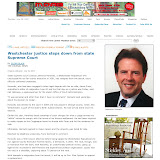
Westchester County Judge Rory Bellantoni is stepping down after six years on the bench, effective June 8. Bellantoni apparently is leaving over money. In his resignation letter, Bellantoni the lack of judicial pay raises has caused economic hardships on Bellantoni’s family, according to Administrative Judge Francis Nicolai. County and state judges make $136,700 a year. They have not receive a raise in 10 years. Bellantoni made headlines in October when he exonerated Richard DiGuglielmo, who had spent 10 years in prison on a murder conviction in the shooting death of Charles Campbell of Dobbs Ferry. Bellantoni threw out the conviction after a hearing in which an eyewitness to the shooting recanted his trial testimony. In his decision, Bellantoni said Dobbs Ferry police coerced witness Michael Dillon to change his story and blasted the Westchester District Attorney’s office in a bizarre “Wizard of Oz” reference, comparing Dillon to Dorothy Gale and authorities to the wizard behind the curtain.
Bellantoni, who had been the presiding judge of sex offender court, was reassigned to civil court a few months ago – shortly after the DiGuglielmo decision – and was made an acting state Supreme Court justice. Nicolai said he needed another judge to hear civil cases in the 9th Judicial District, which includes Westchester, Rockland, Putnam, Orange and Dutchess counties. Bellantoni’s decision means he won’t be following in the steps of his father, Orazio Bellantoni, who has been on the bench for 25 years. There’s some interesting rumors floating around about where Bellantoni, a Republican, is going to be practicing law. I’ll let you know when I get the facts confirmed.
Westchester County Judge Rory Bellantoni is stepping down after six years on the bench, effective June 8. Bellantoni apparently is leaving over money. In his resignation letter, Bellantoni the lack of judicial pay raises has caused economic hardships on Bellantoni’s family, according to Administrative Judge Francis Nicolai. County and state judges make $136,700 a year. They have not receive a raise in 10 years. Bellantoni made headlines in October when he exonerated Richard DiGuglielmo, who had spent 10 years in prison on a murder conviction in the shooting death of Charles Campbell of Dobbs Ferry. Bellantoni threw out the conviction after a hearing in which an eyewitness to the shooting recanted his trial testimony. In his decision, Bellantoni said Dobbs Ferry police coerced witness Michael Dillon to change his story and blasted the Westchester District Attorney’s office in a bizarre “Wizard of Oz” reference, comparing Dillon to Dorothy Gale and authorities to the wizard behind the curtain.
Bellantoni, who had been the presiding judge of sex offender court, was reassigned to civil court a few months ago – shortly after the DiGuglielmo decision – and was made an acting state Supreme Court justice. Nicolai said he needed another judge to hear civil cases in the 9th Judicial District, which includes Westchester, Rockland, Putnam, Orange and Dutchess counties. Bellantoni’s decision means he won’t be following in the steps of his father, Orazio Bellantoni, who has been on the bench for 25 years. There’s some interesting rumors floating around about where Bellantoni, a Republican, is going to be practicing law. I’ll let you know when I get the facts confirmed.
Hacks Hold On, Oppose Governor's Corruption Clean-Up
Counsel Defends Integrity Head; No Members Step Down
The New York Law Journal by By Joel Stashenko - May 15, 2009
ALBANY, NEW YORK - Herbert Teitelbaum, executive director of the state Commission on Public Integrity, and Robert Hermann, a figure in the Spitzer administration, were at one time as close as the "Odd Couple," and their familiarity led to Mr. Hermann inadvertently seeing sensitive information about a commission investigation of Mr. Spitzer's inner circle, an attorney for the commission contended yesterday. State Inspector General Joseph Fisch this week reported that Mr. Teitelbaum improperly leaked information to Mr. Hermann about the commission's investigation of whether aides to former Governor Eliot Spitzer misused State Police resources to discredit a political rival, state Senate Majority Leader Joseph Bruno. Zachary W. Carter of Dorsey & Whitney, pro bono attorney for the commission, argued that Mr. Hermann was a "dear friend" and former law partner of Mr. Teitelbaum and that the two chatted frequently and often had dinner together when both were working in Albany. "They were like Oscar and Felix, that's how often they talked on the phone," Mr. Carter said. "They were two older guys who were up in Albany with nothing else to do."
During one of Mr. Hermann's visits to Mr. Teitelbaum's apartment, Mr. Carter said Mr. Hermann saw notes made on a yellow pad by Mr. Teitelbaum about the commission referring former Spitzer communications director Darren Dopp to the Albany County district attorney's office for a possible perjury prosecution. "He saw this on a pad and goes off and reports this" to Lloyd Constantine, Mr. Spitzer's counsel, and other top advisers to the former governor, said Mr. Carter in an interview yesterday. As to the source of the information, Mr. Hermann testified to the inspector general that he told Mr. Constantine, "I had come upon it from Herb." According to Mr. Fisch's report, Mr. Hermann told the investigators the "yellow pad" story. Mr. Hermann said he had seen words including "inconsistencies" and the "district attorney" and put "two and two together," knowing from media reports that Mr. Dopp had just been in to give testimony before Mr. Teitelbaum.
Mr. Fisch's report concluded that Mr. Hermann told Mr. Constantine and other Spitzer aides more than he could glean from notes on a pad. The information included a legal analysis of the implications to the commission's investigation that was similar to one prepared a week earlier for Mr. Teitelbaum by Meave Tooher, commission counsel, according to the inspector general's report. Mr. Carter also defended the contacts Mr. Teitelbaum had with Mr. Hermann soon after the commission launched its investigation in 2007. Mr. Teitelbaum was trying to use Mr. Hermann to get documents released voluntarily that the Spitzer administration was reluctant to turn over and, in general, to move the in-vestigation along, Mr. Carter said. "He was saying [to Mr. Hermann], 'Listen, I know you are friendly with these guys. Enough already,'" Mr. Carter said. "Not only is that not improper, it is admirable." Mr. Hermann was head of the Governor's Office of Regulatory Reform at the time of the alleged leaks. He now works for state Senate Democrats and did not return calls for comment. Mr. Teitelbaum remained on the job yesterday, as did all members of the commission.
No Resignations
On Wednesday, Governor David A. Paterson called for the six gubernatorial appointees on the commission to step down, and he urged the other political leaders in Albany with selections to the commission to urge their designees to do the same. Mr. Paterson said it was necessary to give his newly named chairman of the commission, Michael G. Cherkasky, a "fresh start" at the embattled agency (NYLJ, May 14). "They are not resigning," Mr. Carter said yesterday. "There is no basis for them to resign."
Members of the Commission on Public Integrity
• Daniel R. Alonso, partner, Kaye Scholer, appointed by then-Governor Eliot Spitzer, term expires October 2012
• Virginia M. Apuzzo, former president of the Civil Service Commission, appointed by Assembly Speaker Sheldon Silver, term expires November 2009
• John M. Brickman, partner, Ackerman, Levine, Cullen, Brickman & Limmer, appoint-ed by Comptroller Thomas DiNapoli, term expires October 2011
• Andrew G. Celli Jr., partner, Emery Celli Brinckerhoff & Abady, appointed by Mr. Spitzer, term expires October 2010
• Chairman Michael G. Cherkasky, president and CEO of U.S. Investigations Services, appointed by Governor David A. Paterson, term expires October 2009.
• Richard D. Emery, partner, Emery Celli Brinckerhoff & Abady, appointed by then-Senate Minority Leader Malcolm Smith, term expires November 2012
• Daniel J. French, partner, French-Alcott, appointed by Attorney General Andrew M. Cuomo, term expires October 2009
• Robert J. Giuffra Jr., partner, Sullivan & Cromwell, appointed by Mr. Spitzer, term expired October 2008, serving as a holdover until Mr. Paterson makes a new appointment.
• David L. Gruenberg, solo practitioner, Troy, appointed by then-Senate Majority Leader Joseph Bruno, term expires November 2011
• James P. King, former Court of Claims judge, appointed by Mr. Spitzer, term expires October 2012
• Howard A. Levine, former state Court of Appeals judge, appointed by Mr. Spitzer, term expires October 2011
• Loretta E. Lynch, partner, Hogan & Hartson, appointed by Mr. Spitzer, term expires November 2012
• John T. Mitchell, of counsel, Tobin and Dempf, appointed by then-Assembly Minority Leader James Tedisco, term expires November 2012
The New York Law Journal by By Joel Stashenko - May 15, 2009
ALBANY, NEW YORK - Herbert Teitelbaum, executive director of the state Commission on Public Integrity, and Robert Hermann, a figure in the Spitzer administration, were at one time as close as the "Odd Couple," and their familiarity led to Mr. Hermann inadvertently seeing sensitive information about a commission investigation of Mr. Spitzer's inner circle, an attorney for the commission contended yesterday. State Inspector General Joseph Fisch this week reported that Mr. Teitelbaum improperly leaked information to Mr. Hermann about the commission's investigation of whether aides to former Governor Eliot Spitzer misused State Police resources to discredit a political rival, state Senate Majority Leader Joseph Bruno. Zachary W. Carter of Dorsey & Whitney, pro bono attorney for the commission, argued that Mr. Hermann was a "dear friend" and former law partner of Mr. Teitelbaum and that the two chatted frequently and often had dinner together when both were working in Albany. "They were like Oscar and Felix, that's how often they talked on the phone," Mr. Carter said. "They were two older guys who were up in Albany with nothing else to do."
During one of Mr. Hermann's visits to Mr. Teitelbaum's apartment, Mr. Carter said Mr. Hermann saw notes made on a yellow pad by Mr. Teitelbaum about the commission referring former Spitzer communications director Darren Dopp to the Albany County district attorney's office for a possible perjury prosecution. "He saw this on a pad and goes off and reports this" to Lloyd Constantine, Mr. Spitzer's counsel, and other top advisers to the former governor, said Mr. Carter in an interview yesterday. As to the source of the information, Mr. Hermann testified to the inspector general that he told Mr. Constantine, "I had come upon it from Herb." According to Mr. Fisch's report, Mr. Hermann told the investigators the "yellow pad" story. Mr. Hermann said he had seen words including "inconsistencies" and the "district attorney" and put "two and two together," knowing from media reports that Mr. Dopp had just been in to give testimony before Mr. Teitelbaum.
Mr. Fisch's report concluded that Mr. Hermann told Mr. Constantine and other Spitzer aides more than he could glean from notes on a pad. The information included a legal analysis of the implications to the commission's investigation that was similar to one prepared a week earlier for Mr. Teitelbaum by Meave Tooher, commission counsel, according to the inspector general's report. Mr. Carter also defended the contacts Mr. Teitelbaum had with Mr. Hermann soon after the commission launched its investigation in 2007. Mr. Teitelbaum was trying to use Mr. Hermann to get documents released voluntarily that the Spitzer administration was reluctant to turn over and, in general, to move the in-vestigation along, Mr. Carter said. "He was saying [to Mr. Hermann], 'Listen, I know you are friendly with these guys. Enough already,'" Mr. Carter said. "Not only is that not improper, it is admirable." Mr. Hermann was head of the Governor's Office of Regulatory Reform at the time of the alleged leaks. He now works for state Senate Democrats and did not return calls for comment. Mr. Teitelbaum remained on the job yesterday, as did all members of the commission.
No Resignations
On Wednesday, Governor David A. Paterson called for the six gubernatorial appointees on the commission to step down, and he urged the other political leaders in Albany with selections to the commission to urge their designees to do the same. Mr. Paterson said it was necessary to give his newly named chairman of the commission, Michael G. Cherkasky, a "fresh start" at the embattled agency (NYLJ, May 14). "They are not resigning," Mr. Carter said yesterday. "There is no basis for them to resign."
Members of the Commission on Public Integrity
• Daniel R. Alonso, partner, Kaye Scholer, appointed by then-Governor Eliot Spitzer, term expires October 2012
• Virginia M. Apuzzo, former president of the Civil Service Commission, appointed by Assembly Speaker Sheldon Silver, term expires November 2009
• John M. Brickman, partner, Ackerman, Levine, Cullen, Brickman & Limmer, appoint-ed by Comptroller Thomas DiNapoli, term expires October 2011
• Andrew G. Celli Jr., partner, Emery Celli Brinckerhoff & Abady, appointed by Mr. Spitzer, term expires October 2010
• Chairman Michael G. Cherkasky, president and CEO of U.S. Investigations Services, appointed by Governor David A. Paterson, term expires October 2009.
• Richard D. Emery, partner, Emery Celli Brinckerhoff & Abady, appointed by then-Senate Minority Leader Malcolm Smith, term expires November 2012
• Daniel J. French, partner, French-Alcott, appointed by Attorney General Andrew M. Cuomo, term expires October 2009
• Robert J. Giuffra Jr., partner, Sullivan & Cromwell, appointed by Mr. Spitzer, term expired October 2008, serving as a holdover until Mr. Paterson makes a new appointment.
• David L. Gruenberg, solo practitioner, Troy, appointed by then-Senate Majority Leader Joseph Bruno, term expires November 2011
• James P. King, former Court of Claims judge, appointed by Mr. Spitzer, term expires October 2012
• Howard A. Levine, former state Court of Appeals judge, appointed by Mr. Spitzer, term expires October 2011
• Loretta E. Lynch, partner, Hogan & Hartson, appointed by Mr. Spitzer, term expires November 2012
• John T. Mitchell, of counsel, Tobin and Dempf, appointed by then-Assembly Minority Leader James Tedisco, term expires November 2012
Other Albany leaders did not comply with Mr. Paterson's request. State Senate Majority Leader Malcolm Smith, D-Queens, said he has "total confidence" in Richard Emery, Mr. Smith's appointee to the commission. State Assembly Minority Leader Brian Kolb, R-Canandaigua, said the Assembly Republican's appointee to the commission, John T. Mitchell, has "outstanding legal credentials and a commitment to ethics and integrity" and should remain on the panel. After an appearance yesterday in Manhattan, Mr. Paterson said he was "very surprised" that the commissioners were not stepping aside voluntarily. "I frankly was surprised and shocked that I am getting this reaction," Mr. Paterson told reporters. Mr. Paterson equated his call for the commissioners' resignations to the letters of resignation he required all commissioners and other agency heads to give him when he succeeded Mr. Spitzer in 2008. Mr. Paterson accepted only a handful of the letters then and said yesterday that some commission members could "quite validly be reappointed." Mr. Paterson said he will study the structure of the board and propose changes if he concludes it contributed to the misconduct that Mr. Fisch reported on Wednesday. Mr. Fisch's report was critical of conversations that Loretta E. Lynch, until Wednesday the acting chairwoman of the commission, had with the inspector general in the weeks leading up to the release of the report.
Ms. Lynch made "strained and specious" attacks on Mr. Constantine and repeatedly called into question his veracity as a witness, according to the report. She also attempted to "distance" Mr. Teitelbaum as the source of the leaked information despite the evidence gathered to the contrary, the report said. Ms. Lynch, a partner at Hogan & Hartson, has been recommended as U.S. Attorney for the Eastern District of New York by U.S. Sen. Charles Schumer (NYLJ, May 6). Ms. Lynch held the post from 1999 to 2001. Mr. Paterson said yesterday he did not believe Ms. Lynch's work on the public integrity commission should affect her candidacy for the Eastern District post, calling her an "outstanding prosecutor who I think would serve well." Neither Mr. Schumer's office nor Ms. Lynch returned calls seeking comment yesterday. Also yesterday, the former chairman of the commission, John D. Feerick, released a statement about Mr. Fisch's report. Mr. Feerick was said by the inspector general to have been aware of evidence of possibly improper conduct by Mr. Teitelbaum but did not question the executive director strenuously or push for a formal commission investigation before Mr. Feerick resigned from the commission in January. "I did my work with the commission and as its chair to the best of my ability and with honesty and integrity," Mr. Feerick said. "I am proud of the work done by the commission and was privileged to serve with a distinguished group of commissioners, consisting of prominent public servants, Republicans and Democrats, among them former United States' attorneys and judges, all of whom had volunteered their time at great personal sacrifice." Joel.Stashenko@incisivemedia.com
Ms. Lynch made "strained and specious" attacks on Mr. Constantine and repeatedly called into question his veracity as a witness, according to the report. She also attempted to "distance" Mr. Teitelbaum as the source of the leaked information despite the evidence gathered to the contrary, the report said. Ms. Lynch, a partner at Hogan & Hartson, has been recommended as U.S. Attorney for the Eastern District of New York by U.S. Sen. Charles Schumer (NYLJ, May 6). Ms. Lynch held the post from 1999 to 2001. Mr. Paterson said yesterday he did not believe Ms. Lynch's work on the public integrity commission should affect her candidacy for the Eastern District post, calling her an "outstanding prosecutor who I think would serve well." Neither Mr. Schumer's office nor Ms. Lynch returned calls seeking comment yesterday. Also yesterday, the former chairman of the commission, John D. Feerick, released a statement about Mr. Fisch's report. Mr. Feerick was said by the inspector general to have been aware of evidence of possibly improper conduct by Mr. Teitelbaum but did not question the executive director strenuously or push for a formal commission investigation before Mr. Feerick resigned from the commission in January. "I did my work with the commission and as its chair to the best of my ability and with honesty and integrity," Mr. Feerick said. "I am proud of the work done by the commission and was privileged to serve with a distinguished group of commissioners, consisting of prominent public servants, Republicans and Democrats, among them former United States' attorneys and judges, all of whom had volunteered their time at great personal sacrifice." Joel.Stashenko@incisivemedia.com
Thursday, May 14, 2009
NYLJ: Governor Calls for Integrity Head to Resign
Inspector General, Governor Call for Integrity Head to Resign
The New York Law Journal by Joel Stashenko - May 14, 2009
ALBANY, NEW YORK - Governor David A. Paterson yesterday called for the resignation of Herbert Teitelbaum, the director of the Commission on Public Integrity, following the release of a report by the state's Inspector General that found Mr. Teitelbaum had improperly disclosed confidential information to a top aide of then-Governor Eliot Spitzer about a commission investigation of the Spitzer administration. Mr. Paterson said Mr. Teitelbaum had compromised the independence of an agency formed to police the conduct of government employees. Mr. Teitelbaum denied any wrongdoing.
In addition to calling for Mr. Teitelbaum to resign his $140,000-a-year post, Mr. Paterson asked commission counsel Barry Ginsberg and all six of his appointees to the 13-member commission to step down. One of the governor's slots on the commission is vacant. Mr. Paterson also said other government leaders should urge the six members they appointed to step down. There is one vacancy. Finally, Mr. Paterson appointed Michael G. Cherkasky, a former prosecutor who is president and chief executive officer of U.S. Investigations Services, as the new chairman of the commission. He will replace former Fordham University Law School Dean John D. Feerick, who resigned in January. "I have waited to replace [Mr. Feerick] until the Inspector General released his report," Mr. Paterson said in a statement. "I am confident that my appointment of Chairman Cherkasky combined with new commission members will give the commission the fresh start it needs and will help to restore public confidence in both the commission and state government." Attorney James DeVita said in a statement that Mr. Teitelbaum "categorically denies having violated his public trust."
"The suggestion that Mr. Teitelbaum improperly leaked confidential information is flatly contradicted by sworn testimony that is supported by contemporaneous documents," the statement said. Mr. DeVita said later in an interview that Mr. Teitelbaum "has no intention of resigning at this time." Mr. Teitelbaum serves at the pleasure of the commission and cannot be removed directly by the governor. The statement by Mr. DeVita of Bryan Cave also defended the members of the commission, who serve without pay. "It is extremely unfortunate that public servants with unblemished reputations and enormous talent, who have committed themselves and made tremendous personal sacrifices to help foster a more ethical environment in Albany, have been subjected to the unjustified and inaccurate aspersions that permeate the Inspector General's investigation and report," the statement said.
Inspector General Joseph Fisch also called for Mr. Teitelbaum's removal.
Mr. Fisch said Mr. Teitelbaum shared with Robert Hermann, a friend and former law partner, information about the 2007 probe into efforts by aides to Mr. Spitzer to misuse State Police resources to discredit Mr. Spitzer's political rival, former Senate Republican Majority Leader Joseph Bruno. Mr. Hermann was head of Mr. Spitzer's Office of Regulatory Reform at the time. While Mr. Teitelbaum told the inspector general's investigators he was using discussions with Mr. Hermann to facilitate the release of Spitzer administration records and move the commission's investigation forward, Mr. Fisch said the communications appear to have violated Executive Law §94(12)(a) and Public Officers Law §74(3)(c). Both statutes prohibit the disclosure of confidential integrity commission information. Mr. Hermann, a former partner of Mr. Teitelbaum's at Teitelbaum, Hiller, Rodman, Paden & Hibsher, may have also violated the Public Officers Law, according to Mr. Fisch's report. Mr. Hermann was solicitor general from 1984 to 1986.
"Herbert Teitelbaum and Robert Hermann betrayed the public trust," Mr. Fisch said in a statement. "It is disturbing that while investigating leaks by the governor's office of confidential information, the commission's executive director committed a similar offense by leaking confidential information." Mr. Fisch said he would have recommended Mr. Hermann's dismissal as well had he not stepped down in March. Mr. Hermann now works in the Legislature. He did not return calls seeking comment. Mr. Fisch also criticized the commission itself for failing to formally investigate Mr. Teitelbaum when Albany County District Attorney P. David Soares began to offer the commission evidence about Mr. Teitelbaum's possibly improper contacts with the Spitzer camp. "Despite receiving evidence of the executive director's misdeeds, the commission inexcusably failed on several occasions to investigate these serious allegations against Mr. Teitelbaum," Mr. Fisch said. Mr. Teitelbaum denied improperly releasing information when asked by members of the commission, and Mr. Feerick did not believe the executive director had breached confidentiality rules, according to the inspector general's report.
'Backdoor Channel'
According to the report, Mr. Teitelbaum had what he termed "backdoor channel" discussions with Mr. Hermann in July 2007 and August 2007, just as the Ethics Commission was beginning to investigate whether Mr. Spitzer's aides had improperly used State Police personnel to gather travel records to discredit Mr. Bruno, who was Mr. Spitzer's bitterest political rival at the time. Mr. Teitelbaum was executive director of the Ethics Commission in July and August 2007. He became executive director of the integrity commission the following month when the new agency was formed by the merger of the ethics and lobbying commissions. Mr. Fisch reported that Mr. Teitelbaum used Mr. Hermann "as an unsanctioned conduit for imparting unsolicited opinions and advice to the Executive Chamber regarding the Spitzer administration's response to the commission's demands for documents" vital to its investigation. Mr. Teitelbaum told the Inspector General's Office that he had discussed the commission's investigation of Mr. Spitzer in a "general way" with Mr. Hermann, but he denied disclosing any confidential information. Phone records reviewed by Mr. Fisch's office showed 165 calls between Mr. Teitelbaum and Mr. Hermann from when Mr. Teitelbaum was appointed to the Ethics Commission on June 20, 2007, to Nov. 13, 2007, when Mr. Soares confronted Mr. Teitelbaum with accusations that he was improperly leaking information.
Mr. Fisch's report contended that Mr. Teitelbaum "equivocated" when asked directly by the inspector general about his contacts with Mr. Hermann. "The Inspector General and the public to whom it reports expect and deserve straightforward, unambiguous denials when posing such questions," the report concluded. Mr. Fisch said the communications between Mr. Teitelbaum and Mr. Hermann appeared to have continued despite warnings to Mr. Teitelbaum by Meave Tooher, investigative counsel at the commission, that he "shouldn't be talking to anybody about the investigation." Mr. Hermann was ordered by then-Spitzer counsel Lloyd Constantine to stop talking to Mr. Teitelbaum. The report also identified Mr. Teitelbaum as the source of the information Mr. Hermann told Mr. Constantine on Nov. 1, 2007, that Mr. Soares would pursue a criminal investigation against former Spitzer communications director Darren Dopp for perjury for discrepancies in statements Mr. Dopp made to the commission and to Attorney General Andrew M. Cuomo's investigators. Earlier that same day, Mr. Soares had confirmed to Mr. Teitelbaum that the district attorney would be pursuing criminal charges, and Mr. Hermann acknowledged to the inspector general's office that Mr. Teitelbaum was his source about the Dopp prosecution. The commission ultimately found that four top Spitzer administration figures had broken the Public Officers Law. Mr. Dopp and Preston Felton, the former superintendent of the State Police, are challenging that determination.
New Chairman
Mr. Cherkasky, 59, the commission's new unpaid chairman, is a former prosecutor who reportedly has close ties to Mr. Spitzer. His appointment does not require Senate confirmation. He is the chief executive officer of US Investigations Services, Inc., the largest supplier of security investigations for the U.S. government. Mr. Cherkasky was named chief executive of the insurance company Marsh & McLennan in October 2004, in the midst of a bid-rigging scandal in which the company faced charges from then-Attorney General Spitzer. He steered the company with a settlement of the case but was ousted in December 2007 following a year of disappointing financial results. He reportedly received a $7.15 million severance package from Marsh. Mr. Cherkasky also served as chief executive of Manhattan security firm Kroll, Inc., which he joined in 1994, following a stint in the Manhattan District Attorney's Office, where he worked with Mr. Spitzer. As an assistant district attorney, Mr. Cherkasky led the rackets bureau and investigations division, and worked on such high-profile cases as the 1993 World Trade Center bombing. A graduate of Case Western Reserve University School of Law in 1975, Mr. Cherkasky clerked in the U.S. District Court for the Northern District Court of Ohio before joining the prosecutor's office. He is the author of "Forewarned: Why the Government Is Failing to Protect Us - and What We Must Do to Protect Ourselves." Mr. Cherkasky was unavailable for comment last night.
Split on Resignation
The New York Law Journal by Joel Stashenko - May 14, 2009
ALBANY, NEW YORK - Governor David A. Paterson yesterday called for the resignation of Herbert Teitelbaum, the director of the Commission on Public Integrity, following the release of a report by the state's Inspector General that found Mr. Teitelbaum had improperly disclosed confidential information to a top aide of then-Governor Eliot Spitzer about a commission investigation of the Spitzer administration. Mr. Paterson said Mr. Teitelbaum had compromised the independence of an agency formed to police the conduct of government employees. Mr. Teitelbaum denied any wrongdoing.
In addition to calling for Mr. Teitelbaum to resign his $140,000-a-year post, Mr. Paterson asked commission counsel Barry Ginsberg and all six of his appointees to the 13-member commission to step down. One of the governor's slots on the commission is vacant. Mr. Paterson also said other government leaders should urge the six members they appointed to step down. There is one vacancy. Finally, Mr. Paterson appointed Michael G. Cherkasky, a former prosecutor who is president and chief executive officer of U.S. Investigations Services, as the new chairman of the commission. He will replace former Fordham University Law School Dean John D. Feerick, who resigned in January. "I have waited to replace [Mr. Feerick] until the Inspector General released his report," Mr. Paterson said in a statement. "I am confident that my appointment of Chairman Cherkasky combined with new commission members will give the commission the fresh start it needs and will help to restore public confidence in both the commission and state government." Attorney James DeVita said in a statement that Mr. Teitelbaum "categorically denies having violated his public trust."
"The suggestion that Mr. Teitelbaum improperly leaked confidential information is flatly contradicted by sworn testimony that is supported by contemporaneous documents," the statement said. Mr. DeVita said later in an interview that Mr. Teitelbaum "has no intention of resigning at this time." Mr. Teitelbaum serves at the pleasure of the commission and cannot be removed directly by the governor. The statement by Mr. DeVita of Bryan Cave also defended the members of the commission, who serve without pay. "It is extremely unfortunate that public servants with unblemished reputations and enormous talent, who have committed themselves and made tremendous personal sacrifices to help foster a more ethical environment in Albany, have been subjected to the unjustified and inaccurate aspersions that permeate the Inspector General's investigation and report," the statement said.
Inspector General Joseph Fisch also called for Mr. Teitelbaum's removal.
Mr. Fisch said Mr. Teitelbaum shared with Robert Hermann, a friend and former law partner, information about the 2007 probe into efforts by aides to Mr. Spitzer to misuse State Police resources to discredit Mr. Spitzer's political rival, former Senate Republican Majority Leader Joseph Bruno. Mr. Hermann was head of Mr. Spitzer's Office of Regulatory Reform at the time. While Mr. Teitelbaum told the inspector general's investigators he was using discussions with Mr. Hermann to facilitate the release of Spitzer administration records and move the commission's investigation forward, Mr. Fisch said the communications appear to have violated Executive Law §94(12)(a) and Public Officers Law §74(3)(c). Both statutes prohibit the disclosure of confidential integrity commission information. Mr. Hermann, a former partner of Mr. Teitelbaum's at Teitelbaum, Hiller, Rodman, Paden & Hibsher, may have also violated the Public Officers Law, according to Mr. Fisch's report. Mr. Hermann was solicitor general from 1984 to 1986.
"Herbert Teitelbaum and Robert Hermann betrayed the public trust," Mr. Fisch said in a statement. "It is disturbing that while investigating leaks by the governor's office of confidential information, the commission's executive director committed a similar offense by leaking confidential information." Mr. Fisch said he would have recommended Mr. Hermann's dismissal as well had he not stepped down in March. Mr. Hermann now works in the Legislature. He did not return calls seeking comment. Mr. Fisch also criticized the commission itself for failing to formally investigate Mr. Teitelbaum when Albany County District Attorney P. David Soares began to offer the commission evidence about Mr. Teitelbaum's possibly improper contacts with the Spitzer camp. "Despite receiving evidence of the executive director's misdeeds, the commission inexcusably failed on several occasions to investigate these serious allegations against Mr. Teitelbaum," Mr. Fisch said. Mr. Teitelbaum denied improperly releasing information when asked by members of the commission, and Mr. Feerick did not believe the executive director had breached confidentiality rules, according to the inspector general's report.
'Backdoor Channel'
According to the report, Mr. Teitelbaum had what he termed "backdoor channel" discussions with Mr. Hermann in July 2007 and August 2007, just as the Ethics Commission was beginning to investigate whether Mr. Spitzer's aides had improperly used State Police personnel to gather travel records to discredit Mr. Bruno, who was Mr. Spitzer's bitterest political rival at the time. Mr. Teitelbaum was executive director of the Ethics Commission in July and August 2007. He became executive director of the integrity commission the following month when the new agency was formed by the merger of the ethics and lobbying commissions. Mr. Fisch reported that Mr. Teitelbaum used Mr. Hermann "as an unsanctioned conduit for imparting unsolicited opinions and advice to the Executive Chamber regarding the Spitzer administration's response to the commission's demands for documents" vital to its investigation. Mr. Teitelbaum told the Inspector General's Office that he had discussed the commission's investigation of Mr. Spitzer in a "general way" with Mr. Hermann, but he denied disclosing any confidential information. Phone records reviewed by Mr. Fisch's office showed 165 calls between Mr. Teitelbaum and Mr. Hermann from when Mr. Teitelbaum was appointed to the Ethics Commission on June 20, 2007, to Nov. 13, 2007, when Mr. Soares confronted Mr. Teitelbaum with accusations that he was improperly leaking information.
Mr. Fisch's report contended that Mr. Teitelbaum "equivocated" when asked directly by the inspector general about his contacts with Mr. Hermann. "The Inspector General and the public to whom it reports expect and deserve straightforward, unambiguous denials when posing such questions," the report concluded. Mr. Fisch said the communications between Mr. Teitelbaum and Mr. Hermann appeared to have continued despite warnings to Mr. Teitelbaum by Meave Tooher, investigative counsel at the commission, that he "shouldn't be talking to anybody about the investigation." Mr. Hermann was ordered by then-Spitzer counsel Lloyd Constantine to stop talking to Mr. Teitelbaum. The report also identified Mr. Teitelbaum as the source of the information Mr. Hermann told Mr. Constantine on Nov. 1, 2007, that Mr. Soares would pursue a criminal investigation against former Spitzer communications director Darren Dopp for perjury for discrepancies in statements Mr. Dopp made to the commission and to Attorney General Andrew M. Cuomo's investigators. Earlier that same day, Mr. Soares had confirmed to Mr. Teitelbaum that the district attorney would be pursuing criminal charges, and Mr. Hermann acknowledged to the inspector general's office that Mr. Teitelbaum was his source about the Dopp prosecution. The commission ultimately found that four top Spitzer administration figures had broken the Public Officers Law. Mr. Dopp and Preston Felton, the former superintendent of the State Police, are challenging that determination.
New Chairman
Mr. Cherkasky, 59, the commission's new unpaid chairman, is a former prosecutor who reportedly has close ties to Mr. Spitzer. His appointment does not require Senate confirmation. He is the chief executive officer of US Investigations Services, Inc., the largest supplier of security investigations for the U.S. government. Mr. Cherkasky was named chief executive of the insurance company Marsh & McLennan in October 2004, in the midst of a bid-rigging scandal in which the company faced charges from then-Attorney General Spitzer. He steered the company with a settlement of the case but was ousted in December 2007 following a year of disappointing financial results. He reportedly received a $7.15 million severance package from Marsh. Mr. Cherkasky also served as chief executive of Manhattan security firm Kroll, Inc., which he joined in 1994, following a stint in the Manhattan District Attorney's Office, where he worked with Mr. Spitzer. As an assistant district attorney, Mr. Cherkasky led the rackets bureau and investigations division, and worked on such high-profile cases as the 1993 World Trade Center bombing. A graduate of Case Western Reserve University School of Law in 1975, Mr. Cherkasky clerked in the U.S. District Court for the Northern District Court of Ohio before joining the prosecutor's office. He is the author of "Forewarned: Why the Government Is Failing to Protect Us - and What We Must Do to Protect Ourselves." Mr. Cherkasky was unavailable for comment last night.
Split on Resignation
Commission members yesterday released a statement prepared by Zachary Carter of Dorsey & Whitney, the commission's outside counsel, in which they said the inspector general's report "inappropriately second-guesses" the handling of the allegations against Mr. Teitelbaum that he was leaking confidential information to Mr. Hermann. The statement does not allude to Mr. Paterson's calls for the resignations of members of the commission. Individual commissioners were split when contacted yesterday. Member John Brickman said he has no plans to resign while Andrew Celli Jr. said, "If the governor wants me gone, I'm gone, probably." Mr. Teitelbaum was a litigation partner at Bryan Cave before coming to first the Ethics and then the Integrity commission in 2007.
Mr. Feerick, who did not return a call for comment yesterday and has declined comment on the commission since his departure in January, referred to Mr. Teitelbaum in a 2007 interview as a person of "unflinching integrity." Critics of the commission, however, said Messrs. Feerick, Teitelbaum and others were hampered with an appearance of a conflict of interest from the inception of the commission. Under a governing structure demanded by Mr. Spitzer, there are seven gubernatorial appointments to the 13-member commission. That gave Mr. Spitzer control of the commission, which included the power to appoint the chairman. When the politically charged investigation of the Spitzer administration became the commission's first high-profile case, critics contended that the commission could not complete an impartial investigation because it was controlled by the governor whose office it was investigating. Blair Horner, legislative director of the New York Public Interest Research Group, said yesterday the structure of the commission, not its members, is compromising the integrity of the agency. "It's a bad place to put somebody, and it's a bad structure," Mr. Horner said. Joel.Stashenko@incisivemedia.com. Vesselin Mitev and Noeleen G. Walder contributed to this report.
Mr. Feerick, who did not return a call for comment yesterday and has declined comment on the commission since his departure in January, referred to Mr. Teitelbaum in a 2007 interview as a person of "unflinching integrity." Critics of the commission, however, said Messrs. Feerick, Teitelbaum and others were hampered with an appearance of a conflict of interest from the inception of the commission. Under a governing structure demanded by Mr. Spitzer, there are seven gubernatorial appointments to the 13-member commission. That gave Mr. Spitzer control of the commission, which included the power to appoint the chairman. When the politically charged investigation of the Spitzer administration became the commission's first high-profile case, critics contended that the commission could not complete an impartial investigation because it was controlled by the governor whose office it was investigating. Blair Horner, legislative director of the New York Public Interest Research Group, said yesterday the structure of the commission, not its members, is compromising the integrity of the agency. "It's a bad place to put somebody, and it's a bad structure," Mr. Horner said. Joel.Stashenko@incisivemedia.com. Vesselin Mitev and Noeleen G. Walder contributed to this report.
Wednesday, May 13, 2009
Governor Paterson Starts Corruption Clean-Up
Governor seeks resignations of executive director and board, names new chariman
The Albany Times Union by JAMES M. ODATO - May 13, 2009
ALBANY, NEW YORK - Gov. David Paterson today asked the executive director and board of commissioners of the embattled Commission on Public Integrity to resign and named security executive Michael Cherkasky to take over as chairman. Paterson's announcement came on the same day the state Inspector General issued a report slamming the commission's executive director, Herbert Teitelbaum, for leaking secrets about the commission's investigation of the Spitzer administration's disclosure of Senate Majority Leader Joseph L. Bruno's travel records to administration officials. "This report finds there has been widespread and continued violation of the public trust," Paterson told reporters this afternoon. "Their actions were inexcusable." Paterson called allegations of leaks about the secret investigation "alarming" and said a change in leadership would allow a "start fresh with a new commission." Paterson said he was asking all of his appointees to the commission's board to resign and urged the rest of the board and Teitelbaum to also step down. Paterson said Cherkasky would bring to the job skills both as an investigator and a reformer.
Cherkasky, a former lawyer in the Manhattan district attorney's office, currently serves as CEO of U.S. Investigations Services Inc. Paterson tapped Cherkasky for the post to fill the vacancy left by John Feerick, who resigned in February. Cherkasky's resume includes 16 years as a trial lawyer, administrator, and investigator. He worked as a law clerk in the U.S. District Court for the Northern District of Ohio. He then became an assistant district attorney in New York County. While in the district attorney's office, Cherkasky led the rackets bureau and investigated mobsters, as well as the 1993 bombing of the World Trade Center.
May 14, 2009 UPDATE: CLICK HERE TO SEE NEW YORK LAW JOURNAL ARTICLE "Inspector General, Governor Call for Integrity Head to Resign"
Tuesday, May 12, 2009
Public Teat Drying Up; Another Clown Arrested for Corruption
Ex-Health Commissioner Novello charged with theft, fraud
The Albany Times Union by ROBERT GAVIN - May 12, 2009
ALBANY, NEW YORK - Former state Health Commissioner Antonia Novello faces up to 12 years in prison on charges she illegally ordered state workers to chauffeur her around on shopping sprees, pick up her dry cleaning and water her plants over a two-year period. A 20-count criminal indictment unsealed in Albany County Court this morning alleged Novello used her staff employees, including a security assistant, to do "personal services for her." It also said she filed false information on a state comptroller's office form, failing to list the "chauffeur amount" that benefitted her. The one-time U.S. surgeon general pleaded not guilty to one count of defrauding the government and three counts of filing a false instrument, both low-level felonies. She entered the same plea to 16 counts of theft of government services, a misdemeanor. The indictment listed the amount of money involved as in "excess of $1,000," though she had been alleged to cost taxpayers $50,000. The typically outspoken Novello, 64, appeared somber as she entered the second-floor courtroom of Judge Stephen Herrick, joined by attorney E. Stewart Jones. She answered no questions from reporters as she awaited Herrick. "Are you Antonia Novello?" the judge asked. "Yes, sir," the former commissioner replied. "Is that your signature," he later asked after Novello signed a procedural document. "Yes it is,'" Novello said quietly. "Yes, your, honor," Herrick released Novello without any bail, but not before asking her to surrender her passport. She exited with Jones to face cameras. Novello remained silent. Jones did not.
The high-profile attorney blasted state Inspector General Joseph Fisch's office, which referred the case to Albany County District Attorney David Soares' office. Jones called her prosecution a "selective process" that should have been handled in civil court. He said the inspector general's office "discriminatory criminalized, politicized and distorted" the case. "It never should have reached this point," Jones said. " (That) one of our nations's great public servants stands here today is a shame. And the shame is on the inspector's office for putting her in this position." He said Novello would have paid back the state had she been asked. He said she was never given notice and called the case unfair. He said members of Congress, as well as the Obama and Paterson administrations, have done "far worse" than Novello and not been criminally charged. "Why is she here?" a visibly irked Jones told reporters. "She's here because she has a bull's-eye on her back. Because politics is a contact sport. Because there are people who are vindictive and who have wanted to get her ever since she left the state."
Soares said Novello's status as a once top state and national official was "irrelevant" in his decision making about the prosecution of the case. Asked about Jones' contention no one ever explained Novello the problem, Soares said, "I think as time goes on and the facts of this case come out, you will see that statement is not necessary correct." He said it was a similar case to his office's prosecution of former Comptroller Alan Hevesi, who used state employees to chauffeur his wife, "in the sense that there's a misappropriation of state resources." He bemoaned that state law does not allow a more serious charges for the amount of money involved. Had Novello taken thousands in paper clips, he noted, she could have been charged with a more serious felony.
The charge of defrauding the government, according to the indictment, alleged Novello used employees under her supervision "for her personal purposes while such state employees were being paid by the state of New York for regular and overtime hours during the time they were directed by the defendant to perform such personal services for her." Heather Orth, a spokeswoman for Soares, said the allegations mirrors accusations detailed in a January state Inspector General's Office report about of her conduct as commissioner. In a strongly worded report, Fisch said Novello shamelessly and blatantly exploited and abused her staff by requiring guards to chauffeur her to malls and stores and required staffers to rack up 2,540 hours of overtime at a cost of $50,000 to taxpayers. Besides ferrying her to Colonie Center and Crossgates Mall, staffers were ordered to water her house plants, buy her groceries, handle her dry cleaning and be "on call" nights, weekends and holidays. The acts drew the concern of Novello's top deputy, Dennis Whalen, now Gov. David Paterson's director of operations. He wrote in 2003 that she should not be using staff for non-state services, Fisch found. In recent weeks, several state officials have testified in front of an Albany County grand jury investigating Novello's conduct during her 1999-to-2006 tenure as commissioner, people familiar with the investigation told the Times Union.
Novello served in the office under Gov. George Pataki following her service as surgeon general under President George H.W. Bush from 1990 to 1993. She would be the latest of a series of state officials investigated and prosecuted for the way they conducted themselves as a public servant. Accusations of misuse of state employees and a warped sense of privilege arose frequently during the 64-year-old doctor's run in charge of the state's multibillion-dollar health program. She was known to spend extravagantly on her large office in the Corning Tower. According to the inspector general's report, security guards repeatedly transported Novello's mother to the Newark, N.J., airport to catch flights to Puerto Rico. He noted that Novello failed to fully declare the perks on her tax returns and turned the case over to the Albany County district attorney. She is employed now as an executive with Disney Children's Hospital in Orlando, Fla. Capitol Reporter James M. Odato contributed to this report.
The Albany Times Union by ROBERT GAVIN - May 12, 2009
ALBANY, NEW YORK - Former state Health Commissioner Antonia Novello faces up to 12 years in prison on charges she illegally ordered state workers to chauffeur her around on shopping sprees, pick up her dry cleaning and water her plants over a two-year period. A 20-count criminal indictment unsealed in Albany County Court this morning alleged Novello used her staff employees, including a security assistant, to do "personal services for her." It also said she filed false information on a state comptroller's office form, failing to list the "chauffeur amount" that benefitted her. The one-time U.S. surgeon general pleaded not guilty to one count of defrauding the government and three counts of filing a false instrument, both low-level felonies. She entered the same plea to 16 counts of theft of government services, a misdemeanor. The indictment listed the amount of money involved as in "excess of $1,000," though she had been alleged to cost taxpayers $50,000. The typically outspoken Novello, 64, appeared somber as she entered the second-floor courtroom of Judge Stephen Herrick, joined by attorney E. Stewart Jones. She answered no questions from reporters as she awaited Herrick. "Are you Antonia Novello?" the judge asked. "Yes, sir," the former commissioner replied. "Is that your signature," he later asked after Novello signed a procedural document. "Yes it is,'" Novello said quietly. "Yes, your, honor," Herrick released Novello without any bail, but not before asking her to surrender her passport. She exited with Jones to face cameras. Novello remained silent. Jones did not.
The high-profile attorney blasted state Inspector General Joseph Fisch's office, which referred the case to Albany County District Attorney David Soares' office. Jones called her prosecution a "selective process" that should have been handled in civil court. He said the inspector general's office "discriminatory criminalized, politicized and distorted" the case. "It never should have reached this point," Jones said. " (That) one of our nations's great public servants stands here today is a shame. And the shame is on the inspector's office for putting her in this position." He said Novello would have paid back the state had she been asked. He said she was never given notice and called the case unfair. He said members of Congress, as well as the Obama and Paterson administrations, have done "far worse" than Novello and not been criminally charged. "Why is she here?" a visibly irked Jones told reporters. "She's here because she has a bull's-eye on her back. Because politics is a contact sport. Because there are people who are vindictive and who have wanted to get her ever since she left the state."
Soares said Novello's status as a once top state and national official was "irrelevant" in his decision making about the prosecution of the case. Asked about Jones' contention no one ever explained Novello the problem, Soares said, "I think as time goes on and the facts of this case come out, you will see that statement is not necessary correct." He said it was a similar case to his office's prosecution of former Comptroller Alan Hevesi, who used state employees to chauffeur his wife, "in the sense that there's a misappropriation of state resources." He bemoaned that state law does not allow a more serious charges for the amount of money involved. Had Novello taken thousands in paper clips, he noted, she could have been charged with a more serious felony.
The charge of defrauding the government, according to the indictment, alleged Novello used employees under her supervision "for her personal purposes while such state employees were being paid by the state of New York for regular and overtime hours during the time they were directed by the defendant to perform such personal services for her." Heather Orth, a spokeswoman for Soares, said the allegations mirrors accusations detailed in a January state Inspector General's Office report about of her conduct as commissioner. In a strongly worded report, Fisch said Novello shamelessly and blatantly exploited and abused her staff by requiring guards to chauffeur her to malls and stores and required staffers to rack up 2,540 hours of overtime at a cost of $50,000 to taxpayers. Besides ferrying her to Colonie Center and Crossgates Mall, staffers were ordered to water her house plants, buy her groceries, handle her dry cleaning and be "on call" nights, weekends and holidays. The acts drew the concern of Novello's top deputy, Dennis Whalen, now Gov. David Paterson's director of operations. He wrote in 2003 that she should not be using staff for non-state services, Fisch found. In recent weeks, several state officials have testified in front of an Albany County grand jury investigating Novello's conduct during her 1999-to-2006 tenure as commissioner, people familiar with the investigation told the Times Union.
Novello served in the office under Gov. George Pataki following her service as surgeon general under President George H.W. Bush from 1990 to 1993. She would be the latest of a series of state officials investigated and prosecuted for the way they conducted themselves as a public servant. Accusations of misuse of state employees and a warped sense of privilege arose frequently during the 64-year-old doctor's run in charge of the state's multibillion-dollar health program. She was known to spend extravagantly on her large office in the Corning Tower. According to the inspector general's report, security guards repeatedly transported Novello's mother to the Newark, N.J., airport to catch flights to Puerto Rico. He noted that Novello failed to fully declare the perks on her tax returns and turned the case over to the Albany County district attorney. She is employed now as an executive with Disney Children's Hospital in Orlando, Fla. Capitol Reporter James M. Odato contributed to this report.
Once Respected 'Officer of Court' Pleads Guilty to Mini-Madoff Fraud
Dreier Pleads Guilty to Fraud Scheme, Remains Free on Bail
The New York Law Journal by Mark Hamblett - May 12, 2009
Attorney Marc S. Dreier said "guilty" eight times but remained free on bail after admitting yesterday evening to selling fictitious promissory notes in a scheme that ripped off investors of hundreds of millions of dollars and ended with the implosion of his 250-member law firm. Southern District Judge Jed S. Rakoff said that allowing Mr. Dreier to remain free pending his July 13 sentencing was a close call in a case where Mr. Dreier "has disgraced the honorable profession of law." Jonathan Streeter, assistant U.S. attorney for the Southern District, argued that every day Mr. Dreier was allowed to remain in his 151 E. 58th St. penthouse interfered with the sale of the apartment and slowed the delivery of monies to victims. The judge urged Mr. Streeter and defense attorney Gerald L. Shargel to compromise and agree that Mr. Dreier surrender one month prior to his sentencing. However, after Messrs. Shargel and Streeter briefly conferred during a break, Mr. Shargel told the court the government had refused to consent. In the end, Judge Rakoff found that Mr. Dreier was not a flight risk or a danger to the community and said he was bound to follow the statute despite his "repugnance for Mr. Dreier's crimes."
"As an abstract matter there are a hundred good reasons why Mr. Dreier should be remanded," the judge said. "By his own admissions here today, he has shown that he is to be ranked with those who have committed some of the most egregious frauds in history." Mr. Dreier, who turns 59 today, pleaded guilty to one count of conspiracy to commit securities fraud and wire fraud, one count of money laundering, one count of securities fraud and five counts of wire fraud. The former head of Dreier LLP agreed that everything he had done was "illegal and wrong" when asked about the first seven counts of the indictment. But he hesitated when Judge Rakoff asked him about the eighth and final count - a money laundering charge based on Mr. Dreier's actions on Dec. 4, 2008. On that date - with his world collapsing in New York while under arrest in Canada for yet another scheme to sell fake notes - Mr. Dreier arranged to have $10 million transferred from attorney trust accounts at Dreier LLP into his personal account.
Mr. Shargel had a quick word with his client, and Mr. Dreier said he understood that the money transfer was done in furtherance of his broader scheme to defraud. Nonetheless, he stubbornly added, "It was not my intent." Judge Rakoff told Mr. Dreier that intent was not the issue on the charge, and the judge went on to settle an unfinished piece of business by accepting the argument of Mr. Streeter that the notes Mr. Dreier sold and attempted to sell were, indeed, securities. Mr. Shargel had asked the judge to dismiss the securities fraud charge. All of the counts carry maximum penalties of 20 years in prison save the conspiracy count, which carries five years. With the guilty plea concluded, the parties turned to the question of whether Mr. Dreier would be allowed to remain free pending sentencing or be remanded to the Metropolitan Correctional Center. Mr. Shargel said his client, whose assets have been frozen, has neither the means nor the ability to flee.
While Judge Rakoff pointed out that "the virtual certainty of meaningful prison time" now "looms with a greater immediacy" than previously, Mr. Shargel responded that he had made clear from the beginning that the case would "end in a guilty plea." "This day comes as no surprise," Mr. Shargel said, adding that a "very effective mechanism" is in place to ensure his client does not flee. Mr. Dreier has been confined in his penthouse since his release on bail in February. His whereabouts have been monitored 24 hours a day by armed guards. The government countered that Mr. Dreier no longer has a constitutional right to bail. However, Judge Rakoff said that if Mr. Dreier has a "statutory right to get bail, he should get bail," regardless of how it may appear to anyone in the world, including the media. Sheila Gowan, the trustee for the Chapter 11 bankruptcy proceeding against Dreier LLP filed on Dec. 16, told the judge she expected to interview Mr. Dreier approximately two more times and suggested the meetings could more effectively occur in his apartment. She also said Mr. Dreier did not believe he could be "clear and lucid" if a May 18 deposition scheduled in a fee dispute involving his former firm occurred in the correctional center's special housing unit.
Salvatore LaMonica, the trustee in Mr. Dreier's personal bankruptcy, also said he would prefer to continue to meet with Mr. Dreier in his apartment. But he conceded that the unit could be sold more easily if it were empty. Authorities accused Mr. Dreier of receiving $670 million between 2004 and 2008 from the sale of the fictitious securities; they are seeking the restitution of the proceeds. They say Mr. Dreier spent much of it on a lavish lifestyle, including $39 million in artwork, beachfront homes on both coasts and an $18.5 million yacht, "Lady Seascape." During the hearing, Mr. Streeter said Mr. Dreier held parties in which he invited celebrities and attempted to pitch the notes. Mr. Dreier also approached lawyers he knew in New York and asked them to solicit their clients to buy the notes, Mr. Streeter said. A court-appointed receiver has said $100 million in assets have been identified that can be pursued on behalf of victims who lost more than $400 million. Mr. Dreier also is facing civil charges by the U.S. Securities and Exchange Commission, filed in December. Mark.Hamblett@incisivemedia.com Noeleen G. Walder contributed to this report.
*****
ATTORNEY: I AM A CROOK
THE NEW YORK POST by BRUCE GOLDING - May 12, 2009
Disgraced attorney Marc Dreier returned to his luxury East Side condo last night after pleading guilty to selling $700 million in phony promissory notes. Manhattan federal Judge Jed Rakoff said he was bound by law to ignore his "repugnance" for the fraudster -- who gets to celebrate his 59th birthday at home today -- because "there is no likelihood" that Dreier would get past the armed guards keeping him in his $10 million pad. "We rarely encounter a less appealing beneficiary of bail," Rakoff said of Dreier, who remains free on $10 million bond. Prosecutor Jonathan Streeter called it unfair for the fallen celebrity lawyer -- who worked his scam at star-studded parties -- to "continue to live rent free in a spectacular apartment bought with his victims' money." But defense attorney Gerald Shargel claimed that Dreier was so broke that his son, a college student, was using his bar mitzvah money to purchase food for him. Rakoff could hit Dreier with as many as 145 years in prison when the two next meet in court, at the July 13 sentence hearing.
*****
The New York Law Journal by Mark Hamblett - May 12, 2009
Attorney Marc S. Dreier said "guilty" eight times but remained free on bail after admitting yesterday evening to selling fictitious promissory notes in a scheme that ripped off investors of hundreds of millions of dollars and ended with the implosion of his 250-member law firm. Southern District Judge Jed S. Rakoff said that allowing Mr. Dreier to remain free pending his July 13 sentencing was a close call in a case where Mr. Dreier "has disgraced the honorable profession of law." Jonathan Streeter, assistant U.S. attorney for the Southern District, argued that every day Mr. Dreier was allowed to remain in his 151 E. 58th St. penthouse interfered with the sale of the apartment and slowed the delivery of monies to victims. The judge urged Mr. Streeter and defense attorney Gerald L. Shargel to compromise and agree that Mr. Dreier surrender one month prior to his sentencing. However, after Messrs. Shargel and Streeter briefly conferred during a break, Mr. Shargel told the court the government had refused to consent. In the end, Judge Rakoff found that Mr. Dreier was not a flight risk or a danger to the community and said he was bound to follow the statute despite his "repugnance for Mr. Dreier's crimes."
"As an abstract matter there are a hundred good reasons why Mr. Dreier should be remanded," the judge said. "By his own admissions here today, he has shown that he is to be ranked with those who have committed some of the most egregious frauds in history." Mr. Dreier, who turns 59 today, pleaded guilty to one count of conspiracy to commit securities fraud and wire fraud, one count of money laundering, one count of securities fraud and five counts of wire fraud. The former head of Dreier LLP agreed that everything he had done was "illegal and wrong" when asked about the first seven counts of the indictment. But he hesitated when Judge Rakoff asked him about the eighth and final count - a money laundering charge based on Mr. Dreier's actions on Dec. 4, 2008. On that date - with his world collapsing in New York while under arrest in Canada for yet another scheme to sell fake notes - Mr. Dreier arranged to have $10 million transferred from attorney trust accounts at Dreier LLP into his personal account.
Mr. Shargel had a quick word with his client, and Mr. Dreier said he understood that the money transfer was done in furtherance of his broader scheme to defraud. Nonetheless, he stubbornly added, "It was not my intent." Judge Rakoff told Mr. Dreier that intent was not the issue on the charge, and the judge went on to settle an unfinished piece of business by accepting the argument of Mr. Streeter that the notes Mr. Dreier sold and attempted to sell were, indeed, securities. Mr. Shargel had asked the judge to dismiss the securities fraud charge. All of the counts carry maximum penalties of 20 years in prison save the conspiracy count, which carries five years. With the guilty plea concluded, the parties turned to the question of whether Mr. Dreier would be allowed to remain free pending sentencing or be remanded to the Metropolitan Correctional Center. Mr. Shargel said his client, whose assets have been frozen, has neither the means nor the ability to flee.
While Judge Rakoff pointed out that "the virtual certainty of meaningful prison time" now "looms with a greater immediacy" than previously, Mr. Shargel responded that he had made clear from the beginning that the case would "end in a guilty plea." "This day comes as no surprise," Mr. Shargel said, adding that a "very effective mechanism" is in place to ensure his client does not flee. Mr. Dreier has been confined in his penthouse since his release on bail in February. His whereabouts have been monitored 24 hours a day by armed guards. The government countered that Mr. Dreier no longer has a constitutional right to bail. However, Judge Rakoff said that if Mr. Dreier has a "statutory right to get bail, he should get bail," regardless of how it may appear to anyone in the world, including the media. Sheila Gowan, the trustee for the Chapter 11 bankruptcy proceeding against Dreier LLP filed on Dec. 16, told the judge she expected to interview Mr. Dreier approximately two more times and suggested the meetings could more effectively occur in his apartment. She also said Mr. Dreier did not believe he could be "clear and lucid" if a May 18 deposition scheduled in a fee dispute involving his former firm occurred in the correctional center's special housing unit.
Salvatore LaMonica, the trustee in Mr. Dreier's personal bankruptcy, also said he would prefer to continue to meet with Mr. Dreier in his apartment. But he conceded that the unit could be sold more easily if it were empty. Authorities accused Mr. Dreier of receiving $670 million between 2004 and 2008 from the sale of the fictitious securities; they are seeking the restitution of the proceeds. They say Mr. Dreier spent much of it on a lavish lifestyle, including $39 million in artwork, beachfront homes on both coasts and an $18.5 million yacht, "Lady Seascape." During the hearing, Mr. Streeter said Mr. Dreier held parties in which he invited celebrities and attempted to pitch the notes. Mr. Dreier also approached lawyers he knew in New York and asked them to solicit their clients to buy the notes, Mr. Streeter said. A court-appointed receiver has said $100 million in assets have been identified that can be pursued on behalf of victims who lost more than $400 million. Mr. Dreier also is facing civil charges by the U.S. Securities and Exchange Commission, filed in December. Mark.Hamblett@incisivemedia.com Noeleen G. Walder contributed to this report.
*****
ATTORNEY: I AM A CROOK
THE NEW YORK POST by BRUCE GOLDING - May 12, 2009
Disgraced attorney Marc Dreier returned to his luxury East Side condo last night after pleading guilty to selling $700 million in phony promissory notes. Manhattan federal Judge Jed Rakoff said he was bound by law to ignore his "repugnance" for the fraudster -- who gets to celebrate his 59th birthday at home today -- because "there is no likelihood" that Dreier would get past the armed guards keeping him in his $10 million pad. "We rarely encounter a less appealing beneficiary of bail," Rakoff said of Dreier, who remains free on $10 million bond. Prosecutor Jonathan Streeter called it unfair for the fallen celebrity lawyer -- who worked his scam at star-studded parties -- to "continue to live rent free in a spectacular apartment bought with his victims' money." But defense attorney Gerald Shargel claimed that Dreier was so broke that his son, a college student, was using his bar mitzvah money to purchase food for him. Rakoff could hit Dreier with as many as 145 years in prison when the two next meet in court, at the July 13 sentence hearing.
*****
Monday, May 11, 2009
Corrupt and Useless 'Ethics' Commission Feeling Heat
And those footsteps they hear are from the angry feet of the feds...
Added Staff Helps Conduct Panel Weather Surge in Complaints
The New York Law Journal by Joel Stashenko - May 11, 2009
ALBANY, NEW YORK - An infusion of new state funding and the subsequent addition of staff attorneys and investigators two years ago has allowed the Commission on Judicial Conduct to stay on top of a record number of complaints filed against judges in 2008, according to administrator Robert H. Tembeckjian. The commission said in its 2009 annual report released Friday that despite an all-time high complaint total of 1,923, the commission ended the year with 208 pending matters. That was down by nearly one-quarter from 2007, the year in which the agency received a funding boost to nearly $4.8 million from $2.8 million. Mr. Tembeckjian said the increase in complaints from 1,711 in 2007 could not be attributed to any deterioration in judicial behavior. Rather, the number of complaints "suggests to me that people know where we are and they are more likely to make complaints," Mr. Tembeckjian said Friday. "But the quality of those complaints, to the extent that they suggest misconduct, is not increasing and the overall sensitivity of the judiciary to their ethical obligations continues to improve," he added. Public disciplinary actions were taken in 21 cases, six fewer than in 2007, though cases referred for investigation rose to 262 from 192 in 2007. Of the 21 public punishment decisions last year, the one removal recommendation involved David F. Jung as Family Court judge in Fulton County for failing to allow jailed prisoners free access to court proceedings involving their families (NYLJ, Feb. 20, 2008). The Court of Appeals upheld the recommendation in October. There were also eight public censures by the commission last year, six public admonitions and six stipulations with the commission under which judges agreed to leave the bench and not seek judicial office in the future.
In 20 other cases, judges resigned from the bench while formal charges were pending against them by the commission. Confidential letters cautioning judges about their behavior were sent out 37 times last year, up from 25 in 2007, though Mr. Tembeckjian said the numbers of such warning letters has fluctuated from year to year from the 20s to the 50s. The additions to the commission's budget starting in the 2007-08 fiscal year allowed it to expand its roster of staff attorneys to 19 from 10 and the number of investigators to 10 from seven. Overall, the staff increased from the equivalent of 28 1/2 positions to the current 49 positions. Mr. Tembeckjian said the added support allowed the commission to more effectively move cases. He said matters involving less complex allegations of misconduct typically move from complaint to disposition in about nine months, down from 15 to 18 months prior to the staff additions. Complaints that are deemed unworthy of investigation are typically disposed of in three months, down from six or seven months prior to 2007, he said. "What I think is most important is that the commission now has the resources to do its job more efficiently than it has in the past, which means that misconduct gets disciplined more promptly and unsubstantiated complaints against judges are dismissed more quickly and also not held over the head of the judge," Mr. Tembjeckian said. Though the commission is authorized for 55 positions, six will not be filled this fiscal year. "We recognize that we have to do our part to conserve resources in a period of serious economic shortage and we appear to be managing our caseload with the number of staff we have," Mr. Tembjeckian said. "We do not want to be in a position of filling staff just because the positions are available." The commission received $5.2 million in funding for the 2009-10 fiscal year, about 2 percent less than in fiscal 2008-09.
Legislative Proposals
The 10-member commission, which is chaired by Rochester-area attorney and Town Justice Thomas A. Klonick, also repeated calls in its annual report for legislative changes that it has advocated for in the past.
They included:
• Adoption of an amendment to the state Constitution giving the Court of Appeals the power to suspend a judge who faces a misdemeanor that does not involve "moral turpitude." The commission said a drinking-and-driving offense does not merit the suspension of a judge under current state laws, though the panel said it is an offense that would harm the public's confidence in a judge.
• Making judges' disciplinary proceedings before the commission public. The commission said proceedings before comparable disciplinary bodies in 35 other states are open to the public.
The commission has proposed to open its proceedings before, but the idea has been rebuffed by the Legislature. Joel.Stashenko@incisivemedia.com
Added Staff Helps Conduct Panel Weather Surge in Complaints
The New York Law Journal by Joel Stashenko - May 11, 2009
ALBANY, NEW YORK - An infusion of new state funding and the subsequent addition of staff attorneys and investigators two years ago has allowed the Commission on Judicial Conduct to stay on top of a record number of complaints filed against judges in 2008, according to administrator Robert H. Tembeckjian. The commission said in its 2009 annual report released Friday that despite an all-time high complaint total of 1,923, the commission ended the year with 208 pending matters. That was down by nearly one-quarter from 2007, the year in which the agency received a funding boost to nearly $4.8 million from $2.8 million. Mr. Tembeckjian said the increase in complaints from 1,711 in 2007 could not be attributed to any deterioration in judicial behavior. Rather, the number of complaints "suggests to me that people know where we are and they are more likely to make complaints," Mr. Tembeckjian said Friday. "But the quality of those complaints, to the extent that they suggest misconduct, is not increasing and the overall sensitivity of the judiciary to their ethical obligations continues to improve," he added. Public disciplinary actions were taken in 21 cases, six fewer than in 2007, though cases referred for investigation rose to 262 from 192 in 2007. Of the 21 public punishment decisions last year, the one removal recommendation involved David F. Jung as Family Court judge in Fulton County for failing to allow jailed prisoners free access to court proceedings involving their families (NYLJ, Feb. 20, 2008). The Court of Appeals upheld the recommendation in October. There were also eight public censures by the commission last year, six public admonitions and six stipulations with the commission under which judges agreed to leave the bench and not seek judicial office in the future.
In 20 other cases, judges resigned from the bench while formal charges were pending against them by the commission. Confidential letters cautioning judges about their behavior were sent out 37 times last year, up from 25 in 2007, though Mr. Tembeckjian said the numbers of such warning letters has fluctuated from year to year from the 20s to the 50s. The additions to the commission's budget starting in the 2007-08 fiscal year allowed it to expand its roster of staff attorneys to 19 from 10 and the number of investigators to 10 from seven. Overall, the staff increased from the equivalent of 28 1/2 positions to the current 49 positions. Mr. Tembeckjian said the added support allowed the commission to more effectively move cases. He said matters involving less complex allegations of misconduct typically move from complaint to disposition in about nine months, down from 15 to 18 months prior to the staff additions. Complaints that are deemed unworthy of investigation are typically disposed of in three months, down from six or seven months prior to 2007, he said. "What I think is most important is that the commission now has the resources to do its job more efficiently than it has in the past, which means that misconduct gets disciplined more promptly and unsubstantiated complaints against judges are dismissed more quickly and also not held over the head of the judge," Mr. Tembjeckian said. Though the commission is authorized for 55 positions, six will not be filled this fiscal year. "We recognize that we have to do our part to conserve resources in a period of serious economic shortage and we appear to be managing our caseload with the number of staff we have," Mr. Tembjeckian said. "We do not want to be in a position of filling staff just because the positions are available." The commission received $5.2 million in funding for the 2009-10 fiscal year, about 2 percent less than in fiscal 2008-09.
Legislative Proposals
The 10-member commission, which is chaired by Rochester-area attorney and Town Justice Thomas A. Klonick, also repeated calls in its annual report for legislative changes that it has advocated for in the past.
They included:
• Adoption of an amendment to the state Constitution giving the Court of Appeals the power to suspend a judge who faces a misdemeanor that does not involve "moral turpitude." The commission said a drinking-and-driving offense does not merit the suspension of a judge under current state laws, though the panel said it is an offense that would harm the public's confidence in a judge.
• Making judges' disciplinary proceedings before the commission public. The commission said proceedings before comparable disciplinary bodies in 35 other states are open to the public.
The commission has proposed to open its proceedings before, but the idea has been rebuffed by the Legislature. Joel.Stashenko@incisivemedia.com
Sunday, May 10, 2009
Justice Denied: A Crime He Didn't Commit
A Crime He Didn't Commit
The New York Daily News by DAVID J. KRAJICEK - May 10, 2009
Fifty years ago, a gawky Canadian boy named Steven Truscott offered a bike ride to his schoolmate Lynne Harper, 12, a petite girl with a mop of auburn curls. She scooted up onto the handle bars, and Truscott peddled along a country road toward a paved highway outside their drowsy hometown of Clinton, Ontario, 75 miles west of Toronto. Harper was steaming. She'd had an argument with her parents and decided to stick out her thumb and hitch a ride somewhere - anywhere. Truscott dropped her at the highway then doubled back. He paused and watched from a distance as Harper got in a car that stopped. Six or seven hours later, just before midnight on June 9, 1959, the girl's father called police to report that she had not come home that night. When word of the disappearance got around, Truscott stepped forward to tell what he knew: that he had given the girl a lift on her bike and watched her get in a car on the highway. Three days later, a search party found Harper's body in the woods outside Clinton. She had been raped and strangled. Even before the corpse was found, authorities had focused on a presumed killer: 14-year-old Truscott. And they worked singlemindedly to confirm that assumption. Investigators surmised that the teen had not dropped the girl on the highway but had diverted into the woods, where he had his way with her and then killed her in a graceless act intended to conceal his sex crime.
Portrait of a predator
Three months later, the boy - charged as an adult - sat wide-eyed in an Ontario courtroom as prosecutors portrayed him as a lethal sexual predator. No physical evidence linked him to the murder, so the case against him was circumstantial, including a key piece of inferred evidence from the coroner, John Penistan. Based on an analysis of the victim's stomach contents, Penistan made a remarkably precise estimate of the hour at which she was killed. He testified she died between 7:15 and 7:45 p.m., about the time she was with Truscott. The girl's mother testified that Lynne was a proper child who would not have hitchhiked - even though the woman had told police on the night of the disappearance that her daughter may have been thumbing a ride to her grandmother's house. Truscott sat mute during the trial on advice from his lawyer. After hearing evidence and arguments for two weeks, a jury convicted him of murder, and under Canadian law the judge had no option but to sentence him to hang. The teen spent several months on Death Row before a public outcry over the impending execution of a 14-year-old led the prime minister to commute his sentence to life in prison.
In 1966, a book by investigative journalist Isabel LeBourdais accused provincial authorities of railroading Truscott while burying evidence that contradicted their presumptions about his guilt. It came to light that a farmer had reported seeing an unusual yellow car near the murder scene, and two boys had told police that they saw Truscott take Harper to the highway, just as he said. Canada's Supreme Court reviewed the case in 1966 but ruled there had been no errors in the judicial process that would call for a new trial - even though coroner Penistan admitted after an "agonizing reappraisal" that his narrow estimate of the time of death might well have been wrong. He changed his window of death from 30 minutes to a 48-hour span. The country's legal system tacitly acknowledged the possibility of Truscott's innocence by paroling him in 1969, after 10 years in prison. He changed his name and settled in Guelph, Ontario, where he married, fathered three children and made a career as a millwright. His case was one motivation when the nation abolished capital punishment in 1976.
'Miscarriage of justice'
Over the years since then, the conviction and near execution of a teenager on such scant evidence has weighed on Canada's national conscience, and journalists and authors have continued to scrutinize what went wrong. In 2000, the soft-spoken Truscott stepped forward to tell his story on Canadian television. He said he was innocent, and an advocacy group for the wrongly convicted asked the government to reexamine the case. A retired judge spent nearly two years reviewing every detail of the murder, investigation and trial. Based on the judge's report, Justice Minister Irwin Cotler referred the matter to the Ontario Court of Appeal, saying, "I have determined that there is a reasonable basis to conclude that a miscarriage of justice occurred in this case." Lynne Harper's body was exhumed in 2006 in a search for DNA evidence that might have definitively cleared Truscott. When no usable evidence was found, the appeals court undertook an exhaustive judicial review in 2006 and 2007. The justices heard testimony for more than four weeks and considered both old and new evidence.
Witnesses picked apart nearly every element of Truscott's prosecution, including Penistan's time of death estimate. One witness, just 9 years old in 1959, said the fundamental details of her account had been blatantly changed by investigators to fit their case against Truscott. A retired investigator admitted that he and his colleagues had not seriously considered other suspects, including a sergeant at a nearby military base who had a record of sexual perversion with adolescent girls - and who owned a yellow car like the one seen near the site of the murder. On Aug. 28, 2007, the five-judge court announced that it had voted unanimously to quash the conviction and acquit Truscott of a crime that had defined his life for 48 years. "I never in my wildest dreams expected in my lifetime for this to come true," Truscott told reporters. "What we've known for years and years, now other people will know." The government issued an apology, and in 2008 it gave him something more tangible for his troubles: $6.5 million. dkrajicek@aol.com
The New York Daily News by DAVID J. KRAJICEK - May 10, 2009
Fifty years ago, a gawky Canadian boy named Steven Truscott offered a bike ride to his schoolmate Lynne Harper, 12, a petite girl with a mop of auburn curls. She scooted up onto the handle bars, and Truscott peddled along a country road toward a paved highway outside their drowsy hometown of Clinton, Ontario, 75 miles west of Toronto. Harper was steaming. She'd had an argument with her parents and decided to stick out her thumb and hitch a ride somewhere - anywhere. Truscott dropped her at the highway then doubled back. He paused and watched from a distance as Harper got in a car that stopped. Six or seven hours later, just before midnight on June 9, 1959, the girl's father called police to report that she had not come home that night. When word of the disappearance got around, Truscott stepped forward to tell what he knew: that he had given the girl a lift on her bike and watched her get in a car on the highway. Three days later, a search party found Harper's body in the woods outside Clinton. She had been raped and strangled. Even before the corpse was found, authorities had focused on a presumed killer: 14-year-old Truscott. And they worked singlemindedly to confirm that assumption. Investigators surmised that the teen had not dropped the girl on the highway but had diverted into the woods, where he had his way with her and then killed her in a graceless act intended to conceal his sex crime.
Portrait of a predator
Three months later, the boy - charged as an adult - sat wide-eyed in an Ontario courtroom as prosecutors portrayed him as a lethal sexual predator. No physical evidence linked him to the murder, so the case against him was circumstantial, including a key piece of inferred evidence from the coroner, John Penistan. Based on an analysis of the victim's stomach contents, Penistan made a remarkably precise estimate of the hour at which she was killed. He testified she died between 7:15 and 7:45 p.m., about the time she was with Truscott. The girl's mother testified that Lynne was a proper child who would not have hitchhiked - even though the woman had told police on the night of the disappearance that her daughter may have been thumbing a ride to her grandmother's house. Truscott sat mute during the trial on advice from his lawyer. After hearing evidence and arguments for two weeks, a jury convicted him of murder, and under Canadian law the judge had no option but to sentence him to hang. The teen spent several months on Death Row before a public outcry over the impending execution of a 14-year-old led the prime minister to commute his sentence to life in prison.
In 1966, a book by investigative journalist Isabel LeBourdais accused provincial authorities of railroading Truscott while burying evidence that contradicted their presumptions about his guilt. It came to light that a farmer had reported seeing an unusual yellow car near the murder scene, and two boys had told police that they saw Truscott take Harper to the highway, just as he said. Canada's Supreme Court reviewed the case in 1966 but ruled there had been no errors in the judicial process that would call for a new trial - even though coroner Penistan admitted after an "agonizing reappraisal" that his narrow estimate of the time of death might well have been wrong. He changed his window of death from 30 minutes to a 48-hour span. The country's legal system tacitly acknowledged the possibility of Truscott's innocence by paroling him in 1969, after 10 years in prison. He changed his name and settled in Guelph, Ontario, where he married, fathered three children and made a career as a millwright. His case was one motivation when the nation abolished capital punishment in 1976.
'Miscarriage of justice'
Over the years since then, the conviction and near execution of a teenager on such scant evidence has weighed on Canada's national conscience, and journalists and authors have continued to scrutinize what went wrong. In 2000, the soft-spoken Truscott stepped forward to tell his story on Canadian television. He said he was innocent, and an advocacy group for the wrongly convicted asked the government to reexamine the case. A retired judge spent nearly two years reviewing every detail of the murder, investigation and trial. Based on the judge's report, Justice Minister Irwin Cotler referred the matter to the Ontario Court of Appeal, saying, "I have determined that there is a reasonable basis to conclude that a miscarriage of justice occurred in this case." Lynne Harper's body was exhumed in 2006 in a search for DNA evidence that might have definitively cleared Truscott. When no usable evidence was found, the appeals court undertook an exhaustive judicial review in 2006 and 2007. The justices heard testimony for more than four weeks and considered both old and new evidence.
Witnesses picked apart nearly every element of Truscott's prosecution, including Penistan's time of death estimate. One witness, just 9 years old in 1959, said the fundamental details of her account had been blatantly changed by investigators to fit their case against Truscott. A retired investigator admitted that he and his colleagues had not seriously considered other suspects, including a sergeant at a nearby military base who had a record of sexual perversion with adolescent girls - and who owned a yellow car like the one seen near the site of the murder. On Aug. 28, 2007, the five-judge court announced that it had voted unanimously to quash the conviction and acquit Truscott of a crime that had defined his life for 48 years. "I never in my wildest dreams expected in my lifetime for this to come true," Truscott told reporters. "What we've known for years and years, now other people will know." The government issued an apology, and in 2008 it gave him something more tangible for his troubles: $6.5 million. dkrajicek@aol.com
Friday, May 8, 2009
What Becomes of Bad Lawyers?
This Posting is our 1,000th !! In the true spirit of the group effort to bring correction to the corruption in our treasured courts, we post the comment left at 9:17pm on Friday, May 8, 2009, as our 1,000th post....
Someone has left a new comment on your post "NYLJ: Misconduct by Prosecutors a Recurring Problem..."
PRESS RELEASE- Feel free to send to local media.
What Becomes of Bad Lawyers?
The Shocking Lack of Ethical Oversight Over Lawyers and Judges in New York State
There is a story of critical importance in New York State which has received virtually no coverage in the press. It regards the so-called "judicial oversight committees" which exist to hold lawyers and judges to attorney ethical rules and judicial laws respectively. In New York State there are the divisional "Grievance Committees" and the "Commission on Judicial Conduct" (CJC).
The corruption in both of these bodies is absolute and flagrant, with not even an effort made at the appearance of legitimacy. Complaints against lawyers with "connections" (or cash on hand) are whitewashed. Lawyers who act against the connected ones are often sanctioned or disbarred - even if no complaint was brought against them. The huge fees some lawyers command is largely due to the impunity vested on them by the Grievance committees. If your lawyer can destroy evidence, perjure himself or intimidate your opponent with impunity, you have a much better chance of winning. Huge fees mean bigger bribes and so it goes in the Judicial circle jerk. Likewise, the CJC dismisses complaints against judges without any investigation or explanation. Judges who dare to challenge the system are punished. To compound the problem, no attorney will touch cases of alleged corruption against crooked attorneys or judges. They know this means professional suicide. There exists an affiliation of people, each with a story of abject corruption by the Grievance Committees and/or the CJC. Their complaints against these agencies are not about unfavorable decisions, but about the flagrant lack of and abuse of due process:
This affiliation includes:
**A woman who secretly videotaped her lawyer demanding “blow jobs” in return for special influence over Supreme Court judges. Despite the incontrovertible videotaped evidence, she has never been granted a hearing or investigation in four years.
**A woman who was an investigating attorney for the First Departmental Grievance Committee (DDC). Her job was to investigate complaints against lawyers and render a determination of guilt to her superiors. She discovered that her reports were being altered to reflect the opposite intent of her determination, and that her signature was forged on these decisions. In other words, her superiors were whitewashing certain complaints by changing the determination and crediting that false determination to this woman. When she complained, she was summarily fired by the DDC and with the approval of now Chief Judge Jonathan Lippman. Her case is pending in Federal Court.
**A lawyer who was disbarred without due process because he stood up for his client against patently illegal acts by a judge upstate.
**A woman who is a survivor of Auschwitz, and the first complainant in the Holocaust restitution case against the Swiss banks. Removed from the case by her lawyer after she exposed graft and corruption by the lawyers and his colleagues. Fourteen Years without a hearing. There are countless other stories, each as egregious as the above, and each thoroughly backed by documented evidence. This is an important and eminently newsworthy story because there is hardly a citizen alive who has not been damaged by his own lawyer, or by dirty tricks of an opposing lawyer, and who has not asked "how can they get away with that?"
The problem is, when anybody attempts to fight back against the outrageous acts of lawyers they fall down the black hole of the disciplinary process. 99% give up. The people in this group were determined enough to keep pursuing justice, wherever it lead. What they found at the end of the rabbit hole is a cold, hard f**k you". A de-facto admission that the rules of law and due process do not apply here. The scale and depth of this corruption is staggering. The most disturbing revelation is that the new Chief Judge of New York State, Jonathan Lippman, is a lynchpin of the culture of corruption whose knowing participation is documented in numerous complaints. To change the status quo it is not necessary to rehabilitate each of the thousands of bad lawyers and judges in New York State- only to thoroughly overhaul the Grievance Committees and the Commission on Judicial Conduct. With effective oversight agencies there would at least be a deterrent to abuses. As it stands, there is none.
PRESS RELEASE- Feel free to send to local media.
What Becomes of Bad Lawyers?
The Shocking Lack of Ethical Oversight Over Lawyers and Judges in New York State
There is a story of critical importance in New York State which has received virtually no coverage in the press. It regards the so-called "judicial oversight committees" which exist to hold lawyers and judges to attorney ethical rules and judicial laws respectively. In New York State there are the divisional "Grievance Committees" and the "Commission on Judicial Conduct" (CJC).
The corruption in both of these bodies is absolute and flagrant, with not even an effort made at the appearance of legitimacy. Complaints against lawyers with "connections" (or cash on hand) are whitewashed. Lawyers who act against the connected ones are often sanctioned or disbarred - even if no complaint was brought against them. The huge fees some lawyers command is largely due to the impunity vested on them by the Grievance committees. If your lawyer can destroy evidence, perjure himself or intimidate your opponent with impunity, you have a much better chance of winning. Huge fees mean bigger bribes and so it goes in the Judicial circle jerk. Likewise, the CJC dismisses complaints against judges without any investigation or explanation. Judges who dare to challenge the system are punished. To compound the problem, no attorney will touch cases of alleged corruption against crooked attorneys or judges. They know this means professional suicide. There exists an affiliation of people, each with a story of abject corruption by the Grievance Committees and/or the CJC. Their complaints against these agencies are not about unfavorable decisions, but about the flagrant lack of and abuse of due process:
This affiliation includes:
**A woman who secretly videotaped her lawyer demanding “blow jobs” in return for special influence over Supreme Court judges. Despite the incontrovertible videotaped evidence, she has never been granted a hearing or investigation in four years.
**A woman who was an investigating attorney for the First Departmental Grievance Committee (DDC). Her job was to investigate complaints against lawyers and render a determination of guilt to her superiors. She discovered that her reports were being altered to reflect the opposite intent of her determination, and that her signature was forged on these decisions. In other words, her superiors were whitewashing certain complaints by changing the determination and crediting that false determination to this woman. When she complained, she was summarily fired by the DDC and with the approval of now Chief Judge Jonathan Lippman. Her case is pending in Federal Court.
**A lawyer who was disbarred without due process because he stood up for his client against patently illegal acts by a judge upstate.
**A woman who is a survivor of Auschwitz, and the first complainant in the Holocaust restitution case against the Swiss banks. Removed from the case by her lawyer after she exposed graft and corruption by the lawyers and his colleagues. Fourteen Years without a hearing. There are countless other stories, each as egregious as the above, and each thoroughly backed by documented evidence. This is an important and eminently newsworthy story because there is hardly a citizen alive who has not been damaged by his own lawyer, or by dirty tricks of an opposing lawyer, and who has not asked "how can they get away with that?"
The problem is, when anybody attempts to fight back against the outrageous acts of lawyers they fall down the black hole of the disciplinary process. 99% give up. The people in this group were determined enough to keep pursuing justice, wherever it lead. What they found at the end of the rabbit hole is a cold, hard f**k you". A de-facto admission that the rules of law and due process do not apply here. The scale and depth of this corruption is staggering. The most disturbing revelation is that the new Chief Judge of New York State, Jonathan Lippman, is a lynchpin of the culture of corruption whose knowing participation is documented in numerous complaints. To change the status quo it is not necessary to rehabilitate each of the thousands of bad lawyers and judges in New York State- only to thoroughly overhaul the Grievance Committees and the Commission on Judicial Conduct. With effective oversight agencies there would at least be a deterrent to abuses. As it stands, there is none.
Thursday, May 7, 2009
NYLJ: Misconduct by Prosecutors a Recurring Problem
Corporate Crime
Serious Misconduct by Prosecutors a Recurring Problem
The New York Law Journal by Howard W. Goldstein - May 07, 2009
At least once in his or her career, and usually more often, every criminal defense lawyer is asked some variant of the question "How can you represent those people?" There are many deeply personal answers to this question, but one constant theme of the answers (aside from a reminder that some of "those people" are, in fact, innocent) is the importance to our criminal justice system and to the protection of our basic liberties of putting the prosecution to the test of proving its case in the face of a vigorous defense. Indeed, as a nation we are historically allergic to the exercise of unchallenged power. On occasion, the product of a vigorous defense is the exposure of a malfunction in the system so obvious that the resulting judgment in favor of the defendant is accepted without the otherwise too frequent and too unfortunate cries that the defendant "beat the rap." The recent case of former Alaska Senator Ted Stevens was such a case. But much as we would hope the Stevens case was an aberration, it is not. Rather, it is only another recent manifestation of what the judge in the Stevens case characterized as a "troubling tendency."
The Legal and Ethical Basics
The basic legal and ethical obligations violated by prosecutors in the recent cases discussed below are well established and clear. In Brady v. Maryland,1 the Supreme Court held that "the suppression by the prosecution of evidence favorable to an accused upon request violates due process where the evidence is material either to guilt or to punishment, irrespective of the good faith or bad faith of the prosecution."2 In Giglio v. United States, the Court made clear that exculpatory evidence included impeachment material, in that case a non-prosecution promise to a testifying co-conspirator.3 These legal obligations are also ethical obligations, violations of which can subject a prosecutor to professional discipline. ABA Model Rule of Professional Conduct 3.8, adopted in substance in New York, specifically provides that the prosecution in a criminal case shall: make timely disclosure to the defense of all evidence or information known to the prosecutor that tends to negate the guilt of the accused or mitigates the offense, and, in connection with sentencing, disclose to the defense and to the tribunal all unprivileged mitigating information known to the prosecutor, except when the prosecutor is relieved of this responsibility by a protective order of the tribunal.4 These legal and ethical obligations are rooted in the prosecutor's role and responsibility in the criminal justice system. As described by the Court in Brady, Society wins not only when the guilty are convicted but when criminal trials are fair; our system of the administration of justice suffers when any accused is treated unfairly. An inscription on the walls of the Department of Justice states the proposition candidly for the federal domain: "The United States wins its point whenever justice is done its citizens in the courts."5
Or, as explained by Justice Sutherland in these oft-quoted words: The United States Attorney is the representative not of an ordinary party to a controversy, but of a sovereignty whose obligation to govern impartially is as compelling as its obligation to govern at all; and whose interest, therefore, in a criminal prosecution is not that it shall win a case, but that justice shall be done. As such, he is in a peculiar and very definite sense the servant of the law, the twofold aim of which is that guilt shall not escape or innocence suffer. He may prosecute with earnestness and vigor - indeed, he should do so. But, while he may strike hard blows, he is not at liberty to strike foul ones. It is as much his duty to refrain from improper methods calculated to produce a wrongful conviction as it is to use every legitimate means to bring about a just one.6
The Stevens Case
These legal and ethical obligations were repeatedly violated in the recent case of former Alaska Senator Ted Stevens. In October 2008, Senator Stevens was convicted after a five-week trial of charges that he had failed to list on Senate disclosure forms approximately $250,000 worth of goods and services he received. During the trial, government prosecutors were repeatedly forced to admit that they had failed to turn over information to the defense.7 At least twice during the trial, the Court instructed the jury to ignore evidence the prosecution introduced.8 The government was also chastised for allowing a witness to leave town without informing the judge or the defense and for introducing evidence it knew was not accurate.9 After the trial, an FBI agent sought whistleblower protection and filed a 10-page affidavit in which he made allegations of misconduct he had witnessed both by prosecutors and by fellow FBI agents, including allegations that evidence had been willfully withheld from the defense.10
On Feb. 3, 2009, shortly after taking office, Attorney General Eric Holder replaced the prosecutors on the case with a new team.11 Later in February, Judge Sullivan held three of the prosecutors (including the chief and the deputy chief of the Public Integrity Section of the Justice Department) in contempt for failing to comply with the Court's orders relating to the production of documents. On April 1, the newly-appointed prosecution team filed a motion to set aside the verdict and to dismiss the indictment with prejudice. The team had discovered prosecutors' notes from an April 2008 interview of a key prosecution witness that contradicted his trial testimony and had never been produced to the defense.
On April 7, 2009, Judge Sullivan granted the motion to set aside the verdict and dismissed the indictment with prejudice. In delivering his decision from the bench, Judge Sullivan called the prosecutors' conduct the most serious he had seen in almost 25 years on the bench and characterized the conduct as part of a "troubling tendency" of prosecutors to stretch the boundaries of ethical restrictions and withhold evidence from defendants.12 Stating that he had no faith in the Justice Department's Office of Professional Responsibility, he appointed an outside attorney to investigate six of the prosecutors, including both the chief and the deputy chief of the Public Integrity Section, for possible criminal contempt charges.13
The Shaygan Case
Dr. Ali Shaygan, a physician in Florida, was charged with 141 counts of unlawfully prescribing medication after one of his patients died from an overdose.14 Midway through trial, during cross-examination, a government witness disclosed for the first time that he had secretly recorded conversations with the defense team with the prosecution's authorization. The prosecution then disclosed that another witness had also recorded conversations - both sets of tapings being done as part of a purported witness tampering inquiry. Neither witness had been presented to the jury as cooperating with the prosecution.15
Dr. Shaygan was acquitted. Thereafter, his lawyer sought attorney's fees and costs under the Hyde Amendment, and the court held a two-day hearing on alleged prosecutorial misconduct, including the undisclosed recordings and violations of Brady, Giglio, and the Jencks Act.16 At the conclusion of the hearing, the court issued a 50-page order criticizing, in the strongest terms, the government's handling of the case. The court granted the defendant full relief for all fees and costs from the time the superseding indictment was filed, which is when the court concluded the prosecution had first taken a position in bad faith. The prosecutors' conduct was described as the product of "the prosecutors' moral obliquity and egregious departures from the ethical standards to which prosecutors are held."17 The order is remarkable for its repeated findings of actions taken in bad faith, repeated rejections of the prosecution's testimony as not credible, and conclusion that the collateral witness tampering investigation was the product of the prosecution's personal animus for the defense lawyers.18
In addition to the Hyde Amendment sanctions, the court, among other steps, entered a public reprimand of the United States Attorney's Office and three prosecutors specifically, indicated that it would refer the matter to the relevant disciplinary authorities, and ordered the United States Attorney's Office to report to the Court the result of the inquiry being conducted by the Justice Department Office of Professional Responsibility.19
The Judge Wolf Cases
In United States v. Jones,20 Chief Judge Mark Wolf of the U.S. District Court for the District of Massachusetts denied the defendant's suppression motion, but only after first rejecting the government's justification for the seizure "because of repeated government misconduct that, if not discovered, might have frustrated the court's ability to find the facts reliably and might have deprived Jones of his right to due process."21 In Jones, the government's arguments to sustain the seizure depended on the testimony of a Boston police officer, who claimed that he knew and recognized the defendant riding a bicycle away from the police after first making eye contact with the officer. In advance of the suppression hearing, this claim was made by the government in its written submission, orally, and in an affidavit by the officer. At the hearing, the police officer reportedly testified to that effect.
At the beginning of the hearing, the prosecution told the court that all exculpatory material had been disclosed. After the officer's testimony, the prosecutor repeated that claim, but at the court's urging to be sure, she provided her notes to the court "out of an abundance of caution."22 The notes disclosed that the officer in fact had told the prosecution several times that he did not recognize the man when he was on the bicycle. On Jan. 21, 2009, in a 42-page memorandum denying the defendant's motion on other grounds, the court ordered the government, among other things, to show cause why the prosecutor should not be sanctioned.23 After receiving the government's response, Judge Wolf scheduled a hearing to consider whether to order the prosecutor to reimburse the court for some of the time spent by the defendant's appointed counsel and to attend a court-organized program on disclosure obligations involving judges, defense lawyers, and prosecutors.24 This was not Judge Wolf's first experience with prosecutorial misconduct in his district. An attachment to the January Memorandum listed eight major cases before Judge Wolf in which prosecutors had withheld important evidence.25 In one of those cases, Ferrara v. United States, a defendant who pleaded guilty in an organized crime case was resentenced to time served after it was discovered that the lead prosecutor had withheld evidence that directly negated the defendant's guilt on charges that he had directed a murder.26 Incredibly, in appealing Judge Wolf's order resentencing the defendant to time served, the government maintained that the withheld evidence was not material, even after the Justice Department's Office of Professional Responsibility concluded in an internal report that the evidence was exculpatory and should have been produced.27
Conclusion
The cases discussed above are only a few examples of recent cases involving serious prosecutorial misconduct. Space limitations preclude discussing additional cases, but interested readers can look at cases cited in the accompanying footnotes for further examples, including one in which the prosecutor attempted to excuse his failure to investigate and disclose indications that his main witness was lying by asserting that he was too busy preparing for trial (the witness did not testify and was ultimately prosecuted for lying to the prosecutors),28 and another characterized by the Ninth Circuit as "prosecutorial misconduct in its highest form."29 This article is not meant to be a condemnation of prosecutors, most of whom are accomplished and dedicated public servants who conduct themselves with a high degree of professionalism. But the fact remains that, for whatever reason, prosecutorial misconduct is a recurring problem.30 And it is also a fact that these ethical and legal lapses frequently would go undetected, to the detriment of the defendants' most basic rights, but for the defense lawyers' dedication to the protection of those rights. So, "how can you represent those people?" The answer is clear. "Eternal vigilance is the price of liberty."31
Howard W. Goldstein is a partner at Fried, Frank, Harris, Shriver & Jacobson. Megan Whyte, an associate at the firm, assisted in the preparation of this article.
1. Brady v. Maryland, 373 U.S. 83 (1963).
2. Id. at 87.
3. Giglio v. United States, 405 U.S. 150 (1972).
4. Model Rules of Prof'l Conduct R. 3.8(d) (2008); see N.Y. Rules of Prof'l Conduct R. 3.8(b) (2009).
5. Brady, n.1 supra, at 87.
6. Berger v. United States, 295 U.S. 78, 88 (1935). See also Standards for Criminal Justice: Prosecution Function & Def. Function 3-3.11 cmt. (3d ed. 1993) ("A prosecutor has the responsibility of a minister of justice and not simply that of an advocate"); United States Attorneys' Manual, Title 9, §9-5.001 (October 2006) (setting forth policy "with respect to the government's obligation both to disclose exculpatory and impeachment information to criminal defendants and to seek a just result in every case").
7. Neil A. Lewis, "Tables Turned on Prosecution in Stevens Case," N.Y. Times, April 8, 2009, at A1.
8. Del Quentin Wilber, "Judge Tosses Out Stevens Conviction," Wash. Post, April 7, 2009.
9. Del Quentin Wilber, "Judge Orders Probe of Attorneys in Stevens Case," Wash. Post, April 8, 2009, at A01.
10. Redacted Complaint, United States v. Stevens, No. 08 Cr. 231 (D.D.C. Jan. 14, 2009).
11. Neil A. Lewis & David Johnston, "Dismayed Lawyers Lay Out Reasons for Collapse of the Stevens Conviction," N.Y. Times, April 7, 2009, at A20.
12. Neil A. Lewis, "Tables Turned on Prosecution in Stevens Case," N.Y. Times, April 8, 2009, at A1.
13. Wilber, "Judge Orders Probe of Attorneys in Stevens Case," n. 9 supra.
14. Martha Neil, "Federal Judge Sanctions US $600K for Secretly Taping Defense Lawyer," ABA J., April 9, 2009.
15. Jay Weaver, "Prosecutors Accused of Misconduct," Miami Herald, March 3, 2009, at B3.
16. Vanessa Blum, "Judge Might Penalize Prosecutors in Failed Drug Case," Sun-Sentinel, March 21, 2009, at 9B.
17. Order on Defendant's Motion for Sanctions Under Hyde Amendment at 41-42, United States v. Shaygan, No. 08 Cr. 20112 (S.D. Fla. April 9, 2009).
18. See id. at 6-27, 29.
19. Id. at 49-50.
20. United States v. Jones, No. 07 Cr. 10289, 2009 WL 151587 (D. Mass. Jan. 21, 2009).
21. Id. at *1.
22. Id. at *4.
23. Id. at *6.
24. United States v. Jones, No. 07 Cr. 10289, 2009 WL 1111210, at *1 (D. Mass. April 27, 2009).
25. Jones, n. 20 supra, 2009 WL 151587, at *17-18.
26. Ferrara v. United States, 384 F. Supp. 2d 384 (D. Mass. 2005), aff'd 456 F. 3f 278 (1st Cir. 2006); Ferrara v. United States, 372 F. Supp. 2d 108 (D. Mass. 2005).
27. Adam Liptak, "Federal Judge Files Complaint Against Prosecutor in Boston," N.Y. Times, July 3, 2007, at A11.
28. United States v. Quinn, 537 F. Supp. 2d 99, 111 (D.D.C. 2008).
29. United States v. Chapman, 524 F.3d 1073, 1090 (9th Cir. 2008).
30. See, e.g., Duff Wilson & David Barstow, "Duke Prosecutor Throws Out Case Against Players," N.Y. Times, April 12, 2007, at A1 (North Carolina Attorney General stated that three Duke University lacrosse players had been wrongly accused by a "rogue prosecutor"; "We believe that these cases were the result of a tragic rush to accuse and a failure to verify serious allegations"); Duff Wilson, "Prosecutor in Duke Case Disbarred by Ethics Panel," N.Y. Times, June 17, 2007, at 1 (North Carolina state ethics panel disbarred Durham's district attorney in light of his dishonesty and deceitfulness toward the court and defense counsel); Aaron Beard, Associated Press, "Ex-Duke Lacrosse Prosecutor Leaves Jail," Sept. 8, 2007 (district attorney served 24-hour jail sentence for criminal contempt for lying to court).
31 Wendell Phillips, Speech at the Melodeon (Jan. 28, 1852), in Speeches Before the Massachusetts Anti-Slavery Society, January 1852, at 13 (1852).
Serious Misconduct by Prosecutors a Recurring Problem
The New York Law Journal by Howard W. Goldstein - May 07, 2009
At least once in his or her career, and usually more often, every criminal defense lawyer is asked some variant of the question "How can you represent those people?" There are many deeply personal answers to this question, but one constant theme of the answers (aside from a reminder that some of "those people" are, in fact, innocent) is the importance to our criminal justice system and to the protection of our basic liberties of putting the prosecution to the test of proving its case in the face of a vigorous defense. Indeed, as a nation we are historically allergic to the exercise of unchallenged power. On occasion, the product of a vigorous defense is the exposure of a malfunction in the system so obvious that the resulting judgment in favor of the defendant is accepted without the otherwise too frequent and too unfortunate cries that the defendant "beat the rap." The recent case of former Alaska Senator Ted Stevens was such a case. But much as we would hope the Stevens case was an aberration, it is not. Rather, it is only another recent manifestation of what the judge in the Stevens case characterized as a "troubling tendency."
The Legal and Ethical Basics
The basic legal and ethical obligations violated by prosecutors in the recent cases discussed below are well established and clear. In Brady v. Maryland,1 the Supreme Court held that "the suppression by the prosecution of evidence favorable to an accused upon request violates due process where the evidence is material either to guilt or to punishment, irrespective of the good faith or bad faith of the prosecution."2 In Giglio v. United States, the Court made clear that exculpatory evidence included impeachment material, in that case a non-prosecution promise to a testifying co-conspirator.3 These legal obligations are also ethical obligations, violations of which can subject a prosecutor to professional discipline. ABA Model Rule of Professional Conduct 3.8, adopted in substance in New York, specifically provides that the prosecution in a criminal case shall: make timely disclosure to the defense of all evidence or information known to the prosecutor that tends to negate the guilt of the accused or mitigates the offense, and, in connection with sentencing, disclose to the defense and to the tribunal all unprivileged mitigating information known to the prosecutor, except when the prosecutor is relieved of this responsibility by a protective order of the tribunal.4 These legal and ethical obligations are rooted in the prosecutor's role and responsibility in the criminal justice system. As described by the Court in Brady, Society wins not only when the guilty are convicted but when criminal trials are fair; our system of the administration of justice suffers when any accused is treated unfairly. An inscription on the walls of the Department of Justice states the proposition candidly for the federal domain: "The United States wins its point whenever justice is done its citizens in the courts."5
Or, as explained by Justice Sutherland in these oft-quoted words: The United States Attorney is the representative not of an ordinary party to a controversy, but of a sovereignty whose obligation to govern impartially is as compelling as its obligation to govern at all; and whose interest, therefore, in a criminal prosecution is not that it shall win a case, but that justice shall be done. As such, he is in a peculiar and very definite sense the servant of the law, the twofold aim of which is that guilt shall not escape or innocence suffer. He may prosecute with earnestness and vigor - indeed, he should do so. But, while he may strike hard blows, he is not at liberty to strike foul ones. It is as much his duty to refrain from improper methods calculated to produce a wrongful conviction as it is to use every legitimate means to bring about a just one.6
The Stevens Case
These legal and ethical obligations were repeatedly violated in the recent case of former Alaska Senator Ted Stevens. In October 2008, Senator Stevens was convicted after a five-week trial of charges that he had failed to list on Senate disclosure forms approximately $250,000 worth of goods and services he received. During the trial, government prosecutors were repeatedly forced to admit that they had failed to turn over information to the defense.7 At least twice during the trial, the Court instructed the jury to ignore evidence the prosecution introduced.8 The government was also chastised for allowing a witness to leave town without informing the judge or the defense and for introducing evidence it knew was not accurate.9 After the trial, an FBI agent sought whistleblower protection and filed a 10-page affidavit in which he made allegations of misconduct he had witnessed both by prosecutors and by fellow FBI agents, including allegations that evidence had been willfully withheld from the defense.10
On Feb. 3, 2009, shortly after taking office, Attorney General Eric Holder replaced the prosecutors on the case with a new team.11 Later in February, Judge Sullivan held three of the prosecutors (including the chief and the deputy chief of the Public Integrity Section of the Justice Department) in contempt for failing to comply with the Court's orders relating to the production of documents. On April 1, the newly-appointed prosecution team filed a motion to set aside the verdict and to dismiss the indictment with prejudice. The team had discovered prosecutors' notes from an April 2008 interview of a key prosecution witness that contradicted his trial testimony and had never been produced to the defense.
On April 7, 2009, Judge Sullivan granted the motion to set aside the verdict and dismissed the indictment with prejudice. In delivering his decision from the bench, Judge Sullivan called the prosecutors' conduct the most serious he had seen in almost 25 years on the bench and characterized the conduct as part of a "troubling tendency" of prosecutors to stretch the boundaries of ethical restrictions and withhold evidence from defendants.12 Stating that he had no faith in the Justice Department's Office of Professional Responsibility, he appointed an outside attorney to investigate six of the prosecutors, including both the chief and the deputy chief of the Public Integrity Section, for possible criminal contempt charges.13
The Shaygan Case
Dr. Ali Shaygan, a physician in Florida, was charged with 141 counts of unlawfully prescribing medication after one of his patients died from an overdose.14 Midway through trial, during cross-examination, a government witness disclosed for the first time that he had secretly recorded conversations with the defense team with the prosecution's authorization. The prosecution then disclosed that another witness had also recorded conversations - both sets of tapings being done as part of a purported witness tampering inquiry. Neither witness had been presented to the jury as cooperating with the prosecution.15
Dr. Shaygan was acquitted. Thereafter, his lawyer sought attorney's fees and costs under the Hyde Amendment, and the court held a two-day hearing on alleged prosecutorial misconduct, including the undisclosed recordings and violations of Brady, Giglio, and the Jencks Act.16 At the conclusion of the hearing, the court issued a 50-page order criticizing, in the strongest terms, the government's handling of the case. The court granted the defendant full relief for all fees and costs from the time the superseding indictment was filed, which is when the court concluded the prosecution had first taken a position in bad faith. The prosecutors' conduct was described as the product of "the prosecutors' moral obliquity and egregious departures from the ethical standards to which prosecutors are held."17 The order is remarkable for its repeated findings of actions taken in bad faith, repeated rejections of the prosecution's testimony as not credible, and conclusion that the collateral witness tampering investigation was the product of the prosecution's personal animus for the defense lawyers.18
In addition to the Hyde Amendment sanctions, the court, among other steps, entered a public reprimand of the United States Attorney's Office and three prosecutors specifically, indicated that it would refer the matter to the relevant disciplinary authorities, and ordered the United States Attorney's Office to report to the Court the result of the inquiry being conducted by the Justice Department Office of Professional Responsibility.19
The Judge Wolf Cases
In United States v. Jones,20 Chief Judge Mark Wolf of the U.S. District Court for the District of Massachusetts denied the defendant's suppression motion, but only after first rejecting the government's justification for the seizure "because of repeated government misconduct that, if not discovered, might have frustrated the court's ability to find the facts reliably and might have deprived Jones of his right to due process."21 In Jones, the government's arguments to sustain the seizure depended on the testimony of a Boston police officer, who claimed that he knew and recognized the defendant riding a bicycle away from the police after first making eye contact with the officer. In advance of the suppression hearing, this claim was made by the government in its written submission, orally, and in an affidavit by the officer. At the hearing, the police officer reportedly testified to that effect.
At the beginning of the hearing, the prosecution told the court that all exculpatory material had been disclosed. After the officer's testimony, the prosecutor repeated that claim, but at the court's urging to be sure, she provided her notes to the court "out of an abundance of caution."22 The notes disclosed that the officer in fact had told the prosecution several times that he did not recognize the man when he was on the bicycle. On Jan. 21, 2009, in a 42-page memorandum denying the defendant's motion on other grounds, the court ordered the government, among other things, to show cause why the prosecutor should not be sanctioned.23 After receiving the government's response, Judge Wolf scheduled a hearing to consider whether to order the prosecutor to reimburse the court for some of the time spent by the defendant's appointed counsel and to attend a court-organized program on disclosure obligations involving judges, defense lawyers, and prosecutors.24 This was not Judge Wolf's first experience with prosecutorial misconduct in his district. An attachment to the January Memorandum listed eight major cases before Judge Wolf in which prosecutors had withheld important evidence.25 In one of those cases, Ferrara v. United States, a defendant who pleaded guilty in an organized crime case was resentenced to time served after it was discovered that the lead prosecutor had withheld evidence that directly negated the defendant's guilt on charges that he had directed a murder.26 Incredibly, in appealing Judge Wolf's order resentencing the defendant to time served, the government maintained that the withheld evidence was not material, even after the Justice Department's Office of Professional Responsibility concluded in an internal report that the evidence was exculpatory and should have been produced.27
Conclusion
The cases discussed above are only a few examples of recent cases involving serious prosecutorial misconduct. Space limitations preclude discussing additional cases, but interested readers can look at cases cited in the accompanying footnotes for further examples, including one in which the prosecutor attempted to excuse his failure to investigate and disclose indications that his main witness was lying by asserting that he was too busy preparing for trial (the witness did not testify and was ultimately prosecuted for lying to the prosecutors),28 and another characterized by the Ninth Circuit as "prosecutorial misconduct in its highest form."29 This article is not meant to be a condemnation of prosecutors, most of whom are accomplished and dedicated public servants who conduct themselves with a high degree of professionalism. But the fact remains that, for whatever reason, prosecutorial misconduct is a recurring problem.30 And it is also a fact that these ethical and legal lapses frequently would go undetected, to the detriment of the defendants' most basic rights, but for the defense lawyers' dedication to the protection of those rights. So, "how can you represent those people?" The answer is clear. "Eternal vigilance is the price of liberty."31
Howard W. Goldstein is a partner at Fried, Frank, Harris, Shriver & Jacobson. Megan Whyte, an associate at the firm, assisted in the preparation of this article.
1. Brady v. Maryland, 373 U.S. 83 (1963).
2. Id. at 87.
3. Giglio v. United States, 405 U.S. 150 (1972).
4. Model Rules of Prof'l Conduct R. 3.8(d) (2008); see N.Y. Rules of Prof'l Conduct R. 3.8(b) (2009).
5. Brady, n.1 supra, at 87.
6. Berger v. United States, 295 U.S. 78, 88 (1935). See also Standards for Criminal Justice: Prosecution Function & Def. Function 3-3.11 cmt. (3d ed. 1993) ("A prosecutor has the responsibility of a minister of justice and not simply that of an advocate"); United States Attorneys' Manual, Title 9, §9-5.001 (October 2006) (setting forth policy "with respect to the government's obligation both to disclose exculpatory and impeachment information to criminal defendants and to seek a just result in every case").
7. Neil A. Lewis, "Tables Turned on Prosecution in Stevens Case," N.Y. Times, April 8, 2009, at A1.
8. Del Quentin Wilber, "Judge Tosses Out Stevens Conviction," Wash. Post, April 7, 2009.
9. Del Quentin Wilber, "Judge Orders Probe of Attorneys in Stevens Case," Wash. Post, April 8, 2009, at A01.
10. Redacted Complaint, United States v. Stevens, No. 08 Cr. 231 (D.D.C. Jan. 14, 2009).
11. Neil A. Lewis & David Johnston, "Dismayed Lawyers Lay Out Reasons for Collapse of the Stevens Conviction," N.Y. Times, April 7, 2009, at A20.
12. Neil A. Lewis, "Tables Turned on Prosecution in Stevens Case," N.Y. Times, April 8, 2009, at A1.
13. Wilber, "Judge Orders Probe of Attorneys in Stevens Case," n. 9 supra.
14. Martha Neil, "Federal Judge Sanctions US $600K for Secretly Taping Defense Lawyer," ABA J., April 9, 2009.
15. Jay Weaver, "Prosecutors Accused of Misconduct," Miami Herald, March 3, 2009, at B3.
16. Vanessa Blum, "Judge Might Penalize Prosecutors in Failed Drug Case," Sun-Sentinel, March 21, 2009, at 9B.
17. Order on Defendant's Motion for Sanctions Under Hyde Amendment at 41-42, United States v. Shaygan, No. 08 Cr. 20112 (S.D. Fla. April 9, 2009).
18. See id. at 6-27, 29.
19. Id. at 49-50.
20. United States v. Jones, No. 07 Cr. 10289, 2009 WL 151587 (D. Mass. Jan. 21, 2009).
21. Id. at *1.
22. Id. at *4.
23. Id. at *6.
24. United States v. Jones, No. 07 Cr. 10289, 2009 WL 1111210, at *1 (D. Mass. April 27, 2009).
25. Jones, n. 20 supra, 2009 WL 151587, at *17-18.
26. Ferrara v. United States, 384 F. Supp. 2d 384 (D. Mass. 2005), aff'd 456 F. 3f 278 (1st Cir. 2006); Ferrara v. United States, 372 F. Supp. 2d 108 (D. Mass. 2005).
27. Adam Liptak, "Federal Judge Files Complaint Against Prosecutor in Boston," N.Y. Times, July 3, 2007, at A11.
28. United States v. Quinn, 537 F. Supp. 2d 99, 111 (D.D.C. 2008).
29. United States v. Chapman, 524 F.3d 1073, 1090 (9th Cir. 2008).
30. See, e.g., Duff Wilson & David Barstow, "Duke Prosecutor Throws Out Case Against Players," N.Y. Times, April 12, 2007, at A1 (North Carolina Attorney General stated that three Duke University lacrosse players had been wrongly accused by a "rogue prosecutor"; "We believe that these cases were the result of a tragic rush to accuse and a failure to verify serious allegations"); Duff Wilson, "Prosecutor in Duke Case Disbarred by Ethics Panel," N.Y. Times, June 17, 2007, at 1 (North Carolina state ethics panel disbarred Durham's district attorney in light of his dishonesty and deceitfulness toward the court and defense counsel); Aaron Beard, Associated Press, "Ex-Duke Lacrosse Prosecutor Leaves Jail," Sept. 8, 2007 (district attorney served 24-hour jail sentence for criminal contempt for lying to court).
31 Wendell Phillips, Speech at the Melodeon (Jan. 28, 1852), in Speeches Before the Massachusetts Anti-Slavery Society, January 1852, at 13 (1852).
Wednesday, May 6, 2009
Schumer's Picks to Clean Up Public Corruption
NY Partner Urged to Take Encore As U.S. Attorney by Schumer
The New York Law Journal by Mark Fass - May 6, 2009
U.S. Senator Charles E. Schumer announced yesterday that he has recommended Loretta Lynch to be the next U.S. attorney for the Eastern District of New York. Ms. Lynch (pictured), who turns 50 later this month, previously held the post from 1999 to 2001, under President Bill Clinton. She is now a partner at Hogan & Hartson, specializing in commercial litigation, white-collar criminal defense and corporate compliance issues. Although the senator's recommendation does not guarantee Ms. Lynch's appointment, President Barack Obama is likely to follow the endorsement of a senior, home-state senator, particularly given Mr. Schumer's status as a ranking member of the Senate Judiciary Committee. In a press release announcing the recommendation, Mr. Schumer said, "Loretta's tremendous experience and steadfast commitment to justice make her the ideal candidate to lead the U.S. Attorney's office in the Eastern District of New York. She is brilliant, dedicated, and fair and her commitment to, and experience in, the Eastern District is simply without parallel."
Mr. Schumer yesterday also announced his recommendations for U.S. attorney in the Western and Northern districts. Richard Hartunian, 48, the senator's choice to head the Northern District, which centers on Albany, has worked as an assistant U.S. attorney in that office for 11 years. He is the Northern District's narcotics supervisor and organized crime drug enforcement task force coordinator. Prior to joining the Northern District, Mr. Hartunian was an assistant district attorney in Albany. William Hochul, 50, the nominee for U.S. Attorney for the Western District, which includes Buffalo and Rochester, joined the office in 1991. He heads the office's national security division. In February, the senator recommended his own chief counsel, Preet Bharara, as U.S. attorney for the Southern District. The nominees must now be interviewed and vetted by the Obama administration and approved by the Senate.
Ms. Lynch's nomination came as a surprise to the odds-makers handicapping the anticipated replacement of the interim U.S. attorney, Benton J. Campbell. Most short lists included Mr. Campbell; former Eastern District prosecutors Jim Walden, who is a litigation partner at Gibson, Dunn & Crutcher; Eric Corngold, now the state's executive deputy attorney general for economic justice; and current criminal division chief Greg Andres. Recently, Nassau County District Attorney Kathleen Rice was rumored to be the senator's preference. Numerous sources said yesterday that Mr. Schumer was disappointed when President George W. Bush asked Ms. Lynch to resign as U.S. attorney in 2001 and saw this as his first chance to re-seat her. A spokesman for the senator said Ms. Lynch had previously served on his informal selection committee for U.S. attorney's openings, but not for the present one. In 11 years at the Eastern District U.S. Attorney's Office, Ms. Lynch worked her way up from a line prosecutor, where she focused on narcotics and violent crimes, to the head of the office, one of the most prestigious and influential federal prosecutor's offices in the country. While in the Eastern District, Ms. Lynch served as lead prosecutor in a series of trials alleging public corruption in Brookhaven, Long Island. She also served on the prosecution team in United States v. Volpe, the civil rights action against several New York City police officers for the sexual assault of Abner Louima.
Ms. Lynch is a 1981 graduate of Harvard College and a 1984 graduate of Harvard Law School. Zachary W. Carter, who preceded Ms. Lynch as U.S. attorney for the Eastern District and appointed her his chief assistant, called her nomination an "excellent" decision. "First of all, she's actually served in the position," said Mr. Carter, now a partner at Dorsey & Whitney. "She served quite ably in that position. She is a known quantity. Before she was U.S. attorney she had been the head of the Long Island division of the Eastern District office, which by itself would probably be one of the 10 largest U.S. attorneys' offices in the country, and acquitted herself very well in that position." With an authorized head count of 180 assistant U.S. attorneys, the Eastern District ranks as one of the largest federal prosecutor's offices in the country. It covers Brooklyn, Queens, Staten Island and Long Island, with offices in Brooklyn and Central Islip. Ms. Lynch did not return a call for comment.
The New York Law Journal by Mark Fass - May 6, 2009
U.S. Senator Charles E. Schumer announced yesterday that he has recommended Loretta Lynch to be the next U.S. attorney for the Eastern District of New York. Ms. Lynch (pictured), who turns 50 later this month, previously held the post from 1999 to 2001, under President Bill Clinton. She is now a partner at Hogan & Hartson, specializing in commercial litigation, white-collar criminal defense and corporate compliance issues. Although the senator's recommendation does not guarantee Ms. Lynch's appointment, President Barack Obama is likely to follow the endorsement of a senior, home-state senator, particularly given Mr. Schumer's status as a ranking member of the Senate Judiciary Committee. In a press release announcing the recommendation, Mr. Schumer said, "Loretta's tremendous experience and steadfast commitment to justice make her the ideal candidate to lead the U.S. Attorney's office in the Eastern District of New York. She is brilliant, dedicated, and fair and her commitment to, and experience in, the Eastern District is simply without parallel."
Mr. Schumer yesterday also announced his recommendations for U.S. attorney in the Western and Northern districts. Richard Hartunian, 48, the senator's choice to head the Northern District, which centers on Albany, has worked as an assistant U.S. attorney in that office for 11 years. He is the Northern District's narcotics supervisor and organized crime drug enforcement task force coordinator. Prior to joining the Northern District, Mr. Hartunian was an assistant district attorney in Albany. William Hochul, 50, the nominee for U.S. Attorney for the Western District, which includes Buffalo and Rochester, joined the office in 1991. He heads the office's national security division. In February, the senator recommended his own chief counsel, Preet Bharara, as U.S. attorney for the Southern District. The nominees must now be interviewed and vetted by the Obama administration and approved by the Senate.
Ms. Lynch's nomination came as a surprise to the odds-makers handicapping the anticipated replacement of the interim U.S. attorney, Benton J. Campbell. Most short lists included Mr. Campbell; former Eastern District prosecutors Jim Walden, who is a litigation partner at Gibson, Dunn & Crutcher; Eric Corngold, now the state's executive deputy attorney general for economic justice; and current criminal division chief Greg Andres. Recently, Nassau County District Attorney Kathleen Rice was rumored to be the senator's preference. Numerous sources said yesterday that Mr. Schumer was disappointed when President George W. Bush asked Ms. Lynch to resign as U.S. attorney in 2001 and saw this as his first chance to re-seat her. A spokesman for the senator said Ms. Lynch had previously served on his informal selection committee for U.S. attorney's openings, but not for the present one. In 11 years at the Eastern District U.S. Attorney's Office, Ms. Lynch worked her way up from a line prosecutor, where she focused on narcotics and violent crimes, to the head of the office, one of the most prestigious and influential federal prosecutor's offices in the country. While in the Eastern District, Ms. Lynch served as lead prosecutor in a series of trials alleging public corruption in Brookhaven, Long Island. She also served on the prosecution team in United States v. Volpe, the civil rights action against several New York City police officers for the sexual assault of Abner Louima.
Ms. Lynch is a 1981 graduate of Harvard College and a 1984 graduate of Harvard Law School. Zachary W. Carter, who preceded Ms. Lynch as U.S. attorney for the Eastern District and appointed her his chief assistant, called her nomination an "excellent" decision. "First of all, she's actually served in the position," said Mr. Carter, now a partner at Dorsey & Whitney. "She served quite ably in that position. She is a known quantity. Before she was U.S. attorney she had been the head of the Long Island division of the Eastern District office, which by itself would probably be one of the 10 largest U.S. attorneys' offices in the country, and acquitted herself very well in that position." With an authorized head count of 180 assistant U.S. attorneys, the Eastern District ranks as one of the largest federal prosecutor's offices in the country. It covers Brooklyn, Queens, Staten Island and Long Island, with offices in Brooklyn and Central Islip. Ms. Lynch did not return a call for comment.
And the Greedy Powerful Begin to Squirm
Enter Andrew, Exit Corrupt Hacks...
The New York Daily News by KENNETH LOVETT - May 1, 2009
ALBANY, NY - State investigators have subpoenaed records involving a top lobbyist with close ties to Assembly Speaker Sheldon Silver, the Daily News has learned. Attorney General Andrew Cuomo's subpoenas cover companies that have won state contracts using Patricia Lynch Associates as their lobbyist, sources said. Lynch was a longtime communications director for Silver and has created one of the biggest lobbyist firms in the state. The subpoenas were sent to the state controller's office. "We are cooperating with the attorney general's office," said controller's office spokeswoman Jennifer Freeman. The records sought include those for Cablevision/Madison Square Garden, Disney, City of Yonkers, Destiny USA, First Albany, Port of Albany and Accenture. Also sought are records on Long Island Power Authority, Erie County, InsCap, M/A Com-Tyco, Macquarie, Markstone and M&T Bank. Some are current clients of Lynch's firm. Others are past clients. "He's looking to see if the [Lynch] firm had any undue influence on the contracting process," a source said. Another source said the subpoenas are part of the pension probe inquiry into the state controller's office under former Controller Alan Hevesi. But many, if not all, of the contracts were said to be with state agencies with no connection to the pension fund. The controller and attorney general must approve every state contract. Lynch couldn't be reached for comment. Her office put out a statement, saying, "like many others, we have received a request for information relating to the controller's office. We have provided information responsive to that request." Patricia Lynch Associates was created in 2001, when Lynch retired after eight years as a top Silver aide. Her firm's Web site highlights that link. "During her tenure in the speaker's office, Pat's responsibilities included setting legislative policy, directing media strategy and negotiating with the executive chamber on budget and legislative initiatives. "In addition, she oversaw all political components affiliated with the speaker's role. Her position brought Pat into close working contact with leaders in the Assembly and Senate as well as with both political parties." In 2007, the latest figures available, Lynch's lobbying firm was the state's second largest, taking in $6.7 million in client fees and expenses. The firm has offices in Albany, New York City, Buffalo, White Plains and Panama, and employed 152 people as of 2007. Lynch has hired the politically connected from both sides of the aisle and has remained close with Silver. Cuomo's office had no immediate comment. klovett@nydailynews.com
Subscribe to:
Posts (Atom)


 Posts
Posts