MLK said: "Injustice Anywhere is a Threat to Justice Everywhere"

End Corruption in the Courts!

Court employee, judge or citizen - Report Corruption in any Court Today !! As of June 15, 2016, we've received over 142,500 tips...KEEP THEM COMING !! Email: CorruptCourts@gmail.com

Monday, May 3, 2010

The Washington Post: Judges and Conflicts

Judges and conflicts
The Washington Post - EDITORIAL - May 3, 2010

Ensuring that every litigant gets an impartial hearing

LAST YEAR, the U.S. Supreme Court ruled that a judge's refusal to step aside from cases in which he or she has a conflict of interest could raise questions about impartiality and undermine the Constitution's guarantee of due process. The case involved a state Supreme Court justice in West Virginia who declined to step down from a matter in which a big campaign contributor had an interest. Abolishing judicial elections would go a long way toward eliminating these kinds of problems, while insulating judges from the corrosive effects of money and politics. But even appointed judges face conflicts, including those triggered by financial holdings or relationships with parties or lawyers who appear before them. Yet challenging a judge who has a potential conflict can be virtually impossible in some jurisdictions. And even states that have a process for challenging both trial and appeals court judges most often leave the recusal decision to the judge in question, with no opportunity for impartial review. A proposal by the American Academy of Appellate Lawyers offers improvements. The proposal calls on courts to make available with sufficient lead time the names of the judges scheduled to hear an appeal. Without such warning, lawyers and litigants might not know that a judge with a possible conflict is sitting on the case until they enter the courtroom. Raising an objection then is awkward, to say the least, and probably futile. Judges with potential conflicts should continue to be given the first opportunity to decide whether recusal is warranted. But the proposal urges courts to review these decisions if a party to the case requests it. These reviews may be done by the chief judge or by a jurist designated as the "ethics officer." Courts should also adopt rules that require judges in most instances to explain why they have recused themselves; such explanations could help avert future conflicts.

Sunday, May 2, 2010

NY Lawyer Sues NY Judge On $500,000.00 Loan

Lawyer suit: Judge owes me half-mil
The New York Post by William J. Gorta and Liz Sadler - April 29, 2010

A Bronx judge accused of having a chronic gambling problem borrowed a half-million dollars from a law- school class mate, telling her that loan sharks would break his legs and hurt his children if she didn't help him, according to court papers. George Villegas, who was elected to state Supreme Court in 2007, was mired in a "vicious cycle of gambling and borrowing money" from lawyer Janet Cohen between January 1988 and December 2006, she alleges in a suit. "Defendant periodically called plaintiff to inform her that loan sharks would soon 'break my legs' and 'hurt my children' if she did not give him money," the suit says. "Defendant borrowed over $500,000 from plaintiff to pay for and subsidize his chronic gambling." The suit, filed in Queens Supreme Court last Friday, said Cohen had inherited approximately $1.5 million between 1988 and 1998 from deceased family members, including her mother and two aunts. Only the first page of the complaint was available at the County Clerk's Office, so the bulk of her demands are unknown. Cohen, 57, declined an opportunity to fill in the gaps. "I don't know if I'm quite ready yet," Cohen said when asked if she would comment. "I didn't anticipate this so suddenly." But she made a point of identifying the man she is suing. "Do you know who he is?" Cohen asked before confirming Villegas' identity to The Post. Pressed outside her Forest Hills home for more details, she said, "No, not right now. I don't want to talk about it," before walking off with her cat. The suit also says that in December 2006, Villegas gave Cohen a promissory note for the $500,000, vowing to pay off the debt in 30 years. Villegas and Cohen both attended law school at SUNY Buffalo. He graduated in 1987 and was admitted to the bar in 1991. Cohen was admitted to the bar in 1988. Villegas, 57, was knocked by the New York City Bar Association when he was running for the Supreme Court as not having the "requisite qualifications." As a Criminal Court judge, Villegas sent rapper DMX to jail for seven days for driving with a suspended license, calling the notoriously bad driver "a violation waiting to happen." A woman who answered the phone in Villegas' chambers in Bronx Supreme Court said the jurist was on the bench yesterday afternoon, but the courtroom was empty when The Post visited. william.gorta@nypost.com

Saturday, May 1, 2010

America's Big Law Firms Know How to Buy Results

Firms Disqualified From Cases for Employing Ex-Judge and Legal Assistant
The Texas Lawyer by John Council - April 29, 2010

It has been a rough couple of weeks for two large Texas firms after intermediate appellate courts ruled that they are disqualified from representing clients because of unusual conflict-of-interest allegations. In an April 16 mandamus opinion in In Re: Guaranty Insurance Services Inc., Austin's 3rd Court of Appeals affirmed a trial court decision and ruled that the trial judge did not abuse his discretion when he disqualified Strasburger & Price from representing a client in an insurance-coverage case because a Strasburger legal assistant had worked for the opposing party in the case while employed at a different firm. And on April 21, San Antonio's 4th Court of Appeals granted a motion in In Re: Maria Cristina Sada de Brittingham to disqualify former 4th Court Justice Sarah Duncan and the firm where she currently works, Locke Lord Bissell & Liddell, from representing clients in a decade-old probate dispute because when she was a justice Duncan had sat on a 4th Court panel that ruled on an earlier appeal related to the case. The 3rd Court's opinion involves a legal assistant who changed jobs. As alleged in its Oct. 5, 2009, motion to disqualify, Trans-Global Solutions sought to disqualify Strasburger from representing Guaranty Insurance Services in an insurance-coverage dispute . As alleged in Trans-Global's motion, Strasburger legal assistant Clyde Williams previously had worked on the case on behalf of Trans-Global while employed at a different firm, Godwin Pappas Langley Ronquillo. Williams left the Godwin firm in 2006; in 2008, some lawyers left the Godwin firm to form Houston's Kane Russell Coleman & Logan. Kane Russell continued to represent Trans-Global.

Guaranty Insurance Services argued in an Oct. 9, 2009, response to the disqualification motion that Strasburger had employed procedures set forth in Texas Supreme Court opinions to guard against disclosure of confidences by legal assistants, such as asking potential employees on their job applications about work they did while employed at different firms for parties involved in litigation against Strasburger clients. Guaranty also wrote in the response that Williams' work on behalf of Trans-Global while at the Godwin firm was minimal, comprising no more than six hours in 2006. Williams had no memory of working on the case when he applied for a job at Strasburger, according to the response. On Oct. 12, 2009, Judge Scott Jenkins of Austin's 53rd District Court issued an order in Guaranty Insurance Services Inc. v. Trans-Global Solutions, et al. stating: "Strasburger & Price is disqualified from serving as counsel for Guaranty Insurance Services Inc. in this proceeding." Guaranty Insurance Services then filed a petition for writ of mandamus at the 3rd Court. In a 2-1 decision issued April 16, the 3rd Court majority looked at the 1994 Texas Supreme Court opinion in Phoenix Founders Inc. v. Marshall , in which the high court wrote that "when a paralegal works on the case at one firm, and then moves to another firm on the opposing side of that litigation, two presumptions come into play." First, there is a conclusive presumption that the legal assistant acquired confidential information during his work on the case at the old firm. Second, there is a rebuttable presumption that the paralegal shared confidential information about the case with members of the new firm. The new firm can rebut the second presumption by showing "that sufficient precautions have been taken to guard against any disclosure of confidences," according to the majority opinion, which quotes Phoenix Founders . The 3rd Court majority also noted specific language in Phoenix Founders that said, "[D]isqualification is not required if the [new] firm is able to establish that it has effectively screened the paralegal from any contact with the underlying suit." The 3rd Court majority concluded that while even the opposing counsel in Guaranty Insurance Services described Strasburger's conflict-screening process as "exemplary," it was not enough to overcome a presumption that the legal assistant shared information with his new firm about the case. "A firm's screening procedures, however thorough, must actually be effective in order to rebut the presumption of shared information," wrote 3rd CourtJustice Diane Henson, who was joined by Chief Justice Woodie Jones. "According to Strasburger, performing a conflicts check and instructing a paralegal not to work on any matter on which he worked during prior employment is sufficient to rebut the presumption of shared confidences, even if the paralegal, after being so instructed, works on such matters anyway. We disagree," Henson added. "It is not merely the act of instructing the paralegal to avoid working on both sides of the same litigation that serves to protect client confidences. It is the implication that the paralegal will actually follow the instructions and refrain from doing so. Unless the instructions are followed, they are of no benefit to the clients whose interests are meant to be protected." Third Court Justice G. Alan Waldrop disagreed with the majority's reading of Phoenix Founders , pointing out the serious consequences a ruling disqualifying counsel can have on a case. "Disqualification of a firm in a case like this where so much has been invested in counsel is no minor matter. It can have not only substantial impacts on the parties, but potentially catastrophic impacts both from a financial standpoint as well as a temporal standpoint. It is not a sanction to be imposed on parties lightly or without just cause demonstrated on the record," Waldrop wrote. "Nevertheless, the majority concludes that the Phoenix Founders standard is not flexible enough to account for this type of situation and allow the courts to arrive at a more just outcome. I do not think the trial court or the majority here have correctly applied the standard for disqualification articulated by the Texas Supreme Court." The mandamus opinion disappoints John Spiller, a partner in Strasburger's Houston office who represents Guaranty Insurance Services. Strasburger has worked on Guaranty Insurance Services' suit for almost six years, he says. Strasburger spent more than $1 million in billable hours litigating the case, Spiller says. "The opinion, in a nutshell, says the procedures that were put in place were thorough. In fact, they were called exemplary. But unfortunately the legal assistant worked on both sides of the case. And the court takes that as per se that the screening was not effective," Spiller says. "It's kind of a cold comfort to say, 'The processes were great, but sorry.' " Spiller says there is nothing in the 3rd Courtmajority opinion that suggests how the firm could have avoided the conflict-of-interest issue with its legal assistant. "I did not read the majority's opinion as suggesting different measures or if there was a different approach that a different result would occur," says Spiller, who, as of Texas Lawyer 's presstime, had not discussed with his client a possible appeal to the Texas Supreme Court. Ron Bankston, a director in the Houston office of Kane Russell who represents Trans-Global Solutions, did not return a telephone call seeking comment. Williams did not return a telephone call seeking comment before presstime on April 22.

Bench to Bar

According to the 4th Court's unanimous opinion in In Re: Maria Cristina Sada de Brittingham , earlier this year, Kevin M. Mackie, successor administrator of the estate of Juan Roberto Brittingham-McLean, moved to disqualify former Justice Duncan and all members of her firm, Locke Lord Bissell & Liddell, from representing heirs to the estate in a post-judgment discovery dispute pending before the 4th Court in Brittingham. Duncan retired from the 4th Court at the end of 2006 and joined Locke Lord's San Antonio office as of counsel in April 2007. Mackie sought the disqualification because in 2006, Duncan sat on a three-justice panel in Tijerina v. Mackie — a separate appeal related to the same probate matter — in which the 4th Court affirmed two trial court orders. Duncan argued in a response brief to the 4th Court that she and her firm should not be disqualified in Brittingham because Mackie's motion did not establish a violation of Texas Disciplinary Rule of Professional Conduct 1.11(a); Mackie consented to Duncan's representation of the heirs; and Mackie had to establish prejudice and failed to do so. However, the 4th Court disagreed and disqualified Duncan and Locke Lord. According to the court, Rule 1.11(a) states: "A lawyer shall not represent anyone in connection with a matter in which the lawyer has passed upon the merits or otherwise participated personally and substantially as an adjudicatory official or law clerk to an adjudicatory official, unless all parties to the proceeding consent after disclosure." While Duncan and Locke Lord argued that Tijerina was not related to Brittingham , the 4th Court wrote that "these discrete appealable issues arise from one probate proceeding." Disputes over the Brittingham estate have been appealed to the 4th Court 14 times since 2000, according to the opinion. "We conclude Duncan is representing relators 'in connection with a matter in which [she] has passed upon the merits or otherwise participated personally and substantially as an adjudicatory official or law clerk to an adjudicatory official,' " wrote Chief Justice Catherine Stone, who was joined by Justices Karen Angelini and Sandee Bryan Marion. The 4th Court also ruled that Mackie did not consent to Duncan appearing in the case. "We hold that simply listing Duncan on a brief in an appellate proceeding is not a proper 'disclosure' of the conflict under Rule 1.11(a). Within the context of Rule 1.11(a), a disclosure requires the lawyer to inform the party that she participated in the matter personally and substantially as an adjudicatory official," Stone wrote. "The mere listing of an attorney in the signature block of an appellate brief does not constitute such a disclosure." The court found that Mackie did not have to show that he was prejudiced by Duncan's appearance in the case under Rule 1.11(a). "Requiring Mackie to show that the confidential discussions among appellate court justices prejudiced him would be an impossible burden, and one we do not believe the rule does or should impose." Peter Kelly, a Houston solo who represents Mackie in Brittingham , is pleased with the ruling. He believes Duncan's participation in the appeal could have prejudiced his client. "A judge who was privy to chambers discussions might know how to frame arguments in a specific case and know how the other judges would respond to those arguments, particularly in a case like this where there have been so many appellate proceedings," Kelly says. Duncan did not return a telephone call seeking comment before presstime on April 22. Locke Lord of counsel Mike Hatchell, who is co-counsel with Duncan on Brittingham, also did not return a call.

Jim McCormack, an Austin solo and legal ethics expert, says both of the disqualification cases presented rare problems for the appellate courts to solve. Unfortunately for Strasburger, it doesn't seem like there was much the firm could do to avoid being disqualified from the case, he says. "Screening systems are not perfect. But, in a case like this, it had to be perfect. It had to accurately detect the conflict, and the fact that it didn't was dispositive," McCormack says. "In terms of a practical solution, I don't think there is one, other than very careful vetting of staff during the process." Duncan and Locke Lord's disqualification was a rare ruling, McCormack says. Rule 1.11(a) mostly comes up regarding former law clerks at courts who subsequently join firms. The rule rarely comes into play regarding judges who leave courts to work at firms, he says. But he says the rule is clear: Former judges cannot represent clients in cases in which they have "participated personally and substantially as an adjudicatory official." Notes McCormack, "That's about as clear as it gets. I'm not fussing at the former judge or the law firm, but I don't see how the court of appeals would have any other alternative" other than to disqualify them.

Friday, April 30, 2010

Americans for Legal Reform Meeting May 4, 2010 !

The next monthly meeting will be on Tuesday, May 4th, 7pm at the Plainview-Old Bethpage Library:

Location: 999 Old Country Rd
Plainview, NY 11803
tel: 516-938-0077
** Call 631-421-6390 for Directions**

Two great guest speakers:

Wesley Martin will speak on "Mortgage Fraud."
Richard Copper ewill speak on "Pork Lawsuits."

Lawyers invited and bring your friends.

Americans for Legal Reform
PO Box 2679
Huntington Station, NY 11746
631-421-6390

www.americans4legalreform.com

Thursday, April 29, 2010

Supreme Court Failure

What’s More Compromising Than Money?
The New York Times - EDITORIAL - April 28, 2010

The Supreme Court abdicated its responsibility to address fundamental questions of ethics and fairness when it declined to review the case of Charles Dean Hood, an inmate on death row in Texas. The one-line order, issued without comment from any of the justices, left in place an egregiously tainted 1990 double-murder conviction. Eighteen years after Mr. Hood was sentenced to death, the state trial judge, Verla Sue Holland, and Tom O’Connell, then the Collin County district attorney, admitted that they had had a secret affair that appears to have ended not long before the trial. After considering these seamy circumstances, the Texas Court of Criminal Appeals last year denied Mr. Hood’s request for a new trial, ruling — incredibly — that he took too long to raise the conflict of interest and should be executed. Yet it took a court-issued subpoena to get the two officials to confirm their long-rumored affair. Their success in hiding their relationship should not count against Mr. Hood. In a separate appeal, Mr. Hood was granted a new punishment trial on grounds that jurors were not allowed to properly consider mitigating evidence that might have persuaded them that he didn’t deserve a death sentence. The ruling made no mention of their entanglement. That trial is pending. Judge Holland’s failure to recuse herself violates the most basic, and obvious, principles of judicial ethics and due process. The Supreme Court should have grabbed the case to say so and order a new trial for Mr. Hood. That was the course urged by 21 former judges and prosecutors and 30 experts on legal ethics who supported Mr. Hood’s petition to the Supreme Court. The Supreme Court correctly ruled last year that millions of dollars in campaign spending on behalf of a judge’s election bid created an intolerable “probability of actual bias.” The court decided that Chief Justice Brent Benjamin, of the West Virginia Supreme Court of Appeals, was required to recuse himself from a case involving Massey Energy, one of the country’s biggest coal companies, after Massey’s chief executive spent $3 million to help get Justice Benjamin elected. The right to a fair hearing, before an impartial judge, is at the heart of the nation’s judicial system. If money raises a serious question about that impartiality, love seems to be at least as worrisome. The Supreme Court, sadly, failed in its duty to clearly draw that line.

Tuesday, April 27, 2010

Corrupt Ex-SEC Lawyer Gets 8 Years in Prison

Pump and Dump Number 2: Ex-SEC Lawyer Gets 8 Years in Prison
The Associated Press by Matthew Barakat - April 26, 2010

A former enforcement attorney for the Securities and Exchange Commission was sentenced Friday to eight years in prison for his role in a series of multimillion dollar pump-and-dump stock fraud schemes. Dallas-based attorney Phillip Offill Jr., 51, was convicted by a jury earlier this year on 10 counts of wire fraud and conspiracy. He testified that he was acting within the law, but the jury rejected his defense, and so too did U.S. District Judge Liam O'Grady. "Your testimony ... was an affront to justice," O'Grady told Offill at Friday's sentencing hearing. "It was one of the biggest packs of lies I've ever heard." Offill, who worked at the SEC for 15 years before taking a job at the Godwin Gruber law firm in Dallas, aided schemes that by conservative estimates cheated more than 1,500 investors out of at least $2.4 million. The fraudsters would pump up the value of dubious penny stocks and then sell the shares at inflated prices to unwitting buyers. Eight other coconspirators have already been convicted and sentenced in a case that has been under investigation for more than three years. Most of the illegal transactions took place in 2004.

The eight-year term imposed on Offill was one of the most severe. Prosecutor Ed Power said the tougher sentence was deserved because Offill lied on the witness stand and because his status as a respected attorney helped provide cover for the fraud. "If anyone knew that these actions were wrong, this defendant did," Power and prosecutor Patrick Stokes wrote in a sentencing memo. Prosecutors had wanted the judge to impose a sentence within federal guidelines, which called for 14 to 17 years. The defense asked for no more than three years. O'Grady said he would have imposed an even higher sentence except for the fact that many in the conspiracy received significantly lighter sentences after striking plea bargains. One leading participant, Las Vegas blackjack dealer-turned-securities lawyer David Stocker, was sentenced last month to less than three years in prison. Nobody received more than 10 years in prison and several were sentenced to only a few months. Some of the conspirators earned as much as $9.5 million in the scheme -- Stocker's profit was significantly less than that. Offill declined to speak at Friday's hearing. His attorney, federal public defender Kevin Brehm, said Offill will appeal the conviction. Offill was also ordered to pay about $30,000 in restitution to victims. In court Friday, prosecutors said that most of the identifiable victims of the scheme have already received restitution from other defendants, totaling several million dollars. It is highly unusual for victims of a fraud of this magnitude to receive full restitution, but in court papers prosecutors estimated that they were able to locate and verify only about 3,000 of the 24,000 investors who were ripped off by the various schemes.

Monday, April 26, 2010

Lawyers Bring Screwing People To Next Level

BigLaw Partner Slept With Lawyer Wife's Boss, Got Spouse Fired, Suit Claims
The Legal Intelligencer by Shannon P. Duffy - April 26, 2010

PHILADELPHIA, PA - An ugly dispute between two women lawyers in the Philadelphia city solicitor's office is now being aired in a federal lawsuit in which one, the plaintiff, claims that her husband was having an affair with the other woman, who was her supervisor, and that the conflict ultimately resulted in the plaintiff's firing. Now a federal judge has tossed out some of the woman's claims, but ruled that she must be allowed to proceed on others, including a claim that her firing was in retaliation for her having sued the other woman for defamation, and a claim that the firing was racially motivated. In the suit, Darlene Davis-Heep claims that her ex-husband, Jeremy Heep, a partner at Pepper Hamilton, became romantically involved with Kathleen Tia Burke. Davis-Heep's suit, filed by attorney Brian Puricelli, alleges that City Solicitor Shelley R. Smith hired Burke in March 2008 and placed Burke in a supervisory position over Davis-Heep. At the time, the suit alleges, Smith knew that Davis-Heep was married to Jeremy Heep and that Burke "was having a physically romantic affair" with Heep. Davis-Heep claims that she was later forced to file a defamation suit against Burke because Burke began making false statements in the office, including the allegedly false statement that Burke had secured a protection-from-abuse order against Davis-Heep. The defamation suit settled, Davis-Heep claims, with a promise by Burke to "concede in writing and to Shelley Smith" that she, Burke, had "lied about Davis-Heep." But the dispute didn't end there, the suit alleges, because Puricelli demanded access to the documents in the defamation suit settlement. At the time, Puricelli had recently secured a $10 million verdict in a civil rights suit against the city, and Burke was handling the city's post-verdict negotiations. The $10 million verdict in McKenna v. City of Philadelphia, a race discrimination suit brought by three white police officers, was later severely slashed when a federal judge ruled that each of the three plaintiff's compensatory awards must be capped at $300,000. With backpay awards added, the total judgment now stands at about $1.1 million and the case is currently on appeal. Davis-Heep claims in the suit that Smith denied to Puricelli that she had any knowledge of the settlement, and that Smith soon after fired Davis-Heep on the grounds that she must have been Puricelli's source for discovering the existence of the defamation suit settlement. The suit alleges that the firing violated Davis-Heep's First Amendment right to petition since the firing was in retaliation for her exercising her right to sue Burke, and that race was also a factor. Davis-Heep is black and both Jeremy Heep and Burke are white.

Lawyers for the city moved to have the entire suit dismissed, arguing that Smith's decision to fire Davis-Heep was clearly justified by Davis-Heep's failure to keep her personal disputes with Burke from interfering with the work in the office, and because Smith had concluded that Davis-Heep had improperly supplied information to Puricelli in a suit against the city. "In light of plaintiff's disregard for Smith's direction to not allow her personal issues with Burke to spill over into the workplace and in light of plaintiffs decision to act in her own personal interest and in reckless disregard for the interests of the city law department, plaintiff was terminated on December 4, 2008," attorneys Danielle Banks and Michelle K. Carson of Stradley Ronon Stevens & Young wrote in the city's motion to dismiss. Now U.S. District Judge Robert F. Kelly has sided with the city, granting dismissal of several of Davis-Heep's claims, but ruled that two of the claims must be allowed to proceed. Kelly found a fatal flaw in one of Davis-Heep's First Amendment claims that focused on her complaints to Smith about Burke. "Here, plaintiff's report to the city supervisors consisted of statements allegedly made by Burke regarding plaintiff, in the context of a 'physically romantic affair' between Burke and Jeremy Heep," Kelly noted in a 24-page opinion in Davis-Heep v. City of Philadelphia. "It is apparent that such complaints consist of purely personal matters and cannot be deemed a matter of public concern. Accordingly, this claim is dismissed," Kelly wrote. But Kelly refused to dismiss Davis-Heep's other First Amendment claim in which she says her firing stemmed from retaliation for her lawsuit against Burke.

"It is well established that a public employee is protected under the First Amendment's Petition Clause against retaliation for having filed non-sham lawsuits, grievances, or other petitions with the courts or other government bodies," Kelly wrote. Defense lawyers argued that Davis-Heep cannot show a "causal relationship" between her alleged protected activity and the alleged retaliatory action. But Kelly found that, at such an early stage of the litigation, Davis-Heep must be allowed the opportunity to establish the connection through discovery. Although the city has not yet filed a formal answer to the suit, there were strong hints in court papers that many of the facts will be disputed. Attached to the city's motion to dismiss was the letter that Smith gave Davis-Heep on the day she was fired. In the letter, Smith noted that she had met with Davis-Heep in March 2008 to discuss Burke's hiring and noting that she warned Davis-Heep not to allow any unresolved problems with Burke to "spill over into the workplace." The letter went on to say that Davis-Heep "showed poor judgment" when she ignored that warning and delivered documents to Burke through Burke's secretary. Smith's letter also faulted Davis-Heep for providing information about Burke to Puricelli. In explaining her decision to fire Davis-Heep, Smith wrote that the "totality of these circumstances leads me to conclude that you have disregarded my direction to not allow your personal issues with [Burke] to spill over into the workplace and have, instead, chosen to act not only in your own personal interest but in reckless disregard of the interests of this department." Banks declined to be interviewed, saying the city has a strict policy of not commenting on pending litigation. Jeremy Heep also declined to be interviewed.

Saturday, April 24, 2010

NY Daily News: Make Justice Blind Again

Make justice blind again for New York's judiciary
The New York Daily News - OP-ED- by Victor A. Kovner - April 23, 2010

New York City's public campaign financing system has proven to be a model for the nation in regulating how money - in the form of campaign contributions to candidates - can distort the selection process of our elected officials. Unfortunately, the judiciary - where the nexus of money, politics and official performance is most corrosive to public confidence in the administration of justice - does not fall under its mandate. The Fund for Modern Courts is today issuing a report containing a proposal we believe would strengthen public confidence absent a broader reform of the judicial selection process. Modern Courts has long supported merit selection of judges at all levels of our multilayered judicial system. But currently, most judges in the Supreme and Civil Courts, among others, are chosen in elections where few voters know the candidates, and ethical obligations constrain the candidates from presenting more than their resumes and endorsements. And virtually the only contributors to judicial candidates, other than the candidates' personal assets, are lawyers, many of whom will then appear before those judges. That is not a recipe for justice and fairness.

Many judges run first in party primaries, prior to a general election against another party's candidate. State Supreme Court justices are nominated in party-controlled judicial conventions where partisan concerns trump quality concerns. Sometimes the same candidate is cross-endorsed on two or more party lines, making elections mere formalities. Moving to merit selection would require a lengthy process of state constitutional change, led by partisan officials who benefit from the current system. We cannot wait that long. Modern Courts wants the Administrative Board of the Courts to adopt a per se rule requiring judges to recuse themselves from cases in which any party - the defendant, plaintiff, any holder of more than 5% of the stock in one of the parties, any insurance company with an interest in the outcome, or the attorneys - has made contributions to the judge's campaign totaling $1,000 or more. This rule would avoid the kind of egregious behavior cited by the U.S. Supreme Court last year in Caperton vs. A.T. Massey Coal Co., which found that a judge on West Virginia's highest court should have recused himself in a case in which Massey's CEO independently spent $3 million to oppose a judge's reelection just as the company's appeal of a $50 million jury verdict was about to go before that court.

New York's highest court, the Court of Appeals, is beyond that pressure since we ended direct election to that bench in 1978 and shifted to a merit appointive system. But principal entry-level judicial positions require contested elections in which candidates must raise and spend money to achieve office. This issue has gained urgency after the recent U.S. Supreme Court decision in Citizens United vs. the Federal Election Commission, which held that the First Amendment prevents the government from limiting independent corporate and union expenditures in political campaigns, including judicial campaigns. As Associate Justice John Paul Stevens (pictured above) noted in his dissent, states cannot limit corporate contributions "even if they believe such limits to be critical to maintaining the integrity of their judicial systems." Modern Courts believes that requiring judges to recuse themselves when parties before them have made significant campaign contributions will avoid abuses and strengthen public confidence in the administration of justice. Kovner is the chair of the Fund for Modern Courts.

Friday, April 23, 2010

Schumer Quiet On New York's Corruption

Friend to Wall Street, Schumer Is Suddenly Quiet
The New York Times by CARL HULSE - April 23,2010

WASHINGTON, D.C. — Senator Charles E. Schumer of New York has long been known as one of Wall Street’s best friends on Capitol Hill, but there are apparently limits to that friendship. After years of being a go-to guy for the elite of high finance, Mr. Schumer has embraced new legislation that would put constraints on his hometown’s leading industry. The stance has put him at odds with Mayor Michael R. Bloomberg, caused consternation among his allies at the investment houses and led to suggestions that he was putting political ambition ahead of protecting New York’s interests. “There are some on Wall Street who want me to say Wall Street right or wrong, and I’m not going to do it,” Mr. Schumer said in interview on Thursday, a few hours after Democrats brought their overhaul of financial rules to the floor. “Clearly they did a lot of things wrong,” he said. “Too many Wall Street firms had no one looking over their shoulder, and they went off the deep end.” Mr. Schumer acknowledges that his evolution on the issue has not been without some anguish as he navigates gingerly between the financial patrons he has mined for millions in campaign donations for himself and his party, and constituents who were hurt by the economic collapse. Normally among the most visible and audible of Democrats, Mr. Schumer has taken an uncharacteristically low profile on the touchy subject, a strategy that somewhat boomeranged when it drew some tabloid heat in New York, as well as a criticism from Mr. Bloomberg. An outspoken defender of the financial industry, Mr. Bloomberg has opposed imposing new costs on or limiting the size of banks, in part out of concern that undercutting Wall Street’s profitability could eat into the city’s tax revenues. The mayor expected Mr. Schumer to join him in backing Wall Street, and when he did not, Mr. Bloomberg used private meetings, including one on April 12 with Senator Mitch McConnell of Kentucky, the Republican leader, to express frustration with Mr. Schumer’s position.

Mr. Schumer said he was caught off guard by reports of the friction since the mayor had not mentioned it to him, sparking an air-clearing phone conversation between the men on Wednesday. “He said, ‘I don’t want to get in a fight with this’ and I said neither do I, but you have to tell me — I may agree, I may disagree — which parts of this bill are good in your opinion, and which are detrimental to New York,” Mr. Schumer recounted. He said their respective staffs are now trying to identify the trouble spots. The mayor’s rebuke also stirred some resentment among other members of the New York Congressional delegation, who at a private meeting Thursday made their views known to a representative of the mayor’s office. Aides insist that Mr. Schumer and Mr. Bloomberg remain friendly and they expect no lasting repercussions from the dust-up. Mr. Schumer’s wife, Iris, served as a commissioner in the Bloomberg administration until 2007, and the couple is known to dine with Mr. Bloomberg and his companion, Diana L. Taylor. But with the legislation now heading toward a showdown in the Senate, Wall Street has been left to defend itself with little public help from Mr. Schumer, who has long been among the top recipients of campaign donations from the financial services industry.

Beyond his concerns with the substance of the issue, Mr. Schumer also has to balance pressure from a crucial constituency at home against national political trends. With Senator Harry Reid of Nevada, the majority leader, facing a tough re-election fight this year, Mr. Schumer is often mentioned by Democrats as a possible successor as party leader. In the current climate being seen as too close to Wall Street would not be an advantage. Mr. Schumer said any suggestion that a leadership contest was a driving factor in his thinking is “bunk,” saying he does not expect one since he anticipates Mr. Reid will win. “This is about doing the right thing for the country and doing the right thing for New York. Period,” he said. Mr. Schumer said he had used his influence as the third-ranking Democrat in the Senate and his senior membership on the Banking Committee to help draw up balanced legislation that seeks to correct flaws in the regulation of the financial industry while avoiding a legislative response that was punitive or vindictive. Colleagues give him credit for applying his expertise on what is a complicated subject. “He understands that world very well,” said Senator Christopher Dodd, Democrat of Connecticut and chairman of the Banking Committee. “He understands the importance of getting a structure in place that works. He knows these people, he knows these institutions and he understands the importance of reform.” “The last thing we want to do is put these people out of business,” Mr. Dodd said.

Even as Mr. Schumer has become a staunch supporter of the Democratic bill in his public comments on the issue he seems to prefer criticizing Republicans to criticizing Wall Street. While Mr. Reid, the majority leader, used a news conference Thursday to lash out at the “endless greed” on Wall Street, and the No. 2 Democrat, Richard J. Durbin of Illinois, said, “Wall Street and many big banks got away with murder,” Mr. Schumer took aim at Republicans, accusing them of spreading lies about the Democratic legislation. “It’s time for Republicans to step up to the plate and do the right thing,” he said. Mr. Schumer said he was comfortable with where he found himself on the Wall Street bill. “In instances when you have difficult terrain,” he said, “follow your internal gyroscope and have a thick skin for the criticisms and it will all work out.”
Michael Barbaro contributed reporting from New York.

Thursday, April 22, 2010

New York Attorney Coolness Tied to Corruptness

Is This a Fad or Something?: NY Attorney Charged In Real Estate Scam
The New York Law Journal by Mark Fass

A Long Island lawyer has been charged with participating in a mortgage fraud scheme where seven conspirators used straw buyers and falsified documents to secure mortgages totalling $2 million. The Brooklyn District Attorney's Office yesterday charged seven people, including Melville solo-practitioner Ralph Pecorale, with conspiring to fraudulently buy and sell the same vacant Bedford-Stuyvesant home as many as five times, using false employment and financial documents and, on one occasion, a stolen identity. According to the indictment, Mr. Pecorale represented the banks in each of the transactions, purposefully misleading them into granting the loans. The defendants have each been charged with grand larceny and conspiracy and face up to 15 years in prison, according to the district attorney. Mr. Pecorale graduated from Touro Law Center in 1998 and specializes in real estate. He is also an accomplished poker player, having placing second in the U.S. Poker Championship in 2005.

Wednesday, April 21, 2010

Lawyer/Mayor/Rising Star/Corrupt Crook Pleads Guilty

Former Mayor of Hoboken Pleads Guilty to Corruption
The New York Times by RICHARD PÉREZ-PEÑA - April 20, 2010

He was not the one accused of human organ trafficking, nor the money-laundering rabbi. No, in the sprawling corruption sting that shook New Jersey last year, what marked Peter J. Cammarano III, then the mayor of Hoboken, was the spectacle of a promising career blown apart almost before it started. His downfall became complete on Tuesday, in Federal District Court in Newark, where Mr. Cammarano, 32, pleaded guilty to accepting illegal campaign contributions in return for aiding proposed development projects. The youngest mayor in the city’s history, he served 23 days in that office last year before being arrested and charged, and eight more before resigning. He now faces a probable sentence of 24 to 30 months in prison. “This is really a sad day for Hoboken,” Dawn Zimmer, who succeeded Mr. Cammarano as mayor, lamented on Tuesday afternoon. “It’s sad to be on the map for corruption again. We don’t want to be known for this.”

A lawyer who ran on a platform of fiscal responsibility, Mr. Cammarano was once called a rising star in the Democratic Party. But he turned out to be just one in a distressingly long list of government officials whose allegiances and official favors were for sale. (A predecessor as mayor, Anthony Russo, pleaded guilty in a corruption case in 2004.) Last summer, the United States attorney’s office in Newark unveiled what officials called the biggest corruption sweep in the state’s history, charging 44 people across multiple counties, including three mayors, two state lawmakers, a deputy mayor of Jersey City, assorted other government officials and political operatives and a group of rabbis. Mr. Cammarano, one of the most prominent defendants, was the 17th to plead guilty; one other, Leona Beldini, the former Jersey City deputy mayor, was convicted at trial. The breadth of the case and its baroque details made it a staple of late-night television comedy shows, piling on New Jersey’s well-established reputation for official vice. Christopher J. Christie, a former prosecutor, exploited the sting in his successful campaign for governor last year. Mr. Cammarano appeared before Judge Jose L. Linares in a blue striped suit and pleaded guilty to one count of “conspiracy to commit extortion under color of official right,” then left the courthouse without speaking to reporters. He admitted that he took $25,000 in illicit campaign contributions in return for promises to help a developer, who was actually working for the Federal Bureau of Investigation. The donations came during and just after Mr. Cammarano’s hard-fought mayoral campaign, including a runoff in which he narrowly defeated Ms. Zimmer. As City Council president, she became acting mayor when he resigned, and then won a special election and become mayor in her own right in November. Mr. Cammarano remains free pending sentencing on Aug. 3. “Peter Cammarano has accepted responsibility for his conduct,” said his lawyer, Joseph A. Hayden Jr. “He is only 32 years old, and after the criminal process is completed, he will rebuild his life as a productive member of society.”

Paul J. Fishman, the United States attorney for New Jersey, said Mr. Cammarano had “sold his influence,” and in that regard was no different from countless other corrupt officials before him. “I’m disappointed that this issue doesn’t go away,” Mr. Fishman said in an interview. “I would hope that all public officials would understand that their job involves a public trust, and that they shouldn’t attempt to feather their own nests at the expense of the constituents they are sworn to serve. Unfortunately, there are some number of folks who haven’t gotten that message.” The common thread in last year’s corruption sweep was Solomon Dwek, a one-time real estate developer who was, himself, caught in illegal financial dealings, and became a cooperating witness. He offered bundles of cash in return for support for fictitious projects, and apparently had no trouble finding takers. Some took illicit campaign contributions, others pocketed the money, prosecutors say. The case snared defendants from New Jersey and New York, including several rabbis accused of running a money-laundering ring and a man accused of trying to arrange the illegal sale of a human kidney.

More on New York's Culture of Corruption

Cuomo Accuses Espada of Diverting Millions From Clinics
The New York Times by NICHOLAS CONFESSORE - April 21, 2010

ALBANY, NY — Attorney General Andrew M. Cuomo filed a civil lawsuit against the Senate majority leader, Pedro Espada Jr., on Tuesday, accusing Mr. Espada, his family and his political aides of siphoning more than $14 million from a network of nonprofit health care clinics he founded — money used for meals, vacations and campaign expenses. Mr. Espada used the network as a “personal piggy bank,” the suit said, to pay for expenses over the last five years like $20,000 worth of takeout sushi and $50,000 to maintain a Bronx apartment where opponents have asserted that he does not live. He was also given a severance package now worth $9 million that would leave the clinics bankrupt if paid out, the suit said. Mr. Espada, a Bronx Democrat, was able to drain money from the organization, the Comprehensive Community Development Corporation, by stacking its board with relatives and Senate employees, the suit said. “I have not seen anything on this scale,” Mr. Cuomo told reporters in a conference call on Tuesday. He said that the civil suit was probably only his first move against Mr. Espada, who was elevated to majority leader by Senate Democrats last summer after agreeing to end a monthlong coup that had paralyzed state government. “I think criminal charges are a very real possibility,” Mr. Cuomo said. “Stay tuned.” The suit, part of a continuing investigation by Mr. Cuomo into Mr. Espada’s political and business activities, seeks to remove Mr. Espada as president of the nonprofit corporation, which runs four health clinics in the Bronx that receive most of their financing from the federal and state governments. The lawsuit, which names 19 current and former directors of the corporation in addition to Mr. Espada, also seeks to remove its entire board. Mr. Cuomo said it had rubber-stamped millions of dollars’ worth of inappropriate contracts and expenditures. Those expenditures, the suit said, also included the use of a Mercedes-Benz by Mr. Espada; vacations for the senator and his family to Las Vegas, Miami and Puerto Rico; and at least $100,000 worth of campaign literature paid for with money funneled through the clinics, known as the Soundview HealthCare Network. The board also appears to have approved for Mr. Espada a $9 million severance package, which far exceeds Soundview’s net assets, leaving the network technically insolvent.

At a news conference on Tuesday, Mr. Espada repeatedly refused to address the charges, saying he would do so in court. But he described the investigation as “simple political payback for what the establishment likes to call the Senate coup.” Mr. Espada, whose long-running battles with prosecutors and election officials are the stuff of political legend, also faces criminal investigations by federal prosecutors into possible money laundering and by the Bronx district attorney, who is looking into whether Mr. Espada actually lives in his Bronx Senate district, as required by law. But the lawsuit filed by Mr. Cuomo may be the greatest threat to Mr. Espada’s political career. In seeking to remove Mr. Espada and his associates from Soundview, Mr. Cuomo is moving to dismantle the political machine that has made the senator a force. Soundview’s bank accounts, the suit said, provided money to Mr. Espada for his political campaigns, and the organization’s employees served as campaign volunteers. The nonprofit also provided patronage jobs for Mr. Espada’s allies, the suit said. The clinics, Mr. Cuomo alleged, also helped pay Mr. Espada’s legal fees — and even covered the $2,500-a-month cost of the Bronx co-op Mr. Espada claimed as his legal residence when he embarked on his 2008 Senate campaign. “This perversion of Soundview improperly enriched Mr. Espada and corruptly enhanced his political status,” the complaint charged. The expenses were all approved by Soundview’s board, which Mr. Cuomo said has included at least five past or current members of Mr. Espada’s Senate staff and at least six people with family ties to the senator, including two uncles, his sister’s boyfriend and the mothers of two of his grandchildren. “I find it disingenuous to demonize my family simply for working for a business that I founded,” Mr. Espada said, taking a swipe at Mr. Cuomo, who is expected to run for governor this year, and his father, former Gov. Mario M. Cuomo. “It is no more inappropriate than working for your daddy as the hatchet man and then aspiring to step on his shoulders to be governor.”

The Soundview network brings in millions of dollars a year in federal and state aid to deliver health care to poor patients, much of it through Medicaid and Medicare reimbursements. But the investigation found that what Mr. Cuomo described as Mr. Espada’s “looting” of Soundview had left the clinics in a precarious financial condition. As an outside accounting firm tried to clean up Soundview’s books in 2007, the complaint said, a Soundview official directed the accountants to ensure that Mr. Espada and his family were paid before any other financial obligations were met, including Soundview’s rent and utilities. Even as Soundview handed out millions of dollars to Mr. Espada and his associates, the suit said, the clinics failed to pay hundreds of thousands of dollars in payroll taxes, an omission that led state officials to cancel a $3 million contract last year that would have allowed Soundview to build a new clinic. Soundview also continued to employ three women who were convicted in 2005 of diverting public money to Mr. Espada’s campaign. As a result, state health officials denied Soundview’s application last year to resume financing from the federal Women, Infants and Children program, which provides food and nutritional counseling to new mothers and young children. Some patients visiting Soundview’s White Plains Road clinic on Tuesday said they were outraged about the allegations. Danette Williams, 26, a home health aide who lives in the Bronx, said that the clinic had been a vital part of her life, providing prenatal care to her. “I would hate to think he’s a person who claims to be about the community,” Ms. Williams said, “but it turns out he really isn’t.” Nate Schweber contributed reporting.

Here's a New York Daily News Article:

Senate Majority Leader Pedro Espada Jr. and family stole $14 million from non-profit clinic: suit
The New York Daily News by Juan Gonzalez - April 21, 2010

Breakaway Democratic Senator Pedro Espada on the floor of the Senate chamber during a short Republican session, in the Capitol in Albany, NY on Monday June 29, 2009. New York's five mob families - the Luchese, Gambino, Bonanno, Genovese and Colombo clans - will have to make some room. Say hello to the Espada organization out of the Bronx. In an astonishing civil suit unveiled Tuesday, state Attorney General Andrew Cuomo charged that Senate Majority Leader Pedro Espada Jr. and 19 relatives or officials of his Soundview HealthCare Network have looted more than $14 million from the government-funded nonprofit since 2005. If proved, the actions of Espada and his associates would mark a new low for brazenness and greed in a city that has seen its share of notorious poverty pimp operations. No official at the White Plains Road headquarters of Soundview would talk with the press Tuesday. Espada started the center 32 years ago, turned it into this political and financial base, and is still president and CEO.

A big billboard outside shows the smiling founder surrounded by neighborhood children and is emblazoned with the slogan, "With You Every Step of the Way." Well, not every step, Cuomo says. It's not just that Espada paid himself $1.7 million in wages and an additional $900,000 in unjustified personal expenditures since 2005 on top of a $9 million deferred compensation deal. Or that Soundview paid for Espada's Mercedes-Benz and car insurance, plus $2,500 a month for a Bronx apartment for him so he could claim a local residence and run for office - even though his main home is in Westchester County. What is truly breathtaking is the sheer number of relatives Espada put on the Soundview payroll and on its rubber-stamp board of directors. Start with his three sons. The eldest, Pedro Gautier Espada, received $776,000 from Soundview since 2005, plus a $28,000 loan he never paid back, plus a corporate credit card. The son's salaries came from both Soundview and the private for-profit company he ran, Espada Management Co., which also happened to have a contract for nearly $400,000 annually to provide Soundview's janitorial services. A second son, Alejandro Espada, got $430,000 from Soundview since 2005; the third, Romero Espada, received $190,000. Then there's Jeanette Torres, the mother of Sen. Espada's grandson. She received more than $300,000 as a Soundview employee. Torres also ran another firm Sen. Espada founded, Platinum Placement Service. It got $35,000 one year to call Soundview patients and remind them of their appointments. Meanwhile, Edwin Miranda, Espada's cousin, received $145,000; Elena Espada, the senator's cousin, brought in $250,000; Lissette Espada, his daughter-in-law, got $95,000. Victor Feliciano, Espada's uncle, was employed by Soundview and also served on its board of directors. As did John Feliciano, another uncle. And the list goes on. No one will deny Pedro Espada Jr. puts family first. The problem is, Cuomo charges, he stole public money to do it. Maybe this explains how he became majority leader of the Albany rackets. Let's see how long Espada remains head of his family. jgonzalez@nydailynews.com

Tuesday, April 20, 2010

Move to Extend Years of Court Corruption

Several States Look to Boost Retirement Age for Judges
The National Law Journal by Marcia Coyle - April 14, 2010

As Justice John Paul Stevens is so ably about to prove, "90" may be the new "70," at least for judges, and state lawmakers are taking note. Stevens announced last week that he would retire when the current Supreme Court term ends. He will turn 90 on April 20. If Stevens were a state Supreme Court justice, he would not have had the option of choosing when to retire because most states require those judges to step down after age 70, according to the National Center for State Courts in a recent study. But nine states this year have legislation pending that would either eliminate or raise the retirement age. The Center noted that 20 states require retirement at age 70; four at 72; two at 74, and six at 75. Vermont is the only state with a mandatory retirement age of 90 for a state Supreme Court justice. If applied to the U.S. Supreme Court, those states' retirement rules would force from the bench not only Justice Stevens, but also Justices Antonin Scalia, Anthony Kennedy, Ruth Bader Ginsburg and Stephen Breyer. In 2009, the Center reported, Kansas increased the age at which their justices must retire from 70 to 75, and South Dakota's House of Representatives also approved an increase from 70 to 75. The nine states that have recently considered or are considering legislation to increase or eliminate mandatory retirement ages for state judges are: Alabama (from 70 to 72); Arizona (70 to 75); Massachusetts (70 to 76); New Hampshire (70 to none); New Jersey (70 to 75); New York (70 to none); Virginia (70 to 73); Washington (75 to none) and Wyoming (70 to none). Justice Stevens' career, of course, is not the trigger for the action in the state legislatures. William Raftery, a court research analyst at the Center first noted what could be an emerging trend back in February. Raftery suggested that the states have begun to reexamine mandatory retirement rules as the Baby Boom generation ages, life expectancies increase, and more veteran and able judges are forced into retirement.

Friday, April 16, 2010

Corrupt Tembeckjian's 'Nickel-and-Diming' to Protect Friend's Big Crimes

Tembeckjian Has Problem With “Evasiveness,” But Embraces Widespread Corruption

STATE OF NE W YORK COMMISSION ON JUDICIAL CONDUCT DETERMINATION

In the Matter of the Proceeding Pursuant to Section 44, subdivision 4, of the Judiciary Law in Relation to CARLOS M. CALDERON III, a Justice of the Milton Town Court, Saratoga County.

THE COMMISSION:
Honorable Thomas A. Klonick, Chair
Stephen R. Coffey, Esq., Vice Chair
Joseph W. Belluck, Esq.
Richard D. Emery, Esq.
Paul B. Harding, Esq.
Elizabeth B. Hubbard
Honorable Jill Konviser
Nina M. Moore
Honorable Karen K. Peters
Honorable Terry Jane Ruderman

APPEARANCES: Robert H. Tembeckjian (Robert H. Tembeckjian and Charles F. Farcher, Of Counsel) for the Commission; Gerstenzang, O’Hern, Hickey. Sills & Gerstenzang (by Thomas J. O'Hern) for the Respondent

The respondent, Carlos M. Calderon III, a Justice of the Milton Town Court. Saratoga County, was served with a Formal Written Complaint dated October 8, 2008, containing one charge. The charge alleged that respondent referred to his status as a judge in communications with prison officials asking them to confiscate documents from an inmate in furtherance of respondent’s personal interests. Respondent filed a verified Answer dated November 7, 2008. By Order dated January 15, 2009, the Commission designated Michael Whiteman, Esq.. as referee to hear and report proposed findings of fact and conclusions of law. A hearing was held on April 10 and May 11, 2009, in Albany. The referee filed a report dated October 16, 2009.

The parties submitted briefs with respect to the referee’s report and the issue of sanctions. Commission counsel recommended that the judge be censured, and the judge’s attorney recommended that the judge be admonished. Oral argument was waived. Thereafter, the Commission considered the record of the proceeding and made the following findings of fact.

1. Respondent has been a justice of the Milton Town Court, Saratoga County, since January 2006. He is not an attorney. Prior to assuming the bench. respondent was a New York State Trooper.

2. On February 24, 2005, as a State Trooper, respondent was involved in a high-speed pursuit of Octavio Rivera, who had stolen a motor vehicle. The chase ended with a collision between respondent’s police cruiser and the stolen car.

3. Mr. Rivera was charged with numerous crimes including Robbery, Driving While Intoxicated and Assault. At the trial, respondent testified against Mr. Rivera and was cross-examined by Mr. Rivera, who acted as his own attorney. Mr. Rivera was convicted, sentenced to 15 years imprisonment and remanded to Sing Sing Correctional Facility.

4. Prior to the sentencing, respondent received a letter from the Saratoga County Probation Department asking him to submit a Victim Impact Statement as part of its Pre-Sentence Investigation of Mr. Rivera and enclosing a form for that purpose. The cover letter stated that the Victim Impact Statement would be attached to the Pre-Sentence Report and would be “submitted to the Court, the Prosecutor, the Defendant’s attorney and the Defendant if he/she has no attorney.”

5. On November 30, 2005, respondent completed the Victim Impact Statement. Respondent described the accident and his physical injuries, indicated that he had not suffered any emotional injury and said that he had “forgiven and [was] moving on.” Respondent gave his home address on the form.

6. Respondent retired from the State Police in part because of injuries he suffered in the collision with Mr. Rivera.

7. On April 18, 2007, respondent commenced a personal injury action against Mr. Rivera in Saratoga County, alleging that he suffered physical injury and “mental anguish” as a result of the collision. Respondent was represented in his civil suit by an attorney.

8. Mr. Rivera sent to respondent a Notice to Admit pursuant to CPLR 3123, dated May 21, 2007, seeking an admission that the Victim Impact Statement, a copy of which was attached, and respondent’s signature on that document were genuine.

9. The Notice to Admit bore the caption and index number of respondent’s lawsuit and was clearly related to respondent’s personal injury action against Mr. Rivera.

10. The envelope bearing Mr. Rivera’s Notice to Admit was addressed to “Hon. Carlos Calderon” and was mailed to respondent’s home address. The Notice to Admit indicated on its face that copies were being sent to respondent, respondent’s attorney and the County Clerk of Saratoga County.

11. Respondent’s declaration in the Victim Impact Statement that he suffered no “emotional injury” as a result of Rivera’s crime was a potential defense to respondent’s claim in the civil suit that he suffered “mental anguish.”

12. Respondent’s attorney instructed him to disregard Mr. Rivera’s Notice to Admit.

13. After receiving Mr. Rivera’s correspondence, respondent telephoned Sing Sing Correctional Facility and spoke with Lieutenant Harry Kerrigan. Respondent told Lieutenant Kerrigan that he had received a letter at his personal residence from an inmate and that the letter was addressed to him as “Honorable Carlos Calderon.” The title “Honorable” was a reference to respondent’s judicial office.

14. Respondent asked that documents in Rivera’s possession containing respondent’s home address be confiscated and that his name be removed from Rivera’s mailing list. Lieutenant Kerrigan advised him that the request should be made in writing.

15. On or about May 27. 2007, respondent mailed copies of the Notice to Admit and the Victim Impact Statement that he had received from Mr. Rivera to Lieutenant Kerrigan, with a cover letter. This correspondence was sent in an envelope bearing respondent’s judicial title, Milton Town Justice, and a return address associated with the Milton Town Court.

16. Respondent’s letter to Lieutenant Kenigan referred to himself as “Hon. Carlos M. Calderon Ill” in the return address as well as the signature line.

17. In the first paragraph of the letter, respondent stated that he was a New York State Trooper for 23 years and that “I have since become a Town Judge in Saratoga County.”

18. Respondent’s letter to Lieutenant Kerrigan stated that Mr. Rivera had a copy of the Victim Impact Statement in his possession, requested that documents containing respondent’s home address be confiscated and destroyed, and requested further that lieutenant Kerrigan advise “the inmate correspondence program” at Sing Sing that respondent wished no further contact with Mr. Rivera. Respondent’s letter asserted that he had spoken with Saratoga County District Attorney James Murphy as well as members of the Saratoga County Department of Probation and that all agreed that Mr. Rivera improperly possessed the Victim Impact Statement.

19. Respondents communications to Lieutenant Kerrigan lacked candor in that respondent did not refer to his pending civil suit against Mr. Rivera or to the fact that a letter he had received from the Saratoga County Department of Probation had informed him that Mr. Rivera would have access to the Victim Impact Statement if he had no attorney.

20. Respondent asserted his judicial office in his communications with prison officials in an attempt to advance his own personal interests.

21. As a result of respondent’s repeated references to his judicial office, Sing Sing officials were made aware of respondent’s judicial status.

22. Respondent’s letter, postmarked May 29, 2007, arrived at Sing Sing Correctional Facility. As a result of respondent’s request, Mr. Rivera’s legal documents, including his copy of respondent’s Victim Impact Statement, were confiscated.

23. Respondent subsequently received a letter from William Lee, Deputy Superintendent of Sing Sing Correctional Facility, dated June 14, 2007, stating that various documents had been secured pursuant to respondent’s request. Deputy Lee’s letter noted the pending lawsuit against Mr. Rivera and requested that respondent submit “a response as to the appropriateness of Mr. Rivera’s possession of these documents.” Respondent did not reply to Deputy Lee’s letter.

24. Mr. Rivera’s documents were returned to him on September 6, 2007, more than three months after respondent’s original request to have them confiscated.

25. In his testimony at the hearing, respondent failed to recognize the impropriety of his actions. In his brief to the Commission, respondent acknowledged, through his attorney, that it was improper to use his judicial title in his communications with prison officials.

Upon the foregoing findings of fact, the Commission concludes as a matter of law that respondent violated Sections 100.1, 100.2(A) and 100.2(C) of the Rules Governing Judicial Conduct (“Rules”) and should be disciplined for cause, pursuant to Article 6, Section 22, subdivision a, of the New York State Constitution and Section 44, subdivision I, of the Judiciary Law. Charge I of the Formal Written Complaint is sustained, and respondent’s misconduct is established. In communications with corrections officials, respondent asserted his judicial status to advance his private interests. Asking the officials to confiscate documents from an inmate, which contained information that was detrimental to respondent’s interests in his personal injury lawsuit against the inmate, respondent gratuitously referred to his judicial office in an unmistakable effort to add clout to his requests. Such conduct is contrary to well-established standards prohibiting a judge from lending the prestige ofjudicial office to advance the private interests of the judge or others (Rules, §lOO.2[C]). See, e.g., Matter of Nesbitt, 2003 Annual Report 152; Matter of Cipolla. 2003 Annual Report 84 (Comm on Judicial Conduct).

Communicating with prison officials, initially by telephone and then in a follow-up letter, respondent advised the officials that the inmate was improperly in possession of a confidential victim impact statement containing respondent’s home address, and he asked the officials to confiscate and destroy any documents in the inmate’s possession that contained respondent’s personal information. Respondent also asked that the inmate be prohibited from contacting him in the future. In making the requests, respondent made several references to his judicial office, referring to himself as “Honorable,” sending the letter in a Town Court envelope, and, in his letter, explicitly identifying himself as a town justice. As the referee concluded, “respondent’s repeated references to his judicial status were gratuitous and can only be seen as an effort to influence the disposition of his personal requests” (Rep. 5). Even if respondent believed that the inmate was not authorized to possess the statement and even if respondent’s sole purpose in making the request was to protect his privacy and personal safety, as he claims, his actions showed extremely poor judgment and insensitivity to his ethical obligations.

Significantly, respondent’s communications with prison officials did not mention his pending lawsuit against the inmate. Nor did respondent mention that the Department of Probation had informed him that the victim impact statement would be available to the unrepresented defendant. (This information was contained in a form letter respondent had received 18 months earlier.) In these respects, respondent’s communications were misleading and lacked candor. Such conduct, while invoking his judicial status in a matter that impinged on his personal interests, violated his ethical obligation to observe high standards of conduct, both on and off the bench (Rules, §100.2. While respondent’s original transgression in making use of his judicial position to secure private advantage may have been impulsive and thoughtless, his misconduct was exacerbated by his subsequent lack of forthrightness when questioned about his actions. Like the referee, who saw and heard the testimony at the hearing, we find that respondent’s testimony in significant respects was evasive and implausible. For example, he insisted under oath that he called prison officials, rather than asking his attorney to do so, because his request involved a “personal matter’ (Tr. 42). He asserted that he referred to himself as “Honorable’ only because that was how the inmate had addressed correspondence to him, then implied that he needed to identify himself as a judge to make clear that the correspondence had nothing to do with his judicial role (Tr. 39, 63-64). He claimed that he had never seen the civil complaint in his lawsuit and could not comment on it (Tr. 58). He even refused to identify the envelope he had sent to the prison, which bore his judicial title:

Q. Can we agree that that is the envelope that you sent your letter in?
A. I don’t remember.
Q. Have you sent any other letters to Sing Sing Correctional Facility?
A. I don’t recall.
Q. Judge, that envelope has your name, your title and an address associated with the court. The date on the envelope is two days after the date on your letter and you are saying that you are not sure if that’s the letter that you sent? The envelope?
A. It has my name. It does not have my title. It does have my name.
Q. Does that envelope not say “Milton Town Justice”?
A. Yeah, it does. (Tr. 44-45)

This record of evasiveness, here depicted only in part, is an aggravating factor that elevates the required sanction. Recognizing that a judge’s testimony as to his or her subjective intentions must be accorded due deference (see, Matter of Kiley, 74 NY2d 364 19891), we underscore that lack of candor in disciplinary proceedings by a judge, who administers oaths and is sworn to uphold the law and seek the truth,” cannot be condoned (Matter of Myers, 67 NY2d 550, 554 [19861; see also, Matter of Doyle, 2008 Annual Report 111 (Comm. on Judicial Conduct). As the Court on the Judiciary stated, “Devious answers in disciplinary proceedings are viewed as proffered for lack of legitimate explanation and as compounding the weight of the charge in question” (Matter of Waltemade. 37 NY2d [Ct. on the Judiciary 1975]). In its totality, the written record before us speaks clearly and warrants the sanction of censure. A judge who exercises authority over the lives and liberty of others, and who must command the respect of the public both on and off the bench, has a responsibility to be forthright and cooperative with the Commission when the judge’s behavior is questioned. We note that in his brief to the Commission, respondent now concedes the impropriety of his actions and agrees that public discipline is warranted. By reason of the foregoing, the Commission determines that the appropriate disposition is censure.

Judge Klonick, Mr. Coffey, Mr. Belluck, Mr. Emery, Ms. Hubbard, Ms. Moore and Judge Ruderman concur. Mr. Emery files a concurring opinion in which Judge Ruderman joins. Mr. Harding and Judge Konviser dissent only as to the sanction and vote that respondent be admonished. Judge Peters was not present.

CERTIFICATION - It is certified that the foregoing is the determination of the State Commission on Judicial Conduct.
Dated: March 26, 2010. Jean M. Savanyu, Esq., Clerk of the Commission, New York State Commission on Judicial Conduct.

STATE OF NEW YORK COMMISSION ON JUDICIAL CONDUCT

In the Matter of the Proceeding Pursuant to Section 44, subdivision 4, of the Judiciary Law in Relation to CARLOS M. CALDERON III, a Justice of the Milton Town Court, Saratoga County.

CONCURRING OPINION BY MR. EMERY, IN WHICH JUDGE RUDERMAN JOINS

I concur with my fellow Commissioners that Judge Calderon should be censured because his evasive, incredible responses under oath exacerbated the underlying misconduct in this case. I write to underscore what is, in my view, at the heart of this case: Judge Calderon’s misuse of the prestige of his judicial status to protect his privacy, rather than to aid his civil case against the inmate. Had the latter been proved, the appropriate sanction might be removal, even without the lack of candor described so convincingly in the determination. As the record stands, Judge Calderon misused his office in an attempt to maintain the privacy of his personal information, ie, to hide from an inmate his home address and telephone number. The judge testified, without contradiction, that that was his purpose in communicating with prison officials to request the confiscation of certain documents in the inmate’s possession. His understandable concern about protecting his family’s privacy is reflected consistently throughout this record; significantly, the only other witness who testified at the hearing, an assistant district attorney, supported the judge’s testimony on this point, noting that the judge had expressed concern in this regard during the earlier criminal matter when the inmate was prosecuted. While this does not excuse his manipulation of prison officials and the invocation of his judicial prestige to add clout to his request, it is somewhat mitigating in determining an appropriate sanction. Based on this record, it cannot be concluded that the judge’s motive was a pecuniary one, related to the pending lawsuit, rather than a legitimate concern about protecting his privacy. As the Court of Appeals indicated in Matter of Kiley, 74 NY2d 364 (1989), a judge’s testimony about his or her “particular subjective intention” should not be lightly disregarded, in the absence of “contrary objective proof’ (Id. at 371, 370). Here, the record is devoid of such persuasive, objective proof. Although the documents that were confiscated (temporarily) as a result of the judge’s request contained an admission that was detrimental to his interests in the lawsuit, the record supports that the judge may have reasonably believed, and indeed still believed at the hearing, that the inmate was not entitled to have these documents in his possession. It is debatable whether the judge recalled receiving a form letter 18 months earlier stating that the victim impact statement would be available to an unrepresented defendant, and it is not clear from the record whether the inmate was in fact entitled to keep a copy of the statement. Even the assistant district attorney testified that she did not know whether such statements were generally given to defendants. Unfortunately, the record in this case is notably sparse in other respects. Had the record been developed further, there may have been more to support the suspicion that the judge was attempting to secure an advantage in his civil suit. For example, since Lieutenant Kerrigan was not called as a witness, the substance and tenor of their telephone conversation can be viewed only through the judge’s uncontradicted testimony. The judge’s version is all we have, including his assertion that he did not identify himself as a judge except to say that the inmate had sent him an envelope addressing him as “Honorable.” The record does not indicate when, or how, Lieutenant Kerrigan or other prison officials learned of the pending lawsuit. At the hearing, the judge was never asked about the basis for his statement, contained in his letter to Lieutenant Kerrigan, that the District Attorney and probation officials were unaware of how Rivera had obtained the victim impact statement and that those individuals agreed that Rivera was not properly in possession of that document. Nor were those individuals called as witnesses to contradict, or support, the judge’s written statements and give context to his request to prison officials. Without more, the judge’s testimony, though notably evasive, stands un contradicted. Under these circumstances, the majority limits its discipline to the misconduct the judge acknowledges: the assertion of his judicial prestige in a misguided, though understandable, effort to protect his privacy. Because the judge manipulated prison officials, and because he compounded his misconduct by his lack of forthrightness in these proceedings, I believe censure is the appropriate sanction.

Dated: March 26, 2010
Richard D. Emery. Esq.. Member New York State Commission on Judicial Conduct

Tuesday, April 13, 2010

Westchester Surrogate Scarpino's Corruption Back in Federal Court

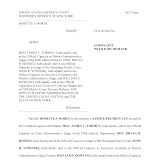
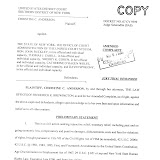
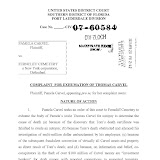
UNITED STATES DISTRICT COURT
SOUTHERN DISTRICT OF NEW YORK

SUPPLEMENTAL OPINION AND ORDER
08 Civ. 3305 (SAS) (dated April 6, 2010)

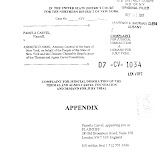
PAMELA CARVEL, Plaintiff,

-against-

NEW YORK STATE; OFFICE OF COURT
ADMINISTRATION OF THE UNIFIED
COURT SYSTEM OF NEW YORK;
THOMAS J. CAHILL, individually and in
his official capacity; SHERRY M. COHEN,
individually and in her official capacity;
GARY L. CASELLA, individually and in his
official capacity; EVE MARKEWICH,
individually and as a partner of BLANK
ROME LLP; FRANK STRENG,
individually and as a partner of
McCARTHY FINGAR LLP; DEBORAH
McCARTHY; JOEL AURNOU; WILLIAM
GRIFFIN, individually and as a co-owner of
HUDSON VALLEY BANK; LAURA
WERNER, individually and in her official
capacity; ANTHONY SCARPINO,
individually and in his official capacity;
CHARLES SCOTT, individually and in his
official capacity; and JOHN/JANE DOE,
DOE COMPANY 1-20,
Defendants.

SHIRA A. SCHEINDLIN, U.S.D.J.:

I. INTRODUCTION

Plaintiff Pamela Carvel, proceeding pro se, brought suit against the above named defendants pursuant to, inter alia, 42 U.S.C. § 1983 (“section 1983”),1 alleging various constitutional violations including the denial of due process and equal protection of the laws under the Fourteenth Amendment.2 Carvel also asserts a number of state law claims.3 The instant case, along with five other cases, were filed as related to Anderson v. State of New York, 07 Civ. 9599 (SAS).4 On August 8, 2008, this Court dismissed this and the five other actions in an omnibus Opinion and Order.5 Carvel appealed to the Second Circuit which, on March 12, 2010, issued a Summary Order, affirming in part, vacating in part, and remanding this case to this Court.6

The Second Circuit affirmed the dismissal of plaintiff’s Amended Complaint in all aspects but one, stating as follows:

we cannot affirm the District Court’s dismissal of plaintiff’s conspiracy allegations under §1983. Plaintiff alleges a “strong appearance of bribery” surrounding $400,000 in loans given to Justice Scarpino. App. 26 (Compi. 7~ 69-70). Although Justice Scarpino enjoys the benefit of absolute judicial immunity from that claim, the other defendants involved in the alleged “bribery” scheme do not. See Dennis v. Sparks, 449 U.S. 24, 28-29 (1980). Because the District Court did not explicitly address this claim before dismissing it sua sponte, we lack a basis on which to affirm its dismissal. We therefore vacate the dismissal with respect to the “bribery” claim and remand for the District Court to address Ihe claim in the first instance.7 This Court must therefore apply the holding of Dennis v. Sparks8 to plaintiff’s allegations and determine whether any part of her conspiracy claim should survive.

II. LEGAL STANDARDS

A. Motion to Dismiss

The first question is whether plaintiff’s allegations meet the plausibility standard recently adopted by the Supreme Court. In deciding a motion to dismiss pursuant to Rule 12(b)(6) of the Federal Rules of Civil Procedure, a court must “accept as true all of the factual allegations contained in the complaint”9 and “draw all reasonable inferences in [the] plaintiffs favor.”10 However, a court need not accord “[l]egal conclusions, deductions or opinions couched as factual allegations . . . a presumption of truthfulness.”11 To survive a Rule 12(b)(6) motion to dismiss, the allegations in the complaint must show that the plaintiff is plausibly entitled to relief.’12 A claim is facially plausible “when the plaintiff pleads factual content that allows the court to draw the reasonable inference that the defendant is liable for the misconduct alleged.”13 Plausibility “is not akin to a probability requirement,” rather plausibility requires “more than a sheer possibility that a defendant has acted unlawfully.”14

B. Conspiracy Under Section 1983

In order to survive a motion to dismiss a section 1983 conspiracy claim, a plaintiff must allege: “(I) an agreement between [two or more state actors or] a state actor and a private party; (2) to act in concert to inflict an unconstitutional injury; and (3) an overt act done in furtherance of that goal causing damages.”5 “Thus, a plaintiff must show that defendants acted in a willful manner, culminating in an agreement, understanding or meeting of the minds, that violated [his] rights, privileges or immunities secured by the Constitution or federal courts.”6 “In addition, ‘complaints containing only conclusory, vague, or general allegations that the defendants have engaged in a conspiracy to deprive the plaintiff of his constitutional rights are properly dismissed.”7 While conclusory allegations may be insufficient, “conspiracies are by their very nature secretive operations,’ and may have to be proven by circumstantial, rather than direct, evidence.”8 Finally, “[a] violated constitutional right is a natural prerequisite to a claim of conspiracy to violate such right.”9 “Without deprivation of a federal constitutional right, ‘there can be no civil rights conspiracy to deprive that right.”20 Thus, to survive a motion to dismiss, a plaintiff must allege a constitutional deprivation.

III. DISCUSSION

A. In General

Because plaintiff’s Amended Complaint is prolix and often vague and repetitive, it is difficult to decipher the parameters of the alleged conduct that resulted in particular constitutional violations. However, the thrust of plaintiffs numerous allegations can be summarized as follows: After the suspicious death of plaintiffs uncle, ice cream magnate Thomas Carvel, his multimillion dollar estate was plundered by private attorneys, assisted by various employees of the state court system, to the financial and emotional detriment of his wife, Agnes Carvel, now deceased,2’ and plaintiff, his surviving niece.22 In sum, plaintiff alleges that individual defendants William Griffin, Eve Markewich, Frank Streng, Deborah McCarthy, and Joel Aurnou (collectively, the “Individual Defendants”), all of whom are attorneys in private practice, colluded with Justice Anthony Scarpino of the Westchester County Surrogate’s Court, and other state employee defendants, to “engage in tax fraud, charity fraud, covert agreements, conversion, and fraudulent transfers of Pamela Carvel ‘s assets and other Carvel assets to themselves and their agents, so as to defraud Pamela Carvel as client, fiduciary, creditor, beneficiary, and charitable benefactor.”23

B. The Alleged Bribery

Carvel further alleges that Griffin, Markewich, Streng, McCarthy, and Aurnou “entered into covert verbal and written agreements in the Southern District, orchestrated, endorsed, or condoned by Defendants Scarpino, Scott, and Werner, to withhold ALL funds from Pamela Carvel (and the Carvel family) as fiduciary, creditor, asset owner, and benefactor.”24 Plaintiff also alleges a “strong appearance of bribery” surrounding $400,000 in “loans” given to Justice Scarpino from Hudson Valley Bank, a bank in which Griffin is the controlling shareholder. As stated by plaintiff: Streng entered the picture only when the matters in Thomas Carvel’s estate were going to trial before Surrogate Scarpino. Defendant Scarpino failed to disclose conflicts with Streng and a strong appearance of bribey through about $400,000 in “loans” from Hudson Valley Bank, controlled by Griffin, who was appearing before Scarpino as witness and adverse litigant against Pamela.

Public records appear to show that Scarpino was given a $100,000 “loan” by Hudson Valley Bank prior to taking office. Neither Scarpino, nor Markewich, nor Streng, nor McCarthy, nor Aurnou, nor Griffin, ever revealed to Plaintiff Pamela Carvel that Griffin’s Hudson Valley Bank gave Scarpino that loan or additional loans. Griffin’s Hudson Valley Bank gave Scarpino another $200,000 “loan” in October 2001 to coincide with commencement of the first trials in Thomas Carvel’s estate. None of the Defendants revealed [that] yet another $100,000 “loan” in December2004 was given to Scarpino by Griffin’s Hudson Valley Bank just prior to the commencement of trials in Agnes Carvel’s estate.25

Plaintiff claims that as a result of this alleged bribery, Scarpino denied plaintiffs request for a trial by jury.26 Furthermore, two days before plaintiffs opposition to a motion for accounting and legal fees was due in the Thomas Carvel case, Streng moved to withdraw his law firm, McCarthy Fingar, from representing plaintiff, leaving her without legal representation.27 Despite Scarpino’s previous recusal in the McKeown case because of his close relationship with Streng, Scarpino did not decline to decide Streng’s motion to withdraw in Carvel’s case.28 Plaintiff further alleges that Scarpino and Streng corruptly agreed to apply Streng’s withdrawal of representation in the Thomas Carvel case to other matters, thereby depriving Pamela Carvel of due process.29

C. Plaintiff’s Alleged Injuries

It appears that plaintiff could properly allege a plausible section 1983 conspiracy claim, at least as to Griffin. According to plaintiff, Paul Amicucci is a member of Griffin’s law firm. After Agnes Carvel’s death, Griffin, allegedly acting on behalf of the Thomas and Agnes Carvel Foundation, sold Agnes Carvel’s 19-acre residence in Ardsley, New York, to Amicucci’s brother for two million dollars in 2006, although it was worth ten million dollars.3° On the same day, Amicucci’s shell company assigned the whole property back to Griffin through Hudson Valley Bank as a lease assignment for security for a mortgage from Hudson Valley Bank.31

Upon plaintiff’s discovery of these transactions in 2007, this “real estate scheme” was brought before Justice Scarpino who allegedly “did nothing.”32 With further elaboration, Scarpino’s handling of this “real estate scheme” may be a sufficient overt act done with the intention of causing plaintiff to be deprived of property without due process.33 These allegations could, with further elaboration, sufficiently allege the agreement and acting in concert elements of a section 1983 conspiracy claim, at least between Griffin and Scarpino, when coupled with the above-mentioned bribery allegations concerning $400,000 in “loans” made to Scarpino by the Hudson Valley Bank. Moreover, Griffin could be deemed to be a state actor under Dennis v. Sparks given his alleged collusion with a state-court judge who, but for absolute judicial immunity, would also be a defendant in this action.34 The question, then, is whether plaintiff can allege sufficient facts so as to include Griffin and the remaining Individual Defendants in a conspiracy to violate her constitutional rights.

In sum, the remaining individual Defendants could also be deemed to be state actors if there is a sufficient factual basis to conclude that they conspired with Justice Scarpino, or any other state actor, to deprive plaintiff of a constitutional right. However, the Complaint fails to adequately plead how plaintiff was deprived of her property without due process and what the Individual Defendants allegedly did, with whom, when, and what corresponding constitutional injury it caused.

IV. CONCLUSION

For the reasons given above, plaintiff’s section 1983 conspiracy claim is dismissed without prejudice. Plaintiff may amend her Complaint against the Individual Defendants within the next thirty (30) days.35 An amended Complaint must contain specific factual allegations, consistent with this Supplemental Opinion and Order, detailing the various conspiracies in which each of the Individual Defendants allegedly engaged and that resulted in a constitutional violation.36 The Clerk of the Court is hereby directed to reinstate this case to my active docket as to defendants Griffin, Markewich, Streng, McCarthy, and Aurnou.

Leave to amend should be freely granted when “justice so requires.” Fed. R. Civ. P. 15(a). See also Foman v. Davis, 371 U.S. 178, 182 (1962). This rule is especially applicable to pro se litigants. See Gomez v. USAA Fed. Scm’. Bank, 171 F.3d 794, 795 (2d Cir. 1999) @er curiam) (stating that a pro se complaint should not be dismissed without granting leave to amend when a liberal reading of such complaint “gives any indication that a valid claim might be stated”) (quotation marks and citation omitted, emphasis added). Although Gomez pre-dates the plausibility standard announced in Twoinbly and elaborated upon in Iqbal, the standard for granting leave to amend, albeit somewhat less relaxed now, must still permit pro se litigants at least one chance to “nudge[] their claims across the line from conceivable to plausible[.]” Twombly, 550 U.S. at 570.

I decline defendant Markewich’s suggestion to stay this case pending a decision on a motion to dismiss filed in a subsequently commenced district court action, Carvel v. Ross, 09 Civ. 722 (LAK). See 3/17/10 Letter from Philip Touitou, counsel to Markewich, at I.

Dated: New York, New York
April 6, 2010

SHIRA A. SCHEINDLIN,
U.S.D.J.

Appearances -Plaintiff (Pro Se):

Pamela Carvel
110 West Ninth Street, Suite 177
Wilmington, DE 19801-1618

For Defendant Markewich:

Philip Touitou, Esq.
Hinshaw & Culbertson LLP
780 Third Avenue, 4t1~ Floor
New York, NY 10017 (212) 471-6211

For Defendants Frank Streng and Joel Aurnou:

Joseph J. Brophy, Esq.
McCarthy Fingar LLP
11 Martine Avenue, I 2th Floor
White Plains, NY 10606 (914) 946-3700

FOOTNOTES:

1. Section 1983 states as follows: Every person who, under color of any statute, ordinance, regulation, custom, or usage, of any State or Territory or the District of Columbia, subjects, or causes to be subjected, any citizen of the United States or other person within the jurisdiction thereof to the deprivation of any rights, privileges, or immunities secured by the Constitution and laws, shall be liable to the party injured in an action at law, suit in equity, or other proper proceeding for redress 42 U.S.C. § 1983.

2. The Fourteenth Amendment to the United States Constitution provides, in relevant part, as follows: No State shall make or enforce any law which shall abridge the privileges or immunities of citizens of the United States; nor shall any State deprive any person of life, liberty, or property, without due process of law; nor deny to any person within its jurisdiction the equal protection of the laws. U.S. CONST., amend. XIV, § 1.

3. See Amended Complaint (“Compl.”) ¶¶ 172-203.

4. See Esposito v. State of New York, 07 Civ. 11612 (SAS); Bernstein v.Appellate Div. First Dep ‘t Departmental Disciplinary Comm., 07 Civ. 11196(SAS); McKeown v. State of New York, 08 Civ. 2391 (SAS); McCormick v. State of New York, 08 Civ. 4438 (SAS); and Capogrosso v. New York State Comm’n on Judicial Conduct, 08 Civ. 5455 (SAS).

5. See Esposito, et at v. State of New York, Nos. 07 Civ. 11612, 08 Civ. 2391, 08 Civ. 3305, 08 Civ. 4438, 08 Civ. 5455, 08 Civ. 6368, 2008 WL 3523910 (S.D.N.Y. Aug. 8, 2008). This Opinion also dismissed Peterec-Tolino v. State of New York, 08 Civ. 6368 (SAS). Bernstein was decided in a separate Opinion and Order, also dated August 8, 2008. See Bernstein v. State of New York, 591 F. Supp. 2d 448, 470 (S.D.N.Y. 2008) (granting defendants’ motion to dismiss, dismissing remaining defendants sua sponte, and denying leave to amend). Carvel, McCormick, Capogrosso, and Petrec-Tolino were dismissed sua sponte while Esposito and McKeown were dismissed pursuant to motions to dismiss, On appeal, the Second Circuit dismissed the appeal in Bernstein and affirmed this Court in Esposito, Capogrosso, and Peterec-Tolino by Summary Order. No appeal was taken in McCormick while the appeal in McKeown is pending.

6. See Carvel v. New York, No. 08-4576-CV, 2010 WL 889326, at *2 (2d Cir. Mar. 12, 2010).

7. Id. at *1.

8. In Dennis, the Supreme Court addressed the question of whether private parties accused of conspiring with a judge could be deemed to be acting “under color of’ state law for purposes of section 1983. See 449 U.S. at 27-28. In answering this question, the Supreme Court stated that:

to act “under color of’ state law for § 1983 purposes does not require that the defendant be an officer of the State. It is enough that he is a willful participant in joint action with the State or its agents. Private persons, jointly engaged with state officials in the challenged action, are acting “under color” of law for purposes of § 1983 actions. Of course, merely resorting to the courts and being on the winning side of a lawsuit does not make a party a co-conspirator or ajoint actor with the judge. But here the allegations were that an official act of the defendantjudge was the product of a corrupt conspiracy involving bribery of the judge. Under these allegations, the private parties conspiring with the judge were acting under color of state law; and it is of no consequence in this respect that the judge himself is immune from damages liability. Immunity does not change the character of the judge’s action or that of his co-conspirators. . . . Private parties who corruptly conspire with a judge in connection with such conduct are thus acting under color of state law within the meaning of § 1983 as it has been construed in our prior cases.

Id. at 27-29 (footnotes and citations omitted, emphasis added).

9. Bell At/i Corp. v. Twombly, 550 U.S. 544, 572 (2007). Accord Rescuecoin Corp. v. Google Inc., 562 F.3d 123, 127 (2d Cir. 2009).

10. Ofori-Tenkorang v. American Int’l Group, Inc., 460 F.3d 296, 298 (2d Cir. 2006).

11. In re NYSE Specialists Sec. Litig., 503 F.3d 89, 95 (2d Cir. 2007) (quotation marks omitted).

12. See Twombly, 550 U.S. at 570 (“[WJe do not require heightened fact pleading of specifics, but only enough facts to state a claim to relief that is plausible on its face.”).

13. Ashcroft v. Iqbal, 129 S. Ct. 1937, 1949 (2009) (quotation marks omitted).

14. Id. (quotation marks omitted).

15. Ciambriello v. County of Nassau, 292 F.3d 307, 324-25 (2d Cir. 2002) (citing Pangburn v. Culbertson, 200 F.3d 65, 72 (2d Cir. 1999)).

16. Bussey v. Phillips, 419 F. Supp. 2d 569, 586-87 (S.D.N.Y. 2006) (quotation marks and citations omitted, alteration in original).

17. Ciambriello, 292 F.3d at 325 (quoting Dwares v. City of N.Y., 985 F.2d 94, 100 (2d Cir. 1993) (quotation marks, citations, and alteration omitted)).

18. Pangburn, 200 F.3d at 65 (quoting Rounseville v. Zahl, 13 F.3d 625, 632 (2d Cir. 1994)).

19. Romer v. Morgenthau, 119 F. Supp. 2d 346, 363 (S.D.N.Y. 2000) (“Thus, if a plaintiff cannot sufficiently allege a violation of his rights, it follows that he cannot sustain a claim of conspiracy to violate those rights.”).

20. Bussey, 419 F. Supp. 2d at 587 (quoting Young v. County of Fulton,160 F.3d 899, 904 (2d Cir. 1998)). Accord Singer v. Fulton County Sheriff 63F.3d 110, 119 (2d Cir. 1995) (noting that a section 1983 conspiracy claim “will stand only insofar as the plaintiff can prove the sine qua non of a § 1983 action: the violation of a federal right”) (citing Adickes v. 5.11. Kress & Co., 398 U.S. 144,
150 (1970)).

21. Plaintiff claims that Agnes’s death on August 4, 1998, was caused by a stroke “procured deliberately by stress from [defendant Williamj Griffin instigated through [the] Surrogate’s Court.” Compl. ¶ 62.

22. See id. ¶ 6 (“Defendants as individual lawyers, in various positions, created or furthered systemic corruption in New York State for the purpose of furthering deceptions to steal control of the Carvel family’s. . . assets — to the total exclusion of the legitimate asset owners and their successors in interest.”); ¶ 7 (“The fundamental mechanism that makes such corruption possible is the deprivation to Pamela Carvel (and others) of all legitimate avenues of redress of grievances or judicial abuses because of intentional and negligent collusion by State employees charged with protection of Pamela Carvel (and all other citizens).”).

23. Id. . ¶ 11
24. Id. . ¶ 29
25. Id. . ¶ 69-70.
26. Id. . ¶ 71.
27. Id. . ¶ 75

28. See id. ¶ 77. According to plaintiff Scarpino, in a written decision, “specifically denied responsibility over ethical and professional complaints against Streng and his firm.” fd. ¶ 24. Plaintiff fails to explain the significance of how and when Scarpino “denied responsibility” for Streng’s conduct and how this alleged denial violated any of her constitutional rights.

29. Id. . ¶ 77.
30. Id. . ¶ 84.

31. Id. . See id. Plaintiff does not identify to whom the mortgage from Hudson Valley Bank was made.

32. Id. ¶ 85. Once again, plaintiff fails to identify how this “real estate scheme” was presented to Justice Scarpino.

33. For example, plaintiff fails to explain the basis of her property interest in her aunt’s residence. Presumably, Pamela Carvel was the beneficiary, or a beneficiary, of Agnes Carvel’s estate but this is not specifically alleged in connection with the Ardsley residence.

34. I need not decide whether plaintiff has asserted plausible claims against Justice Scarpino as the Second Circuit held that he is shielded from suit under the doctrine of absolute judicial immunity. See Carvel, 2010 WL 889326, at *1.

Blog Archive

See Video of Senator John L. Sampson's 1st Hearing on Court 'Ethics' Corruption
The first hearing, held in Albany on June 8, 2009 hearing is on two videos:


               Video of 1st Hearing on Court 'Ethics' Corruption
               The June 8, 2009 hearing is on two videos:
         
               CLICK HERE TO SEE Part 1
               CLICK HERE TO SEE Part 2
Add to Technorati Favorites