MLK said: "Injustice Anywhere is a Threat to Justice Everywhere"

End Corruption in the Courts!

Court employee, judge or citizen - Report Corruption in any Court Today !! As of June 15, 2016, we've received over 142,500 tips...KEEP THEM COMING !! Email: CorruptCourts@gmail.com

Sunday, January 8, 2012

Doing What They Do Best, Court System Operates From the Shadows

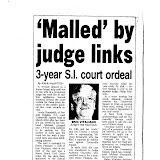
4-Year-Old Queens Custody Case Shifted to Brooklyn
The unexplained transfer of a long-running and highly volatile custody case from a judge in one borough to a judge in another—without a motion, hearing or formal request to move the case—has added another ember to an already fiery matrimonial dispute.
McAvoy v. Hannigan had been dragging on for more than four years before Supreme Court Justice Sidney F. Strauss in Queens when, just before Thanksgiving, the Office of Court Administration without explanation took the case away from him and sent it to Supreme Court Justice Jeffrey S. Sunshine in Brooklyn. The shift was mandated in an order issued in late November by Justice Fern A. Fisher, deputy chief administrative judge for the New York City courts. Apparently neither party asked for the case to be transferred, and the shift has given the estranged couple, who have been at loggerheads for a decade, one more thing to fight over. The mother, Annemarie McAvoy, an adjunct professor at Fordham University School of Law, former federal prosecutor, one-time candidate for city comptroller and legal commentator for Fox News, said she wants the case to remain with Justice Sunshine. The father, New Jersey real estate investor John Hannigan, wants it back before Justice Strauss in Queens and filed a writ of prohibition in the Appellate Division, Second Department, to get it there. "There was no motion, no hearing, no papers served and that is the part that is extraordinary," said Glenn S. Koopersmith, a matrimonial attorney in Garden City who represents Mr. Hannigan on an Article 78 writ of prohibition. Mr. Koopersmith is among at least eight matrimonial attorneys, many of them members of the prestigious American Academy of Matrimonial Lawyers, who have been involved in this case. "I'm doing this for 35 years and I have never seen anything like this," Mr. Koopersmith said. "Normally, you would have a motion and a chance to oppose. This was done summarily."
David Bookstaver, a spokesman for the OCA, said on Jan. 6 that the case was "assigned to Judge Sunshine because there were extremely serious concerns about the welfare of the child involved in this case." Mr. Bookstaver said that court administrators thought it best to have another judge take a look. His comments marked the first time the OCA had provided an explanation for the shift. "The feeling was that a fresh set of eyes that did not have four years of dealing with the case would be the best way to deal with this matter," Mr. Bookstaver said. "Once Judge Sunshine makes a determination regarding the child's welfare, the case will be sent back to Queens. The intent here was always keeping the child's welfare as the focus." It is unclear whether the case will go back to Justice Strauss. At the center of the tug of war is the couple's 10-year-old son, Chad. Ms. McAvoy and Mr. Hannigan divorced in 2005. Initially, the parents agreed to an arrangement whereby the mother had residential custody and the father shared legal custody, meaning they had joint decision-making authority. But their very different views of Chad's needs quickly led to a conflict. Ms. McAvoy believes the boy is autistic, or borderline autistic, and suffers from neuro-behavioral issues. In an interview, she said that she had Chad in therapy 40 hours a week when he was 18 months old. "He had issues," she said. "He still has neurological issues." Mr. Hannigan's attorney paints a different picture. "The mother basically saw the child through very dark glasses and was insistent to label this child autistic or being on the autistic spectrum," said Audrey M. Sager of Sager & Gellerman in Forest Hills, counsel for Mr. Hannigan in the divorce proceedings. "The father, however, did not see the child that way at all and the professionals that he dealt with did not corroborate the mother's viewpoint. The mother had not agreed with a single neutral professional opinion." Ms. Sager said the disagreement reached a tipping point when Chad entered kindergarten and the mother insisted on a restrictive placement that the father opposed. In early 2007, without a hearing, Justice Strauss shifted residential custody from Ms. McAvoy to Mr. Hannigan. A few months later, the Second Department affirmed Justice Strauss and held that the evidence before him was sufficient to "reach a sound conclusion that, under the circumstances of this case, it was in the child's best interest to award temporary residential custody to the father until such time as a hearing could be conducted on the issue of permanent custody." The Second Department in its terse decision (41 AD3d 791, 2007) did not say what that evidence was, although there was some suggestion, according to both sides of the dispute, that Chad was underweight while living with Ms. McAvoy and that his teeth were unhealthy. The panel sent the matter back to Justice Strauss for a trial on permanent custody. That trial has consumed about 30 trial days over the four-year duration of the litigation.
Multiple Counsel
Ms. Sager blames the slow progress on the fact that Ms. McAvoy has gone through six lawyers—Steven D. Kommor, Alexander Potruch, Stephen Gassman, Raoul Felder, Robert Hiltzik and Edward Hayes—before going pro se. Ms. Sager also said that, along the way, there were unfounded allegations of sexual abuse against the father and an unsuccessful motion by Ms. McAvoy under the Uniform Child Custody Jurisdiction and Enforcement Act to transfer the case to New Jersey. "Every time, we had another set of lawyers and they needed time to prepare," Ms. Sager said. Ms. McAvoy said in an interview that she is not to blame for the delay and wants the case to end. She said she accumulated more than $1 million in legal bills before running out of money and going pro se. "This is not an issue of switching lawyers," Ms. McAvoy said. "When I switched lawyers there was maybe a couple weeks' delay, if that. I made sure that there was no delay because my interest was in getting Chad back." Now, an imminent risk hearing is taking place before Justice Sunshine and is slated to continue on Jan. 9 and 10 in Brooklyn. Ms. McAvoy contends she brought her concerns about Chad before Justice Strauss more than a year ago. "I raised on the record with the judge that [Chad] was talking about killing himself, and the judge did nothing," Ms. McAvoy said. "In September, my son was hospitalized for hurting himself and having suicidal thoughts, as well as homicidal thoughts toward his father. The thought of killing himself always revolves around he would rather be dead than continue living with his father. He feels that if he has to do that, he doesn't want to live."  Ms. Sager said neutral professionals dispute those claims and insists Chad is doing fine with his father—performing well in school, making friends, getting involved in extra-curricular activities.
Once Justice Sunshine concludes the imminent risk hearing in Brooklyn, the matter will go back to Queens, according to Mr. Bookstaver. Ms. Sager said the Nov. 23 order transferring the matter out of Queens caught her completely by surprise. "There was no motion, no application, nothing, and all of a sudden a case was being moved to a county with improper venue, from a sitting judge where there has been no mistrial and no recusal after 32 days of trial," Ms. Sager said. "I want a written decision and I want to know how it happened. My client wants this case adjudicated fairly and adjudicated quickly." Ms. McAvoy said she had made clear her displeasure with Justice Strauss, but said she did not seek transfer of the case. "I have been pretty vocal about my dissatisfaction with how this thing is moving, so it [the transfer] may have come through that," Ms. McAvoy said. "The judge on the record said we would be submitting post-trial briefs in 2014, so there was no end in sight. Temporary custody shouldn't be four and a half years. But I have not had any contact with any of the administrative judges." Ms. McAvoy also noted that Justice Strauss posted a question on the International Institute of Judaic Law website asking whether Jewish law supports or refutes the New York legal concept that custody determinations should be based on the best interests of the child. On the website (judaiclaw.org/Questions_Answers_010.html), a rabbi responded that under Talmudic law children under 6 should be placed with the mother and boys over 6 are to be placed with the father and that the welfare of the child is not the primary consideration. Chad was 6 when custody was shifted to the father, Ms. McAvoy said. Justice Strauss was unavailable for comment.  John Caher can be contacted at jcaher@alm.com.

New York Lawyer Digs Through Horse Manure in Money Grab

Foundation Sues Attorney Acting as Executor for Donor
The New York Law Journal by Joel Stashenko  -  January 9, 2012

A New York attorney who serves as an executor of the Paul Mellon Estate has been accused of defaming a nonprofit organization the estate endows to care for more than 1,000 retired thoroughbreds.  What began as a "well-intentioned" effort by executor Frederick A. Terry Jr., who is of counsel to Sullivan & Cromwell, to become more involved in the operations of the Thoroughbred Retirement Foundation "descended into an unjustified attempt to wrest control of the TRF from its current board and officers that threatens to undermine the vitally important mission of the TRF," a suit filed on Jan. 5 by the foundation against Mr. Terry in Manhattan Supreme Court alleges.  Paul Mellon, an heir to the Mellon Bank fortune, was a noted philanthropist and horseman. The year before his 1999 death, Forbes Magazine estimated his wealth at $1.4 billion.  His estate has contributed $7 million to the foundation's endowment, with the stipulation that the group can use up to 5 percent of the funds annually for care of retired race horses.  The complaint in Thoroughbred Retirement Foundation v. Terry, 150012/2012, contends that Mr. Terry falsely claimed in a Nov. 11, 2011, letter to the foundation's accounting firm that the foundation's financial report for 2010 was "incomplete and misleading."  He objected specifically to a 2007 loan of $500,000 from the foundation from endowment funds. Mr. Terry also questioned the propriety of the foundation using Mellon funds to secure another $500,000 loan from a South Carolina bank, in part to pay off the 2007 loan.  The foundation's complaint maintains that Mr. Terry also shared his concerns with the New York Attorney General's Office, which prompted an inquiry.  In addition, the complaint argues that Mr. Terry and a co-executor of the Mellon Estate, Beverly Carter, who is not named as a defendant, hired veterinarian Stacey Huntington, who the foundation says misrepresented the condition of horses being cared for with Thoroughbred Retirement Foundation aid.  Ms. Huntington reported that a large percentage of the horses she examined were malnourished or in ill health. She was eventually fired by the foundation's board, as the foundation and Mr. Terry and Ms. Carter bickered over what the foundation maintains was meddling by the two co-executors in its operations.  According to the complaint, the veterinarian's report resulted in a series of negative articles about the Thoroughbred Retirement Foundation, including one in The New York Times on March 17, 2011, "Ex-Racehorses Starve as Charity Fails in Mission to Care for Them."  In addition, the complaint alleges that Mr. Terry made uncomplimentary verbal statements about the foundation's financial status and its operations to people within the horse racing industry. The group's fundraising has fallen off as a result, the complaint alleges.  "Defendant's oral statements were false and defamatory, impeached the honesty, integrity and business conduct of the TRF and exposed the TRF to public hatred, contempt, and/or disgrace," the complaint says.  The foundation seeks at least $400,000, which it estimates it has lost due to Mr. Terry's actions, plus punitive damages and legal fees.  Under the endowment agreement, the foundation is allowed to use up to 5 percent of the "annual fair-market value" of the endowment each year for its operating expenses. The lawsuit states that the endowment provides some 12 percent of the TRF's annual budget.  According to the Times, the organization ran a deficit of $1.2 million in 2009.  Foundation chairman John C. Moore said in an interview that Mr. Terry and Ms. Carter have not talked directly with the foundation in a year, choosing instead to communicate with the accountants and the state attorney general.  "It's a heck of a shame that we have to sue these people," Mr. Moore said. "It is really simple for them to pick up the phone if they had a problem with us. Call us. Negotiate with us and if you can't do that, don't accuse us of doing something illegal. What they did was distinctly unhealthy to the horses because they damaged our ability to raise money."  Mr. Moore called the article about the veterinarian's report "distorted." "No horses died of starvation last year or because of neglect," he said. "That is nonsense."  Robert J. Giuffra Jr. of Sullivan & Cromwell said the executors have been "working diligently to improve the operations" of the TRF.  "The executors have no interest other than the protection of the horses in the care of TRF," he said. "This lawsuit is regrettable and baseless."  Mr. Terry, who was unavailable for comment, joined Sullivan & Cromwell in 1957, according to the firm's website. He also has served as a trustee of several foundations and is an executor of the estate of Frank Perdue, the former CEO of Perdue Chicken.  Michael Ledley of Wollmuth Maher & Deutsch is representing the Thoroughbred Retirement Foundation, which is based in Lexington, Ky. , and has an office in Saratoga Springs, N.Y.  Among the programs it funds in New York state is a farm for retired thoroughbreds maintained by inmates at the Wallkill Correctional Facility in Ulster County.  Joel Stashenko can be contacted at jstashenko@alm.com.

Saturday, January 7, 2012

Lawyer ‘axed’ for it

Lawyer ‘axed’ for it
The New York Post by Dareh Gregorian  -  January 7, 2012
He almost pulled it off.

A state appeals court has thrown out a lawyer’s baffling $500,000 discrimination award against the law firm that canned him for trying to charge their clients for his hotels, booze, porn, limo rides and escort- service calls.  The lawyer, James Hazen, claimed the firm, Hill, Betts and Nash, fired him because he has bipolar disorder, and they didn’t accommodate his disability by just allowing the $21,000 in improper charges to his corporate credit card.  Hazen convinced an administrative law judge at the state Division of Human Rights that he was a victim of discrimination, and was awarded $50,000 for his “mental anguish,” court records say.  That award was sent to the DHR commissioner for approval — and the commissioner found that wasn’t enough for his pain at being fired for the misconduct. The commissioner OK’d Hazen’s claim for lost wages and upped the award to a whopping $548,161.  That wasn’t enough for the booze-loving porn and escorts fan. He filed a petition with Manhattan Supreme Court seeking to have a judge enforce the DHR order and to throw in another $126,000 in lost wages plus $200,000 for his mental anguish.  The case was transferred to the state Appellate Division, which stopped the insanity.  In a unanimous ruling, the five- judge panel found that Hazen was fired not because of his disability, but for trying to charge his firm’s clients for his many vices.  Justice James Catterson, who wrote the decision, called the DHR ruling “incomprehensible,” especially since Hazen had never claimed to anyone at the firm that he was bipolar until after he was fired, so he couldn’t have been discriminated against.  “There is no evidence at all, much less substantial evidence, that HBN knew, before they terminated [Hazen], that the petitioner was disabled by a bipolar disorder,” the judge wrote.  Hazen now has his own firm in Red Bank, NJ. His lawyer, William Roth, declined comment on the case.  dgregorian@nypost.com

******** The Decision:

Hazen v Hill Betts & Nash, LLP
2012 NY Slip Op 00047  -  Decided on January 5, 2012  -  Appellate Division, First Department  -  Catterson, J.  -  Published by New York State Law Reporting Bureau pursuant to Judiciary Law § 431.
This opinion is uncorrected and subject to revision before publication in the Official Reports.
Decided on January 5, 2012  -  SUPREME COURT, APPELLATE DIVISION
First Judicial Department  -  Angela M. Mazzarelli, J.P., James M. Catterson, Leland G. DeGrasse, Sheila Abdus-Salaam,Nelson S. Román, JJ.  -  104781/10  -   [*1]James M. Hazen, Petitioner/Respondent, v Hill Betts & Nash, LLP, Respondent/Petitioner, New York State Division of Human Rights, Respondent.

Petitioner James Hazen challenges a determination of respondent State Division of Human Rights, dated October 27, 2010, which, in this employment discrimination proceeding (transferred to this Court, pursuant to Executive Law § 298 and 22 NYCRR 202.57(c)(2), by order of the Supreme Court, New York County [Lucy Billings, J.], entered March 11, 2011), after a hearing, found that respondent Hill Betts & Nash, LLP unlawfully discriminated against him, and awarded him damages.  William H. Roth, New York, for petitioner/respondent. Jackson Lewis LLP, New York (Diane Windholz of counsel), for respondent/petitioner.  CATTERSON, J. [*2]

In this employment discrimination action arising from the termination of the petitioner attorney by the respondent law firm, we reiterate that a petitioner's disability does not shield him from the consequences of workplace misconduct.  Respondent Hill Betts & Nash (hereinafter referred to as "HBN") terminated the petitioner, James Hazen, on March 15, 2006, upon discovering that the petitioner charged hotel rooms, limousines, alcohol, adult movies and calls to escort services to his corporate American Express card and then attempted to have these charges billed to clients. On August 30, 2006, HBN reported the petitioner's misconduct to the Departmental Disciplinary Committee for the First Judicial Department (hereinafter referred to as the "DDC"). The petitioner filed a verified complaint with the New York State Division of Human Rights (hereinafter referred to as the "DHR") on November 7, 2006 charging HBN with unlawful discrimination and retaliation. The petitioner claims that his misconduct was caused by his bipolar disorder, that HBN failed to accommodate his mental illness, that his termination was discriminatory, and that HBN retaliated against him by reporting him to the DDC. Evidence and testimony before the Administrative Law Judge (hereinafter referred to as "ALJ") at a public hearing held during four days in December 2007 and January 2008 established the following: The petitioner was one of several partners at HBN who were issued a corporate American Express card for business expenses. HBN permitted Hazen to use the credit card for personal expenses, but required that he identify these charges and reimburse HBN. HBN's policy is to send each cardholder a sub-statement to mark up with notations indicating whether the charges are personal, chargeable to the firm or a client, or related to travel, entertainment or automobile expenses. It was not HBN's practice to return the statement to the cardholder for further review. The petitioner testified that until the period at issue in this case, he had adhered to this procedure and returned marked-up sub-statements with any receipts and payment for his personal charges.  However, in December 2005, when the petitioner was provided with a sub-statement for the last quarter of 2005, he ignored requests from HBN's accounting department and did not submit his annotated sub-statement. The petitioner stopped coming to the office in mid-December, and advised HBN that he was told to "decompress." On January 11, 2006, a partner at HBN contacted the petitioner and asked him to submit his credit card sub-statement on the following day so that the accounting department could close out the 2005 books. The petitioner sent a fax in reply stating that he could not "waste two hours coming in [to] do the bills," but that he would mark up the sub-statement and fax it to accounting. When he did not send in the sub-statement on January 12, the accounting department e-mailed the sub-statement to the petitioner again and copied two partners at HBN. That evening, one of the partners reviewed the bills, and, seeing charges for more than 50 hotel stays between September 26 and December 27, 2005, initiated an internal investigation of the petitioner's credit card use.
The day after the petitioner received the e-mail from HBN's accounting department, he asked Phillip Russotti, his friend, also an attorney, to intervene on his behalf. Russotti testified that the petitioner advised him that he was having a problem at work with his credit card reports and that the firm was demanding that he complete them. Later that day, Russotti called a partner [*3]at HBN and advised him that he had met with the petitioner and found him in a "terrible state" and that the petitioner planned to begin seeing a psychiatrist. HBN presented evidence that until this point, it was unaware that the petitioner was having any mental health issues. Russotti also requested more time for the petitioner to prepare his expense reports.  The evidence reflects that the petitioner saw a doctor on January 16. On January 17 and 25, Russotti advised HBN that the petitioner was suffering from a mental ailment, but did not specify the ailment. On January 23, the petitioner faxed the accounting department his annotated credit card sub-statement. The same day, HBN requested medical documentation supporting the petitioner's claim of mental illness and inability to return to work. However, on January 26, petitioner refused to discuss his purported illness with HBN citing "privacy" reasons.  On January 27, Russotti mailed a copy of a one-page letter from the petitioner's doctor stating that the petitioner had experienced an unspecified "severe mood disorder." None of the correspondence contained any medical documentation of bipolar disorder or a description of the petitioner's workplace limitations as a result of his "disorder." The letter indicated only that the petitioner was responding well to treatment and was expected to be able to return to work within a few weeks. On January 31, Russotti sent a letter to HBN on the petitioner's behalf advising HBN that the credit card sub-statement that the petitioner submitted on January 23 falsely listed personal expenses in December 2005 and January 2006 as chargeable to clients. Russotti explained that these false expenses were attributable to "[the petitioner's] emotional illness." On February 3, HBN's counsel informed Russotti that HBN was terminating the petitioner effective March 6, 2006.  During the hearing, the petitioner testified that although he engaged in the conduct for which he was terminated, it was caused by his bipolar disorder. The petitioner admitted that he repeatedly charged hotel rooms, limousines, and liquor to the HBN corporate card. Furthermore, during his hotel stays, petitioner charged pornographic movies and calls to escort services on the HBN card. Although HBN expected the petitioner to stay a few nights at a hotel in September to work on a case, the petitioner did not tell HBN about any of the other stays. The petitioner blamed his conduct on his bipolar disorder, and testified that he "only engaged in this inappropriate behavior and needed a companion when [he] was either in a manic or depressed state." However, he also admitted that in 2001, he had charged an escort to his corporate credit card and marked it as a client expense that was later discovered and corrected by HBN.
The petitioner testified that he also booked hotel rooms to avoid contact with people in the office on days when he was productive, but not manic. However, the petitioner explained that he booked the hotel rooms in advance on a travel web site. The petitioner conceded that despite using the hotels for inappropriate conduct, he believed that he could list the hotel fees as client expenses because he used the rooms for work.  A partner at HBN testified that the investigation of the petitioner's expenses was concluded in March 2006 and determined that petitioner had charged $21,117.77 in personal expenses to the credit card since October 25, 2005, and attempted to list many of those expenses as billable to clients. HBN sent a letter to the petitioner on March 20 that included the [*4]investigation findings and stated the amount that the petitioner owed to the firm. Although the petitioner testified that he could have reimbursed HBN at any time, he did not remit the balance owed. On April 24, the petitioner sent a letter to HBN indicating that he believed he was wrongfully terminated.  HBN submitted evidence that in June 2006, HBN retained a legal ethics expert to seek an opinion as to whether HBN was under a duty to report the petitioner's misconduct to the DDC. HBN's counsel advised HBN that it could not avoid reporting the petitioner's misconduct, and that the obligation to report was not affected by the petitioner's alleged disability. Following a meeting with the petitioner's counsel regarding the allegations of discrimination in July, HBN reported the petitioner's misconduct on August 30, 2006.  Nine months after the hearing concluded, on September 25, 2008, the DHR ALJ issued a Recommended Findings of Fact, Opinion and Decision and Order finding that HBN had discriminated and retaliated against the petitioner. The ALJ awarded the petitioner $50,000 for mental anguish, but declined to award any compensation for lost salary or benefits on the ground that the petitioner failed to show that he made reasonable efforts to mitigate damages. Both parties objected to the ALJ Order and submitted supplemental briefs to the DHR Commissioner. The Commissioner issued a Final Order on October 27, 2010, amending the Recommended Order to award the petitioner compensation for lost wages through December 31, 2009, in the amount of $548,161, plus interest.

In his petition to Supreme Court, the petitioner sought to affirm the Final Order to the extent that it found HBN liable and calculated lost wages through December 31, 2009. However, the petitioner objected to the Final Order to the extent of claiming that he is entitled to additional compensation. The petitioner asserts that he should have also been awarded lost wages from December 31, 2009 through October 27, 2010, in the amount of $126,840, and an additional $200,000 for mental anguish. The petitioner also claims that he should have been awarded lost wages until his anticipated retirement date in the amount of $973,356.  The Commissioner filed a cross petition to enforce the Final Order as issued, and HBN filed a cross petition to annul, reverse and vacate the Final Order and dismiss the petitioner's complaint. By order entered March 11, 2011, Supreme Court transferred the proceeding pursuant to Executive Law § 298 and 9 NYCRR 202.57 to this Court for review.  For the reasons set forth below, we annul the Commissioner's Final Order, vacate the award, and dismiss the petitioner's complaint. Under the Human Rights Law, the scope of judicial review is "extremely narrow and is confined to the consideration of whether the Division's determination is supported by substantial evidence in the record." City of New York v. State Div. of Human Rights, 70 N.Y.2d 100, 106, 517 N.Y.S.2d 715, 717, 510 N.E.2d 799, 801 (1987); see also 300 Gramatan Ave. Assoc. v. State Div. of Human Rights, 45 N.Y.2d 176, 179-181, 408 N.Y.S.2d 54, 56-57, 379 N.E.2d 1183, 1185-1186 (1978). "Substantial evidence, which has been characterized as a minimal standard or as comprising a low threshold must consist of such relevant proof, within the whole record, as a reasonable mind may accept as adequate to support a conclusion or ultimate fact." Matter of Café La China Corp. v. New York State Liq. Auth., 43 AD3d 280, 280, 841 N.Y.S.2d 30, 31 (1st Dept. 2007) (internal quotation [*5]marks and citations omitted). Although judicial review of an agency determination appears to be limited, the Court of Appeals has made clear that a reviewing court exercises a genuine judicial function and that review is more than a "rubber stamp" of an agency's determination. See Matter of New York City Tr. Auth. v. State Div. of Human Rights, 78 N.Y.2d 207, 216, 573 N.Y.S.2d 49, 54, 577 N.E.2d 40, 45 (1991); Matter of Reape v. Adduci, 151 A.D.2d 290, 293, 542 N.Y.S.2d 562, 564 (1st Dept. 1989).  In this case, the ALJ found that the respondent's reason for terminating the petitioner was a pretext and that the real reason for terminating him was his disability. We disagree. The record reflects that there is no evidence at all, much less substantial evidence, that HBN knew, before they terminated the petitioner, that the petitioner was disabled by a bipolar disorder or how that disorder limited his performance in the workplace. See e.g. Pimentel v. Citibank, N.A., 29 AD3d 141, 811 N.Y.S.2d 381 (1st Dept. 2006), lv. denied, 7 NY3d 707, 821 N.Y.S.2d 813, 854 N.E.2d 1277 (2006) (employer was not required to accommodate employee's depression where employee failed to adequately explain extent and limits of her restrictions).

The record reflects that until the petitioner began receiving requests from HBN in December 2005 to account for his credit card expenses, there was no indication that the petitioner was suffering from a mental illness. By his own account, the petitioner was able to produce "quality professional legal work" during the time he was allegedly disabled, and argued his portion of a complex summary judgment motion on December 9, 2005. Russotti testified that when he saw the petitioner in December, shortly before their January meeting, the petitioner's behavior did not seem unusual. The petitioner's doctor's records also indicate that neither the internist who had been treating him for more than a year for diabetes, nor the therapist who had been treating him for post-9/11 stress, diagnosed the petitioner with bipolar disorder or even mentioned the possibility that he was bipolar.  Furthermore, once the petitioner began alluding to an "emotional illness," HBN specifically requested the details of the petitioner's condition in order to evaluate the medical benefits available to the petitioner, and the petitioner flatly refused to provide any information. The communications from Russotti, the petitioner, and the petitioner's doctor, contained only vague references to emotional illness or "mood disorder," and thus did not fall into the category of an "impairment [...] which [...] is demonstrable by medically accepted clinical [...] techniques." Executive Law § 292(21)(a).  Thus, all that was before HBN when it terminated the petitioner on February 3 was that he had charged more than $21,000 in hotels and other personal expenses to the corporate credit card and tried to bill HBN's clients for personal expenses. Then, when confronted and asked for an explanation, he did not reimburse HBN and instead blamed his conduct on a "mood" illness, which he still did not identify.  Despite this total lack of evidence as to the petitioner's termination due to his bipolar disorder, the ALJ incomprehensibly found that HBN's legitimate reason for terminating the plaintiff was a pretext. The ALJ relied on evidence that another HBN attorney had charged $25,000 to his corporate credit card and was not terminated. However, this demonstrates only that the ALJ misapprehended the nature of the professional misconduct. The other HBN attorney [*6]did not attempt to charge clients for his personal expenses and paid the money back over time; therefore, his conduct is clearly distinguishable from the petitioner's, which essentially amounted to attempted theft from HBN and its clients.  The ALJ also noted that e-mails between two HBN partners raised an inference of discrimination. This too is not supported by record evidence. The e-mails have no direct statements of animus based on disability. Rather, they are the rational concerns of a law firm in the midst of litigating what the ALJ called "the largest case [HBN] had ever had in 10 to 15 years, with a potential for realizing damages in the hundreds of millions of dollars."

In rejecting HBN's nondiscriminatory reason, the ALJ further credited the petitioner's belated excuse that he behaved improperly because of his disability and accepted the petitioner's argument that HBN was obligated to accommodate him. The ALJ was persuaded by the petitioner's testimony and that of his doctor that the petitioner booked hotel rooms and escorts and falsified his credit card accounting as a result of his bipolar disorder.  We note that the petitioner also testified that he had engaged in the same misconduct in 2001, four years before the onset of his purported bipolar disorder, when he billed an escort to his credit card and was discovered by HBN trying to list it as a client expense. Furthermore, although the petitioner testified that he only used the hotel rooms and escorts when he was either manic or depressed, he also testified that he booked the rooms on-line weeks in advance. Thus, the only way to credit the testimony that his disorder caused him to engage in such behavior, is to accept the preposterous notion that he was able to predict his mental state weeks in advance and plan accordingly.  The record further refutes the ALJ's findings. Petitioner submitted the sub-statement on January 23. By that time, he had seen his doctor twice. On January 25, the doctor reported that the petitioner had responded promptly to drug treatment on January 16 and continued to have a "brisk, robust response to appropriate treatment." This testimony directly refutes the petitioner's claim that the sub-statement was the "diary of a madman."  Even were we to accept that there was some evidence — sufficient to satisfy the substantial evidence standard — that the petitioner was disabled and that his misconduct was caused by his disability, HBN was not required to excuse that misconduct as an accommodation. Well-established precedent demonstrates that the New York State Human Rights Law "does not immunize disabled employees from discipline or discharge for incidents of misconduct in the workplace." Valentine v. Standard & Poor's, 50 F.Supp.2d 262, 289 (S.D.N.Y. 1999), aff'd, 205 F.3d 1327 (2d Cir. 2000); see e.g. McPhatter v. New York City, 378 Fed.Appx. 70, 72, available at 2010 WL 2025758 (2d Cir. May 24, 2010) (even assuming that employee had a history of a disability, the reasons for terminating the employee, including poor attendance, disciplinary record, and other insubordinate behavior, were not pretexts for disability-based discrimination).

There are few reported decisions examining workplace misconduct resulting from a bipolar condition. In each case, the court found that the employer was not required to endure misconduct simply because the employee is disabled. Husowitz v. Runyon, 942 F.Supp. 822 (E.D.N.Y. 1996); Davila v. Qwest Corp., 113 Fed.Appx. 849, available at 2004 WL 2005915 (10th Cir. 2004). Nor is the employer required to retroactively excuse the misconduct as an [*7]accommodation under the Americans with Disabilities Act of 1990 (42 U.S.C. § 12101 et seq.). Davila, 113 Fed.Appx. at 854, 2004 WL 2005915 at *4. In Davila, the petitioner was terminated for workplace violence and argued that his termination was based on his bipolar disorder, which the employer should have accommodated. In dismissing the petitioner's claim, the court found that "excusing workplace misconduct to provide a fresh start/second chance to an employee whose disability [was] offered as an after-the-fact excuse is not a required accommodation under the ADA." Id.  In this case, the record is clear that it was not until after the petitioner accrued the expenses on his corporate credit card, and was asked to account for them, that he then consulted an attorney and sought a diagnosis from a psychiatrist. Thus, here, as in Davila, the petitioner has offered his disability as an "after-the-fact excuse."  The Equal Employment Opportunity Commission similarly acknowledges that an employee's disability does not relieve him of the consequences of his misconduct. EEOC Guideline No. 30 specifically provides that "an employer [may] discipline an individual with a disability for violating a workplace conduct standard if the misconduct resulted from a disability," when "the workplace conduct standard is job-related for the position in question and is consistent with business necessity." Here, it is undisputed that charging personal expenses to clients constitutes serious job-related misconduct.  The ALJ's finding of retaliation is also not supported by substantial evidence. We note at the outset that rule DR 1—103 of the Code of Professional Responsibility, which was in effect in August 2006, requires an attorney to report another attorney's violation of the rules. See 22 NYCRR 1200.0 (now Rules of Professional Conduct rule 8.3). The ALJ concluded that the proximity of notification by the petitioner's attorney of his discrimination claim in July to HBN's report to the DDC in August 2006 raised an inference of retaliation. It is undisputed that in June HBN consulted an attorney specializing in ethics and was advised that it had an obligation to report the petitioner's attempted theft to the DDC if it had a reasonable belief of wrongdoing, regardless of the petitioner's disability. Thus, HBN has provided a legitimate, nondiscriminatory reason demonstrating that the report was not retaliatory.  Accordingly, the determination of respondent State Division of Human Rights, dated October 27, 2010, which, in this employment discrimination proceeding (transferred to this Court, pursuant to Executive Law § 298 and 22 NYCRR 202.57(c)(2), by order of the Supreme Court, New York County [Lucy Billings, J.], entered March 11, 2011), after a hearing, found that [*8]respondent Hill Betts & Nash, LLP unlawfully discriminated against petitioner James Hazen, and awarded petitioner damages, is annulled, on the law, without costs, the award vacated and the complaint dismissed.  All concur.  Determination of respondent State Division on Human Rights, dated October 27, 2010 (transferred to this Court, pursuant to Executive Law § 298 and 22 NYCRR 202.57(c)(2), by order of the Supreme Court, New York County [Lucy Billings, J.], entered March 11, 2011), annulled, on the law, without costs, the award vacated, and the complaint dismissed.  Opinion by Catterson, J. All concur.  Mazzarelli, J.P., Catterson, DeGrasse, Abdus-Salaam, Román, JJ.  -  THIS CONSTITUTES THE DECISION AND ORDER OF THE SUPREME COURT, APPELLATE DIVISION, FIRST DEPARTMENT.  -  ENTERED: JANUARY 5, 2012  -  CLERK

Friday, January 6, 2012

More On Corrupt "Show/Give-Me-The-Money" Judge Scarpino

Rod Covlin hires high-powered lawyer to defend against claims he killed wife Shele Attorney says Covlin's tired of 'being a punching bag'
The New York Daily News by Helen Kennedy  -  January 4, 2012

Last week, a judge blocked his access to the money after learning he was a suspect in Shele’s death.  Rod Covlin says he’s sick of being tagged the killer of his beautiful blond banker wife.  The Daily News has learned that after two years of silence, Covlin hired high-profile criminal lawyer Robert Gottlieb on Wednesday to defend him against suspicions in the mysterious death of his estranged wife, Shele Danishefsky Covlin.  “He’s through with being a punching bag for others who clearly do not have the best interest of the children at heart,” Gottlieb told The News.  Covlin had “chosen not to respond to scurrilous comments in order to shield his children — but enough is enough,” Gottlieb said.  He batted back accusations that Covlin had not cooperated with cops after his 49-year-old wife — who had an order of protection against him — was found dead in her upper West Side bathtub on New Year’s Eve 2009.  Covlin “cooperated fully with detectives from the beginning. He spoke with them at length on the day his wife’s body was found,” Gottlieb said.  The death was initially ruled a slip-and-fall accident and Shele Covlin was buried without an autopsy. But she was exhumed three months later and officials found signs she had been strangled, reclassifying her death a homicide.  Asked if police had interviewed Covlin since his wife’s death was ruled murder, Gottlieb said, “I can’t say if he’s had additional conversations after that.”  Law enforcement sources have told The News that authorities still hope to indict Covlin for murder in the next few months.  Gottlieb said he’s confident that won’t happen “because he did not commit any crime.”  Gottlieb is an ally of Manhattan District Attorney Cy Vance and served on his transition team in 2009.  “I will be in touch with the DA’s office to see what, if anything, they want,” he said.  Covlin hired his high-powered lawyer on the same day that he was in a Westchester civil court refusing to surrender his claim to a $1.6 million Aetna life insurance payout on his slain wife.  A Westchester judge continued to block Covlin’s access to the money and rejected his offer to step aside in exchange for having his parents put in charge of the fortune.  “Nobody gives me conditions,” Westchester County Surrogate Court Judge Anthony Scarpino said.  Scarpino was gulled into granting Covlin control of the money last June when Covlin said he was the best person to control the money on behalf of his two young kids, Anna, 11, and Myles, 5.  Covlin’s paperwork failed to mention there was a custody battle over his kids or a war over his wife’s estate, which includes nearly $4 million in three life insurance payouts.  The judge put a temporary hold on Covlin’s control of the Aetna policy last week after learning of the financial battles and that Covlin is the main suspect in his wife’s murder.  On Wednesday, he extended that hold until a March 6 hearing and also ordered Covlin to provide a full accounting of where the money is and how much, if any, has been spent.  Covlin and his parents were in the courtroom.  Both sets of grandparents are seeking to administer the estate on behalf of the kids.  Covlin appeared briefly agitated when a lawyer for his wife’s family said a federal judge proposed consolidating the payouts from all three of Shele Covlin’s policies under one impartial administrator.  “No!” he exclaimed, and began urgently signaling his civil lawyer, Gina Alberta.  She told the judge the issue was not settled, and he said he would look into it.  hkennedy@nydailynews.com

Thursday, January 5, 2012

Corrupt Judge Anthony Scarpino Starts Barking in Westchester

Show me the money!
The New York Post by Laurel Babcock and Dan Mangan  -  January 5, 2012
Get out your calculator, creep!

An angry judge yesterday demanded that an Upper West Sider suspected of murdering his estranged wife account for the $1.6 million insurance payout to their kids over her death, and repeated his order that the man keep his hands off the loot.  “You say everything is there and fine,” snapped Westchester County Surrogate’s Court Judge Anthony Scarpino to murder suspect Rod Covlin’s lawyers. “I need an accounting of that.”  Hours later, Covlin’s new criminal-defense lawyer proclaimed the unemployed backgammon whiz innocent of the New Year’s Eve 2009 strangulation of his wife, Shele Danishefsky, in her West 68th Street apartment. The beautiful blond money manager was killed a day before she was due to meet with an attorney about cutting out Covlin from her will.  “He was not involved in any way whatsoever with the tragic death of his wife,” said lawyer Robert Gottlieb. “He will defend himself and is confident that the DA will not charge him with any crimes for one simple reason — he did not commit any crimes.”  The Manhattan DA’s Office is investigating Covlin in Danishefsky’s murder. She was originally buried without an autopsy because of her Orthodox Jewish faith, but after friends told the victim’s family members that Covlin had threatened to kill her, they agreed to an exhumation and autopsy that determined that she had been strangled.  Last week, the New York County Public Administrator’s Office sued Covlin for allegedly causing Danishefsky’s wrongful death by strangling her.  Then The Post revealed that last year, Covlin apparently conned his way into controlling the $1.6 million left to his and Shele’s two kids by failing to tell Scarpino in a Surrogate’s Court guardianship petition that Danishefsky had been murdered, and that he is the suspect.  Scarpino then suspended Covlin’s control of the cash and ordered yesterday’s hearing.  But the judge’s efforts to learn whether he’d been duped were stymied by the absence of Covlin lawyer Phillip Shapiro, who was being treated for a pinched nerve.  Scarpino told the other lawyers to make sure Shapiro is in court on March 6 “to explain exactly what went on here.”  Scarpino also barked, “Nobody gives me conditions” when lawyers said Covlin would agree to continued suspension of his guardianship only if his parents were appointed guardians.  Gina Alberta, one of the lawyers, said, “There is no fraud perpetuated on this court.”  She also said Covlin’s petition had been “truthful by statute,” and that the money was invested with “appropriate financial institutions” and had “not been spent.”  dan.mangan@nypost.com

Wednesday, January 4, 2012

Top U.S. Judge Addresses Ethical Issues

Chief Justice Defends His Colleague's Approach to Recusal
The National Law Journal by Tony Mauro  -  January 4, 2012

WASHINGTON, D.C. - Chief Justice John Roberts Jr., in his year-end report on the state of the federal judiciary, last week offered a vigorous defense of the U.S. Supreme Court's handling of ethical issues. He also said he has "complete confidence in the capability of my colleagues to determine when recusal is warranted."  Though he said he was not specifically addressing "ongoing debates" about justices' ethics, Justice Roberts was clearly responding to recent calls for applying the judicial code of conduct for lower courts to U.S. Supreme Court justices. Those proposals have been triggered by criticism from both ends of the political spectrum of Justices Elena Kagan and Clarence Thomas for participating in the upcoming cases challenging the constitutionality of the Affordable Care Act. Critics have pointed out that justices have no rules governing their recusal actions, and no one reviews their decisions to stay in or bow out of a case.  Justice Roberts' discussion of Supreme Court ethics was extraordinary, taking up all but the final two paragraphs of his 12-page report. He usually touches on several topics facing the federal judiciary in general, rather than focusing on the high court. His report on the workload of the federal courts this year is in an appendix.  In an illuminating opening section, Justice Roberts drew a connection between the "Black Sox Scandal" that hit major league baseball in 1920 and the early formation of ethics rules for federal judges. Team owners, seeking to restore confidence in baseball, chose Chicago federal Judge Kenesaw Mountain Landis as baseball commissioner. Mr. Landis resigned his judgeship to take the job, but Justice Roberts said controversy over whether he should resign led the American Bar Association to create a commission on judicial ethics, headed by Chief Justice William Howard Taft. That eventually resulted in adoption of ethical canons and a code of conduct created by the Judicial Conference.  But Justice Roberts stressed that under the structure of the U.S. Constitution, the Judicial Conference has no formal jurisdiction over the Supreme Court. In Article III, the Constitution created "one Supreme Court" explicitly, but said Congress could create inferior courts as it sees fit. Congress created the appeals and district courts, and it also established the Judicial Conference to set policy for those courts. As a result, Justice Roberts said, the Judicial Conference and its committees "have no mandate to prescribe rules or standards for any other body." Nonetheless, Justice Roberts said, Supreme Court justices consult the conference's code of conduct, as well as other sources including their colleagues and the Court's own legal office.  Justice Roberts also said that Congress has directed justices and judges alike to file financial disclosure reports and imposed limits on gifts and outside income. "The Court has never addressed whether Congress may impose those requirements on the Supreme Court," Justice Roberts added. "The justices nevertheless comply with those provisions." He said the Court in 1991 adopted an "internal resolution" agreeing to follow Judicial Conference regulations.

As for recusals, Justice Roberts said justices follow the "same general principles" used by lower court judges, but are also influenced by the "unique circumstances" of the Supreme Court. He explained that when lower court judges recuse themselves, they are easily replaced by other judges, and their decisions can be reviewed by a higher court. But at the Supreme Court, when a justice is recused, no one else can replace him or her, and Justice Roberts said the Court "must sit without its full membership. A justice cannot withdraw from a case as a matter of convenience or simply to avoid controversy."  In addition, Justice Roberts suggested it would be inappropriate for justices to pass on whether a colleague should or should not recuse. He wrote, "It would create an undesirable situation in which the Court could affect the outcome of a case by selecting who among its members may participate."  In expressing his confidence in his colleagues to recuse when warranted, Justice Roberts said, "They are jurists of exceptional integrity and experience whose character and fitness have been examined through a rigorous appointment and confirmation process. …We are all committed to the common interest in preserving the Court's vital role as an impartial tribunal governed by the rule of law."  He also wrote that "at the end of the day, no compilation of ethical rules can guarantee integrity. Justices must exercise both constant vigilance and good judgment to fulfill the obligations they have all taken since the beginning of the Republic."  Justice Roberts ended his report by expressing gratitude to federal court judges and staff "for their selfless commitment to public service in the face of demanding dockets and tightened budgets." He also thanked Congress for its "careful consideration of the judiciary's financial needs."  Tony Mauro, who covers the U.S. Supreme Court for The National Law Journal, an affiliate, can be contacted at tmauro@alm.com.

Second Department Disbars Two Long Island Attorneys

Second Department Disbars Two Long Island Attorneys
The New York Law Journal by Brendan Pierson  -  January 4, 2012

Two Long Island attorneys were banned from practicing law by the Appellate Division, Second Department last week. Frederic A. Powell pleaded guilty to grand larceny, criminal possession of a forged instrument and attempted bribery on March 29, 2011, all felonies. Mr. Powell admitted to forging a name on a mortgage; trying to bribe a Hempstead, N.Y. town employee with $250 to expedite a Freedom of Information Act request for the location of a property; and stealing more than $50,000. He accomplished his theft by acting as a middle man for loans and keeping loan payments for himself instead of forwarding them to lenders, according to charges filed against him by Nassau County District Attorney Kathleen M. Rice. Mr. Powell's felony plea resulted in automatic disbarment by a Second Department panel consisting of Justices William F. Mastro, Reinaldo E. Rivera, Peter B. Skelos, Mark C. Dillon and Sheri S. Roman. The Second Department also disbarred Edward J. Martz, who was accused of failing to preserve client funds, using such funds for his own purposes, misleading a client into believing that he still had her funds in a bank account when he did not, failing to keep records and failing to cooperate with the grievance committee's investigation.  Mr. Martz was suspended by the Second Department in January and served with the petition against him. He failed to respond. In light of that failure, a Second Department panel consisting of Justices Mastro, Rivera, Skelos, Dillon and Randall T. Eng disbarred him.

Matter of Powell
2011 NY Slip Op 09651  -  Decided on December 27, 2011  -  2009-04002
Appellate Division, Second Department  -  Per Curiam.
Published by New York State Law Reporting Bureau pursuant to Judiciary Law § 431.
This opinion is uncorrected and subject to revision before publication in the Official Reports.
Decided on December 27, 2011
SUPREME COURT OF THE STATE OF NEW YORK
APPELLATE DIVISION : SECOND JUDICIAL DEPARTMENT
WILLIAM F. MASTRO, A.P.J.
REINALDO E. RIVERA
PETER B. SKELOS
MARK C. DILLON
SHERI S. ROMAN, JJ.

[*1]In the Matter of Frederic A. Powell, an attorney and counselor-at-law. Grievance Committee for the Tenth Judicial District, petitioner; Frederic A. Powell, respondent. (Attorney Registration No. 1935741) Motion by the Grievance Committee for the Tenth Judicial District to strike the respondent's name from the roll of attorneys and counselors-at-law, pursuant to Judiciary Law § 90(4)(b), based upon his felony convictions. The respondent was admitted to the Bar at a term of the Appellate Division of the Supreme Court in the Second Judicial Department on July 11, 1984.  Robert A. Green, Hauppauge, N.Y. (Daniel M. Mitola of counsel), for petitioner.

OPINION & ORDER  -  PER CURIAM.  On March 29, 2011, in the Supreme Court, Nassau County (McCormack, J.), the respondent entered a plea of guilty to grand larceny in the second degree, a class C felony in violation of New York Penal Law § 155.40; criminal possession of a forged instrument in the second degree, a class D felony in violation of New York Penal Law § 170.25; and attempted bribery in the third degree, a class E felony in violation of New York Penal Law § 200.00.  The respondent admitted that he stole property with a value exceeding $50,000; that, with intent to defraud and deceive, he placed a person's name on a mortgage without her knowledge or consent, thereby possessing a forged instrument; and that he attempted to confer a benefit upon a public servant to influence her actions, to wit, that he attempted to give $200 to an employee of the Town of Hempstead in exchange for her expediting a request under the Freedom of Information Law.The Grievance Committee for the Tenth Judicial District (hereinafter the Grievance Committee) moves to strike the respondent's name from the roll of attorneys and counselors-at-law pursuant to Judiciary Law § 90(4)(b) based upon his felony convictions. The respondent has neither opposed the Grievance Committee's motion nor submitted any papers in response.  By virtue of his felony convictions, the respondent ceased to be an attorney and counselor-at-law pursuant to Judiciary Law § 90(4)(a), and was automatically disbarred on March 29, 2011. Accordingly, the Grievance Committee's motion to strike the respondent's name from the roll of attorneys and counselors-at-law is granted, effective March 29, 2011, and the respondent's name is stricken from the roll of attorneys and counselors-at-law based upon his disbarment. [*2] MASTRO, A.P.J., RIVERA, SKELOS, DILLON and ROMAN, JJ., concur.

ORDERED that pursuant to Judiciary Law § 90(4)(a), the respondent, Frederic A. Powell, is disbarred, effective March 29, 2011, and his name is stricken from the roll of attorneys and counselors-at-law, pursuant to Judiciary Law § 90(4)(b); and it is further,ORDERED that the respondent, Frederic A. Powell, shall comply with this Court's rules governing the conduct of disbarred, suspended, and resigned attorneys (see 22 NYCRR 691.10); and it is further, ORDERED that pursuant to Judiciary Law § 90, the respondent, Frederic A. Powell, is commanded to desist and refrain from (l) practicing law in any form, either as principal or as agent, clerk, or employee of another, (2) appearing as an attorney or counselor-at-law before any court, Judge, Justice, board, commission, or other public authority, (3) giving to another an opinion as to the law or its application or any advice in relation thereto, and (4) holding himself out in any way as an attorney and counselor-at-law; and its is further, ORDERED that if the respondent, Frederic A. Powell, has been issued a secure pass by the Office of Court Administration, it shall be returned forthwith to the issuing agency and the respondent shall certify to the same in his affidavit of compliance pursuant to 22 NYCRR 691.10(f).  ENTER:  Aprilanne Agostino, Clerk of the Court

----------
Matter of Martz
2011 NY Slip Op 09647  -   Decided on December 27, 2011  -  2010-09953
Appellate Division, Second Department  -  Per Curiam.
Published by New York State Law Reporting Bureau pursuant to Judiciary Law § 431.
This opinion is uncorrected and subject to revision before publication in the Official Reports.
Decided on December 27, 2011
SUPREME COURT OF THE STATE OF NEW YORK
APPELLATE DIVISION : SECOND JUDICIAL DEPARTMENT
WILLIAM F. MASTRO, A.P.J.
REINALDO E. RIVERA
PETER B. SKELOS
MARK C. DILLON
RANDALL T. ENG, JJ.

[*1]In the Matter of Edward J. Martz, a suspended attorney. Grievance Committee for the Tenth Judicial District, petitioner; Edward J. Martz, respondent. (Attorney Registration No. 2051506) DISCIPLINARY proceeding instituted by the Grievance Committee for the Tenth Judicial District. The respondent was admitted to the Bar at a term of the Appellate Division of the Supreme Court in the First Judicial Department on March 31, 1986.  Robert A. Green, Hauppauge, N.Y. (Robert H. Cabble of
counsel), for petitioner.

OPINION & ORDER  -  PER CURIAM. By decision and order on motion of this Court dated January 25, 2011, the respondent was immediately suspended from the practice of law upon a finding that he was guilty of professional misconduct immediately threatening the public interest based on his failure to cooperate with the lawful demands of the Grievance Committee for the Tenth Judicial District (hereinafter the Grievance Committee), substantial admissions made under oath, and other uncontroverted evidence of professional misconduct. That decision and order also authorized the Grievance Committee to institute and prosecute a disciplinary proceeding against the respondent based upon the allegations set forth in a petition dated August 16, 2010; ordered that the respondent serve an answer to the petition within 20 days; and referred the issues raised to the Honorable Arthur J. Cooperman, as Special Referee to hear and report.  The petition contains 17 charges of professional misconduct against the respondent, including breaching his fiduciary duty by failing to preserve funds entrusted to him as a fiduciary incident to his practice of law (three counts); misappropriating and/or converting funds entrusted to him in his capacity as attorney, by using them for purposes other than those for which they intended (four counts); engaging in conduct involving dishonesty, fraud, deceit, or misrepresentation, by misleading a client that he still maintained her funds in his bank account, would be remitting them, and delaying remitting the funds; failing to maintain funds received on behalf of another, incident to his practice of law, in a special bank account; engaging in conduct prejudicial to the administration of justice by failing to timely or properly cooperate in the investigation by the Grievance Committee; permitting multiple checks or electronic transfers to be dishonored in his attorney trust account due to insufficient funds; failing to maintain required bookkeeping records; and engaging in conduct adversely reflecting on his fitness as a lawyer (five counts). [*2]  On March 28, 2011, the respondent was personally served with a copy of the decision and order dated January 25, 2011, with notice of entry; notice of petition; and the petition dated August 16, 2010. More than 20 days have since elapsed without an answer to the petition, as directed, or a request for an adjournment. The Grievance Committee now moves to deem the charges against the respondent established, and to impose such discipline upon him as the Court deems appropriate, based upon his default. No opposition or other response to the Grievance Committee's motion has been received from the respondent to date.  Accordingly, the Grievance Committee's motion is granted, the charges in the verified petition are deemed established and, effective immediately, the respondent is disbarred on default and his name is stricken from the roll of attorneys and counselors-at-law.  MASTRO, A.P.J., RIVERA, SKELOS, DILLON and ENG, JJ., concur.

ORDERED that the Grievance Committee's motion is granted; and it is further, ORDERED that, pursuant to Judiciary Law § 90, effective immediately, the respondent, Edward J. Martz, is disbarred and his name is stricken from the roll of attorneys and counselors-at-law; and it is further, ORDERED that the respondent, Edward J. Martz, shall continue to comply with this Court's rules governing the conduct of disbarred, suspended, and resigned attorneys (see 22 NYCRR 691.10); and it is further, ORDERED that pursuant to Judiciary Law § 90, the respondent, Edward J. Martz, is commanded to continue to desist and refrain from (1) practicing law in any form, either as principal, agent, clerk, or employee of another, (2) appearing as an attorney or counselor-at-law before any court, Judge, Justice, board, commission, or other public authority, (3) giving to another an opinion as to the law or its application or any advice in relation thereto, and (4) holding himself out in any way as an attorney and counselor-at-law; and it is further, ORDERED that if the respondent, Edward J. Martz, has been issued a secure pass by the Office of Court Administration, it shall be returned forthwith to the issuing agency and the respondent shall certify to the same in his affidavit of compliance pursuant to 22 NYCRR 691.10(f). ENTER: Aprilanne Agostino, Clerk of the Court

Corrupt Court System Spews Twist on Judicial Departures

OCA Sees Fewer Judges Leave Bench in 2011 Than Prior Year 
The New York Law Journal by Joel Stashenko  -  January 4, 2012

Departures from the ranks of New York state judges in 2011 may have been quelled by the prospect of the first pay raise for the judiciary since 1999, Chief Judge Jonathan Lippman said. Last year, 54 judges left the bench through retirement, resignation or death, half the number of judges, 110, who left in 2010, according to the Unified Court System. There are about 1,200 state judges in New York. Legislation establishing a panel to recommend pay raises was passed in December 2010. The panel has proposed boosting all state judicial salaries by 27 percent over the next three years, beginning April 1, 2012. Judge Lippman said the probability that state judges will get a pay raise may have accounted for the fall-off in departures last year. "I think it did have a major impact on the mindset of our judges," Judge Lippman said yesterday in an interview. Among those leaving the bench in 2011 were 11 experienced judges who had exhausted the recertification process under which their terms were extended by a total of six years past reaching the mandatory retirement age of 70. They included Supreme Court Justice Alfred J. Weiner in Rockland County, who wrapped up a career in which he spent 39 years in various courts. Supreme Court Justice Frank A. Sedita in Erie County spent 35 years on the bench while Appellate Division, Fourth Department, Justice Samuel Green and Bronx Supreme Court Justice John P. Collins each had been on the bench for 33 years. Judge Lippman said one of the strengths of the Judiciary is the longevity of its judges.
"Look, you are losing people of invaluable experience" through mandatory retirement, he said. "I don't think you can replace 30 years or more on the bench be it on the criminal side, the civil side or the other subsets that we specialize in. It is a tremendous loss when we lose experienced judges and that's why we thought it was essential to resolve the salary issue so that we didn't lose more highly trained and experienced judges," many of whom are relatively young. Judge Lippman added, "I think it is fair to say that most judges aged out, but our experienced judges are our heart and soul of the system. I cannot tell you how helpful and significant it was that we now have this process where we can continue regular, permanent [pay] increases." Unless Governor Andrew M. Cuomo and the Legislature, which both had representatives on the pay commission, intervene, the salaries for Supreme Court justices, for example, will increase to $174,000 from $136,700 over the next three years.
One high-profile judge who quit the bench in 2011 citing the judicial pay situation was James M. McGuire of the Appellate Division, First Department. Mr. McGuire, 58, who has two young children, said he needed to earn more than the $144,000 a year salary of an appellate judge. Mr. McGuire, now a partner at Dechert, said the prospect of a pay raise, especially one to be phased in over three years, has not mollified all of his former colleagues. Some judges feel the hike is "too little, too late," he said. Court of Claims Judge Robert K. Holdman, who will turn 48 at the end of the month, also cited inadequate judicial pay when he resigned in September after six years. Three judges died in office in 2011: Presiding Justice Anthony V. Cardona of the Third Department; Housing Court Judge Oymin Chin in the Bronx, and Supreme Court Justice Robert A. Ross in Nassau County, who specialized in matrimonial matters.
Mandatory Departures
Still, the appeal of remaining on the bench, raise or no raise, was obvious among many of those who left on Dec. 31.
For example, Supreme Court Justice Anthony Falanga of Nassau County, 76, said he thought it would be fairer to have allowed him to serve out the rest of his current 14-year term, which ends at the end of 2012. Money was not an issue, said Mr. Falanga, who started yesterday with the Garden City firm of Jaspen Schlesinger Hoffman after 17 years on the bench. "I did not take the job for the money, nor did my colleagues," he said in an interview. "If I wasn't mandated to retire and I would have been allowed to serve the extra time, whether or not I was getting a pay raise, I would not have left." He added, "Retirement is not in my DNA. I am ready to get back into the fray and to do battle. The state Constitution says you are washed up at age 76, but I say 'boo-hoo to you.'"
Retiring judges have a range of plans, some tapping into their areas of expertise, some teaching, and others, well, retiring.
Onondaga County Court Judge William D. Walsh plans, for now, to go into conventional retirement mode. He said he was diagnosed with prostate cancer late in 2010 and that he promised his wife that if surgery went well, which it did, he would step down at the end of 2011. Judge Walsh said he plans to indulge two passions in retirement: racing motorcycles (NYLJ, Jan. 18, 2011) and waterskiing barefoot.
Mr. Sedita said he offered to work as an unpaid judicial hearing officer, but opted instead to join Counsel Financial in Buffalo beginning yesterday. Mr. Sedita said he will be one of the in-house counsels evaluating the loans lawyers seek from the firm to finance their litigation upon expectation of a favorable pay-off. He said he has no hard feelings about the mandatory retirement rules, but felt that he could have served capably for years to come. "My health is good, my mind is good," he said. "I think I could have still made a contribution." William Erlbaum, who stepped down as Queens Supreme Court justice in the fall after 33 years on the bench (NYLJ, Oct. 13, 2011) said he has spent weeks identifying significant legal papers from his judicial career and discarding others. He said he wants to keep his hand in practicing law by being a consultant to other lawyers, especially those involved in cases where the psychiatry or psychotherapy of the parties is at issue. He is also continuing as an instructor at Brooklyn Law School and at York College in the City University of New York system, he said. "I really don't have a great craving to go into courts," Mr. Erlbaum said. "There are a lot of lawyers who like to fire spitballs. I like to make good spitballs." Mr. Erlbaum, 75, stepped down 14 months earlier than he had to under state law. His last term of recertification would have ended at the close of 2012. He said, however, he wanted to leave the bench according to his own timetable. "They say at the state prison at Bedford Hills that the lights out is at 9 p.m., but that the women unscrewed the bulbs at 8:45 p.m.," he said. "I wanted to leave under my own steam."  Joel Stashenko can be contacted at jstashenko@alm.com.

Tuesday, January 3, 2012

Lawyers' Duty of Truth Telling—Is Deceit Ever Permissible?

Lawyers' Duty of Truth Telling—Is Deceit Ever Permissible?
The New York Law Journal by Anthony E. Davis - January 3, 2012

In his Professional Responsibility column, Anthony E. Davis of Hinshaw & Culbertson writes: This article addresses a profoundly troubling area of legal ethics, the meaning and scope of lawyers' duty of honesty. Why troubling? Because while the governing Rules of Professional Conduct are crystal clear - honesty is not only the best, but the only permissible policy - there are in fact circumstances where the law permits lawyers to engage in certain kinds of conduct that can only be described as dishonest.  This article addresses a profoundly troubling area of legal ethics, the meaning and scope of lawyers' duty of honesty. Why troubling? Because while the governing Rules of Professional Conduct are crystal clear—honesty is not only the best, but the only permissible policy—there are in fact circumstances where the law, beyond the ethics rules, permits lawyers to engage in certain kinds of conduct, either directly or through the use of agents acting on their behalf, that can only be described as dishonest. Generally, when this subject is discussed in any depth, lawyers seem to fall into one of four groups.

Some lawyers take the position that the ethics rules' absolute prohibition of dishonesty on the part of lawyers should govern in all circumstances, without exception. Next to the purists are the lawyers who argue that the only permissible exception should be for government lawyers, particularly prosecutors, who, while prohibited themselves from engaging in deceit, should be permitted—as the law generally provides—to use and direct agents to engage in dishonesty to the extent necessary to apprehend and prosecute miscreants.  Staking out the middle ground, and arguing for a "level playing field" for all members of the bar, and not just government lawyers, some assert that while the rule for lawyers themselves should be absolute, all lawyers—not just prosecutors—should be permitted to use and direct agents (and clients) to engage in limited forms of deceitful conduct to advance clients' legal rights. Finally, at the opposite end of the spectrum from the purists, some lawyers argue that the distinction between using agents and enabling lawyers themselves to engage in dishonest conduct is meaningless and pointless, and that if the objectives of the deceit are appropriate, lawyers themselves, as well as acting through agents, should be permitted to engage in such conduct.1  Let us begin our discussion with a review of the applicable Rules of Professional Conduct (RPC) in New York. RPC 4.1 provides: "Truthfulness In Statements To Others—In the course of representing a client, a lawyer shall not knowingly make a false statement of fact or law to a third person." And, more generally (i.e., in all circumstances, and not just in the course of representing clients), RPC 8.4 provides: "Misconduct—A lawyer or law firm shall not: (a) violate or attempt to violate the Rules of Professional Conduct, knowingly assist or induce another to do so, or do so through the acts of another; (b) engage in illegal conduct that adversely reflects on the lawyer's honesty, trustworthiness or fitness as a lawyer; (c) engage in conduct involving dishonesty, fraud, deceit or misrepresentation…"  Thus, as it stands now, the New York rules unambiguously prohibit lawyers from engaging in the prohibited conduct themselves as well as from assisting or inducing others, or acting through others to do so.

Case Law and Ethics Opinions

The issue for New York lawyers has been further complicated over the years in two respects. First, there is case law holding that notwithstanding the ethics rules, evidence gained by the use of deceit, at least when engaged in by lawyers' agents, will be admitted. The leading case for this proposition is Gidatex, S.r.L., v. Campaniello Imports, Ltd.2 There, plaintiff's counsel hired two private investigators to pose as interior designers, visiting defendants' showrooms and warehouse, and to secretly tape-record conversations with defendants' salespeople. The defendants unsuccessfully sought to suppress their evidence based upon the fact that it was obtained in violation of New York's ethics rules.  While the court in the Southern District of New York did not determine whether such conduct should be treated as unethical, and there are no reported instances of professional discipline being imposed in similar circumstances, the possibility nonetheless exists that lawyers may be disciplined in New York for such conduct—as RPC 8.4 in its current form plainly provides. Further complicating the situation is an ethics opinion from the New York County Lawyers' Association which purports to interpret the ethics rules as somehow permitting deceitful conduct, but only in civil rights or trademark infringement cases (see The Committee on Professional Ethics of the New York County Lawyers' Association Formal Opinion 737 ("NYCLA Opinion 737")). But the problem remains because ethics opinions do not trump the plain language of the RPCs, and what is therefore left for lawyers is a dilemma, not a solution.

Into this mix, the New York City Bar has recently issued a Report—"Proposed Amendment to Rule of Professional Conduct 8.4 Regulating Lawyers' Supervision of Undercover Investigations"—which the Professional Responsibility Committee prepared and which the other two committees in the "ethics cluster"—the Professional Ethics Committee and the Professional Discipline Committee—also adopted (the "City Bar 8.4 Report"). The City Bar 8.4 Report proposes that the RPCs be revised so as to bring them into line with the case law and, in effect, with the findings of NYCLA Opinion 737. (Before discussion of the report, it is appropriate to disclose that the author of this article was a member of the Professional Responsibility Committee and was one of the drafters of the report).  The scope of the City Bar 8.4 Report is well summarized in its introduction: "This Report, and proposed amendment to the Rules of Professional Conduct, addresses a serious professional responsibility dilemma repeatedly faced by lawyers confronted with situations requiring the use of "undercover investigations": whether deceptive tactics may be employed by the lawyers themselves, by investigators, by so-called "testers," or by others acting under the lawyers' direction, and if so, under what circumstances?"  The City Bar 8.4 Report begins by an extensive review of the current position in New York, summarized above. The Report also notes that "[n]otwithstanding the [existing] Rules…some New York lawyers…routinely employ officers, agents, inspectors, investigators and testers who engage in what can fairly be called "deceptive" conduct in order to: (i) protect or assert their clients' rights; (ii) pursue good faith claims that a violation of law has taken place; or (iii) establish a defense to claims that a violation of law has taken place. On the other hand, it appears that many lawyers shy away from the use of such methods for the fear that they may run afoul of the [existing RPCs]."  The City Bar 8.4 Report then reviews the different ways other jurisdictions have addressed the same issue. Notably, all four of the different approaches to the issue discussed at the beginning of the article have been adopted by some states. Colorado, for example, has adopted the "purist" view, by imposing an outright prohibition on the use of deceptive tactics by lawyers. In People v. Pautler,3 the Colorado Supreme Court upheld disciplinary sanctions against a state prosecutor who posed as a public defender in order to induce the surrender of a suspect who had confessed to killing three women and raping another. The City Bar 8.4 Report notes that "[a]lthough the Pautler case concerned a lawyer who personally engaged in deceptive conduct (and also grossly interfered with the attorney-client relationship)…it construed the attorney-ethics rules in Colorado, to impose a blanket prohibition on both the direct and supervisory role of attorneys in the commission of deception under any circumstance."  The City Bar 8.4 Report goes on to note that several other jurisdictions have addressed the issue by rewriting their legal ethics rules to permit lawyers to engage in conduct involving the use of undercover investigations in certain limited circumstances. For example, Rule 8.4(a)(3) of the Oregon Rules of Professional Conduct—the functional equivalent of New York Rule 8.4(c)—bans only deception "that reflects adversely on the lawyer's fitness to practice law."4  Oregon Rule 8.4(b) further clarifies that "it shall not be professional misconduct for a lawyer to advise clients or others about or to supervise lawful covert activity in the investigation of violations of civil or criminal law or constitutional rights, provided the lawyer's conduct is otherwise in compliance with these Rules…" The Oregon Rule also defines "covert activity" as "an effort to obtain information on unlawful activity through the use of misrepresentations or other subterfuge," and makes clear that such covert activity may only be commenced or supervised by the lawyer when he or she "in good faith believes there is a reasonable possibility that unlawful activity has taken place, is taking place or will take place in the foreseeable future."5

Continuing, the City Bar 8.4 Report notes that "[t]hus, Oregon permits the use of indirect deception in undercover investigations by all lawyers, regardless of the status of the lawyer or the substantive nature of the claim (i.e., by its terms, the Rule is not limited to criminal, civil rights or intellectual property cases).…Virginia and Florida likewise have adopted rules permitting some deceptive conduct. Although not a formal Rule change, Iowa has adopted the substance of Oregon Rule 8.4(b) in a comment to Rule 32:8.4(c) of the Iowa Rules of Professional Conduct, permitting both criminal and civil lawyers to supervise or participate in lawful covert activity in certain circumstances, regardless of the nature of the claim."  The review of other states' approaches to the problem concludes by noting that "the positions taken in the District of Columbia, Utah, New Jersey, and Illinois are sub-optimal simply because, while they recognize the need for and the propriety of lawyer-supervised undercover investigations, they ignore the fact that the Rules in such jurisdictions do not expressly condone such attorney conduct. Thus, these jurisdictions in effect ignore the problem. Based on this survey, the City Bar 8.4 Report concludes that New York is currently aligned with the jurisdictions that have tacitly approved of lawyer-supervised undercover investigations but have not changed their ethics rules in accordance with that carve out. "Simply put, …there is no Rule in New York that expressly authorizes a lawyer's supervision of agents who engage in deceptive conduct, regardless of motive."

Proposed Rule Amendment

The City Bar 8.4 Report accordingly recommends that New York should adopt the Oregon approach, with a rule change that directly addresses the question of what conduct will, and will not, be permitted by way of exception to Rule 8.4(a)'s mandate that a lawyer shall not violate the Rules of Professional Conduct directly or "through the acts of another." The Report proposes to amend New York Rule 8.4(a) as set forth in italics below:

RULE 8.4: MISCONDUCT

A lawyer or law firm shall not:  (a) violate or attempt to violate the Rules of Professional Conduct, knowingly assist or induce another to do so, or do so through the acts of another, provided, however, that this Rule does not prohibit a lawyer from advising or supervising another in conducting an otherwise lawful undercover investigation that does not violate Rule 4.2;

The Report adds the following important commentary to the Proposed Amendment:

Unlike Opinion 737, the language of the above Proposed Amendment does not refer to any one particular area of substantive law, such as civil rights or intellectual property law. Rather, its mandate is universally applicable to lawyer conduct in all substantive disciplines.  As for a lawyer's personally engaging in the commission of deceptive conduct (as distinguished from the lawyer's supervision of, or giving advice regarding, the deceptive conduct of clients or agents), we are resigned to leave for another day the task of crafting a rule that identifies what conduct may and may not be permissible. Thus, the Proposed Amendment does not address in any fashion a lawyer's personally engaging in deceptive conduct.  Finally, it should also be noted that the Proposed Amendment does not provide a safe harbor for conduct that would otherwise violate Rule 4.2: Communication with Person Represented by Counsel. Thus, the uses of undercover investigations that would be authorized by the Proposed Amendment would not extend to conduct that would otherwise violate Rule 4.2. Nor is the Proposed Amendment intended to restrict in any way undercover communications with represented parties otherwise permissible under Rule 4.2 as part of a law enforcement investigation.  These considerations are set forth in a proposed Comment [6A], which would accompany the Proposed Amendment:

Comment - [6A] Notwithstanding the general restriction against engaging in deceit, a lawyer may advise or supervise another who engages in an otherwise lawful and ethical undercover investigation, in which the investigator does not disclose his or her true identity and motivation, regardless of the nature of the matter or substantive area of law involved. This Rule does not effect any change in the scope of a lawyer's obligations under Rule 4.2, and thus a lawyer must take reasonable measures so that the investigator does not communicate with a represented party in violation of Rule 4.2, does not seek to elicit privileged information, and otherwise acts in compliance with these Rules, court orders, and civil and criminal law.

As noted at the beginning of this article, the City Bar 8.4 Report adopts the position of those who believe that lawyers should not themselves be permitted to engage in deceit, but should be able to advise and assist others, acting as their agents, to engage in dishonesty to the extent encompassed by otherwise lawful acts of undercover investigations. Inevitably, this will not appeal to those who adhere strongly to one of the other three positions commonly held within the profession. In its favor, however, the city bar's proposed rule change would reconcile New York's RPCs with what is permissible under relevant case law and ethics opinions, would "level the playing field" as between lawyers in private practice and government lawyers, and would free lawyers to use otherwise lawful (but hitherto ethically impermissible) means to explore illegal conduct.  Before concluding, the City Bar 8.4 Report notes the existence of an "argument that the Proposed Amendment would run counter to Section 487 of New York's Judiciary Law, which defines a misdemeanor and creates a private cause of action, with treble damages, against any attorney who, inter alia, '[i]s guilty of any deceit or collusion, or consents to any deceit or collusion, with intent to deceive the court or any party.' It may be that some conduct covered by the Proposed Amendment—much like the conduct already condoned in Gidatex and other case law—would violate Section 487 under certain circumstances. If so, a change to Judiciary Law Section 487 may be required."  The conclusion of the City Bar 8.4 Report states, "…that the addition of Proposed Amendment is necessary in light of the lack of synchronicity between the plain language of the aforementioned NY Rules on the one hand, and well-established practices among prosecutors and civil lawyers in certain contexts, as well as judicial and other precedent, on the other. We further believe that the attorney conduct that would be authorized by the Proposed Amendment furthers the State's interest in identifying and curbing unlawful activity, whether criminal or civil, and regardless of the nature of the claim." It is to be hoped that the proposed change will be adopted, in order both to remove the disconnect that presently exists between what the RPCs actually state and the practices that are accepted and permitted by the courts and in NYCLA Opinion 737, and to level the playing field for undercover investigations as between lawyers in private practice and government lawyers.  Anthony E. Davis is a partner at Hinshaw & Culbertson and a past president of the Association of Professional Responsibility Lawyers.

Endnotes:
1. For a powerful intellectual justification for permitting lawyers to lie, see William H. Simon, "Virtuous Lying: A Critique of Quasi-Categorical Moralism," Georgetown Journal of Legal Ethics, Vol. 12:433 1999.
2. 82 F.Supp.2d 119 (S.D.N.Y. 1999).
3. 35 P.3d 571 (Colo.O.P.D.J. 2001), aff'd 47 P.3d 1175 (Colo. 2002).
4. Oregon Rule 8.4(a)(3).
5. Oregon Rule 8.4(b).

Monday, January 2, 2012

The Supreme Court's Judgment Isn't Absolute

The Supreme Court's Judgment Isn't Absolute
Townhall.com by Jeff Jacoby  -  January 2, 2012

Newt Gingrich's presidential ambitions may be heading for the exits -- opinion polls suggest that the former House speaker's hour has come and gone -- but his critique of judicial supremacy deserves to taken seriously no matter what happens in Iowa or New Hampshire.  Contrary to popular belief, their judgments were never meant to be revered "almost as if God has spoken."  In a 54-page position paper, Gingrich challenges the widely held belief that the Supreme Court is the final authority on the meaning of the Constitution. Though nothing in the Constitution says so, there is now an entrenched presumption that once the court has decided a constitutional question, no power on earth short of a constitutional amendment -- or a later reversal by the court itself -- can alter that decision.  Thus, when House Minority Leader Nancy Pelosi was asked for her reaction to the Supreme Court's notorious eminent-domain ruling in Kelo v. New London, she replied as though a new tablet had been handed down from Sinai: "It is a decision of the Supreme Court. If Congress wants to change it, it will require legislation of a level of a constitutional amendment. So this is almost as if God has spoken."  But judges are not divine and their opinions are not holy writ. As every American schoolchild learns, the judiciary is intended to be a co-equal branch of government, not a paramount one. If the Supreme Court wrongly decides a constitutional case, nothing obliges Congress or the president -- or the states or the people, for that matter -- to simply bow and accept it. Naturally this isn't something the courts have been eager to concede. Judges are no more immune to the lure of power than anybody else, and their assertion of judicial supremacy -- plus what Gingrich calls "the passive acquiescence of the executive and legislative branches" -- has won them an extraordinary degree of clout and authority. That aggrandizement, in turn, they have attempted to cast as historically unassailable. In Cooper v. Aaron, the 1958 Little Rock desegregation case, all nine justices famously declared "that the federal judiciary is supreme in the exposition of the law of the Constitution" -- a principle, they asserted, that has "been respected by this court and the country as a permanent and indispensable feature of our constitutional system."  That wasn't really true. In the words of Larry Kramer, dean of Stanford's Law School (and a former clerk for Justice William Brennan, one of the court's liberal lions), "The justices in Cooper were not reporting a fact so much as trying to manufacture one." It worked. In recent decades, the claim of judicial supremacy has clearly prevailed. Look at the way it's taken for granted, for example, that whatever the Supreme Court decides next spring about the constitutionality of the ObamaCare insurance mandate will settle the issue once and for all.  Gingrich argues that this is unhealthy, and that the elected branches have an obligation to check and balance the judiciary. "The courts have become grotesquely dictatorial, far too powerful and, I think, frankly arrogant," he said in Iowa last month. From the unhinged reaction his words provoked -- "this attempt to turn the courts into his personal lightning rod of crazy is simply Gingrich proving yet again that he needs to be boss of everything," railed Dahlia Lithwick in Slate -- you'd think he had declared war on the heart and soul of American democracy. But the heart and soul of American democracy is that power derives from the consent of the governed, and that no branch of government -- executive, legislative, or judicial -- rules by unchallenged fiat. Gingrich is far from the first to say so.  "To consider the judges as the ultimate arbiters of all constitutional questions," wrote Thomas Jefferson in 1820, is "a very dangerous doctrine indeed, and one which would place us under the despotism of an oligarchy." Abraham Lincoln -- revolted by the Supreme Court's ruling in Dred Scott that blacks "had no rights a white man was bound to respect" -- rejected the claim that the justices' word was final. "If the policy of the government upon vital questions affecting the whole people is to be irrevocably fixed by decisions of the Supreme Court the instant they are made," he warned in his first inaugural address, "the people will have ceased to be their own rulers."  Not all of Gingrich's proposals for reining in the courts, such as summoning judges before congressional committees to explain their rulings, may be wise or useful. But his larger point is legitimate and important. Judicial supremacy is eroding America's democratic values. For the sake of our system of self-government, the balance of federal power needs to be restored.


----- RELATED STORY:


Newt Gingrich says U.S. ‘courts have become grotesquely dictatorial’
The Wasington Post Election Blog by Nia-Malika Henderson  -  December 15, 2011

Newt Gingrich has advocated abolishing courts and subpoenaing judges for controversial decisions. And he defended his position in the Iowa debate Tuesday night, pushing back against critics who have said such a move would alter the checks and balances on the three branches of government.  “The courts have become grotesquely dictatorial, far too powerful and I think frankly arrogant in their misreading of the American people,” the former House speaker said. “I would, just like [former presidents] Jefferson, Jackson, Lincoln and FDR, I would be prepared to take on the judiciary [branch of government] if it did not restrict itself in what it was doing.”  Agreeing with Gingrich, Rep. Michele Bachmann (R-Minn.) said “if we give to the courts the right to make law than the people will have lost their representation.”

Blog Archive

See Video of Senator John L. Sampson's 1st Hearing on Court 'Ethics' Corruption

The first hearing, held in Albany on June 8, 2009 hearing is on two videos:


               Video of 1st Hearing on Court 'Ethics' Corruption
               The June 8, 2009 hearing is on two videos:
         
               CLICK HERE TO SEE Part 1
               CLICK HERE TO SEE Part 2
Add to Technorati Favorites