MLK said: "Injustice Anywhere is a Threat to Justice Everywhere"

End Corruption in the Courts!

Court employee, judge or citizen - Report Corruption in any Court Today !! As of June 15, 2016, we've received over 142,500 tips...KEEP THEM COMING !! Email: CorruptCourts@gmail.com

Saturday, February 25, 2012

Lawyer to Serve Two Years for Defrauding Insurance Company

Leesburg lawyer to serve two years for defrauding insurance company
The Loudoun Times by Crystal Owens  -  February 24, 2012

A U.S. District judge on Friday sentenced a Leesburg lawyer to two years in prison for his role in carrying out a scheme with a Leesburg accountant to fraudulently obtain life insurance proceeds. Christopher Agresto, 36, pleaded guilty to the charge on Nov. 4, 2011.  According to the U.S. Attorney’s Office for the Eastern District of Virginia, Agresto, along with James Cilenti, 47, schemed a plot to obtain $500,000 from the life insurance policy of Cilenti’s late wife, Susan.  Cilenti was sentenced on Feb. 10 to more than five years in prison for his role in the scheme. According to court documents, the Loudoun County Sheriff’s Office had identified Cilenti as a person of interest after his wife was found dead in 2009 in their Leesburg home. As a result, the insurance company declined to pay Cilenti the proceeds of her life insurance policy, instead making his adopted daughter the beneficiary. 
Then, authorities say, Cilenti retained Agresto to create a trust for Cilenti’s adopted daughter, of which Agresto was a trustee.  Court documents show the men falsely represented to the insurance company that Cilenti would neither control, access or benefit from the account and the insurance company paid $507,000 to the trust.  Within a week Agresto wrote checks for $300,000 and $100,000 to Cilenti, records state, and he deposited them into his business account.  Agresto made out additional checks to Cilenti and made wire transfers from the account totaling $40,000 over the next five weeks, all of which went into the business account. Court records state Cilenti spent nearly all the funds from the trust account, “very little, if any of which, benefited his adopted daughter.”  The investigation was conducted by the FBI’s Washington Field Office, the LCSO, the Social Security Administration of the Inspector General and the Commonwealth Attorney’s Office. Assistant U.S. Attorneys Uzo Asonye and Micheal Rich prosecuted the case on behalf of the United States.  Staff Writer Matt Vecchio contributed to this report.

-----FBI Press Release:
The Federal Bureau of Investigation 
Washington Field Office (WFO)
U.S. Attorney's Office  -  Eastern District of Virginia  -  703-299-3700  -  February 24, 2012

Leesburg Attorney Sentenced to 24 Months for Defrauding Life Insurance Company

ALEXANDRIA, VA—Christopher Agresto, 36, of Leesburg, Va., was sentenced today to 24 months in prison, followed by three years of supervised release, for carrying out a scheme to fraudulently obtain life insurance proceeds.  Neil H. MacBride, United States Attorney for the Eastern District of Virginia; James W. McJunkin, Assistant Director in Charge of the FBI’s Washington Field Office; and Michael L. Chapman, Loudoun County Sheriff, made the announcement after sentencing by United States District Liam O’Grady. Agresto pled guilty on Nov. 4, 2011.  According to court records, in 2009, Susan Cilenti was found dead under suspicious circumstances in the Leesburg home she shared with her husband, James Cilenti. The Loudoun County Sheriff’s Office opened a death investigation and James Cilenti was named a “person of interest.” As a result, USAA, which had issued a $500,000 life insurance policy on the life of the late Mrs. Cilenti, declined to pay Cilenti, who was the primary beneficiary of Mrs. Cilenti’s life insurance policy. Cilenti obtained the services of Christopher Agresto, a Leesburg attorney, and together they devised a scheme to induce USAA, through materially false representations, to pay the insurance proceeds to a trust they created. The trust was ostensibly for the benefit of Cilenti’s adopted daughter, who was the contingent beneficiary under the policy. Based on Agresto’s false representations, which included that the funds would be spent only on the adopted daughter’s behalf, USAA wired $507,000 to the trust account. Agresto wrote more than $450,000 in checks and wire transfers to Cilenti, which Cilenti used for his own benefit, not his adopted daughter’s. Cilenti was sentenced on Feb. 10, 2012, to 64 months in prison. This investigation was conducted by the FBI’s Washington Field Office, Loudoun County Sheriff’s Office, the Social Security Administration Office of the Inspector General, and the Commonwealth Attorney’s Office. Assistant United States Attorneys Uzo Asonye and Michael Rich prosecuted the case on behalf of the United States.  A copy of this press release may be found on the website of the United States Attorney’s Office for the Eastern District of Virginia at http://www.usdoj.gov/usao/vae. Related court documents and information may be found on the website of the District Court for the Eastern District of Virginia athttp://www.vaed.uscourts.gov or on http://pacer.uspci.uscourts.gov.
-----Background Story:

Leesburg attorney, accountant plead guilty to fraud scheme
The Loudoun Times by Matt Vecchio  -  November 7, 2011

Two Leesburg men have pleaded guilty to carrying out a fraud scheme to obtain more than $500,000 in life insurance proceeds.  Accountant James C. Cilenti, 47, and lawyer Christopher Agresto, 36, pleaded guilty to one count of conspiracy to commit wire fraud, a charge with a 20-year maximum prison term. Cilenti also pleaded guilty to aggravated identity theft, which carries a mandatory two-year sentence.  The pleas were heard by United States District Judge Liam O’Grady and announced by United States Attorney for the Eastern District of Virginia Neil H. MacBride and the FBI’s James W. McJunkin.  According to court documents, the duo tried to defraud a Texas-based company out of the $500,000 life insurance policy of Cilenti’s late wife.  The Loudoun County Sheriff’s Office had identified Cilenti as a person of interest in his wife’s death, so the insurance company had declined to pay him the proceeds, making his adopted daughter the beneficiary.  Then, authorities say, Cilenti retained Agresto, an attorney, to create a trust for Cilenti’s adopted daughter on which Agresto was trustee.  Court documents indicate that the men falsely represented to the insurance company that Cilenti would neither control, access or benefit from the account and the insurance company paid the $507,000 to the trust.  Within a week, Agresto wrote checks for $300,000 and $100,000 to Cilenti, records state, and he deposited them into his business account.  Agresto made out additional checks to Cilenti and made wire transfers from the account totaling $40,000 over the next five weeks, all of which went into the business account.  Court records state Cilenti spent nearly all the funds from the trust account, “very litte, if any of which, benefitted his adopted daughter.”  But Cilenti also applied for Social Security survivor benefits on his adopted daughter’s behalf, using her social security number and forging her signature without her knowledge. Court records indicate Celenti benefitted approximately $7,600 in survivor payments, the groundwork for the aggravated identity theft charge.  A bevy or organizations contributed to the investigation, including the FBI’s Washington Field Office, the Loudoun County Sheriff’s Office, the Commonwealth Attoney’s Office and the Social Security Administration.  Cilenti was initially arrested in May 2010 on embezzlement, fraud and money laundering charges.

-----Background Story:

Leesburg solo admits to conspiracy in insurance fraud
The Virginia Lawyers Weekly by Peter Vieth  -  November 7, 2011

Leesburg lawyer Christopher J. Agresto has acknowledged in court his role in a scheme to help a man pocket insurance proceeds from his wife’s death, even though the man was deemed a “person of interest” in the death.  According to authorities, James Cilenti of Leesburg was barred from receiving $500,000 in life insurance proceeds because he was under investigation in his wife’s death. Agresto was accused of helping Cilenti get around that prohibition by creating a trust supposedly for the benefit of Cilenti’s adopted daughter.  Instead of using the trust to help the daughter, authorities said, Agresto promptly paid out $400,000 to Cilenti. More money followed, all of it headed for Cilenti’s business account, not for the daughter.  Agresto and Cilenti both pleaded guilty last week to one count of conspiracy to commit wire fraud, which carries a maximum 20-year term, according to the Loudoun Times.  Agresto was disciplined by the Virginia State Bar in 2009 with a public reprimand with terms for transgressions involving diligence and safekeeping of client money. He remains in good standing with the VSB.  Oddly, Agresto’s website bio indicates his 1993 law degree comes from the “University of Leesburg, The T.C. Williams School of Law, Leesburg, Virginia.”  The T.C. Williams School of Law is at the University of Richmond. There is no law school in Leesburg.

Diverting Precious Court Time From Domestic Corruption

Why the Supreme Court should curb the Alien Tort Statute
The Washington Post - OPINION - by John B. Bellinger III - February 23, 2012

On Tuesday, the Supreme Court will hear arguments in Kiobel v. Royal Dutch Petroleum, which will decide whether corporations may be sued in U.S. courts for violations of international law under a peculiar 223-year-old federal law, the Alien Tort Statute.  The Obama administration argues that corporations should be subject to lawsuits under the Alien Tort Statute for alleged human rights violations in other countries. But foreign governments contend that allowing U.S. courts to judge actions with no connection to the United States violates international law. To avoid this conflict and the diplomatic friction the Alien Tort Statute was intended to prevent, the Supreme Court should limit the law’s extraterritorial reach.  First enacted as part of the Judiciary Act of 1789, the Alien Tort Statute (ATS) authorizes U.S. federal courts to hear civil lawsuits by “aliens” for acts that violate the “law of nations.” The law was apparently intended by its 18th-century drafters to allow ambassadors and other foreign nationals to sue in federal courts for assaults or other offenses committed in violation of international law — acts that might cause diplomatic friction for the new American republic if left unaddressed by state courts.  The law was virtually forgotten for its first 200 years — until 1980, when human rights lawyers used it to sue a Paraguayan official over the torture of a Paraguayan citizen. As reinvented, the ATS has become the fountainhead for human rights lawsuits against foreign government officials for actions in their own countries.

In the 1990s, plaintiffs’ lawyers began to use the ATS to sue multinational corporations for violations of international law. More than 120 lawsuits have been filed in federal courts against 59 corporations for alleged wrongful acts in 60 foreign countries.  Multinational corporations in almost every industry have been sued, including Coca-Cola (accused of aiding murders by Colombian paramilitary groups), ExxonMobil (accused of aiding human rights abuses by the Indonesian military), General Motors (accused of aiding South Africa’s apartheid government) and Yahoo (accused of sharing subscriber data with the Chinese government). Almost all of these suits have been over “aiding and abetting” abuses by foreign governments, rather than over direct offenses.  Few ATS lawsuits have resulted in judgments, but most cases have dragged on for years, and some companies have settled rather than submit to protracted and reputation-damaging litigation.  The Kiobel case was filed against Shell Oil by Ni­ger­ian villagers who accused the company of aiding human rights abuses by Nigeria’s military. In 2010, an appellate court in New York ruled that corporations may not be held liable under the Alien Tort Statute, citing the grounds that international law binds only nations and individuals.  In a brief to the Supreme Court, the Obama administration urges the justices to reverse the lower-court decision. The administration’s goal of promoting accountability for serious human rights abuses committed by foreign governments is laudable, but its position here reflects a desire to change existing international law, rather than adhere to it.  International law does not allow courts of one country to exercise jurisdiction in civil cases over offenses in other countries. For this reason, foreign governments, including many close U.S. allies, have filed more than 20 protests with the State Department and federal courts in Alien Tort Statute suits over the past decade. The British, Dutch and German governments — all strong advocates of human rights — have filed briefs in the Kiobel case, arguing that applying the ATS to acts that take place in other countries and have no connection to the United States is a violation of international law. (I submitted a brief on behalf of several corporations in support of Shell, describing the objections filed by foreign governments in other cases.)  Ironically, the modern application of the Alien Tort Statute has caused the very diplomatic tensions it was enacted to prevent.  Moreover, the Obama administration should be concerned about reciprocity: It would certainly object if foreign governments were to encourage lawsuits in their courts against U.S. companies for perceived violations of international law, such as against the manufacturers of drone aircraft.  In 1992, Congress passed the Torture Victim Protection Act, a narrowly tailored law that authorizes civil suits against foreign government officials for acts of torture or murder committed in their countries, but the suits are subject to numerous procedural limitations. Even this narrow statute is unprecedented in international law and risks reciprocal lawsuits against U.S. officials. But this law was specifically intended by Congress to apply to acts in other countries. The Supreme Court should not interpret the Alien Tort Statute, which was enacted for a different purpose, to allow U.S. courts to sit in judgment over acts that take place in foreign countries, without a clear congressional mandate.  The writer is a partner with Arnold & Porter LLP and an adjunct senior fellow in international and national security law at the Council on Foreign Relations. He served as the State Department’s legal adviser from 2005 to 2009.

Friday, February 24, 2012

2 Lawyers Sue Over Use of Legal Papers by West and Lexis

2 Lawyers Sue Over Use of Legal Papers by West and Lexis
The New York Law Journal by Mark Hamblett  -  February 24, 2012

Two lawyers have filed suit claiming that the digital collection and sale of their publicly filed legal briefs and memoranda violate U.S. copyright laws.  In a putative class action filed in the Southern District of New York on Feb. 22, the lawyers are seeking damages, disgorgement of profits and a declaratory judgment against West Publishing Corp. and LexisNexis for engaging in the "unabashed wholesale copying of thousands of copyright-protected works created by, and owned by, the attorney and law firms."  The lead plaintiff for one possible subclass is Edward L. White, an Oklahoma City intellectual property lawyer who, according to the complaint and exhibits, obtained copyright registration for 22 documents he wrote as far back as March 2007.  A second possible subclass is for attorneys who have not obtained copyright registration, with the lead plaintiff Kenneth A. Elan, a New York commercial litigator who claims the defendants had no right to include his documents in their electronic databases.  The plaintiffs in White v. West Publishing Corp., 12 cv 1340, are represented by two New York attorneys, solo practitioner Gregory A. Blue and Raymond A. Bragar of Bragar Wexler Eagel & Squire.  Southern District Judge Jed S. Rakoff has drawn the case.  Mr. Blue said today that this appears to be the first case of its kind in the United States, and while the documents at issue are on public file in courthouses for anyone to peruse, the database companies have gone a step too far in repackaging and selling the information to lawyers.  "The analogy that comes to me is, what if West or Lexis had decided to put out a series of books of the best legal briefs in the United States and sell them in Barnes & Noble?" Mr. Blue said. "I don't think anyone would have any question they were violating copyrights. The fact that they are making this available on a more massive scale or form doesn't change the copyright analysis."

The case will turn on the issue of whether publishing the content produced by the attorneys constitutes fair use, a question that will include an analysis of whether the companies provide valuable services for researchers and educators or, by aggregating the material in a unique way, have had a "transformative" effect on the works.  Robert W. Clarida of Reitler Kailas & Rosenblatt is a Law Journal columnist and the author of the forthcoming "Copyright Law Deskbook" (BNA). Mr. Clarida, who is not involved in the litigation, said the lawsuit poses some interesting questions, including whether the lawyer or the law firm owns the copyright.  "I can certainly see an argument that it's an infringement and I can certainly see an argument that it's fair use," Mr. Clarida said. "Fair use is very fact-specific and it's hard to predict the results in one case based on the results in others. The problem is that fair use has become a matter of whether the use is transformative so, you have to ask yourself, in what way is the use transformative here?"  Mr. White is a member of the patent bar who has handled a series of complex litigation matters including patent infringement, disputes over oil and gas royalties, employment discrimination cases and class actions alleging Consumer Protection Act violations and unconstitutional racial preferences.  Two documents cited specifically in the complaint are a motion in limine and a motion for summary judgment authored by Mr. White.  Mr. Elan is a solo practitioner with offices on Broadway in Manhattan who has litigated on the plaintiffs' side in a number of class actions.  Among the "numerous" documents he has written are a complaint and a memorandum in opposition to defendants' motions to dismiss in Totilo v. Gross, a lawsuit brought by a bank depositor against the executive officers of NetBank. 2008 U.S. Dist Ct. Pleadings LEXIS 14958; 2008 WL 1802547.  Neither Mr. White nor Mr. Elan returned calls for comment about their lawsuit.  West Publishing Corp. is an arm of Thomson-Reuters. ALM, the publisher of the New York Law Journal, licenses its content to LexisNexis, an arm of Reed Elsevier Inc.  Both West Publishing and LexisNexis sell access to online digital databases containing judicial opinions, news articles and legal treatises to attorneys and other professionals. The companies also digitally warehouse complaints, motions, legal memoranda and briefs written by attorneys and their firms.  "What West and LexisNexis are doing is, they are relying on the attorneys to provide them with content," Mr. Blue said. "They scoop up this high-quality content, essentially for free, and then they sell it back to the same audience that produced the content."  Mr. Blue and Mr. Bragar draw the distinction between the two companies' offerings and other uses.  Judges, of course, are the intended audience of the briefs and legal memoranda. And the federal court system's PACER database, the two lawyers say, is clearly a different animal than a private database.  "The difference," Mr. Blue said, "is that Congress has mandated these briefs and pleadings be made available and the PACER system covers its overhead—they aren't in the business of turning a profit. PACER is making the court records available as part of the courts' mandate for open records."  Thomson-Reuters declined to comment, saying it refrains from commenting on ongoing litigation.  There was no immediate comment from LexisNexis.  One issue facing the lawyers in the subclass that would be led by Mr. White is numerosity, the requirement that proposed class members be so numerous that joinder is impractical and the disposition of their claims in a class action would benefit the court and the parties.  Mr. Bragar said he did not know for sure how many lawyers have made the effort to register any of their filings but that they would only need 100 to 200 people to satisfy the numerosity requirement.  Mr. Blue said the idea that attorneys might have a copyrightable interests in their filings has been percolating long enough that they should hit the threshold.  "I think very highly of Mr. White and it seems to me that in a country full of lawyers, the idea that there is only one attorney who sought to do this is pretty far fetched," Mr. Blue said. "I suspect I'll be hearing from a lot of lawyers who are pleased with the filing of this lawsuit."  Mark Hamblett can be contacted at mhamblett@alm.com.

Sanity and Adherence to the Law May Be Returning to 2nd Department

Firm Disqualified After Hiring Ex-Judge Who Had Heard Client's Case
The New York Law Journal by Andrew Keshner  -  February 24, 2012

A Brooklyn appellate court has disqualified a Long Island law firm from handling a woman's divorce after the judge presiding over the case retired and joined the firm.  In Manditch v. Manditch, 2011-04091, a unanimous panel of the Appellate Division, Second Department, rejected arguments that the former judge had been effectively insulated from the case. It held in a brief, unsigned Feb. 7 decision that a lower court judge had "improvidently exercised its discretion" by declining the husband's motion to disqualify his wife's firm.  Now-retired Suffolk County Supreme Court Justice Donald R. Blydenburgh had been presiding over the divorce action between Douglas C. Manditch and his wife, Devon, since its 2007 inception when he filed his retirement papers on Aug. 27, 2010, effective Sept. 30.  Following a Sept. 19, 2010, report in Newsday of the judge's imminent retirement from the bench, Ms. Manditch's attorney, Philip Castrovinci of Castrovinci & Mady in Smithtown, said in court papers that he approached the judge on Sept. 21 about a job.  On Oct. 1, 2010, the judge became a non-equity partner in what became known as Castrovinci, Blydenburgh & Mady.  Attorneys for the husband— the chairman and CEO of Empire National Bank in the still-pending divorce action—unsuccessfully moved for disqualification of the firm before Acting Suffolk County Justice James F. Quinn.  On appeal, Mr. Manditch argued in his brief that the "integrity of the judicial process has been eviscerated" by Justice Quinn's refusal to disqualify the firm, later saying "the taint of impropriety is simply overwhelming."  Mr. Manditch added that the Castrovinci firm had not followed requirements to notify its opponents and the court of its intentions to stay on the case after Mr. Blydenburgh joined the firm.

Specifically, Mr. Manditch cited Rule 1.12 of the Rules of Professional Conduct, which states that when firms become affiliated with someone who has acted "in a judicial capacity" on a matter, the firm cannot "undertake or continue representation in such a matter unless…the firm acts promptly and reasonably to…give written notice to the parties and any appropriate tribunal to enable it to ascertain compliance with the provisions of this Rule."  Mr. Manditch said purported safeguards to ensure the former judge did not become involved in the case were "at best, vague and at worst, illusory."  But the Castrovinci firm stressed in its own court papers that Mr. Blydenburgh was "totally insulated" from the case, having been excluded from all conversations, never meeting Ms. Manditch and earning a salary instead of fees generated by this case or other cases where he acted as a judge.  Noting Mr. Manditch's large income, the Castrovinci firm called the appeal "simply another weapon in [Mr. Manditch's] arsenal, calculated to financially exhaust [Ms. Manditch] until she has no choice but to capitulate."  The Castrovinci firm responded in its brief to the issue of notice by arguing there was no case law to buttress the proposition that "such a formality was lauded over substance."  Disqualification of the firm was "punitive, harsh, unnecessary and highly prejudicial," the Castrovinci firm argued. It claimed that with Ms. Manditch's "limited financial means," she could not find new representation, amounting to a "death knell" for her case.

But the panel was not swayed, writing that "under the facts of this case, including that the law firm representing the defendant did not comply with the notice requirements of the Rules of Professional Conduct (22 NYCRR 1200.0) rule 1.12(d), the Supreme Court improvidently exercised its discretion in denying the plaintiff's motion."  The couple was married in June 2003, the third marriage for Mr. Manditch and the second for Ms. Manditch.  While presiding over the case, Mr. Blydenburgh in April 2010 granted partial summary judgment to Mr. Manditch, ruling that, under a pre-nuptial agreement, it was the intent of the parties that all past, present and future retirement and stock option benefits were separate property.  Following a request for clarification from Ms. Manditch, the judge issued a June 2010 amended order, that according to Mr. Manditch "effectively reversed" the earlier decision. On Sept. 3, 2010, the judge refused to vacate his June 2010 amended order.  Mr. Manditch appealed the refusal to vacate the order. The Second Department affirmed Judge Blydenburgh in a November 2011 ruling.  In the current case, Mr. Manditch argued, "It strains credulity to believe that after the retirement papers were filed on August 27, 2010, the former Judge and Mr. Castrovinci were not discussing, negotiating and planning for him to join the firm" while the judge was writing the Sept. 3 order.  The Castrovinci firm said the September decision only reiterated the June decision—made about four months before Mr. Blydenburgh joined the firm.  Mr. Blydenburgh is no longer with the firm, which is now named Castrovinci & Mady, according to a receptionist at the firm.  Mr. Blydenburgh, 60, served as a Suffolk County Supreme Court justice from January 1997 until his Sept. 2010 retirement. He could not be reached for comment.  Glenn S. Koopersmith of Garden City represented Mr. Manditch on appeal. He said his client was "uncomfortable" with the firm's attempts to stay on the case after hiring the judge.  "Notwithstanding their representation they were not involving him in the representation, that did not make my client feel comfortable, he felt the appearance of impropriety was overwhelming," Mr. Koopersmith said.  Justices Peter B. Skelos, Ruth C. Balkin, Sheri S. Roman (See Profile) and Sandra L. Sgroi joined the decision.  The case was argued on Jan. 17, though the Castrovinci firm did not appear for oral argument, Mr. Koopersmith said.  Mr. Castrovinci did not respond to a request for comment. Ruth Sovronsky of the Castrovinci firm appeared on the brief.  Andrew Keshner can be contacted at akeshner@alm.com.

Make Believe Due Process Screws 91-Year-Old

Divided Court Rejects Challenge by Illiterate Taxpayer to Sale Notice
The New York Law Journal by Joel Stashenko  -  February 24, 2012

While saying they "sympathize" with the plight of an illiterate, 91-year-old man who lost his home to tax foreclosure, three of five judges on a state appeals court have nevertheless decided that the owner received adequate notice of the impending loss of his property to the city of Rochester. Two dissenters said the homeowner's due process rights were violated because the city did not do more to guarantee that he understood, given his disabilities, that he faced the imminent loss of the home in which he had lived for 46 years unless he settled a bill for $600 in back taxes.  The majority of the Appellate Division, Fourth Department, concluded in Matter of City of Rochester (Duvall), 11-01162, that the city's notification by regular mail of the outstanding tax bill and the impending foreclosure was sufficient to preserve Mitchell Duvall's property interests.

The panel observed in an unsigned opinion that due process is a "flexible concept" requiring a case-by-case analysis of the reasonableness of a municipality's efforts to inform people when their property rights are in jeopardy.  The court found that notice sent by regular mail has been deemed "reasonably calculated to inform interested parties that their property rights are in jeopardy" under the due process clause of the Fourteenth Amendment, quoting Weigner v. City of New York, 852 F2d 646 (2nd Cir. 1988).  Despite his advanced age and inability to read, Mr. Duvall was not incompetent mentally and could have asked either his daughter or his lawyer to read him the notices he received by first-class mail at his home in the weeks leading up to the March 2010 sale of his property, the majority said. He had used both his daughter and the lawyer in the past to read his mail, the majority said.  "It was reasonable for respondent [the City of Rochester] to believe that petitioner had someone read his mail to him," the court ruled. "To hold that a municipality must provide notice other than by ordinary mail to persons it knows to be illiterate, or who it knows cannot read English, would place an unreasonable burden on the municipality."  The court added in its Feb. 17 ruling, "We sympathize with petitioner's situation, inasmuch as he has lived at the property since 1964 and has not abandoned it, he relies on limited income to pay his bills, and the amount of tax due was a small percentage of the market value of his property."  Still, the court said the city showed that the property was the subject of six prior tax foreclosure actions and that Mr. Duvall must have had some inkling of the possibility of losing the property because five payments on back taxes were made between April 2009 and January 2010 before they stopped.  According to the ruling, the city sent foreclosure notices to Mr. Duvall via regular mail on Dec. 16, 2009, and on Feb. 26, 2010, telling him the property would be sold or taken by the city on March 19, 2010, if it was not redeemed from foreclosure by March 18, 2010. No further payments were received.  On March 19, no one bid on the property, and the city assumed ownership. A tax foreclosure deed was recorded on April 29, 2010.  Mr. Duvall was served with a 10-day notice to vacate the premises on May 6, 2010, at which point he asked the process server to read the notice to him, the court said.  Mr. Duvall immediately reached out to his attorney, Angelo T. Calleri, but Mr. Calleri was told by the city's corporation counsel that nothing could be done to reverse the foreclosure or to allow Mr. Duvall to redeem the property by paying outstanding back taxes and any other obligations.  Monroe County Supreme Court Justice John J. Ark denied Mr. Duvall's motion to vacate the judgment of foreclosure and the tax foreclosure deed in January 2011. Mr. Duvall's eviction was stayed pending his appeal.  Presiding Justice Henry J. Scudder and Justices John V. Centra and Edward D. Carni joined in the majority ruling upholding Justice Ark.

'Reasonably Calculated'?

In an unsigned dissenting memorandum, Justices Eugene M. Fahey and Rose H. Sconiers  said Justice Ark acted "improvidently" when he concluded he was "powerless" to vacate the foreclosure that was entered upon Mr. Duvall's default.  The Supreme Court has the "inherent authority" to vacate a default judgment for "sufficient reason and in the interests of substantial justice," the dissenters wrote, quoting Woodson v. Mendon Leasing Corp., 100 NY2d 62 (2003).  The dissenters said the city had deprived Mr. Duvall of his due process rights by failing to adopt a means of notification "reasonably calculated" to inform him that his rights to the property were in jeopardy.  When a municipality is aware that the normal process of notification would be inadequate, it has an "obligation" of government to take additional steps to effect notice in a meaningful way that would not deprive people of their property, Justices Fahey and Sconiers agreed.  "Here, respondent was or should have been aware that petitioner was illiterate, and his illiteracy was a significant circumstance or condition that weighed against a 'reasonable calculat[ion]' that the usual method of mailing the foreclosure notice would apprise petitioner of the foreclosure action," the dissenters wrote, quoting Walker v. City of Hutchinson, 352 US 112 (1956). "Put differently, '[n]o one desirous of actually informing' the elderly, illiterate petitioner that his house was in foreclosure would reasonably think that sending him a letter would give him notice of the impending foreclosure."  The losing party in a 3-2 civil decision in the Appellate Division have an automatic appeal by right to the Court of Appeals.  Mr. Calleri of Rochester, who argued for Mr. Duvall in the Fourth Department, said in an interview that Mr. Duvall's was a "very good case" on appeal.  Of the foreclosure papers mailed to Mr. Duvall, Mr. Calleri said, "You might just as well have sent him a blank piece of paper."  "He literally cannot read anything," Mr. Calleri said. "This is not a scenario, where people cannot read Spanish or Italian. He might well be able to decipher a letter or a number alone, but when you put that number against the letter 'q' he cannot make sense of it together with the other."  However, he said that the ruling also could have a bearing on foreclosure notices delivered solely in English to non-English speakers.  Mr. Calleri said Mr. Duvall's home and property were valued at $25,000 when it was foreclosed on in 2010. Mr. Duvall, who moved to New York from Florida and worked as a laborer, raised four children in the house, according to his lawyer.  Assistant Rochester Corporation Counsel John M. Campolieto argued for Rochester.  Joel Stashenko can be contacted at jstashenko@alm.com.

Thursday, February 23, 2012

Pro Se Plaintiff's Misconduct Forfeits His Case, Court Says

Pro Se Plaintiff's Misconduct Forfeits His Case, Court Says
The New York Law Jouranl by John Caher - January 3, 2012

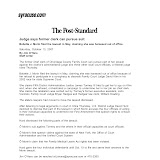
A pro se plaintiff who accused a Western District federal judge of treason and suggested that a magistrate judge is insane has had his case dismissed with prejudice. "Although litigants normally have the right to have their claims decided on their merits, that right is not absolute," Magistrate Judge Jeremiah J. McCarthy wrote Friday in Bellet v. City of Buffalo, 03-cv-00027. "In a rare case, it can be forfeited by a party's misconduct. This is such a case."  The plaintiff, Kenneth J. Bellet, had alleged various civil rights violations in a 42 U.S.C. §1983 action against the City of Buffalo, its school district and other defendants. Since 2003, Mr. Bellet has sought the recusal of Western District Judge William M. Skretny and Magistrate Judge McCarthy on several occasions. In one affidavit, Mr. Bellet said Judge Skretny "without doubt committed the crime of treason against the United States Constitution." In another, he said that the magistrate judge "is not a man of sound mind," believes he is God and is in need of Thorazine and "perhaps shock treatment."  Last week, Magistrate Judge McCarthy cited a decision by Judge Skretny (Blum v. Schlegel, 1996 WL 925921, 2006) in which the court dismissed a case where the plaintiff had repeatedly insulted the court with baseless accusations. "This case, so there is no question, shall be dismissed with prejudice pursuant to the Court's inherent power," Judge Skretny wrote in Blum. "The court, jealous of its integrity and concerned about deterrence, is entitled to send a message loud and clear." Magistrate Judge McCarthy adopted the same reasoning in dismissing Bellet.

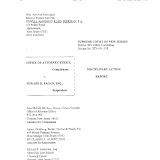
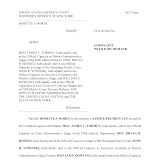
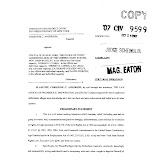
UNITED STATES DISTRICT COURT   
WESTERN DISTRICT OF NEW YORK
 _____________________________
KENNETH J. BELLET,   

Plaintiff,   
v.
CITY OF BUFFALO, et al.,   

Defendants. 
_____________________________


DECISION AND ORDER        03-CV-00027(M)

Although litigants normally have the right to have their claims decided on their merits, that right is not absolute. In a rare case, it can be forfeited by a party’s misconduct. This is such a case.
BACKGROUND  -   Plaintiff commenced this action pro se in January 2003, seeking relief pursuant to 42 U.S.C. §1983 for alleged violations of his civil rights by the City of Buffalo and various other defendants. Complaint [1].1 On February 7, 2007 District Judge William Skretny referred the case to Magistrate Judge Leslie Foschio for supervision of pretrial proceedings [17], and it was reassigned to me on March 1, 2007 [19]. On March 29, 2010, the parties filed a consent to all further proceedings before a Magistrate Judge, pursuant to 28 U.S.C. §636(c) [125]. Over the course of this litigation, plaintiff has on several occasions sought recusal of both Judge Skretny and me [5, 11, 98, 102, 103, 134, 160], in the course of which he has made accusations which far exceed the bounds of fair commentary by any litigant. For example, he has alleged:

  1. that Judge Skretny “without doubt committed the crime of treason against the United States Constitution” (June 21, 2003 affidavit [5], ¶8);
  2. that Judge Skretny “deliberately deceived a higher Court in granting a summary judgment motion by lying about a cause of action” (May 7, 2007 affidavit [21], ¶11);
  3. that Judge Skretny “conspired with other judges to create a local rule to justify his impropriety” (March 18, 2009 Supplemental Affirmation [103], ¶2);
  4. that Judge Skretny “falsified a cause of action and other things in a prior case of mine and I know Skretny to be corrupt” (id., ¶3);
  5. that I have “colaborated [sic] in [defendants’] deliberate deception” (May 20, 2010 affidavit [131], ¶10);
  6. that “McCarthy is not a man of sound mind” (June 28, 2010 affidavit [134], ¶12);
  7. that “I moved for McCarthy’s recusal and he refuses. Wherefore I, by the powers granted to me by the Congress of the United States do hereby remove McCarthy from this matter and if Judge McCarthy believes I can’t do this than we’ll let the Supreme Court decide whether I can and any decisions or orders from McCarthy will be considered by me as void” (March 18, 2009 Supplemental Affirmation [103], ¶11);
  8. that “although McCarthy has a trial date set . . . I will not try a case in his Court as McCarthy is not trustworthy”(June 28, 2010 Affidavit [134], ¶37);
  9. that “Judge McCarthy believes that he (McCarthy) is God Almighty . . . . I have a Right to a sane Judge, I demand one; Let Judge McCarthy go some place get some treatment perhaps shock treatment, Thorazine and maybe he (McCarthy) will get well” (June 16, 2011 Objections [160], ¶8 and p.3)

In addressing plaintiff’s most recent request for recusal [160], I issued a Decision and Order on June 23, 2011 [161], in which I stated: “We have been down this road more than once before, and plaintiff’s objections have previously been addressed. If plaintiff disagrees with any of my rulings, he is free to seek appellate review in the event he does not prevail in this case. In the meanwhile, I see no basis for recusal. A party cannot force disqualification by attacking the judge and then claiming that these attacks must have caused the judge to be biased against him.’ United States v. Marshall, 77 F.Supp.2d 764, 768 (N.D.Tex. 1999). Therefore, plaintiff’s motion is once again denied. Furthermore, I remind plaintiff of his obligations under Fed. R. Civ. P. (“Rule”) 11(b) (a copy of which is attached to this Decision and Order), and that future violations of those obligations may lead to the imposition of appropriate sanctions, up to and including dismissal of this action.” On September 29, 2011 plaintiff filed an application for entry of default against defendant Donald Miller [178], alleging that he had served the complaint upon defendant Miller by mail pursuant to Rule 5, and that Mr. Miller had not timely answered. By letter dated October 7, 2011 [186], City of Buffalo Assistant Corporation Counsel Carmen J. Gentile requested a conference with the court, noting that service by first class mail only upon defendant In addition to proceedings in this court, on October 15, 2010 plaintiff filed a complaint with the Judicial Council of the Second Circuit, charging me with judicial misconduct. That complaint was dismissed by Chief Judge Dennis Jacobs on November 29, 2010 (Docket No. 10-90129-jm). Miller was improper,3 and offering to accept service and file an answer on his behalf, as he Miller was retired from the Buffalo Police Department. Upon receipt of that letter, I scheduled a telephonic conference with the parties [179], which I then adjourned twice at plaintiff’s request [180, 182]. The conference finally took place on December 9, 2011 [187], during which the following exchange occurred:
“MR. BELLET:
THE COURT: MR. GENTILE: MR. BELLET: THE COURT: MR. BELLET: THE COURT: MR. GENTILE: THE COURT: MR. GENTILE: THE COURT: MR. BELLET: THE COURT: MR. BELLET: THE COURT:
I received an answer from the city on the 21st that’s untimely. Mr. Miller did not hire a city attorney.
Well, I think Mr. --
I’d be willing to accept service for Mr. Miller.
You can’t go out and solicit your client, you know that. Mr. Bellet --
Who do you think you are?
Mr. Bellet --
Mr. Bellet --
Now, Mr. Gentile, let me speak for a minute.
Buffalo police officer.
Mr. Bellet, I’m the judge in this case.
Not anymore.
Mr. Bellet --
The guy hasn’t been an officer in ten years.
Mr. Bellet, I’m the judge in this case. If --Service was indeed improper, because it was attempted pursuant to Rule 5 rather than Rule 4(d), nor was there any indication that defendant Miller had been served with a summons, as required by Rule 4(c).
MR. BELLET: THE COURT:
MR. BELLET: THE COURT: MR. BELLET:
THE COURT: MR. BELLET: THE COURT:
MR. BELLET:
At that point, plaintiff hung up the telephone.

ANALYSIS  -   “Courts of justice are universally acknowledged to be vested, by their very creation, with power to impose silence, respect, and decorum, in their presence, and submission to their lawful mandates . . . . These powers are governed not by rule or statute but by the control necessarily vested in courts to manage their own affairs so as to achieve the orderly and expeditious disposition of cases.” Chambers v. NASCO, Inc., 501 U.S. 32, 43 (1991), rehearing denied, 501 U.S. 1269 (1991). “A primary aspect of that discretion is the ability to fashion an appropriate sanction for conduct which abuses the judicial process.” Id., pp.44-45.
City charter doesn’t let this guy solicit private clients.
Mr. Bellet, if Mr. Gentile is willing to represent Mr. Miller, then he may do so. I’m not going to allow any default to be taken at this time as long as --
I want to see a retainer.
That’s none of your business, Mr. Bellet.
Oh yes it is my business. It’s very much my business. And who the hell are you to talk to me like that?
Mr. Bellet, if you --
I don’t give a damn what title you have.
Mr. Bellet, if you continue, I will dismiss this case, and I will hold you in contempt. Now back off.
Oh yeah? Goodbye.” [187, pp.5-6].

Although “outright dismissal of a lawsuit . . . is a particularly severe sanction, [it] is within the court’s discretion.” Id., p.45. “For . . . abusive tactics that do not directly relate to discovery, this Court must rely on its inherent power to sanction bad-faith conduct.” Blum v. Schlegel, 1996 WL 925921, *5 (W.D.N.Y.1996) (Skretny, J.), aff’d on other grounds, 108 F.3d 1369 (2d Cir. 1997)(unpublished opinion).  In Blum, Judge Skretny dismissed an action in which the plaintiff repeatedly made baseless accusations against the court: “Blum continued his campaign of insults and improper influence charges with the intent to harass and intimidate the Court and his opponents. A court of law cannot tolerate such unacceptable conduct . . . . Blum's conduct here is so vituperative, debasing, insulting and threatening as to infect the integrity of the judicial process. Its only purpose could be harassment. Such conduct by a claimant who seeks relief from our judicial system will not be tolerated. The appropriate remedy for such abuse is to dismiss the claim under this court's inherent powers.” Id., **8, 12-13.  Judge’s Skretny’s reasoning in Blum is equally applicable in this case. I do not make this decision lightly, recognizing that “dismissal is a harsh remedy, not to be utilized without a careful weighing of its appropriateness”. Dodson v. Runyon, 86 F.3d 37, 39 (2d Cir. 1996). “[O]ne of the factors that should inform a trial court's decision is the suitability of lesser sanctions.” Id. If plaintiff’s outburst on December 9, 2011 were an isolated occurrence, I might be inclined to impose a less drastic sanction than outright dismissal.  However, I am “free to consider the full record in the case in order to select the appropriate sanction”. Southern New England Telephone Co. v. Global NAPs Inc., 624 F.3d 123, 144 (2d Cir. 2010). Plaintiff’s demonstrated history of disrespect for this court’s authority, coupled with his disregard of my express warnings on June 23, 2011[161] and December 9, 2011 [187], leaves me convinced that if a lesser sanction were imposed, his “obstructionist and abusive tactics would continue undeterred”. Blum, *12. “This Court has not lost sight of the strong interest in resolving cases on the merits. [Plaintiff], however, will not allow it notwithstanding his empty rhetoric to the contrary. He has chosen to prove that he is a victim of the judicial process rather than a victim on the substantive merits. By harassing and attempting to intimidate the Court and counsel, [plaintiff] has infected all of the pretrial procedures and interfered egregiously with the court's administration of justice . . . . When a litigant resorts to such tactics, rather than respect the judicial process as a means to litigate the substance of his claims, he eviscerates the Court's ability to fairly adjudicate them on the merits.” Id., *11.  In National Hockey League v. Metropolitan Hockey Club, Inc., 427 U.S. 639, 643 (1976), the Court noted that “the most severe in the spectrum of sanctions . . . must be available to the district court in appropriate cases, not merely to penalize those whose conduct may be deemed to warrant such a sanction, but to deter those who might be tempted to such conduct in the absence of such a deterrent”. Plaintiff’s repeated and blatant misconduct leaves me with “little alternative to dismissal. Any other course would place the credibility of the Court in doubt and invite even further abuse.” Gantt v. Maryland Division of Correction, 894 F.Supp. 226, 230 (D.Md. 1995), aff’d, 73 F.3d 357 (4th Cir. 1996) (unpublished opinion).

CONCLUSION  -    “This case, so there is no question, shall be dismissed with prejudice pursuant to the Court's inherent power . . . . The court, jealous of its integrity and concerned about deterrence, is entitled to send a message, loud and clear.” Blum, *13. The clerk of the court shall enter judgment accordingly.
SO ORDERED. Dated: December 30, 2011 /s/ Jeremiah J. McCarthy JEREMIAH J. MCCARTHY United States Magistrate Judge

Wednesday, February 22, 2012

With Liberty and Justice for Some: How the Law Is Used to Destroy Equality and Protect the Powerful

With Liberty and Justice for Some: How the Law Is Used to Destroy Equality and Protect the Powerful
By Glenn Greenwald, Metropolitan Books, Henry Holt and Company, N.Y. $26, 304 pages

BOOK REVIEW: The New York Law Journal by Eric Dinnocenzo  -  January 19, 2012

John Adams famously said that we are "a nation of laws, not men." In his fourth and most recent book, "With Liberty and Justice for Some: How the Law Is Used to Destroy Equality and Protect the Powerful," liberal blogger, Salon.com columnist and attorney Glenn Greenwald argues that, in recent years, our nation has come to pay mostly lip-service to this bedrock principle when it comes to political and financial elites.  When they violate the law, this class has managed to get off with merely a slap on the wrist, and in many cases is staunchly defended by their peers and the mainstream media. The rule of law, in effect, is reserved for the rest of us, creating a two-tiered justice system.  Greenwald, in this well-researched and intellectually rigorous book, traces the origin of this shift to Ford's pardon of Nixon for his Watergate offenses in 1974 and sets forth a factual record of how it has continued up to the present day: the pardons of those involved in the Iran-Contra scandal and most recently of Scooter Libby; the immunization of the telecom industry for its involvement in warrantless wiretapping of thousands of U.S. citizens; the failure to prosecute financial elites for the financial crisis of 2008 that devastated large segments of the economy. And the list goes on.  To his credit, unlike many commentators, Greenwald assigns blame to both Democrats and Republicans alike for excusing political leaders and financial elites from the rule of law.  Greenwald perhaps most closely examines the torture of Guantánamo detainees to make his case. The Bush administration, he says, clearly violated the Convention Against Torture, adopted by the United States and thus law under Article VI of the Constitution. General Barry McCaffrey said, "We tortured people unmercifully. We probably murdered dozens of them during the course of that, both the armed forces and the CIA."  Greenwald shows the failure of those in positions of power to stand up and demand accountability. Although in April 2008, while in a contentious primary battle with Hillary Clinton, Barack Obama said that "nobody is above the law" and that "if crimes have been committed, they should be investigated," in April 2009, after taking office, the president abruptly changed course by saying that he preferred "to look forward not backward." This would prove to be a chorus repeated by administration officials.  The media, says Greenwald, were hardly more effective in calling for accountability. He specifically lays blame on those famous, well-paid journalists in the mainstream media who he alleges are part of the same power apparatus and run in the same social circles as political leaders, thus willingly abdicating their role as an adversarial check on power.  Many of these media figures, he points out, enthusiastically approved of the lack of any meaningful investigation or jail time for those responsible for illegal torture. On "Meet the Press," Rick Stengel, Time magazine's managing editor, praised Obama by saying that he "is very Mandela-like in the sense that he's saying let the past be the past and let us move in to the future."  As Greenwald humorously suggests, try adopting the Obama approach in common judicial proceedings and see how far it gets you. A Housing Court judge, for instance, may not be very receptive to the tenant who is behind in rent and contends that it is time to look forward not backward.  Greenwald astutely recognizes there are limitations to his argument, acknowledging that the Founding Fathers never advocated for social and political equality, nor was equality under the law always observed in practice. "Slavery, the dispossession of Native Americans, the denial of voting rights to women, and the granting of superior legal rights to property owners are a few of the most glaring deviations."  The difference between then and now, he says—and this makes up the central thesis of his book—is that while the equal application of law was at least aspired to in our nation's history, it no longer is.  One critique is that Greenwald's analysis that a major shift occurred in 1974 with the Nixon pardon may be a little too neat. Civil rights leaders in the 1960s may argue, for example, that there was no pretense of, or aspiration to, equality under the law for officials in the south who violated their civil rights and perpetrated violence against them.  Still, it is difficult to deny that the trend cited by Greenwald is for real. Perhaps the most interesting part of the book comes near the end, when he points out that during the same time period, law-and-order has only increased toward regular Americans. More than 2.2 million Americans are incarcerated and America has the highest rate of imprisonment of any nation in the world at 756 people per 100,000 citizens, followed by Russia (629) and Rwanda (604). There are mandatory minimum sentences, harsh drug laws that disproportionately affect minorities, and overworked public defenders represent a large number of criminal defendants.  Adding to this inequity, Greenwald says, is how the unequal distribution of wealth has skyrocketed during that same time-frame.  As a result, a perfect storm is brewing of social, economic and political inequality creating a sharp dividing line between elites and the middle and lower classes. This threatens the very fabric of our democratic society, Greenwald says, and it is hastened by the failure to make and apply the law equally to all citizens.  Eric Dinnocenzo is the principal of the Law Offices of Eric Dinnocenzo located in New York City and New Jersey.

Tuesday, February 21, 2012

Appellate Court Scoffs at Law, Moves Again To Protect Banks

Panel Reinstates Foreclosure Action, Assigns to New Judge
The New York Law Journal by Andrew Keshner  -  February 21, 2011

A state appeals panel has reinstated a foreclosure action thrown out by a Brooklyn judge known for his scrutiny of lenders and ordered that the case be handled by another judge on remand.  The Appellate Division, Second Department, faulted Supreme Court Justice Arthur M. Schack for sua sponte dismissing a foreclosure complaint with prejudice after the lender did not provide requested loan origination documents.  The decision marks the second time in less than two months that a Second Department panel has reversed Justice Schack on a foreclosure action. Moreover, the Feb. 14 decision cites a 2011 case in which the court restored a foreclosure case dismissed by the judge.  In the latest case, Aurora Loan Services v. Sookoo, 2011-03143, the unanimous panel wrote that Justice Schack "erred in, sua sponte, directing the dismissal of the complaint with prejudice and the cancellation of the notice of pendency. Under the circumstances of this case, we deem it appropriate to remit the matter for further proceedings before a different Justice."  Homeowner Shahmela Shah Sookoo received a mortgage in August 2007 for her Bushwick residence but she failed to make any mortgage payments and eventually defaulted on the loan.  Aurora Loan Services began foreclosure proceedings, but Ms. Sookoo never appeared in the action nor answered the complaint, the panel said.  Aurora, which was represented by Rosicki, Rosicki & Associates at the Supreme Court, moved for an order of reference appointing a referee to compute the amount owed to the bank.  Justice Schack denied the motion in March 2009, but granted leave to renew provided Aurora submit all loan origination documentation and an affirmation identifying whether the loan was a subprime home loan as defined in RPAPL §1304 or a high-cost home loan as defined under Banking Law §61.  Justice Schack commented in his March 2009 order that he was "concerned that defendant Sookoo's immediate default could be a strong indicator of either defendant's inability to pay or outright fraud."  He said he would determine if Ms. Sookoo did not have sufficient income to make any payments, "which could mean that the loan may have been in violation of federal statutes, or that the entire mortgage event was a fraud."  When Aurora renewed its application for an order of reference, it submitted the records on the type of loan but did not provide the origination documents.  Justice Schack in August 2009 dismissed Aurora's complaint and canceled the notice of pendency.  The Second Department reversed, finding that Aurora's motion for an order of reference should have been granted.  "The defendants failed to answer within the time allowed, and the plaintiff submitted, in support of its unopposed motion, the mortgage, the note, the verified complaint setting forth the facts establishing the claim, and an affidavit of its employee attesting to the default," the panel said in its unsigned opinion.  The case follows US Bank, N.A. v. Guichardo, 19086/08, in which the Second Department on Dec. 27, 2011, reversed Justice Schack's decision to dismiss a foreclosure action with prejudice after a requested affirmation came 123 days after a 60-day deadline (NYLJ, Jan. 3).  The latest case also cites an April 26, 2011, decision overruling Justice Schack's dismissal of an earlier foreclosure complaint. The court in U.S. Bank, N.A. v. Emmanuel, 83 AD 3d 1047, observed that "a court's power to dismiss a complaint, sua sponte, is to be used sparingly and only when extraordinary circumstances exist to warrant dismissal."  The Emmanuel court, in turn, cited HSBC Bank USA, N.A. v Valentin, 72 AD3d 1027 (2010), a fourth decision in which Justice Schack, was found to have abused his discretion by dismissing a foreclosure complaint.  Justices Peter B. Skelos, L. Priscilla Hall, Leonard B. Austin and Robert J. Miller joined the unsigned opinion in Sookoo.  Andrew P. Zacharda of Tompkins, McGuire, Wachenfeld & Barry in Newark, N.J., represented Aurora Loan Services on appeal.  Justice Schack declined to comment on the ruling.  Andrew Keshner can be contacted at akeshner@alm.com.

Subway Token: $2.25, Judicial Power: Priceless

The Love of the Law, Still Fulfilled
The New York Times by William Glaberson  -  February 20, 2012
He has the white hair and the black robe.

But this judge, up on the bench in Queens Supreme Court, is a little different from most of the other 1,200 in the state’s courts. Judge Allen Beldock, 92, is paid nothing. Zip. Nada. No salary. In this era of budget cuts, no honorarium.  Not even gas money.  Of course, after 44 years on the bench, coming to work just about every day is second nature, he said recently, maybe 130 pounds soaking wet, judicial robe included, leaning back at a desk he uses at the courthouse on Sutphin Boulevard in Jamaica.  “If I were not a judge, I wouldn’t be doing anything,” he said. “What would I be doing if I were not a judge? What am I even qualified to do? I’ve been a judge for 44 years. My father was a butcher. I’m not trained to be a butcher.”  So, four days a week, Judge Beldock gets into his eight-year-old Chevrolet Impala, which has seen better days, and makes his way to the courthouse. Mondays and Tuesdays he shepherds damage suits. Thursdays and Fridays he supervises jury selection.  Of course, for most of those 44 years, he did get a check, first as a full-time judge hearing criminal cases, and later, after he officially retired more than 20 years ago, as a judge paid a daily rate of $300 to handle civil cases. Then the fiscal crisis hit the courts about a year ago, the budget was cut and a lot of the retired judges who had been $300-a-day “judicial hearing officers” went home.  Not Judge Beldock. Like a hardy few other retired judges around the state — one or two in Manhattan, at least one in Brooklyn — he has continued with a more or less full schedule for no compensation whatsoever.  Why? Well, there is the love of the law. But there are other contributing factors.  “I don’t read books,” Judge Beldock said.  “I’ve done all my traveling,” he said. And the city’s glittering cultural life? “I’m not a big fan of museums. I’ve been to them.”  One of his three quite-grown children, Neil Beldock, 55, said in a separate interview that it was almost as if his father had no choice: “I think he just loves going to court and being in court every day.”  Judge Beldock ruled out returning to practicing law, as he did for years before Mayor John V. Lindsay appointed him to the bench in 1968. “I don’t want to deal with clients,” he said.  But working, he added, does beat one of the alternatives. “Too many of my friends that I did have over the years, when they stopped working or retired, they died,” he said with a matter-of-factness befitting a lifelong New Yorker.  Judges, all-powerful when they are sitting up a step or two on the bench, evidently are just mortals. Judge Beldock said a dozen of them used to crowd around a big table every day at the Flagship Diner on Queens Boulevard. These days, he said, he is often the only one.  “They’re dead,” he said. “You’d be amazed. I could give you a list.”  In reports and hearings, bar associations have bemoaned the loss of the judicial hearing officers, saying that they helped the overburdened judiciary keep some limits on ballooning court delays and that their decades of experience could be useful. But the salad days for retired judges do seem to be over.  For some of them, the end of their judging may be a little hard to take, though they do get healthy pensions and good benefits. For Judge Beldock, the per diem job also brought growing acknowledgment as the decades passed and he became a senior statesman of the courts. The Daily News recognized him a couple of years ago as the oldest state judge at work in the five boroughs. That was before the cuts.  At first, while court officials were deciding whether to permit some of the retirees to come back as volunteers, his new unemployment was strange. Long a widower, Judge Beldock said he would be unsure how to begin the day if a tie and a black robe were not involved. “I’d just feel, ‘I gotta get up because I gotta eat to live,’ ” he said. “I’d buy the paper and I would read.”  Some paid judges and some lawyers disparage the volunteer judges as dabblers. But in his courtroom the other day, some lawyers waiting for cases said Judge Beldock seemed to be the real thing.  “He’s still as sharp as I would imagine he was,” said Bradley M. Wanner, a young lawyer.  John J. Proios, a lawyer himself for 49 years, said Judge Beldock “is like me, an old goat.”  The task at hand, setting schedules for recently filed suits, was not too demanding. But the proceedings may have seemed a touch more official because of the white-haired gentleman on the bench, peering through bifocals, as judges do.  In an interview, an appeals court judge with many years’ experience in the courts, Justice Randall T. Eng, said Judge Beldock had had that judicial look since Mr. Eng first appeared before him as a young prosecutor in the early 1970s.  “He always had white hair,” Justice Eng said. “He actually hasn’t changed much.” Judge Beldock said that even back at the beginning, he was proud of the position. “I’m called ‘Judge’ wherever I go,” he said. Maybe you cannot put a price on that.

Monday, February 20, 2012

Bank Settles Some Charges in Defrauding Patrons Case

Bank Settles Some Charges in Defrauding Patrons Case
The American Lawyer by Scott Graham  -  January 20, 2012

Bank of New York Mellon has reached a partial settlement of federal charges that it defrauded some of its customers by giving them lower rates on foreign currency conversions than they had been promised. The bank has agreed that it will no longer tell customers they are getting the "best execution" of their conversions. Southern District Judge Lewis Kaplan approved the settlement on Jan. 17.  The office of Southern District U.S. Attorney Preet Bharara indicated separately that it hopes to resolve the issue of civil penalties next month. Mr. Bharara demanded "hundreds of million" in penalties when he filed the lawsuit in October. BNY Mellon has previously said the suit represents "prosecutorial overreach" and is based on a misunderstanding of the global foreign exchange market.  Partners Reid Figel, Derek Ho, David Schwarz, Gregory Rapawy, and Rebecca Benyon from Washington, D.C.'s Kellogg, Huber, Hansen, Todd, Evans & Figel are representing the bank. Mr. Figel did not reply to a request for comment.  "Pursuant to the partial settlement, BNYM must disclose how transactions executed through its standing instruction foreign exchange service are priced, and must make certain pricing data available to its custodial clients on a periodic basis," Mr. Bharara's office said in a statement. Assistant U.S. Attorneys Pierre Armand, Lawrence Fogelman and James Nicholas Boeving are handling the case for Mr. Bharara.
See Related Stories:

Bank of NY Upset US Court Corruption Doesn't Work in Russia

Sunday, February 19, 2012

Judge in Doghouse Over Sealing Attorney's Dog's Bestiality Case

[Lawyer]Tenant allegedly tapes super sodomizing dog
The Journal News by Shawn Cohen - February 17, 2012
Rye resident sets up a 'nannycam' in apartment

RYE, NY — The superintendent of a Rye apartment complex is accused of sneaking into a tenant’s apartment and sodomizing the man’s pet dog. Kujtim Nicaj, 41, who lives and had worked as a superintendent at Rye Colony at 58 Peck Ave., was caught having intercourse with the male Labrador retriever on a “nannycam” on Feb. 8, police said.  The tenant reported him to Rye city police and turned over the video that he had secretly set up because he suspected someone had illegally entered his apartment before, according to a source familiar with the investigation.  Nicaj was arrested Feb. 9 and charged with second-degree burglary, a felony, and sexual misconduct, a misdemeanor, under a section of the law that deals with having sex with dead bodies or animals. He is free on $100,000 bail, pending his next appearance in Rye City Court on March 6. After learning of the arrest, property manager Mike May promptly fired Nicaj, who had worked at Rye Colony for six years and lives in one of the complex’s units with his wife and two children.  May also took away all the keys Nicaj had to residents’ apartments. Nicaj’s lawyer, Steven Davidson, said that his client denies molesting the dog.  The lawyer said he knows of the video but said the Westchester District Attorney’s Office has yet to show it to him.  “I don’t believe any of it,” Davidson said. “He’s a nice guy and he deserves to be treated like everybody else. He’s innocent until he’s proved guilty.”  Shawn Cohen email:  spcohen@lohud.com

------------------ RELATED STORY:

Rye Court Releases Limited Info on Sordid Case; Withholds Police Report
The Rye Patch by Renea Henry  -  February 17, 2012

Early Friday afternoon, Rye City Court clarified the criminal charges pending against the former Rye Colony Apartments superintendent, but maintains a hold on police reports and other court documents.

Early Friday afternoon, Rye City Court provided information about the specific charges pending against former Rye Colony Apartments superintendent Kutjim Nicaj. Nicaj was arrested on February 9 and last appeared in Rye City Court on Tuesday, February 14. On Tuesday, Nicaj appeared with counsel and was released after posting $100,000 bail; his next court date is Tuesday, March 6.  Rye Patch was not permitted access to the police report from the initial incident. Lt. Joseph Verille explained by email: "This report along with any and all records have been ordered confidential by Judge Latwin, Rye City Court and shall not be made available for public inspection pursuant to civil rights law, Section 50 (b)."  After a FOIL request, the Rye City Court clerk contacted Rye Patch to provide some information related to the alleged incident and pending charges. Details of the case have been sealed to protect the identities of the parties involved. The alleged incident occurred on the afternoon of Wednesday, February 8 and does involve a dog, according to court documents.  According to the court clerk's office, two charges have been entered by the Westchester County District Attorney's Office against Nicaj: one felony count of burglary, second degree and one misdemeanor count of sexual misconduct.  New York is one of 14 states that categorizes sexual contact with an animal as a misdemeanor, according to the Animal Legal and Historical Center of Michigan State University College of Law. As of 2010, thirty states have laws prohibiting sexual contact with an animal.  The New York Penal Code defines burglary, second degree [140.25] as follows:  A person is guilty of burglary in the second degree when he knowingly enters or remains unlawfully in a building with intent to commit a crime therein, and when: 1. In effecting entry or while in the building or in immediate flight therefrom, he or another participant in the crime: (a) Is armed with explosives or a deadly weapon; or (b) Causes physical injury to any person who is not a participant in the crime; or (c) Uses or threatens the immediate use of a dangerous instrument; or (d) Displays what appears to be a pistol, revolver, rifle, shotgun, machine gun or other firearm; or 2. The building is a dwelling. Burglary in the second degree is a class C felony.  The New York Penal Code defines sexual misconduct [130.20(3)] as follows:  A person is guilty of sexual misconduct when: 1. He or she engages in sexual intercourse with another person without such person's consent; or 2. He or she engages in oral sexual conduct or anal sexual conduct with another person without such person's consent; or 3. He or she engages in sexual conduct with an animal or a dead human body. Sexual misconduct is a class A misdemeanor.  Renea Henry email: renea.henry@patch.com

------------------ RELATED STORY:


Rye Judge Redacts Specifics of Bestiality Case
The Daily Peekskill by Luke Lavoie  -  February 17, 2012
Kujtim Nicaj, 41 of Rye, has been charged with sexual misconduct for allegedly engaging in sexual contact with a dog.

RYE, N.Y. - Rye City Court Judge Joseph Latwin has redacted information from court files surrounding a case of alleged bestiality in Rye Colony citing a section of civil rights law as the reason.  Civil Rights law section 50b states the right of privacy to victims of sex offenses.  Documents from Rye City Court corroborate reports from the District Attorneypublished first in The Daily Rye that Kujtim Nicaj, 41, the former superintendent of Rye Colony, was arrested Feb. 9 and charged with the felony of burglary in the second degree and a misdemeanor of sexual misconduct.  According to the accusatory instruments filed by the District Attorney's office, Nicaj allegedly engaged in sexual misconduct with a dog. The court documents also state that the misconduct took place on Feb. 8 at approximately 2:30 p.m.  According to the New York State Office of Court Administration, the court documents were never sealed as has been reported. Rather, only information identifying the breed of the dog and the tenant's address has been redacted.  According to Lt. Joseph Verille of the Rye Police Department, Latwin has placed a gag order on the case, which has prevented information surrounding the incident from being released.  The District Attorney's office has also honored Latwin's decision and has declined comment regarding the redacted information.  Two residents who have lived in the development for five years called the charges "salacious rumors" and said their former super is a nice man. Luke Lavoie email:  llavoie@mainstreetconnect.us

Rapist Mocks DA for Missteps That Got Charges Dismissed

'Teflon rapist' mocks Bx. DA for missteps that got charges dismissed
The New York Post by Kevin Fasick  -  February 19, 2012

A slippery suspect whose DNA was matched to three sex attacks mocked the Bronx DA for missteps that got his charges dismissed, joyfully taunting during a jailhouse interview “How’d they blow it? How’d they blow it?”  Brian Brockington, 34, insisted he never raped anyone -- though he claims that a full calendar year is a blackout for him. “I don’t even remember 1993,” told the Post during an exclusive interview Friday. “I don't need to rape nobody. I'll buy the [sex].” The vile Bronx man said he was “happy” and anticipating his release from jail after prosecutors missed a filing deadline by one day -- and accusations against him in three attacks, in 1993, 1997 and 2003, fell apart. “They had me locked up for five years,” he said. “What took them so long?” Prosecutors first charged Brockington in the sex assaults in 2007, when he was taken into custody on an unrelated charge and prosecutors said his DNA matched the cold cases.   "I'm sitting in here and they say you did this one and you did that one,” he insisted. “They're lying. They don't have any DNA on me.”  The earliest complaint linked to Brockington accused him of joining two thugs in the vicious gang rape of a 28-year-old in a playground in 1993.  Brockington continues to deny it but the creep doesn’t hold back when it comes to insulting one of his accusers.  "How can you rape someone you've had sex with 40 times,” he asked while fidgeting in his seat. “Crackhead.”  Brockington downplayed the accusations, bragged about himself and insisted he was locked up solely for attempted assault -- the charge that prosecutors agreed to after the cases accusing him of sex attacks were thrown out. Brockington also insists that the charges weren't dismissed because of the statute of limitations and prosecutors missing a filing deadline.  “You know what my charge is?” he asked incredulously. “Assault. Just like if you and me and you got in a fight at a bar. Assault.”  The Teflon jailbird wasn’t so boisterous when asked to explain the incident that led to the attempted assault charge.  That’s when he clammed up, but documents show the “attempted assault” occurred at the same time and place where the 2003 sex attack occurred.  The difference is this -- a sentence that’s little more than time served.

Friday, February 17, 2012

Collection Firms Running Back to Their Rat Holes

Collection and Credit Firms Facing Broad New Oversight
The New York Times by Ben Protess  -  February 16, 2012

Debt collectors and credit reporting companies are bracing for intense scrutiny after the government’s consumer finance watchdog unveiled a broad plan to regulate financial firms that have largely evaded federal oversight.  On Thursday, the Consumer Financial Protection Bureau proposed regulations that would allow the agency to supervise those two controversial corners of the finance industry, which have drawn complaints of aggressive tactics and unfair practices.  The draft rule is the most significant proposal yet to emerge from the consumer agency — a symbol of the government’s new regulatory powers and a favorite target of Congressional Republicans — and the first of several efforts to police financial companies that are not banks.  “Debt collectors and credit reporting agencies have gone unsupervised by the federal government for too long,” Richard Cordray, the bureau’s director, told reporters on Thursday. “It is time to provide the kind of oversight of these markets that will help ensure that federal laws protecting consumers in these financial markets are being followed.”  The proposal now enters a 60-day comment period. The bureau expects to complete the rule by July, the two-year anniversary of its creation. The rule, like many of the bureau’s actions, could become bogged down in a larger political battle that has bedeviled many regulators in the Obama administration. Republicans have threatened to rein in the consumer agency’s budget and authority.  The bureau, a product of the Dodd-Frank regulatory overhaul, has a broad mandate to police Wall Street banks as well as the more shadowy corners of the financial industry. Such firms are unmarked territory for the federal government. Until now, state authorities largely have licensed and supervised these companies.  But the agency was hamstrung without a leader at the helm, the result of a bitter battle in Congress over the appointment of Mr. Cordray. Republicans refused to bless his nomination unless Democrats agreed to subject the bureau to stricter Congressional oversight.  In a sharp challenge to Republican lawmakers in January, President Obama circumvented Congress and opted for a recess appointment of Mr. Cordray. The move empowered the bureau to take on the lightly regulated world of payday lenders, mortgage firms and student lenders. The bureau can also oversee the “larger participants” in industries like debt collection, credit reporting and check cashing.  The bureau began its new effort on Thursday with the proposal to define the largest debt collectors and credit reporting companies. The bureau can also sanction smaller firms that run afoul of federal rules.

Some financial firms, on and off Wall Street, are squirming at the thought of an emboldened regulator. New oversight means rising compliance costs and the likelihood of additional penalties. “I expect increased diligence and increased costs in light of the pronouncement from Mr. Cordray,” said Donald N. Lamson, a former regulator who now works at the law firm Shearman & Sterling. “It would be incumbent on them to beef up those areas that deal with consumer complaints.”  Under the debt collector proposal, the consumer bureau would keep watch over companies that make more than $10 million a year from their consumer business, limiting the scope to about 175 firms. These companies account for about two-thirds of the business in the debt collection market.  The oversight comes after a prolonged upheaval for the industry, which for years has been ensnared in lawsuits and regulatory actions for questionable collection practices. Debt collectors habitually rank as the most common topic of nonfraud consumer complaints at the Federal Trade Commission.  The F.T.C. recently cracked down on debt collectors for harassing consumers, sometimes for money that is not even legally owed. The agency last month levied a $2.5 million fine on Asset Acceptance, one of the nation’s largest debt collectors, to settle accusations that the company deceived consumers.  But the F.T.C.’s powers are limited. While it can sanction a debt collector for violating consumer protection laws, the Consumer Financial Protection Bureau has authority to root out wrongdoing and keep a closer eye on the industry to try and prevent bad acts.  Consumer advocates cheered the bureau’s proposal on Thursday, saying it was taking a proactive approach to regulation.  “You’re looking at problems on the front end rather than going in after the fact,” said Travis Plunkett, legislative director for the Consumer Federation of America, a nonprofit advocacy group. “You can actually prevent problems.”  The bureau’s plan also takes aim at the largest consumer reporting agencies, defined as companies that make more than $7 million annually from their consumer business. The proposal would capture 30 companies, firms like Experian, TransUnion and Equifax, that account for more than 90 percent of the industry’s business, according to the bureau.  Credit agencies, which produce on-demand reports featuring a borrower’s credit score and history, are inextricably linked to the consumer finance industry. Consumers clamor for favorable reports, a prerequisite for obtaining credit cards, a home mortgage or even a cellphone. But the credit reporting companies have also faced criticism for being overly deferential to creditors at the expense of consumers.  Later this year, the bureau could roll out plans to oversee check cashing companies and other nonbank firms. The bureau saw debt collectors and credit reporting companies as a logical starting point, Mr. Cordray said, because consumers lack the power to shop around for alternative providers. Banks and creditors, not customers, typically select debt collectors and credit reporting firms.  The bureau’s oversight of these industries will largely mirror its supervision of Wall Street. The agency will examine these firms individually and may also order the companies to turn over detailed snapshots of their businesses.  “This oversight would help restore confidence that the federal government is standing beside the American consumer,” Mr. Cordray said.

Was the Judge Mortified or Just Horny?

Accused family court judge says he doesn't remember alleged inappropriate behavior
The Asbury Park Press by Michelle Sahn  -  February 15, 2012

An Ocean County family court judge accused of inappropriately touching women and making inappropriate comments at a holiday party says he does not remember doing so, but “does not question the perceptions of those who have alleged otherwise.”  If it happened, it may have been the result of “having a little too much to drink,” and state Superior Court Judge Marquis D. Jones Jr. is mortified, according to a legal document filed by his attorney last week.  According to the Jan. 18 complaint filed by the Supreme Court of New Jersey’s Advisory Committee on Judicial Conduct, the holiday party was hosted by the Ocean County chapter of the Probation Association of New Jersey. Jones, who has been a judge since 2008 and sits on the bench in Toms River, was invited to the party by a probation officer who worked in the Child Support Enforcement Unit and appeared before him in court on a weekly basis, the complaint said. During the party, Jones “inappropriately touched multiple female probation officers and an employee of the establishment at which the party was held, without their consent, and made several inappropriate and/or sexually suggestive remarks to these women,” according to the complaint. In his formal answer to that complaint, Jones, 53, said he attended the party in Toms River in December 2010 at the invitation of a member of the Ocean County Probation Department. Jones said he simply thought it was a gathering of probation employees and had never heard of the Probation Association of New Jersey until he received a letter from the advisory committee in July. That letter was his first notice of the alleged inappropriate conduct, he said in the legal documents filed by his Toms River-based attorney, William Cunningham.

Formal response

According to Jones’ formal answer filed with the court: Jones paid for his own drinks and bought drinks for others at the party. He “does not have any recall of inappropriately touching anyone or making inappropriate comments,” the answer said. “However, Respondent (Jones) does not question the perceptions of those who have alleged otherwise. He does not have a present intention to require their personal appearance and testimony in this matter. However, if Respondent was inappropriate, it was perhaps the result of having a little too much to drink, in the Holiday spirit.” The judge “has taken steps, both before and after this event, to see to it that such conduct will never happen again.” He is “embarrassed and mortified by the events in question” and apologizes to those who were offended, to the judiciary and to his family. Officials have said Jones will remain on the bench until the committee members make a recommendation to the state Supreme Court about what, if any, action should be taken. If the committee determines he committed misconduct, it can recommend a reprimand, censure, suspension or his removal from the bench. His attorney said because of the sensitive nature of the matter, it would be inappropriate for him to comment at this time. Michelle Sahn: msahn@njpressmedia.com

Thursday, February 16, 2012

"Unfit to Serve" Lawyer Accused of Fraud

Family of heiress launches challenge of multi-million dollar will, claiming fraud
The New York Post -  February 16, 2012

Relatives of the late New York heiress Huguette Clark have launched a challenge to her will, claiming fraud by its beneficiaries -- her nurse, accountant and attorney -- MSNBC reported Wednesday. Clark, who died last year at the age of 104, signed a will leaving her nurse Hadassah Peri $35 million, and her lawyer Wallace Bock and accountant Irving Kamsler $500,000 each and control of a multimillion-dollar foundation. It cut her family out entirely. In another will, signed just six weeks earlier, she left Peri $5 million, with the rest of the $400 million copper mining fortune going to Clark's family. This week, 19 members of Clark's family filed an objection to the second will in Manhattan's Surrogate's Court. The heiress "was not competent to make a will," the family's attorney John R. Morken said, according to court documents. "...she did not know the nature, extent or value of her assets, was not of sound mind or memory and was not mentally capable of making a will." Morken went on to claim that the will "was not freely and voluntarily made" and had been "procured by the undue influence" of Peri, Block and Kamsler, among other people. Should the court find that Clark was not competent to sign the second will in April 2005, it would likely raise questions as to how she was competent to sign the first will -- in March 2005 -- which favored the family. However, if both wills are thrown out, under New York state law, the family stands to inherit everything. Clark, whose father was the second richest man in the US in the early 1900s, died May 24, 2011 at New York's Beth Israel Hospital, where she had reportedly been staying since at least September 2010.

RELATED STORY:
Executors get the ax
The New York Post by Liz Sadler  -  December 24, 2011

Lawyer Wallace Bock and accountant Irving Kamsler, suspected of taking advantage of an elderly copper heiress, got the boot yesterday as executors of her $400 million estate. Manhattan Surrogates Court Judge Kristin Booth Glen called the pair “unfit to serve” and suspended them from administrating the late Huguette Clark’s affairs. The ruling came after Peter Schram, a lawyer for the county public administrator, accused Bock and Kamsler of failing to pay some $90 million in gift taxes and interest over the years. The Manhattan DA’s Office is probing the handling of Clark’s finances.

Federal Court Three Ring Circus, Courtesy of Suspended Attorney/Juror

Former Juror Hauled Into Court as Judge Mulls New Trial Request
The New York Law Journal by Mark Hamblett  -  February 16, 2012

Southern District Judge William H. Pauley III had to order the arrest of a former juror on Feb. 15 as part of an effort to find out whether all or some of those convicted in the Jenkens & Gilchrist tax shelter fraud case deserve a new trial. Suspended lawyer Catherine M. Conrad was arrested at her Bronxville home by U.S. marshals and hauled into court to answer questions about why she kept from the lawyers during voir dire in United States v. Daugerdas that she had a criminal history, that she was suspended from practice in New York state for problems associated with severe alcoholism, and that her husband was a convicted felon who served seven years behind bars in New Jersey. Ms. Conrad was Juror #1 on the panel that convicted Jenkens & Gilchrist lawyers Paul Daugerdas and Donna Guerin, former BDO Seidman CEO Denis Field and former Deutsche Bank Alex.Brown banker David Parse on May 24 of a tax shelter scheme designed to provide wealthy clients with bogus tax losses (NYLJ, May 25, 2011). After the verdict, lawyers with Brune & Richard, representing Mr. Parse, made a motion for a new trial saying they had discovered Ms. Conrad had lied about her identity. But prosecutors argue that Theresa Trzaskoma of Brune & Richard knew Ms. Conrad's identity within two hours of the start of jury deliberations on May 12 and that she shared her concerns with Susan Brune and Laurie Edelstein of the firm. This knowledge, they argue in papers filed with Judge Pauley, constitutes a waiver of any right to ask for a new trial.

On Feb. 15, while Ms. Conrad waited in a holding cell off a courtroom on the 24th floor at 500 Pearl St., Ms. Trzaskoma was questioned by Assistant U.S. Attorney Jason Hernandez about how and when she came to learn about Ms. Conrad's background. Ms. Trzaskoma said she woke up on the morning of May 12, 2011, wondering why Juror #1 had sent a note to the judge asking questions about respondeat superior and vicarious liability—terms not usually thrown around by a layperson. Ms. Trzaskoma said she began an investigation with the help of a paralegal, learning on Westlaw that Juror #1 had the same last name as a suspended attorney. At one point she sent an e-mail saying, "OK, unless Conrad totally lied about her highest level of education, it can't be the same person as the suspended lawyer. But let's keep a little dossier on her." But in yet another e-mail, Ms. Trzaskoma states, "Jesus, I do think it's her." Ms. Trzaskoma insisted under questioning on Feb. 15 that there was confusion regarding Ms. Conrad's real identity and that, in the end, she and her colleagues simply could not believe she was the same person as the suspended attorney. That possibility, she said, "was just so far out there, so remote" that they dismissed it. However, one problem for Brune & Richard is that, in the fact section of their memorandum asking for a new trial, they neglected to mention either their suspicions or their inquiries during trial and only made their motion after lead prosecutor Stanley Okula disclosed to the court he had received a post-trial note from Ms. Conrad saying, "KUDOS to you and your team." Under pressure from Mr. Hernandez, Ms. Trzaskoma expressed "regret" for not including her pre-deliberation investigation and suspicion in the memorandum. "It should be in there, correct?" Mr. Hernandez asked. "I regret the brief conveyed the impression it had never occurred to us before," she said. Nonetheless, Ms. Trzaskoma insisted that she had been straight with Judge Pauley when asked by the judge during a post-trial conference whether she or the firm had any knowledge—at trial—that Ms. Conrad was the same person as the suspended lawyer. "We did not know at trial," she said. Judge Pauley had one question for Ms. Trzaskoma, reminding her that, on the third day of deliberations, May 16, he had excused one juror for medical reasons, seated an alternate and then instructed the panel to begin deliberations anew. "During that entire episode, did you ever revisit the question of Juror #1 and the possibility that she might be someone other than who she said she was?" the judge asked. "I did not," Ms. Trzaskoma answered. "I genuinely believed that Juror #1 was who she said she was."

Former Juror Testifies

Then it was Ms. Conrad's turn. Ms. Conrad had behaved erratically at a Dec. 20 hearing in which Judge Pauley said she would be subpoenaed to testify at the Feb. 15 hearing. "I reject it and you're going to have to arrest me because nothing is going to change," Ms. Conrad responded at the time. "They're fricken crooks and they should be in jail and you know that. Good." Ms. Conrad phoned chambers at 7:52 a.m. on Feb. 15, telling a judge's deputy, "I will not be coming and I will not testify." Shortly after the hearing began at 9:30 a.m., Judge Pauley issued a warrant for her arrest. After she was led into the courtroom, Judge Pauley instructed her court-appointed counsel, Bobbi C. Sternheim, to sit in the jury box as close as possible to the witness stand to keep Ms. Conrad on track. As arranged beforehand, Ms. Conrad invoked her Fifth Amendment right not to testify and the judge compelled her to answer by granting her "use immunity" for her testimony. That would prevent the prosecution from using her testimony or any evidence derived from the testimony against her. Christopher Gair of Jenner & Block in Chicago, trying to win a new trial for Mr. Daugerdas, began a tortured direct examination of Ms. Conrad, asking her time and again if she knew the difference between rational and irrational and whether it was rational to flout an order of a federal judge or lie about her identity during voir dire. "I don't know, I'm not a psychologist," Ms. Conrad said repeatedly. At one point, she glared at the defense lawyer and said, "Why don't we get to the meat of this?" She insisted, "I was a very unbiased juror" and when asked again if she could tell the difference between rational and irrational, she stated, "It has nothing to do with the jury verdict that was rendered against your client."

"Have you ever been examined by a psychologist?" Mr. Gair asked. "Has anyone ever told you you suffer from bi-polar disorder? What medications do you take?" "Water," Ms. Conrad answered. "That's a medication?" Mr. Gair asked. "If it calms me down, sure," Ms. Conrad said. Mr. Gair introduced into evidence the 2007 decision of the Appellate Division, First Department, suspending Ms. Conrad from practicing and a 2010 decision by the same court denying her reinstatement. After being asked a few questions by Paul Shechtman of Zuckerman Spaeder who represents Mr. Parse, Ms. Conrad was asked several times by Mr. Okula whether she entered the case with an ax to grind. "Were you biased against the defendants in any manner or form," Mr. Okula asked. "Not at all," she responded. At the close of the day, Judge Pauley asked Ms. Conrad why she perjured herself when she answered questions on voir dire. Ms. Conrad said that, while she was unemployed, it certainly was not for the money. Instead, she said she missed the dynamics of the courtroom and was interested in serving as a juror at trial. Ms. Conrad was released at the end of the day, but Judge Pauley did not lift the arrest warrant, as it is possible she could be recalled to court. The hearing will continue on Feb. 16. Mr. Daugerdas was convicted on 18 counts of tax evasion and Ms. Guerin nine counts for giving their legal blessing to the tax shelters prosecutors said had no economic purpose. Mr. Field was convicted of four counts of tax evasion. The three of them and Mr. Parse were found guilty of mail fraud and a corrupt endeavor to obstruct and impede the tax laws.  Raymond Craig Brubaker, a banker at Deutsche Bank, was acquitted on all counts.  Also appearing for the defendants at the Feb. 15 hearing were Mark Rotert of Stetler, Duffy & Rotert in Chicago for Ms. Guerin; and Sharon L. McCarthy of Kostelanetz & Fink for Mr. Field.  Mark Hamblett can be contacted at mhamblett@alm.com.

Blog Archive

See Video of Senator John L. Sampson's 1st Hearing on Court 'Ethics' Corruption

The first hearing, held in Albany on June 8, 2009 hearing is on two videos:


               Video of 1st Hearing on Court 'Ethics' Corruption
               The June 8, 2009 hearing is on two videos:
         
               CLICK HERE TO SEE Part 1
               CLICK HERE TO SEE Part 2
Add to Technorati Favorites