MLK said: "Injustice Anywhere is a Threat to Justice Everywhere"

End Corruption in the Courts!

Court employee, judge or citizen - Report Corruption in any Court Today !! As of June 15, 2016, we've received over 142,500 tips...KEEP THEM COMING !! Email: CorruptCourts@gmail.com

Monday, December 7, 2009

Tom Robbins Insight Into The Bowels of New York's Corruption

Joe Bruno and the Life Fantastic
The Village Voice by Tom Robbins - December 1, 2009
The divine rights of an Albany powerbroker

One of the best snapshots of the wonderful world that Joe Bruno inhabited was a memo to the former State Senate leader from one of his many aides: On April 11, 2005, Amy Leitch—Bruno's $93,000-a-year special assistant—wrote to update her boss on several important matters.
Matter number one was a contractor's estimate for a new roof on the veteran lawmaker's farmhouse in nearby Brunswick. The cost would be $11,180, she wrote. The bid included a 30-year warranty on the roof shingles and a four-year guarantee on the work itself. If Bruno didn't like that number, she informed him, another builder was due to offer his own estimate for the job the following week. It is widely accepted that elected office carries certain perks. Among these are choice parking spots, no waiting in line, and reserved seats at public concerts. But the corruption trial of Joe Bruno over the past month has provided an entirely new tutorial on the depth and scope of political entitlement. Who knew, for instance, that it was standard procedure for your Senate secretary to arrange a roofing job for your own house?

Matter number two on Leitch's memo concerned an even better benefit: This involved a meeting that the senator's staff was arranging for a trucking mogul with the state official in charge of rebuilding the World Trade Center site. The trucker, a man named Russell Ball, was then paying Bruno $20,000 per month in exchange for the Senate leader's sage advice. What Ball was hoping, as he later put it on the witness stand, was that Bruno would help "change the culture" of Ball's company, Roadway Contracting Inc. of Brooklyn. Part of the cultural change that Ball was seeking was access to those signing checks for the huge, multibillion-dollar downtown rebuilding effort. Who better to arrange a meeting with the leaders of the state's Lower Manhattan Development Corporation than Joe Bruno? The silver-haired Republican was not only the key figure in the success or failure of every piece of legislation affecting the site, he was a top member of the corporation's General Advisory Council. He was also, of course, a great patriot who had passionately declared that rebuilding downtown was another way to show the terrorists that Americans cannot be bullied. And if he happened to know a trucker who was fully capable of handling part of this task, why shouldn't he make sure that development officials got a chance to meet him?

On the bottom of the memo, as was his style, Bruno penned a short response to the meeting plan. It was this: "Ken Riddett supposed to be setting up—let me know." This was another example of the marvelous public-private partnership that Bruno had established for himself: Riddett, at the time, was the $180,000-per-year general counsel to the New York State Senate. More precise details about how the senator's Albany aides were enlisted in the support of all things Bruno came from his executive assistant of 24 years, Patricia Stackrow, who testified at the trial in federal court. Stackrow's state salary was $100,000 a year and she worked hard for the money, she said, as much as 80 hours a week. In addition to handling the senator's schedule and appointments, she also opened and responded to all of his personal mail, balanced checkbooks for Bruno and his wife, and did his personal shopping. Stackrow was asked what kind of shopping she was talking about? "Christmas shopping, gifts for his family, gifts for his wife," she answered. Every morning, Stackrow testified, Bruno handed her a packet of his unopened personal mail, which she would then sort through. She would prepare the checks for him to sign in order to keep his bills paid. She endorsed incoming checks from the senator's various businesses, handing them to the senator's state driver to take to the bank to deposit. She kept a ledger as well, which tracked the senator's household expenses, along with those of his horse-breeding enterprise, Mountain View Farm, and any other costs associated with his affairs.

This nonstop private work by public servants on Joe Bruno's personal behalf was ongoing at the same time that another top state official ran afoul of ethics investigators in late 2006. The complaint against former state comptroller Alan Hevesi was that he had allowed a state driver to chauffeur his badly ailing wife around while being paid on the state's dime. This violation created a great public outcry and eventually resulted in Hevesi's resignation and guilty plea to a felony charge of defrauding the government. Back then, some of the loudest catcalls from the sidelines demanding that Hevesi come clean about his terrible transgressions came from none other than State Senate majority leader Joseph Bruno. In fact, Bruno gets credit for being the very first official to call on Hevesi to quit for having brought disgrace on his office. The Senate chieftain insisted that the comptroller's abuses were so extreme that they had "eroded public confidence in him as the state's chief fiscal officer and have damaged his credibility beyond repair." During his decade-plus as chief of the State Senate, Joe Bruno was much praised by those who encountered him. He was a man's man, an ex-boxer, a former sergeant in the infantry in Korea, whose love of horses and the simple life he imparted to all who visited his gracious farm in Rensselaer County. He was also, as the two-week-long trial definitively proved, a man without any shame whatsoever who was himself actively engaged in massive fraud of taxpayers.

The question now is whether Bruno's former legislative colleagues are sufficiently shamed by the trial's revelations to finally do something about it. Pending in the legislature is a bill that would close some of the loopholes that Bruno so thoroughly exploited in order to keep his lucrative private-consultant work a secret. Bruno never had to publicly disclose just how much he was earning in outside income. The new bill would at least let us see what category he fell into: $250,000 or more? $1 million or above? Likewise, Bruno wasn't obligated to say if any of his clients happened to be lobbyists with business pending before the legislature that he was in a position to assist. The new bill would disclose those ties. Also for the first time, a new legislative ethics commission would actually be charged with investigating—by random audit—the annual financial disclosure forms filed by lawmakers. Thanks to the Bruno trial, we now know that legislative leaders worried not at all about deceiving state regulators. But Bruno had his counsel instruct members of his Republican caucus never to send their statements through the U.S. mail, lest they fall prey to federal fraud statutes. "It was all pretty shocking," says bill sponsor Daniel Squadron, the first-term senator representing Brooklyn and Lower Manhattan, of the Bruno trial. "We shouldn't have to rely on the feds for enforcement." The bill would also break up the state's current Commission on Public Integrity, created by former governor Eliot Spitzer, divvying up its chores among new separate arms to monitor lobbyists and state workers. This would supposedly boost ethics enforcement firepower, but it is an odd way to respond to the Bruno scandal. In recent months, the commission sanctioned several powerful unions that had hosted expensive soirees where legislators were wined and dined. It took the added and unprecedented step of sending the names of the legislators who attended over to the current Legislative Ethics Commission for possible action. "There is this sense of entitlement out there, and we have been trying to change the culture," says commission director Barry Ginsberg. trobbins@villagevoice.com

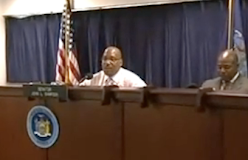
Next Sampson Hearing on Court Corruption Set for December 16th

************ IMPORTANT UPDATE *****

The Next New York State Senate Court Corruption Hearing will NOT be held on December 16th .... A new date will be announced soon.


*********

NOTICE OF PUBLIC HEARING


Wednesday, December 16th, 2009, 10:00 am - 4:00 pm
NYS Senate Hearing Room
250 Broadway 19th Floor Hearing Room
New York, NY, 10007
Phone: 518-455-2788
Fax: 518-426-6806


SENATE STANDING COMMITTEE ON THE JUDICIARY

NOTICE OF PUBLIC HEARING

SUBJECT: The Appellate Division First Department Departmental Disciplinary Committee, the grievance committees of the various Judicial Districts and the New York State Commission on Judicial Conduct

PURPOSE: This hearing will review the mission, procedures and level of public satisfaction with the Appellate Division First Department Departmental Disciplinary Committee, the grievance committees of the various Judicial Districts as well as the New York State Commission on Judicial Conduct

New York City
Wednesday, December 16, 2009 - 10 A.M.
250 Broadway, 19th Floor Hearing Room
New York, New York 10007


ORAL TESTIMONY BY INVITATION ONLY

The Appellate Division of the Supreme Court is the entity that is legally responsible for enforcing the Rules of Professional Conduct governing the conduct of attorneys in New York State. The Appellate Division Departments have created grievance committees that are charged with the investigation of complaints against attorneys. Within the First Judicial Department the Departmental Disciplinary Committee of the Appellate Division investigates complaints against attorneys. The New York State Commission on Judicial Conduct was created by the State Constitution and is charged with investigating complaints against Judges and Justices of the Unified Court System.

According to the 2009 Report of the Commission on Judicial Conduct, there were 1,923 complaints filed in 2008. Yet of these complaints only 262 were investigated and of those, 173 were dismissed. This hearing will examine the processes and procedures that are followed by the various agencies charged with the responsibility of enforcing the rules and regulations that must be followed by the Judiciary and the Bar in the State of New York. It will also evaluate public satisfaction with the disciplinary process.

Thursday, December 3, 2009

Holder's Army Forging Ahead with Judicial Honest Services Fraud

County jurist 20th person feds charged
The Times Leader by Terrie Morgan-Beseckertmorgan@timesleader.com
Law & Order Reporter


WILKES-BARRE, PA – Months of speculation regarding the fate of Luzerne County Judge Michael Toole ended Wednesday when federal prosecutors announced the jurist has agreed to plead guilty to honest services fraud for improperly influencing a court case, and to tax evasion for an unrelated matter. Luzerne County President judge Chester Muroski announces that Luzerne County Judge Michael Toole signed a plea agreement Sept. 25 to charges that he committed honest services fraud. Toole has agreed to resign from office, according to the plea agreement. The uninsured motorist case that led to charges against Luzerne County Judge Michael Toole isn’t the first such case to draw scrutiny. Attorneys have questioned Toole’s judgment in the naming of a neutral arbitrator and his refusal to dismiss a case against an insurance company on technical legal grounds, court records show.

In 2005 attorney Robert Smith of Scranton sought to have attorney Brian Corcoran removed as the neutral arbitrator in the case of Matthew Cienciva vs. Farmers Insurance. Smith had argued Corcoran, who had been appointed by Toole, had a conflict of interest because of Corcoran’s relationship with attorney John Nardone, who represented Cienciva. Smith had learned Corcoran had chosen Nardone to serve as the plaintiff’s arbitrator in at least four cases Corcoran brought against various insurance companies. That created an appearance of impropriety, Smith argued. A transcript of the hearing shows Toole gave Smith a dressing down, telling him it was up to the attorney appointed as the arbitrator to report if he felt he had a conflict of interest. He denied Smith’s request, saying he believed the attorney was engaging in a “fishing expedition” that would open up a “Pandora’s box” of unjustified challenges to court appointed arbitrators. Toole did not mention that he, himself, had a conflict in hearing the Cienciva case because he had a financial relationship with Nardone.

Statements of financial interest Toole filed in 2004 and 2005 list Nardone as a source of income. The transcript of the Cienciva hearing shows Toole never mentioned that relationship. Smith never appealed Toole’s ruling. The case settled out of court before going to the arbitration panel for a decision. Questions regarding Toole’s relationship with Nardone surfaced again this April, when attorney Michael Blazick filed a motion seeking to recuse Toole from the case of Charles Davis vs. Hartford Insurance. Blazick was seeking to overturn a $2.9 million uninsured motorist arbitration award that had been entered in favor of Davis, who was represented by Nardone. Toole was set to rule on a motion Blazick filed that sought to dismiss the case against Hartford on legal grounds. He sought Toole’s recusal after he read media reports regarding the Cienciva case and learned, for the first time, that Toole had a financial relationship with Nardone. Toole granted that request in August. Senior Judge Carson Brown was appointed to hear the case. A hearing on the motion to dismiss is scheduled for Monday. A complaint filed by the U.S. Attorney’s Office says Toole secretly communicated with a plaintiff’s attorney to appoint a person that attorney had sought as a neutral arbitrator in an uninsured motorist case. The neutral arbitrator is part of a three-person panel and is a key vote in deciding how much money to award or not award a plaintiff. Unbeknownst to the insurance company, Toole had a “long standing financial relationship” with the attorney, identified as “participant #1,” the complaint says. Toole had also stayed multiple times at a New Jersey beach house prosecutors say was “controlled” by the attorney, free of charge. He failed to disclose any of that information to the insurance company or to recuse himself. In a separate matter, Toole is also charged with failing to report on his income tax return a $30,000 referral fee he received from another attorney, who is identified a “participant #2.” Rumors that Toole would be arrested have been circulating for months. They intensified last month, when Toole, who has served on the bench since 2004, suddenly announced he was taking several weeks of vacation and had rescheduled all his cases to be heard in December and January.

His arrest is the latest to rock the county. He is the third county judge and 20th person overall to be snagged in the ongoing corruption probe. A plea agreement filed simultaneously with the complaint says Toole will plead guilty to one count each of honest services fraud and tax evasion. He has agreed to resign from office within 10 days of the acceptance of the plea, which is scheduled for Dec. 29 at 11 a.m. before U.S. District Judge Richard Conaboy. The charges carry a maximum sentence of up to 23 years in prison and a $350,000 fine. Prosecutors have agreed to seek a lesser sentence, however, if Toole follows through on a promise to cooperate in the investigation of wrongdoing of others. Toole could not be reached for comment Wednesday. His attorney, Frank Nocito, declined to comment. The federal complaint does not identify which underinsured motorist case Toole influenced, but details contained in the federal charges indicate it involves a $1.2 million arbitration award entered on behalf of Richard Gazenski of Wilkes-Barre. The case was filed by attorney Harry Cardoni of Cardoni and Associates in Kingston against Erie Insurance Exchange. Uninsured motorist claims involve drivers who sue their own insurance company to recover money for injuries caused by another driver who had little or no insurance. Disputes over the amount of money due are settled by a three-member arbitration panel. The plaintiff and defense attorney each choose one person. Together they chose a third, neutral arbitrator. If they cannot agree, a judge can appoint the neutral.

According to the federal complaint, in March 2006 Toole presided over a proceeding to select a neutral arbitrator. In November 2007, the parties filed a motion before Toole seeking to force the arbitrators to render an opinion in the case. Court records show the Gazenski case is the only uninsured motorist case that Toole heard in which he entered court rulings during the time period in question. According to the records, on March 6, 2006 Toole granted a motion filed by Cardoni that sought the appointment of attorney Bruce Phillips as the neutral arbitrator in the Gazenski case. On Nov. 30, 2007, Toole issued an order compelling the arbitration panel to meet on Dec. 18, 2007 and to deliberate until they reached a decision. A search of property records in New Jersey show that Cardoni is the owner of a home located at 117 E. Connecticut Avenue in Beach Haven, Ocean County, N.J. Cardoni has not been charged with any wrongdoing. He did not return a detailed phone message left at his office Wednesday afternoon. Attempts to reach him at home were unsuccessful. Contacted Wednesday, Gazenski said he was “blown away” to learn his case appeared to be the subject of the federal case against Toole. Gazenski is an insurance agent with J.W. Hoban and Associates in Wilkes-Barre, which sells Erie Insurance. He was injured in a crash caused by an uninsured driver at Sullivan and South Franklin streets on July 24, 2005, and filed a claim against his own insurance company. “You could blow me away with a feather,” Gazenski said when told of information The Times Leader had uncovered. “You hit me cold. I just don’t know what to do.” Phillips confirmed he served as the neutral arbitrator in the Gazenski case. He said he had no knowledge that anyone had specifically sought to have him appointed to the case. “I can tell you on behalf of myself I played no role in getting appointed,” Phillips said. Phillips said he has served as an arbitrator only a handful of times and had no idea why someone would want to see him appointed to that case. He said he and the other two arbitrators reviewed the case carefully and issued an appropriate award. “It was a lengthy case. I can tell you the decision of the arbitration panel was based on the evidence presented,” Phillips said. Court documents show the panel’s decision was not unanimous. Phillips and Gerard Martillotti, the plaintiff’s arbitrator, voted for the award while James A. Doherty Jr., the defense arbitrator, voted against it. Neither Doherty nor Richard Polachek, the attorney who represented Erie, returned a phone message Wednesday. Martillotti could not be reached for comment.

The federal investigation into uninsured motorist arbitrations awards became public in April, when FBI agents removed 79 files relating to the appointment of neutral arbitrators from the Luzerne County Courthouse. Attorneys previously told The Times Leader that insurance companies have been complaining for years that arbitration process in Luzerne County was biased in favor of plaintiffs. That’s precisely what happened in the case involving Toole, the U.S. Attorney’s office alleges. According to the complaint, Toole, through an intermediary, secretly asked the plaintiff’s attorney whom he wished to serve as the neutral. That attorney relayed the information through the intermediary, and Toole appointed that person. “Judge Toole appointed the neutral arbitrator . . . under the guise that the appointment was made free of deceit, bias, favoritism, self enrichment or conflict of interest,” the complaint says. “In fact, however, the appointment was corrupt, deceptive and biased and was made in a manner that undermined the fairness and integrity of the arbitration process.”

Prosecutors further allege that Toole and the attorney took steps in the summer of 2008 to conceal the fact Toole had stayed free at the attorney’s beach home. Toole also failed to report on his financial relationship with the attorney on Toole’s statement of financial interest for 2006, 2007 and 2008. In the case involving the referral fee, prosecutors say that in 2005, Toole referred a case to an attorney. After that case settled, the attorney paid Toole a referral fee of $30,000 in October 2006. There is nothing illegal about paying a referral fee. The practice is common amongst attorneys, who may refer a case to another attorney should a conflict arise, or if they feel that attorney is better suited to handle a particular case. Toole’s actions constituted a crime because he failed to report the income on his income tax, according to the complaint. The complaint does not identify the person who paid Toole the money. Sources previously told the Times Leader that Toole was under investigation for accepting money from attorney Robert Powell, who has also been charged in connection with the corruption probe. Powell could not be reached for comment Wednesday.

*************

Who’s been charged?

MARK CIAVARELLA, of Kingston, the former president judge of the Luzerne County Court of Common Pleas, was charged on Jan. 26 with accepting $2.6 million from private individuals in exchange for rulings that benefited two juvenile detention centers the county utilized. He pleaded guilty, but the plea agreement was rejected by a judge. A grand jury issued a 48-count indictment against him on Sept. 9. He is awaiting trial.

MICHAEL CONAHAN, of Wright Township, a former senior judge on the Luzerne County Court of Common Pleas, was charged on Jan. 26 with accepting $2.6 million from private individuals in exchange for rulings that benefited two juvenile detention centers the county utilized. He pleaded guilty, but the plea agreement was rejected by a judge. A grand jury issued a 48-count indictment against him on Sept. 9. He is awaiting trial.

WILLIAM SHARKEY, of West Hazleton, the former Luzerne County court administrator, was charged on Feb. 3 with stealing more than $70,000 in illegal gambling funds that had been turned over to the county by the Pennsylvania State Police Bureau of Liquor Control Enforcement. He pleaded guilty on Feb. 17 and awaits sentencing.

SANDRA BRULO, of Hanover Township, the former Luzerne County probation deputy director of forensic programs, was charged on Feb. 20 with altering a juvenile’s record in an attempt to lessen her potential culpability in a lawsuit filed against her. She pleaded guilty on March 26 and awaits sentencing.

ROSS SCARANTINO, of Duryea, the former Pittston Area School District superintendent and a former member of Luzerne County Community College’s Board of Trustees, was charged on April 16 with accepting money in exchange for the awarding of a Pittston Area contract. He pleaded guilty on May 29 and was sentenced on Oct. 8 to 13 months in prison. He began serving his sentence on Nov. 10.

BRIAN DUNN, of Wilkes-Barre, a Wilkes-Barre Area School Board member, was charged on April 21 with accepting tens of thousands of dollars in kickbacks in exchange for his influence in the awarding of contracts and the hiring of teachers within the district. He agreed to plead guilty and is scheduled to enter that plea on Dec. 16.

JIM HEIGHT, of Wilkes-Barre, a former Wilkes-Barre Area School Board president, was charged on May 18 with accepting $2,000 in cash in connection with support he provided to a contractor trying to obtain a contract with the Wilkes-Barre Area School District. He pleaded guilty on May 29 and is scheduled to be sentenced on Jan. 26.

ROBERT POWELL, of Hazleton, an area lawyer and former co-owner of PA Child Care and Western PA Child Care juvenile detention centers, was charged on June 9 with failing to report illegal activity by two former judges. Prosecutors say he paid former judges Mark Ciavarella and Michael Conahan $772,500 in kickbacks, often disguising the payments as rental fees for docking his boat at the judges’ condominium in Florida. He pleaded guilty on July 1 and awaits sentencing.

KAREN HOLLY, of West Pittston, a former district magisterial judge in West Pittston, was charged on Aug. 5 with stealing more than $5,000 from the Wyoming Valley Sanitary Authority, where she worked as a billing clerk. She pleaded guilty on Aug. 24. She was sentenced on Nov. 23 to 30 days in a halfway house and two years probation.

JOSEPH OLIVERI, of Hughestown, a former Pittston Area School Board member, was charged on Aug. 11 with accepting a bribe for his influence in the awarding of a contract in the school district. He pleaded guilty on Aug. 25 and awaits sentencing.

ROBERT MERICLE, of Jackson Township, a major local developer, was charged on Aug. 13 with failing to disclose his knowledge that Conahan and Ciavarella committed income tax evasion by failing to report money they accepted from Mericle and Robert Powell in connection with the operation and construction of the PA and Western PA juvenile detention centers that Mericle built. He pleaded guilty on Sept. 2 and awaits sentencing.

GERALD BONNER, of Mountain Top, a member of the Luzerne County Housing Authority and a Luzerne County jury commissioner, was indicted on Sept. 1 on a charge of helping a fellow board member obtain a bribe. He has pleaded not guilty. A hearing on a motion to suppress statements he made to federal agents is scheduled for Dec. 16.

WILLIAM MAGUIRE, of Mountain Top, another member of the Luzerne County Housing Authority, was charged on Sept. 11 with corrupt receipt of a reward. Prosecutors said he took money from a business owner in exchange for influencing a Housing Authority contract to that business. He pleaded guilty on Oct. 22 and awaits sentencing.

FRANK PIZZELLA JR., of Plains Township, president of the Wilkes-Barre Area School Board, was indicted on Sept. 15 on a charge he allegedly passed on a $5,000 bribe to help an unnamed person get a teaching position. His arraignment is set for Dec. 18 in federal court in Wilkes-Barre.

BARTON WEIDLICH, a Pittston businessman, was charged with attempted obstruction of justice on Oct. 1. His warehouse was searched for records relating to the Luzerne County corruption probe. Prosecutors allege Weidlich made veiled threats against a witness he suspected was wearing a concealed recording device. His lawyer has filed court papers that state Weidlich is working out a plea agreement with prosecutors.

HOWARD ALLEN BELLAS, of Kingston, a member of the Luzerne County Redevelopment Authority and Wyoming Valley West School Board, was charged Oct. 15 with corrupt receipt of a reward. Prosecutors say he took money in exchange for his influence on the authority in getting a contractor approved for a tax-forgiveness program. He resigned from the authority and the school board on Oct. 16 and has agreed to plead guilty.

RICHARD EMANSKI, of Harveys Lake, was charged Oct. 15 with corrupt payment of a reward for official action. Prosecutors say he installed free carpeting in the residence of a member of the Wilkes-Barre Area School Board as a reward for support of a contract given to Emanski’s business. He has agreed to plead guilty, but no plea date has been set.

ANTHONY SPINOZZA, of Hanover Township, a member of the Hanover Area School Board, was charged Wednesday with accepting a bribe in exchange for his influence in the awarding of a contract within the district. He pleaded guilty on Oct. 26 and awaits sentencing.

BILL BRACE, of Wilkes-Barre, charged on Nov. 12 with receiving a custom-fitted suit in exchange for supporting a contract in 2007 or 2008 when he was Luzerne County’s deputy chief clerk. Brace signed a plea agreement but has not yet appeared in court.

MICHAEL TOOLE, of Wilkes-Barre, a judge, has agreed to plead guilty to honest services fraud and filing a false income tax return. According to a complaint, Toole secretly communicated with an attorney to determine whom that attorney wished to have appointed as a neutral arbitrator in an underinsured motorist case in exchange for the judge’s free use of a New Jersey beach house. He’s also charged with failing to report on his income tax return a $30,000 referral fee he received from another attorney. He is scheduled to plead guilty on Dec. 29.

Wednesday, December 2, 2009

Rules of Game Keep Jurors In Dark

Rules Of Game Keep Jurors In Dark
Connecticut Law Tribune by Norm Pattis - November 30, 2009

One day, in some courtroom in the United States, a juror will stand up in the middle of a criminal case and shout: “Liar, liar, robe on fire!” I hope it happens in Connecticut. Here is why. When we refuse to let juries know the truth about the consequences of a conviction in a criminal case, we hamper a jury’s ability to check the abuse of power. Juries that are not fully informed can’t do their job. Withholding truth from juries is dishonest. We do it every day in Connecticut and call it justice. We refer to juries as the conscience of the community, but we don’t treat jurors with such regard. We treat them as moral idiots unsuited to reckon the consequences of their acts. We want juries to decide facts and facts alone, leaving to the judge the responsibility of imposing such conditions as the law requires. This rigid separation of fact and law results in moral paralysis, however. In what other context do we ask folks to make a decision regardless of the outcome? Recklessness and justice are not twin sisters. Moral philosophers distinguish so-called deontological theories of ethics from consequentialist theories. Deontological ethics are severe: we do right as an end itself. In this spare universe, virtue is not even permitted to be its own reward.

Consequentialism comes in many forms. The hard core consists of act utilitarians. In this view, each act ought to be regarded in terms of its impact. Thus, breaking the law makes sense if it promotes some good. Rule utilitarians take a broader view, claiming that general conduct requires adherence to laws that will yield bad outcomes in particular cases. The law may be but a useful tool, but its use is best serve by general obedience. But even here, a good law can serve bad ends. Justice requires bending a rule when the facts require it. What’s all this high-falutin’ stuff to do with criminal trials? The law should promote social utility and is all about consequences. Juries are supposed to stand between the state and an ordinary citizen accused of a crime. We expect some reasoned response from the community. But we refuse to tell jurors the consequence of their decision. We do not even permit jurors to make a recommendation about sentencing. Thus, we play Alice In Wonderland at criminal trial. “Don’t think about what happens if you find a verdict of guilty,” we say. Leap, but never look. I wonder how many jurors are shocked when they read about a sentence imposed in a case on which they sat in judgment. Hiding the truth from jurors undermines the very reason we have juries. The state and the state alone selects the charges. A judge cannot order that an overcharged case be recast in terms that better serve justice. And, let’s face a truth that cannot be repeated often enough: The state does not exist in any meaningful sense. It is a legal fiction. Depriving jurors of a role in gauging the consequences of a conviction empowers individual prosecutors. Did the founders intend prosecutorial tyranny?

The courts encourage blindness. Consider the case of sex offenders or immigrants convicted of a crime. All sorts of consequences flow from a conviction. Yet we are not permitted to tell juries about this. And when lawyers try to challenge these inevitable consequences, we’re told they are not part of the punishment, they are mere incidents to punishment. Tell it to a homeless sex offender registrant. I agree that blind juries promote fairness in trial, but that is only if trial is viewed as a game. If I know the rules in advance of the contest, I know how to play. But isn’t what goes on in a courtroom so much more than a game? Isn’t liberty on the line and the people’s right to have a say in weighty decisions that carry enormous consequences? Juries ought to know what they are doing and why. Requiring them to wear blinders yields something other than justice. I am not sure what to call the product. Norm Pattis is a criminal defense lawyer and civil rights attorney in Bethany. Most days he blogs at normpattis.blogspot.com.

Tuesday, December 1, 2009

U.S. Attorney: Lawyer's Ponzi Scheme "Greed Run Amok"

Firm Founder Arrested in Billion Dollar Ponzi Scam
The Daily Business Review by Jordana Mishory and John Pacenti - December 1, 2009

MIAMI, FL - Whether it was facilitating his $1.2 billion Ponzi scheme, forging judge’s signatures on bogus documents or hiding political contributions, federal prosecutors said Tuesday that the one-time power-wielding attorney had plenty of help perpetrating arguably the biggest scam in Florida history. In a 34-page criminal information filed Tuesday, the U.S. Attorney’s Office indicated that Rothstein’s arrest in the morning hours may not be the last in the case. He had plenty of help targeting his friends and clients of his firm, prosecutors said. The document is peppered with the notation “co-conspirators” among the numerous allegations levied against Rothstein. It confirms that the investigators are looking hard at the fallen attorney’s political contributions to an array of candidates, including Rothstein’s good friend, Florida Gov. Charlie Crist. Acting U.S. Attorney Jeffrey Sloman and top federal officials promised Tuesday that the investigation is far from over. “We are looking at all aspects of this case,” he said. The criminal information charges Rothstein with racketeering conspiracy, money laundering, and mail and wire fraud. It contends he ran the Ponzi scheme out of the Fort Lauderdale office of his now-defunct law firm, Rothstein Rosenfeldt Adler, as well as other locations. The government does not identify the co-conspirators and Sloman refused to elaborate at a Tuesday afternoon news conference. Rothstein pleaded not guilty Tuesday — four weeks after returning to Fort Lauderdale after fleeing to Morocco as investors started to raise questions about his investment business. A conviction on all charges could result in 100 years behind bars. The case is assigned to U.S. District Judge James I. Cohn. The government confirmed through its filing that RRA employees accepted large work-related bonuses shortly after being instructed to make large campaign contributions to political candidates. “Such conduct was designed to conceal the true sources of the contribution and to illegally circumvent campaign finance laws,” according to the filing signed by Sloman and three assistant U.S. attorneys. Prosecutors say Rothstein also used his many corporations to launder illegal funds generated from the Ponzi scheme in order to make political contributions.

Co-conspirators engaged in helping solicit potential investors through misstating facts and falsely assuring them that the funds existed to pay returns on these investments, prosecutors say. The co-conspirators also created and transferred funds between a number of accounts at different financial institutions. Wearing a faded designer T-shirt and blue jeans, Rothstein appeared nonchalant as he stood in handcuffs and leg restraints before U.S. Magistrate Robin Rosenbaum, who ordered him held without bail because he is a flight risk. Assistant U.S. Attorney Paul Schwartz said in court that Rothstein wired $16 million to an account in Morocco before fleeing there on a chartered jet with $400,000 to $500,000 in cash. Schwartz declared the forging of documents with the names of federal judges “goes to the heart of our justice system.” Walking into court, Rothstein pointed at a reporter-packed gallery and later swiveled in his chair surveying the audience that came to observe his first court appearance. Jeffrey Sonn, an attorney with Sonn & Erez who represents several investors and firm clients allegedly fleeced by Rothstein, said the one-time power broker appeared to be in a surreal state. “It was like watching a megalomaniac come to grips that he is going to jail,” said Sonn, who observed Rothstein’s first appearance in court. It did seem he was resigned to his fate. Rothstein waived his right to a grand jury indictment and to contesting detention. At a Miami press conference, Sloman said Rothstein was shockingly brazen in his crimes by forging judges’ names and bilking his own clients. “That is a height of chutzpah,” Sloman said. “This is one of a small handful of cases in which a law firm has been named as a RICO [racketeering] enterprise.” The government contends Rothstein took millions in investor money in a scheme that focused on the sale of fabricated confidential settlements of whistle-blower and harassment legal disputes made by lawyers at Rothstein Rosenfeldt Adler. Rothstein told investors he “rigorously screened” agreements and used the Internet and toll-free telephone numbers to attract cases. He ensured investors that the accounts were “verified on a regular basis.” The government claimed Tuesday that it was all smoke and mirrors. Rothstein created and maintained fictitious banking statements that falsely reflected funds held and fake wire transfers. Rothstein also sought investors to finance loans for firm clients, the government filing claims. The government also noted he forged judicial signatures as part of a scheme to fleece family friend and auto magnate Ed Morse out of $57 million — funds that went into paying the multiyear Ponzi scheme. Rothstein presented Morse a forged court order allegedly signed by a federal district judge saying he won a $23 million judgment. Rothstein allegedly told Morse he needed to post bonds of $57 million in order to obtain the money, which had been transferred to the Cayman Islands in order to avoid payment.

Rothstein, who was permanently disbarred by the Florida Supreme Court last week, also created a false order by a U.S. magistrate judge to avoid repaying the money to Morse.
Rothstein and his co-conspirators used the money to enrich themselves, as well as help run the law firm, prosecutors said. He also lavished gifts including “exotic cars, jewelry boats, loans, cash and bonuses” to firm members as part of a plan to generate worker loyalty and enhance the firm’s prestige. The money was also donated to charities and used to pay police departments for security. “Ponzi scheme funds were also used to provide gratuities to high ranking members of police agencies in order to curry favor with such police personnel and to deflect law enforcement scrutiny of the activities of RRA and defendant Rothstein,” government papers say. The government contends Rothstein continued to bulk up the law firm and used it to legitimize the credibility of the scheme. As for himself, Rothstein lived like a king. He bought expensive properties, fast cars, jewelry, cash and his ownership interest in a number of companies, including the posh Versace Mansion in South Beach. “This case is a glaring example of greed run amok,” Sloman said. “Now the mansions, the Ferraris, the yachts, the law firm, his friends are all gone. He sought to buy power and influence at the expense of his clients and instead has potentially bought himself a lengthy prison sentence.” Rothstein was arrested in the early morning hours by agents who took him to FBI headquarters in North Miami Beach. The arrest comes almost a month after the Ponzi scheme Rothstein had allegedly been running since 2005 began to unravel. His law firm removed him as CEO before it was thrust into Chapter 11 bankruptcy. Creditors filed suits against him seeking their money back. A group of investors claiming losses of $100 million also claimed in a lawsuit that TD Bank and its local officials were part of the scheme. TD Bank has denied the allegations. The circumstances of Rothstein’s arrest indicate he is cooperating with authorities, white-collar criminal defense attorneys say. Miami attorney Richard Sharpstein of Jorden Burt said the only time a defendant tends to waive a right to a grand jury presentment is when an agreement with prosecutors has been reached. “There’s either a deal, a plea negotiation ongoing or some kind of negotiation,” Sharpstein said of the waiver. He also said the fact that Nurik didn’t contest detention indicates that cooperation. Sharpstein said Rothstein could be helping point the finger at others who were involved in the scheme, and showing where funds were kept to help compensate victims. “All roads lead to Scott’s lengthy incarceration and obvious cooperation, because he has no other choice at this point,” Sharpstein said. He said the size of the Ponzi scheme is “off the charts” when it comes to sentencing guidelines, and Rothstein would be facing maximums across the board.

Former acting U.S. Attorney Guy Lewis said Rothstein will most likely be facing a life sentence.
“It’s likely that Scott will be carried out [of prison] in a box,” said Lewis of the Lewis Tein law firm in Miami. He said a judge probably won’t find much sympathy in an attorney at the center of a mammoth Ponzi scheme. “There is one single sole opportunity for him to mitigate his sentence and that is cooperation,” Lewis said. He said a charge by way of information instead of indictment usually indicates a negotiated settlement. Nurik has denied that a deal is in place. Lewis and Sharpstein hypothesized that the government didn’t want Rothstein or Nurik to talk about cooperation while the investigation is under way. Nurik told reporters outside the Fort Lauderdale courthouse that his client was calm and accepting his fate well. “Scott is a strong individual, and he is taking it like a man,” Nurik said. But he acknowledged Rothstein’s mental state is “not good” and that he feels “very remorseful.” He also told reporters that the actual loss to investors was less than $500 million. “Legitimate investors,” he added, would receive their money back. He did not elaborate on how.

Monday, November 30, 2009

Judges Charge Taxpayers for Frivolous Expenses

Judges charge taxpayers for frivolous expenses
The New York Post by JAMES FANELLI - November 29, 2009
Objection, your honor!

State judges are using taxpayer money to buy everything from spa trips to self-portraits to electronics, The Post has learned. On Nov. 1, New York Chief Judge Jonathan Lippman doubled the expense allowances for his judges to $10,000 a year each. But the special compensation -- which now costs $12.6 million annually and is intended to reimburse judges for work-related costs -- isn't always spent judiciously. Meditation retreats, framed photographs of themselves, and a $233 Apple iPod Touch are among the expense claims reimbursed this year by the New York Office of Court Administration, a Post analysis found. Brooklyn Housing Court judges Cheryl Gonzales and John Stanley decided to get in touch with their inner Buddha by attending a February getaway at the Spirit Rock Meditation Center in Northern California. Gonzales and Stanley were reimbursed $890 and $780, respectively, for the cost of travel, accommodations and the program. According to the meditation center's Web site, some of the courses include "Heart Practices for Couples," "The Neurology of Awakening" and "Relationships as Spiritual Practice." Gonzales' expense allowance has also extended to her associates. She was reimbursed $1,665 for the cost of an entire table at a May dinner of the Metropolitan Black Bar Association, a group she chairs. Other judges have used their allowance to foot travel bills. Brooklyn Supreme Court Justice Laura Jacobson was reimbursed $2,878.40 to travel to Cuba in late September with the National Association of Women Judges for what one attendee reportedly called a "fact-finding vacation." Vanity also seems like a justifiable cost to the OCA.

At least 10 Queens Supreme Court judges used their allowances to cover the $390 cost to get photos taken of themselves. The framed photos will hang in a public hallway of the Queens Supreme Court house in the near future, according to the OCA. Brooklyn Supreme Court Justice Delores Thomas submitted a $260 claim for a Poland Springs water cooler for her chamber. Manhattan Supreme Court Justice Roger Hayes sought reimbursement for a one-year, $127 New York Times subscription delivered to his home. Brooklyn Civil Court Judge Sylvia Ash put in for a $290 room air purifier bought on Home Shopping Network, and Queens Family Court Judge Linda Tally sought state money to buy the iPod Touch. Blair Horner, legislative director of the New York Public Interest Research Group, said the OCA should review the expenses "with a fine-tooth comb." "They should reject the ones without merit. They should toss them out of court," Horner said. Lawrence Marks, the administrative director of the state court system, said that while the allowances mirror policies in other states' courts, they are especially necessary in New York because judges "have not had a raise in 11 years." Currently, salaries range from $108,800 for a full-time city court judge to $136,700 for a state Supreme Court justice to the chief judge's $156,000. State legislators must approve any raises, and they have traditionally pegged their own salaries to those of judges. Even though the expense account increase to $10,000 went into effect on Nov. 1, Marks said it would be put in next year's budget request. The court has a $2.6 billion annual budget. Most state judges choose to take the special compensation as one taxable lump sum for which they don't have to account -- a de facto raise. When the compensation was set at $5,000, judges generally took home about $3,700 after taxes, according to Marks. But some judges opt to receive the special compensation tax-free by submitting expenses for reimbursement. Marks said the expenses must be related to judicial duties. james.fanelli@nypost.com

Thursday, November 26, 2009

Madoff Victims Be Damned; Lawyers Must Get Their Fees....

NY Lawyer, Firm Cleaning Up After Madoff Ask for More Than $20 million in Fees
The New York Law Journal by Noeleen G. Walder - November 24, 2009

The trustee and his team of lawyers liquidating Bernard L. Madoff's investment firm have asked a bankruptcy judge for $22 million in interim counsel fees. In papers filed yesterday in Southern District Bankruptcy Court, Baker & Hostetler and Irving H. Picard, respectively, requested some $21.3 million and $836,000 in fees for May 1 through Sept. 30, a 10 percent discount off of their customary billable rates. Mr. Picard was appointed trustee of Bernard L. Madoff Investment Securities in the wake of Mr. Madoff's arrest last December.
The recent fee application comes 3 1/2 months after Bankruptcy Judge Burton R. Lifland approved about $15 million in interim counsel fees for Mr. Picard and his attorneys. Judge Lifland's ruling dispensed with objections by a number of Madoff investors who claimed Mr. Picard's failure to look at a customer's most recent statement when valuing claims violated the Securities Investor Protection Act. A hearing on Mr. Picard's approach is scheduled for Feb. 2.

Wednesday, November 25, 2009

NY Partner Tapped to Head DOJ Fraud Section

NY Partner Tapped to Head DOJ Fraud Section
The National Law Journal by Mike Scarcella - November 20, 2009

The Justice Department announced Thursday that it has tapped a Davis Polk & Wardwell partner to serve as its new Fraud Section chief. The Department has been searching for a new chief since this summer, when Steve Tyrrell announced he was stepping down. The new section chief, Denis McInerney, accepted the position today, according to Assistant Attorney General Lanny Breuer. Breuer said today that McInerney brings an "extraordinary career as a lawyer" to the section. According to McInerney's online biography, he was as an assistant U.S. attorney for the Southern District of New York from 1989 to 1994, and served as a deputy chief of the Criminal Division from 1993 to 1994. In 1994, he served as an associate independent counsel in the Whitewater Investigation alongside independent counsel Robert Fiske Jr.
Tuesday, November 24, 2009

Enabling Public Corruption, New York Style

Where's Joe's Law?: Gross corruption shown at Bruno trial cries out for ethics reform
The New York Daily News - Editorial - November 23, 2009

Just as scandalous as the revelations coming out of Joe Bruno's federal corruption trial is the utter lack of outrage coming out of the state Legislature. Each day of testimony produces more evidence that the former Senate GOP leader - one of the most powerful men in state government - flagrantly and continuously abused his office. Yet not one former colleague, Democrat or Republican, has stood up to express shock, disgust, revulsion, betrayal, remorse - or much of any reaction at all. Nor have lawmakers rushed to stop future Brunos from fleecing taxpayers. They haven't even been motivated enough to unstall a better-than-nothing ethics proposal that would improve disclosure of lawmakers' outside income while boosting enforcement against violators. The pols' silent acquiesence is yet another reason why New Yorkers must throw the bums out next fall. On Friday, businessman Jared Abbruzzese confirmed that he secretly hired Bruno as a $20,000-a-month "consultant" in 2004, even as he was lobbying for government help with business ventures. Previously, Bruno had arranged $500,000 in state grants for an Abbruzzese firm.

Before that, a Senate lawyer testified that Bruno ignored his warnings to stop mixing public and private affairs. Before that, jurors learned that senators are routinely advised to hand-deliver financial disclosure forms to the Legislative Ethics Commission - the better to avoid federal mail fraud charges for any lies they might contain. Before that, Bruno's longtime secretary testified that she handled all the senator's personal bookkeeping - not to mention Christmas shopping - out of his Capitol office. In fact, the trial has made clear that Bruno treated his government digs, and his aides, as appendages of private enterprises. He took meetings with clients there. He received his "consulting" checks there. Government secretaries sitting at government desks opened his business mail. Government lawyers drafted his business contracts. He even named his firm "Capitol Business Consultants." What more evidence does anyone need that "Albany ethics" is a contradiction in terms? Bruno didn't just skirt the laws barring profiteering from his public office and abuse of government resources. He apparently blew right through them. And the small army of enablers surrounding him knew exactly what was going on but held their tongues. And now virtually every member of the Assembly and Senate have joined in the silence. Where are the outraged press conferences to denounce gross abuses of the public trust? Where is the rush of proposals to ban private business from government offices, to require full disclosure of legislators' outside incomes, to finally create a truly tough, truly independent ethics watchdog in Albany? Where is Joe's Law?

Monday, November 23, 2009

Judicial Immunity Must End; Animal Gives Pass to "Kids for Cash" Judges

2 Pa. judges given partial immunity in civil suit
The Associated Press by MARK SCOLFORO - November 23, 2009

HARRISBURG, Pa. Two former county judges accused of taking millions of dollars in kickbacks to send juveniles to private detention facilities are partially immune from civil lawsuits, a federal judge in Pennsylvania ruled Friday. The decision by U.S. District Judge A. Richard Caputo could make it harder for the people suing former Luzerne County judges Michael T. Conahan and Mark A. Ciavarella Jr. to collect damages. Caputo said Ciavarella will avoid civil consequences for "the vast majority" of his conduct, because much of it occurred inside a courtroom, such as determination of delinquency and sentencing. He said Conahan largely would not be immune, because his alleged actions were more administrative in nature, such as signing a placement agreement with the detention centers. The decisions have no bearing on the federal criminal charges that Ciavarella and Conahan are currently facing in what has become known as the kids-for-cash scandal. Marsha Levick, a lawyer with the Juvenile Law Center in Philadelphia, a co-counsel for plaintiffs in the case, said Friday she did not consider the ruling to be a major setback. There are more than 400 named plaintiffs in the case, and lawyers are seeking class-action status. "I think what's important is the judges remained in the litigation," Levick said. "Conahan is extremely vulnerable because most of what Conahan did with respect to the plaintiffs' allegations, it was all outside the courtroom." She said the plaintiffs cannot appeal Caputo's decision at this point in the proceedings, although Conahan or Ciavarella can if they want.

Both former judges are representing themselves in the lawsuit, and neither appeared to have a listed home phone number. Caputo said the case involved principles of judicial independence that date back hundreds of years and are designed to protect judges who make sincere mistakes, uphold the reputation of the courts and meet the need for the court system to render final judgments. "I am not unmindful of the egregious nature of the alleged conduct presented in this case," Caputo wrote. "This is, however, about the rule of law. It is about the rule of law in the face of popular opinion which would seek a finding directly contrary to the result the rule of law dictates." At the heart of the lawsuit and criminal case are claims that Ciavarella routinely violated the legal rights of juvenile defendants in his courtroom as part of a conspiracy with Conahan and others to funnel them into privately run detention centers. Authorities say the judges received about $2.8 million in kickbacks as a result. The Pennsylvania Supreme Court has voided thousands of juvenile convictions issued by Ciavarella. The two former judges pleaded guilty in February to honest services fraud and tax evasion in a deal with prosecutors that called for an 87-month sentence. But that plea bargain was voided in August when a federal judge decided the two were not accepting proper responsibility for their deeds. Ciavarella and Conahan changed their pleas to not guilty, and were later indicted on racketeering charges. They await trial.

Judge: Ciavarella, Conahan immune from civil suits for in-court actions

The Citizen's Voice by DAVE JANOSKI - November 20, 2009

A federal judge has ruled that former judges Michael T. Conahan and Mark A. Ciavarella Jr. are immune from damages in civil suits stemming from the kids-for-cash scandal for actions they took in court, but not for their out-of-court actions. U.S. District Judge A. Richard Caputo also denied a motion by Luzerne County claiming immunity in the suits filed by hundreds of juveniles sentenced by Ciavarella. But Caputo rejected the plaintiffs' move to amend their civil-rights compalints to present additional arguments aganst the county, leading a county attorney to call the rulings "a great victory." Because Caputo rejected the arguments that would have been made in the amended complaints, the county is a defendant "in name only" and will file motions to extricate itself from the suit, county attorney John Dean said .

Sunday, November 22, 2009

Very Interesting: NY's Top Judge Best Buddies with Top Law/Money Maker

Pal says Bruno wanted his own 'Shel game'
The New York Post ADAM NICHOLS - November 22, 2009

ALBANY, NY -- Former state Senate Majority Leader Joe Bruno allegedly pitched a friend on a $30,000-a-month consultant job because he saw Assembly Speaker Sheldon Silver making big bucks as a lawyer -- and he too wanted in on the side-gig action. The bombshell claim -- which exposed the routine, sanctioned dysfunction in New York's Capitol -- came from the star witness in Bruno's political corruption trial, who took the stand as prosecutors closed their three-week case yesterday. Jared Abbruzzese, a Bruno golfing buddy, said he was sharing a plane ride back from West Palm Beach, Fla., in 2004 when the powerful Republican legislator made his surprising proposal. "He started talking about Sheldon Silver and how Sheldon Silver was getting paid 40, 50, 60 thousand a month from the trial lawyers association," Abbruzzese, whose relationship with Bruno kicked off a far-flung FBI probe, said on the stand. Silver is "of counsel" to the Manhattan firm Weitz & Luxenberg and is believed to earn lucrative compensation that he's not required to disclose. Abbruzzese, an Albany-area businessman, also said about Bruno: "He brought up the possibility of a consultation agreement between my company and him. "He started talking about the uniqueness of New York state [lawmakers], about how they are part-time legislators, and how they are allowed to work away from it."

The bombshell testimony was the latest astonishing portrait painted by prosecutors of the state's Capitol, where critics have long howled that government and personal business routinely mix without clear separation. Abbruzzese said Bruno called him a few days after the plane ride to renew his pitch. "I said something like, I would consider it. What would he want? He said, '30,000 a month,' " he testified. "I said, 'I'm not going to pay you 30,000 a month. Maybe I'll pay you 10.' " They eventually agreed on $20,000 a month, he said. Bruno received $200,000 during the 10 months of the deal, he said. This drew a quick denial from Bruno, the lawyers group and Silver, a Democrat. "The evidence he was giving was that Sheldon Silver is a trial lawyer and he just misspoke," Bruno, 80, told reporters outside court. "Never did I say that [he earns that much from the association]. That would be just ludicrous." Silver's spokesman, Dan Weiller, said any notion that the speaker gets cash from a lawyers' group is "absolutely not true." Prosecutors have accused Bruno of denying citizens honest services by commingling private and public work and then trying to hide it. The stunning testimony came a day after prosecutors revealed that Bruno secured a $2.5 million legislative grant to create office space for an Abbruzzese firm. Abbruzzese said Bruno's contribution to the businessman's tech firm was providing "his contacts" and giving credibility to him and his companies by appearing with him. "I didn't need him for his telecommunications advice. I wanted him for his Rolodex," he said. But he said the only appearances he could recall were dinners they had at hard-to-book New York restaurants like Rao's.

"I used Senator Bruno to try to build credibility. It was a visual presentation," he said. He said Bruno also introduced him to Donald Trump and to businessman Richard Field, who was building a casino in Florida. Abbruzzese also hired Bruno in July 2005 to work for two of his other firms. But in August, Abbruzzese's new CEO, Bob Brumley, wondered why they were paying Bruno for so little work. "I said, 'It's your company. You do what you like,' " Abbruzzese said. "I told Bruno, 'You're terminated.' He said, 'Ouch.' " But Abbruzzese said he felt he had shortchanged Bruno. "I felt I had an obligation to come to a successful conclusion," he said -- so "I bought a horse for $80,000 from him." The horse, Christy's Night Out, has been described as virtually worthless. The defense wrapped up its case in the afternoon, and the two sides will present summation arguments in Albany federal court on Monday. Bruno won't take the stand in his defense. adam.nichols@nypost.com

Saturday, November 21, 2009

Clear View of New York's Corruption

A window on the swamp
The New York Post - EDITORIAL - November 21, 2009

Has there ever been a more revealing clinic on public corruption than the ongoing trial of former Senate Majority Leader Joe Bruno? None comes to mind. Day by day, it becomes clearer than ever that, in Albany, mutual back-scratching is the coin of the realm: You fill my pocket, I'll fill yours. Witness after witness has testified as to how Bruno used the perks of his public position -- paid with taxpayer dollars -- to conduct his personal business. Other witnesses have told how Bruno guided them through Albany's power structure, but only after they promised the powerful senator lush consultancies -- and, sometimes, a cut of the profits. To be sure, testimony so far has been presented solely by the prosecutors; Bruno's turn is coming up. And the veteran legislator, who retired last year, insists that such overlapping of private and official interests is not only fully legal, but par for the course in what essentially is a part-time legislative body -- "a citizen legislature," as he puts it. And it's almost -- repeat, almost -- possible to feel a twinge of sympathy for him after last Friday's testimony. Jared Abbruzzese, a technology investor, told the court he paid Bruno $20,000 a month for two years after the senator spoke to him about setting up a consulting service. He said Bruno told him that "Sheldon Silver was being paid 40, 50, 60 thousand a month from the trial lawyers association" -- an apparent reference to the Assembly speaker's "of counsel" arrangement with the tort-law powerhouse Weitz & Luxenberg. Silver refuses to discuss his outside income but historically has maintained that the arrangement is bulletproof legally -- and he's probably right: Lawmaking in Albany is formally a part-time job. Whether or not Bruno broke any laws will be for the jury to decide. Still, some of the testimony thus far has been positively jaw-dropping. Back in 1995, for example, Bruno wrote then-Gov. George Pataki, asking him to meet with an IBM executive. What Pataki didn't know, according to testimony, was that Bruno was a paid consultant to an IBM subcontractor founded by a friend. In 2004, witnesses testified, Bruno and his chief counsel assembled top state officials in his office for a meeting with the CEO of a software firm seeking state business. But he never told them he'd been paid for setting up the sitdown -- and that he would get a 10 percent commission on any government contracts. Albany has been an ethical swamp for decades. No secret there. But rarely do details of this sort emerge. How ironic, if Joe Bruno's greatest contribution to good government in New York turns out to be the light cast by his corruption trial.

Friday, November 20, 2009

Dominatrix Attorney Pleads Not Guilty to Tax Evasion

NY Lawyer Facing Fraud Charges, Dominatrix Scandal Pleads Not Guilty to Tax Evasion
The New York Law Journal by Noeleen G. Walder - November 20, 2009

A Long Island attorney targeted earlier this year in connection with a $50 million real estate scam has pleaded not guilty to charges of tax evasion, said Suffolk County District Attorney Thomas Spota. Indicted in August for allegedly helping to recruit straw buyers at a Manhattan dominatrix club (NY Lawyer, Aug. 12), a grand jury indicted George Guldi of Westhampton Beach for failing to file personal state income tax returns for 2006-2008. A Suffolk County legislator from 1994-2003, Mr. Guldi, 56, was subsequently indicted for stealing insurance money held in escrow to build a beach house that was ravaged by fire in 2008. If convicted of the tax evasion charges, he faces up to four years in prison.

Thursday, November 19, 2009

OCA Goes Innovative While Ignoring Widespread Court Corruption

Communications Office:
David Bookstaver, Director
Kali Holloway, Deputy Director
(212) 428-2500

Date: November 13, 2009

Hon. Ann Pfau
Chief Administrative Judge
www.nycourts.gov/press


Courts and CUNY Law School Partner on Innovative New Pilot Program

NEW YORK – The Unified Court System today announced the launch of an historic collaborative effort between the courts and CUNY Law School to provide much needed legal representation to low-income New Yorkers. LaunchPad for Justice is an innovative new pilot that will train recent CUNY Law School graduates to provide free legal services to civil litigants who cannot afford an attorney. This groundbreaking partnership – the first of its kind in the country – will give graduates the opportunity to sharpen their skills professionally and gain critical courtroom experience, while also increasing access to justice for all New Yorkers. The six-month pilot project will focus on housing law, an area where thousands of underserved New Yorkers are in need of legal assistance. Participants will be trained and supervised by court-employed attorneys, practicing CUNY Law School alumni and lawyers enrolled in the CUNY Law School Community Legal Resource Network initiative, which trains attorneys to practice in under-represented communities. New York State Chief Judge Lippman said, “I am pleased to announce this important partnership, the benefits of which will be numerous and far reaching. LaunchPad for Justice will provide CUNY Law School graduates the chance to build their resumes with real-world experience; the courts additional aid in dealing with heavy caseloads; and low-income New Yorkers engaged with the court system the legal counsel they desperately need.”

Deputy Chief Administrative Judge for the Courts in New York City and Director of the New York State Access to Justice Program Fern Fisher added, “CUNY Law School’s intensive clinic program has primed its graduates to work with litigants and to quickly grasp the skills they need to be effective in court. The LaunchPad for Justice program will further hone their legal and litigation expertise and go a long way toward addressing the unmet legal needs of indigent New Yorkers.” “Providing legal representation to underserved communities is central to our mission. This unique collaboration with the courts is an amazing opportunity to increase access to civil justice and help graduates earn more experience in a tough job market. The LaunchPad for Justice program will allow us to play an expansive role through education and practice in making a difference in the courts and in New York City,” said CUNY Law School Dean Michelle Anderson. CUNY Law School CLRN Director Fred Rooney said, “LaunchPad for Justice will ensure that recent graduates entering their law careers truly understand the legal issues that affect New York’s most vulnerable communities, as well as the professional obligation of all attorneys to work toward the goal of equal justice for every citizen.” Legislative funds for LaunchPad for Justice were obtained through the efforts of New York State Assemblymen Adriano Espaillat and Hakeem Jeffries of the 72nd and 57th Districts, respectively. The pilot program will cover legal services for their constituent areas of Washington Heights, Inwood, Fort Green and Bedford Stuyvesant. The LaunchPad for Justice program will be based at 80 Centre Street in Manhattan. Participating graduates will work in Manhattan and Brooklyn Housing Courts. For more information on the pilot program, contact CUNY Law School CLRN at 718/340-4451.

Wednesday, November 18, 2009

Tembeckjian 'Lie-of-the-Day' - No Arbitrary Judicial Discipline

Jurist challenges discipline for slowness in cases; says missed deadlines common
The Albany Times Union by TIM O'BRIEN - November 18, 2009
Gilpatric: I'm not the only one late

ALBANY, NY -- Attorneys debated before the state Court of Appeals Tuesday over whether Judge James Gilpatric should be disciplined for slowness in handling cases. The arguments came two weeks to the day after the Kingston City Court judge won election as a state Supreme Court justice. The state Office of Judicial Conduct admonished Gilpatric over his failure to stay within required legal deadlines for handling cases while he was a part-time judge in Kingston. The position later became full time. Gilpatric had previously received a letter cautioning him that he needed to abide by the deadlines. Gilpatric, a recovering alcoholic, was also once censured for being drunk on the bench. Gilpatric is challenging the admonition, the mildest form of discipline the commission can issue, before the state's highest court. His attorney, James Long, argued that a 1989 court decision, Greenfield vs. the Commission on Judicial Conduct, limits discipline to cases where a judge either defies an order or falsifies records. Neither applies in Gilpatric's case, he said. He also argued the administrative judge, George Ceresia, did not see fit to intervene in Gilpatric's court, so the commission should not be disciplining him. "They should go to the administrative judge. They should not attack Judge Gilpatric," Long said. "This does not rise to a level of judicial misconduct." Court of Appeals Judge Victoria Graffeo questioned Long. "There is an obligation and duty owed to the litigants here," she said. "You're saying let this go," added Court of Appeals Judge Eugene F. Pigott, Jr. "That doesn't solve a problem that has happened twice with your judge."

Robert Tembeckjian, the commission's administrator and counsel, said that failing to respond to a letter of caution should be considered defiant under the court's precedents. Tembeckjian urged the court to revisit the Greenfield case and either reverse or clarify it. But he added doing so was not needed to uphold Gilpatric's discipline. "A caution is a warning," he said. But Pigott said judges throughout the state could be disciplined for failing to meet deadlines. "You could charge every single Family Court judge in the state," he said. Tembeckjian said the commission does not arbitrarily discipline judges. He said it is not the administrative judge's role to discipline judges. After the arguments, Long said, 30 to 40 percent of judges are reporting cases late. "There is not enough time to do it all," he said. Staff writer Tim O'Brien can be reached at 454-5092 or by e-mail at tobrien@timesunion.com.

Tuesday, November 17, 2009

New Trial Sought in NY State Corruption Case, AG Blasted for Massive Conflicts

New Federal Trial Requested in NY State Corruption Case, AG Blasted for Massive Conflicts

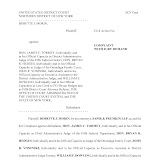
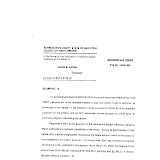
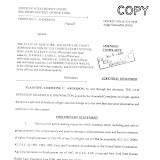
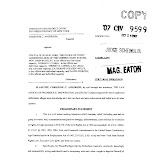
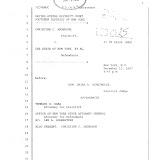
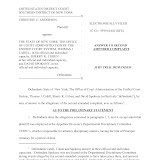
Christine C. Anderson yesterday filed a Motion for a New Trial in Manhattan's federal district court. The case is again before U.S. District Court Judge Shira A. Scheindlin after an October 29, 2009 jury found against Anderson. The motion for a new trial includes startling revelations including the fact that the District Court failed to take appropriate action after learing that there had been threats made against at least one witness in the federal proceeding. The largest problem for those involved appears to be the little tested issue of the usually-accepted widespread conflicts of interest inside the New York State Attorney General’s office.

Highlights from the motion for a new trial include:

  • Apparent abuse of discretion by the District Court Judge.
  • A new trial to “avoid a miscarriage of justice.”
  • Correction: “the district court possesses the power to rectify its own mistakes in the period immediately following the entry of judgment.”
  • “Irregularity of Proceedings: The State of New York Attorney General's Representation of Defendants Unduly Prejudiced Plaintiff and Denied Her Due Process Rights.
  • Anderson was confronted with an unquestionably unfair set of circumstances as the defendants were defended by the New York State Attorney General; and while the plaintiff charged the defendants with serious violations of law, the Attorney General stood before the jury defending these very same actions as proper and within the law. This arrangement seriously prejudiced plaintiff Anderson, as jurors could and most likely did conclude that the State of New York supported fully the conduct of the defendants.
  • Not only did the Attorney General’s representation of the defendants unduly prejudice the Anderson, it also raised serious conflict of interest issues with respect to the defendants themselves. To protect their own rights, each of the defendants should have had their own attorneys in order to permit them to cross claim or make admissions.
  • VIOLATIONS OF ETHICS RULES: Under New York State and federal conflict of interest rules, each of the defendants must be free to undertake these independent actions. To do so, they must have their own counsel. (See NYS Code of Professional Conduct Cannon 5 Conflict of Interest Rules.) The Attorney General as a state attorney is bound by these rules as well. New York State law requires that the attorney who violates these safeguards to be immediately removed from the case.
  • CONFLICT - As a result of these conflict of interest issues, the Attorney General cannot properly represent the defendants, either as a group or individually. Each defendant must have the right to cross-claim against the others, and to bring a counterclaim against the State. These actions most certainly could not be undertaken in a case where the Attorney General represents all the named defendants. Without question, the Attorney General violated its ethical rules and the public trust in undertaking to represent all of the defendants.
  • The involvement of the New York Attorney General in refuting plaintiff's allegations, which involved serious violations of federal and state law and ethical standards, and in presenting the case of each defendants, denied plaintiff's due process and equal protection guarantees, and right to a fair and impartial trial.
  • WHY DIDN”T THE NYS ATTORNEY GENERAL INVESTIGATE?? - The conflict here is particularly acute given the nature of the claims brought by plaintiff Anderson. Plaintiff’s charges warranted an independent investigation by the New York State Attorney General Office to review the basic claims given that Anderson was formerly a Departmental Disciplinary Committee staff attorney with considerable experience. The fact is that these are not allegations from a lay person.
  • While at the DDC, Plaintiff Anderson was charged with investigating cases involving possible criminal and civil misconduct. She carried out her duties as a duly authorized officer of the Court. The New York State Attorney General Office was therefore obligated to protect her and to investigate her claims of serious misconduct against the named parties. For no reason, the New York State Attorney General Office failed to do so.
  • The Attorney General is a publicly funded arm of the State. It was conflicted from the outset of this case because it could not possibly defend any of the defendants, while simultaneously investigating plaintiff ’s claims of serious ongoing misconduct by the defendants. Indeed, no explanation has ever been provided as to why the Attorney General did not represent plaintiff Anderson against any of the original defendants. This was itself a misappropriation of public funds by a state investigatory agency with prosecution powers.
  • Federal law mandates that a special prosecutor be substituted into the case, and this was not done. The actions of the Attorney General here confused, misled and confounded the jury, by creating a false impression that the acts were officially sanctioned by the state.
  • Christine Anderson’s allegations have substantial impact on the public, the bench and bar, and cannot be ignored by the New York State Attorney General Office just because they were motivated to defend this lawsuit. This serious conflict demanded independent counsel for the defendants as a matter fairness and high ethical conduct to all involved, particularly to Christine Anderson.
  • Having denied independent counsel to the defendants, the Attorney General prejudiced plaintiff by making it appear to the jury that the State of New York and the New York State Attorney General Office supported defendants’ conduct. This was a burden Christine Anderson could never overcome and, at a minimum, warrants a new trial.
  • The Court was concerned about the aforestated conflict of interest and in one of its last instructions to the jury, the Court warned the jury not to draw a negative inference adverse to the defendants for their joint representation by the New York State Attorney General Office. That instruction was injurious to the plaintiff, Christine Anderson, in that it prejudiced the jury against her and in and of itself warrants a new trial.
  • It was one of the last instructions to the jury and was thus ingrained in the minds of the jury as a lasting impression. Furthermore, as one of the last instructions to the jury, it elevated its importance over and above all prior instructions as something that had to be considered in deference to all else.
  • There was no countervailing instruction to the jury not to draw a negative inference of the joint representation by the New York State Attorney General Office adverse to the plaintiff. This failure prejudiced the jury against the plaintiff by implying at a minimum, that the state supported all of the defendants’ conduct and found that it was within the bounds of the law.
  • By the Court issuing the jury instruction not to draw a negative inference adverse to the defendants for their joint representation by the New York State Attorney General Office, the court preserved the argument to be raised in this motion and/or appeal.
  • Allowing all of the defendants to be represented jointly by the same counsel and by the New York State Attorney General Office created an impermissible conflict of interest. Indeed, the conflict was so strong, that had the jury ruled against any one or all of the defendants, they would have been entitled to seek a new trial for impermissible conflict of interest, as they would be entitled to their own independent counsel.
  • The court is thus faced with the fact any unsuccessful litigant in this case could be expected to move for and would be entitled to a new trial because of the impermissible conflict of interest, as all of the defendants are required to have their own independent counsel, and to not be represented by the New York State Attorney General’s Office.
  • The American Bar Association's Code of Professional Responsibility elaborates on the duty of a public prosecutor such as the New York Attorney General to seek justice as follows: "This special duty exists because: (1) the prosecutor represents the sovereign and therefore should use restraint in the discretionary exercise of governmental powers, such as in the selection of cases to prosecute; (2) during trial the prosecutor is not only an advocate but he also may make decisions normally made by an individual client, and those affecting the public interest should be fair to all ...."
  • A prosecutor's duty of neutrality is born of two fundamental aspects of his employment. First, the prosecutor, in this case the Attorney General, is a representative of the sovereign, and consequently must act with the impartiality required of those who govern. Second, the Attorney General can at all times call upon the vast power of the government, and therefore must refrain from abusing that power by failing to act evenhandedly.
  • These key duties are not limited to criminal prosecutions, but must also be observed in civil cases as well. These safeguards are included in the ABA Code. "A government lawyer in a civil action or administrative proceeding has the responsibility to seek justice and to develop a full and fair record, and he should not use his position or the economic power of the government to harass parties or to bring about unjust settlements or results."
  • In the present case, the Attorney General was under the ethical duty to withdraw in order to preserve plaintiff's right to a fair and impartial trial. In a case such as this, not only is the Attorney General's neutrality essential to a fair outcome for the plaintiff, it is critical to the proper function of the judicial process as a whole. Our system of justice relies for its validity on the confidence of society. Without a continuing belief by the people that the system is just and impartial, the concept of the rule of law cannot survive.
  • The New York State Attorney General is a public official elected by statewide ballot . The American Bar Association's Code of Professional Responsibility addresses the special considerations applicable to a lawyer who is also a public official as follows: "A lawyer who is a public officer, whether full or part-time, should not engage in activities in which his personal or professional interests are or foreseeably may be in conflict with his official duties." The government's investigative and prosecutorial interests must be balanced against the public interest in insuring that the individuals and organizations receive effective representation, and are accorded their full constitutional rights and protections.
  • There are at least two reasons why a court should satisfy itself that no conflict exists or at least provide notice to the affected party if one does. First, a court is under a continuing obligation to supervise the members of its Bar.(district court obligated to take measures against unethical conduct occurring in proceedings before it). Second, trial courts have a duty "to exercise that degree of control required by the facts and circumstances of each case to assure the litigants of a fair trial."
  • Occupying a position of public trust, the Attorney General, as any public prosecutor is 'possessed ... of important governmental powers that are pledged to the accomplishment of one objective only, that of impartial justice.' The duty of a government attorney has been characterized as 'a sober inquiry into values, designed to strike a just balance between the economic interests of the public and those of the landowner,' is of high order."
  • Central to the issue of preventing prejudicial influence of government attorneys on court proceedings, it is common for states to adopt statutes or regulations that prohibit those holding the office of Attorney General, as well as their deputies and staff attorneys, from participating as attorneys in private litigation matters. The reason for adopting these restrictions is most obvious. For the Attorney General or any member of the staff to participate in a civil trial involving a private litigant will create the prejudicial inference that the state has reviewed and approved the position advocated by the government attorney. Such an inference can and likely will influence the outcome of the matter to the detriment of the opposing party. It is for the stated reasons that no Attorney General or staff member should be permitted to represent a private litigant in any adversarial proceeding. Only such an outright prohibition will properly preserve the standards of fairness and impartiality guaranteed to all litigants under federal and state constitutions. The present lack of statutory and/or ethical policy guidelines barring the participation of state law officers from representing private litigants in civil proceedings which must be addressed by courts and policy makers.
  • Irregularity of Proceedings: Confusing, Misleading and Prejudicial Instructions to the Jury.
  • The Court issued detailed Verdict Sheets to the jury addressing the plaintiff's allegation of retaliation and the related issues of deprivation of a federal right and plaintiff's acts of speech. During the jury's deliberation, the foreman submitted a question to the court for review. The question (SEE EXHIBITS) sought the Court's guidance with respect to instruction number 1b which was described as “ambiguous.” The Court provided an answer (SEE EXHIBITS) to the question which addressed the fact that the plaintiff had made certain statements rather than the way in which the “DDC responded (investigated) properly to the statements [plaintiff] made.”
  • In answering the jury, the court addressed only the initial question, which dealt with the critical issue of the lawsuit, i.e., whitewashing. This key issue was specifically removed from consideration by the jury, when the Court circled the question as to whether the plaintiff had made statements to her superiors and not whether those statements averred that the DDC was not diligently prosecuting allegations of misconduct by respondent attorneys.

 Having circled that question for consideration, the succeeding questions were dealing only with plaintiff's statements [not defined] and NOT with issue of whitewashing. Thus, the succeeding questions were asked in a vacuum and expected to be answered in a vacuum.

 Also, by structuring the questions as the court did, the jury never reached other issues of retaliation or damages, even after it found in plaintiff’s favor in Question 1. The jury was confused by the unclear, very puzzling and convoluted nature of the instructions.
  • This confusion on the part of the jury resulted in a verdict which is in a word repugnant.
  • By eliminating whitewashing from Question 1, the court effectively excised the key gravamen of the complaint , i.e., retaliatory discharge, as a result of plaintiff's complaints of whitewashing and corruption. This constitutes judicial error of the highest order.
  • Juries only get to see and use the instructions for a short time, thus it is crucial that they be clear and understandable to the laymen and laywomen. The court and counsel have the luxury of days to craft and understand the instructions as professionals. The instructions presented in this case are unclear, quite confusing and simply impossible to apply to the facts adduced at trial.
  • There is also no record that the role of the Attorney General as defense counsel was properly and adequately explained to the jury. This also constitutes another reversible error by the Court which could have been rectified.
  • Newly Discovered Evidence
  • The court gave the jury above-referenced instructions and its members adjourned to the jury room to deliberate at approximately 1:25 pm on Thursday, October 29. After the jury left the courtroom, Judge Scheindlin first announced that she had denied the defendants’ pending motion for a directed verdict. She next stated words to the effect that she found that , "....Cahill was aware of the whitewashing allegations..." The judge read this statement related to defendant Cahill’s conduct into the record as part of her order denying defendant's directed verdict. This fact alone requires a new trial.
  • In addition, Courts have an obligation to report and order investigation into official and at times criminal misconduct. This is a duty of the Court. There is no record to date as to any action having been undertaken by the Court regarding this central question. The Court’s finding of culpability on the part of Defendant Cahill constitutes newly discovered evidence, which directly supports the fundamental allegations of Plaintiff.
  • Clearly the newly discovered fact that defendant Cahill, as the head of the DDC and supervisor of the other named defendants, had full knowledge of whitewashing activities would in all likelihood have changed the outcome of the case. This central fact establishing the liability of all named defendants could not have been discovered earlier and is not merely cumulative or impeaching.
  • The new evidence establishes that in the view of the Court, Defendant Cahill, the head officer of the DDC and the supervisor of Cohen, had full knowledge of the practice of whitewashing as alleged by Plaintiff, leading to the parallel conclusion that whitewashing was accepted as a common practice by the defendants, and presumably other staff members of the DDC. Had such facts been confirmed during the trial stage, the jury would have come to know and understand the illegal activities that were accepted as everyday practice by the DDC staff, a finding totally consistent with a main element of Plaintiff’s case.
  • The Court’s statement after the close of trial accepting the establishing the whitewashing activities by Defendant Cahill must be found to constitute grounds for granting the instant motion.
  • Witness Tampering – Threat on Witness in a Federal Proceeding
  • Based on information submitted in the proceeding, the court is aware that one of Plaintiff’s witnesses, DDC staff attorney Nicole Corrado, was confronted by her DDC supervisor on the street just prior to her deposition in this proceeding.
  • As the court was also aware, plaintiff’s former counsel, John Beranbaum, advised the court of this incident in a letter to the court dated October 24, 2008. (SEE EXHIBITS) In the Beranbaum submission, it was made clear to the court that Ms. Corrado was given a ‘“warning’ about the testimony she was to gave at the deposition[,]” and further advised that “Ms. Corrado is very upset about the entire experience.”
  • Mr. Beranbaum again raised the issue on the record four days later on October 30, 2008. (SEE EXHIBITS– Transcript of October 30, 2009 hearing, Page 26 (lines 17-25), and page 27 (lines 1-8)). The court, in responding to the letter advising of the threat on plaintiff’s witness, commented, “You [Mr. Beranbaum] seem to want to tell me something or report it to me. Okay. You reported it to me.”
  • It is plaintiff’s belief that the court had an obligation to report the matter to federal agents and, further, to interview Ms. Corrado concerning the incident. Plaintiff believes she has been severely prejudiced by the threat upon witness Corrado, and, as the court is aware, Ms. Corrado did not appear at a witness in this proceeding.
  • While plaintiff is aware that counsel within the Office of the New York Attorney General’s office offered to “fully” compensate Mr. Beranbaum for ALL of his legal fees, expenses, etc., if plaintiff settled her case, I am unaware of the exact timing of when the compensation offer, believed to be between $120,000.00 and $150,000.00, was actually made.
  • Conclusion
  • For the reasons set forth in detail herein, Movant respectfully requests that this Court in the interest of justice grant a new trial. As noted, the participation of the Attorney General in failing to investigate the charges submitted by plaintiff against the defendants, and subsequently representing these same persons in the instant court proceedings, denied plaintiff’s constitutionally protected right to a fair and impartial trial. This denial of basic rights was compounded by unclear, confusing and convoluted instructions to the jury, discovery of new evidence and serious allegations of intimidation of witnesses, which all support the instant motion for a new trial. For all of the reasons set forth herein, the plaintiff is entitled and warrants being accorded a new trial. Furthermore, Movant is Ready willing and able to go to trial immediately and no delay, harm, or prejudice will occur to the other parties as a result of Movant's motion. Inasmuch as the Attorney General should even be denied the opportunity to answer, and as justice demands, the court should sua sponte, grant the herein sought relief.

Christine C. Anderson

Blog Archive

See Video of Senator John L. Sampson's 1st Hearing on Court 'Ethics' Corruption

The first hearing, held in Albany on June 8, 2009 hearing is on two videos:


               Video of 1st Hearing on Court 'Ethics' Corruption
               The June 8, 2009 hearing is on two videos:
         
               CLICK HERE TO SEE Part 1
               CLICK HERE TO SEE Part 2
Add to Technorati Favorites