MLK said: "Injustice Anywhere is a Threat to Justice Everywhere"

End Corruption in the Courts!

Court employee, judge or citizen - Report Corruption in any Court Today !! As of June 15, 2016, we've received over 142,500 tips...KEEP THEM COMING !! Email: CorruptCourts@gmail.com

Sunday, March 15, 2009

Castigated Judge Known as Fair, Faithful Man

Castigated Judge Known as Fair, Faithful Man
Pr. George's Jurist Criticized for Freeing Murder Defendant Without Bond
The Washington Post by Avis Thomas-Lester - March 15, 2009


In the courtroom, Judge Hassan A. El-Amin is known for delivering stern but respectful lectures. Some defendants get the "Rayful Edmond" speech, where they hear about the notorious drug kingpin serving a life sentence for running the area's largest crime organization. Others get the "this is why you are going to jail" speech. "He'll say something like, 'Your parents couldn't correct you, your teachers couldn't correct you, so now you're faced with a whole correctional system. You have to be corrected,' " said Sonsyrea Tate Montgomery, a longtime friend of the Prince George's County district judge. Although El-Amin's March 5 decision to release murder defendant Sean M. Sykes without bond has drawn criticism from police and prosecutors, acquaintances said his approach on the bench is informed by his Muslim faith, and several defense lawyers described him as a fair judge. "My clients walk away feeling like they had a fair hearing, whether they leave through the back door wearing handcuffs or walk out the front of the courthouse," said criminal defense attorney Antoini Jones. Sykes was arrested Thursday on a drug charge, a week after being released. Those critical of El-Amin's decision in the Sykes case could point to no specific cases that would prove a broad pattern of leniency toward defendants. Last March, however, El-Amin set bond at $50,000 for Arlen C. Garrett, another defendant charged with second-degree murder.

District judges in Prince George's rarely release murder defendants before trial. The few who are released usually post a high bond -- generally no less than $500,000. Garrett, then 22 and enrolled at Howard University, was accused, along with another man, of killing a teenager in Hyattsville over drugs. In court, Garrett had strong support from his father, an architect, and his mother, a teacher. After El-Amin set bond, Garrett's family paid 10 percent to a bondsman and Garrett was released. Garrett appeared at all court hearings and stayed out of trouble. He ultimately pleaded guilty to attempted armed robbery and a gun charge and was sentenced in January to eight years in prison. Defense lawyer Christopher Griffiths cited the case as an example of a judge exercising discretion properly. "Some judges have knee-jerk reactions when they see someone charged with murder," said Griffiths, who represented Garrett. "That's not what we want from members of the bench." El-Amin is a classical pianist and motorcycle enthusiast, a former defense attorney who coordinates an annual youth oratorical contest and who founded a chess program at a high school in Temple Hills.

Sykes is charged with second-degree murder in the Feb. 24 stabbing of Rene R. Belasco in Oxon Hill. Police allege that Sykes is a member of the Bloods gang and that, on the night of the slaying, he and another man threatened to kill a witness. Sykes was initially held on $1.5 million bond, but El-Amin released him to his mother after concluding that Sykes posed no danger to the community and was not a flight risk. Prosecutors are seeking to reverse the ruling, alleging in court papers that returning Sykes to the apartment building where he lives and where the stabbing occurred "places all residents in fear and all witnesses in potential danger." Belasco's stepfather called the judge's decision a "travesty." Prosecutors revived an earlier drug case against Sykes, and he was arrested Thursday for possession of marijuana with intent to distribute. He is expected to be in court tomorrow in that case. El-Amin, who was appointed to the District Court in 2000 by Gov. Parris N. Glendening (D), declined to speak for this story. Acquaintances said El-Amin's treatment of defendants in his courtroom is borne of a respect for individual rights that is a tenet of his Muslim faith. Born Vernon Jones in Charleston, W.Va., he attended Yale on a full scholarship before embracing Islam and going to law school.

For several years, El-Amin has coordinated a youth oratorical contest sponsored by the J. Franklyn Bourne Bar Association, an organization of mostly black lawyers in Prince George's and Montgomery counties. El-Amin, 61, helped found programs to provide educational enrichment to at-risk youths and to teach students about the consequences of drug and alcohol abuse. He started a chess program at Crossland High School, said attorney Betty Hewlett, who has known El-Amin for 27 years. "He is very bright, very studious, very dedicated and multi-talented," Hewlett said. "But his biggest commitment is to young people. He feels it is a responsibility . . . because we lose so many." The judge holds a patent for a device that pre-moistens bathroom tissue, records show. He has been married for more than 30 years and has adult children and grandchildren, acquaintances said. Steven Stosny, director of the Core Value Workshop, a treatment program for domestic-violence defendants, said his clients credit El-Amin for taking an interest in their progress and encouraging them to continue to improve. "He believes you can make a psychological difference in people's lives," Stosny said. "I find him to be compassionate and caring. When you give people the benefit of the doubt, there can be a margin of error."

Jones said the controversy surrounding El-Amin's decision in the Sykes case is likely to have a "chilling effect" on the willingness of other judges to exercise their discretion over whether to release defendants before trial. In a previous interview, El-Amin criticized the Maryland court system for failing to provide lawyers to defendants at bond hearings. He also said he takes seriously "the presumption of innocence." But some law enforcement officials said that the decision was wrong and that residents' safety should outweigh defendants' rights. "I appreciate his focus on the rights of the defendants, but the bigger group we deal with in the police department are victims," said Maj. Andy Ellis, spokesman for the county police. "What about the rights of our victims?" Staff writer Ruben Castaneda and researcher Meg Smith contributed to this report.

Saturday, March 14, 2009

Push for Madoff to Sing about Schumer-like Ties, Appeal Filed

Circuit Set to Hear Appeal on Madoff Bail
The New York Law Journal by Mark Hamblett - March 16, 2009

Bernard Madoff's lawyers will have a tough time convincing the U.S. Court of Appeals for the Second Circuit to order their client released on bail until he is sentenced June 16, because the standards for post-conviction release are high and hard to meet. Ira Sorkin and Daniel Horwitz of Dickstein Shapiro filed papers in the circuit Friday arguing that Southern District Judge Denny Chin should not have revoked Mr. Madoff's bail on Thursday, which sent him off to the Metropolitan Correctional Center following his guilty plea. Arguments are scheduled for this Thursday morning before Judges Dennis Jacobs, Richard Wesley and Robert Sack. The government is expected to submit its own papers by tomorrow, arguing that Judge Chin's decision should stand. Messrs. Sorkin and Horwitz will first try to convince the panel to quickly grant their motion to stay the remand order and their motion to reinstate the bail conditions that governed Mr. Madoff until he pleaded guilty to 11 felonies in the multi-billion dollar fraud he executed out of the offices at Bernard L. Madoff Investment Securities. If they are unsuccessful on those motions, the attorneys can still follow through with their appeal of Judge Chin's decision, albeit over a longer time period. Post-conviction detention is governed under 18 U.S.C. §3143, and the standards for determining bail are much stricter than those for pretrial bail under §3142, in part because the presumption of innocence no longer applies.

But the basic difference is that in the Bail Reform Act "there is no constitutional right to bail once a person has been convicted." These distinctions were made by Mr. Sorkin in papers filed during his successful effort in January to persuade Magistrate Judge Ronald Ellis to allow Mr. Madoff to remain out on bail pending a trial or a plea - a decision Judge Lawrence McKenna later left undisturbed on appeal. Release of a defendant pending sentencing, as opposed to pending appeal, is covered by §3143(a), a tough standard. The statute states the judge "shall order" a person be detained unless the judge finds by clear and convincing evidence that the person is not likely to flee or pose a danger to the safety of any person or the community if released under §3142(b) or (c). These subsections lay out the standard for pretrial release. But if the defendant can make such a showing by clear and convincing evidence, the statute goes on to state that the judge "shall order" release.

Judge Chin's decision's will be reviewed by the Second Circuit under the clear error standard, another difficult hurdle for the defense team. When Mr. Madoff, 70, pleaded guilty last week, Mr. Sorkin tried to argue that other high-profile white-collar defendants have been allowed to stay out of prison post-conviction and pending sentencing. But when Assistant U.S. Attorney Marc Litt rose to give the counter-argument, Judge Chin said he did not need to hear the government's side. "The exposure is great, 150 years in prison," Judge Chin said. "In light of Mr. Madoff's age, he has an incentive to flee, he has the means to flee, and thus, he presents a risk of flight." In their papers, Messrs. Sorkin and Horwitz said Judge Chin "erroneously failed to release Mr. Madoff because the evidence clearly shows that Mr. Madoff is not a flight risk and does not pose a threat to the community."

The attorneys cite the Second Circuit case of United States v. Abuhamra, 389 F. 3d 309 (2004). Abuhamra states that if a defendant "can make the required evidentiary showing, the statute establishes a right to liberty that is not simply discretionary but mandatory." The Abuhamra court also notes the language in the statute that the judge "SHALL order the release of the person in accordance with §3142(b) or (c)." The lawyers say Judge Chin applied the wrong standard "because the Bail Reform Act does not require a showing that the defendant does not have an incentive to flee." Until Thursday, Mr. Madoff was out on $10 million bail but was confined to his Park Avenue penthouse, wearing an electronic monitoring bracelet. Initially, the government did not object to Mr. Madoff's bail package, but that changed when Mr. Madoff and his wife, Ruth, mailed $1 million in jewelry and other valuables in late December to family and friends. Mr. Sorkin and Mr. Horwitz claim Mr. Madoff's guilty plea does not change a thing. They remind the circuit that Mr. Madoff "confessed to his sons that he had committed fraud in the amount of $50 billion," and "voluntarily admitted his culpability to the FBI."

"Based on these actions, Mr. Madoff certainly understood that he faced essentially a life sentence at the time he made his confessions," they said. "Finally, that Mr. Madoff has now pled guilty does not alter the factual analysis regarding his risk of flight in any meaningful way," they said. "The district court ignored the fact that Mr. Madoff was always cognizant of the fact that he would die in prison - in essence, this was a foregone conclusion since the moment of his arrest on Dec. 11, 2008." Meanwhile, papers released Friday as part of the appeal states that Mr. Madoff has between $823 million and $826 million in assets. The papers, a statement of assets and liabilities assembled for the civil case brought against Mr. Madoff by the Securities and Exchange Commission, show that the bulk of the assets, $700 million, represented the net value of Mr. Madoff's businesses. Among the monthly expenses listed on the documents is $100,000 a month in legal fees. Mark.Hamblett@incisivemedia.com

Friday, March 13, 2009

Another Lawyer Accused of Screwing With Property Deed

Lawsuit: Congers woman duped out of deed to home
The Journal News by James Walsh and Steve Lieberman - March 13, 2009

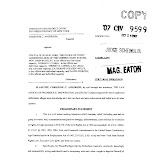
A 76-year-old Congers woman has accused Monsey attorney Ryan Karben and a New Jersey-based company of misrepresenting a real estate transaction in which she says she lost the deed to her home. The lawsuit filed in federal court in White Plains accuses Karben and a limited liability corporation called High Mountain Sanitation Haverstraw of engaging in a "scheme" to deprive Elizabeth DiGiacomo of a two-bedroom townhouse at 46 Leif Blvd. "She thought she was getting a $40,000 loan and giving back a mortgage," said Wayne Gavioli, a Nanuet attorney representing DiGiacomo, but instead she signed the property deed over to High Mountain Sanitation. Karben said the lawsuit was baseless. "I attended a closing, and that's the extent of my involvement in this," Karben said. "Any conjecture that I did anything improper is utter nonsense." He said that a son of DiGiacomo's attended the closing and appeared to be advising her throughout the transaction.

DiGiacomo needed the loan to pay her son's medical and business debts, Gavioli said. The deed filed at the Rockland County Clerk's Office on Dec. 12 stated that $260,000 was paid for the house, but Gavioli said DiGiacomo got only the $40,000. "My client said Ryan put the document in front of her and told her to sign," said Gavioli, who filed the lawsuit Monday. "She had no idea she was conveying over the property," Gavioli said. "When she later learned that, she almost had a heart attack." The lawsuit was filed under civil provisions of the federal Racketeer Influenced Corrupt Organizations Act, known as RICO. Citizens are allowed to initiate lawsuits using the statute if they believe they can prove they were victimized by a criminal enterprise. Neither Karben nor Gavioli knew the son's name or how to contact him. Gavioli said the son was undergoing treatments for cancer.

Karben would not discuss how he came to represent DiGiacomo, but later stated in an e-mail that "a local businessperson" asked if he would represent a friend's mother at the closing on Nov. 18. In a subsequent interview, Karben wouldn't name that businessperson. "It wouldn't be appropriate to discuss that because there's litigation going on," Karben said. "I'm not going to discuss other people." He said DiGiacomo's lawsuit "is utterly baseless. She reviewed the documents that she signed. She knew she was doing a real estate sale and that was that." Karben said he was not involved in the sale price or any negotiations with High Mountain Sanitation. He said he didn't know anyone connected with High Mountain, and no lawyer represented the company at the closing. By bringing the lawsuit, DiGiacomo sought "to vacate and set aside the deed as (a) false and fraudulent instrument induced by a scheme to deprive (DiGiacomo) of full ownership and title" to the property. DiGiacomo also wants $500,000 from the defendants.

The new owner

Public records did not provide the names of High Mountain Sanitation's principals or attorneys. A telephone call to Meister Abstract of Brooklyn, the title company involved in the transaction, was not returned yesterday. Incorporation records filed with the New York Department of State on June 15 gave the address of High Mountain Sanitation as 892 Belmont Ave., Prospect Park, N.J.

The street, though, does not extend into Prospect Park, and 892 Belmont is the North Haledon, N.J., location of the Puddingstone Group, a real estate business that last year proposed building apartments on the closed Ramapo landfill. Gershon Alexander, a member of the corporation, is a brother of Naomi Streicher, a Pomona real estate broker who had listed the sale of DiGiacomo's home. Streicher said she had been unaware of the deed transfer and had thought that only a lien was being put against the property so DiGiacomo could get the $40,000 loan. "The deal was that she was selling the house and that she'd get a loan until she sold the house," Streicher said. She said the transaction occurred in her office, but she wasn't present and was unaware until months later that the deed had changed hands. Streicher said she received no commission, and she removed the property from Multiple Listing Service on Feb. 12. Alexander said he knew nothing about High Mountain Sanitation Haverstraw or about the real estate transaction with DiGiacomo. He was not at his North Haledon office when a reporter went there yesterday morning, and he did not return messages seeking additional information from him.

She's still in the house

Gavioli said DiGiacomo hasn't moved from the house and while there were no attempts to evict her, she was staying with relatives in Massachusetts. He said she paid the mortgage and common charges until he advised her to stop a month ago. DiGiacomo went to Gavioli in February for advice about Medicare for her husband, Frank, who was in a long-term-care facility, and to have Gavioli represent her when she sold her house. Gavioli said he discovered the transferred deed while researching public records for the $40,000 lien. He said he sent copies of the lawsuit to the U.S. Attorney's Office in White Plains. A spokesman for the office, Herbert Hadad, would not say whether it knew of the lawsuit and would not confirm nor deny a potential investigation.

Karben, a Spring Valley deputy village attorney and special counsel for Suffern's urban renewal project, said he was surprised by DiGiacomo's charges. "I walked in there thinking it was a property sale and left thinking it was a property sale," Karben said. "I was shocked to learn Mrs. DiGiacomo did not think she was transferring title to their property." Karben is a former state assemblyman who resigned abruptly nearly three years ago. Last week, Suffern Mayor John Keegan and Deputy Mayor John Meehan proposed removing Karben and transferring his duties to Village Attorney Terry Rice. They were overruled by Trustees Dagan LaCorte, Patricia Abato and Andrew Haggerty. "My reason was that I'm fully confident the village attorney can take this project into the future," Keegan said, "and in these times we have to look at (eliminating) duplication of services." LaCorte, who's opposing Keegan in a mayoral primary, has seen Karben's continued work on the project as crucial to its success.

Thursday, March 12, 2009

Thug, Just Admonished by Judge, Arrested for Fraud, Wanted for Rape

Man charged with scamming NYC Transit wanted in rape
Newsday by ROCCO PARASCANDOLA -  March 12, 2009

The Queens man called "a crook" by a civil court judge suspicious of his injury claims against New York City Transit has been charged with insurance fraud and grand larceny - and authorities say he's wanted for a rape in Pennsylvania. Newsday on Monday reported on the unusual case involving Paul Hightower, the 37-year-old mortgage company worker who said that in 2006 he had to quit work because of debilitating injuries suffered when the driver of the Q-85 bus in Springfield Gardens turned so sharply that he was thrown from his seat and into the exit well of the bus. Hightower sued. But last month, with the case close to trial, Judge Duane Hart sharply rebuked Hightower in court. He declared a mistrial, recused himself and referred the case to the Queens district attorney's office. "What I am saying is, in this case, and I am telling Mr. Hightower on the record, I am recusing myself because I think you are a crook," Hart said. "It seems like you live on files, claims for accidents, real or imagined or set up." Yesterday, the DA accused Hightower of fraud.

Hightower after the incident received $17,000 in insurance money from New York City Transit, a sum that was based on lost wages DA Richard Brown says were dramatically overstated. Paul J. Fleuranges, vice president of corporate communications for New York City Transit, said, "Individuals who engage in the prosecution of fraudulent or exaggerated claims of personal injury need be aware of the potentially severe consequences of their conduct." As Hightower was being processed in Queens on the fraud charge, authorities learned there was a warrant out for his arrest in Harrisburg, Penn.  Authorities there could not be reached for comment yesterday, but Brown says Hightower was charged in 2002 with raping a minor. Hightower was arraigned Tuesday night and ordered held without bail. He refused to waive extradition on the rape charge. Hart and his lawyer did not respond to requests for comment. rocco.parascandola@newsday.com

NYLJ: Lippman Shakes Up Court Administration

Lippman Shakes Up Court Administration
The New York Law Journal by Joel Stashenko - March 12, 2009

ALBANY, NEW YORK - Jonathan Lippman yesterday took what he called the first of many intended steps as chief judge to clear away "administrative clutter" in the upper echelons of New York state's court structure by reducing from five to two the number of deputy chief administrative judges. The new chief judge said that only the posts of deputy chief administrative judges for the courts in New York City and for the courts outside of New York City remain.

He announced that he has appointed Supreme Court Justice Fern Fisher, 54, as deputy chief administrative judge for courts in New York City. She succeeds Judge Joan B. Carey, the deputy chief administrative judge for New York City courts since 1997. Judge Carey, 69, will remain as interim administrative judge for the civil branch of Manhattan Supreme Court through the end of the year, when she retires. Judge Jan H. Plumadore, 66, is chief administrative judge for courts outside New York City. The titles of deputy chief administrative judges for matrimonial affairs, for justice initiatives and for court operations and planning will be eliminated and their former holders have either been reassigned to other duties or retired.  Chief Judge Lippman also announced, as expected, that Ann Pfau would remain as chief administrative judge. Judge Pfau, 60, succeeded Judge Lippman as chief administrative judge in 2007, when Judge Lippman was appointed presiding justice of the Appellate Division, First Department.

In addition, Judge Juanita Bing Newton, the deputy chief administrative judge for justice initiatives, has been appointed dean of the Pace University-affiliated New York State Judicial Institute. Judge Newton, 58, will succeed Robert G.M. Keating, who became Pace's vice president for strategic initiatives last year. Judge Judy Harris-Kluger, 56, deputy chief administrative judge for court operations and planning, will head a newly created Office of Policy and Planning that will work with judges to improve the efficiency of the state's courts.  The title of the fifth deputy chief administrative judge, for matrimonial matters, will be eliminated. It has been vacant since the Dec. 31 retirement of Jacqueline W. Silbermann. Chief Judge Lippman said the training and mentoring of matrimonial judges statewide will now be done through the Judicial Institute. He added that Judge Fisher will relinquish her job as citywide Civil Court administrator, Judge Kluger as citywide Family Court administrator and Judge Newton as citywide Criminal Court administrator as they take their new assignments.

Time to Reassess

He said with all three jobs open, it would be a good time to reassess the effectiveness of the positions as part of the overall analysis of supervisory and administrative judges statewide.  Judge Lippman has been hinting at making significant changes in court leadership since Feb. 11, the day he was confirmed by the state Senate.  Yesterday's announcements also represented his first significant break with operations of the courts as they developed during former Chief Judge Judith S. Kaye's 15-plus years as chief judge.  Judge Lippman served for 12 of those years as chief administrative judge and, as he acknowledged yesterday, was in part responsible for developing the structure of the five deputy chief administrators at the top of the court system.  Judge Lippman called Ms. Kaye "the greatest chief judge in the history of this state," but said it is time for changes. He said the grim state of New York's finances and of the state and national economies are in large part dictating the streamlining of the court leadership's flow chart.

"As chief judge, in my own right, just as Judge Kaye addressed the challenges that confronted her during her 15-year tenure, I think there are new challenges facing this state," Judge Lippman said yesterday in an interview. "Two that hit you square in the face - one is this judicial salary debacle that must be addressed and the other is a fiscal crisis of epic proportions facing this state and this country. That is the framework for the challenges that I am going to confront in the years ahead." He said the changes are designed to create a "clean, straight line from administration to the trial courts."  "The idea is to put the focus on court operations, on the trial courts, and to streamline the administrative structure to allow that priority of the court system to shine through," Judge Lippman said.  While he had no estimate of savings to the court system, he said the shift would ultimately free up resources that could be directed to the trial-level courts.

Judge Lippman said other changes are coming. The state courts' 56 administrative and supervising judges will be re-evaluated and bureaucratic changes at the Office of Court Administration are also under review. The courts have increasingly drawn criticism from within the Legislature in recent years, especially from the former chairman of the Senate Judiciary Committee, John DeFrancisco, R-Syracuse, for being top-heavy administratively and bureaucratically.  Judge Lippman acknowledged the criticism and said the administrative structure grew because changes in the court system demanded administrators with new "portfolios" to respond to new stresses on the courts. The changes announced yesterday were made in consultation with the four presiding justices of the Appellate Division and went into effect immediately. Judge Lippman said that having a "leaner" administrative structure will not inhibit the courts' efforts to address the judicial pay raise controversy or respond to other challenges facing the courts, including the possibility of drug law reform, shortages of funding for indigent legal services in civil and criminal courts and the continuing need to improve town and village courts. Joel.Stashenko@incisivemedia.com

NY BigLaw Firm Lays Off 25 Attorneys

NY BigLaw Firm Lays Off 25 Attorneys
The National Law Journal by Leigh Jones - March 11, 2009

New York-based Chadbourne & Parke let go of 25 attorneys on Tuesday, according to a spokesman for the law firm. The cuts were made because of the economic downturn and will affect associates and counsel handling transactional work in its U.S. and overseas offices, according to Andrew Blum, media relations manager at the firm. In addition, the law firm will delay the start date for its first-year associates until January. It will pay those people a $13,000 "bar and expense" stipend, the spokesman said. The reductions will not affect Chadbourne & Parke's summer associate class, he said, adding that the firm does not expect additional layoffs. The spokesman declined to disclose the details of severance packages. In October, Chadbourne & Parke implemented a hiring freeze, as reported on the legal blog Above the Law. Before the layoffs, Chadbourne & Parke had about 480 attorneys in 13 offices, according to The NLJ 250, The National Law Journal¹s annual survey of the nation¹s largest law firms. Mr. Blum told Law Journal affiliate Legal Times that the layoffs were "an economic decision due to the recession." He says the associates who were affected were primarily in the firm's transactional practices. Blum says the affected lawyers who were in the office today have already been informed. He would not confirm whether anyone was laid off in the firm's Washington office, which has over 50 lawyers. The firm will be offering severance packages to those affected, but Blum says "the individual separation pay arrangements will not be disclosed." Additional reporting for this story was provided by Jeff Jeffrey, a reporter with Legal Times, a Law Journal affiliate based in Washington.

Wednesday, March 11, 2009

'Officer of Court' Admits to Bribery

Local Attorney Bribed Government Official
The Connecticut Law Tribune by Douglas S. Malan - March 11, 2009

Meriden attorney Sebastian S. Ciarcia has pleaded guilty to one count of bribing a government employee to obtain contracts for construction companies he managed. Ciarcia, 56, also pleaded guilty before Judge Donna F. Martinez in federal court in Hartford of one count of aiding and assisting in the preparation of a false tax return for the construction companies’ principal owner. Ciarcia, who had no prior disciplinary record, is a solo practitioner who has handled personal injury, real estate and family law cases. For a time, he also managed Escarnio Construction LLC of Meriden and Fischer Supply LLC of Wallingford. Both companies are now dissolved, according to state records.

From 2002 to 2005, Ciarcia bribed Kevin Malarney, a West Haven-based supervisor for the U.S. Department of Veterans Affairs, to steer VA contracts for services and supplies for the two businesses, according to the U.S. Attorney's office in Connecticut. Malarney, 56, was a construction and maintenance supervisor at the VA facility in West Haven. He pleaded guilty in June 2007 to one count each of bribery and filing a false income tax return. He awaits sentencing. Ciarcia's companies agreed to pay Malarney's mortgage, automobile loan, student loans, insurance policy premiums and credit card bills. They also paid for Malarney’s trips to St. Maarten and New York. The estimated value of the bribes: $45,600. In return, Malarney assisted in awarding 27 VA contracts worth approximately $303,000 to Ciarcia’s companies. Malarney also helped direct 48 payments totaling about $81,000 to Fischer Supply for services and supplies. When he is sentenced in May, Ciarcia, an Avon resident, faces up to 15 years in prison and a fine of up to $250,000 on the bribery charge. The false tax return charge carries maximum penalties of three years in prison and a $100,000 fine.

BigLaw Firm Ponies Up $10 Million to Settle Malpractice Suit

BigLaw Firm Ponies Up $10 Million to Settle Malpractice Suit
The San Francisco Recorder by Amanda Royal - March 11, 2009

SAN FRANCISCO, CA - Pillsbury Winthrop Shaw Pittman has reached a $10 million settlement in a malpractice dispute with bankrupt client SonicBlue, a court filing Tuesday shows. The firm will pay $7.6 million and forgo $2.4 million in outstanding fees to SonicBlue's estate, according to the filing, which awaits approval by a bankruptcy judge at a hearing slated for March 31. SonicBlue's estate had sued Pillsbury for malpractice and breach of fiduciary duty, demanding the firm return $4.2 million in fees and pay $11 million in damages. "The creditors committee is pleased with the terms of the settlement," said Ron Oliner, a partner at Duane Morris who represents the creditors committee in the bankruptcy.

Pillsbury General Counsel Ronald Van Buskirk declined to comment beyond pointing at language in the settlement saying the deal had been reached to the parties' mutual satisfaction. Pillsbury represented the SonicBlue estate from the filing of its bankruptcy petition in 2003 until 2007 when it came to light that the firm had failed to disclose to the court a 2002 pre-bankruptcy promise to creditors. The firm promised in a letter to three hedge funds, which had invested in a $75 million bond issue, that they would be repaid in full should SonicBlue enter bankruptcy protection. Pillsbury attorneys later described the letter as a "scrivener's error." The hedge funds threatened to sue for repayment in September 2006. In a 2005 internal e-mail sent by Pillsbury partner William Freeman about the retainer SonicBlue had paid, he told partner Craig Barbarosh that the firm had "major exposure here." Citing the potential conflicts, the bankruptcy judge removed Pillsbury from the case in March 2007. In early 2008, the bankruptcy trustee, Dennis Connolly of Alston & Bird, sued Pillsbury over the undisclosed promise, as well as a failure to disclose that it had received payments from SonicBlue within 90 days of the bankruptcy filing. Any firm that participates in a bankruptcy must disclose such "preference payments" because they can represent a conflict of interest and sometimes must be returned to distribute to other creditors.

The settlement comes as a result of mediation in February between the parties, which was ordered by Judge Marilyn Morgan of the U.S. Bankruptcy Court for the Northern District of California in San Jose. She denied Pillsbury a jury trial in November, and had set a bench trial for this fall in the event mediation failed. Howard, Rice, Nemerovski, Canady, Falk & Rabkin litigation chairman Bernard Burk, who represents Pillsbury, referred comment to Pillsbury's Van Buskirk. Another firm involved in SonicBlue's bankruptcy, Levene, Neale, Bender, Rankin & Brill, settled for $2.5 million in November, and forfeited $2.2 million in fees it was owed. The firm, which was accused of failing to disclose preference payments, did not have to pay back $1.2 million in fees it had already collected. The court-appointed trustee, Connolly of Alston & Bird, is out of the office for the week and could not be reached for comment. The SonicBlue estate paid out about $75 million to creditors last fall after a liquidation plan was approved.

Tuesday, March 10, 2009

MADOFF CHARGED IN ELEVEN-COUNT CRIMINAL INFORMATION

United States Attorney Southern District of New York
FOR IMMEDIATE RELEASE  MARCH 10, 2009
CONTACT: U.S. ATTORNEY'S OFFICE - YUSILL SCRIBNER, REBEKAH CARMICHAEL, JANICE OH
PUBLIC INFORMATION OFFICE - (212) 637-2600
FBI - JIM MARGOLIN, MONICA McLEAN - PUBLIC INFORMATION OFFICE - (212) 384-2720, 2715
DOL-EBSA - GLORIA DELLA - PUBLIC INFORMATION OFFICE - (202) 693-8666


BERNARD L. MADOFF CHARGED IN ELEVEN-COUNT CRIMINAL INFORMATION

LEV L. DASSIN, the Acting United States Attorney for the Southern District of New York, JOSEPH M. DEMAREST, JR., the Assistant Director-in-Charge of the New York Field Office of the Federal Bureau of Investigation ("FBI"), and ALAN D. LEBOWITZ, the Deputy Assistant Secretary of the United States Department of Labor, Employee Benefits Security Administration ("DOL-EBSA"), announced the filing today of a Criminal Information in Manhattan federal court charging BERNARD L. MADOFF with eleven felony charges including securities fraud, investment adviser fraud, mail fraud, wire fraud, three counts of money laundering, false statements, perjury, false filings with the United States Securities and Exchange Commission ("SEC"), and theft from an employee benefit plan. There is no plea agreement between the government and the defendant. If found guilty of all counts, MADOFF, 70, faces a statutory maximum sentence of 150 years' incarceration. MADOFF is also subject to mandatory restitution and faces fines up to twice the gross gain or loss derived from the offense. The Criminal Information filed today also includes forfeiture allegations which would require MADOFF to forfeit the proceeds of the charged crimes, as well as all property involved in the money laundering offenses and all property traceable to such property. The statutory maximum sentences for each of the charged offenses are set forth in an attached chart.

Specifically, the Criminal Information alleges that:

BERNARD L. MADOFF is the founder, and served as the sole member and principal, of Bernard L. Madoff Investment Securities LLC, and its predecessor, Bernard L. Madoff Investment Securities, (collectively and separately, "BLMIS"). BLMIS was a broker-dealer, with its principal place of business in New York City, which engaged in three principal types of business: market making; proprietary trading; and investment advisory services. Madoff Securities International Ltd. ("MSIL") was an affiliate of BLMIS incorporated in the United Kingdom, which engaged principally in proprietary trading. MADOFF owned the majority of the voting shares of MSIL, and served as the Chairman of MSIL's Board of Directors. From at least the 1980s until his arrest on December 11, 2008, MADOFF perpetrated a scheme to defraud the clients of BLMIS by soliciting billions of dollars of funds under false pretenses, failing to invest investors' funds as promised, and misappropriating and converting investors' funds to MADOFF's own benefit and the benefit of others without the knowledge or authorization of the investors.

To execute the scheme, MADOFF solicited and caused others to solicit prospective clients to open trading accounts with BLMIS, based upon his promise to use investor funds to purchase shares of common stock, options, and other securities of large, well-known corporations, and representations that he would achieve high rates of return for clients, with limited risk. However, as MADOFF well knew, these representations were false. MADOFF failed to invest the BLMIS investment advisory clients' funds in securities as he had promised. Instead, notwithstanding representations that MADOFF made and caused to be made on tens of thousands of account statements and other documents sent to BLMIS clients throughout the operation of the scheme, MADOFF operated a massive Ponzi scheme in which client funds were misappropriated and converted to the use of MADOFF, BLMIS, and others. In connection with the Ponzi scheme, MADOFF accepted billions of dollars of investor money—cumulatively, from individual investors, charitable organizations, trusts, pension funds, and hedge funds, among others—and established on their behalf thousands of accounts at BLMIS.

Among the false representations he made to clients and prospective clients about his investment strategies, MADOFF marketed an investment strategy referred to as a "split strike conversion" strategy. Clients were promised that BLMIS would invest their funds in a basket of approximately 35-50 common stocks within the Standard & Poor's 100 Index (the "S&P 100"), a collection of the 100 largest publicly traded companies in terms of their market capitalization. MADOFF claimed that he would select a basket of stocks that would closely mimic the price movements of the S&P 100. MADOFF further claimed that he would opportunistically time those purchases, and would be "out of the market" intermittently, investing clients' funds in these periods in United States Government-issued securities such as United States Treasury bills. MADOFF also claimed that he would hedge the investments that he made in the basket of common stocks by using investor funds to buy and sell option contracts related to those stocks, thereby limiting potential losses caused by unpredictable changes in stock prices. Further, to induce new and continued investments by clients and prospective clients, MADOFF promised certain clients annual returns in varying amounts of up to approximately 46 percent per year. MADOFF also told certain clients that the fee for his services would be based on an approximately $0.04 per share commission on the stocks that MADOFF traded for such clients. Contrary to promises that he would use investor funds to purchase securities on their behalf and invest client funds pursuant to the strategies he had marketed, MADOFF used most of the investors' funds to meet the periodic redemption requests of other investors. In addition, MADOFF took some of these clients' investment funds as "commissions," which he used to support the market making and proprietary trading businesses of BLMIS, and from which he and others received millions of dollars in benefits.
MADOFF created and caused to be created a broad infrastructure at BLMIS to generate the impression and support the appearance that BLMIS was operating a legitimate investment advisory business in which client funds were actively traded as he had promised, and to conceal the fact that no such business was actually being conducted. Among other things, MADOFF hired numerous employees—many of whom had little or no prior pertinent training or experience in the securities industry—to serve as a "back office" for this investment advisory business. MADOFF directed those BLMIS employees to communicate with clients and generate false and fraudulent documents, including monthly client account statements and trade confirmations purporting to reflect the purchases and sales of securities which MADOFF claimed were conducted on behalf of BLMIS's clients. Furthermore, account statements and trade confirmations sent to clients reflected fictitious returns consistent with the returns that had previously been promised to them. Moreover, to support BLMIS's market making and proprietary trading businesses, between at least 2002 and about 2008, MADOFF caused more than $250 million of BLMIS investment advisory clients' funds to be directed, through a series of wire transfers, to the operating accounts that funded the operations of these businesses. Specifically, MADOFF caused those investor funds to be sent from a BLMIS account in New York City (the "BLMIS Client Account") to accounts held by BLMIS-affiliate MSIL in London, United Kingdom (the "MSIL Accounts"). He then further caused funds to be transferred from the MSIL Accounts to either the BLMIS Client Account or to another bank account in New York City, which was principally used to fund BLMIS's operations.
MADOFF directed these funds transfers, in part, to give the appearance that he was conducting securities transactions in Europe on behalf of the investors when, in fact, he was not. MADOFF also directed the transfer of funds from the MSIL Accounts to purchase and maintain property and services for the personal use and benefit of MADOFF, his family members, and associates. To conceal his scheme, MADOFF, among other things, withheld information from regulators and repeatedly lied to the SEC in written submissions and in sworn testimony. In furtherance of the scheme, MADOFF caused fraudulent certified financial statements for BLMIS, including balance sheets, statements of income, statements of cash flows, and reports on internal control, to be created. MADOFF further caused such fraudulent financial statements to be sent to clients and prospective clients and to be filed with the SEC. MADOFF knew that the certification attached to the BLMIS financial statements falsely averred that those statements had been prepared in accordance with Generally Accepted Auditing Standards and Generally Accepted Accounting Principles.

As of November 30, 2008, BLMIS had approximately 4,800 client accounts. On December 1, 2008, BLMIS issued account statements for the calendar month of November 2008 reporting that those client accounts held a total balance of approximately $64.8 billion. In fact, BLMIS held only a small fraction of that balance on behalf of its clients. MADOFF is expected to appear at a plea proceeding on March 12, 2009, at 10:00 a.m. before United States District Judge DENNY CHIN in Manhattan federal court. Pursuant to an order issued by Judge CHIN on March 6, 2009, any individual who wishes to be heard during that proceeding must send notice via e-mail to the U.S. Attorney's Office for the Southern District of New York at usanys.madoff@usdoj.gov by 10:00 a.m. on March 11, 2009. Mr. DASSIN praised the investigative work of the FBI and the DOL-EBSA. Mr. DASSIN also thanked the SEC for its assistance.

"The charges reflect an extraordinary array of crimes committed by Bernard Madoff for over twenty years. While the alleged crimes are not novel, the size and scope of Mr. Madoff's fraud are unprecedented. As a result, Mr. Madoff faces one hundred fifty years in prison, mandatory restitution to the victims of his crimes, forfeiture of his ill-gotten gains, and criminal fines. The government has not entered into any agreement with Mr. Madoff about his plea or sentencing," said Acting United States Attorney LEV L. DASSIN. "The filing of these charges does not end the matter. Our investigation is continuing." Assistant United States Attorneys MARC LITT, LISA A. BARONI, WILLIAM J. STELLMACH, BARBARA A. WARD, and SHARON FRASE, are in charge of the prosecution. The charges and allegations contained in the Criminal Information are merely accusations, and the defendant is presumed innocent unless and until proven guilty.
09-054 ###

STATUTORY MAXIMUM SENTENCES
United States v. Bernard L. Madoff


Count - ChargeMaximum Penalties
  • ONESecurities Fraud - 20 years in prison; 3 years' supervised release; fine of the greatest of $5 million or twice the gross gain or loss from the offense; and restitution
  • TWOInvestment Adviser Fraud - 5 years in prison; 3 years' supervised release; fine of the greatest of $10,000 or twice the gross gain or loss from the offense; and restitution.
  • THREEMail Fraud - 20 years in prison; 3 years' supervised release; fine of the greatest of $250,000 or twice the gross gain or loss from the offense; and restitution.
  • FOURWire Fraud - 20 years in prison; 3 years' supervised release; fine of the greatest of $250,000 or twice the gross gain or loss from the offense; and restitution.
  • FIVE - International Money Laundering to Promote Specified Unlawful Activity - 20 years in prison; 3 years' supervised release; fine of the greatest of $500,000 or twice the value of the monetary instruments or funds involved, or twice the gross gain or loss from the offense; and restitution.
  • SIXInternational Money Laundering to Conceal and Disguise the Proceeds of Specified Unlawful Activity - 20 years in prison; 3 years' supervised release; fine of the greatest of $500,000 or twice the value of the monetary instruments or funds involved, or twice the gross gain or loss from the offense; and restitution
  • SEVENMoney Laundering - 10 years in prison; 3 years' supervised release; fine of the greatest of $250,000 or twice the gross gain or loss from the offense; and restitution.
  • EIGHT - False Statements - 5 years in prison; 3 years' supervised release; fine of the greatest of $250,000 or twice the gross gain or loss from the offense; and restitution.
  • NINEPerjury - 5 years in prison; 3 years' supervised release; fine of the greatest of $250,000, or twice the gross gain or loss from the offense; and restitution.
  • TENMaking a False Filing with the SEC - 20 years in prison; 3 years' supervised release; fine of the greatest of $5,000,000 or twice the gross gain or loss from the offense; and restitution.
  • ELEVENTheft from an Employee Benefit Plan - 5 years in prison; 3 years' supervised release; fine of the greatest of $250,000, or twice the gross gain or loss from the offense; and restitution.

Madoff to Plead Guilty in Largest U.S. Ponzi Schem

Madoff to Plead Guilty in Largest U.S. Ponzi Scheme
Bloomberg News by David Glovin, Erik Larson and David Voreacos - March 10, 2009

March 10 (Bloomberg) -- Bernard Madoff will plead guilty in two days to fraud charges related to the largest Ponzi scheme in U.S. history, his lawyer Ira Sorkin said in a court hearing.  Madoff, 70, will admit on March 12 that he directed the fraud, his lawyer said. Prosecutors said today in Manhattan federal court that it totaled as much as $64.8 billion. The government will seek forfeiture from Madoff of as much as $170 billion. Madoff, free on $10 million bail, faces 150 years in prison. The guilty plea had been expected since March 6, when Sorkin said his client would agree to be prosecuted without a grand jury indictment. Sorkin said Madoff would plead guilty during a hearing today on whether the lawyer faced a conflict of interest. “There is no plea agreement,” Assistant U.S. Attorney Marc Litt said at the hearing, meaning Madoff must plead guilty to 11 counts that he now faces in a criminal information filed today. Madoff is charged with securities fraud, investment adviser fraud, mail fraud, wire fraud, three counts of money laundering, false statements, perjury, false filings with the U.S. Securities and Exchange Commission and theft from an employee benefit plan, Litt said.

Two Issues

U.S. District Judge Denny Chin said at today’s proceeding that there will be only two issues at the March 12 hearing -- whether he will accept the guilty plea and whether Madoff will be sent to jail that day. Chin said victims who wish to speak about the jail term Madoff receives will have to wait until sentencing. Madoff promised investors returns of as much as 46 percent, prosecutors said. He “repeatedly lied to the SEC” and sent documents showing fictitious returns, they said. Madoff had about 4,800 client accounts as of Nov. 30, prosecutors said. Madoff was arrested on Dec. 11 and charged with fraud for using billions of dollars from new investors to pay off old ones. The day before, he told relatives that his business was “one big lie,” prosecutors said in court papers. Thousands of investors with Madoff’s New York-based firm, Bernard L. Madoff Investment Securities LLC, have reported about $43 billion in losses, according to Bloomberg’s tally of disclosures, news reports, and court filings. The alleged Ponzi scheme may have cost investors $50 billion, Madoff said before his arrest, according to court papers.

Wife’s Lawyer

Sorkin and Madoff appeared in court today with another lawyer, Peter Chavkin. Chavkin said he may be a “potential counsel” for Madoff’s wife, Ruth, in future related litigation. Madoff’s years-long scheme unraveled in early December amid a rush of investor redemptions. On Dec. 9, he told his son Mark, 42, who ran Madoff’s proprietary trading business, and Andrew, 40, who was a director of that unit, that he wanted to pay bonuses two months earlier than usual, according to the FBI complaint and to the sons’ lawyer, Martin Flumenbaum. Neither is accused of wrongdoing. The conflict of interest involved an investment that Sorkin’s now-deceased father had with Madoff. Also, in 1992 Sorkin represented a Florida investment firm, Avellino & Bienes, that invested with Madoff.

Father’s Investment

The investment by Sorkin’s father came to light last month with the filing of a list of Madoff clients in federal court. The elder Sorkin opened an individual retirement account that he left to the attorney’s mother in 2001, Sorkin said. When Sorkin’s mother died in 2007, the IRA was cashed out. Madoff’s alleged Ponzi scheme, which would be the largest in history, went back at least to the 1980s, prosecutors said. Sorkin represented Fort Lauderdale-based Avellino & Bienes in 1992 after it was sued by the SEC. The unregistered firm invested more than $441 million in client money with Madoff, according to court papers. The firm agreed to close the business and refund the money, the regulator said. Michael Bienes told the Sun Sentinel of Fort Lauderdale, Florida on March 8 that he lost millions of dollars and was wiped out after investing with Madoff. The criminal case is U.S. v. Madoff, 08-mj-2735, U.S. District Court, Southern District of New York (Manhattan).

To contact the reporters on this story: David Glovin in New York federal court at dglovin@bloomberg.net; David Voreacos in New York federal court at dvoreacos@bloomberg.net; Erik Larson in New York federal court at elarson4@bloomberg.net.

FORMER CONGRESSIONAL AIDE PLEADS GUILTY TO HONEST SERVICES FRAUD

The United States Department of Justice
FOR IMMEDIATE RELEASE - TUESDAY, MARCH 10, 2009
www.doj.gov  - CRM - (202) 524-2007 - TDD (202) 514-1888


FORMER CONGRESSIONAL STAFFER PLEADS GUILTY TO CONSPIRACY TO COMMIT HONEST SERVICES FRAUD


WASHINGTON, D.C. – A former congressional staffer pleaded guilty today to conspiring with others to commit honest services fraud, Acting Assistant Attorney General Rita M. Glavin of the Criminal Division announced. Ann Copland, 52, pleaded guilty before U.S. District Judge Richard W. Roberts in the District of Columbia. According to the factual basis filed with the court, Copland worked on the staff of a U.S. senator from 1979 until 2008. From 2002 through 2004, Copland worked as an assistant on legislative and administrative matters, particularly those legislative matters involving Native American tribes. In her plea agreement, Copland admitted being lobbied by Jack Abramoff, Todd Boulanger and another lobbyist on matters involving a Native American tribe located in Mississippi. Copland admitted that she took and agreed to take a variety of official actions beneficial to the lobbyists and their clients, including the Mississippi tribe, at the request of Abramoff, Boulanger and others, based in part on the fact that she was receiving and wanted to continue receiving thousands of dollars in tickets to concerts, sports and other entertainment events, from the lobbyists. Specifically, Copland admitted to receiving more than $25,000 worth of tickets, meals and drinks from March 2002 through May 2004, during which time she understood that the lobbyists were giving her those things of value in order to influence her in the performance of her official actions. The case is part of the ongoing investigation into the activities of former lobbyist Jack Abramoff and his associates. Boulanger pleaded guilty on Jan. 30, 2009, for his role in the scheme. Nineteen individuals, including lobbyists and public officials, have pleaded guilty or are awaiting trial as a result of the investigation, including Abramoff, who was sentenced in September 2008 to 48 months in prison. This case is being prosecuted by trial attorneys M. Kendall Day and Peter C. Sprung of the Public Integrity Section, headed by Section Chief William M. Welch II. The investigation is being conducted by the FBI.

Serpico on Today's Corruption

March, 2009, Frank Serpico, "...The system has not changed. Somehow, we keep electing these ego-driven, capitalist, greedy people to office." Frank Serpico is the man who inspired the 1973 Al Pacino film "Serpico" about corruption and intimidation in the New York City Police Department. "We can't just stand by and let them run us into the poorhouse. The government, people have to realize, is the most corrupt in the world. If you're gonna quote me on anything, that should be it. Why do people refuse to believe that the people we entrust with our nation's safety are not all trustworthy people?"

Growing Epidemic: NY Judges Bucking Old Corrupt Club Rules

The trend is only undesirable to the blood-sucking bar's number one rule: legal fees. In a return to the rule of law, a growing number of judge's are doing what's right, and speaking their conscience. Give judges a long-overdue raise, and return integrity and respect to every judicial position. Support judges who buck the corrupt 'orders' of spineless political hacks.  The Legal System should NOT be about legal fees, but about Fairness, Due Process and Equal Justice--- for everyone, including judges.

Schack Cites Judicial Pay Stall as Reason for Recusal

The New York Law Journal by Mark Fass -  March 10, 2009

A Brooklyn judge has recused himself from a receivership case where the plaintiff is represented by a law firm that employs two state lawmakers, one of whom voted against a judicial pay raise. In a scathing 10-page decision, Supreme Court Justice Arthur M. Schack (See Profile) wrote that it would be improper for him, as a petitioner in an action against the Legislature seeking raises for judges, to adjudicate an action in which the firm has a stake. "To avoid any potential appearance of impropriety in the instant case, since both Senator Craig M. Johnson and Assembly Member Marc S. Alessi are both of counsel to Jaspan Schelsinger Hoffman . . . I must recuse myself," Justice Schack wrote in JPMorgan Chase v. Bergen Plaza, 126/09. The Brooklyn Supreme Court decision will be published Thursday. "I hope that Mr. Johnson and Mr. Alessi would allow the judges of this state to receive their first pay raise in this century. Thanks to our legislators . . . our New York State judges are the 'Rodney Dangerfields' of government. A pay raise would help to give us a little respect, instead of, as recently said by Chief Judge Kaye, 'the disdain with which we are treated.'"

Justice Schack's recusal order is yet another salvo in the fight for pay increases for New York's approximately 1,300 trial judges, who have not received a raise since 1999, when the Legislature bumped their salaries to $136,700 a year. No state has gone longer without raising judicial pay; according to one study, New York ranks 48th in judicial pay when adjusted for the cost of living. Last May, then-Chief Judge Judith S. Kaye, a leading advocate for judicial raises, e-mailed the entire state judiciary, advising her fellow judges that they may recuse themselves as a matter of "individual conscience," but that a "strategy" of recusals could "hurt our cause" (NYLJ, May 2, 2008).

Two weeks later, the state Commission on Judicial Conduct warned that judges who recuse themselves to protest legislative inaction could face disciplinary actions. The County Judges Association of the State of New York then adopted a resolution supporting "the recusal of any New York State Judges, as a matter of personal conscience, in regard to their ability to be fair and impartial due to the controversy surrounding Judicial compensation." Though no one keeps an official count of the recusals, Steven W. Schlesinger told the Law Journal last year that in a three-month period about 20 judges recused themselves from cases involving his firm. Yesterday, he did not return a call for comment.  In one such case, Trump on the Ocean, LLC v. Cortes-Vasquez, 5329-08, then-Nassau Supreme Justice Leonard B. Austin granted a potential intervenor's motion for recusal.

"The integrity of the judicial process requires that all attorneys and their clients believe that the decisions of this or any other court are based upon the facts and the law and not some issue in an unrelated matter which can be perceived as affecting the Court's impartiality or sense of fairness," Justice Austin wrote. Last week Justice Austin was appointed to the Appellate Division, Second Department. In the present action before Justice Schack, JPMorgan Chase, the plaintiff, sought the appointment of a receiver for a bankrupt Brooklyn shopping plaza. Justice Schack recused himself, citing his status as a plaintiff in Maron v. Silver, 06-021984, which seeks an increase in judicial salaries to $169,300. He wrote that it would neither be proper nor appear proper for him to rule on a case involving Jaspan Schlesinger, where both Mr. Johnson and Mr. Alessi are counsel. Mr. Alessi voted against the raises; the issue has not come to a vote before the Assembly.

"Both Senator Johnson and Assemblyman Alessi have the right to earn additional income, unlike judges," Justice Schack wrote. "It is high time for [them] to realize that the approximately 1300 New York State judges are working people who deserve their first pay raise in more than a decade." According to a spokesman for the Office of Court Administration, JPMorgan Chase will now go to Justice Abraham Gerges, Brooklyn's administrative judge, for reassignment. Antonia Donohue of Jaspan Schlesinger represented the plaintiffs, JPMorgan Chase. She declined to comment.  The defendant, Bergen Plaza, did not answer the complaint. Its phone has been disconnected and no one responded to an e-mail requesting comment. The judges' pay-raise suit, Maron, is not faring well. In December 2007, Albany Supreme Court Justice Thomas J. McNamara dismissed all but one claim (NYLJ, Dec. 3, 2007). The Appellate Division, Third Department, affirmed 4-1, and the judges are now seeking leave to appeal (NYLJ, Nov. 14, 2008).

There are two other lawsuits seeking higher pay for judges.  Larabee v. Silver, 112301/07, was filed in Manhattan Supreme Court in September 2007 on behalf of the New York City Family Court Association, the state Family Court Judges Association, the New York City Civil Court Judges Association and the New York City Criminal Court Judges Association. In Kaye v. Silver, 400763/08, filed in April 2008, Judge Kaye claimed the Legislature denied the judges their constitutional right to an adequate salary.  Manhattan Supreme Court Justice Edward Lehner is now considering a motion for summary judgment and a motion to dismiss in Kaye.  Justice Lehner's denial of the government's motion for summary judgment in Larabee has been appealed to the Appellate Division, First Department. Mark.Fass@incisivemedia.com

CLICK HERE TO SEE RELATED STORY, HERO JUDGE OF THE DAY, "Judge Cuts Firm's Fees for Receiver Role by 20 Percent"

CLICK HERE TO SEE RELATED STORY, "Hero Judge of the Day: Hon. Joseph W. Bellacosa"

Wanted: More Judges Like This

Judge calls man in NYC bus lawsuit a crook, recuses self
Newsday by ROCCO PARASCANDOLA - March 9, 2009

It's not every day that a judge calls a plaintiff a crook even before a trial starts. But that's what happened recently in Queens Civil Court, where Judge Duane Hart lit into bus rider Paul Hightower, accusing him of concocting a tall tale so he could sue New York City Transit. "What I am saying is, in this case, and I am telling Mr. Hightower on the record, I am recusing myself because I think you are a crook," Judge Duane Hart told Hightower in court in January. "I cannot give you a fair trial. It seems like you live on files, claims for accidents, real or imagined or set up."  Hart declared a mistrial and referred the case to Queens District Attorney Richard Brown for possible prosecution on fraud. That office is investigating, and for now the civil case is on hold. Hart, who didn't respond to requests for comment, is no stranger to controversy, having been censured twice by the state Judicial Conduct Commission. In this case, Hart seemed troubled that Hightower, now 37, had previously sued the city after a city garbage truck in 1994 ran him over on his bicycle, Hightower's lawyer Michael Singer, told Newsday. 

And a lawyer for NYC Transit, Moses Lachman, said in court that Hightower's boss at a Rosedale mortgage company had heard that Hightower was telling colleagues "he wanted to stage a bus accident," according to a court transcript. Hightower did not respond to requests for comment, and neither did Stephen Michaels, president of Discount Home Mortgage Corp., where Hightower was working at the time of the incident. But Singer says Hightower suffered real injuries in both cases and that no one ever testified under oath that Hightower was looking to stage an accident. "It's very unusual for a judge to do something like this," Singer said. "Paul Hightower should not be the poster child for insurance fraud." Hightower said he was hurt the morning of Sept. 11, 2006, when the driver of a Q-85 bus turned left, from Baisley Boulevard onto Bedell Street in Springfield Gardens, while speeding, sending him into the bus' rear well.

Hightower, the only passenger at the time, with no other witnesses, needed surgery to repair a herniated disc and fuse his right wrist, injuries that left him unable to work, court papers say. He said in the lawsuit that he spent the $17,000 insurance money he received from NYC Transit, then fell behind on the rent at his home in Jamaica. His electricity was shut off, the suit says, and he was forced onto welfare. With the trial about to start, Hart spoke up. "If you are not guilty of anything I apologize to you for striking this matter from the calendar, for the thoughts that I have of you," he said, according to the transcript. "But if you are guilty of what it appears you might be guilty of, you should be able to take a nice long vacation in another part of the state." rocco.parascandola@newsday.com

CLICK HERE TO SEE RELATED STORY, HERO JUDGE OF THE DAY, "Judge Cuts Firm's Fees for Receiver Role by 20 Percent"

CLICK HERE TO SEE RELATED STORY, "Hero Judge of the Day: Hon. Joseph W. Bellacosa"
.

Monday, March 9, 2009

Can Judges Be Bought?

Can Judges Be Bought?
Parade by Sharon Male - March 8, 2009

From 2000 to 2007, some $167 million was spent on judicial campaigns—more than twice as much as in the entire previous decade. Now, advocates of judicial reform are worried that the influx of special-interest money is getting in the way of citizens’ rights to a fair trial. “If you were in court and found out that your opponent was one of the biggest contributors to the judge, would you be happy?” asks Charles W. Hall of Justice at Stake, a nonpartisan group that advocates for judicial reforms. “I think almost all Americans would say, ‘I want a different judge.’”

Should a judge be allowed to hear a case involving a campaign contributor?
Yes or No   CLICK HERE TO VOTE

In West Virginia in 2004, the CEO of a coal company spent $3 million to help Brent D. Benjamin’s judicial campaign. When the company had a case before the court, Benjamin declined to recuse himself—to step aside—and instead cast a deciding vote in favor of the CEO’s company. The case has worked its way up to the Supreme Court, which is expected to make a ruling this spring. Meanwhile, jurists and legal scholars across the country are locked in debate. One group of state supreme court justices argued in a legal brief that the “strong presumption of integrity” of elected judges should override apparent conflicts of interest. But others say that the current system undermines the public’s faith in the integrity of the court.

Sunday, March 8, 2009

Madoff Waives Indictment, Set to Plead Guilty

Madoff Waives Indictment, Set to Plead Guilty
The New York Law Journal by Mark Hamblett - March 8, 2009

Bernard L. Madoff appears set to plead guilty in the multi-billion Ponzi scheme that shocked the nation. Mr. Madoff, 70, is scheduled to appear before Southern District Judge Denny Chin at 10 a.m. on Thursday and is expected to be arraigned on an information and, absent a change of heart, enter a guilty plea. Assistant U.S. Attorneys Marc Litt and Lisa Baroni Friday morning informed Judge Chin that the government will file an information upon Mr. Madoff's waiver of indictment. Mr. Madoff's attorney, Daniel J. Horwitz of Dickstein Shapiro, confirmed Friday that Mr. Madoff would indeed waive indictment. Lead defense lawyer Ira L. Sorkin declined to discuss details or even whether his client would actually plead, saying only, "The document speaks for itself." 

Friday's notice of intent to file an information was filed one week before a March 13 deadline to indict Mr. Madoff under the Speedy Trial Act. One issue the parties must resolve before any plea is the allegations by prosecutors that Mr. Sorkin is laboring under a conflict of interest in his representation of Mr. Madoff.  Mr. Sorkin disputes there is a conflict but said that, in any event, he believes the prosecution would not object to Mr. Madoff waiving any future claim that a conflict rendered his counsel ineffective.

Under this scenario, the prosecutors would merely want the defendant to make a clear waiver to ensure that any guilty plea could not be attacked later by Mr. Madoff on the grounds that Mr. Sorkin was hamstrung by the conflict.  A hearing on the conflict issue under United States v. Curcio, 680 F.2d 881 (2d Cir. 1982), has been scheduled for tomorrow at 3 p.m. before Judge Chin. The potential conflict stems from the fact that Mr. Sorkin's late father had an account with Mr. Madoff and Mr. Sorkin represented the principals of Avellino & Bienes, an investment firm that funneled its clients' money to Mr. Madoff and was sued by the Securities and Exchange Commission in 1992.

Mr. Madoff was arrested on Dec. 11 on one count of securities fraud. After initially being allowed to walk free on $10 million bail, he was ordered confined to his Park Avenue penthouse for all but court appearances. He wears an electronic monitoring bracelet and his front door is watched around-the-clock by security guards. Mr. Madoff angered prosecutors by mailing more than $1 million in jewelry to family and friends in late December, a move that prompted Mr. Litt to seek to have bail revoked. Magistrate Judge Ronald Ellis and then Judge Lawrence McKenna refused to order detention (NYLJ Jan. 15, 2009). But the bail calculus could be altered by a decision by Mr. Madoff to plead guilty.  Mr. Litt could then argue, now before a new judge, that the defendant faces what is in essence a life sentence in prison and, with the end drawing near, has every incentive to flee. If Judge Chin agrees with Judge McKenna, however, Mr. Madoff could still remain out of jail until he is sentenced.

Judge McKenna found in January that the possibility of Mr. Madoff fleeing was "as close to nil as you can get at this point."  In the vast majority of cases where the defendant waives indictment and pleads guilty to an information, the defendant has entered into a cooperation agreement with prosecutors, hoping to receive in return a 5K.1 letter from the government. The letter informs the sentencing judge that the defendant performed substantial assistance in the investigation and prosecution of others in the ongoing criminal case and should therefore be considered for a lower sentence. It is only the rare case where the defendant opts to plead guilty to an information without an agreement, and that is because the evidence is overwhelming and the defendant is seeking a measure of goodwill from the judge at sentencing. It is not clear into which category Mr. Madoff fits.

Extent of Fraud

Mr. Madoff is alleged to have admitted his crimes to his sons and then later to the FBI officer who came to arrest him.  Prosecutors are attempting to find out who else was involved in the scheme, but because Mr. Madoff is the mastermind of what might be the most notorious financial crime in history, it is hard to see the government willing to exchange anything of value for information that convicts lesser actors, and certainly not a lighter sentence. One attorney said it would be "extraordinary" for the government to make that kind of offer given the high-profile nature of the case and the scope of Mr. Madoff's crimes.

Mr. Madoff, through his attorneys, claims to have been working with the government by providing details needed to help locate assets and unravel the fraud. If Mr. Madoff has pledged to cooperate with the government in a plea deal, it would signal that the government considers the investigation far from over and may be close to obtaining charges against others in the scheme. Several legal observers say it is clear Mr. Madoff will plead guilty. Veteran defense attorney Elkan Abramowitz of Morvillo, Abramowitz, Grand, Iason, Anello & Bohrer said Friday's filing of the notice by the prosecutors indicates an agreement to plead guilty. "If he had not already agreed to plead, you can't file an information on a felony charge because only a grand jury can charge felonies," Mr. Abramowitz said. "We know that he has agreed to at least waive indictment and I'm not aware of any situation where that hasn't already included an agreement to plead guilty." An information will normally contain fewer counts and be less complicated than an indictment, Mr. Abramowitz said.  In any event, even if Mr. Madoff has reached an agreement to plead guilty to an information, there is nothing that prevents him from changing his mind.

Victims of Fraud

Meanwhile, Stephen Harbeck of the Securities Investor Protection Corp. told The Associated Press that checks were sent on Friday to two investors who were victims of Mr. Madoff's fraud. The Securities Investor Protection Corp. is an industry-funded organization that steps in when a brokerage firm fails. It has been helping process hundreds of claims by investors hoping to recoup losses. Investors are eligible for up to $500,000 from the organization, and have until July to file claims. Mr. Harbeck would not disclose how much money was sent to the first two investors to receive checks. Mark.Hamblett@incisivemedia.com

Law and Man-Hating County Attorney's Office Sued

(March 9, 2009, 11:25am: CORRECTION: the Westchester County District Attorney's Office is NOT a party to the action)

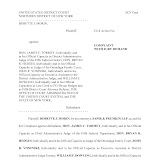
EX-MARINE SUES 'MAN-HATING' W'CHESTER LADY LAWYERS

The New York Post by KATHIANNE BONIELLO - March 8, 2009

He could handle the Marines, but the women of the Westchester County Attorney's Office were apparently too much for this lawyer, claims a federal lawsuit. Public ridicule, demeaning assignments and being denied raises were all part of life for Westchester County's male lawyers, claims Marine veteran Michael A. Deem in a lawsuit filed Feb. 27 in Manhattan federal court. County Attorney Charlene Indelicato was so anti-male that she allegedly barred her male lawyers from even speaking to her, and her female subordinates followed her lead, making life so miserable that three male lawyers left, Deem alleges in court papers. A 20-year veteran of the Marines, Deem also accuses Indelicato of being critical of his choice to serve in the military and of trying to deny or reduce his pay and benefits during his military leaves. Along with Indelicato, Deem is suing three of his coworkers - including one who changed clothes in her office while the door was open, according to court papers. He is seeking unspecified damages. kboniello@nypost.com

CLICK HERE TO SEE THE FEDERAL COMPLAINT

**************Here's the Case Docket Sheet (as of March 6, 2009) ****************

U.S. District Court 
United States District Court for the Southern District of New York (White Plains)
CIVIL DOCKET FOR CASE #: 7:09-cv-01842-SCR

Deem v. Idelicato et al
Assigned to: Judge Stephen C. Robinson  -  Cause: 42:1983 Civil Rights Act
Date Filed: 02/27/2009  -  Jury Demand: Plaintiff
Nature of Suit: 440 Civil Rights: Other  -  Jurisdiction: Federal Question

Plaintiff  -  Michael A Deem
represented by Jonathan Lovett, Esq.
222 Bloomingdale Road - Suite 305
White Plains , NY 10605
(914) 428-8401
Fax: (914) 428-8916
Email: jlovett@lovett-gould.com
LEAD ATTORNEY  -  ATTORNEY TO BE NOTICED

V.

Defendant - Charlene Idelicato, individually,
Defendant - Lori Alesio, individually
Defendant - Hillary Raimondi, individually
Defendant - County of Westchester, New York


02/27/2009 1 COMPLAINT against Charlene Idelicato, Lori Alesio, Hillary Raimondi, County of Westchester, New York. (Filing Fee $ 350.00, Receipt Number 677757)Document filed by Michael A Deem.(ll) (Entered: 02/27/2009)

02/27/2009 SUMMONS ISSUED as to Charlene Idelicato, Lori Alesio, Hillary Raimondi, County of Westchester, New York. (ll) (Entered: 02/27/2009)

02/27/2009 Case Designated ECF. (ll) (Entered: 02/27/2009)

02/27/2009 Magistrate Judge Lisa Margaret Smith is so designated. (ll) (Entered:       02/27/2009)

03/06/2009 2 NOTICE of Requirement to Submit a Scheduling Order: Case Management Conference set for 7/8/2009 at 10:00 AM before Judge Stephen C. Robinson. (Melendez, Melissa) (Entered: 03/06/2009)

(March 9, 2009 11:25am: CORRECTION: the Westchester County District Attorney's Office is NOT a party to the action)

CLICK HERE TO SEE THE FEDERAL COMPLAINT

Saturday, March 7, 2009

Balls: Disrobed Judge Still Gets "Robe Allowance"

Disrobed judge can still collect state's ‘robe allowance’
The Buffalo News by Matthew Spina - March 7, 2009

Joseph G. Makowski has been disrobed. Yet he can still collect a “robe allowance.” State court officials said Makowski remains eligible for about $1,700 in so-called robe-allowance money even though he was forced to resign Friday from the State Supreme Court bench. Chalk it up to the system. For most judges the annual checks for a taxable $5,000 arrived this week. Makowski says he didn’t get his. But he eventually will be paid a reduced amount reflecting his midyear resignation, said David Bookstaver, a spokesman for the state Office of Court Administration. The $5,000 “judicial supplemental support allowance” allows full-time judges to buy and maintain their robes and cover other expenses. Part-time judges receive lesser amounts. Bookstaver said Makowski’s allowance will be prorated to reflect the four months he served since Nov. 1 when the current expense-year began. That will work out to about $1,700, rather than the full $5,000, Bookstaver said.

Makowski, reached Friday afternoon, refused to speak publicly on the matter, and he was not raising a fuss over his robe allowance. He and his staff had been working over the last two weeks to close out cases and to draw the curtain on his 10 years as a jurist. “He has been a fair judge to everyone who came before him,” said Lorraine Ceccarelli, Makowski’s court clerk for the last four years. For several local lawyers, however, Makowski’s forced departure was no occasion for sorrow. Take William C. Altreuter, a lawyer who writes a blog about his observations on the law and other interests. “The most important quality that a judge can have is a good judicial temperament,” Altreuter said. “There isn’t enough black silk in the world to conceal the fact that this was something he was sadly lacking.” Late last month, Makowski chose to resign rather than face a charge in connection with his attempt to help Anne E. Adams, an attorney friend, evade drunken-driving charges. He had stated in an affidavit that Adams drank little and appeared fit to drive when they were together on the evening of Sept. 2. Other witnesses offered a distinctly different view of Adams that night. District Attorney Frank A. Sedita III said Makowski and Adams had tried to fix her case. Makowski, 55, still could be suspended or disbarred by the Attorney Grievance Committee. The judgeship paid $136,700 a year, and Makowski initially announced that his resignation would be effective March 5 — Thursday. He later sent a letter telling Administrative Judge Sharon Townsend that he would make Friday his last day, to deal with pending cases. News Staff Reporter Matt Gryta contributed to this report.  mspina@buffnews.com

Friday, March 6, 2009

Corrupt Administrative Judge Stayed by Appellate Division

Appeals court blocks order for PAC tied to White Plains mayor to open books
The Journal News by Keith Eddings - March 5, 2009

WHITE PLAINS, NEW YORK - An effort by city Democratic leaders to force a local Political Action Committee tied to Mayor Joseph Delfino to make its financial records available stalled last week when an appeals court blocked - at least temporarily - a lower court's order. The Appellate Division issued the stay to give the PAC time to make its case that state Supreme Court Justice Francis Nicolai had usurped the powers of the state Board of Elections. Nicolai ordered the Year 2001 Committee PAC to make its ledgers, bank statements, checking accounts, bills and vouchers available to the Democrats. Guy Parisi, a lawyer for the PAC, said courts cannot rule on disputes over campaign finance before the Board of Elections does. Parisi also argued that forcing the PAC to open its books would endanger "the preservation of the two-party system." He said the documents the Democrats are seeking "relate to internal affairs of a rival political party and are not required to (be) filed with the Board of Elections." The Elections Board requires candidates and political parties and committees to file regular financial disclosure forms detailing their fundraising and spending. It does not require them to file bank statements, bills and other financial documents, but they must keep those documents for five years. 

The Appellate Division delays Nicolai's order until it can fully consider arguments from both sides. To get the stay, Parisi had to convince the court that the PAC was likely to win the case. Tim James, a lawyer for the Democrats, looked for a silver lining. He noted that the court gave Parisi only a month to submit his arguments, which he called "the shortest leash imaginable." "I'm disappointed by the stay, but I feel that the court heard and understood what I was saying when I made the point that the (PAC) is pursuing a strategy of delay designed to stretch this out so that Mayor Delfino can get safely past the next election," he said. Delfino, a Republican, declined to comment. Democratic leader Liz Shollenberger, who is Tim James' wife, and four other Democrats filed the lawsuit in May after The Journal News detailed the PAC's ties to Delfino's campaign organization, Friends of Mayor Joseph Delfino. Delfino and the PAC hold joint fundraisers and have shared a post office box, staff and donor lists.

Blog Archive

See Video of Senator John L. Sampson's 1st Hearing on Court 'Ethics' Corruption

The first hearing, held in Albany on June 8, 2009 hearing is on two videos:


               Video of 1st Hearing on Court 'Ethics' Corruption
               The June 8, 2009 hearing is on two videos:
         
               CLICK HERE TO SEE Part 1
               CLICK HERE TO SEE Part 2
Add to Technorati Favorites