MLK said: "Injustice Anywhere is a Threat to Justice Everywhere"

End Corruption in the Courts!

Court employee, judge or citizen - Report Corruption in any Court Today !! As of June 15, 2016, we've received over 142,500 tips...KEEP THEM COMING !! Email: CorruptCourts@gmail.com

Friday, January 23, 2009

Three Cheers for Paterson's Senate Pick

Three Cheers for Paterson's Senate Pick
Expose Corrupt Courts OPINION - January 23, 2009

In choosing Kristen Gillibrand as New York's next U.S. Senator, Governor Paterson has provided hope that the state court system's ethics cesspool may soon find a long overdue cleaning.

Big Cheer Number One - that Attorney General Andrew Cuomo will continue his actions to hold those accountable in the state court system who participate in corrupting a justice system for personal gain. (Unfortunately, Andrew Cuomo could not be cloned, thus preventing a dual role of NYS Attorney General and U.S. Senator from New York.)

Big Cheer Number Two - that Shelly Silver, will NOT be picking a New York State Attorney General. Horrifically, had Attorney General Cuomo become Senator, his AG vacancy, by statute, would be filled NOT by Governor Paterson but by one Shelton Silver. And to continue the pay-to-play, criminal-whitewashing pattern of New York state political insiders, any Silver-appointed Attorney General would have derailed the important work by the Attorney General over the last year to finally address the systemic corruption of law and order throughout the state.

Big Cheer Number Three - that the voice of an important NON-lower state public servant, in Senator Kirsten Gillibrand, will break the good 'ole boy, back-room deals of the small ring of greedy downstate thieves.

Three Cheers!! for Paterson, Cuomo, Gillibrand and the rule of law.

Dreier Continues to Sit in Jail, Madoff in Lap of Luxury

Dreier Remains Jailed as Court Imposes Bail Beyond His Reach
The New York Law Jourmal by Mark Hamblett - January 23, 2009

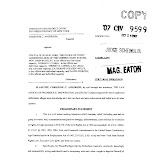
Marc S. Dreier will remain behind bars until he can get another judge to take a look at possible bail conditions as he awaits trial for alleged frauds totaling more than $380 million. Magistrate Judge Douglas Eaton yesterday declined to order Mr. Dreier, 58, detained outright, but he set such tough conditions for his pretrial release that defense attorney Gerald Shargel said his client was "effectively" denied bail. Mr. Shargel said after the hearing he would appeal the ruling to a Southern District judge. Mr. Shargel did not hesitate to play the Madoff card yesterday, contrasting his client's continued confinement with the pretrial release of Bernard Madoff, who is accused of orchestrating a $50 billion Ponzi scheme. Mr. Madoff has been confined to his Upper East Side penthouse. Mr. Shargel, his voice rising as he referred to Mr. Madoff, said, "$50 billion and counting!" Referring to the government's emphasis on Mr. Dreier's traveling and foreign connections, he said of Mr. Madoff, "Hotels over $7,000 a night! Money all over the place! [Visiting] Countries we've never heard of."

But Magistrate Judge Eaton said there were critical differences between Mr. Dreier and Mr. Madoff, including how Mr. Dreier was apprehended and his inability to find the money or backers who can secure his appearance in court. Magistrate Judge Eaton set bail at $20 million, with $10 million to be secured by at least four financially responsible persons, in addition to conditions agreed to by Mr. Shargel - 24-hour armed guards in Mr. Dreier's apartment on East 58th Street and electronic monitoring.  The magistrate judge also cited Mr. Dreier's erratic and impulsive behavior as contributing to the risk that he could flee, and added the condition that he see a psychiatrist twice a week, who may prescribe medication as needed.

Mr. Dreier, wearing the prison blues of the Metropolitan Correctional Center, looked far more composed yesterday than he did at his initial court appearance on Dec. 8, when he appeared haggard and exhausted. He was animated yesterday, speaking several times to Mr. Shargel during the 90-minute hearing. At a bail argument on Dec. 11, Assistant U.S. Attorney Jonathan Streeter called Mr. Dreier a "Houdini of impersonation," and said he suspected that the former head of the 250-lawyer Dreier LLP had a pile of cash stashed somewhere overseas. Magistrate Judge Eaton on Dec. 11 agreed on the risk of flight but invited Mr. Shargel to come back once he could obtain evidence that Mr. Dreier did not have assets hidden abroad. That evidence, he said, would come in the form of full disclosure to Mark Pomerantz of Paul, Weiss, Rifkind, Wharton & Garrison, the receiver appointed to discover and hold Mr. Dreier's assets in a related case brought by the Securities and Exchange Commission.

Mr. Shargel thought he had the evidence he needed - a favorable report from Mr. Pomerantz with a laundry list of now-frozen assets and no foreign bank accounts or property Mr. Dreier could use to lead a life of leisure if he jumped bail and fled the United States. Magistrate Judge Eaton was not convinced by Mr. Shargel's argument that his client voluntarily returned to the United States on more than one occasion in October and November despite "clear storm warnings" that he would face criminal charges. Mr. Dreier is accused of pretending to represent Solow Realty and peddling more than $100 million in bogus promissory notes in the company's name to three hedge funds in New York and Connecticut. Mr. Streeter also said that Mr. Dreier looted his law firm's client escrow accounts and spent the money on bad investments, expensive artworks, high-priced vehicles, real estate and other items.

Clear Distinctions

Magistrate Judge Eaton said there were "extraordinary facts" that distinguished the Madoff and Dreier cases. For one, it did not impress him that Mr. Dreier returned to the United States in the fall despite "clear storm warnings," because he went to Canada, where he was arrested on Dec. 2 trying to peddle millions more in phony notes. The judge called that behavior "reckless and clever." "Frankly, it suggests a mental disorder," Magistrate Judge Eaton said. "He did something extremely reckless, and that behavior was after he knew he was facing the prospect of a criminal charge. That makes this case very different from the Madoff case."

Another factor was that Magistrate Judge Eaton was presiding in magistrate's court on the evening of Dec. 11, when Mr. Madoff was brought before him for an initial appearance. Mr. Madoff was released with the consent of the prosecution. Although the prosecution would later reverse course when it discovered Mr. Madoff had mailed more than $1 million in jewelry to family and friends in direct violation of a court order in a related SEC case, Magistrate Judge Ronald Ellis and then Judge Lawrence McKenna ruled that Mr. Madoff could remain under house arrest. In Mr. Madoff's case, Magistrate Judge Eaton said yesterday, "You had no complaint from any investors. The government just opened up a file" based on information offered by Mr. Madoff's two sons.

"Whatever you have to say about him, he told his sons and he expected to be arrested and he took no extraordinary measures," Magistrate Judge Eaton said. "He just sat there waiting to be arrested. The government came in here with a bare bones complaint" and they consented to bail.  "I think the risk of flight is greater in Mr. Dreier's case than in Mr. Madoff's case," he said. In contrast to Mr. Madoff, the prosecution has sought to have Mr. Dreier detained from the outset. In a letter brief filed Wednesday, Mr. Streeter pointed to connections Mr. Dreier had in Turkey and the attempts of his 19-year-old son, Spencer, to try and have cell phones in Mr. Dreier's offices destroyed; keep Mr. Dreier's yacht in St. Martin rather than have it returned to the United States; and have Mr. Dreier's caretaker sign documents that would purport to transfer real property from the father to the son. Magistrate Judge Eaton said he was willing to accept some of Mr. Shargel's conditions, but would not approve a bail package without some cash or property as security.

But although he made reference to Mr. Dreier's various connections in the legal and financial world, where presumably people with means could be found to pledge security for the disgraced attorney, Mr. Shargel indicated such people were unlikely to come forward, saying some of those relationships have been "squandered" based on "the allegations in the complaint."  He called the bail package "excessive." Unless the defense consents to an extension, Mr. Streeter must obtain an indictment by Feb. 7. An indictment would result in the random assignment of the case to a judge and the chance for Mr. Shargel to make a fresh bail argument. But Mr. Shargel said he plans to appeal the decision to the Part I judge in the Southern District next week. Absent a recusal or some other scheduling conflict, that judge would be Alvin Hellerstein. Mr. Shargel, speaking to reporters after the hearing, said without further comment that he expected the case to be "resolved" within the year, but declined further comment.

Toronto Case

Also yesterday, Mr. Dreier received another hearing date in Toronto. Mr. Dreier was not present in a Toronto courtroom yesterday morning, the first scheduled hearing date since he was arrested there in December for allegedly impersonating a lawyer from the Ontario Teachers' Pension Plan. Another hearing date has been scheduled for March 5 in Toronto. Todd White, one of Mr. Dreier's lawyers in Toronto, said he has not yet received the disclosure document from the government, which lays out the allegations and the evidence in the case. "Once we have that information, we'll deal with it then," said Mr. White, a partner in Toronto's Greenspan, White.  Mr. White said he has not been in touch with Mr. Dreier, only his other lawyers. The charge in Canada is being handled separately from his charges in the United States, he said. Mark.Hamblett@incisivemedia.com

NY Lawyer Charged with Stealing $700,000.

Lawyer pleads not guilty to charges of stealing $700G
Real estate attorney pleads not guilty to grand larceny charges
Newsday by ERIK GERMAN - erik.german@newsday.com - January 22, 2009

East Meadow lawyer Frederic Powell was a real estate middle man who didn't just take a cut of the loans he brokered -- he sometimes pocketed the whole sum, Nassau prosecutors said Wednesday. Powell, 53, was charged with stealing $700,000 from two investors who'd made bridge loans -- money advanced to clients needing temporary cash as they arranged long-term mortgages. The terms of the loans -- one in 2006 and another in 2007 -- required the clients to make monthly interest payments through Powell, but prosecutors said he simply kept the cash rather than pass it back to the lenders. Prosecutors did not identify the victims. Powell pleaded not guilty to two counts of second-degree grand larceny in First District Court in Hempstead Wednesday and District Court Judge Robert Bruno ordered him released with no bail. If convicted, Powell faces a maximum of 5 to 15 years in prison. Powell's lawyer, Joseph Girardi of Syosset, said he was "completely confident Mr. Powell will be cleared of all charges." Girardi declined to discuss any details of a planned defense. In a statement, Nassau District Attorney Kathleen Rice accused Powell of "gross misconduct and unfathomable greed" and pledged to prosecute him aggressively.

Prosecutors said that, in February 2007, Powell brokered a $250,000 loan, promising to forward the borrower's monthly interest checks to the lender, followed by the fully repaid principle once the borrower obtained a new mortgage. After the payments became sporadic in 2008, the lender discovered the borrower had already repaid the loan to Powell, who simply kept it, prosecutors said. In 2006, a mother-and-son team of real estate investors fell victim to what prosecutors described as a similar scheme. Powell brokered the $450,000 loan for a client looking to expand his Manhattan business, prosecutors said. The mother and son put up half the cash and a third investor put up the other half. When payments became sporadic in early 2008, prosecutors said the third investor became anxious and the mother and son bought the man out. Soon after, the pair learned that the client had repaid the entire loan to Powell, who pocketed the money, prosecutors said.

Thursday, January 22, 2009

Real Ethics Oversight Coming Soon to New York

Troopergate report doesn't answer big Eliot Spitzer question, say critics
A Daily News EXCLUSIVE BY KENNETH LOVETT  - January 22, 2009

ALBANY - Officials will release a long-awaited report on Troopergate on Thursday, but sources said it ignores a key question - whether state agencies protected ex-Gov. Eliot Spitzer in the scandal. "It's a disgrace," said a source with knowledge of the report. "It's a joke, but the whole thing has been laughable."

The state Investigation Commission report reviewed the myriad investigations into the Troopergate mess: the Albany district attorney's office, the state Commission on Public Integrity and the state inspector general's office. All the agencies probed whether Spitzer and his top aides misused state police to smear a political rival, then-Senate Majority Leader Joseph Bruno. The commission also interviewed members of the state police and the governor's office and reviewed "thousands of documents" related to the probes. Regardless, the report is said to read like a summation of news accounts.

The report, according to sources, does not address:

- Whether Herbert Teitelbaum, executive director of the Public Integrity Commission and a Spitzer friend, leaked information to the governor's aides through a third party.

- Why then-Inspector General Kristine Hamann, who was appointed by Spitzer, suddenly aborted her probe and simply signed off on findings by the attorney general's office.

- Why Albany District Attorney David Soares did not place anyone under oath when he first reviewed and dismissed the matter. And why Soares came out with a more critical second report only after Spitzer left office, stating that some of Spitzer's aides may have violated the law. Instead, the investigation committee report finds that the three agencies had competing interests and "lacked sufficient jurisdiction to conduct a thorough investigation into all of the issues of Troopergate." And it calls for merging the inspector general's office and the Public Integrity Commission into the commission itself. Doing so "will create a single investigatory agency, promoting efficiency, providing cost savings and helping to restore public confidence," commission chairman Alfred Lerner said in a draft press release obtained by the Daily News. Currently, there are six commissioners, two each appointed by the governor, Senate majority leader and Assembly speaker. klovett@nydailynews.com

Wednesday, January 21, 2009

Senator Sampson to Hold NYS Chief Judge Hearings

SENATOR JOHN SAMPSON, CHAIR OF NYS SENATE JUDICIARY COMMITTEE TO HOLD HEARINGS ON SELECTION PROCESS FOR APPOINTMENT OF CHIEF JUDGE

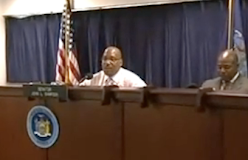
(Albany, NY)- Senator John Sampson, Chair of the New York State Senate Judiciary Committee, today, announced that his first order of business in convening the Judiciary Committee, prior to addressing the appointment of the new Chief Judge, is to hold hearings concerning the criteria employed by the Commission on Judicial Nomination during its selection process. At the hearings, Senator Sampson plans to ask members of the Commission and its Chair, John O'Mara to testify concerning how the Commission decided on its final list of candidates and the methods it employed throughout the candidate selection process. "I find it incomprehensible and deeply disturbing that not a single woman appeared on the list of qualified judicial candidates to succeed Judith Kaye, our first female Chief Judge of the Court of Appeals," said Senator Sampson. "As the birthplace of women's suffrage and civil and political rights, the Commission failed to meet the high standards and great tradition of our state when it failed to include a woman on its list of candidates for our highest court," said Senator Sampson.

The vacancy on the Court of Appeals was created by the mandatory retirement of Chief Judge Judith S. Kaye on December 31, 2008. In a December 1, 2008 letter to the Governor, John O'Mara, the former lobbyist appointed by Republican Governor George Pataki to chair the eleven-member Commission, submitted a list seven candidates to fill the vacancy, but failed to include a single woman on its list. Over the past 10 years, 22 men and only 6 women have been chosen as candidates to fill the 8 vacancies that occurred during that period. "Any process that ignores the substantial role women have played in the history of our state and the judicial process is flawed," said Senator Sampson. "We need to show a true commitment to providing opportunities for all qualified candidates, particularly women. As Chair of the Judiciary Committee I want to know what went wrong and why, so it cannot be permitted to happen again," said Senator Sampson.

****

Representatives from the office of New York State Senator John L. Sampson have advised that confirmation hearings will be held soon regarding the nomination by Governor Paterson of the Hon. Jonathan Lippman as the state's next Chief Judge.

Senator Sampson is Chairman of the Senate Judiciary Committee, the state body that will confirm or reject the Governor's choice as the state's highest justice. It was indicated that members from the Democratic and Republican leadership will soon determine exactly who will sit on the committee under Senator Sampson.

Senator Sampson's office also advised that they are accepting the public's input, either by facsimile, if under 5 pages, or by U.S. Mail.

Senator John L. Sampson Contact Informaton:

The Hon. John L. Sampson
New York State Senator and
Chairman of the NYS Judiciary Committee
506 Legislative Office Building
Albany, New York 12247

518-455-2788 telephone
518-426-6806 facsimile
sampson@senate.state.ny.us

First Amendment Sacred, Except When Criticizing Judges

Famous Lawyer Loses Fight for Right to Criticize Judges
The Associated Press by Ed White - January 21, 2009

A federal appeals court threw out a lawsuit Tuesday by Geoffrey Fieger, who claims his criticism of Michigan judges is protected by the First Amendment. The court, in a 2-1 decision, overturned a significant ruling that had gone in Fieger's favor in a long-running clash between the outspoken and often unbridled trial lawyer and the Michigan judiciary. Fieger got in hot water in 1999 when he gave a blistering critique of three state judges who reversed a $15 million malpractice verdict against his client. "I declare war on you," he said on a radio show -- and much more. The Michigan Supreme Court said Fieger violated rules of professional conduct. But a federal judge in Detroit found the civility rules overly broad and unconstitutional.

The 6th U.S. Circuit Court of Appeals has reversed that ruling, saying, in part, that Fieger can't show any harm from a reprimand. And the "threat of future injury arising from a general desire to criticize the Michigan judiciary is significantly diminished" by the state Supreme Court's narrow rules, the 6th Circuit said. "The Michigan Supreme Court emphasized that Fieger violated the rules, not because he criticized judges, but because he made vulgar, personally abusive comments about participants in a pending case," the appeals court said. Fieger said the judges who reversed his medical-malpractice verdict were "three jackass ... judges." He likened them to Nazi leaders and said Judge Jane Markey was "Eva Braun," wife of Adolf Hitler. Fieger agreed to a reprimand while reserving his right to go to court to challenge certain rules of professional conduct for Michigan lawyers. A message seeking comment was left at his office Tuesday.

In a dissent, Judge Gilbert Merritt of the 6th Circuit said there's nothing "narrow" about Michigan's rules for lawyers. "Comparing judges to Hitler and Goebbels evidently falls on the wrong side of the line," he said. "But would it be permissible to ... say that the judges 'behaved dictatorially?' "Saying that a judge is a 'jackass' appears to be impermissible -- despite the fact that the word is a non-vulgar name for a donkey," Merritt wrote. "But would it be permissible," he added, "to vary the 'form and manner' and say that he is a 'stubborn idiot,' a 'right-wing radical,' a 'doctrinaire ideologue' or 'driven by party politics?'" Former Michigan Supreme Court Chief Justice Cliff Taylor, who in 2006 wrote the 4-3 opinion reprimanding Fieger, said he was trying to address conduct "at the very center" of incivility. "I want lawyers to speak about what the court has done professionally, not as vulgar backroom brawlers," Taylor said.

Tuesday, January 20, 2009

Greed Ends Banking Money Pit, Ethical Abuses On Last Breath

FAIR GAME - The End of Banking as We Know It
The New York Times by GRETCHEN MORGENSON - January 18, 2009

THE concept of the financial supermarket — the all-things-to-all-people, intergalactic, behemoth banking institution — bit the dust last week. The first death notice came on Tuesday, when Citigroup, Exhibit A for the failure of the soup-to-nuts business model, said it was dismantling. Just over a decade after the deal-maker Sanford I. Weill tried to meld insurance, investment banking, mortgage lending, credit cards and stock brokerage services, the dissolution began. Citigroup, it turned out, was too big to manage, too unwieldy to succeed and too gigantic to sell to one buyer. A few days later, Bank of America, another serial acquirer of troubled institutions —Merrill Lynch and Countrywide Financial most recently — fessed up that its deals now need taxpayer backing. The United States government invested an additional $20 billion in Bank of America (after $25 billion last fall) and agreed to guarantee more than $100 billion of imperiled assets. Clearly, the entire financial industry is in the midst of a makeover. And while no one wants to call it nationalization, perhaps we can agree on this much: The money business as we have come to know it over the last two decades — with its lush salaries, big-swinging risk-takers and ultrathin capital cushions — is a goner. Got that? Toast. Toe-tagged.

And that’s a good thing, because maybe we can go back to a banking model that is designed to do more than simply enrich the folks at the top of the enterprise while shareholders and taxpayers absorb all the hits. Banking, because it oils the crucial wheels of commerce, has a special standing in our world. That will always be the case. But in exchange for that role, our country’s leading bankers might have approached their jobs with a sense of prudence and duty. Instead, a handful of arrogant greedmeisters blew up their institutions and took our economy off the cliff along the way. It’s too soon to say how much taxpayer money will be spent trying to rebuild banks hollowed out by bad lending practices. Paul J. Miller, an analyst at Friedman, Billings, Ramsey, thinks that the nation’s financial system needs an additional $1 trillion in common equity to restore confidence and to get lending — the lifeblood of a thriving and entrepreneurial free-market economy — moving again. That $1 trillion would come on top of funds disbursed through the Troubled Asset Relief Program, which has tapped $700 billion, and the president-elect’s stimulus plan, clocking in at $825 billion. Larger capital requirements, beefed up to serve as a proper buffer when lenders misfire, will be one change facing banks when we emerge from this mess, Mr. Miller said. He thinks regulators will require banks to hold tangible common equity of 6 percent of assets. Now many institutions hold under 4 percent. Such a requirement will cut into earnings, of course. Toning down the risk-taking will also reduce the profitability — or the appearance of it — at these institutions.

“This industry made a lot of money by taking a business line with 20 percent return on assets and levering it up 30 times,” Mr. Miller said. “But no more. Banks are going back to being the boring companies they should be, growing roughly in line with gross domestic product.” Clearly this means that the rip-roaring performance of financial services companies and their stocks isn’t likely to return anytime soon. Because these companies’ earnings fed both the economy and the stock market in recent years, a more muted performance has considerable implications for investors, consumers and the economy. FOR example, since 1995, according to Standard & Poor’s, earnings of financial concerns have accounted for 22 percent of profits, on average, among the S.& P. 500 companies. That performance is almost double that of the next largest contributor — the energy industry. In 2003, earnings among financial companies peaked at 30 percent of total profits generated by the S.& P. 500; back in 1995, financial company earnings accounted for 18.4 percent of the total.

Of course, many of these earnings were ephemeral and have since turned to losses. But while the companies were reporting the profits, their stocks roared. Between 2003 and the peak in 2007, the American Stock Exchange financial services index essentially doubled. At the peak, financial services companies dominated the S.& P. 500 index, accounting for 22 percent of its market value in 2007. With many of these stocks in free fall, that figure is now just 12.5 percent. Will valuations on financial services stocks bounce back soon? Not in Mr. Miller’s view. “They are going to look more like the insurance industry, trading at book value or 1.5 times book,” he said. “That is, if you are really good.” For financial services workers, of course, the inevitable downsizing has already begun. But there will be more. “The industry was way too big; too many people were not producing anything,” Mr. Miller said. “Jobs will be lost and not replaced. And financial industry salaries won’t be anywhere close to where they have been.” The bright side is that all those displaced financial services professionals can now set their sights on doing something, well, truly useful. Still, this adjustment will be painful for all those who have to carve out new careers, as well as for New York and other places these companies call home.

Finally, what will a humbled financial services industry mean for consumers? Higher borrowing costs, Mr. Miller said. “The leverage that these companies were using allowed them to lower their rates,” he said. “Rates have to go higher for the banks to operate in a safe and sound manner and make money.” Credit is also likely to remain tight, in Mr. Miller’s opinion. A result is that consumer spending won’t recover to bubble levels. “It is going to be difficult to get credit, and that is something the system has to adapt to,” Mr. Miller said. “That is where the government is going to have to step in and replace that debt growth to make sure there is a smooth transition.” In other words, Barack Obama’s first stimulus plan is not likely to be his last. When a driving economic force takes a big dive, the ripples are far-reaching. Change is painful, there is no doubt. But American business can be awfully good at reinventing itself when it needs to. And does it ever need to now.

Urgent Call to All Americans

CALLING ALL AMERICANS: JUDICIAL VICTIMS, JUDICIAL REFORMERS, CJA FAMILY, FRIENDS, MEMBERS, & SUPPORTERS

JOIN US TO MAKE HISTORY NOW

On this day we honor Dr. Martin Luther King's memory. To build on his victory for equality, fairness, freedom, and fundamental justice, vindicated by tomorrow's inauguration of Barack Obama, America's first black president, Doris L. Sassower, President of the Center for Judicial Accountability, Inc., asks you to sign onto the letter below and email it to YOUR U.S. HOME SENATORS and every other U.S. Senator you can. Feel free to adapt it for dissemination to TV and radio talk show hosts, editors of your local newspapers, in support of our demand for a Senate Inquiry into critical facts -- BEFORE Senator Clinton's full Senate confirmation as Secretary of State, predicted to occur on Wednesday or Thursday of this week -- with cc to CJA.

Please do not think we have sat on our hands to wait until the 11th hour to distribute this information. Our repeated mass media mailings of our press releases on the subject, starting more than a year ago before the primary elections concerning the tragic role Senator Clinton played in the six-month incarceration by our government of an innocent woman, shockingly produced no news coverage of our vital issues -- only proving what CJA has said all along -- that mainstream media has, by consistently failing and refusing to meet its journalistic responsibilities as the guardian of the People's right to know, has been guilty of press suppression and protectionism, designed to cover up the true facts in this matter for the benefit of political interests in both parties. http://www.judgewatch.org/web-pages/suing-nyt/lawsuit-nyt.htm, http://www.judgewatch.org/web-pages/press-suppression/press-gannett.htm. This may be the last clear chance opportunity to prevent confirmation of a most unworthy candidate, Senator Hillary Clinton -- whose actions speak louder than all her empty rhetoric about her protection of constitutional rights. By her conduct in office as Senator, she has revealed her willingness to betray the public trust for her ulterior political and private self-interest. If she cannot defend the civil rights and freedoms of one American, indeed, her own constituent, how can she defend the rights and freedoms of all Americans as our Secretary of State?

Do it today, do it tomorrow, but please don't fail to do it ASAP! Time is of the essence! In addition, to compliment our herculean efforts to protect our democracy, would you kindly make a donation by clicking on the Donate button on our website. Your credit card or check shows your support for our herculean, pro bono efforts. United, we too shall overcome!

A thousand thanks!

Yours in struggle and solidarity for a quality judiciary.

From All of Us at Center for Judicial Accountability, Inc. (CJA) 
DORIS L. SASSOWER , Co-Founder and President
Tel: 914-997-8105 Fax: 914-684-6554
www.judgewatch.org
------------------------------------- Sample Letter --------------------------------------------
Dear Senator

The Center for Judicial Accountability Inc., (CJA), a national 501(c) 3 public interest, nonpartisan, nonprofit organization, working to improve the quality of our judiciary by removing political considerations from the judicial selection process and by ensuring that the process of disciplining and removing judges is effective and meaningful, urges you to let the voices of our concerned citizenry be heard on this important subject affecting core values of our democracy.

The incoming Obama presidential administration and its appointments to the President's cabinet and to the judiciary, will set the standard for democracy, decency and fair-play in America for generations to come. At this historic break with the past on a successful platform of "Yes, we can" change our broken government, it is a critical principle that those considered for the nation's highest offices have irreproachable records. Sadly, the appointment of Senator Hillary Clinton to US Secretary of State turns this principle on its head.

Please read the following press release of the Center for Judicial Accountability, Inc., issued last week calling for a public integrity Senate Inquiry BEFORE confirmation of Senator Hillary Clinton anticipated this week, regarding issues as to which the U.S. Senate Foreign Relations Committee conspicuously did NOT interrogate her before its members confirmed her nomination last Tuesday. Incredibly, that press release received no coverage by the media, another fact calling for Senate investigation.

__________________________

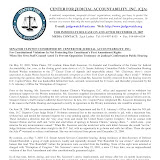
CENTER FOR JUDICIAL ACCOUNTABILITY, INC. (CJA)

A national, nonpartisan, nonprofit citizens’ organization, working, pro bono, to protect the public interest in the integrity of our judicial selection and judicial discipline processes. Its mission is to ensure that only the most qualified trial lawyers become, and remain judges.
E-mail: judgewatch@aol.com Web: http://www.judgewatch.org
Tel: 914-997-8105 ▪ Fax: 914-684-6554
Office of the President
Direct line: (914) 997 1677

FOR IMMEDIATE RELEASE ON AND AFTER JANUARY 15, 2009

CJA Calls for US Senate Inquiry -- before her confirmation as Secretary of State -- into Senator Clinton’s violation of innocent constituent’s free speech and due process rights*

Statement from CJA President and Co-Founder Doris L. Sassower

“Senator Hillary Clinton was complicit in behind-the-scenes politically-motivated deal making between Republican and Democratic party leaders, resulting in "rubber-stamped" lifetime federal judges to ensure their confirmation by the Senate. One such pre-arranged deal involved President Bush’s federal judicial nominee Republican Richard C. Wesley. On May 22, 2003, she set in motion a chain of events that led to the filing of a criminal complaint against her own constituent, Elena Ruth Sassower, CJA's Co-Founder, then Coordinator, now Director, a patriotic American citizen and public advocate, seeking to testify, the lone voice in opposition, at a Senate Judiciary Committee Public Confirmation Hearing.

With the collusion of Republican Senator Saxby Chambliss, then Acting Chairman of the Senate Judiciary Committee Hearing, her constituent was unjustly arrested, wrongfully prosecuted by the DC U.S. Attorney's office, steamrolled to conviction, and given an unprecedented sentence of six months in a DC jail for an alleged “Disruption of Congress.” This travesty of justice occurred because Senator Clinton would not let anyone upset her pre-arranged political deal for bi-partisan confirmation of that judicial nominee. Yet, all her constituent had done was to respectfully request to testify in opposition to that nominee. But, thanks to Senator Clinton, such courageous citizen advocacy in exercise of constitutionally guaranteed free speech and due process rights is now a ‘crime’ in America.

“No bail was fixed by the DC trial judge, himself recently nominated by President Bush and confirmed as a result of a similar bi-partisan political deal, who denied her repeated requests for a stay pending appeal. Her constituent was thus forced to serve out her full sentence, without objection from Senator Clinton, despite calls from all over the country for the Senator’s intercession. An advance copy of the intended negative testimony had been provided to the Committee by her constituent in advance, along with her written request to be heard.

“The Clinton-Chambliss judgeship issue was subsequently not raised in the key 2008 Georgia Martin-Chambliss recount election campaign because of the Clinton connection. In fact, the Martin Campaign deliberately chose to avoid raising the issue against opponent Chambliss because of concerns that Senator Clinton (then courting an Obama Cabinet appointment) would become collateral damage. For that reason, the Martin Campaign likely took direction on this issue from senior staffers on the Obama team.

“CJA will continue to advocate for full exposure of Senator Clinton’s civil rights violations while serving as NY Senator, specifically, her constitutional and ethical derelictions as they impacted on one of her own constituents, issues highly relevant to her appointment as America’s next Secretary of State.”

For more details, see recent story in New York’s Westchester Guardian, 11/27/08:
Help Hold Senators Saxby Chambliss and Hillary Clinton Accountable
http://www.judgewatch.org/web-pages/cja/latest-news.htm

*Please contact Doris L. Sassower at doris@judgewatch.org at CJA, if you would like to discuss any related issues. We look forward to your swift response to this wake-up call to the Senate's conscience so as to suspend any confirmation of Hillary Clinton as Secretary of State until the facts presented by this e-mail are fully investigated so as to protect the lives, liberty, and happiness of our citizenry.

Monday, January 19, 2009

New York Times: How Much Should Judges Make?

How Much Should Judges Make?
SIDEBAR - The New York Times by ADAM LIPTAK - January 19, 2009

WASHINGTON, D.C. - Federal judges say they are underpaid. The problem, in Chief Justice John G. Roberts Jr.’s words, “has now reached the level of a constitutional crisis.” It takes a pretty brave soul to argue the other side. “I couldn’t find any evidence to support his claim,” Scott Baker, a law professor at the University of North Carolina, said of the chief justice. Professor Baker published a study last year in the Boston University Law Review that considered whether society would be better off were judges paid more as a matter of labor economics. Its conclusion: “Pretty much nothing would happen if Congress decided to raise judicial salaries.” Money appears to have almost no impact on the quantity and quality of the work judges produce, Professor Baker found, and lots of capable people are eager to take the jobs at the current salary. A second study to be published in The Journal of Legal Analysis, a peer-reviewed publication at Harvard Law School, goes even further. Its title seems calculated to provoke the people who wear black robes at work: “Are Judges Overpaid?” G. Mitu Gulati, who conducted the study with Eric A. Posner and Stephen J. Choi, said judges had not embraced their findings. “There was anger and even incredulity that we would even ask the question,” he said.

Federal district judges make $169,300; federal appeals court judges, $179,500; Supreme Court justices, $208,100; and the chief justice, $217,400. There is no question that those salaries, which increased 2.5 percent last year, have dropped significantly in real terms in recent decades or that they represent a small fraction of what partners in big city law firms make. This year, federal judges, alone among federal employees, did not even receive a cost-of-living adjustment. On the other hand, being a judge is pretty sweet work and the job is in high demand. It comes with status, power, good working conditions, no clients, the ability to affect policy and the satisfaction of doing justice. Federal judges get very good health care, exceptionally generous pensions and the ultimate in job security — life tenure. The two sides in the debate, in any event, are mostly talking past each other. The professors collected data and analyzed it using the tools of economics. They measured things like productivity (number of published opinions), quality (how often other courts cite those opinions), speed (how quickly opinions are produced) and independence (how often judges disagree with colleagues with similar political views). The study in The Journal of Legal Analysis considered the relative quality of state-court judges around the nation in light of their varying salaries. Professor Baker looked at federal appeals court judges in different parts of the country, taking account of the pay scales at the regional law firms judges might join if they left the bench. Both studies found almost no evidence that taxpayers would be better off by paying judges more. A possible exception, according to Professor Baker’s study, is that “low salaries lead to slightly fewer dissents.” Frank B. Cross, a law professor at the University of Texas and a sophisticated empiricist, said the new studies went off the rails. “I love these economic tools,” Professor Cross said. “But we don’t have a good measure of judicial quality.”

“Given the anecdotal evidence, economic logic and the great importance of a quality judiciary,” he wrote in a reply to Professor Baker, “the case for a judicial pay raise is reasonably strong.” Many judges say the entire enterprise is absurd and insulting. “The country wants and deserves the strongest possible judiciary, and we should be willing to pay for that,” said David F. Levi, the dean of Duke Law School and a former federal judge. (He said he did not step down for financial reasons.) Chief Justice Roberts, in his report on the state of the judiciary at the end of 2006, cited a few kinds of data to support his argument that low pay was leading to a crisis. One was that 38 judges left the federal bench from 2000 to 2005, some citing the need to make more money. Richard A. Posner, a prominent federal appeals court judge in Chicago (and the father of Eric Posner), called this “crying wolf” in his recent book, “How Judges Think.” The chief justice had lumped retirements and resignations together, Judge Posner said. Only 12 federal judges had resigned out of a total of 1,200 active and senior judges in the years in question, a small number in absolute terms and a smaller percentage than in the six years ending in 1974. Judge Posner did not dispute that low pay may meant that there were fewer judges coming from private firms, but he did not see why that should matter so long as there appeared to be plenty of qualified candidates.

Chief Justice Roberts also said that the real pay of federal judges had dropped about 24 percent since 1969 while the average worker’s real pay rose about 18 percent. “But this is misleading,” Judge Posner responded. Federal judges received a roughly 30 percent pay raise in 1969. “Had Roberts picked as his base year 1968 rather than 1969,” Judge Posner said, “the picture of decline would have been less dramatic.” What is most interesting about the basic argument made for a judicial pay raise is that it appeals to a value that many judges resist in other contexts. It is an argument about fairness and respect. It is the sort of argument liberals make for raising the minimum wage or for laws that guarantee equal pay for equal work. Professor Baker said those arguments ought not matter. “Judicial selection has to be subjected to cost-benefit analysis just like everything else,” he said. But he acknowledged a human dimension to the question. “I got some e-mails from judges saying, ‘How would you like it if your salary were not raised?’ ” Professor Baker said. “I kind of feel sympathetic to that. I’d probably be mad.”

Madoff Wacks Minneapolis, Failed NY Ethics Oversight to Blame

Madoff does Minneapolis
Fortune by Dave Kansas - January 17, 2009

Heartland families lost hundreds of millions of dollars. How the scandal stunned a community that doesn't even like to talk about money.

MINNEAPOLIS (Fortune) -- Tucked into the rolling hills of Hopkins, a suburb west of Minneapolis, the recently refurbished Oak Ridge Country Club looks much like a middle school: beige paneling, a limestone base, and energy-efficient windows. Along the main road to the club is a modest apartment complex with four signs advertising units for rent. Beyond Oak Ridge's modest doors, however, is a well-appointed interior that provides a gathering place for some of the wealthier families in the Twin Cities. In Minnesota's warm summers the club's golf course, tennis courts, and playground bustle with prosperity, but this winter, with the grounds buried in snow, the conversation at Oak Ridge has turned as grim as the weather. Typically at such clubs, members swap tips and ideas. People you golf with, after all, are usually people you trust. And for more than 20 years some of the members have enthusiastically shared one notable financial strategy: investing with Bernard L. Madoff. The predominantly Jewish country club, which dates back to 1921, is the hub of the scandal in the Cities. While fraud victims in Manhattan, Palm Beach, Hollywood, and European cities have grabbed the headlines, Madoff's alleged $50 billion Ponzi scheme reached other towns as well. He had a particularly painful impact on the Cities, where his method of preying on Jewish families and foundations was highly effective in this close-knit and long-established community.

While some regional reports put the losses at $300 million, a local attorney working with victims believes $600 million is a more accurate number. He knows of two families who lost a total of more than $130 million. Dozens of other families lost smaller amounts, representing everything from children's college savings to retirement accounts, while local Jewish-funded philanthropies find themselves scrambling to pay for basic core missions for the poor. As a native of St. Paul, I returned to find my hometown stunned to be a victim of this kind of crime. I know it as a place of quiet money and conservative investors, where the banks rarely need bailouts and the great fortunes created by the likes of Pillsbury, General Mills, and Cargill keep a low profile. But financial scandal has rocked the Twin Cities twice in one season. By a strange coincidence, just two months before the Madoff case broke open, the celebrated local tycoon Tom Petters was arrested and charged with 20 felony counts for his own alleged Ponzi scheme in which he took $3.5 billion from investors. His tactics, in part, were similar to Madoff's, prosecutors allege: He preyed on a religious community, in this case members of his own evangelical Christian faith.

Madoff, operating remotely from Manhattan, developed a network of local feeders to steer business his way, and in the Twin Cities he had a good one: Mike Engler, an unassuming stockbroker. Engler, as part of Engler & Budd securities, backed small, local stocks that traded on the more obscure edges of the financial markets, making him as different from the posh and powerful Madoff as Minneapolis is from Manhattan. Engler began his work in the 1980s, steering families into the machine with promises of sterling but not spectacular investment performance - usually returns of around 12% per year. The Oak Ridge Country Club, whose online history says it was founded for everyone in town "who knew the difference between a golf ball and a matzo ball," was fertile ground for Engler. Madoff investors became like a club within a club. "The illusion was created that Bernard had to pick you to be in there," Minneapolis asset manager John Pohlad told the St. Paul Pioneer Press. "Madoff was one of the most difficult to compete against because he had so much momentum and mystique about him." Even after Engler's death in 1994, the money kept flowing to Madoff as estate lawyers and financial advisors kept up the tradition and families extended their participation, adding new generations to the mill. Besides soaking members of the Oak Ridge Country Club, Madoff worked the other side of the Mississippi river too, attracting a smaller following at Hillcrest Country Club, a predominantly Jewish golf course in St. Paul.

'A safe and conservative investment'

Bruce Graybow, president of Graybow Communications in the Minneapolis suburb of Golden Valley, became familiar with Madoff through Graybow's late father, Marvin, who had regarded Engler as an "honorable" and "trusted" family friend, Graybow told Fortune. After his father sold the family's plumbing and heating business, the family poured that money into Madoff's firm. Bruce built his own business, which provides corporate audio-visual systems, and eventually sold a chunk of it in 2007. As his father and friends had done, he placed most of the proceeds with Madoff.

"I saw this as a safe and conservative investment, a good place to put my discretionary savings," says Graybow. "When I found out what happened, I was shocked and in absolute disbelief." He also felt physically ill and went into a cold sweat. "I put on my coat, and I walked to my friend's house down the street to gather my thoughts and sort things out." The losses have affected people of much smaller means. One woman had kept her ties to Madoff secret for more than a decade. She was a mistress of a rich and powerful man in the Twin Cities. After a chance meeting in a park, they began a relationship that lasted nearly 20 years and included a promise that he would always take care of her. Once every quarter, a check from a Swiss bank account that included the name of Madoff's securities firm arrived in her mailbox. She moved into a new apartment, got a nice car, and like many associated with Madoff, gave away some of the money to charities and favored causes. She had a habit of reading the New York Times to keep track of the world she had intersected with in secret. Even after the man's death a few years ago, the checks continued to arrive on schedule. "Then one morning I pick up the Times, and there's Bernie," she recalls. "What's he doing in the paper? I read the article and realized that my life was over." Now she is struggling to find a way to survive, relying heavily on the generosity of friends. The check scheduled for the first week of January didn't arrive, as she expected, and her car has been repossessed.

Just as the Madoff scandal devastated charities on the coasts, including foundations associated with Elie Wiesel and Stephen Spielberg, it hit hard in the Twin Cities, which are notably proud of their philanthropy. The impact of Madoff's machinations can be seen down to the street level. "As difficult as this tragedy is for some families, it's the loss to the poor and to the charitable programs in the Cities that is even worse," said Andy Parker, an attorney who represents some Madoff victims. Human-rights activism, a Minnesota passion that ranges from voting-rights efforts to campaigns aimed at shutting down the military prison at Guantánamo Bay, has been set back by the scandal. "A lot of money has just disappeared. It's beyond shocking, the widespread damage that has resulted from this behavior," said Barbara Frey, director of the human rights program at the University of Minnesota. "Local charities played a strong role in funding this work, and a lot of them are all of a sudden out of cash."

Many of their supporters find themselves in the position of Violet Werner, a member of the Oak Ridge Country Club whose late husband owned a trucking company and set up a small foundation to support local arts and cultural groups. The foundation had $1.6 million in assets, much of it invested with Madoff. "The whole thing is just the most horrible scam I've ever heard of," she told the Minneapolis Star Tribune. "This money went to help people in need, and to people who do wonderful work. I'm so sad I can hardly speak." Among the Minnesotans absorbing the news were workaday people who most likely had never heard of Madoff. One company, Upsher-Smith Laboratories in suburban Maple Grove, a generic-drug company with 650 employees, placed some of its profit-sharing programs for its employees with Madoff. These Upsher-Smith accounts, which reportedly had built up to more than $100,000 for some workers, were frozen when the Madoff scandal came to light. A representative of Upsher-Smith declined to comment. Even the state government is concerned about Madoff's impact. Because of the allegedly fraudulent nature of returns associated with Madoff, many investors will have the right to reclaim taxes paid on phantom gains at the state and federal level. Given the parlous state of the economy, governments are already scrambling for tax revenue. For a state like Minnesota, the highly localized impact of the losses and the potential for refunds on taxes paid by investors in both the Madoff and Petters cases could have significant consequences.

How is it that the Twin Cities found themselves sharing headline space with Palm Beach and Hollywood? While one seldom sees a Rolls-Royce or other public displays of wealth, the Cities have no small number of rich families. Older money associated with James J. Hill's Great Northern Railroad and the Weyerhaeuser timber fortune clustered around St. Paul. In Minneapolis descendants of the early grain millers and grain traders held sway. This money moved quietly in the shadows, seldom drawing much attention to itself. The wealthy who came later, including the Jewish community, also embraced the understated approach to money. Since the Twin Cities aren't particularly large, some families preferred to invest with money managers in New York or Chicago. "That made it less likely that you'd run into someone at a dinner party or other social function who knew exactly how rich you might be," said an attorney representing local victims.

Under the radar

For Jewish Minnesotans, conforming to the quiet-money standards of the Twin Cities had another benefit: It kept latent anti-Semitism at bay. The Jewish population, despite its relatively small size of about 50,000, or 1% of the total, has had a large impact on philanthropy and politics in Minnesota. Al Franken and Norm Coleman, the two candidates in November's senate race, are both Jewish. Despite this public-sector success, fear of a backlash has always lingered, especially since the Twin Cities were not a welcoming place for Jews as recently as the postwar era. In 1946 progressive author Carey McWilliams called Minneapolis the "capital of anti-Semitism in the United states." Indeed, many Jewish families have expressed alarm that the Madoff scandal will evoke darker thoughts. "There's always some anti-Semitism, and [the scandal] becomes fodder for those gristmills," says Harlan Jacobs, who runs a small-company investment incubator in the Twin Cities and is past president of the local Jewish Community Relations Council. "People who hate will hate, and this unfortunately will give them more excuses to do so." Members of Oak Ridge, meanwhile, have worried that the scandal might threaten the future of their 88-year-old club. Speculation reached such a pitch that club president Rom Zamansky, a Minneapolis attorney, sent a note to members saying that the club would pull through fine. In that letter he extolled the charitable work of Oak Ridge members and admonished members not to talk to the media about Madoff.

Most Jewish houses of worship are already struggling financially amid the economic downturn, and the Madoff situation could make things tougher in the near term. But some rabbis have sought to turn the Madoff scandal into a teaching moment. Not far from Oak Ridge, at the Beth El Synagogue in the Minneapolis suburb of St. Louis Park, Rabbi Alexander Davis maintains an optimistic mien. He acknowledges that people are shocked and that some feel the scandal has brought shame to the Jewish community. At the same time, he feels this is a chance to get a spiritual message across. "It's definitely an opportunity, whether we wanted it or not, to rethink our values," says Davis. "We need to examine the cultural norms that allowed us to get into this situation. There's an opportunity to reorganize our thinking so that it better reflects our priorities." In a letter to his members during Hanukkah in December, he decried Madoff as one who would steal from his own people. "This year the lights of may seem dimmer, the gifts may be fewer," he wrote. "But the message of Hanukkah continues to shine forth brightly. We will not allow Madoff - the Grinch who stole Hanukkah - to dampen the message of Hanukkah. For the light of Hanukkah is not the sparkle of gelt but the spirit of god."

What about the laws of men - can they provide for any recourse to the alleged Madoff sins? Alas, attorneys representing victims are finding it hard to unlock the Madoff puzzle. Some prominent class-action attorneys see no real path to recover lost investments. "He cut a fairly large swath through here, and it's a terrible, awful tragedy," said Karl Cambronne, an attorney in Minneapolis at Chestnut & Brooks. "But as we look at the details, we just can't see anything we can do to help." One reason that locals are so reticent is that not a small number, like the mistress who spoke to Fortune, received funds throughout the alleged scam. Foundations regularly drew down from their endowments invested with Madoff. The potential for "clawbacks," or litigation to wrest money from those who got cash out of Madoff before the scandal surfaced, remains high. Local attorneys are still scrambling to find some angle to recoup losses. The hunt includes a search for potential fiduciaries, those who might have offered enough advice to bear some responsibility for the failed investments. But many lawyers are skeptical about finding a successful legal strategy beyond the standard bankruptcy path and possible recovery of some assets via the Securities Investor Protection Corp.

Graybow, the communications entrepreneur and victim, is particularly incensed that the government failed to spot Madoff's mischief despite repeated warnings and several investigations into the firm. "It is shameful that after numerous inquiries from the investment community," Graybow says, "the regulators didn't thoroughly research and investigate the truth and uncover the underlying mechanics of the Madoff operations." He believes a government fund for victims is an appropriate solution, citing the failure of regulators to catch Madoff. At a time when everyone from auto companies to investment banks to state governments is holding a hand out to the government, Graybow's notion might have a chance, at least in theory. But in reality, the line at the government till is already very long and is likely to grow longer. For some members of the Oak Ridge club, the only solace may be springtime, which will come not a moment too soon.

Sunday, January 18, 2009

NY Trained Attorney Pulls $350 million Madoff Scam in Florida

Another Bernard Madoff? Hedge-fund manager Arthur Nadel vanishes with $350 million of clients' cash
The New York Daily News by TINA MOORE - January 17, 2009

In a case with parallels to the Bernie Madoff scandal, a prominent Florida hedge-fund manager has vanished - and so has up to $350 million of his clients' money. Sarasota police said they are looking into claims that Arthur Nadel, 76, defrauded investors before leaving a distraught note for his family and disappearing. Nadel's wife, Peg, filed a missing person report with police on Wednesday. She told the Daily News on Saturday that she's cooperating. "We are being very proactive," she said. "There is nothing to show that anything was taken. They're investigating his disappearance for his own safety and his own well-being." Some reports estimated that the hedge fund was out some $350 million, but Spitler said it's too soon to say exactly how much it was worth. Nadel - president of Scoop Management - graduated from New York University Law School and was a real estate developer in the 1960s. He was last seen by his wife at 8:45 a.m. on Jan. 14 when he left for work, cops said. He called his stepson, Geoff Quisenberry, and told him to go to his house where he had left a note, cops said. His disappearance comes a month after authorities charged Madoff, 70, with securities fraud for allegedly duping investors with a giant $50 billion Ponzi scheme. Earlier this week, Marcus Schrenker, an Indiana investment adviser suspected of bilking investors, was taken into custody by police in Florida, after allegedly attempting to fake his death in a plane crash. tmoore@nydailynews.com

Saturday, January 17, 2009

Albany Times Union Editorial on Chief Judge: On the merits? Prove it.

On the merits? Prove it.
Albany Times Union EDITORIAL - January 9, 2009

Picking a new senator for New York isn't the only election in which Gov. David Paterson essentially is a voter of one. The governor in the next few days is expected to name a chief judge, subject to Senate confirmation, to lead the Court of Appeals and direct the state court system . There really are two issues before the governor — who should fill the vacancy created when Judith Kaye retired, and how to fix a flawed selection process.

This post requires both the legal acumen to serve on the state's highest court and the skills to oversee New York's Unified Court System, which covers the entire judicial system down to the smallest village justice court. While the supervisory task is shared with the chief administrative judge, it falls on the chief judge to be vision and voice of the justice system. And, with the state facing huge deficits, the pressure will be on to ensure that the courts and all their machinery, including legal services for the poor, are efficiently run and adequately funded. For that task, it appears that Jonathan Lippman, the longest-serving chief administrative judge in state history, stands out among the seven candidates the governor is considering. A former chief state Supreme Court clerk and judge in Supreme Court, the Court of Claims and the Appellate Division, he served as chief administrative judge from 1996 to 2007, before then-Gov. Eliot Spitzer appointed him presiding justice of the Appellate Division in the First Judicial Department.

That is not to say there might not be more qualified people out there when it comes to either the administrative or legal duties. The fact is, we don't know, and neither do most New Yorkers. Which brings us to our second point: the shortcomings of New York's merit selection system of picking Court of Appeals judges. Under the system, created in the 1970s to make the selection process more about qualifications than politics, potential candidates are reviewed by a panel named by the governor, chief judge and legislative leaders. It gives the governor a list of three to seven names from which he must choose. The problem is, the commission's process is, by law, largely secretive. All its transcripts and other files, even the names of who else was considered, are confidential.

The governor doesn't get much guidance, either. Delivered to Mr. Paterson, for example, was a stack of publicly available material such as news clippings and court decisions, brief biographies containing less information than a newspaper obituary and a letter listing the candidates, with no analysis. When the governor complained, the panel provided a somewhat more expanded report. We suggest Mr. Paterson, the new chief judge and the Legislature take a fresh look at this process. There is no reason why, for example, the commission's interviews shouldn't be public, and why it can't deliver a publicly available memo explaining what sets its candidates apart. If citizens are to accept the idea that a governor's choice is better than the collective wisdom of the people, the least the people could get is good explanation of why their would-be judges deserve to sit in judgment of us all.

The issue:  The post of New York chief judge is vacant.

The Stakes:  The governor, new chief judge and legislative leaders should revisit the selection process.

Henry Stern on Paterson's Lippman Pick

Why Not the Best? 
By Henry J. Stern - January 14, 2009

Let New Yorkers Elect New U.S. Senator in 2010 Like Moynihan, Hillary;
Based on Achievements, Not 2-Year Incumbency

With Hillary Clinton’s confirmation as Secretary of State regarded as both assured and imminent, the mini-drama that has accompanied the succession to her seat, held by Daniel Patrick Moynihan for 24 years, will come to a close.

Governor Paterson is poised to appoint Caroline Kennedy to the position, which will be first major result of the Bloomberg-Paterson alliance, a union of unequals, based on incumbency and mutual ambition. We cannot say mutual admiration because we don’t know what the allies really think of each other, but for practical purposes that doesn’t matter. In this business, private beliefs have little to do with public actions. In fact, in certain circles it is cooler when they conflict, since that shows one is willing not to act on personal feelings in order to serve the greater good, the expansion and preservation of one’s personal empire.

Wayne Barrett has written an article in today’s Village Voice that deserves more attention than it will receive. The title is WHO’S CAROLINE’S DADDY? BLOOMBERG MANEUVERS TO CROWN A KENNEDY. It is undeniable that the mayor and chancellor Joel Klein are strong supporters of Ms. Kennedy, and that Deputy Mayor Kevin Sheekey’s phone calls on her behalf came very early in the race. Their efforts antagonized Speaker Sheldon Silver, who did not believe that Bloomberg’s network of upstate mayors was the key to power in the Democratic Party. He saw the Assembly, which now contains 109 elected Democrats (out of 150 seats), as deserving of consultation. Speaker Silver once spoke negatively of Ms. Kennedy, but days later said he would support anyone the governor appointed.

Although the Speaker has the power (through his dominant position in the legislature) to fill vacancies in the office of State Comptroller and Attorney General, it is the Governor who fills Senate vacancies and chooses judges and the chief judge of the Court of Appeals from seven nominees selected by a panel. Paterson pleased Speaker Silver yesterday by appointing Jonathan Lippman as chief judge to fill the vacancy caused by Chief Judge Judith Kaye’s mandatory retirement at age 70. Federal judges are not obliged to retire at any age, but may take senior status at the age of 65 if they have served 15 years on the bench. Senior status provides a reduced caseload at full salary, modest as it may be.

Justice Lippman, who has spent his entire 40-year career in the state court system, was recommended by Chief Judge Kaye. He is principally known for his work in court administration and judicial reform, not becoming a judge until Governor Pataki appointed him to the Court of Claims in 1995. His childhood friendship with Speaker Silver did not preclude his appointment; one hopes the people Lippman appoints will be selected on the merits and not on the basis of political recommendations.


If Paterson does not appoint Ms. Kennedy, he would be criticized for leading her through the charade of visiting clubs and leaders to seek their support. It is also difficult for the less important, or the accidentally important, to resist requests from people who are more important than they are, and have been so since they were children. How could our humble governor resist the opportunity to choose one of America’s royalty, and have her thereafter indebted to him? Since she would come up for election in 2010, she is likely to go to the polls at that time.  Paterson will be on the ballot seeking a full term, unless Andrew Cuomo, whom he will have passed over for the senate seat, defeats him in the Democratic gubernatorial primary. Andrew indicated his ambition in 2002 when he ran for governor, the office his father, Mario, had held for three terms, from 1983 to 1994. The son withdrew in 2002, abandoning the Liberal Party line, and leaving the Democrat, Carl McCall, to be trounced by Governor Pataki.

For Bloomberg to support Ms. Kennedy is not, however, a crime. It is a shrewd political maneuver to neutralize an important Democrat, and to enhance his own relationship with her. Her lack of qualifications, her absence of professional achievement or political participation, do not matter an iota to her sponsors. They would support Bucephalus or Incitatus if it served their purpose. Robert F. Kennedy (elected in 1964), Pat Moynihan (1976) and Hillary Clinton (2000), all of whom graced that Senate seat, were remarkable people who served with distinction. Before they were elected, however, they had records of achievement that made their candidacies not only plausible but highly regarded. Nonetheless, Ms. Kennedy, or anyone, has a right to run, and if the people prefer her to others, so be it. There is the issue that she is being selected by one person, who was never elected himself to the office he now holds. But even if he were, as Eliot Spitzer was, he should not choose a senator to serve for a generation. The appropriate action is to choose a distinguished New Yorker who would not spend two years running for election in 2010, but someone with good judgment who would devote himself or herself to the job, while allowing the people to decide whom they want to elect 2010 to an open seat in a fair match.

New York has an appointed State Comptroller, and an appointed Governor, both candidates for election. Do we need an appointed United States Senator seeking re-election, so that three unelected state-wide officials will be competing as incumbents? What became of the level playing field? This is not a judgment on the way Comptroller DiNapoli and Governor Paterson are doing their jobs. They are ahead of the Legislature in dealing with the fiscal crisis, although that is faint praise. Neither has betrayed his office, either by personal behavior or common crimes. And both vacancies they filled, caused by the forced resignations of Governor Spitzer and Comptroller Hevesi, required immediate successors.

But with so many qualified contenders, many with good records in Congress or other elected office (e.g. Attorney General), why should one person with high visibility and minimal experience or prior interest be selected as the permanent replacement of her iconic predecessors? It is awkward to write about this subject because the situation would be ridiculous if it were not stark reality. It may well be in the interest of Mr. Paterson to attach himself to someone more popular and attractive than he is. A seat in the United States Senate should not, however, be held hostage to one man’s political needs, ambition or fantasies. We do not doubt that, if selected, Ms. Kennedy would be a reasonably competent Senator. She has had great parents, a fine education (Harvard, Columbia Law), and a blameless private life. She has never been embarrassed by her husband or children. She will have a very competent staff; many fine people will want to work for her. And she is not arrogant or mean-spirited.

Would she be a Moynihan or a Hillary? Nothing in her life suggests that level of knowledge, diligence, or ability to persuade others. Her late uncle Robert was elected to the senate seat from New York. If she really wants it, his niece should follow the same route, seeking the seat in 2010. That would afford her time to visit the 62 counties she would represent. The fact is that her accomplishments to date simply do not justify a Senate seat being handed to her on a silver platter, no matter what political advantage that would bring to others. This does not mean that there is a conspiracy to appoint her. Different people, acting for different reasons, may come to the same conclusion. But the fact that it is not a plot does not mean that it is the right thing. New York State deserves the best. It certainly needs it at this time. Is this the best we can do?

Henry J. Stern writes as StarQuest. Direct email to him at StarQuest@nycivic.org. Peruse Mr. Stern’s writing at New York Civic.

Friday, January 16, 2009

Any Attorneys Involved in Latest Bank Fraud?

OFFICE OF THE GOVERNOR - FOR IMMEDIATE RELEASE:
January 16, 2009
GOVERNOR PATERSON AND MANHATTAN DISTRICT ATTORNEY ROBERT MORGENTHAU ANNOUNCE NEW YORK STATE WILL RECEIVE $109 MILLION UNDER DEFERRED PROSECUTION AGREEMENT WITH BRITISH BANK LLOYDS TSB

New York State Recovers $109 Million of a $350 Million Settlement

Governor David A. Paterson and Manhattan District Attorney Robert M. Morgenthau today announced that New York State will receive $109 million of a $350 million settlement under a Deferred Prosecution Agreement with the British bank Lloyds TSB. The settlement relates to a stripping scheme in which the bank caused the falsification of records of New York financial institutions and enabled its Iranian and Sudanese banking clients to access the U.S. banking system in violation of federal law. Stripping is the practice of removing wire transfer information that would identify that the transfers originated from a prohibited source. The United States government prohibits certain countries from accessing U.S. financial institutions and the U.S. banking system. “Lloyds’ actions violated federal restrictions. A distinguished financial institution engaged in illegal conduct and now the bank will pay for it,” said Governor Paterson. “New York State will recover $109 million which will help us as we work to recover from the collapse of the financial services industry as a whole. Going forward, we must continue to be vigilant in our regulation of the financial services sector.”

“I want to congratulate District Attorney Morgenthau for his office’s exemplary work in this case. Over 40 years ago, he established a special unit in the District Attorney’s office to investigate securities fraud, and ever since, he has tenaciously fought every kind of financial misconduct,” added Governor Paterson. “I also want to commend the attorneys and investigators from the Department of Justice for their great work, as well as New York State Banking Superintendent Richard Neiman for assisting in this investigation. Today is a good day for New York and a good day for justice. ” Manhattan District Attorney Robert Morgenthau said: “This settlement is important for two reasons. First, it contributes much needed revenues to the State's treasury in this time of economic distress. Second, it highlights the danger Iran represents in trying to obtain materials that threaten the security of New Yorkers, as well as all Americans. We are continuing to pursue cases of stripping by other banks to ensure that New York banks are not used to evade federal sanctions.” Superintendent of Banks Richard H. Neiman said: “This case highlights the complexity and globalization of financial markets and stresses the importance of cooperation between global regulators and enforcement agencies. I commend the Department’s Criminal Investigation Bureau, which is unique in its mandate to assist other regulatory and law enforcement agencies in their investigations, and we were pleased to have done so in this case.”

The agreement was announced by District Attorney Morgenthau on January 9, 2009. In the agreement, Lloyds admitted that from 2001-2004 it falsified the business records of banks in Manhattan by engaging in a systematic process of altering wire transfer information to hide the identity of its clients. This process allowed the illegal transfer of more than $300 million on behalf of Iranian banks, including Bank Melli, Bank Saderat, Sepah Bank and others. While Lloyds voluntarily left the Iranian market by 2004, the Sudanese business, which resulted in the illegal transfer of over $20 million, continued into 2007, after the beginning of the investigation. The transfers were made to buy goods and services from U.S. companies and to finance the purchase of goods and services from foreign vendors that sought payment in dollars. The investigation into Lloyds’ stripping activities grew out of an investigation into the suspicious movement of money by alleged Iranian front companies and charities. The settlement was the result of a joint investigation by the Manhattan District Attorney’s Office and the Asset Forfeiture and Money Laundering Section of the United States Department of Justice. The New York State Banking Department also assisted with the investigation. The Manhattan District Attorney’s Office and the Department of Justice continue to jointly investigate stripping activities.

NY Lawyer Cannot Be Prosecuted for Giving Advice, Panel Finds

NY Lawyer Cannot Be Prosecuted for Giving Advice, Panel Finds
The New York Law Journal by Vesselin Mitev - January 16, 2009

A lawyer facing criminal charges for advising 10 nurses they could quit their jobs at a Long Island nursing facility gave "objectively reasonable" advice and cannot be prosecuted, a Brooklyn appeals panel has ruled.  In a unanimous decision, the Appellate Division, Second Department, ruled that District Attorney Thomas J. Spota of Suffolk County must halt his prosecution of attorney Felix Vinluan and his clients.  "We cannot conclude that an attorney who advises a client to take an action that he or she, in good faith, believes to be legal, loses the protection of the First Amendment if his or her advice is later determined to be incorrect," Justice Randall T. Eng wrote for the panel in Matter of Vinluan v. Doyle, 08-02568.

"Indeed, it would eviscerate the right to give and receive legal counsel with respect to potential criminal liability if an attorney could be charged with conspiracy and solicitation whenever a District Attorney disagreed with that advice," the panel said. The nurses were recruited as a group from the Philippines by SentosaCare, which operates the Avalon Gardens Rehabilitation and Health Care Center in Smithtown.  In April 2006, they left their posts in protest over job conditions.  The district attorney accused the nurses of abandoning their patients by leaving their shifts without giving administrators enough notice to find replacements.  They, along with Mr. Vinluan, were indicted in March 2007 on 13 counts, including charges of sixth-degree conspiracy, endangering the welfare of a child, and endangering the welfare of a physically disabled person.

In an interview last year, Mr. Vinluan, a naturalized U.S. citizen who emigrated from the Philippines in 1996, denied he encouraged the nurses to resign. Rather, he said, after hearing their complaints about substandard pay, poor living conditions, changes in work shifts and other alleged violations of their contracts, he "advised them that they could resign if they wanted to as their contracts were already breached." In yesterday's ruling, Justice Eng pointed out that the nurses "did not abandon their posts in the middle of their shifts." Rather, he wrote, they resigned "after the completion of their shifts, when the pediatric patients at Avalon Gardens were under the care of other nurses and staff members."  Justice Eng also noted that the state Education Department ultimately cleared the nurses of professional misconduct after taking into account that "no children were deprived of nursing care." Next, the judge turned to the role Mr. Vinluan played as an advocate.
"It cannot be doubted that an attorney has a constitutional right to provide legal advice to his clients within the bounds of the law," the judge wrote, citing Matter of Primus, 436 US 412, among others. Here, the indictment "seeks to punish Vinluan for providing legal advice, which he avers was given in good faith."  Since Mr. Spota did not dispute that Mr. Vinluan acted in good faith, Justice Eng held, the attorney could not be prosecuted for giving legal advice to commit an act, which, under the circumstances, was not a crime.  "The potential impact of allowing an attorney to be prosecuted in circumstances such as those presented here are profoundly disturbing," concluded Justice Eng, adding that the prosecution of any matter potentially involving the disclosure of confidential attorney-client confidences as a defense "is an assault on the adversarial system of justice."

The court also prohibited Suffolk Supreme Court Justice Robert W. Doyle, who had rejected a motion to dismiss, from presiding over the matter.  Oscar Michelen, a partner at Sandback, Birnbaum & Michelen in Mineola, who represents Mr. Vinluan, said he felt vindicated by the decision.  "We won," Mr. Michelen said in an interview yesterday. "It's a vindication for the nurses, certainly for the rights of attorneys and for the lawyers who represent people in the labor and health fields. This was a dangerous prosecution from the beginning." Assistant District Attorney Leonard Lato represented Mr. Spota. Robert Clifford, a spokesman for Mr. Spota, could not be reached for comment.  Justices Fred T. Santucci, Daniel D. Angiolillo, and Cheryl E. Chambers concurred in the decision.

Thursday, January 15, 2009

NYS Senator John L. Sampson Accepting Input on Chief Judge Nomination

Representatives from the office of New York State Senator John L. Sampson today stated that confirmation hearings will be held soon regarding the nomination by Governor Paterson of the Hon. Jonathan Lippman as the state's next Chief Judge. 

Senator Sampson is Chairman of the Senate Judiciary Committee, the state body that will confirm or reject the Governor's choice as the state's highest justice. It was indicated that members from the Democratic and Republican leadership will soon determine exactly who will sit on the committee under Senator Sampson.

Senator Sampson's office also advised that they are accepting the public's input, either by facsimile, if under 5 pages, or by U.S. Mail.

Senator John L. Sampson Contact Informaton:

The Hon. John L. Sampson
New York State Senator and
Chairman of the NYS Judiciary Committee
506 Legislative Office Building
Albany, New York 12247

518-455-2788 telephone
518-426-6806 facsimile
sampson@senate.state.ny.us

Public Integrity Call for US Senate Inquiry

CENTER FOR JUDICIAL ACCOUNTABILITY, INC. (CJA)

A national, nonpartisan, nonprofit citizens’ organization, working, pro bono, to protect the public interest in the integrity of our judicial selection and judicial discipline processes. Its mission is to ensure that only the most qualified trial lawyers become, and remain judges.

E-mail: judgewatch@aol.com Web: http://www.judgewatch.org
Tel: 914-997-8105 ▪ Fax: 914-684-6554


Office of the President - Direct line: (914) 997 1677

FOR IMMEDIATE RELEASE ON AND AFTER JANUARY 15, 2009

CJA Calls for US Senate Inquiry -- before her confirmation as Secretary of State -- into Senator Clinton’s violation of innocent constituent’s free speech and due process rights

Statement from CJA President and Co- Founder, Doris L. Sassower

“Senator Hillary Clinton was complicit in behind-the-scenes politically-motivated deal making between Republican and Democratic party leaders, resulting in " rubber-stamped " lifetime federal judges to ensure their confirmation by the Senate. One such pre-arranged deal involved President Bush’s federal judicial nominee Republican Richard C. Wesley. On May 22, 2003, she set in motion a chain of events that led to the filing of a criminal complaint against her own constituent, Elena Ruth Sassower, CJA's Co-Founder, then Coordinator, now Director, a patriotic American citizen and public advocate, seeking to testify, the lone voice in opposition, at a Senate Judiciary Committee Public Confirmation Hearing.

With the collusion of Republican Senator Saxby Chambliss, then Acting Chairman of the Senate Judiciary Committee Hearing, her constituent was arrested, ultimately convicted and given an unprecedented sentence of 6 months in a DC jail for an alleged “Disruption of Congress.” This travesty of justice occurred because Senator Clinton would not let anyone upset her pre-arranged political deal for bi-partisan confirmation of that judicial nominee. Yet, all her constituent had done was to respectfully request to testify in opposition to that nominee. But, thanks to Senator Clinton, such courageous citizen advocacy in exercise of constitutionally guaranteed free speech and due process rights is now a ‘crime’ in America.

“No bail was fixed by the DC trial judge, himself recently nominated by President Bush, confirmed as a result of a similar bi-partisan political deal, who further denied repeated requests for a stay pending appeal. Her constituent was thus forced to serve out her full sentence, without objection from Senator Clinton, despite calls from all over the country for the Senator’s intercession. An advance copy of the intended negative testimony had been provided to the Committee by her constituent in advance, along with her written request to be heard.

“The Clinton-Chambliss judgeship issue was subsequently not raised in the key 2008 Georgia Martin-Chambliss recount election campaign because of the Clinton connection. In fact, the Martin Campaign deliberately chose to avoid raising the issue against opponent Chambliss because of concerns that Senator Clinton (then courting an Obama Cabinet appointment) would become collateral damage. For that reason, the Martin Campaign likely took direction on this issue from senior staffers on the Obama team.

“CJA will continue to advocate for full exposure of Senator Clinton’s civil rights violations while serving as NY Senator, specifically, her constitutional and ethical derelictions as they impacted on one of her own constituents, issues highly relevant to her appointment as America’s next Secretary of State.”

For more details, see recent story in New York’s Westchester Guardian, 11/27/08:

Help Hold Senators Saxby Chambliss and Hillary Clinton Accountable

NY Post Editorial: CHIEF-JUDGE INJUSTiCE

CHIEF-JUDGE INJUSTICE
EDITORIAL- New York Post - January 15, 2009

Gov. Paterson's selection Tuesday of Jonathan Lippman as chief judge of the Court of Appeals - the state's highest judicial body - illustrates two undeniable truths about New York state politics:

* No good deed goes unpunished.

* Being in the good graces of Assembly Speaker Sheldon Silver is always rewarding.

In picking Lippman, a presiding justice on the Appellate Division of the state Supreme Court, Paterson passed over a more natural choice - Court of Appeals Associate Judge Theodore Jones. That's rather surprising: Going back more than a century, every chief judge on the Court of Appeals has first served as an associate judge. So, why would Paterson go against precedent and, incidentally, miss the opportunity to select the state's first African-American chief judge? Well, Jones, a moderate, thoughtful jurist, did his career no favors when he crossed organized labor: He was the officiating judge on the Brooklyn Supreme Court when the Transport Workers Union launched its illegal Christmas-season strike in 2005. Jones followed the spirit of law, enjoining the strike under the Taylor Law, fining the union millions and tossing TWU President Roger Toussaint in jail. (He also imposed smaller fines on two other unions that joined the transit workers in sympathy walkouts.) After the strike, Jones removed the TWU's automatic dues-checkoff, imposing a considerable financial burden on the union's leadership. Labor never forgets such humiliation - never mind that it was well-earned.

Lippman, meanwhile, had two things going for him. One, as the state's chief administrative judge from 1996 to 2007 and retired Chief Judge Judith Kaye's handpicked administrator, he shares his patron-predecessor's passion for judicial activism. But, perhaps far more important, he was "recommended" by Silver - the top legislative servant to both unions and trial lawyers. Silver, as the speaker's spokesman admitted recently, "grew up with Jonathan Lippman, and Lippman is an old friend." (Oddly, Paterson yesterday said he'd been unaware of the friendship before making the appointment, meaning that at best he's shockingly inattentive - and, at worst, truth-challenged.) As for Jones, an honest, hard-working judge who opted to uphold the law? He never had a chance.

Watch Governor Paterson on Chief Judge Lippman Appointment

See Governor David Paterson's announcement of his pick for New York State Chief Judge, the Hon. Jonathan Lippman. To watch the video,  ** CLICK HERE **

Wednesday, January 14, 2009

NY Post and NY Daily News on Paterson Lippman Pick

Sheldon Silver pal gets court nod from Gov. Paterson
The New York Daily News by KENNETH LOVETT - January 13,2009

ALBANY - Gov. Paterson on Tuesday nominated a childhood friend of Assembly Speaker Sheldon Silver as chief judge of the state's highest court. Paterson picked Jonathan Lippman, presiding justice of the First Department of the Appellate Division of the state Supreme Court, from a list of seven finalists to head the Court of Appeals. "Judge Lippman led the implementation of nationally significant reforms, including jury reform, contributed to the creation of problem-solving courts, such as special drug courts and domestic violence courts, and played an integral role in keeping the courts open after the attacks on Sept. 11," Paterson said. The nomination goes to the state Senate for approval. "It's certainly an unusual pick even if it's not a surprising one," said Vincent Bonventre, an Albany Law School professor and Court of Appeals expert.

Besides his friendship with Silver, Lippman is also close to Judith Kaye, the longtime chief judge who was required to retire at the end of last year after turning 70. Between 1996 and May 2007, Lippman was Kaye's right-hand man administering the state's vast court system. Lippman is the first non-Court of Appeals judge to become its chief since Alton Parker in 1898, Bonventre said. While Lippman, 63, was always considered a front-runner, some were surprised Paterson did not choose one of two sitting Court of Appeals associate judges on the list of finalists - Theodore Jones and Eugene Pigott. Jones would have been the first black chief justice, but he was the judge who heavily sanctioned the city transit workers union for its illegal strike in 2006. One of the union's lawyers is Basil Paterson, the governor's father.

Choosing Jones or Pigott as chief judge would have meant creating a vacancy on the court, giving Paterson an immediate chance to select a second member of the seven-judge body, court observers said. Paterson last month complained angrily about the lack of diversity on the list of finalists he received from the Commission on Judicial Nomination, noting there were no women or Hispanics. "I would think that, politically, it would have made more sense for him to pick someonbdy on the court so he would have been creating another vacancy," Bonventre said. "He would then have had two opportunities to put his imprint on the Court of Appeals." A Manhattan native, Lippman received his undergraduate degree in 1965 and a law degree in 1968 from New York University. He has been a member of the state bar since 1968.
klovett@nydailynews.com


CITY JUDGE TO BE NEXT CHIEF
The New York Post - January 14, 2009 

ALBANY - Jonathan Lippman, who presides over the intermediate appellate court in Manhattan, has been named New York's next chief judge by Gov. Paterson. Lippman will succeed Judge Judith Kaye, who retired last year, after reaching the age limit of 70. Kaye headed the Court of Appeals for 15 years. The nomination must be approved by the state Senate.

Blog Archive

See Video of Senator John L. Sampson's 1st Hearing on Court 'Ethics' Corruption

The first hearing, held in Albany on June 8, 2009 hearing is on two videos:


               Video of 1st Hearing on Court 'Ethics' Corruption
               The June 8, 2009 hearing is on two videos:
         
               CLICK HERE TO SEE Part 1
               CLICK HERE TO SEE Part 2
Add to Technorati Favorites