ROAD-RAGE LI JUDGE IS AT IT AGAIN
The New York Post by MURRAY WEISS, LORENA MONGELLI and CHUCK BENNETT - February 21, 2009
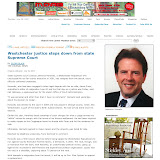
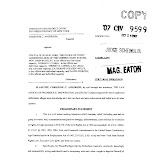
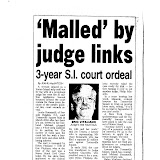
A Long Island judge notoriously dubbed "Senator Road Rage" for his horrifying behavior while he was a politician nearly mowed down a traffic agent in Manhattan on Thursday and then threatened the officer's job, The Post has learned. Court of Claims Judge James J. Lack and his daughter, Katherine, 37, were "barreling down" West 60th Street near the Mandarin Oriental Hotel at about 5 p.m. when they crossed paths with the unlucky agent, sources said. Lack, who was awarded the judgeship by former Gov. George Pataki in 2002 after a stint in the state Senate, ignored an order to slow down from the officer, who was standing in the street, the sources said. The robed rage-a-holic - who's been involved in dozens of angry driving incidents over the last 20 years - gunned his engine to swerve around the agent, who struck his hand on the passenger's-side mirror, the sources said. Lack jumped out of his 2005 Mercury SUV and declared he was a judge, flashed an ID, and screamed, "I'll have your job!" the sources said. Katherine then heaped her own abuse on the agent before they abruptly drove off, said the sources.
Lack objected to that version of events. He said he had just left the Hospital for Special Surgery, where his wife was undergoing cancer surgery. He claimed the agent was not wearing a reflective vest and confused him with a jaywalker. The agent, he said, punched his window and broke the mirror. Lack called the cops, and Internal Affairs launched an investigation, the NYPD confirmed. His daughter admitted to being a little hotheaded but apologized, saying, "I was very upset. I get a rush of adrenaline when I'm scared." This was far from Lack's first roadside confrontation. In 2001, when Lack represented East Northport in the state Senate, he followed a horrified 39-year-old mother home after a traffic incident, threatened to have her jailed and cursed the woman out in her own garage. He also reduced an East Northport car wash attendant to tears after his credit card was rejected. murray.weiss@nypost.com
Saturday, February 21, 2009


Friday, February 20, 2009
NY State Supreme Court Judge Resigns, Admits Wrongdoing
Makowski resigns as State Supreme Court justice
State is probing tie to friend’s DWI case
The Buffalo News by Patrick Lakamp, Gene Warner and Matt Gryta
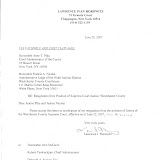
Joseph G. Makowski this afternoon resigned his seat as a State Supreme Court justice -- but escaped criminal charges -- in the wake of a state judicial investigation and a potential grand jury probe of written claims he made trying to clear a friend in a drunken-driving case. In a letter to Justice Sharon S. Townsend, administrative judge of the Eighth Judicial District, Makowski said: "This letter will advise you that I have decided to resign my position as a justice of the New York State Supreme Court, effective March 5, 2009. It has been a distinct privilege to serve as a member of the court for the past 10 years."
For at least three months, the State Commission on Judicial Conduct has been asking local law enforcement officials what they know about the affidavit Makowski signed after the Sept. 2 DWI arrest of former prosecutor Anne E. Adams. Makowski filed that affidavit as a witness after having been with Adams in the hours before her arrest. In that statement, dated Sept. 11, Makowski repeatedly stated that nothing in Adams’ behavior suggested she couldn’t drive safely home from a downtown Buffalo restaurant that night. Several witnesses, though, have given authorities statements that suggest Adams showed obvious signs of being intoxicated, both in her manner and in her driving. "Before we presented our case to the grand jury, Justice Makowski, like any other witness, was given a choice: recant, tell the truth and cooperate or be prosecuted," District Attorney Frank Sedita said. "Today, Makowski made the choice to recant, reject the affidavit and give our investigators a truthful statement," Sedita said. "Additionally, Justice Makowski agreed to provide truthful testimony against Ms. Adams in the grand jury and at trial. "Because of his recantation and cooperation, I will not seek to brand Makowski a criminal. However, I am deeply troubled by Makowski's original affidavit and initial conduct. Accordingly, Makowski, in lieu of criminal prosecution, will also be required to resign from the bench."
Adams today pleaded guilty to misdemeanor drunken driving, falsifying business record charges and attempted to tamper with physical evidence linked to her Sept. 2 drunken driving arrest. Adams, 46, who runs the trial technique program at the University at Buffalo Law School pleaded guilty before Erie County Judge Sheila A. DiTullio just before 4 p.m., shortly after Makowski submitted his resignation letter from the bench. Adams, of Quaker Road, Orchard Park, faces a possible jail term of up to two years when she returns to court for sentencing April 23. Also faxing a copy of his resignation letter to Justice Ann Pfau, the state's chief administrative judge, Makowski wrote that he had "decided to resign my position as a justice of the New York State Supreme court effective March 5, 2009." "It has been a distinct privilege to serve as a member of the Court for the past 10 years," Makowski added in his two-sentence resignation letter. DiTullio allowed Adams to remain free without bail and said she will impose "a very thoughtful" sentence. Adams also could be placed on probation and faces professional disciplinary action. Under the plea deal, Adams admitted to driving drunk on Sept. 2 and, on Sept. 3, falsifying the date when a physician drew blood from her -- in an apparent attempt to counter police claims she was legally drunk during her Sept. 2 arrest.
"I would expect that as a consequence of this plea, Ms. Adams may lose her license to practice law and her professorship at UB Law School," Sedita said. "Her punishments will be determined by others, including a county court judge and the attorney grievance committee. Whether or not she loses her license and or job, Ms. Adams will be forever branded a criminal."
Adams was charged originally with aggravated DWI, accused of having a blood-alcohol content of 0.19 percent at the time of her arrest. That’s more than twice the state’s legal limit. A call to Makowski’s attorney, Joel L. Daniels, was not returned. “Ms. Adams has a 20-year, high-profile career as both a prosecutor and defense attorney,” Makowski wrote in his affidavit. “She also holds a full-time faculty position at UB Law School. These charges, even if resulting in an acquittal, would seriously damage her reputation in the community and future professional prospects. For these reasons, I believe a dismissal in the interests of justice is warranted.” Investigators were studying the following possible discrepancies between Makowski’s affidavit and witnesses’ statements to authorities, according to sources close to the case:
• “When we left the restaurant, I walked Ms. Adams to her car,” the affidavit states. “There was nothing unusual in her speech, gait or mannerisms. She was entirely appropriate.” An eyewitness, however, told law enforcement officials that Adams was stumbling as she headed for her car and that the man with her was holding her to keep her from falling.
•“After speaking with Ms. Adams for another five minutes, I told her I had to get on the Skyway to my mother’s house,” the judge wrote. “She told me she was heading to her home in Angola on the same route. I drove over the Skyway to South Buffalo with Ms. Adams’ vehicle in my continuous presence.” But an eyewitness told authorities Makowski also got into Adams’ car, and the two sat inside the car for about 20 minutes. Adams then pulled her convertible into another part of the Shanghai Red’s restaurant parking lot, near the marina. That is where she backed into a parked car before pulling away. A Buffalo police officer, parked nearby, noticed what happened and pulled up alongside her vehicle. He recognized Adams and said to her, “Counselor, where are you going?” a law enforcement source told The News. The judge was in Adams’ car at the time, the same source said. Adams then parked her car and went into the restaurant to try to find out who owned the car she had struck with her vehicle. A restaurant employee discovered the car belonged to another employee. A few days later, Adams sent a payment of several hundred dollars to the employee to cover the damage.
• “We traveled along Route 5, which is now under construction,” wrote Makowski, who was following her in his car. “Her driving was entirely appropriate. She drove at the appropriate speed, she negotiated turns and tight construction lanes properly.” But another driver later reported an erratic driver in that area. Hamburg Police Officer Vincent Pupo III pulled Adams’ vehicle over when he saw her convertible weaving from lane to lane, nearly striking a guardrail, near Ford Motor Co.’s Buffalo Stamping Plant, according to a police report. plakamp@buffnews.com and gwarner@buffnews.com
State is probing tie to friend’s DWI case
The Buffalo News by Patrick Lakamp, Gene Warner and Matt Gryta
Joseph G. Makowski this afternoon resigned his seat as a State Supreme Court justice -- but escaped criminal charges -- in the wake of a state judicial investigation and a potential grand jury probe of written claims he made trying to clear a friend in a drunken-driving case. In a letter to Justice Sharon S. Townsend, administrative judge of the Eighth Judicial District, Makowski said: "This letter will advise you that I have decided to resign my position as a justice of the New York State Supreme Court, effective March 5, 2009. It has been a distinct privilege to serve as a member of the court for the past 10 years."
For at least three months, the State Commission on Judicial Conduct has been asking local law enforcement officials what they know about the affidavit Makowski signed after the Sept. 2 DWI arrest of former prosecutor Anne E. Adams. Makowski filed that affidavit as a witness after having been with Adams in the hours before her arrest. In that statement, dated Sept. 11, Makowski repeatedly stated that nothing in Adams’ behavior suggested she couldn’t drive safely home from a downtown Buffalo restaurant that night. Several witnesses, though, have given authorities statements that suggest Adams showed obvious signs of being intoxicated, both in her manner and in her driving. "Before we presented our case to the grand jury, Justice Makowski, like any other witness, was given a choice: recant, tell the truth and cooperate or be prosecuted," District Attorney Frank Sedita said. "Today, Makowski made the choice to recant, reject the affidavit and give our investigators a truthful statement," Sedita said. "Additionally, Justice Makowski agreed to provide truthful testimony against Ms. Adams in the grand jury and at trial. "Because of his recantation and cooperation, I will not seek to brand Makowski a criminal. However, I am deeply troubled by Makowski's original affidavit and initial conduct. Accordingly, Makowski, in lieu of criminal prosecution, will also be required to resign from the bench."
Adams today pleaded guilty to misdemeanor drunken driving, falsifying business record charges and attempted to tamper with physical evidence linked to her Sept. 2 drunken driving arrest. Adams, 46, who runs the trial technique program at the University at Buffalo Law School pleaded guilty before Erie County Judge Sheila A. DiTullio just before 4 p.m., shortly after Makowski submitted his resignation letter from the bench. Adams, of Quaker Road, Orchard Park, faces a possible jail term of up to two years when she returns to court for sentencing April 23. Also faxing a copy of his resignation letter to Justice Ann Pfau, the state's chief administrative judge, Makowski wrote that he had "decided to resign my position as a justice of the New York State Supreme court effective March 5, 2009." "It has been a distinct privilege to serve as a member of the Court for the past 10 years," Makowski added in his two-sentence resignation letter. DiTullio allowed Adams to remain free without bail and said she will impose "a very thoughtful" sentence. Adams also could be placed on probation and faces professional disciplinary action. Under the plea deal, Adams admitted to driving drunk on Sept. 2 and, on Sept. 3, falsifying the date when a physician drew blood from her -- in an apparent attempt to counter police claims she was legally drunk during her Sept. 2 arrest.
"I would expect that as a consequence of this plea, Ms. Adams may lose her license to practice law and her professorship at UB Law School," Sedita said. "Her punishments will be determined by others, including a county court judge and the attorney grievance committee. Whether or not she loses her license and or job, Ms. Adams will be forever branded a criminal."
Adams was charged originally with aggravated DWI, accused of having a blood-alcohol content of 0.19 percent at the time of her arrest. That’s more than twice the state’s legal limit. A call to Makowski’s attorney, Joel L. Daniels, was not returned. “Ms. Adams has a 20-year, high-profile career as both a prosecutor and defense attorney,” Makowski wrote in his affidavit. “She also holds a full-time faculty position at UB Law School. These charges, even if resulting in an acquittal, would seriously damage her reputation in the community and future professional prospects. For these reasons, I believe a dismissal in the interests of justice is warranted.” Investigators were studying the following possible discrepancies between Makowski’s affidavit and witnesses’ statements to authorities, according to sources close to the case:
• “When we left the restaurant, I walked Ms. Adams to her car,” the affidavit states. “There was nothing unusual in her speech, gait or mannerisms. She was entirely appropriate.” An eyewitness, however, told law enforcement officials that Adams was stumbling as she headed for her car and that the man with her was holding her to keep her from falling.
•“After speaking with Ms. Adams for another five minutes, I told her I had to get on the Skyway to my mother’s house,” the judge wrote. “She told me she was heading to her home in Angola on the same route. I drove over the Skyway to South Buffalo with Ms. Adams’ vehicle in my continuous presence.” But an eyewitness told authorities Makowski also got into Adams’ car, and the two sat inside the car for about 20 minutes. Adams then pulled her convertible into another part of the Shanghai Red’s restaurant parking lot, near the marina. That is where she backed into a parked car before pulling away. A Buffalo police officer, parked nearby, noticed what happened and pulled up alongside her vehicle. He recognized Adams and said to her, “Counselor, where are you going?” a law enforcement source told The News. The judge was in Adams’ car at the time, the same source said. Adams then parked her car and went into the restaurant to try to find out who owned the car she had struck with her vehicle. A restaurant employee discovered the car belonged to another employee. A few days later, Adams sent a payment of several hundred dollars to the employee to cover the damage.
• “We traveled along Route 5, which is now under construction,” wrote Makowski, who was following her in his car. “Her driving was entirely appropriate. She drove at the appropriate speed, she negotiated turns and tight construction lanes properly.” But another driver later reported an erratic driver in that area. Hamburg Police Officer Vincent Pupo III pulled Adams’ vehicle over when he saw her convertible weaving from lane to lane, nearly striking a guardrail, near Ford Motor Co.’s Buffalo Stamping Plant, according to a police report. plakamp@buffnews.com and gwarner@buffnews.com
NY Supreme Court Judge Expected to Resign, Pressured by Corrupt 'Ethics' Committee
Justice Makowski expected to resign amid state judicial probe
State is probing tie to friend’s DWI case
The Buffalo News by Patrick Lakamp and Gene Warner - February 20, 2009
Joseph G. Makowski is expected to resign his seat as a State Supreme Court justice—possibly in the next few days— amid a state judicial investigation and a potential grand jury probe of written claims he made trying to clear a friend in a drunken-driving case, several legal sources have told The Buffalo News. For at least three months, the State Commission on Judicial Conduct has been asking local law enforcement officials what they know about the affidavit Makowski signed after the Sept. 2 DWI arrest of former prosecutor Anne E. Adams. Makowski filed that affidavit as a witness after having been with Adams in the hours before her arrest. In that statement, dated Sept. 11, Makowski repeatedly stated that nothing in Adams’ behavior suggested she couldn’t drive safely home from a downtown Buffalo restaurant that night. Several witnesses, though, have given authorities statements that suggest Adams showed obvious signs of being intoxicated, both in her manner and in her driving.
Adams was charged with aggravated DWI, accused of having a blood-alcohol content of 0.19 percent at the time of her arrest. That’s more than twice the state’s legal limit. A call to Makowski’s attorney, Joel L. Daniels, was not returned. An Erie County grand jury is expected to investigate both Makowski and Adams, probably sometime in the next couple of weeks, legal sources have said. That probe, of course, would be called off if any plea deals are made in the case. A plea deal that might result in a misdemeanor admission by Makowski probably would not save his seat on the bench, legal sources say. But such a deal could keep him from being permanently disbarred. Any decision on disbarment would be made by an attorneys grievance committee, an arm of the State Appellate Division. Such a plea deal also could end the Commission on Judicial Conduct probe.
The commission has jurisdiction over 3,400 judges and justices of the state Unified Court System. It investigates about 1,500 complaints per year and recommends a wide range of actions against any jurists found guilty of misconduct through formal hearings. Adams’ former attorney had filed the judge’s signed statement as part of a motion to dismiss the DWI case against her in Town of Hamburg Court. That attorney eventually withdrew that motion. “Ms. Adams has a 20-year, high-profile career as both a prosecutor and defense attorney,” Makowski wrote in his affidavit. “She also holds a full-time faculty position at UB Law School. These charges, even if resulting in an acquittal, would seriously damage her reputation in the community and future professional prospects. For these reasons, I believe a dismissal in the interests of justice is warranted.” Investigators are studying the following possible discrepancies between Makowski’s affidavit and witnesses’ statements to authorities, according to sources close to the case:
• “When we left the restaurant, I walked Ms. Adams to her car,” the affidavit states. “There was nothing unusual in her speech, gait or mannerisms. She was entirely appropriate.” An eyewitness, however, has told law enforcement officials that Adams was stumbling as she headed for her car and that the man with her was holding her to keep her from falling.
•“After speaking with Ms. Adams for another five minutes, I told her I had to get on the Skyway to my mother’s house,” the judge wrote. “She told me she was heading to her home in Angola on the same route. I drove over the Skyway to South Buffalo with Ms. Adams’ vehicle in my continuous presence.” But an eyewitness told authorities Makowski also got into Adams’ car, and the two sat inside the car for about 20 minutes. Adams then pulled her convertible into another part of the Shanghai Red’s restaurant parking lot, near the marina. That is where she backed into a parked car before pulling away. A Buffalo police officer, parked nearby, noticed what happened and pulled up alongside her vehicle. He recognized Adams and said to her, “Counselor, where are you going?” a law enforcement source told The News. The judge was in Adams’ car at the time, the same source said. Adams then parked her car and went into the restaurant to try to find out who owned the car she had struck with her vehicle. A restaurant employee discovered the car belonged to another employee. A few days later, Adams sent a payment of several hundred dollars to the employee to cover the damage.
• “We traveled along Route 5, which is now under construction,” wrote Makowski, who was following her in his car. “Her driving was entirely appropriate. She drove at the appropriate speed, she negotiated turns and tight construction lanes properly.” But another driver later reported an erratic driver in that area. Hamburg Police Officer Vincent Pupo III pulled Adams’ vehicle over when he saw her convertible weaving from lane to lane, nearly striking a guardrail, near Ford Motor Co.’s Buffalo Stamping Plant, according to a police report. plakamp@buffnews.com and gwarner@buffnews.com
State is probing tie to friend’s DWI case
The Buffalo News by Patrick Lakamp and Gene Warner - February 20, 2009
Joseph G. Makowski is expected to resign his seat as a State Supreme Court justice—possibly in the next few days— amid a state judicial investigation and a potential grand jury probe of written claims he made trying to clear a friend in a drunken-driving case, several legal sources have told The Buffalo News. For at least three months, the State Commission on Judicial Conduct has been asking local law enforcement officials what they know about the affidavit Makowski signed after the Sept. 2 DWI arrest of former prosecutor Anne E. Adams. Makowski filed that affidavit as a witness after having been with Adams in the hours before her arrest. In that statement, dated Sept. 11, Makowski repeatedly stated that nothing in Adams’ behavior suggested she couldn’t drive safely home from a downtown Buffalo restaurant that night. Several witnesses, though, have given authorities statements that suggest Adams showed obvious signs of being intoxicated, both in her manner and in her driving.
Adams was charged with aggravated DWI, accused of having a blood-alcohol content of 0.19 percent at the time of her arrest. That’s more than twice the state’s legal limit. A call to Makowski’s attorney, Joel L. Daniels, was not returned. An Erie County grand jury is expected to investigate both Makowski and Adams, probably sometime in the next couple of weeks, legal sources have said. That probe, of course, would be called off if any plea deals are made in the case. A plea deal that might result in a misdemeanor admission by Makowski probably would not save his seat on the bench, legal sources say. But such a deal could keep him from being permanently disbarred. Any decision on disbarment would be made by an attorneys grievance committee, an arm of the State Appellate Division. Such a plea deal also could end the Commission on Judicial Conduct probe.
The commission has jurisdiction over 3,400 judges and justices of the state Unified Court System. It investigates about 1,500 complaints per year and recommends a wide range of actions against any jurists found guilty of misconduct through formal hearings. Adams’ former attorney had filed the judge’s signed statement as part of a motion to dismiss the DWI case against her in Town of Hamburg Court. That attorney eventually withdrew that motion. “Ms. Adams has a 20-year, high-profile career as both a prosecutor and defense attorney,” Makowski wrote in his affidavit. “She also holds a full-time faculty position at UB Law School. These charges, even if resulting in an acquittal, would seriously damage her reputation in the community and future professional prospects. For these reasons, I believe a dismissal in the interests of justice is warranted.” Investigators are studying the following possible discrepancies between Makowski’s affidavit and witnesses’ statements to authorities, according to sources close to the case:
• “When we left the restaurant, I walked Ms. Adams to her car,” the affidavit states. “There was nothing unusual in her speech, gait or mannerisms. She was entirely appropriate.” An eyewitness, however, has told law enforcement officials that Adams was stumbling as she headed for her car and that the man with her was holding her to keep her from falling.
•“After speaking with Ms. Adams for another five minutes, I told her I had to get on the Skyway to my mother’s house,” the judge wrote. “She told me she was heading to her home in Angola on the same route. I drove over the Skyway to South Buffalo with Ms. Adams’ vehicle in my continuous presence.” But an eyewitness told authorities Makowski also got into Adams’ car, and the two sat inside the car for about 20 minutes. Adams then pulled her convertible into another part of the Shanghai Red’s restaurant parking lot, near the marina. That is where she backed into a parked car before pulling away. A Buffalo police officer, parked nearby, noticed what happened and pulled up alongside her vehicle. He recognized Adams and said to her, “Counselor, where are you going?” a law enforcement source told The News. The judge was in Adams’ car at the time, the same source said. Adams then parked her car and went into the restaurant to try to find out who owned the car she had struck with her vehicle. A restaurant employee discovered the car belonged to another employee. A few days later, Adams sent a payment of several hundred dollars to the employee to cover the damage.
• “We traveled along Route 5, which is now under construction,” wrote Makowski, who was following her in his car. “Her driving was entirely appropriate. She drove at the appropriate speed, she negotiated turns and tight construction lanes properly.” But another driver later reported an erratic driver in that area. Hamburg Police Officer Vincent Pupo III pulled Adams’ vehicle over when he saw her convertible weaving from lane to lane, nearly striking a guardrail, near Ford Motor Co.’s Buffalo Stamping Plant, according to a police report. plakamp@buffnews.com and gwarner@buffnews.com
Clawback: Ponzi Victims to be Double Screwed, but more legal fees
Alleged Madoff victims may be vulnerable to other victims' claims
The Los Angelos Times by Carol J. WIlliams - February 16, 2009
Those who profited before suffering losses -- including retirees and charities -- could be hit with demands to give back cash in a settlement.
Santa Monica retiree Bob Braslau considers himself a victim of accused fraud mastermind Bernard L. Madoff. But the court-appointed bankruptcy trustee, he fears, might consider him a beneficiary. Braslau was among the thousands who lost money when the Madoff fund collapsed amid allegations that it was a $50-billion Ponzi scheme. But because Braslau had taken out some proceeds over the years, he could be forced to return those earnings if a court determines they weren't real investment returns, simply money from other victims. "I do feel in jeopardy," said Braslau, a former aerospace engineer for TRW Inc. who invested with Madoff through Stanley Chais, a Beverly Hills money manager. "People are going to be frantic in trying to recover their money." Some of the charities and foundations that lost millions with Madoff are also potential targets in the gathering scramble to recover cash from those who profited to distribute among those who did not. Madoff, 70, has been under house arrest at his luxury Manhattan apartment since Dec. 11. The former Nasdaq chairman is reported to be cooperating with investigators while awaiting trial on securities fraud charges.
Irving Picard, a partner with law firm Baker Hostetler appointed by the federal Bankruptcy Court to recover assets for distribution to defrauded investors, has so far found $830 million and sent out 8,000 letters to potential claimants. In pursuit of other funds from the lost Madoff fortune, Picard is expected to employ a little-used legal tool, the "clawback" suit, to collect what remains of the alleged scheme's payouts for a more equitable redistribution, analysts say. The track record for clawbacks is limited because Ponzi scheme victims are typically left with little that can be recovered. Retrieving funds can also be difficult if those who profit take their proceeds abroad, where the trustee may have no jurisdiction. But there have been successful efforts to recover money. After the Bayou Management hedge fund, run by Wall Street stalwarts Samuel Israel III and Daniel Marino, collapsed in 2005, the court-appointed receiver managed to recover about one-third of the $450 million lost by investors.
In another case, groups affiliated with the Church of Scientology agreed in 2006 to pay back $3.5 million they received from former Santa Barbara money manager Reed Slatkin and others who invested with him. Slatkin is set for release in 2014 from the U.S. penitentiary at Lompac, where he has been serving time in connection with a $593-million operation in which money from some investors was used to pay off others -- the classic definition of a Ponzi scheme. "The legal basis for the trustees being able to clawback is the allegation that the transfer of any of the proceeds to anyone in a Ponzi scheme is a fraudulent conveyance," said Bob Klueger, a Los Angeles attorney who specializes in asset protection. "The theory behind it is that if it was a Ponzi scheme, the trustee is not bound by any considerations of who got in early and who got in late. The trustee is permitted to treat everyone the same, take back all money invested and divide it up evenly among all the investors," Klueger said.
Klueger worked for two clients hit by clawback lawsuits for their role in funneling investment money to Slatkin. His clients settled with the bankruptcy trustee for an undisclosed amount that was returned to the pool of investors. Most investors who suffered losses in Madoff's scheme, both individuals and institutions, didn't deal directly with the New York magnate, instead putting their money in through feeder funds such as Brighton Co., which was run by Chais, a Beverly Hills investor and philanthropist. The founder of the Chais Family Foundation, a contributor to Jewish causes around the world, Chais is the target of a $250-million civil suit and has folded the foundation for lack of funds. Investments that were structured as part of retirement plans are exempt from clawback lawsuits, legal experts note, but that is of little comfort to Braslau. He was simply an investor, and he feels exposed.
He declined to say how much he lost but said it was more than he took out over the 30-plus years he was invested. He does not blame Chais, however, saying he was "99.99% convinced" that Chais knew nothing about Madoff's corrupt dealings, given that Chais was providing money from friends, relatives and charitable groups. Chais did not return phone messages from The Times. Joe Grundfest, a Stanford University securities law professor, predicted complex and controversial legal actions among the Madoff victims, including charitable foundations with considerable assets that could be tapped and thousands who counted on the fund's proceeds to support them in old age. "You can imagine that litigation of that sort gives rise to many potential problems and appearances of harshness," said Grundfest, raising the prospect of charities that used investment proceeds for humanitarian causes being hit with demands for the return of money already spent. "It's going to be hotly litigated."
In New York, Atty. Gen. Andrew Cuomo has already signaled that such investors are under scrutiny. He has served subpoenas on at least a dozen universities and nonprofits that took investment advice from Madoff intermediary J. Ezra Merkin. "Anything withdrawn within 90 days of the bankruptcy filing most certainly would be targeted," said Donald Chase, a securities litigator who represents clients who consider themselves Madoff victims. "Beyond that, what everyone is bracing for, if you take the Bayou case as an example and blueprint, is the trustee filing claims against anyone who redeemed or received profits in the last six years." A primary residence is fully protected from bankruptcy seizure in a few states, such as Florida and Texas, but in California the homestead exemption is only $75,000 per couple under 65 and $200,000 for those at or above retirement age. The statute of limitations in most states for recovering fraudulent redemptions is six years, four in California. But lawyers warn that the statutes are often ambiguous, neither clear nor consistent about when the clock begins running.
Others who could be sued for return of allegedly ill-gotten gains include executives of now-bankrupt funds who drew exorbitant salaries or severance packages even as the portfolios they were managing were sliding. "People are entitled to get paid for their work. But golden parachutes are different," Los Angeles bankruptcy attorney Arthur Greenberg said. "If you've got just a plain fraudster, the answer is he's going to be giving back what he took from the estate." Reed Kathrein, a Berkeley securities litigator, said he had his doubts that the bankruptcy trustee in the Madoff case would target victims such as Braslau with clawback suits. "Certainly, if they try to come back after people like that, there's going to be a massive revolt and a big fight," said Kathrein, noting that even some who came out ahead were unwitting victims. "You can only squeeze so much blood out of a stone." carol.williams@latimes.com
*****************************************
Related Story:
Madoff Victims Face Grim Prospects in Court: Jane Bryant Quinn
BLOOMBERG Commentary by Jane Bryant Quinn - February 11, 2009
Feb. 11 (Bloomberg) -- The securities laws may be your worst enemy if you lost money in the Madoff scam. Investors are suing the feeder funds that channeled their money to Bernard Madoff, charging the feeders with fraud, negligence or breach of fiduciary duty. On the surface, the cases sound like slam dunks. They’re not. Congress and the courts have spent more than a decade writing and affirming laws that protect companies from irate investors. Those laws may turn out to be feeder fund protection acts.
For bilked investors, the problems begin with the federal Private Securities Litigation Reform Act (PSLRA), passed in 1995. It was designed to reduce the number of “frivolous” securities lawsuits filed in federal courts. In essence, it says that investors can’t proceed with a case unless they already have facts in hand that strongly suggest a deliberate fraud. By this standard, it’s not enough to claim that the feeders failed to investigate Madoff or issued financial statements later found to be false. You have to show that the feeder probably knew about the fraudulent scheme, or recklessly disregarded evidence of it, or that the fund violated a written commitment -- say, by investing all of your money with a single manager when it specifically promised not to. You need documentary evidence showing that your claim is strong.
Stupid, Not Criminal
The feeders will argue that they didn’t know what Madoff was up to, that they vetted him along with other managers and that everyone was fooled. They have a good chance of getting your case dismissed. “Stupid” isn’t a triable offense. Prior to the PSLRA, you could start your case with minimal evidence and use pre-trial discovery to search for more. The feeder would have to turn over e-mails and other documents that might show it had doubts about the Madoff accounts. Today, however, you need such evidence just to begin, and it’s tough to get.
You also can’t argue that the feeders are liable because their actions made the fraud possible. In 1994, the Supreme Court ruled that investors may not sue advisers -- investment banks, lawyers, accountants -- that aid and abet a securities fraud (the case was Central Bank of Denver vs. First Interstate Bank of Denver). Abetters have get-out-of-jail-free cards. You might get a break if Madoff made secret kickbacks to one or more feeder funds, to bring in more cash. No one knows if that happened. If it did and Madoff confesses to it, that could be enough evidence of fraud to get you into court, says John C. Coffee, a professor of law at Columbia University in New York.
Seeking Friendlier Courts
Most securities fraud cases have to be brought in federal court, but there’s potentially a second road to justice. Instead of claiming fraud, investors can claim that the feeders breached their fiduciary duty -- a charge that’s tried in state courts. It doesn’t require proof of fraudulent intent. “Getting these cases into state courts is crucial for the litigation, because success will depend heavily on getting access to the feeder funds’ records,” says James Cox, professor of law at Duke University in Durham, North Carolina. There’s a hitch. Class actions involving the securities laws and covering more than 50 people can easily be moved by the defendant to the inhospitable federal courts. A case can also be moved for other reasons -- for example, if it was filed in a different state from the one where the feeder has its main office.
Court Hurdles
Many of these cases will wind up in New York, where some of the principal feeders are located. That creates yet another problem. A state law called the Martin Act prevents individuals from filing claims under New York securities laws. Only the attorney general can pursue an action. You can’t even pursue a breach-of-fiduciary-duty claim in New York’s courts, if the breach involves a securities case. It has to go to the federal courts -- a finding affirmed as recently as July 2007. In that case, South Cherry Street LLC, an investment group, sued Hennessee Group LLC, a consultant, for recommending the Bayou Group, a hedge-fund Ponzi that blew up in 2005. The judge, Colleen McMahon, also found that, even if Hennessee’s principals had egregiously failed to investigate Bayou, they weren’t liable for South Cherry’s losses as long as they didn’t deliberately shut their eyes to what was going on.
Pursuing Deep Pockets
Her decision is on appeal and lawyers are watching it closely. “It’s a stark example of how many barriers there are now to private investors seeking to recover,” says attorney Joel Laitman of Schoengold Sporn Laitman & Lometti in New York. Investors are pursuing one other set of deep pockets: The institutions chosen by the feeder funds to be custodians of the assets. Custodians are supposed to hold your investments and account for them. Their presence made people feel secure. Most custodial contracts, however, permit the appointment of subcustodians, says Dominic Hobson, editor-in-chief of London- based GlobalCustodian, which covers the field. Ideally, the sub should be independent but the contract may not require it. In this case, the institutions handed off to Madoff, acting as his own custodian. Custodial contracts typically require that subs be chosen carefully and monitored, Hobson says. An institution might argue, successfully, that it did indeed monitor Madoff but was craftily misled. This isn’t to say that the feeder funds are safe, only that lawsuits face surprising hurdles. Investors whose contracts include an arbitration clause might do better. Arbitrations don’t follow the securities laws. At the very least, you’ll have a chance to make your case.
(Jane Bryant Quinn, a leading personal finance writer and author of “Smart and Simple Financial Strategies for Busy People,” is a Bloomberg News columnist. She is a director of Bloomberg LP, parent of Bloomberg News. The opinions expressed are her own.) To contact the writer of this column: Jane Bryant Quinn in New York at jbquinn@bloomberg.net
Santa Monica retiree Bob Braslau considers himself a victim of accused fraud mastermind Bernard L. Madoff. But the court-appointed bankruptcy trustee, he fears, might consider him a beneficiary. Braslau was among the thousands who lost money when the Madoff fund collapsed amid allegations that it was a $50-billion Ponzi scheme. But because Braslau had taken out some proceeds over the years, he could be forced to return those earnings if a court determines they weren't real investment returns, simply money from other victims. "I do feel in jeopardy," said Braslau, a former aerospace engineer for TRW Inc. who invested with Madoff through Stanley Chais, a Beverly Hills money manager. "People are going to be frantic in trying to recover their money." Some of the charities and foundations that lost millions with Madoff are also potential targets in the gathering scramble to recover cash from those who profited to distribute among those who did not. Madoff, 70, has been under house arrest at his luxury Manhattan apartment since Dec. 11. The former Nasdaq chairman is reported to be cooperating with investigators while awaiting trial on securities fraud charges.
Irving Picard, a partner with law firm Baker Hostetler appointed by the federal Bankruptcy Court to recover assets for distribution to defrauded investors, has so far found $830 million and sent out 8,000 letters to potential claimants. In pursuit of other funds from the lost Madoff fortune, Picard is expected to employ a little-used legal tool, the "clawback" suit, to collect what remains of the alleged scheme's payouts for a more equitable redistribution, analysts say. The track record for clawbacks is limited because Ponzi scheme victims are typically left with little that can be recovered. Retrieving funds can also be difficult if those who profit take their proceeds abroad, where the trustee may have no jurisdiction. But there have been successful efforts to recover money. After the Bayou Management hedge fund, run by Wall Street stalwarts Samuel Israel III and Daniel Marino, collapsed in 2005, the court-appointed receiver managed to recover about one-third of the $450 million lost by investors.
In another case, groups affiliated with the Church of Scientology agreed in 2006 to pay back $3.5 million they received from former Santa Barbara money manager Reed Slatkin and others who invested with him. Slatkin is set for release in 2014 from the U.S. penitentiary at Lompac, where he has been serving time in connection with a $593-million operation in which money from some investors was used to pay off others -- the classic definition of a Ponzi scheme. "The legal basis for the trustees being able to clawback is the allegation that the transfer of any of the proceeds to anyone in a Ponzi scheme is a fraudulent conveyance," said Bob Klueger, a Los Angeles attorney who specializes in asset protection. "The theory behind it is that if it was a Ponzi scheme, the trustee is not bound by any considerations of who got in early and who got in late. The trustee is permitted to treat everyone the same, take back all money invested and divide it up evenly among all the investors," Klueger said.
Klueger worked for two clients hit by clawback lawsuits for their role in funneling investment money to Slatkin. His clients settled with the bankruptcy trustee for an undisclosed amount that was returned to the pool of investors. Most investors who suffered losses in Madoff's scheme, both individuals and institutions, didn't deal directly with the New York magnate, instead putting their money in through feeder funds such as Brighton Co., which was run by Chais, a Beverly Hills investor and philanthropist. The founder of the Chais Family Foundation, a contributor to Jewish causes around the world, Chais is the target of a $250-million civil suit and has folded the foundation for lack of funds. Investments that were structured as part of retirement plans are exempt from clawback lawsuits, legal experts note, but that is of little comfort to Braslau. He was simply an investor, and he feels exposed.
He declined to say how much he lost but said it was more than he took out over the 30-plus years he was invested. He does not blame Chais, however, saying he was "99.99% convinced" that Chais knew nothing about Madoff's corrupt dealings, given that Chais was providing money from friends, relatives and charitable groups. Chais did not return phone messages from The Times. Joe Grundfest, a Stanford University securities law professor, predicted complex and controversial legal actions among the Madoff victims, including charitable foundations with considerable assets that could be tapped and thousands who counted on the fund's proceeds to support them in old age. "You can imagine that litigation of that sort gives rise to many potential problems and appearances of harshness," said Grundfest, raising the prospect of charities that used investment proceeds for humanitarian causes being hit with demands for the return of money already spent. "It's going to be hotly litigated."
In New York, Atty. Gen. Andrew Cuomo has already signaled that such investors are under scrutiny. He has served subpoenas on at least a dozen universities and nonprofits that took investment advice from Madoff intermediary J. Ezra Merkin. "Anything withdrawn within 90 days of the bankruptcy filing most certainly would be targeted," said Donald Chase, a securities litigator who represents clients who consider themselves Madoff victims. "Beyond that, what everyone is bracing for, if you take the Bayou case as an example and blueprint, is the trustee filing claims against anyone who redeemed or received profits in the last six years." A primary residence is fully protected from bankruptcy seizure in a few states, such as Florida and Texas, but in California the homestead exemption is only $75,000 per couple under 65 and $200,000 for those at or above retirement age. The statute of limitations in most states for recovering fraudulent redemptions is six years, four in California. But lawyers warn that the statutes are often ambiguous, neither clear nor consistent about when the clock begins running.
Others who could be sued for return of allegedly ill-gotten gains include executives of now-bankrupt funds who drew exorbitant salaries or severance packages even as the portfolios they were managing were sliding. "People are entitled to get paid for their work. But golden parachutes are different," Los Angeles bankruptcy attorney Arthur Greenberg said. "If you've got just a plain fraudster, the answer is he's going to be giving back what he took from the estate." Reed Kathrein, a Berkeley securities litigator, said he had his doubts that the bankruptcy trustee in the Madoff case would target victims such as Braslau with clawback suits. "Certainly, if they try to come back after people like that, there's going to be a massive revolt and a big fight," said Kathrein, noting that even some who came out ahead were unwitting victims. "You can only squeeze so much blood out of a stone." carol.williams@latimes.com
*****************************************
Related Story:
Madoff Victims Face Grim Prospects in Court: Jane Bryant Quinn
BLOOMBERG Commentary by Jane Bryant Quinn - February 11, 2009
Feb. 11 (Bloomberg) -- The securities laws may be your worst enemy if you lost money in the Madoff scam. Investors are suing the feeder funds that channeled their money to Bernard Madoff, charging the feeders with fraud, negligence or breach of fiduciary duty. On the surface, the cases sound like slam dunks. They’re not. Congress and the courts have spent more than a decade writing and affirming laws that protect companies from irate investors. Those laws may turn out to be feeder fund protection acts.
For bilked investors, the problems begin with the federal Private Securities Litigation Reform Act (PSLRA), passed in 1995. It was designed to reduce the number of “frivolous” securities lawsuits filed in federal courts. In essence, it says that investors can’t proceed with a case unless they already have facts in hand that strongly suggest a deliberate fraud. By this standard, it’s not enough to claim that the feeders failed to investigate Madoff or issued financial statements later found to be false. You have to show that the feeder probably knew about the fraudulent scheme, or recklessly disregarded evidence of it, or that the fund violated a written commitment -- say, by investing all of your money with a single manager when it specifically promised not to. You need documentary evidence showing that your claim is strong.
Stupid, Not Criminal
The feeders will argue that they didn’t know what Madoff was up to, that they vetted him along with other managers and that everyone was fooled. They have a good chance of getting your case dismissed. “Stupid” isn’t a triable offense. Prior to the PSLRA, you could start your case with minimal evidence and use pre-trial discovery to search for more. The feeder would have to turn over e-mails and other documents that might show it had doubts about the Madoff accounts. Today, however, you need such evidence just to begin, and it’s tough to get.
You also can’t argue that the feeders are liable because their actions made the fraud possible. In 1994, the Supreme Court ruled that investors may not sue advisers -- investment banks, lawyers, accountants -- that aid and abet a securities fraud (the case was Central Bank of Denver vs. First Interstate Bank of Denver). Abetters have get-out-of-jail-free cards. You might get a break if Madoff made secret kickbacks to one or more feeder funds, to bring in more cash. No one knows if that happened. If it did and Madoff confesses to it, that could be enough evidence of fraud to get you into court, says John C. Coffee, a professor of law at Columbia University in New York.
Seeking Friendlier Courts
Most securities fraud cases have to be brought in federal court, but there’s potentially a second road to justice. Instead of claiming fraud, investors can claim that the feeders breached their fiduciary duty -- a charge that’s tried in state courts. It doesn’t require proof of fraudulent intent. “Getting these cases into state courts is crucial for the litigation, because success will depend heavily on getting access to the feeder funds’ records,” says James Cox, professor of law at Duke University in Durham, North Carolina. There’s a hitch. Class actions involving the securities laws and covering more than 50 people can easily be moved by the defendant to the inhospitable federal courts. A case can also be moved for other reasons -- for example, if it was filed in a different state from the one where the feeder has its main office.
Court Hurdles
Many of these cases will wind up in New York, where some of the principal feeders are located. That creates yet another problem. A state law called the Martin Act prevents individuals from filing claims under New York securities laws. Only the attorney general can pursue an action. You can’t even pursue a breach-of-fiduciary-duty claim in New York’s courts, if the breach involves a securities case. It has to go to the federal courts -- a finding affirmed as recently as July 2007. In that case, South Cherry Street LLC, an investment group, sued Hennessee Group LLC, a consultant, for recommending the Bayou Group, a hedge-fund Ponzi that blew up in 2005. The judge, Colleen McMahon, also found that, even if Hennessee’s principals had egregiously failed to investigate Bayou, they weren’t liable for South Cherry’s losses as long as they didn’t deliberately shut their eyes to what was going on.
Pursuing Deep Pockets
Her decision is on appeal and lawyers are watching it closely. “It’s a stark example of how many barriers there are now to private investors seeking to recover,” says attorney Joel Laitman of Schoengold Sporn Laitman & Lometti in New York. Investors are pursuing one other set of deep pockets: The institutions chosen by the feeder funds to be custodians of the assets. Custodians are supposed to hold your investments and account for them. Their presence made people feel secure. Most custodial contracts, however, permit the appointment of subcustodians, says Dominic Hobson, editor-in-chief of London- based GlobalCustodian, which covers the field. Ideally, the sub should be independent but the contract may not require it. In this case, the institutions handed off to Madoff, acting as his own custodian. Custodial contracts typically require that subs be chosen carefully and monitored, Hobson says. An institution might argue, successfully, that it did indeed monitor Madoff but was craftily misled. This isn’t to say that the feeder funds are safe, only that lawsuits face surprising hurdles. Investors whose contracts include an arbitration clause might do better. Arbitrations don’t follow the securities laws. At the very least, you’ll have a chance to make your case.
(Jane Bryant Quinn, a leading personal finance writer and author of “Smart and Simple Financial Strategies for Busy People,” is a Bloomberg News columnist. She is a director of Bloomberg LP, parent of Bloomberg News. The opinions expressed are her own.) To contact the writer of this column: Jane Bryant Quinn in New York at jbquinn@bloomberg.net
Corrupt Politician Blames Lawyer's Advice for Criminal Acts
On Stand, Politician's Former Lawyers Attack His Advice-of-Counsel Defense
The Legal Intelligencer by Shannon P. Duffy - February 19, 2009
PHILADELPHIA - It was a day of jaw-dropping revelations in the corruption trial of former Pennsylvania state Sen. Vincent J. Fumo as prosecutors called three of Fumo's former lawyers -- led by Richard A. Sprague -- to rebut testimony that Fumo was relying on poor legal advice when he instructed his staff to destroy documents in the midst of an FBI probe. Fumo, who spent more than five days on the witness stand, claims he was advised by several lawyers that he was free to continue business as usual in his Senate office -- including following a policy of deleting e-mails -- until he was served with a subpoena. But Sprague, called as a rebuttal witness by the prosecutors, testified that he never gave Fumo any such advice and never would have, and that Sprague himself never believed Fumo's claim that he received such advice from another lawyer, Robert Scandone.
Fumo's current lawyer, Dennis Cogan, reminded Sprague that Sprague had relied on the account of Scandone's advice in shaping Fumo's defense both in a press conference and in a letter to Congress. But Sprague insisted that he was simply doing his best for Fumo and that Sprague himself "doubted the truth of it very much from the beginning." Scandone later testified that he thought Fumo's decision to assert an advice of counsel defense was "the dumbest argument I've ever heard" and that the brief conversation Fumo was referring to as the one in which he gleaned the advice from Scandone was a "nothing" conversation. But Cogan pointed to notes from a meeting attended by Fumo, Sprague and two other lawyers from Sprague & Sprague that, he said, suggested Sprague had at one time agreed with Fumo's view on the law of obstructing justice.
To understand the lawyers' testimony, one must first understand the time line of events that led up to the former senator's indictment. Initial press accounts of the probe suggested that the FBI was focusing on Fumo's dealings with PECO and Verizon and possible allegations that Fumo had extorted contributions from them to Citizens Alliance for Better Neighborhoods, a nonprofit Fumo created and controlled. Ultimately, Fumo was never charged with extortion but instead was charged with defrauding Citizens Alliance by having the charity pay for a wide variety of goods and services, including vehicles. The indictment also charges that Fumo cheated the state Senate by using his staff as personal servants and defrauded the Independence Seaport Museum by taking yacht trips for free. Fumo is also accused of orchestrating a massive cover-up of his schemes by instructing his staff to destroy documents, most notably thousands of e-mails, in a process that including "wiping" clean all of the laptops, computers and BlackBerrys used by the scores of workers on Fumo's staff.
As a defense to the obstruction of justice charges, Fumo has testified that he received advice from two lawyers -- Sprague and Scandone -- that convinced him there was nothing wrong with his decision to strictly enforce a "document retention" policy that called for regularly deleting all e-mails to and from the senator. Fumo testified that when the news of the FBI probe first began to surface in press accounts, he had a conversation with one of his top aides in Harrisburg, attorney Christopher Craig, who was concerned because all of the e-mails relating to the PECO and Verizon negotiations had been lost forever when the Senate replaced the main e-mail server in Harrisburg. It was then, Fumo said, that Sprague told him that the lost e-mails were of no concern because the government cannot expect documents to be maintained unless they are under subpoena. Fumo also claims that later, when Citizens Alliance was served with a subpoena, he had a conversation with Scandone about whether the subpoena would require Fumo and his staff to change their office practices and that Scandone assured him he was under no duty to change anything because the subpoena was not directed to Fumo or his office.
After Fumo's testimony was completed, the defense rested and prosecutors set out to torpedo Fumo's advice of counsel defense by calling the very lawyers whose advice Fumo claims he relied on. Sprague said he routinely advises clients who are under investigation not to destroy anything because even an innocent defendant can end up in trouble for a cover-up. "You can get out of the fire, but you can be in the frying pan," Sprague said. Under questioning by Assistant U.S. Attorney John Pease, Sprague dealt a series of body blows to Fumo's advice of counsel defense. First, Sprague denied that he had ever had a conversation with Fumo about the concern that all of the PECO and Verizon e-mails had been lost in the changeover to the new e-mail server. Emphatically denouncing Fumo's account, Sprague said, "I never heard that at all until I heard that in this trial."
Sprague said that in a meeting with Fumo, the issue of deleting e-mails was discussed and that when Fumo said he believed he was free to delete documents until the day he was served with a subpoena, Sprague's partner, Mark Sheppard, asked Fumo where he had gotten such a "crazy" idea. Sprague recalled that later in the same meeting, Fumo had a question. The lawyer quoted the ex-senator as asking: "Would it help me if I had a lawyer who gave me that advice?" Fumo then left the meeting briefly, Sprague testified. When the former senator returned, Sprague continued, he said Scandone would testify that he had given Fumo such advice. Later on Wednesday, Scandone offered an account that dovetailed with Sprague's, saying he had received a call from Fumo who said that he was in a meeting with Sprague and needed a "really big favor."
Scandone said he told Fumo at the time that he was not his lawyer and that the conversation Fumo was referring to was "a nothing conversation." But Scandone said he ultimately agreed to write a letter that memorialized the conversation, even though he disagreed with the decision by Sprague and Fumo to rely on it as legal advice that would support a defense to obstruction charges. Attorney Geoffrey Johnson of Sprague & Sprague also testified briefly Wednesday and rejected Fumo's claim that Johnson's notes from a 2005 meeting showed that Sprague had agreed with Fumo's view of the law. Scandone's testimony will continue today. Fumo's lawyers are expected to seek permission to call Sheppard as a surrebuttal witness.
The Legal Intelligencer by Shannon P. Duffy - February 19, 2009
PHILADELPHIA - It was a day of jaw-dropping revelations in the corruption trial of former Pennsylvania state Sen. Vincent J. Fumo as prosecutors called three of Fumo's former lawyers -- led by Richard A. Sprague -- to rebut testimony that Fumo was relying on poor legal advice when he instructed his staff to destroy documents in the midst of an FBI probe. Fumo, who spent more than five days on the witness stand, claims he was advised by several lawyers that he was free to continue business as usual in his Senate office -- including following a policy of deleting e-mails -- until he was served with a subpoena. But Sprague, called as a rebuttal witness by the prosecutors, testified that he never gave Fumo any such advice and never would have, and that Sprague himself never believed Fumo's claim that he received such advice from another lawyer, Robert Scandone.
Fumo's current lawyer, Dennis Cogan, reminded Sprague that Sprague had relied on the account of Scandone's advice in shaping Fumo's defense both in a press conference and in a letter to Congress. But Sprague insisted that he was simply doing his best for Fumo and that Sprague himself "doubted the truth of it very much from the beginning." Scandone later testified that he thought Fumo's decision to assert an advice of counsel defense was "the dumbest argument I've ever heard" and that the brief conversation Fumo was referring to as the one in which he gleaned the advice from Scandone was a "nothing" conversation. But Cogan pointed to notes from a meeting attended by Fumo, Sprague and two other lawyers from Sprague & Sprague that, he said, suggested Sprague had at one time agreed with Fumo's view on the law of obstructing justice.
To understand the lawyers' testimony, one must first understand the time line of events that led up to the former senator's indictment. Initial press accounts of the probe suggested that the FBI was focusing on Fumo's dealings with PECO and Verizon and possible allegations that Fumo had extorted contributions from them to Citizens Alliance for Better Neighborhoods, a nonprofit Fumo created and controlled. Ultimately, Fumo was never charged with extortion but instead was charged with defrauding Citizens Alliance by having the charity pay for a wide variety of goods and services, including vehicles. The indictment also charges that Fumo cheated the state Senate by using his staff as personal servants and defrauded the Independence Seaport Museum by taking yacht trips for free. Fumo is also accused of orchestrating a massive cover-up of his schemes by instructing his staff to destroy documents, most notably thousands of e-mails, in a process that including "wiping" clean all of the laptops, computers and BlackBerrys used by the scores of workers on Fumo's staff.
As a defense to the obstruction of justice charges, Fumo has testified that he received advice from two lawyers -- Sprague and Scandone -- that convinced him there was nothing wrong with his decision to strictly enforce a "document retention" policy that called for regularly deleting all e-mails to and from the senator. Fumo testified that when the news of the FBI probe first began to surface in press accounts, he had a conversation with one of his top aides in Harrisburg, attorney Christopher Craig, who was concerned because all of the e-mails relating to the PECO and Verizon negotiations had been lost forever when the Senate replaced the main e-mail server in Harrisburg. It was then, Fumo said, that Sprague told him that the lost e-mails were of no concern because the government cannot expect documents to be maintained unless they are under subpoena. Fumo also claims that later, when Citizens Alliance was served with a subpoena, he had a conversation with Scandone about whether the subpoena would require Fumo and his staff to change their office practices and that Scandone assured him he was under no duty to change anything because the subpoena was not directed to Fumo or his office.
After Fumo's testimony was completed, the defense rested and prosecutors set out to torpedo Fumo's advice of counsel defense by calling the very lawyers whose advice Fumo claims he relied on. Sprague said he routinely advises clients who are under investigation not to destroy anything because even an innocent defendant can end up in trouble for a cover-up. "You can get out of the fire, but you can be in the frying pan," Sprague said. Under questioning by Assistant U.S. Attorney John Pease, Sprague dealt a series of body blows to Fumo's advice of counsel defense. First, Sprague denied that he had ever had a conversation with Fumo about the concern that all of the PECO and Verizon e-mails had been lost in the changeover to the new e-mail server. Emphatically denouncing Fumo's account, Sprague said, "I never heard that at all until I heard that in this trial."
Sprague said that in a meeting with Fumo, the issue of deleting e-mails was discussed and that when Fumo said he believed he was free to delete documents until the day he was served with a subpoena, Sprague's partner, Mark Sheppard, asked Fumo where he had gotten such a "crazy" idea. Sprague recalled that later in the same meeting, Fumo had a question. The lawyer quoted the ex-senator as asking: "Would it help me if I had a lawyer who gave me that advice?" Fumo then left the meeting briefly, Sprague testified. When the former senator returned, Sprague continued, he said Scandone would testify that he had given Fumo such advice. Later on Wednesday, Scandone offered an account that dovetailed with Sprague's, saying he had received a call from Fumo who said that he was in a meeting with Sprague and needed a "really big favor."
Scandone said he told Fumo at the time that he was not his lawyer and that the conversation Fumo was referring to was "a nothing conversation." But Scandone said he ultimately agreed to write a letter that memorialized the conversation, even though he disagreed with the decision by Sprague and Fumo to rely on it as legal advice that would support a defense to obstruction charges. Attorney Geoffrey Johnson of Sprague & Sprague also testified briefly Wednesday and rejected Fumo's claim that Johnson's notes from a 2005 meeting showed that Sprague had agreed with Fumo's view of the law. Scandone's testimony will continue today. Fumo's lawyers are expected to seek permission to call Sheppard as a surrebuttal witness.
Pillsbury Winthrop Lawyer Caught Blabbing on Train
Who Blabbed the BigLaw Layoff on the Train? Read On
The Recorder by Amanda Royal - February 20, 2009
SAN FRANCISCO - Someone is always listening. Especially on the train. That's the lesson for Pillsbury Winthrop Shaw Pittman, which said Thursday it will conduct layoffs after the legal blog Above the Law reported an anonymous tipster's detailed description of a loud cell phone conversation in a public place between two senior managers regarding the reductions. "We apologize for the unfortunate manner in which our deliberations about reductions have become public," Pillsbury said in a statement issued Thursday morning. "It is an unfortunate fact in today's economy that no business or law firm can rule out adjustments to their overall workforce levels. This includes Pillsbury, and among other cost-cutting measures, we will be implementing reductions to assure that our resources are aligned with our business needs."
The call apparently took place between Robert Robbins, head of the corporate and securities practice, and COO Richard Donaldson. Robbins reportedly named out loud at least some of the 15 to 20 attorneys who the firm was talking about laying off in four offices by the end of March. The conversation apparently took place on an Amtrak train between Washington, D.C., and New York. "I, along with all of the other passengers, were sitting quietly when the man directly behind me decided to make a phone call using his Bluetooth. He was talking so loudly that I think most people in the car were able to hear him," the tipster apparently told ATL. "His conversation, though he stressed how necessary it was to be kept secret [ah, the irony], detailed the current plans of Pillsbury to lay off somewhere in the range of 15-20 attorneys from four offices by the end of March, including a few senior associates with low billable hours and two or three first-year associates," the tipster continued. Firms are increasingly wary of the instant flow of information made possible by blogs, which are more receptive to anonymous information than traditional media.
"Most firms assume that any communications they make internally, particular to associates, will get on a blog, and they try to tailor those communications accordingly," said Newport Beach, Calif.-based consultant Peter Zeughauser. Comments posted below blog stories often reveal confidential information as well. By the end of the day, more than 300 comments were logged on the ATL story, with one poster claiming to be a Pillsbury associate who had been told to leave by the end of March and wasn't offered severance. Pillsbury declined to discuss layoff decisions beyond its statement. Many firms are conducting layoffs in this recession, which has caused demand for legal services to plummet. Last week, more than 800 attorneys and staff nationwide were laid off by at least eight major firms. In the last week of January, more than 1,000 people were laid off from law firms. Last week, Zeughauser said he knew more layoffs were coming, a piece of information he repeated on Thursday, though he declined to name firms. "I know there are more layoffs coming, big ones," he said. "And I'm not going to talk about them on the Amtrak train or to a reporter."
The Recorder by Amanda Royal - February 20, 2009
SAN FRANCISCO - Someone is always listening. Especially on the train. That's the lesson for Pillsbury Winthrop Shaw Pittman, which said Thursday it will conduct layoffs after the legal blog Above the Law reported an anonymous tipster's detailed description of a loud cell phone conversation in a public place between two senior managers regarding the reductions. "We apologize for the unfortunate manner in which our deliberations about reductions have become public," Pillsbury said in a statement issued Thursday morning. "It is an unfortunate fact in today's economy that no business or law firm can rule out adjustments to their overall workforce levels. This includes Pillsbury, and among other cost-cutting measures, we will be implementing reductions to assure that our resources are aligned with our business needs."
The call apparently took place between Robert Robbins, head of the corporate and securities practice, and COO Richard Donaldson. Robbins reportedly named out loud at least some of the 15 to 20 attorneys who the firm was talking about laying off in four offices by the end of March. The conversation apparently took place on an Amtrak train between Washington, D.C., and New York. "I, along with all of the other passengers, were sitting quietly when the man directly behind me decided to make a phone call using his Bluetooth. He was talking so loudly that I think most people in the car were able to hear him," the tipster apparently told ATL. "His conversation, though he stressed how necessary it was to be kept secret [ah, the irony], detailed the current plans of Pillsbury to lay off somewhere in the range of 15-20 attorneys from four offices by the end of March, including a few senior associates with low billable hours and two or three first-year associates," the tipster continued. Firms are increasingly wary of the instant flow of information made possible by blogs, which are more receptive to anonymous information than traditional media.
"Most firms assume that any communications they make internally, particular to associates, will get on a blog, and they try to tailor those communications accordingly," said Newport Beach, Calif.-based consultant Peter Zeughauser. Comments posted below blog stories often reveal confidential information as well. By the end of the day, more than 300 comments were logged on the ATL story, with one poster claiming to be a Pillsbury associate who had been told to leave by the end of March and wasn't offered severance. Pillsbury declined to discuss layoff decisions beyond its statement. Many firms are conducting layoffs in this recession, which has caused demand for legal services to plummet. Last week, more than 800 attorneys and staff nationwide were laid off by at least eight major firms. In the last week of January, more than 1,000 people were laid off from law firms. Last week, Zeughauser said he knew more layoffs were coming, a piece of information he repeated on Thursday, though he declined to name firms. "I know there are more layoffs coming, big ones," he said. "And I'm not going to talk about them on the Amtrak train or to a reporter."
Thursday, February 19, 2009
We Love Blabbing Attorneys, Even if From Fear of Prosecution
NY Attorney in Fraud Scandal Tells All
The New York Law Journal by Zach Lowe - February 19, 2009
There are a ton of legal angles to be explore amid the growing scandal swirling around R. Allen Stanford and the Stanford Group Co. — most notably, where exactly Stanford himself is at the moment. One issue in particular, though, is relevant for the lawyer community: that an attorney for the company, Thomas Sjoblom of Proskauer Rose, sniffed out the fraud, withdrew his representation, and told federal investigators he essentially took back everything he had told to them in recent weeks, according to Bloomberg. Sjoblom didn't return calls for comment, nor did Richard Razook of Hunton & Williams, another attorney reportedly representing Stanford.
In the meantime, Recorder affiliate the Am Law Daily contacted a number of legal ethics experts to discuss Sjoblom's decision to come clean about a client's alleged frauds — especially given the possibility that in doing so, he disclosed confidential client information to the government. Experts said Sjoblom did precisely the right thing — and, more importantly, that the federal Sarbanes-Oxley Act likely made his decision much easier than it otherwise might have been. The SOX Act contains a provision that explicitly states that any attorney before the Securities and Exchange Commission "may" reveal confidential client information to investigators if that attorney believes that doing so will prevent a violation of the law or help rectify losses investors have already suffered, says Bruce Green, a law professor and ethics expert at Fordham University. Before SOX, attorneys in Sjoblom's predicament faced a patchwork of confusing state laws and bar regulations through which they had to navigate, experts say.
The tangle of regulations dated back to the famous OPM case of the early 1980s, when lawyers at a now defunct firm kept quiet about OPM's use of bogus assets to obtain loans and were later found liable for their silence in several civil suits, says Stephen Gillers, a legal ethics expert at New York University School of Law. The SOX regulation gave securities lawyers clarification if their state bar associations or state laws did not, says Steven Lubet, a legal ethics expert at Northwestern University. Sarbanes-Oxley even created a term for withdrawing representation and handing over information to investigators, Gillers says: a "noisy withdrawal." "He did the right thing here," Gillers says of Sjoblom. Lubet says most "noisy withdrawals" never become public. But the SEC mentioned Sjoblom — though not by name — in its complaint against Stanford, something that likely reveals the importance of Sjoblom's cooperation.
In the coming days, there will be other angles connected to the unfolding Stanford scandal to delve into. John Coffee, a securities law expert at Columbia Law School, says it's too early too tell if any third parties who may have steered investors to Stanford might be liable for damages (a la the Madoff feeder funds). That's in part because Stanford's companies are not insolvent; if that remains true, investors will go after the alleged wrongdoer directly instead of targeting third parties, Coffee says. There's also the pending whistle-blower suit two ex-Stanford employees filed against Stanford last year, and the fact that the federal government fined Stanford in 2007 but never went any further. Finally, there's the fun and interesting copyright suit Stanford University filed against the financial group last year. A team from Curtis Mallet-Prevost Colt & Mosle is repping R. Allen Stanford in that case but not in the corporate investigation, court records show.
The New York Law Journal by Zach Lowe - February 19, 2009
There are a ton of legal angles to be explore amid the growing scandal swirling around R. Allen Stanford and the Stanford Group Co. — most notably, where exactly Stanford himself is at the moment. One issue in particular, though, is relevant for the lawyer community: that an attorney for the company, Thomas Sjoblom of Proskauer Rose, sniffed out the fraud, withdrew his representation, and told federal investigators he essentially took back everything he had told to them in recent weeks, according to Bloomberg. Sjoblom didn't return calls for comment, nor did Richard Razook of Hunton & Williams, another attorney reportedly representing Stanford.
In the meantime, Recorder affiliate the Am Law Daily contacted a number of legal ethics experts to discuss Sjoblom's decision to come clean about a client's alleged frauds — especially given the possibility that in doing so, he disclosed confidential client information to the government. Experts said Sjoblom did precisely the right thing — and, more importantly, that the federal Sarbanes-Oxley Act likely made his decision much easier than it otherwise might have been. The SOX Act contains a provision that explicitly states that any attorney before the Securities and Exchange Commission "may" reveal confidential client information to investigators if that attorney believes that doing so will prevent a violation of the law or help rectify losses investors have already suffered, says Bruce Green, a law professor and ethics expert at Fordham University. Before SOX, attorneys in Sjoblom's predicament faced a patchwork of confusing state laws and bar regulations through which they had to navigate, experts say.
The tangle of regulations dated back to the famous OPM case of the early 1980s, when lawyers at a now defunct firm kept quiet about OPM's use of bogus assets to obtain loans and were later found liable for their silence in several civil suits, says Stephen Gillers, a legal ethics expert at New York University School of Law. The SOX regulation gave securities lawyers clarification if their state bar associations or state laws did not, says Steven Lubet, a legal ethics expert at Northwestern University. Sarbanes-Oxley even created a term for withdrawing representation and handing over information to investigators, Gillers says: a "noisy withdrawal." "He did the right thing here," Gillers says of Sjoblom. Lubet says most "noisy withdrawals" never become public. But the SEC mentioned Sjoblom — though not by name — in its complaint against Stanford, something that likely reveals the importance of Sjoblom's cooperation.
In the coming days, there will be other angles connected to the unfolding Stanford scandal to delve into. John Coffee, a securities law expert at Columbia Law School, says it's too early too tell if any third parties who may have steered investors to Stanford might be liable for damages (a la the Madoff feeder funds). That's in part because Stanford's companies are not insolvent; if that remains true, investors will go after the alleged wrongdoer directly instead of targeting third parties, Coffee says. There's also the pending whistle-blower suit two ex-Stanford employees filed against Stanford last year, and the fact that the federal government fined Stanford in 2007 but never went any further. Finally, there's the fun and interesting copyright suit Stanford University filed against the financial group last year. A team from Curtis Mallet-Prevost Colt & Mosle is repping R. Allen Stanford in that case but not in the corporate investigation, court records show.
Federal Retaliation Lawsuit Moves Toward Justice in NY
The New York Law Journal CIVIL RIGHTS DECISION OF INTEREST - February 19, 2009
Abel v. Morabito
U.S. DISTRICT COURT SOUTHERN DISTRICT OF NEW YORK
Judge Gardephe
PLAINTIFF COLUMNIST sued defendant town, its elected supervisor, and four town councillors. He alleged First and Fourteenth Amendment rights breaches by defendants' authorization of a retaliatory lawsuit against him for unpaid property taxes after columns criticized town officials. The court denied defendants summary judgment, finding that plaintiff offered sufficient evidence for a jury to find in his favor. The court determined that from plaintiff's evidence a reasonable jury could find that he met the second and third elements of Curley v. Village of Suffern: that defendants' lawsuit was motivated by a desire to retaliate against him for his columns, and that by discontinuing his column plaintiff's behavior changed due to defendant's initiation of the tax suit, which chilled exercise of his First Amendment rights. Plaintiff also showed that he was the only person sued by the town for property taxes during the period when defendants controlled the town's government. Also, due to defendants' improper motives, the individual defendants were not entitled to qualified immunity.
Abel v. Morabito, 04 Civ. 07284 - Decided: February 9, 2009 -District Judge Paul G. Gardephe
U.S. DISTRICT COURT SOUTHERN DISTRICT OF NEW YORK
Plaintiff's counsel: Jonathan Lovett - Lovett & Gould
Defendants' counsel: Jeffrey K Van Etten - Kral, Clerkin, Redmond, Ryan, Perry & Girvan, LLP (NYC)
Judge Gardephe
MEMORANDUM OPINION AND ORDER
In this action, Plaintiff Bernard Abel brings claims under 42 U.S.C. §1983 against the Town of Rye, the town's elected supervisor (Defendant Morabito) and four elected members of the town council (Defendants Walter, Daly, Borrelli and Lagana). Plaintiff asserts that the defendants violated his rights under the First and Fourteenth Amendments by authorizing a retaliatory lawsuit against him for unpaid property taxes after he authored and published newspaper columns criticizing town officials.1 (Cmplt. ¶¶7-24) Defendants have moved for summary judgment on both claims, arguing that they are entitled to judgment as a matter of law on the merits and that the individual defendants are entitled to qualified immunity. For the reasons set forth below, Defendants' motion (Docket No. 23) is DENIED.
DISCUSSION
Summary judgment is warranted if the moving party shows that "there is no genuine issue as to any material fact" and that it "is entitled to a judgment as a matter of law." Fed. R. Civ. P. 56(c). "A dispute about a 'genuine issue' exists for summary judgment purposes where the evidence is such that a reasonable jury could decide in the non-movant's favor." Beyer v. County of Nassau, 524 F.3d 160, 163 (2d Cir. 2008). The Court "resolve[s] all ambiguities, and credit[s] all factual inferences that could rationally be drawn, in favor of the party opposing summary judgment." Cifra v. General Electric Co., 252 F.3d 205, 216 (2d Cir. 2001).
I. FACTS
Plaintiff Bernard Abel was the author of a column called the "Town Crier" in the Westmore News, a weekly newspaper that he founded. (Pltf. Rule 56.1 Response ¶¶1-2)2 Defendant Morabito was Town Supervisor for the Town of Rye from 1994 through at least 2005. (Pltf. Rule 56.1 Response ¶3; Morabito Dep. 6:14-17) Defendants Walter, Daly, Borrelli and Lagana were the Town of Rye's town council members from the mid-to late-1990s through at least 2004. (See Pltf. Rule 56.1 Response ¶3; Walter Dep. 6:11-14 (member since approximately 1997); Daly Dep. 5:21-23 (member since approximately 1995); Borrelli Dep. 6:19-21 (member since approximately 1998); Lagana Dep. 5:16-18 (member since approximately 1996).)
This lawsuit concerns Defendants' alleged reaction to the "Town Crier" columns that Plaintiff wrote in 2003 and 2004. The columns undisputedly portray the defendants in a negative light. Defendants characterize the columns as "critical of the individual defendants in the manner that they conducted their governmental duties." (Def. Rule 56.1 Statement ¶2) Plaintiff characterizes them as expressing his opinions regarding "matters of public concern including corruption, municipal corporate stupidity, incompetence, nonfeasance, and malfeasance" by the individual defendants. (Pltf. Rule 56.1 Response ¶2)
The conduct most directly at issue here is Defendants' authorization of a suit for back taxes against Plaintiff. In 2004, the Town Assessor, Mitchell Markowitz, made a presentation to the Town Council concerning Plaintiff's property tax exemption. (Pltf. Rule 56.1 Response ¶31) Since late 2002, Markowitz had been in communication with the assessor's office in Broward County, Florida concerning Plaintiff's Florida property tax exemption, and those communications had raised questions about whether Plaintiff had improperly claimed residents' exemptions in both Florida and New York. (Pltf. Rule 56.1 Response ¶¶22-25, 30) During Defendants' tenure as town officials, the town had never previously sued a property owner for back taxes. (September 26, 2006 Aff. of Bernard Abel ¶5; Morabito Dep. 25:5-14; Walter Dep. 19:13-20) However, after Markowitz's presentation, the individual defendants voted unanimously in an executive session of the Town Council to commence a suit for back taxes against Plaintiff. (Pltf. Rule 56.1 Response ¶34; Daly Dep. 7:4-20) The suit was commenced in July 2004. (Abel Aff. ¶3)
After the lawsuit was filed, it appears that Plaintiff wrote only one additional "Town Crier" column, which was published on September 10, 2004. (Id. ¶6) Three days later, Plaintiff commenced this action, in which he asserts that the suit for back taxes was filed in retaliation for his "Town Crier" columns and in violation of his First Amendment and Fourteenth Amendment rights.
II. PLAINTIFF'S FIRST AMENDMENT RETALIATION CLAIM
In order to prevail on his First Amendment retaliation claim, Plaintiff "must prove [that]: (1) he has an interest protected by the First Amendment; (2) defendants' actions were motivated or substantially caused by his exercise of that right; and (3) defendants' actions effectively chilled the exercise of his First Amendment right." Curley v. Village of Suffern, 268 F.3d 65, 73 (2d Cir. 2001). Defendants argue that Plaintiff cannot establish the second or third elements of his claim. (Def. Br. at 2, 9-10) However, Plaintiff has met his burden of offering sufficient evidence for a jury to find in his favor on both elements.3
A. A Reasonable Jury Could Find that Plaintiff Has Satisfied the Second Element of the Curley Test
To show that Defendants' decision to file the suit for back taxes was "motivated or substantially caused by his exercise of [his First Amendment rights]," Plaintiff must provide "[s]pecific proof of improper motivation." Curley, 268 F.3d at 73. Circumstantial evidence such as temporal proximity between Plaintiff's speech and the act in question, or direct evidence such as comments by the defendants, may suffice to meet this burden. Webster v. City of New York, 333 F. Supp. 2d 184, 202 (S.D.N.Y. 2004). Here, Plaintiff has offered sufficient evidence from which a jury could conclude that Defendants' authorization and initiation of the back taxes lawsuit was motivated by a desire to retaliate against Plaintiff because of his "Town Crier" columns.
The temporal proximity between Plaintiff's publication of the "Town Crier" columns and the filing of the lawsuit is circumstantial evidence of Defendants' alleged improper motive. Plaintiff published his columns from 2003 through September 10, 2004. (Pltf. Rule 56.1 Stat. ¶¶2, 60) The alleged retaliatory conduct occurred toward the end of this time period: the individual defendants voted to commence the tax suit in April or May 2004, and the Town filed suit in July 2004. (Cabble Aff. ¶85; Pltf. Rule 56.1 Stat. ¶¶45, 60; Cmplt. ¶16)
In addition, Plaintiff has offered direct evidence of Defendants' alleged improper motive, in the form of testimony that Defendants were unhappy with Plaintiff's columns and wanted them to stop. It is undisputed, for example, that in the spring of 2003, Defendants Morabito, Borrelli and Lagana discussed suing Plaintiff for libel based on his "Town Crier" columns. (Pltf. Rule 56.1 Response ¶7) Anthony Provenzano, who was present when these defendants discussed suing Plaintiff, summarized the "consensus" of the defendants at that meeting as being that "[t]he articles were not true, and there should be some action taken to stop [Plaintiff] from doing that." (Provenzano Dep. 12:21-13-22) There is likewise evidence that the entire town council discussed suing Plaintiff for libel during a council meeting in mid-2003. (Walter Dep. 8:5-10:6; Daly Dep. 20:25-20, 25:2-5 (testifying that Defendant Morabito said he was "not happy" with Plaintiff's columns because they were not true, and that all of the defendants expressed the view that the columns were not true)). Moreover, Plaintiff testified that the town attorney, Mann, told him in Defendant Morabito's office that, "If you don't stop, we're going to get you." (Abel Dep. 27:19-22) Plaintiff also testified that the town chairman of the Democratic Party, to which at least three of the defendants belonged, asked whether Plaintiff would "stop writing if they reduced . . . [his] taxes . . . ." (Id. 100:15-18; see also Morabito Dep. 17:11-23 (explaining that Morabito's 2003 campaign expenses were paid for by the Rye Town Democratic Committee); id. at 7:7-10 (noting that in 2003, Morabito, Lagana and Borrelli ran on the same ticket))
Moreover, it is undisputed that during the individual defendants' tenure on the town council, Plaintiff was the only resident they decided to sue for back taxes, although hundreds of other residents had had similar improper tax exemptions. (See also Pltf. Rule 56.1 Stat. ¶¶47-48, 52-54, 56-57; Cabble Aff. ¶¶175-182 (citing Markowitz's deposition testimony); Morabito Dep. 43:3-44:2) The Second Circuit has recognized that "circumstances suggesting in a substantial fashion that the plaintiff has been singled out" may be evidence of improper retaliatory motive.Blue v. Koren, 72 F.3d 1075, 1084 (2d Cir. 1995).
Plaintiff has also offered evidence suggesting that Defendants did not have a legitimate reason to sue him, which could further support an inference that their true motivation was improper. See Greenwich Citizens Committee, Inc. v. Counties of Warren and Washington Indus. Development Agency, 77 F.3d 26, 31 & n.5 (2d Cir. 1996) (identifying frivolity of claims as one issue that could be relevant to plaintiff's proof of his First Amendment retaliatory litigation claim). Plaintiff testified that before the property tax lawsuit was filed, he discussed the tax issue with the town assessor, Markowitz, who told him that he disagreed with Mann's assertion that Abel was not a New York resident (which was a predicate for the suit), and also said that "he didn't want to get involved in the middle of all this." (Abel Dep. 103:17-104:19, 104:24-105:2) Markowitz corroborated this testimony, agreeing that he told Abel that he did not want to be involved in a lawsuit about back taxes because in his opinion it was "political in nature." (Markowitz Dep. 67:15-68:5)4
Drawing all inferences in Plaintiff's favor, as the Court must do at this juncture, a reasonable jury could find that Defendants authorized the tax suit in retaliation for Plaintiff's exercise of his First Amendment rights based on (1) the temporal proximity between the protected speech and the alleged retaliatory conduct; and (2) evidence suggesting that Defendants (a) wanted to stop Plaintiff's columns, (b) singled him out for a back taxes lawsuit, and (c) may not have had a legitimate reason to sue him at all.
Defendants argue that Plaintiff nonetheless cannot establish the second Curley element because they in fact had a legitimate reason for suing him. However, as described above, Plaintiff's evidence creates a genuine factual dispute as to that issue, which in itself is enough to defeat a summary judgment motion. Moreover, where, as here, there is evidence that an "impermissible reason [i.e., retaliation] was at least part of . . . [the defendants'] basis for [their] action," the defendants are not entitled to summary judgment unless they can show that they would "have taken the same adverse action even if the impermissible reason had not existed." Greenwich Citizens Committee, 77 F.3d at 31; see also Webster, 333 F. Supp. 2d at 201 (if the plaintiff provides evidence of an improper reason for the defendant's conduct, "the defendant must show by a preponderance of the evidence that the defendant's conduct would have been the same 'even in the absence of the protected conduct'"). Defendants have not even attempted to make such a showing here. Therefore, Defendants have not shown that they are entitled to judgment as a matter of law on this issue.
B. A Reasonable Jury Could Find that Plaintiff Has Satisfied the Third Element of the Curley Test
To determine whether a plaintiff has offered sufficient evidence to establish the third element of the Curley test, courts look to whether there is evidence that the plaintiff's behavior changed after the alleged retaliatory act. See, e.g., Curley, 268 F.3d at 73 (plaintiff could not establish "chill" element where there was "no change in his behavior"); New England Health Care, Employees Union, Dist. 1199, SEIU/AFL-CIO v. Rowland, 221 F. Supp. 2d 297, 343 (D. Conn. 2002) ("If the plaintiff continues to engage in the protected speech that allegedly motivated unconstitutional retaliation, then it failed to established an actual chilling of its speech.").
Here, the only evidence concerning Plaintiff's behavior after the Town initiated the tax suit is that he published a single farewell column approximately two months later, on September 10, 2004. (Abel Aff. ¶¶3, 6) Plaintiff has offered affidavit testimony that he stopped writing the column because of the tax suit. (Id. ¶5 ("due to the harassment I sustained at the hands of Town officials, including but not limited to the Town's commencement of the . . . action against me to recover back taxes . . . I ceased writing my column 'Town Crier' in the Westmore News")) Although the evidence on this issue is sparse, a jury could reasonably find that Plaintiff's behavior did in fact change due to Defendants' initiation of the tax suit, and that Defendants' conduct therefore chilled Plaintiff's exercise of his First Amendment rights. Cf. Spear v. Town of West Hartford, 954 F.2d 63, 67 (2d Cir. 1992) (suggesting that plaintiff could meet the "chill" requirement by showing either that "he had declined to write further . . . editorials" on the subject at issue or "had toned down his writing on the subject").
III. PLAINTIFF'S EQUAL PROTECTION CLAIM
Plaintiff also asserts that Defendants' conduct gives rise to a Fourteenth Amendment selective enforcement claim. To prevail on this claim, Plaintiff must show: "(1) that . . . [he was] treated differently from other similarly situated individuals, and (2) that such differential treatment was based on impermissible considerations such as race, religion, intent to inhibit or punish the exercise of constitutional rights, or malicious or bad faith intent to injure a person." Harlen Assocs. v. Incorporated Village of Mineola, 273 F.3d 494, 499 (2d Cir. 2001) (internal quotation omitted). Defendants argue that Plaintiff cannot establish the first element of this claim. (Def. Br. at 17-18)5
To establish the first element, Plaintiff must show that: (1) "the persons to whom . . . [he] compares himself . . . [are] 'similarly situated in all material respects,'" Estate of Morris v. Dapolito, 297 F. Supp. 2d 680, 686 (S.D.N.Y. 2004); and (2) that Defendants knew there were similarly situated individuals and "consciously applied a different standard" to Plaintiff, LaTrieste Restaurant v. Village of Port Chester, 188 F.3d 65, 70 (2d Cir. 1999). As with Plaintiff's First Amendment claim, although Plaintiff's evidence is relatively thin, it is sufficient for a jury to find in his favor.
A. Plaintiff Has Offered Evidence From Which a Jury Could Find That Similarly Situated Individuals Existed and Were Treated Differently
The undisputed evidence shows that Plaintiff was the only person sued by the Town of Rye for property taxes during the period when Defendants controlled the town government. (See, e.g., Morabito Dep. 25:5-14 (acknowledging that the suit against Abel was the only suit for back taxes that he voted on in his 10-year tenure as town supervisor); Walter Dep. 19:13-20 (testifying that through the day of his deposition, the suit against Abel was the only suit for back taxes he was aware of in his 9.5 years on the town council).) Based on this evidence, a jury could reasonably find that Plaintiff was treated differently from any other resident who may have owed back taxes.
To show that such individuals did exist, Plaintiff must identify comparators whom a "prudent person would think . . . [were] roughly equivalent." Estate of Morris, 297 F. Supp. 2d at 686 (internal citations omitted). Plaintiff need not show an "exact correlation" between himself and the comparators. Id. (internal citations omitted). See also Penlyn Dev. Corp. v. Inc. Vill. of Lloyd Harbor, 51 F.Supp.2d 255, 264 (E.D.N.Y.1999) ("The test is whether a prudent person, looking objectively at the incidents, would think them roughly equivalent. Exact correlation is neither likely nor necessary, but the cases must be fair congeners. In other words, apples should be compared to apples." (internal citations omitted)).6
Here, the evidence is sufficient for a jury to find that similarly situated individuals existed. Defendant Morabito, the town supervisor, testified that a tax reevaluation conducted in 2003 and 2004 "cleaned up and brought forth numerous situations similar to . . . [Abel's]" and that other action based on this information had been "anticipated." (Morabito Dep. 25:5-26:17) He further testified that the town assessor, Markowitz, told Morabito "that there's probably upwards of a dozen [individuals] that we need to take action against [due to improper exemptions]," and that Morabito told Markowitz to "put [them] on hold" "[b]ecause we are in litigation . . . with Mr. Abel." (Id. 28:2-14) Morabito also testified that Markowitz had resolved "hundreds" of exemption issues administratively but could not handle the remaining dozen the same way (id. 43:3-44:2), and Morabito later described those dozen cases as ones where the town "would have to file suit." (Id. 50:23-51:4) A jury could reasonably infer from this testimony that there were approximately a dozen individuals who were similar "in all material respects" to Plaintiff - i.e., they were at least "roughly equivalent," Estate of Morris, 297 F. Supp. 2d at 686 - because their situations allegedly warranted the Town suing them over a property tax exemption.
Defendants attempt to show that they are entitled to judgment as a matter of law on this issue by presenting facts concerning alleged differences between Plaintiff and the other individuals who had questionable or incorrect tax exemptions. (Def. Br. at 19-20; Def. Reply Br. at 8-9) However, Defendants' evidence merely creates a factual dispute for the jury. It does not show that Defendants are entitled to judgment as a matter of law. See Cine SK8, Inc. v. Town of Henrietta, 507 F.3d 778, 790 (2d Cir. 2007) (in selective enforcement case, "[g]enerally, whether two . . . [comparators] are similarly situated is a factual issue that should be submitted to the jury"); see alsoHarlen, 273 F.3d at 499 n.2 (same).
B. Evidence that Defendants Knew of the Similarly Situated Individuals
To establish the first element of his selective enforcement claim, Plaintiff must also offer evidence showing either that Defendants had knowledge of the similarly situated individuals at the time they decided to sue him, or that they lacked that knowledge due to a "see-no-evil policy of not enforcing" the Town's right to collect back taxes, which they "then abandoned . . . with respect to a violator engaged in protected activity." LaTrieste, 188 F.3d at 70 n.1.
Plaintiff has not offered any evidence that the individual defendants - except perhaps Defendant Morabito - had the requisite knowledge at the time they voted to sue him, and Defendants have offered affirmative evidence to the contrary.7 However, a jury could reasonably find that the defendants, as long-serving council members, knew they were taking unprecedented action when they voted to sue Plaintiff. Further, there is evidence that before voting to sue Plaintiff, Defendants confirmed that their action was unprecedented by asking the town assessor whether anyone else had been sued in similar circumstances in the past (Lagana Dep. 17:18-24), but failed to ask whether there were any other individuals who were then similarly situated to Plaintiff.8 Based on these facts, a reasonable jury could conclude that Defendants' lack of knowledge was due to a "see-no-evil policy."
IV. QUALIFIED IMMUNITY
Having found that Defendants are not entitled to judgment as a matter of law on the merits of Plaintiff's claims, the Court must determine whether the individual defendants are nonetheless entitled to judgment as a matter of law because they are entitled to qualified immunity.9 In order to make that determination, the Court must: (1) "determine whether . . . [Plaintiff] has alleged a violation of a constitutional right;" (2) "consider if the violated right was clearly established at the time of the conduct;" and (3) if the first two factors are met, decide whether Plaintiff has "demonstrate[d] that [D]efendants' actions were not objectively reasonable." Harhay v. Town of Ellington Bd. of Educ., 323 F.3d 206, 211 (2d Cir. 2003). Here, Defendants do not contest that Plaintiff has alleged a violation of constitutional rights. However, they argue that the law concerning the rights at issue was not clearly established at the time of the conduct and that, as a matter of law, their actions were objectively reasonable.
Contrary to Defendants' argument, the law with respect to both of Plaintiff's claims was clearly established in 2004. Defendants' sole argument with respect to Plaintiff's Fourteenth Amendment claim is that "there was no clearly recognized right to be free from retaliation under the Equal Protection Clause." (Def. Br. at 18) However, as discussed above, the question is whether Plaintiff had a right to be free from selective enforcement of the law in retaliation for the exercise of First Amendment rights. The Second Circuit had clearly recognized that right as of 2004. See, e.g., supra pp. 10-11 & n.5 (citing pre-2004 cases). Indeed, Defendants do not argue that the law with respect to this right was not clearly established by 2004.
With respect to Plaintiff's First Amendment claim, Defendants argue that the Second Circuit itself recognized a lack of clarity in the law in 1998 when it stated, in Smith v. Garretto, 147 F.3d 91 (2d Cir. 1998), that "[w]ith retaliatory lawsuits, at least in the civil context, a showing that the retaliatory suit is frivolous seems to be required." Id. at 95 (emphasis added) citing Greenwich Citizens Committee, 77 F.3d at 31 & n.5. (Def. Br. at 13-14) However, a later Second Circuit decision clarified this issue prior to 2004. In Gorman-Bakos v. Cornell Co-op Extension of Schenectady, 252 F.3d 545 (2d Cir. 2001), the Second Circuit described its 1996 decision in Greenwich Citizens Committee as holding that:
the constitutionality of the government's filing of counterclaims . . . turned solely on whether the government would have filed the counterclaims in the absence of an impermissible punitive or retaliatory reason . . . . Where the routine conduct of litigation could justify the response, we held the government would be entitled to take action . . .unless the government acted in order to retaliate. Id. at 556 (emphasis added).
Thus, in Gorman-Bakos, the Second Circuit made clear that even non-frivolous litigation may be unconstitutional if it is motivated by retaliatory intent.10 Based on Greenwich Citizens Committee and Gorman-Bakos, reasonable government officials deciding whether to authorize litigation against a private citizen in 2004 would have understood that even if the litigation was not frivolous, their conduct would be unlawful if they would not have taken such action absent a retaliatory motive. Thus, the relevant law was clear when the Defendants authorized the suit against Plaintiff in 2004. See Higazy v. Templeton, 505 F.3d 161, 169 (2d Cir. 2007) (where the right asserted by the plaintiff clearly existed under applicable law, the question is "whether under preexisting law a reasonable defendant official would have understood that his or her acts were unlawful").
Defendants would still be entitled to qualified immunity if the Court could find in their favor on the third factor, which is whether Plaintiff has "demonstrate[d] that [D]efendants' actions were not objectively reasonable." Harhay, 323 F.3d at 211. However, the Court cannot do so here. In a case "where . . . specific intent is actually an element of the plaintiff's claim as defined by clearly established law, it can never be objectively reasonable for a government official to act with the intent that is prohibited by law." Locurto v. Safir, 264 F.3d 154, 169 (2d Cir. 2001). Therefore, "in an action in which . . . an unconstitutional subjective intent is alleged," the plaintiff can defeat a summary judgment motion on the issue of qualified immunity by "proffer[ing] particularized evidence of direct or circumstantial facts . . . supporting the claim of an improper motive." Sheppard v. Beerman, 94 F.3d 823, 828 (2d Cir. 1996) (applying rule in First Amendment retaliation case); see also Mandell v. County of Suffolk, 316 F.3d 368, 385 (2d Cir. 2003) (summary judgment on qualified immunity was inappropriate where "retaliatory intent is an element of plaintiff's claim" and "plaintiff's evidence of retaliatory animus is sufficient to make defendants' motivation a triable issue of fact"). Here, the Court has already found that Plaintiff has offered sufficient evidence of Defendants' improper motive to withstand summary judgment on both of his claims. (See supra pp. 5-8, 12-13.) Therefore, the individual defendants have not shown an entitlement to qualified immunity.
CONCLUSION
For the foregoing reasons, Defendants' motion for summary judgment (Docket No. 23) is DENIED.
SO ORDERED.
1. In the Complaint, Plaintiff alleges that Defendants engaged in a variety of retaliatory conduct. (Cmplt. ¶¶7-24) However, in his memorandum of law opposing summary judgment, Plaintiff focuses on a single allegedly retaliatory act - the town's lawsuit against him for back taxes - as the action giving rise to his claims. (Pltf. Br. at 12-16) Plaintiff asserts that the other alleged conduct is relevant to show that Defendants had a retaliatory motive in authorizing that suit. (Id. at 9) Therefore, the Court will not consider whether any of the other conduct alleged by Plaintiff, standing alone, could support a First Amendment or Fourteenth Amendment claim.
2. Unless otherwise noted, the cited paragraphs of Plaintiff's Rule 56.1 Response are paragraphs in which Plaintiff admitted the facts that Defendants characterized as undisputed in the correspondingly numbered paragraph of their Rule 56.1 Statement.
3. Plaintiff has argued that he need not show the third element of the Curley test - i.e., that Defendants' actions effectively chilled the exercise of his First Amendment rights. (Pltf. Br. at 12) However, while the Second Circuit has not "impose[d] an actual chill requirement for First Amendment retaliation claims" in all cases "involving criticism of public officials by private citizens," Gill v. Pidlypchak, 389 F.3d 379, 381 (2d Cir. 2004), it has clearly done so where, as here, the alleged retaliatory conduct is the filing of a lawsuit. See Spear v. Town of West Hartford, 954 F.2d 63, 67 (2d Cir. 1992) (in case where plaintiff asserted that defendants' filing of a lawsuit violated his First Amendment rights, holding that plaintiff's "naked assertion of a chill" was insufficient to state a retaliation claim in the absence of allegations that, for example, "he had declined to write further anti-abortion editorials" or "had toned down his writing on the subject").
4. Defendants argue that these statements are inadmissible (1) under F.R.E. 701 because they constitute lay witness opinion testimony, and (2) because Markowitz is not competent to testify about the individual defendants' state of mind. (Def. Reply Br. at 6) Neither argument is well-founded. Markowitz testified about his own evaluation as to whether Plaintiff was a New York resident and about his own reluctance to get involved in a litigation that he perceived as "political in nature." His testimony does not address what the defendants were thinking. Moreover, because Markowitz was the Town Assessor and responsible for tax exemptions, he is obviously qualified to comment on the merits of the dispute, particularly when Defendants have claimed (Def. Br. at 14-16) that they had a legitimate basis for bringing the suit. Markowitz's testimony would clearly be admissible, at least as to the Town, as an admission under F.R.E. 801(d)(2)(D) ("a statement by the party's agent or servant concerning a matter within the scope of the agency or employment made during the existence of the relationship"). Finally, even if the jury were not entitled to consider this testimony as to the individual defendants, there is sufficient additional evidence from which it could find that Defendants were motivated by Plaintiff's exercise of his First Amendment rights.
5. Defendants make two additional arguments that are meritless because they are based on mischaracterizations of the Complaint. First, Defendants argue that Plaintiff is attempting to assert a Fourteenth Amendment retaliation claim, which the Second Circuit does not recognize. However, Plaintiff is clearly asserting a selective enforcement claim (see Cmplt. ¶¶29-30; Pltf. Br. at 15 (citing selective enforcement test)), and in cases where the plaintiff has asserted First Amendment retaliation and Fourteenth Amendment selective enforcement claims arising from the same facts, the Second Circuit has considered both claims. See, e.g., Cobb v. Pozzi, 363 F.3d 89 (2d Cir. 2004);African Trade & Information Center, Inc. v. Abromaitis, 294 F.3d 355 (2d Cir. 2002); Brady v. Town of Colchester, 863 F.2d 205, 216-17 (2d Cir. 1988). Second, Defendants argue that Plaintiff "has not alleged that he was discriminated against . . . to prevent him from exercising a constitutional right," and must therefore prove that Defendants were "motivated by malicious or bad faith intent." (Def. Br. at 20) However, Plaintiff clearly asserts that Defendants were motivated by a desire to prevent him from exercising his First Amendment rights. (Cmplt. ¶¶16-17; Pltf. Br. at 15) Further, he has offered evidence from which a jury could find in his favor on this element. (See supra p. 5-8.)
6. Defendants argue that to show that a comparator is similarly situated, Plaintiff must show that "no rational person could regard the circumstances of the plaintiff to differ from those of a comparator to a degree that would justify the differential treatment on the basis of a legitimate government policy." Neilson v. D'Angelis, 409 F.3d 100, 105 (2d Cir. 2005), overruled on other grounds by Appel v. Spiridon, 531 F.3d 138 (2d Cir. 2008). However, as the Neilson court explicitly noted, its definition of "similarly situated" is "simply an adaptation of the rational review standard applicable to equal protection 'class of one' cases." Neilson, 409 F.3d at 105 n.2. The rational review standard does not apply in this case. See id. (citing Weinstein v. Albright, 261 F.3d 127, 140 (2d Cir. 2001), as holding that that "rational basis review applies to equal protection claims not based on plaintiff's membership in a suspect class or on effects of the challenged action on fundamental rights" (emphasis added)). Therefore, the Neilson definition of "similarly situated" is also inapplicable here.
7 Defendant Walter testified that on the day Markowitz presented the town council with information about Plaintiff's alleged dual residency and improper tax exemptions, Markowitz did not discuss any other taxpayers. (Walter Dep. 17:21-18:10) Walter testified that he did not learn of the existence of taxpayers who were arguably similarly situated until the day of his deposition (January 16, 2006). (Id. 18:23-19:3) Plaintiff asserts that Defendant Daly's testimony contradicts Walter's testimony (see Pltf. Rule 56.1 Response ¶35), but while Daly testified that Markowitz told the council about others with unwarranted tax exemptions, the entirety of her testimony makes clear that she believed this conversation took place after the council voted to sue Plaintiff for back taxes. (Daly Dep. 27:2-24, 28:10-13)
8. Defendant Walter testified that neither he nor anyone else at the meeting asked whether "other people ha[d] done the same thing." (Walter Dep. 18:11-15) Defendant Lagana similarly testified that at that meeting, Markowitz only discussed Plaintiff, and he could not recall anyone asking about others with illegal exemptions. (Lagana Dep. 11:3-12) If Defendants had inquired about others, there is evidence that Markowitz would have been able to answer the question. Markowitz testified that he compiled information about other taxpayers who were similarly situated to Plaintiff during the same time period that the tax re-evaluation was conducted - i.e., during late 2003 and early 2004. (Markowitz Dep. 27:3-23)
9. The qualified immunity defense is available only to the individual defendants and not to the Town of Rye. Vives v. City of New York, 524 F.3d 346, 350 (2d Cir. 2008) ("[U]nlike individual defendants, a municipality may not assert qualified immunity based on its good faith belief that its actions or policies are constitutional.").
10. It is also worth noting that the Garetto excerpt relied on by Defendants is a passing observation - not a holding - that is not supported by the cases it cites. The cases cited in Garetto merely stand for the proposition that an improper motive might reasonably be inferred from the assertion of frivolous claims - these cases do not indicate that a plaintiff must prove that the allegedly retaliatory litigation was frivolous. See Greenwich Citizens Committee, 77 F.3d at 31 & n.5 (stating in a footnote that "[a]mong the issues that the Greenwich plaintiffs might litigate in attempting to prove retaliation are . . . whether the counterclaims were frivolous" (emphasis added)); Harrison v. Springdale Water & Sewer Commission, 780 F.3d 1422, 1428 (8th Cir. 1986) (noting that plaintiffs had alleged that the counterclaims at issue were frivolous in holding that the plaintiffs had stated a claim for violation of their First Amendment rights with respect to the defendants' alleged acts in pressuring them to settle a lawsuit).
Abel v. Morabito
U.S. DISTRICT COURT SOUTHERN DISTRICT OF NEW YORK
Judge Gardephe
PLAINTIFF COLUMNIST sued defendant town, its elected supervisor, and four town councillors. He alleged First and Fourteenth Amendment rights breaches by defendants' authorization of a retaliatory lawsuit against him for unpaid property taxes after columns criticized town officials. The court denied defendants summary judgment, finding that plaintiff offered sufficient evidence for a jury to find in his favor. The court determined that from plaintiff's evidence a reasonable jury could find that he met the second and third elements of Curley v. Village of Suffern: that defendants' lawsuit was motivated by a desire to retaliate against him for his columns, and that by discontinuing his column plaintiff's behavior changed due to defendant's initiation of the tax suit, which chilled exercise of his First Amendment rights. Plaintiff also showed that he was the only person sued by the town for property taxes during the period when defendants controlled the town's government. Also, due to defendants' improper motives, the individual defendants were not entitled to qualified immunity.
Abel v. Morabito, 04 Civ. 07284 - Decided: February 9, 2009 -District Judge Paul G. Gardephe
U.S. DISTRICT COURT SOUTHERN DISTRICT OF NEW YORK
Plaintiff's counsel: Jonathan Lovett - Lovett & Gould
Defendants' counsel: Jeffrey K Van Etten - Kral, Clerkin, Redmond, Ryan, Perry & Girvan, LLP (NYC)
Judge Gardephe
MEMORANDUM OPINION AND ORDER
In this action, Plaintiff Bernard Abel brings claims under 42 U.S.C. §1983 against the Town of Rye, the town's elected supervisor (Defendant Morabito) and four elected members of the town council (Defendants Walter, Daly, Borrelli and Lagana). Plaintiff asserts that the defendants violated his rights under the First and Fourteenth Amendments by authorizing a retaliatory lawsuit against him for unpaid property taxes after he authored and published newspaper columns criticizing town officials.1 (Cmplt. ¶¶7-24) Defendants have moved for summary judgment on both claims, arguing that they are entitled to judgment as a matter of law on the merits and that the individual defendants are entitled to qualified immunity. For the reasons set forth below, Defendants' motion (Docket No. 23) is DENIED.
DISCUSSION
Summary judgment is warranted if the moving party shows that "there is no genuine issue as to any material fact" and that it "is entitled to a judgment as a matter of law." Fed. R. Civ. P. 56(c). "A dispute about a 'genuine issue' exists for summary judgment purposes where the evidence is such that a reasonable jury could decide in the non-movant's favor." Beyer v. County of Nassau, 524 F.3d 160, 163 (2d Cir. 2008). The Court "resolve[s] all ambiguities, and credit[s] all factual inferences that could rationally be drawn, in favor of the party opposing summary judgment." Cifra v. General Electric Co., 252 F.3d 205, 216 (2d Cir. 2001).
I. FACTS
Plaintiff Bernard Abel was the author of a column called the "Town Crier" in the Westmore News, a weekly newspaper that he founded. (Pltf. Rule 56.1 Response ¶¶1-2)2 Defendant Morabito was Town Supervisor for the Town of Rye from 1994 through at least 2005. (Pltf. Rule 56.1 Response ¶3; Morabito Dep. 6:14-17) Defendants Walter, Daly, Borrelli and Lagana were the Town of Rye's town council members from the mid-to late-1990s through at least 2004. (See Pltf. Rule 56.1 Response ¶3; Walter Dep. 6:11-14 (member since approximately 1997); Daly Dep. 5:21-23 (member since approximately 1995); Borrelli Dep. 6:19-21 (member since approximately 1998); Lagana Dep. 5:16-18 (member since approximately 1996).)
This lawsuit concerns Defendants' alleged reaction to the "Town Crier" columns that Plaintiff wrote in 2003 and 2004. The columns undisputedly portray the defendants in a negative light. Defendants characterize the columns as "critical of the individual defendants in the manner that they conducted their governmental duties." (Def. Rule 56.1 Statement ¶2) Plaintiff characterizes them as expressing his opinions regarding "matters of public concern including corruption, municipal corporate stupidity, incompetence, nonfeasance, and malfeasance" by the individual defendants. (Pltf. Rule 56.1 Response ¶2)
The conduct most directly at issue here is Defendants' authorization of a suit for back taxes against Plaintiff. In 2004, the Town Assessor, Mitchell Markowitz, made a presentation to the Town Council concerning Plaintiff's property tax exemption. (Pltf. Rule 56.1 Response ¶31) Since late 2002, Markowitz had been in communication with the assessor's office in Broward County, Florida concerning Plaintiff's Florida property tax exemption, and those communications had raised questions about whether Plaintiff had improperly claimed residents' exemptions in both Florida and New York. (Pltf. Rule 56.1 Response ¶¶22-25, 30) During Defendants' tenure as town officials, the town had never previously sued a property owner for back taxes. (September 26, 2006 Aff. of Bernard Abel ¶5; Morabito Dep. 25:5-14; Walter Dep. 19:13-20) However, after Markowitz's presentation, the individual defendants voted unanimously in an executive session of the Town Council to commence a suit for back taxes against Plaintiff. (Pltf. Rule 56.1 Response ¶34; Daly Dep. 7:4-20) The suit was commenced in July 2004. (Abel Aff. ¶3)
After the lawsuit was filed, it appears that Plaintiff wrote only one additional "Town Crier" column, which was published on September 10, 2004. (Id. ¶6) Three days later, Plaintiff commenced this action, in which he asserts that the suit for back taxes was filed in retaliation for his "Town Crier" columns and in violation of his First Amendment and Fourteenth Amendment rights.
II. PLAINTIFF'S FIRST AMENDMENT RETALIATION CLAIM
In order to prevail on his First Amendment retaliation claim, Plaintiff "must prove [that]: (1) he has an interest protected by the First Amendment; (2) defendants' actions were motivated or substantially caused by his exercise of that right; and (3) defendants' actions effectively chilled the exercise of his First Amendment right." Curley v. Village of Suffern, 268 F.3d 65, 73 (2d Cir. 2001). Defendants argue that Plaintiff cannot establish the second or third elements of his claim. (Def. Br. at 2, 9-10) However, Plaintiff has met his burden of offering sufficient evidence for a jury to find in his favor on both elements.3
A. A Reasonable Jury Could Find that Plaintiff Has Satisfied the Second Element of the Curley Test
To show that Defendants' decision to file the suit for back taxes was "motivated or substantially caused by his exercise of [his First Amendment rights]," Plaintiff must provide "[s]pecific proof of improper motivation." Curley, 268 F.3d at 73. Circumstantial evidence such as temporal proximity between Plaintiff's speech and the act in question, or direct evidence such as comments by the defendants, may suffice to meet this burden. Webster v. City of New York, 333 F. Supp. 2d 184, 202 (S.D.N.Y. 2004). Here, Plaintiff has offered sufficient evidence from which a jury could conclude that Defendants' authorization and initiation of the back taxes lawsuit was motivated by a desire to retaliate against Plaintiff because of his "Town Crier" columns.
The temporal proximity between Plaintiff's publication of the "Town Crier" columns and the filing of the lawsuit is circumstantial evidence of Defendants' alleged improper motive. Plaintiff published his columns from 2003 through September 10, 2004. (Pltf. Rule 56.1 Stat. ¶¶2, 60) The alleged retaliatory conduct occurred toward the end of this time period: the individual defendants voted to commence the tax suit in April or May 2004, and the Town filed suit in July 2004. (Cabble Aff. ¶85; Pltf. Rule 56.1 Stat. ¶¶45, 60; Cmplt. ¶16)
In addition, Plaintiff has offered direct evidence of Defendants' alleged improper motive, in the form of testimony that Defendants were unhappy with Plaintiff's columns and wanted them to stop. It is undisputed, for example, that in the spring of 2003, Defendants Morabito, Borrelli and Lagana discussed suing Plaintiff for libel based on his "Town Crier" columns. (Pltf. Rule 56.1 Response ¶7) Anthony Provenzano, who was present when these defendants discussed suing Plaintiff, summarized the "consensus" of the defendants at that meeting as being that "[t]he articles were not true, and there should be some action taken to stop [Plaintiff] from doing that." (Provenzano Dep. 12:21-13-22) There is likewise evidence that the entire town council discussed suing Plaintiff for libel during a council meeting in mid-2003. (Walter Dep. 8:5-10:6; Daly Dep. 20:25-20, 25:2-5 (testifying that Defendant Morabito said he was "not happy" with Plaintiff's columns because they were not true, and that all of the defendants expressed the view that the columns were not true)). Moreover, Plaintiff testified that the town attorney, Mann, told him in Defendant Morabito's office that, "If you don't stop, we're going to get you." (Abel Dep. 27:19-22) Plaintiff also testified that the town chairman of the Democratic Party, to which at least three of the defendants belonged, asked whether Plaintiff would "stop writing if they reduced . . . [his] taxes . . . ." (Id. 100:15-18; see also Morabito Dep. 17:11-23 (explaining that Morabito's 2003 campaign expenses were paid for by the Rye Town Democratic Committee); id. at 7:7-10 (noting that in 2003, Morabito, Lagana and Borrelli ran on the same ticket))
Moreover, it is undisputed that during the individual defendants' tenure on the town council, Plaintiff was the only resident they decided to sue for back taxes, although hundreds of other residents had had similar improper tax exemptions. (See also Pltf. Rule 56.1 Stat. ¶¶47-48, 52-54, 56-57; Cabble Aff. ¶¶175-182 (citing Markowitz's deposition testimony); Morabito Dep. 43:3-44:2) The Second Circuit has recognized that "circumstances suggesting in a substantial fashion that the plaintiff has been singled out" may be evidence of improper retaliatory motive.Blue v. Koren, 72 F.3d 1075, 1084 (2d Cir. 1995).
Plaintiff has also offered evidence suggesting that Defendants did not have a legitimate reason to sue him, which could further support an inference that their true motivation was improper. See Greenwich Citizens Committee, Inc. v. Counties of Warren and Washington Indus. Development Agency, 77 F.3d 26, 31 & n.5 (2d Cir. 1996) (identifying frivolity of claims as one issue that could be relevant to plaintiff's proof of his First Amendment retaliatory litigation claim). Plaintiff testified that before the property tax lawsuit was filed, he discussed the tax issue with the town assessor, Markowitz, who told him that he disagreed with Mann's assertion that Abel was not a New York resident (which was a predicate for the suit), and also said that "he didn't want to get involved in the middle of all this." (Abel Dep. 103:17-104:19, 104:24-105:2) Markowitz corroborated this testimony, agreeing that he told Abel that he did not want to be involved in a lawsuit about back taxes because in his opinion it was "political in nature." (Markowitz Dep. 67:15-68:5)4
Drawing all inferences in Plaintiff's favor, as the Court must do at this juncture, a reasonable jury could find that Defendants authorized the tax suit in retaliation for Plaintiff's exercise of his First Amendment rights based on (1) the temporal proximity between the protected speech and the alleged retaliatory conduct; and (2) evidence suggesting that Defendants (a) wanted to stop Plaintiff's columns, (b) singled him out for a back taxes lawsuit, and (c) may not have had a legitimate reason to sue him at all.
Defendants argue that Plaintiff nonetheless cannot establish the second Curley element because they in fact had a legitimate reason for suing him. However, as described above, Plaintiff's evidence creates a genuine factual dispute as to that issue, which in itself is enough to defeat a summary judgment motion. Moreover, where, as here, there is evidence that an "impermissible reason [i.e., retaliation] was at least part of . . . [the defendants'] basis for [their] action," the defendants are not entitled to summary judgment unless they can show that they would "have taken the same adverse action even if the impermissible reason had not existed." Greenwich Citizens Committee, 77 F.3d at 31; see also Webster, 333 F. Supp. 2d at 201 (if the plaintiff provides evidence of an improper reason for the defendant's conduct, "the defendant must show by a preponderance of the evidence that the defendant's conduct would have been the same 'even in the absence of the protected conduct'"). Defendants have not even attempted to make such a showing here. Therefore, Defendants have not shown that they are entitled to judgment as a matter of law on this issue.
B. A Reasonable Jury Could Find that Plaintiff Has Satisfied the Third Element of the Curley Test
To determine whether a plaintiff has offered sufficient evidence to establish the third element of the Curley test, courts look to whether there is evidence that the plaintiff's behavior changed after the alleged retaliatory act. See, e.g., Curley, 268 F.3d at 73 (plaintiff could not establish "chill" element where there was "no change in his behavior"); New England Health Care, Employees Union, Dist. 1199, SEIU/AFL-CIO v. Rowland, 221 F. Supp. 2d 297, 343 (D. Conn. 2002) ("If the plaintiff continues to engage in the protected speech that allegedly motivated unconstitutional retaliation, then it failed to established an actual chilling of its speech.").
Here, the only evidence concerning Plaintiff's behavior after the Town initiated the tax suit is that he published a single farewell column approximately two months later, on September 10, 2004. (Abel Aff. ¶¶3, 6) Plaintiff has offered affidavit testimony that he stopped writing the column because of the tax suit. (Id. ¶5 ("due to the harassment I sustained at the hands of Town officials, including but not limited to the Town's commencement of the . . . action against me to recover back taxes . . . I ceased writing my column 'Town Crier' in the Westmore News")) Although the evidence on this issue is sparse, a jury could reasonably find that Plaintiff's behavior did in fact change due to Defendants' initiation of the tax suit, and that Defendants' conduct therefore chilled Plaintiff's exercise of his First Amendment rights. Cf. Spear v. Town of West Hartford, 954 F.2d 63, 67 (2d Cir. 1992) (suggesting that plaintiff could meet the "chill" requirement by showing either that "he had declined to write further . . . editorials" on the subject at issue or "had toned down his writing on the subject").
III. PLAINTIFF'S EQUAL PROTECTION CLAIM
Plaintiff also asserts that Defendants' conduct gives rise to a Fourteenth Amendment selective enforcement claim. To prevail on this claim, Plaintiff must show: "(1) that . . . [he was] treated differently from other similarly situated individuals, and (2) that such differential treatment was based on impermissible considerations such as race, religion, intent to inhibit or punish the exercise of constitutional rights, or malicious or bad faith intent to injure a person." Harlen Assocs. v. Incorporated Village of Mineola, 273 F.3d 494, 499 (2d Cir. 2001) (internal quotation omitted). Defendants argue that Plaintiff cannot establish the first element of this claim. (Def. Br. at 17-18)5
To establish the first element, Plaintiff must show that: (1) "the persons to whom . . . [he] compares himself . . . [are] 'similarly situated in all material respects,'" Estate of Morris v. Dapolito, 297 F. Supp. 2d 680, 686 (S.D.N.Y. 2004); and (2) that Defendants knew there were similarly situated individuals and "consciously applied a different standard" to Plaintiff, LaTrieste Restaurant v. Village of Port Chester, 188 F.3d 65, 70 (2d Cir. 1999). As with Plaintiff's First Amendment claim, although Plaintiff's evidence is relatively thin, it is sufficient for a jury to find in his favor.
A. Plaintiff Has Offered Evidence From Which a Jury Could Find That Similarly Situated Individuals Existed and Were Treated Differently
The undisputed evidence shows that Plaintiff was the only person sued by the Town of Rye for property taxes during the period when Defendants controlled the town government. (See, e.g., Morabito Dep. 25:5-14 (acknowledging that the suit against Abel was the only suit for back taxes that he voted on in his 10-year tenure as town supervisor); Walter Dep. 19:13-20 (testifying that through the day of his deposition, the suit against Abel was the only suit for back taxes he was aware of in his 9.5 years on the town council).) Based on this evidence, a jury could reasonably find that Plaintiff was treated differently from any other resident who may have owed back taxes.
To show that such individuals did exist, Plaintiff must identify comparators whom a "prudent person would think . . . [were] roughly equivalent." Estate of Morris, 297 F. Supp. 2d at 686 (internal citations omitted). Plaintiff need not show an "exact correlation" between himself and the comparators. Id. (internal citations omitted). See also Penlyn Dev. Corp. v. Inc. Vill. of Lloyd Harbor, 51 F.Supp.2d 255, 264 (E.D.N.Y.1999) ("The test is whether a prudent person, looking objectively at the incidents, would think them roughly equivalent. Exact correlation is neither likely nor necessary, but the cases must be fair congeners. In other words, apples should be compared to apples." (internal citations omitted)).6
Here, the evidence is sufficient for a jury to find that similarly situated individuals existed. Defendant Morabito, the town supervisor, testified that a tax reevaluation conducted in 2003 and 2004 "cleaned up and brought forth numerous situations similar to . . . [Abel's]" and that other action based on this information had been "anticipated." (Morabito Dep. 25:5-26:17) He further testified that the town assessor, Markowitz, told Morabito "that there's probably upwards of a dozen [individuals] that we need to take action against [due to improper exemptions]," and that Morabito told Markowitz to "put [them] on hold" "[b]ecause we are in litigation . . . with Mr. Abel." (Id. 28:2-14) Morabito also testified that Markowitz had resolved "hundreds" of exemption issues administratively but could not handle the remaining dozen the same way (id. 43:3-44:2), and Morabito later described those dozen cases as ones where the town "would have to file suit." (Id. 50:23-51:4) A jury could reasonably infer from this testimony that there were approximately a dozen individuals who were similar "in all material respects" to Plaintiff - i.e., they were at least "roughly equivalent," Estate of Morris, 297 F. Supp. 2d at 686 - because their situations allegedly warranted the Town suing them over a property tax exemption.
Defendants attempt to show that they are entitled to judgment as a matter of law on this issue by presenting facts concerning alleged differences between Plaintiff and the other individuals who had questionable or incorrect tax exemptions. (Def. Br. at 19-20; Def. Reply Br. at 8-9) However, Defendants' evidence merely creates a factual dispute for the jury. It does not show that Defendants are entitled to judgment as a matter of law. See Cine SK8, Inc. v. Town of Henrietta, 507 F.3d 778, 790 (2d Cir. 2007) (in selective enforcement case, "[g]enerally, whether two . . . [comparators] are similarly situated is a factual issue that should be submitted to the jury"); see alsoHarlen, 273 F.3d at 499 n.2 (same).
B. Evidence that Defendants Knew of the Similarly Situated Individuals
To establish the first element of his selective enforcement claim, Plaintiff must also offer evidence showing either that Defendants had knowledge of the similarly situated individuals at the time they decided to sue him, or that they lacked that knowledge due to a "see-no-evil policy of not enforcing" the Town's right to collect back taxes, which they "then abandoned . . . with respect to a violator engaged in protected activity." LaTrieste, 188 F.3d at 70 n.1.
Plaintiff has not offered any evidence that the individual defendants - except perhaps Defendant Morabito - had the requisite knowledge at the time they voted to sue him, and Defendants have offered affirmative evidence to the contrary.7 However, a jury could reasonably find that the defendants, as long-serving council members, knew they were taking unprecedented action when they voted to sue Plaintiff. Further, there is evidence that before voting to sue Plaintiff, Defendants confirmed that their action was unprecedented by asking the town assessor whether anyone else had been sued in similar circumstances in the past (Lagana Dep. 17:18-24), but failed to ask whether there were any other individuals who were then similarly situated to Plaintiff.8 Based on these facts, a reasonable jury could conclude that Defendants' lack of knowledge was due to a "see-no-evil policy."
IV. QUALIFIED IMMUNITY
Having found that Defendants are not entitled to judgment as a matter of law on the merits of Plaintiff's claims, the Court must determine whether the individual defendants are nonetheless entitled to judgment as a matter of law because they are entitled to qualified immunity.9 In order to make that determination, the Court must: (1) "determine whether . . . [Plaintiff] has alleged a violation of a constitutional right;" (2) "consider if the violated right was clearly established at the time of the conduct;" and (3) if the first two factors are met, decide whether Plaintiff has "demonstrate[d] that [D]efendants' actions were not objectively reasonable." Harhay v. Town of Ellington Bd. of Educ., 323 F.3d 206, 211 (2d Cir. 2003). Here, Defendants do not contest that Plaintiff has alleged a violation of constitutional rights. However, they argue that the law concerning the rights at issue was not clearly established at the time of the conduct and that, as a matter of law, their actions were objectively reasonable.
Contrary to Defendants' argument, the law with respect to both of Plaintiff's claims was clearly established in 2004. Defendants' sole argument with respect to Plaintiff's Fourteenth Amendment claim is that "there was no clearly recognized right to be free from retaliation under the Equal Protection Clause." (Def. Br. at 18) However, as discussed above, the question is whether Plaintiff had a right to be free from selective enforcement of the law in retaliation for the exercise of First Amendment rights. The Second Circuit had clearly recognized that right as of 2004. See, e.g., supra pp. 10-11 & n.5 (citing pre-2004 cases). Indeed, Defendants do not argue that the law with respect to this right was not clearly established by 2004.
With respect to Plaintiff's First Amendment claim, Defendants argue that the Second Circuit itself recognized a lack of clarity in the law in 1998 when it stated, in Smith v. Garretto, 147 F.3d 91 (2d Cir. 1998), that "[w]ith retaliatory lawsuits, at least in the civil context, a showing that the retaliatory suit is frivolous seems to be required." Id. at 95 (emphasis added) citing Greenwich Citizens Committee, 77 F.3d at 31 & n.5. (Def. Br. at 13-14) However, a later Second Circuit decision clarified this issue prior to 2004. In Gorman-Bakos v. Cornell Co-op Extension of Schenectady, 252 F.3d 545 (2d Cir. 2001), the Second Circuit described its 1996 decision in Greenwich Citizens Committee as holding that:
the constitutionality of the government's filing of counterclaims . . . turned solely on whether the government would have filed the counterclaims in the absence of an impermissible punitive or retaliatory reason . . . . Where the routine conduct of litigation could justify the response, we held the government would be entitled to take action . . .unless the government acted in order to retaliate. Id. at 556 (emphasis added).
Thus, in Gorman-Bakos, the Second Circuit made clear that even non-frivolous litigation may be unconstitutional if it is motivated by retaliatory intent.10 Based on Greenwich Citizens Committee and Gorman-Bakos, reasonable government officials deciding whether to authorize litigation against a private citizen in 2004 would have understood that even if the litigation was not frivolous, their conduct would be unlawful if they would not have taken such action absent a retaliatory motive. Thus, the relevant law was clear when the Defendants authorized the suit against Plaintiff in 2004. See Higazy v. Templeton, 505 F.3d 161, 169 (2d Cir. 2007) (where the right asserted by the plaintiff clearly existed under applicable law, the question is "whether under preexisting law a reasonable defendant official would have understood that his or her acts were unlawful").
Defendants would still be entitled to qualified immunity if the Court could find in their favor on the third factor, which is whether Plaintiff has "demonstrate[d] that [D]efendants' actions were not objectively reasonable." Harhay, 323 F.3d at 211. However, the Court cannot do so here. In a case "where . . . specific intent is actually an element of the plaintiff's claim as defined by clearly established law, it can never be objectively reasonable for a government official to act with the intent that is prohibited by law." Locurto v. Safir, 264 F.3d 154, 169 (2d Cir. 2001). Therefore, "in an action in which . . . an unconstitutional subjective intent is alleged," the plaintiff can defeat a summary judgment motion on the issue of qualified immunity by "proffer[ing] particularized evidence of direct or circumstantial facts . . . supporting the claim of an improper motive." Sheppard v. Beerman, 94 F.3d 823, 828 (2d Cir. 1996) (applying rule in First Amendment retaliation case); see also Mandell v. County of Suffolk, 316 F.3d 368, 385 (2d Cir. 2003) (summary judgment on qualified immunity was inappropriate where "retaliatory intent is an element of plaintiff's claim" and "plaintiff's evidence of retaliatory animus is sufficient to make defendants' motivation a triable issue of fact"). Here, the Court has already found that Plaintiff has offered sufficient evidence of Defendants' improper motive to withstand summary judgment on both of his claims. (See supra pp. 5-8, 12-13.) Therefore, the individual defendants have not shown an entitlement to qualified immunity.
CONCLUSION
For the foregoing reasons, Defendants' motion for summary judgment (Docket No. 23) is DENIED.
SO ORDERED.
1. In the Complaint, Plaintiff alleges that Defendants engaged in a variety of retaliatory conduct. (Cmplt. ¶¶7-24) However, in his memorandum of law opposing summary judgment, Plaintiff focuses on a single allegedly retaliatory act - the town's lawsuit against him for back taxes - as the action giving rise to his claims. (Pltf. Br. at 12-16) Plaintiff asserts that the other alleged conduct is relevant to show that Defendants had a retaliatory motive in authorizing that suit. (Id. at 9) Therefore, the Court will not consider whether any of the other conduct alleged by Plaintiff, standing alone, could support a First Amendment or Fourteenth Amendment claim.
2. Unless otherwise noted, the cited paragraphs of Plaintiff's Rule 56.1 Response are paragraphs in which Plaintiff admitted the facts that Defendants characterized as undisputed in the correspondingly numbered paragraph of their Rule 56.1 Statement.
3. Plaintiff has argued that he need not show the third element of the Curley test - i.e., that Defendants' actions effectively chilled the exercise of his First Amendment rights. (Pltf. Br. at 12) However, while the Second Circuit has not "impose[d] an actual chill requirement for First Amendment retaliation claims" in all cases "involving criticism of public officials by private citizens," Gill v. Pidlypchak, 389 F.3d 379, 381 (2d Cir. 2004), it has clearly done so where, as here, the alleged retaliatory conduct is the filing of a lawsuit. See Spear v. Town of West Hartford, 954 F.2d 63, 67 (2d Cir. 1992) (in case where plaintiff asserted that defendants' filing of a lawsuit violated his First Amendment rights, holding that plaintiff's "naked assertion of a chill" was insufficient to state a retaliation claim in the absence of allegations that, for example, "he had declined to write further anti-abortion editorials" or "had toned down his writing on the subject").
4. Defendants argue that these statements are inadmissible (1) under F.R.E. 701 because they constitute lay witness opinion testimony, and (2) because Markowitz is not competent to testify about the individual defendants' state of mind. (Def. Reply Br. at 6) Neither argument is well-founded. Markowitz testified about his own evaluation as to whether Plaintiff was a New York resident and about his own reluctance to get involved in a litigation that he perceived as "political in nature." His testimony does not address what the defendants were thinking. Moreover, because Markowitz was the Town Assessor and responsible for tax exemptions, he is obviously qualified to comment on the merits of the dispute, particularly when Defendants have claimed (Def. Br. at 14-16) that they had a legitimate basis for bringing the suit. Markowitz's testimony would clearly be admissible, at least as to the Town, as an admission under F.R.E. 801(d)(2)(D) ("a statement by the party's agent or servant concerning a matter within the scope of the agency or employment made during the existence of the relationship"). Finally, even if the jury were not entitled to consider this testimony as to the individual defendants, there is sufficient additional evidence from which it could find that Defendants were motivated by Plaintiff's exercise of his First Amendment rights.
5. Defendants make two additional arguments that are meritless because they are based on mischaracterizations of the Complaint. First, Defendants argue that Plaintiff is attempting to assert a Fourteenth Amendment retaliation claim, which the Second Circuit does not recognize. However, Plaintiff is clearly asserting a selective enforcement claim (see Cmplt. ¶¶29-30; Pltf. Br. at 15 (citing selective enforcement test)), and in cases where the plaintiff has asserted First Amendment retaliation and Fourteenth Amendment selective enforcement claims arising from the same facts, the Second Circuit has considered both claims. See, e.g., Cobb v. Pozzi, 363 F.3d 89 (2d Cir. 2004);African Trade & Information Center, Inc. v. Abromaitis, 294 F.3d 355 (2d Cir. 2002); Brady v. Town of Colchester, 863 F.2d 205, 216-17 (2d Cir. 1988). Second, Defendants argue that Plaintiff "has not alleged that he was discriminated against . . . to prevent him from exercising a constitutional right," and must therefore prove that Defendants were "motivated by malicious or bad faith intent." (Def. Br. at 20) However, Plaintiff clearly asserts that Defendants were motivated by a desire to prevent him from exercising his First Amendment rights. (Cmplt. ¶¶16-17; Pltf. Br. at 15) Further, he has offered evidence from which a jury could find in his favor on this element. (See supra p. 5-8.)
6. Defendants argue that to show that a comparator is similarly situated, Plaintiff must show that "no rational person could regard the circumstances of the plaintiff to differ from those of a comparator to a degree that would justify the differential treatment on the basis of a legitimate government policy." Neilson v. D'Angelis, 409 F.3d 100, 105 (2d Cir. 2005), overruled on other grounds by Appel v. Spiridon, 531 F.3d 138 (2d Cir. 2008). However, as the Neilson court explicitly noted, its definition of "similarly situated" is "simply an adaptation of the rational review standard applicable to equal protection 'class of one' cases." Neilson, 409 F.3d at 105 n.2. The rational review standard does not apply in this case. See id. (citing Weinstein v. Albright, 261 F.3d 127, 140 (2d Cir. 2001), as holding that that "rational basis review applies to equal protection claims not based on plaintiff's membership in a suspect class or on effects of the challenged action on fundamental rights" (emphasis added)). Therefore, the Neilson definition of "similarly situated" is also inapplicable here.
7 Defendant Walter testified that on the day Markowitz presented the town council with information about Plaintiff's alleged dual residency and improper tax exemptions, Markowitz did not discuss any other taxpayers. (Walter Dep. 17:21-18:10) Walter testified that he did not learn of the existence of taxpayers who were arguably similarly situated until the day of his deposition (January 16, 2006). (Id. 18:23-19:3) Plaintiff asserts that Defendant Daly's testimony contradicts Walter's testimony (see Pltf. Rule 56.1 Response ¶35), but while Daly testified that Markowitz told the council about others with unwarranted tax exemptions, the entirety of her testimony makes clear that she believed this conversation took place after the council voted to sue Plaintiff for back taxes. (Daly Dep. 27:2-24, 28:10-13)
8. Defendant Walter testified that neither he nor anyone else at the meeting asked whether "other people ha[d] done the same thing." (Walter Dep. 18:11-15) Defendant Lagana similarly testified that at that meeting, Markowitz only discussed Plaintiff, and he could not recall anyone asking about others with illegal exemptions. (Lagana Dep. 11:3-12) If Defendants had inquired about others, there is evidence that Markowitz would have been able to answer the question. Markowitz testified that he compiled information about other taxpayers who were similarly situated to Plaintiff during the same time period that the tax re-evaluation was conducted - i.e., during late 2003 and early 2004. (Markowitz Dep. 27:3-23)
9. The qualified immunity defense is available only to the individual defendants and not to the Town of Rye. Vives v. City of New York, 524 F.3d 346, 350 (2d Cir. 2008) ("[U]nlike individual defendants, a municipality may not assert qualified immunity based on its good faith belief that its actions or policies are constitutional.").
10. It is also worth noting that the Garetto excerpt relied on by Defendants is a passing observation - not a holding - that is not supported by the cases it cites. The cases cited in Garetto merely stand for the proposition that an improper motive might reasonably be inferred from the assertion of frivolous claims - these cases do not indicate that a plaintiff must prove that the allegedly retaliatory litigation was frivolous. See Greenwich Citizens Committee, 77 F.3d at 31 & n.5 (stating in a footnote that "[a]mong the issues that the Greenwich plaintiffs might litigate in attempting to prove retaliation are . . . whether the counterclaims were frivolous" (emphasis added)); Harrison v. Springdale Water & Sewer Commission, 780 F.3d 1422, 1428 (8th Cir. 1986) (noting that plaintiffs had alleged that the counterclaims at issue were frivolous in holding that the plaintiffs had stated a claim for violation of their First Amendment rights with respect to the defendants' alleged acts in pressuring them to settle a lawsuit).
Lawyers Sweating Tax Probes as Swiss Bank Scams End
A Swiss Bank Is Set to Open Its Secret Files
The New York Times by LYNNLEY BROWNING - February 19, 2009
In the hush-hush world of Swiss banking, the unthinkable is happening: secrets are spilling into the open. UBS, the largest bank in Switzerland, agreed on Wednesday to divulge the names of well-heeled Americans whom the authorities suspect of using offshore accounts at the bank to evade taxes. The bank admitted conspiring to defraud the Internal Revenue Service and agreed to pay $780 million to settle a sweeping federal investigation into its activities. It is unclear how many of its clients’ names UBS will divulge. Federal prosecutors have been examining about 19,000 accounts at the bank, but UBS ultimately may disclose the identities of only a few hundred customers. But to some, turning over any names at all heralds the end of the secret Swiss bank account, whose traditions date to the Middle Ages. “The Swiss are saying that this is the end of Swiss banking as they knew it,” said Jack Blum, an offshore tax specialist. “Nobody will trust the security of the Swiss bank account.”
As part of the settlement, UBS agreed to cooperate with a broad summons issued by the Justice Department to turn over the names. Under the terms of a so-called deferred prosecution agreement, the bank and its executives could be indicted if UBS didn’t identify the customers. UBS has said it is closing the offshore accounts of its American clients. But under the deal with the United States authorities, the bank must provide periodic written evidence of that to prosecutors. UBS earned $200 million annually from the business. Prosecutors suspect that from late 2002 to 2007, UBS helped American clients illegally hide $20 billion, letting them evade $300 million a year in taxes.
In a striking admission, UBS said that from 2000 through 2007, some of its private bankers and managers had “participated in a scheme to defraud the United States” and the I.R.S. by helping American clients set up and conceal offshore accounts. The scheme involved falsifying or not properly obtaining or filing certain tax forms required of both the bank and its clients. UBS’s offshore private banking business once employed some 60 private bankers in Lugano, Zurich and Geneva. Prosecutors claimed UBS referred clients to lawyers and accountants who set up secret offshore entities to conceal assets from the I.R.S. UBS urged some American clients to destroy records and to stash watches, jewelry and artwork that they had bought with money hidden offshore in safe deposit boxes in Switzerland. The bank also encouraged them to use Swiss credit cards so the I.R.S. could not track purchases. In a statement on Wednesday, Peter Kurer, the chairman of UBS, said that “UBS sincerely regrets the compliance failures in its U.S. cross-border business that have been identified by the various government investigations in Switzerland and the U.S., as well as our own internal review. We accept full responsibility for these improper activities.” Marcel Rohner, the group chief executive of UBS, said in a statement that “it is apparent that as an organization we made mistakes and that our control systems were inadequate.”
In January a senior UBS executive, Raoul Weil, was declared a fugitive, two months after being indicted by a federal judge in connection with the investigation of the bank. Mr. Weil, a Swiss citizen, oversaw the cross-border private banking operations from 2002 to 2007. UBS had fiercely resisted turning over the names, even after some executives were indicted and implicated in the offshore private banking business. Swiss law distinguishes broadly between tax avoidance, tax evasion and tax fraud. Unlike in the United States, tax evasion is not a criminal offense under Swiss law. The move by UBS to settle the case, on the eve of a Senate subcommittee hearing next Tuesday on the matter, signals how close the bank came to being indicted for not cooperating with prosecutors. Indictment is a near-certain death knell for corporations.
Of the $780 million that UBS will pay, $380 million represents disgorgement of profits from its cross-border business. The remainder represents United States taxes that UBS failed to withhold on the accounts. The figures include interest, penalties and restitution for unpaid taxes As part of the deal, UBS also entered into a consent order with the Securities and Exchange Commission in which it agreed to charges of having acted as an unregistered broker-dealer and investment adviser for Americans. The settlement caps a painful run for UBS, which suffered more than $50 billion in losses in the collapse of the American mortgage market and received a $60 billion bailout from the Swiss government last October. The bank will not have to pay additional fines and penalties, which could have brought the deal to more than $1 billion. People briefed on the issue said the banking crisis and the recession were factors in this decision by prosecutors.
See, also:
The New York Times by LYNNLEY BROWNING - February 19, 2009
In the hush-hush world of Swiss banking, the unthinkable is happening: secrets are spilling into the open. UBS, the largest bank in Switzerland, agreed on Wednesday to divulge the names of well-heeled Americans whom the authorities suspect of using offshore accounts at the bank to evade taxes. The bank admitted conspiring to defraud the Internal Revenue Service and agreed to pay $780 million to settle a sweeping federal investigation into its activities. It is unclear how many of its clients’ names UBS will divulge. Federal prosecutors have been examining about 19,000 accounts at the bank, but UBS ultimately may disclose the identities of only a few hundred customers. But to some, turning over any names at all heralds the end of the secret Swiss bank account, whose traditions date to the Middle Ages. “The Swiss are saying that this is the end of Swiss banking as they knew it,” said Jack Blum, an offshore tax specialist. “Nobody will trust the security of the Swiss bank account.”
As part of the settlement, UBS agreed to cooperate with a broad summons issued by the Justice Department to turn over the names. Under the terms of a so-called deferred prosecution agreement, the bank and its executives could be indicted if UBS didn’t identify the customers. UBS has said it is closing the offshore accounts of its American clients. But under the deal with the United States authorities, the bank must provide periodic written evidence of that to prosecutors. UBS earned $200 million annually from the business. Prosecutors suspect that from late 2002 to 2007, UBS helped American clients illegally hide $20 billion, letting them evade $300 million a year in taxes.
In a striking admission, UBS said that from 2000 through 2007, some of its private bankers and managers had “participated in a scheme to defraud the United States” and the I.R.S. by helping American clients set up and conceal offshore accounts. The scheme involved falsifying or not properly obtaining or filing certain tax forms required of both the bank and its clients. UBS’s offshore private banking business once employed some 60 private bankers in Lugano, Zurich and Geneva. Prosecutors claimed UBS referred clients to lawyers and accountants who set up secret offshore entities to conceal assets from the I.R.S. UBS urged some American clients to destroy records and to stash watches, jewelry and artwork that they had bought with money hidden offshore in safe deposit boxes in Switzerland. The bank also encouraged them to use Swiss credit cards so the I.R.S. could not track purchases. In a statement on Wednesday, Peter Kurer, the chairman of UBS, said that “UBS sincerely regrets the compliance failures in its U.S. cross-border business that have been identified by the various government investigations in Switzerland and the U.S., as well as our own internal review. We accept full responsibility for these improper activities.” Marcel Rohner, the group chief executive of UBS, said in a statement that “it is apparent that as an organization we made mistakes and that our control systems were inadequate.”
In January a senior UBS executive, Raoul Weil, was declared a fugitive, two months after being indicted by a federal judge in connection with the investigation of the bank. Mr. Weil, a Swiss citizen, oversaw the cross-border private banking operations from 2002 to 2007. UBS had fiercely resisted turning over the names, even after some executives were indicted and implicated in the offshore private banking business. Swiss law distinguishes broadly between tax avoidance, tax evasion and tax fraud. Unlike in the United States, tax evasion is not a criminal offense under Swiss law. The move by UBS to settle the case, on the eve of a Senate subcommittee hearing next Tuesday on the matter, signals how close the bank came to being indicted for not cooperating with prosecutors. Indictment is a near-certain death knell for corporations.
Of the $780 million that UBS will pay, $380 million represents disgorgement of profits from its cross-border business. The remainder represents United States taxes that UBS failed to withhold on the accounts. The figures include interest, penalties and restitution for unpaid taxes As part of the deal, UBS also entered into a consent order with the Securities and Exchange Commission in which it agreed to charges of having acted as an unregistered broker-dealer and investment adviser for Americans. The settlement caps a painful run for UBS, which suffered more than $50 billion in losses in the collapse of the American mortgage market and received a $60 billion bailout from the Swiss government last October. The bank will not have to pay additional fines and penalties, which could have brought the deal to more than $1 billion. People briefed on the issue said the banking crisis and the recession were factors in this decision by prosecutors.
See, also:
FBI Eyeing NY Lawyers in $10 Million Mortgage Fraud
FOUR INDICTED IN MORTGAGE FRAUD SCHEME INVOLVING OVER $10 MILLION IN LOANS
United States Attorney Southern District of New York
FOR IMMEDIATE RELEASE - FEBRUARY 18, 2009
CONTACT: U.S. ATTORNEY'S OFFICE - YUSILL SCRIBNER, REBEKAH CARMICHAEL, JANICE OH
PUBLIC INFORMATION OFFICE: (914) 993-1900, (212) 637-2600
JIM MARGOLIN, MONICA McLEAN - PUBLIC INFORMATION OFFICE-(212) 384-2720, 2715
LEV L. DASSIN, the Acting United States Attorney for the Southern District of New York, and JOSEPH M. DEMAREST, JR., the Assistant Director-in-Charge of the New York Office of the Federal Bureau of Investigation, announced the unsealing of charges against SHARMON HOWELL, a/k/a "Sharmon Wade," DAVID MOORE, JUNE PERSAUD, and OSCAR ANCRUM, a/k/a "Red," a/k/a "Manny," for their roles in a "sub-prime" mortgage fraud scheme involving more than two dozen loans which totaled over $10 million. HOWELL, 35, of Queens, New York, was arrested earlier this morning in Manhattan and is expected to be presented later today in Manhattan federal court. PERSAUD, 45 of Brooklyn, New York, is expected to surrender to authorities tomorrow. MOORE, 40, of Brooklyn, New York, and ANCRUM, 54, of New York, New York, remain at large. According to the Indictment unsealed in Manhattan federal court earlier today:
From 2006 through 2007, HOWELL was the leader of a scheme to obtain dozens of home mortgage loans by fraud. Specifically, the defendants submitted to various banks and lenders mortgage applications and supporting documentation which contained false and misleading information. The defendants obtained over $10 million in sub-prime mortgages for individuals and on terms that the lender would not have approved had the defendants not submitted the fraudulent documents. To further the fraud scheme, the defendants recruited individuals, or "straw buyers," to purchase properties in and around New York City. The straw buyers were recruited from, among other places, a halfway house in New York City that served individuals recently released from prison and a public housing complex in Brooklyn. The defendants told the straw buyers that, by purchasing the homes, they would be assisting sellers who were trying to save their homes from foreclosure and/or that purchasing the homes would be a good investment opportunity. Several of the straw buyers were also told that they would not have to worry about paying the mortgage because the defendants would make payments for several months, and thereafter would repurchase and/or sell the properties from the straw buyers. The defendants typically obtained mortgages on behalf of the straw buyers for amounts greater than the actual sale price of the homes. To do so, the defendants obtained fraudulent appraisals for the homes, and misrepresented to the lenders various material facts about the straw buyers' income, assets, debts, and intent to live in the properties they were purchasing.
After obtaining these mortgages, the defendants distributed among themselves the difference or "spread" between the price of the house and the inflated value of the mortgage. Thereafter, in some instances, the defendants rented the property out and made mortgage payments for a time before allowing the mortgage to go into default; in other instances, the defendants simply failed to make mortgage payments as promised, resulting in the straw buyers of certain of the properties going into default on the mortgage. Currently the vast majority of the mortgages obtained by the defendants are in default and/or foreclosure. Each defendant is charged with one count of conspiracy to commit bank fraud and wire fraud. In addition, HOWELL and MOORE are charged with six counts of bank fraud and two counts of wire fraud; PERSAUD is charged with two counts of bank fraud and one count of wire fraud; and ANCRUM is charged with two counts of bank fraud. The conspiracy charge and the bank fraud charges each carry a maximum potential sentence of thirty years in prison and a fine of the greater of $1 million, or twice the gross gain or loss resulting from the crime. Each wire fraud charge carries a maximum sentence of twenty years in prison and a fine of the greater of $250,000, or twice the gross gain or loss resulting from the crime. The Indictment also seeks the forfeiture of $10 million from the defendants. The forfeitures represent the alleged proceeds obtained from the charged offenses.
The case is assigned to United States District Judge GEORGE B. DANIELS. Mr. DASSIN praised the investigative work of the Federal Bureau of Investigation. Assistant United States Attorneys AMANDA KRAMER and MARK LANPHER are in charge of the prosecution. The charges and allegations contained in the Indictment are merely accusations, and the defendants are presumed innocent unless and until proven guilty.
United States Attorney Southern District of New York
FOR IMMEDIATE RELEASE - FEBRUARY 18, 2009
CONTACT: U.S. ATTORNEY'S OFFICE - YUSILL SCRIBNER, REBEKAH CARMICHAEL, JANICE OH
PUBLIC INFORMATION OFFICE: (914) 993-1900, (212) 637-2600
JIM MARGOLIN, MONICA McLEAN - PUBLIC INFORMATION OFFICE-(212) 384-2720, 2715
FOUR INDICTED IN MORTGAGE FRAUD SCHEME
INVOLVING OVER $10 MILLION IN LOANS
LEV L. DASSIN, the Acting United States Attorney for the Southern District of New York, and JOSEPH M. DEMAREST, JR., the Assistant Director-in-Charge of the New York Office of the Federal Bureau of Investigation, announced the unsealing of charges against SHARMON HOWELL, a/k/a "Sharmon Wade," DAVID MOORE, JUNE PERSAUD, and OSCAR ANCRUM, a/k/a "Red," a/k/a "Manny," for their roles in a "sub-prime" mortgage fraud scheme involving more than two dozen loans which totaled over $10 million. HOWELL, 35, of Queens, New York, was arrested earlier this morning in Manhattan and is expected to be presented later today in Manhattan federal court. PERSAUD, 45 of Brooklyn, New York, is expected to surrender to authorities tomorrow. MOORE, 40, of Brooklyn, New York, and ANCRUM, 54, of New York, New York, remain at large. According to the Indictment unsealed in Manhattan federal court earlier today:
From 2006 through 2007, HOWELL was the leader of a scheme to obtain dozens of home mortgage loans by fraud. Specifically, the defendants submitted to various banks and lenders mortgage applications and supporting documentation which contained false and misleading information. The defendants obtained over $10 million in sub-prime mortgages for individuals and on terms that the lender would not have approved had the defendants not submitted the fraudulent documents. To further the fraud scheme, the defendants recruited individuals, or "straw buyers," to purchase properties in and around New York City. The straw buyers were recruited from, among other places, a halfway house in New York City that served individuals recently released from prison and a public housing complex in Brooklyn. The defendants told the straw buyers that, by purchasing the homes, they would be assisting sellers who were trying to save their homes from foreclosure and/or that purchasing the homes would be a good investment opportunity. Several of the straw buyers were also told that they would not have to worry about paying the mortgage because the defendants would make payments for several months, and thereafter would repurchase and/or sell the properties from the straw buyers. The defendants typically obtained mortgages on behalf of the straw buyers for amounts greater than the actual sale price of the homes. To do so, the defendants obtained fraudulent appraisals for the homes, and misrepresented to the lenders various material facts about the straw buyers' income, assets, debts, and intent to live in the properties they were purchasing.
After obtaining these mortgages, the defendants distributed among themselves the difference or "spread" between the price of the house and the inflated value of the mortgage. Thereafter, in some instances, the defendants rented the property out and made mortgage payments for a time before allowing the mortgage to go into default; in other instances, the defendants simply failed to make mortgage payments as promised, resulting in the straw buyers of certain of the properties going into default on the mortgage. Currently the vast majority of the mortgages obtained by the defendants are in default and/or foreclosure. Each defendant is charged with one count of conspiracy to commit bank fraud and wire fraud. In addition, HOWELL and MOORE are charged with six counts of bank fraud and two counts of wire fraud; PERSAUD is charged with two counts of bank fraud and one count of wire fraud; and ANCRUM is charged with two counts of bank fraud. The conspiracy charge and the bank fraud charges each carry a maximum potential sentence of thirty years in prison and a fine of the greater of $1 million, or twice the gross gain or loss resulting from the crime. Each wire fraud charge carries a maximum sentence of twenty years in prison and a fine of the greater of $250,000, or twice the gross gain or loss resulting from the crime. The Indictment also seeks the forfeiture of $10 million from the defendants. The forfeitures represent the alleged proceeds obtained from the charged offenses.
The case is assigned to United States District Judge GEORGE B. DANIELS. Mr. DASSIN praised the investigative work of the Federal Bureau of Investigation. Assistant United States Attorneys AMANDA KRAMER and MARK LANPHER are in charge of the prosecution. The charges and allegations contained in the Indictment are merely accusations, and the defendants are presumed innocent unless and until proven guilty.
Wednesday, February 18, 2009
The Lingering Question: 'What Were the Lawyers Doing?"
SEC Alleges $8 Billion Savings Fraud
Allen Stanford, Colleagues Lied About Investments, CD Return Rates, Agency Says
The Washington Post by Zachary A. Goldfarb - February 18, 2009
The Securities and Exchange Commission yesterday charged R. Allen Stanford, a prominent Texas businessman, and three companies under his control with carrying out a "massive, ongoing fraud" involving the sale of $8 billion in certificates of deposit. The case is one of the largest alleged financial frauds in U.S. history and comes just two months after the SEC accused New York financier Bernard L. Madoff of orchestrating a Ponzi scheme of up to $50 billion.
Allen Stanford, Colleagues Lied About Investments, CD Return Rates, Agency Says
The Washington Post by Zachary A. Goldfarb - February 18, 2009
The Securities and Exchange Commission yesterday charged R. Allen Stanford, a prominent Texas businessman, and three companies under his control with carrying out a "massive, ongoing fraud" involving the sale of $8 billion in certificates of deposit. The case is one of the largest alleged financial frauds in U.S. history and comes just two months after the SEC accused New York financier Bernard L. Madoff of orchestrating a Ponzi scheme of up to $50 billion.
Stanford and two colleagues, operating through a web of firms based in Houston and the Caribbean, lied to customers about how their money was being invested and how the firms' investment portfolios had performed in the past, the SEC said in a civil complaint filed in federal court in Dallas. Antigua-based Stanford International Bank and related firms promised "improbable, if not impossible" returns to investors on certificates of deposit, the SEC added, often many percentage points higher than what rivals offered. CDs, popular savings products, promise fixed returns to investors, who usually agree to deposit their money for a set period of time. Stanford clients were told their deposits were safe, invested in easily sellable securities. In fact, the SEC said, the funds were largely invested in illiquid real estate and private equity holdings.
"We are alleging a fraud of shocking magnitude that has spread its tentacles throughout the world," Rose Romero, director of the SEC's Fort Worth office, said in a statement. In addition to Allen Stanford, the SEC charged Stanford International Bank; two affiliates in Houston, Stanford Group and Stanford Capital Management; and two top executives, James M. Davis and Laura Pendergest-Holt. The SEC acted after Stanford moved to liquidate some of its holdings, including $178 million from the bank's accounts, over the past two weeks. Yesterday, federal agents raided Stanford office buildings in Houston, posting a sign on the door: "The company is still in operation but under the management of a receiver." The fate of customer deposits -- largely from wealthy investors -- wasn't immediately clear. Stanford had 50,000 CD accounts as of 2007, with customers around the world, according to the SEC.
A federal judge in North Texas yesterday froze Stanford Bank's assets. The SEC said Allen Stanford and his associates refused to help account for the funds. "People are not going to get their money immediately," said Julie Preuitt, an SEC official in Fort Worth. "The receiver has to determine where all the assets are and how much they're worth and do their best to distribute the funds." No lawyer representing Allen Stanford or other defendants could be identified yesterday. Executives at Stanford Group referred inquiries to the SEC. The SEC said it is continuing its investigation. The investigation into Stanford Group, which has involved Florida regulators and the Financial Industry Regulatory Authority, has been ongoing for at least several months. The firm recently acknowledged the probes, which it called routine. The case comes just two months after the SEC filed charges against Madoff. After that case was exposed, the SEC faced criticism from commentators and lawmakers that its oversight and enforcement operations were ineffective.
"The SEC has been under a tremendous amount of scrutiny and it probably has sensitized the staff both to red flags and to the timeliness of bringing the case," said Don Walker, a former SEC official and now at FTI Consulting. The SEC said Stanford International Bank offered CDs paying anywhere from 7.45 percent to 10 percent annual interest rates, often more than double what rivals offered. The SEC said Stanford Group advisers, who were paid hefty commission fees, aggressively marketed these CDs to investors around the world. The bank told customers that it invested their money in highly liquid securities such as equities or cash and that it had been able to post double-digit returns consistently over the past 15 years, the SEC said. Customers were told that investments were overseen by a team of more than 20 research analysts. In fact, the SEC said, much of the investment was in illiquid assets, such as private equity or real estate, and managed just by Allen Stanford and Davis.
More recently, the firms falsely told customers that they were not exposed to losses related to the Madoff case, the SEC said, when executives knew of $400,000 tied to Madoff. Stanford Group has nearly $50 billion under management or advisement, according to the SEC. The SEC also alleged that a $1.2 billion mutual fund program was sold to investors based on false information about its historical returns. Allen Stanford, with citizenship in the United States and Antigua & Barbuda, is one of the world's richest men, with an estimated worth of $2 billion, according to Forbes magazine. The Antiguan government knighted him; he now uses the honorific "sir." Stanford has given campaign contributions to some of the nation's top lawmakers. A Stanford Group political action committee contributed more than $100,000 to various causes last year. Staff researcher Julie Tate contributed to this report.
"We are alleging a fraud of shocking magnitude that has spread its tentacles throughout the world," Rose Romero, director of the SEC's Fort Worth office, said in a statement. In addition to Allen Stanford, the SEC charged Stanford International Bank; two affiliates in Houston, Stanford Group and Stanford Capital Management; and two top executives, James M. Davis and Laura Pendergest-Holt. The SEC acted after Stanford moved to liquidate some of its holdings, including $178 million from the bank's accounts, over the past two weeks. Yesterday, federal agents raided Stanford office buildings in Houston, posting a sign on the door: "The company is still in operation but under the management of a receiver." The fate of customer deposits -- largely from wealthy investors -- wasn't immediately clear. Stanford had 50,000 CD accounts as of 2007, with customers around the world, according to the SEC.
A federal judge in North Texas yesterday froze Stanford Bank's assets. The SEC said Allen Stanford and his associates refused to help account for the funds. "People are not going to get their money immediately," said Julie Preuitt, an SEC official in Fort Worth. "The receiver has to determine where all the assets are and how much they're worth and do their best to distribute the funds." No lawyer representing Allen Stanford or other defendants could be identified yesterday. Executives at Stanford Group referred inquiries to the SEC. The SEC said it is continuing its investigation. The investigation into Stanford Group, which has involved Florida regulators and the Financial Industry Regulatory Authority, has been ongoing for at least several months. The firm recently acknowledged the probes, which it called routine. The case comes just two months after the SEC filed charges against Madoff. After that case was exposed, the SEC faced criticism from commentators and lawmakers that its oversight and enforcement operations were ineffective.
"The SEC has been under a tremendous amount of scrutiny and it probably has sensitized the staff both to red flags and to the timeliness of bringing the case," said Don Walker, a former SEC official and now at FTI Consulting. The SEC said Stanford International Bank offered CDs paying anywhere from 7.45 percent to 10 percent annual interest rates, often more than double what rivals offered. The SEC said Stanford Group advisers, who were paid hefty commission fees, aggressively marketed these CDs to investors around the world. The bank told customers that it invested their money in highly liquid securities such as equities or cash and that it had been able to post double-digit returns consistently over the past 15 years, the SEC said. Customers were told that investments were overseen by a team of more than 20 research analysts. In fact, the SEC said, much of the investment was in illiquid assets, such as private equity or real estate, and managed just by Allen Stanford and Davis.
More recently, the firms falsely told customers that they were not exposed to losses related to the Madoff case, the SEC said, when executives knew of $400,000 tied to Madoff. Stanford Group has nearly $50 billion under management or advisement, according to the SEC. The SEC also alleged that a $1.2 billion mutual fund program was sold to investors based on false information about its historical returns. Allen Stanford, with citizenship in the United States and Antigua & Barbuda, is one of the world's richest men, with an estimated worth of $2 billion, according to Forbes magazine. The Antiguan government knighted him; he now uses the honorific "sir." Stanford has given campaign contributions to some of the nation's top lawmakers. A Stanford Group political action committee contributed more than $100,000 to various causes last year. Staff researcher Julie Tate contributed to this report.
Subscribe to:
Posts (Atom)


 Posts
Posts