MLK said: "Injustice Anywhere is a Threat to Justice Everywhere"

End Corruption in the Courts!

Court employee, judge or citizen - Report Corruption in any Court Today !! As of June 15, 2016, we've received over 142,500 tips...KEEP THEM COMING !! Email: CorruptCourts@gmail.com

Friday, October 16, 2009

One Big Corrupt Problem: Unchecked Power of Supervisory Judges

"Kids for Cash" Court Scandal in Pennsylvania highlights New York's Corruptive Influence over Court Cases. CLICK HERE TO SEE NEW YORK'S ADMINISTRATIVE DISASTER - JUDGE FRANCIS A. NICOLAI - "The Sordid Nicolai History"

Judge: County jurists might have too much power
The Associated Press by MARK SCOLFORO - October 15, 2009

HARRISBURG, Pa. - A judge leading efforts to rebuild the system of juvenile justice in Luzerne County in the wake of the "kids for cash" corruption scandal said Wednesday that the state courts may be giving county supervisory judges too much unchecked power. Luzerne County President Judge Chester Muroski told the first public hearing of the 11-member Interbranch Commission on Juvenile Justice that he hopes state rules will be changed to give all judges in a given county more input into decisions. Muroski's two predecessors as his county's top judge, Mark Ciavarella Jr. and Michael Conahan, are facing federal charges that accuse them of taking kickbacks to place juvenile defendants in private youth detention centers. The commission was established by the Legislature, governor and state Supreme Court in August to examine the causes of the Luzerne County juvenile court scandal and to recommend changes to prevent it from recurring. "Simply put, it is my opinion that the absolute authority of the president judge over court affairs, and the abuse of power regarding same, coupled with the improper conduct of another judge, have been the principal causes of the scandal," Muroski said. President judges are elected by their fellow judges to serve as the top administrative officials for their counties' court systems.

"What happens now, it's all based upon who's running the show," Muroski said. Many of the actions Ciavarella and Conahan are alleged to have taken so they could profit personally occurred while each was serving as president judge, prosecutors have said. Ciavarella and Conahan held very few meetings of the county judges as a group and their decisions about where and how to place juveniles went unchecked by state and county officials. There were enough rumors swirling around the courthouse, however, that Muroski contacted the FBI in 2006 with his concerns. Muroski said there was wide support within his community, particularly among school officials and police officers, for Ciavarella's efforts to crack down on juvenile offenders. He said a 2004 series in the Wilkes-Barre Times Leader about Ciavarella's sentencing patterns was a rare example of questions being raised about those practices before the judges were indicted in January, but that it "did not have legs" and Ciavarella won a retention election the next year. "The sound that resonated loudly from Ciavarella's courtroom was his no-nonsense, zero-tolerance approach, particularly in school cases," Muroski said. The commission also heard testimony Wednesday from House Majority Leader Todd Eachus, D-Luzerne, and state Sen. Lisa Baker, R-Luzerne, as well as experts in juvenile criminal procedure and attorney ethics. Superior Court Judge John M. Cleland, who chairs the commission, said it was self-evident that Luzerne's president judges exercised their authority improperly. "Whether that exists in other counties is something we're going to have to look at," Cleland said. The commission plans hearings in Luzerne County next month and must issue a report with recommendations by the end of May.

UPDATE: New York's Court Corruption Trial Begins at 10am on Tuesday, October 20, 2009..... 500 Pearl Street, New York City, Courtroom 15c

Feds Fail to Acknowledge National Court Corruption Crisis

Obama Criticized as Too Cautious, Slow on Judicial Posts
The Washington Post by Michael A. Fletcher - October 16, 2009

President Obama has not made significant progress in his plan to infuse federal courts with a new cadre of judges, and liberal activists are beginning to blame his administration for moving too tentatively on what they consider a key priority. During his first nine months in office, Obama has won confirmation in the Democratic-controlled Senate for just three of his 23 nominations for federal judgeships, largely because Republicans have used anonymous holds and filibuster threats to slow the proceedings to a crawl. But some Democrats attribute that GOP success partly to the administration's reluctance to fight, arguing that Obama's emphasis on easing partisan rancor over judgeships has backfired and only emboldened Senate Republicans. Some Republicans contend that the White House has hurt itself by its slow pace in sending over nominations for Senate consideration. President George W. Bush sent 95 names to the Senate in the same period that Obama has forwarded 23. "I commend the president's effort to change the tone in Washington," said Wade Henderson, executive director of the Leadership Conference on Civil Rights. "I recognize that he is extending an olive branch to Republicans on the Judiciary Committee and in the Senate overall. But so far, his efforts at reconciliation have been met with partisan hostility." The delays are having a ripple effect in federal courts, where caseloads continue to back up, said Senate Judiciary Chairman Patrick J. Leahy (D-Vt.). Currently, about 90 judicial seats -- about 10 percent of the total -- remain vacant in appeals and district courts. The White House predicts that nominations and confirmations will pick up soon. "The administration has been working closely with members of Congress to identify a set of uniquely qualified judicial nominees with diverse professional experiences," said Ben LaBolt, an Obama spokesman. "This process has been bipartisan and we have made every effort to make confirmation wars a thing of the past." But liberal activists argue that Obama needs to quicken the pace, partly for political reasons. "It is incumbent on the Democrats and the White House to push as hard as they can to confirm judicial nominees, given that next year Republicans will make an all-out effort to block candidates as a means to gin up their base before the election," said Nan Aron, president of the Alliance for Justice, an advocacy organization. Analysts say that unlike Bush, who saw judicial appointments as a way to advance a strict view of the Constitution, Obama has not sharply defined his judicial philosophy. Eric Posner, a professor at the University of Chicago Law School, said that Republicans consider the federal courts crucial to furthering their policy aims by overturning current law, but that Obama is among Democrats who view court appointments mainly as a means of defending the legal status quo.

Obama has said he wants to appoint empathetic judges, but "beyond that, he hasn't said much. So it is hard to know exactly what he has in mind," Posner said. Both the White House and its Republican detractors blame part of the delays on the intense focus early in Obama's term on the nomination of Sonia Sotomayor to the Supreme Court. The White House devoted weeks of work to ensuring her smooth confirmation, and Republican senators and their staffs say they also concentrated on preparing for her August hearings. While there is always intense focus on the Supreme Court, the lower court nominations offer a president the chance to find judges who share his views on hot-button issues, including abortion rights, affirmative action, the role of religion in public life and the reach of federal regulation. But Republicans also note that the tables have turned for Democrats, who confirmed fewer of Bush's court nominees than those of any other two-term president in recent history. Many point out that as a senator, Obama voted against Justices Samuel A. Alito Jr. and John G. Roberts Jr., for what they see as ideological reasons. In March, Senate Republicans urged Obama to renominate two of Bush's appeals court picks who were never confirmed as a gesture to improve a process that has grown "needlessly acrimonious." GOP senators also warned that if they were not consulted on judicial nominees, they would be "unable to support moving forward." Obama made his first judicial nomination in March, naming Indiana federal District Court Judge David F. Hamilton for a vacancy on the U.S. Court of Appeals for the 7th Circuit. The White House said Hamilton -- a nephew of respected former congressman Lee H. Hamilton (D-Ind.) who had support from Republican Sen. Richard G. Lugar (Ind.) -- symbolized the president's intention to pick moderates. Hamilton's nomination received a lukewarm response from some liberals, and he still encountered stiff opposition from Senate Republicans. Hamilton embraced Obama's "empathy" standard, which conservative legal thinkers reject as having nothing to do with a judge's work. "Whatever the empathy standard is, it is not law, and we have courts of law in this country," said Sen. Jeff Sessions (Ala.), the top Republican on the Judiciary Committee. Republicans also seized on several controversial cases decided by Hamilton. In 2005, he ruled that the daily invocation of the Indiana House too often referred to Jesus and a Christian god in violation of the Constitution. The decision was overturned on appeal.

In 2003, Hamilton struck down part of an Indiana law requiring abortion clinics to give women information about alternatives in the presence of a physician or nurse. That decision also was overturned on appeal. Nearly seven months after his nomination, Hamilton's name has yet to be brought to the Senate floor. Last month, the Senate confirmed Judge Jeffrey L. Viken, who will serve on the U.S. District Court in South Dakota. He was the third Obama judicial nominee to win Senate confirmation, following Sotomayor and Judge Gerard E. Lynch, who was confirmed last month to serve on the U.S. Court of Appeals for the 2nd Circuit. Despite ending in a lopsided 94 to 3 vote for confirmation, Lynch's nomination was delayed for three months. On Tuesday, the White House forwarded another nomination to the Senate: Rosanna M. Peterson, who worked as a criminal lawyer before becoming a professor at Gonzaga University School of Law, to the federal District Court for the Eastern District of Washington. Last week, it announced two new appeals court nominees and one for the district court. But nominees such as U.S. District Judge Andre M. Davis, Obama's choice to serve on the U.S. Court of Appeals for the 4th Circuit, are still waiting for resolution. Davis was nominated in April and received a hearing within weeks, winning Judiciary Committee approval with a bipartisan vote of 16 to 3 on June 4. Then, the anonymous holds began, thwarting a final vote on the Senate floor. The delays have annoyed Leahy, the panel chairman. In a statement following Viken's confirmation, he said: "We should not have to overcome filibusters and spend months seeking time agreements to consider these nominations."

Thursday, October 15, 2009

New York Law Journal on State Court Corruption Trial

Damages Trial Set to Start in Case of Fired Attorney
The New York Law Journal by Daniel Wise - October 15, 2009

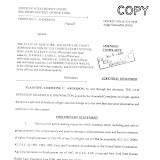
Six jurors and two alternates were selected Tuesday to hear a $10 million damage action against the Office of Court Administration brought by a former attorney for the First Department Disciplinary Committee. Christine C. Anderson claims that after six years as a staff attorney she was fired for complaining that the committee "whitewashed" at least nine cases because the lawyers being investigated were politically connected or represented by lawyers who had previously worked for the committee. The OCA counters that Ms. Anderson was fired because she had been insubordinate. The committee polices the conduct of lawyers practicing in Manhattan and the Bronx. Southern District Judge Shira A. Scheindlin will preside over the trial, which starts Monday and is expected to last one week.

Fired Brooklyn Court Attorney Cites History as Hands-On Experience

From Pinczewski & Shpelfogel, P.C website:

Mitchell B. Shpelfogel, Esq. ......Partner .......After being the youngest graduate of Hofstra University School at Law at the age of 22, Mr. Shpelfogel started his career as Senior Court Attorney to New York Civil Court Judge Lila P. Gold. In that capacity Mitchell drafted numerous published decisions, conducted settlement negotiations and researched complex legal issues in civil matters including No-Fault, Real Estate, Personal Injury and Contract Law. Combining his personal hands-on experience in real estate and his concentration in Real Estate Law which he received at Hofstra Law, Mr. Shpelfogel is well equipped to deal with all types of complex real estate matters. The focus of Mr. Shpelfogel’s practice is in the area of transactional law with an emphasis on commercial and real estate transactions. His extensive real estate experience allows him to successfully handle all real estate matters, including partnership agreements and various complex matters. In addition to transactional work, Mr. Shpelfogel handles litigation of cases involving real estate, no-fault and other commercial matters. Mr. Shpelfogel takes pride in working hard, not just for his clients, but for the community as well. He is a board member of Community Board 15, sitting on various committees including Public Safety and Community Affairs. Mr. Shpelfogel also sits on the Board of Trustees of local schools and is a board member of several charitable organizations. Mr. Shpelfogel is happily married and is the proud father of three boys. Bar Admissions: New York, New Jersey, U.S. Southern District of New York, U.S. Eastern District of New York

Brooklyn court attorney whose brother loaned judge campaign money is fired
The New York Daily News by NANCIE L. KATZ - July 31, 2008

A Brooklyn court attorney for a judge who got an $80,000 loan from his family has been fired, the Daily News has learned. Brooklyn Civil Court Judge Lila Gold hired Mitchell Shpelfogel in January 2006 for the competitive $63,000-a-year state post - only weeks after the 22-year-old graduated from law school. He passed the bar a month later. Five months after The News spotlighted the appointment, the court's inspector general ordered him out. He was terminated July 18, a court spokeswoman said, declining further comment. In February, Shpelfogel - whose family's Brighton Beach buildings have had hundreds of violations - said his hiring had nothing to do with his brother, Rafael, 27, lending Gold the money for her uncontested 2003 bid. The loan was quickly repaid. Mitchell Shpelfogel called himself a "qualified" family friend. "There was no quid pro quo. I'm a capable, talented person," he said in February, adding that even judges came to him for advice.

Few state judges hire assistants right out of law school because the job requires drafting complex legal opinions. Experienced lawyers often seek the positions as a path to the bench. Mitchell Shpelfogel, a father of two, said he took the job to be with his family. But sources said Shpelfogel got in trouble for allegedly doing outside legal work and being off-site at family construction projects during court hours. Charges were referred by Administrative Judge Ellen Spodek to court inspectors, a source said. The report is confidential. Shpelfogel, now 24, did not return calls this week nor did Gold. Spodek declined comment. "I do not have time to talk to you," said patriarch Sam Shpelfogel, who still owes the city $8,200 for emergency repairs on his buildings. The Shpelfogels own at least nine Brooklyn buildings, including a multimillion-dollar Manhattan Beach house and two apartment houses cited for multiple violations. "The News is the district attorney of Brooklyn," said Zev Yourman, a community activist who charged that the family used profits from tenants' suffering to get ahead politically. He has sued Shpelfogel for defamation. The city sued Sam Shpelfogel twice since 2004 for more than 1,000 violations and settled after he fixed them. nkatz@nydailynews.com

CLICK HERE TO SEE more stories on the Shpelfogel family and their corrupting influences on Brooklyn politics and community life.

U.S. Supreme Court Doubts Lawyers Should Be Paid Extra For Winning

Justices Doubt Lawyers Should Be Paid Extra for Winning
The New York Law Journal by Tony Mauro - October 15, 2009

WASHINGTON, D.C. - The nine justices of the U.S. Supreme Court are all lawyers, but most showed little empathy for their fellow attorneys yesterday as they debated whether legal fee awards can be enhanced for superior performance or exceptional results under a federal fee-shifting statute. The justices heard arguments in Perdue v. Kenny A., 08-970, brought by the state of Georgia to challenge a $4.5 million fee enhancement it was ordered to pay by a district court judge to reward lawyers who succeeded in reforming the state foster care system in a long-running class action. The enhancement would be on top of a $6 million "lodestar" award based on prevailing fees and hours billed. Lawyers for Children's Rights Inc. of New York and a private Atlanta firm worked on the case. Civil rights groups from across the political spectrum are watching the dispute, asserting that the prospect of enhanced fees is necessary to attract quality representation in the lengthy and complex litigation they pursue (NYLJ, Oct. 14). But during yesterday's hour-long argument, several justices seemed more worried about high legal fees than in encouraging quality lawyers to do public-minded work. "Seven hundred thousand dollars for a lawyer. Wow!" said Justice Stephen Breyer, referring to the amount one lawyer could make for a year's work on the Georgia litigation. "How do we explain this to the average person?" Justice Breyer said that "very high is enough" when it comes to lawyer fees. "You don't need very, very, very, high." Justice Samuel Alito Jr. said he was "very troubled" by the notion of a judge taking "$4-plus million from the taxpayers of Georgia" and giving it as a bonus to the lawyers in the case for good performance.

"It seems totally standardless," Justice Alito said. "I see a great danger that trial judges are going to use this as a way of favoring their favorite nonprofit foundation or their favorite cause or their favorite attorney." Chief Justice John Roberts Jr. even challenged the premise behind fee enhancements: that better lawyering can achieve better results. "The results that are obtained are presumably the results that are dictated or commanded or required under the law," Justice Roberts said. "It's not like, well, you had a really good attorney, so I'm going to say the law means this…but if you had a bad lawyer, I would say the law says this." Former solicitor general Paul Clement, representing Children's Rights Inc., countered Chief Justice Roberts' point. "I have seen lawyers come into this Court and concede a point in oral argument, and I have seen that prominently featured in the Court's opinion," said Mr. Clement, head of appellate practice at King & Spalding. "So it does seem to me that sometimes the quality of the performance and the results obtained do depend on the lawyer's performance."

Chief Justice Roberts acknowledged, "Maybe we have a different perspective. You think the lawyers are responsible for a good result, and I think the judges are." Mr. Clement's friendly retort: "And maybe your perspective's changed, your honor," a reference to the fact that, before becoming a judge, the chief justice was a highly paid appellate advocate for Hogan & Hartson in Washington. Chief Justice Roberts had the last word, countering, "Maybe your perspective has changed too, Mr. Clement. …Your argument is that, you know, for $495 an hour you really can't get a good lawyer?" The chief justice is paid $223,500 a year (associate justices are paid $213,900). When King & Spalding hired Mr. Clement last year, his pay package reportedly was $5 million. Asked afterward how much he is being paid for his representation in the Georgia case, Mr. Clement declined to give a specific figure but said the payment will be "just what you would expect given our position: a special fee arrangement with a potential enhancement for exceptional results." Mark Cohen of Troutman Sanders in Atlanta, representing the state of Georgia, argued that, under law, superior performance cannot be the basis for departing from the lodestar amount. One reason, he said, is that quality performance is already factored into the basic amount paid, so an enhancement amounts to "double-counting."

Justice Sonia Sotomayor wondered whether the enhancement could be made by, for example, bumping a $200-an-hour associate who performs well up to $500 an hour when the lodestar amount is calculated. Mr. Cohen said no, because that associate would be charging other clients $200 hourly no matter how good he was. Justice Sotomayor countered that "law firms get bonuses from clients all the time." In his rebuttal, Mr. Cohen also responded to a crack made by Mr. Clement earlier. Chief Justice Roberts had noted that some lawyers argue at the high court for free to enhance their reputations, so that paying them prevailing rates might amount to overcompensation. "Sometimes you get what you pay for" when clients get free representation, Mr. Clement replied. Mr. Cohen told the justices, "I am getting paid half my hourly rate in this case," but said he is doing so because of his professional responsibility to represent his client "zealously within the bounds of the law." If the Court allows the fee enhancement to stand in the Georgia case, Mr. Cohen argued, applications for similar enhancements in other cases "are going to come out the wazoo, and district courts are going to be deciding things arbitrarily and on different bases." Tony Mauro covers the U.S. Supreme Court for ALM, the Law Journal's parent. He can be reached at tmauro@alm.com.

*************************************

Justices Weigh $4.5 Million Bonus Awarded Lawyers in Ga. Litigation
Judge Was Impressed by Attorneys' Work on Foster-Care Case
The Washington Post by Robert Barnes - October 15, 2009

The Supreme Court spends a sizable portion of its time dealing with lawyers gone bad: the ones who miss critical filing deadlines, put up halfhearted defenses of clients facing death row, give bad advice with disastrous results. On Wednesday, the court was faced with what to do about lawyers who do good. And also, extremely well. The justices focused on a group of lawyers from a children's rights group and a private law firm who won a transformation of the state of Georgia's dysfunctional foster-care system. Their work on behalf of 3,000 children so impressed the federal judge who presided over the case that he awarded them a bonus of $4.5 million -- on top of the $6 million in legal fees he told the state to pay. It made for an animated debate on the skyrocketing cost of legal work, exorbitant salaries for lawyers, whether judges should grade the lawyers who come before them and whether Congress intended some sort of bonus for lawyers who take on uncertain and sometimes unpopular civil rights cases. Federal law allows those who prevail in such cases to recover their fees, and the judge in the case calculated those fees by multiplying what he thought were the reasonably expected billable hours by the prevailing hourly rate in Atlanta for such work, ranging from $215 an hour for the most junior associate to up to $495 for the most experienced partner.

But U.S. District Judge Marvin H. Shoob went further in awarding the bonus. He said the lawyers from the group Children's Rights and Atlanta's Bondurant, Mixson & Elmore law firm displayed a "higher degree of skill, commitment, dedication and professionalism" than he had seen during his time on the bench, and that in "58 years as a practicing attorney and federal judge, the court is unaware of any other case in which a plaintiff class has achieved such a favorable result on such a comprehensive scale." The state of Georgia balked at paying the multimillion-dollar bonus, and said neither federal law nor Supreme Court precedent allowed such "enhancements." Although the winning lawyers in the case are supported at the court by an array of liberal and conservative public interest groups and represented by Paul D. Clement, President George W. Bush's former solicitor general, the reaction of the justices seemed to divide into ideological camps. Justice Sonia Sotomayor said there must be incentives for private lawyers to take a chance on representing the underprivileged and those pressing claims that their constitutional rights have been violated. "If the market doesn't give them attorneys to start with, because there are so many risks involved in this process, and it sets a reduced fee because of those risks, how do you attract competent counsel?" she asked. Mark H. Cohen, representing Georgia, said judges already take into account the lawyers' performance when calculating the base payment for the work. He acknowledged that such enhancements are rare but warned that if the court agrees with this one, "requests are going to come out the wazoo, and district courts are going to be deciding things arbitrarily and on different bases."

On the other side, Justice Samuel A. Alito Jr. said that while he takes the district judge at his word about the lawyers' exemplary performance, he was troubled that a judge "in effect takes $4-plus million from the taxpayers of Georgia" and awards it to a special interest group. "It seems totally standardless, and I see no way of policing it, and I see a great danger that trial judges are going to use this as a way of favoring their favorite nonprofit foundation or their favorite cause or their favorite attorneys, because they think they generally do good work," Alito said. But Clement said the court already allows judges discretion in adjusting payments downward, and without an incentive to be rewarded for extraordinary work, it would make no sense for private lawyers to take on civil rights cases, in which payment might not come for years. "You are basically guaranteeing that . . . the maximum you can make in a civil rights case is the minimum you can make in any other kind of case," Clement said. Justice Stephen G. Breyer said he was unsure how he thought the case should come out, but he did a quick finger-in-the-air calculation and said he thought the public would be shocked by what the award would mean when translated as an annual salary for the lawyers involved. "But $700,000 a year for a lawyer. Wow," Breyer said. "And that's what this judge said." The subject of a lawyer's worth was also part of an interesting exchange between Chief Justice John G. Roberts Jr., who made more than $1 million a year as an appellate specialist before joining the federal bench, and Clement, who recently left public service for a reported multimillion-dollar package at a Washington firm. Roberts questioned whether the outcome of a case was so dependent on the lawyer involved, rather than what is "dictated or commanded or required under the law." "Maybe we have a different perspective," Roberts said. "You think the lawyers are responsible for a good result and I think the judges are." "And maybe your perspective's changed, your honor," Clement replied. Moments later, Alito added, "Maybe your perspective has changed too, Mr. Clement." The case is Perdue v. Kenny A.

Lippman Increases Judges' Allowance from 5k to $10,000

Citing Lack of Raise, Lippman Boosts Judge Allowance to $10,000
The New York Law Journal by Noeleen G. Walder - October 15, 2009

While New York's 1,300 state judges wait for their first raise in more than 10 years, Chief Judge Jonathan Lippman yesterday said he would boost to $10,000 from $5,000 payments they receive to cover a wide range of expenses, from uncovered medical care to judicial license plates. The enhanced benefit was announced by the chief judge in a brief webcast to the judiciary. The presentation was not available to the general public, but Judge Lippman and other judges confirmed its content. Judge Lippman said in an interview yesterday that he was "pleased to be able to double" the support. "We are not giving judges [added] salary. …We have finite resources. I think it's an appropriate reimbursement of judges for expenses of all different kinds." Judge Lippman in the webcast first briefed the judges on the status of several suits to force a pay raise. The Court of Appeals is scheduled to hear oral arguments on Jan. 12, 2010, of three pending actions, two filed by individual judges and one brought by the court system. Judge Lippman, who has recused himself from the Court of Appeals case, expressed the hope that lawmakers and the governor "do their job" and make a court ruling unnecessary. He said in the interview that he is "going to do everything in my power…and more to persuade [lawmakers] that they should act." He said, "This is the time. The time is right now. I am urging them virtually every day to act as they should." Judge Lippman said the increased allowances would kick-in for the year beginning Nov. 1. However, due to budgetary constraints, he noted that the additional $5,000 would not be paid until after April 15, 2010.

Sample of Covered Expenses Under Judges' 'Allowance'

• Health care
• Commuting
• Home technology and Internet service
• Home security: installation, maintenance and related fees
• Staff appreciation
• Reference materials
• Specialized furnishings and equipment
• Dependent care
• Life insurance
• Purchase and cleaning of judicial robes
• Judicial license plates
• Marriage counseling

According to a description of the "judicial supplemental support fund" issued in November 2008 by the court system, judges automatically receive an "allowance," originally $5,000 and now $10,000, unless they opt out of the program. The money is paid in a lump sum and does not require receipts. The lump sum, which is subject to taxes, can be used for commuting costs, Internet service, home security systems, life insurance and health care, marriage counseling and other expenses. Judges who want to avoid tax consequences have the option of applying for reimbursement of actual out-of-pocket expenses such as bar and judicial association dues, education and research but must present receipts. In yesterday's webcast, Justice Lippman reportedly suggested that judges use the additional $5,000 to purchase life insurance to allay concerns about the so-called "pension death gamble." If judges stay on the bench and lose that gamble, their surviving spouses stand to receive only a fraction of the amount they would have been paid had the judges retired, he said. This is "one of the main reasons why we thought" the additional $5,000 was a "good idea," Justice Lippman said in the interview. According to David Bookstaver, a spokesman for the Office of Court Administration, nearly all of the state's judges took advantage of the $5,000 reimbursement last year, with more than 90 percent using the full benefit. This cost OCA roughly $6 million, and the additional $5,000 reimbursement will cost another $6 million, Mr. Bookstaver said. He said OCA would pay for the benefits by cutting down on overtime. Last year, OCA's total yearly budget was $2.27 billion, according to Mr. Bookstaver.

Judges' Reaction

Judges yesterday generally welcomed the additional $5,000, although some said it would not compensate for the lack of a raise. "I think in view of the really disastrous salary situation, it's an especially good measure on Chief Judge Lippman's part," said former chief judge Judith S. Kaye, who brought the judicial pay raise suit against the Legislature. Manhattan Criminal Court Melissa C. Jackson agreed. She said all the judges at Manhattan Criminal Court "feel [Chief Judge Lippman] is doing his best to help out the judges" and we are "very grateful," she said. Queens Supreme Court Justice Peter Kelly said the action is "not as good as a raise, but it's the best the chief judge can do under these circumstances, and it certainly is better than having nothing done at all." Brooklyn Supreme Court Justice Michelle Weston, president of the Association of Justices of the Supreme Court of the State of New York, said the increase was a "first step," but added that she and the group's members wish it was higher. However, ultimately, the "Legislature has to take care of us" and provide a "permanent solution…so we don't have to go begging every couple of years. …We are a separate branch of government. We should be funded adequately," Justice Weston said. Supreme Court Justice Joseph G. Golia, president of the Queens chapter of the association, said that any additional money is "better than what we had," but "we are not satisfied." Justice Golia, who said he and his wife had depleted nearly their entire life savings, said he did not understand "why we are in this quagmire," adding that the stalemate must be a result of a disagreement between the governor and the Legislature. Similarly, Robert A. Spolzino, who left the Appellate Division, Second Department, earlier this month after nearly six years, called Judge Lippman's action "certainly helpful, but not sufficient. Judges' pay is atrocious and what we need is a raise from the Legislature." Mr. Spolzino is now a partner at Wilson Elser Moskowitz Edelman & Dicker. "We appreciate the increase in the wellness account but it would be nice to put some meat on the bones and get us the long-overdue raise that we so sorely deserve," said Nassau County Justice Edward A. Maron, the lead plaintiff in one of the pay raise cases. Noeleen G. Walder can be reached at nwalder@alm.com. Daniel Wise contributed to this report.

Wednesday, October 14, 2009

U.S. Supreme Court Addresses "Bad Lawyers" - Ignores "Corrupt Lawyers"

Bad Lawyering Day at Supreme Court
The National Law Journal by Tony Mauro - October 14, 2009

Lawyer competence was the topic of the day at the U.S. Supreme Court on Tuesday, as justices heard two cases involving claims of ineffective assistance of counsel that violated the Sixth Amendment. In one, a lawyer's flawed advice exposed his client to deportation. In the other, the defense lawyer in a capital case called his client sick and twisted during a closing argument, and minimized mitigating evidence that might have helped avoid the death penalty. In the first case, Padilla v. Kentucky, a lawyer told his client Jose Padilla, a permanent resident alien arrested for drug trafficking, that pleading guilty as part of a plea agreement would not expose him to deportation. That advice was flat wrong. Padilla sued in 2004, claiming ineffective assistance that deprived him of his constitutional rights. But the Kentucky Supreme Court ruled that incorrect advice on matters that are collateral to the criminal case don't make out a case of ineffective assistance under the Supreme Court's Strickland v. Washington standard. Most U.S. Supreme Court justices seemed wary of expanding the definition of ineffective assistance to include flawed advice on matters beyond the actual criminal case the lawyer is handling.

"We have to decide whether we are opening a Pandora's box here," said Justice Antonin Scalia, who said flawed advice about the effect of a guilty plea on child custody could be another issue defendants would raise. Justice Stephen Breyer also said, "The world is filled with 42 billion circumstances" that could trigger ineffective-assistance claims for other reasons. Stephen Kinnaird of Paul, Hastings, Janofsky & Walker, arguing for Padilla, said deportation is "so severe and so material" that the Court could limit its ruling to advice in that area. "The lawyer has the distinct duty to assess the advantages and disadvantages of the plea." Deputy Solicitor General Michael Dreeben told the Court that a criminal defense lawyer does not have a constitutional duty to advise his client about immigration law, but if he or she does and does so incorrectly, "the lawyer has used his professional skills to undermine a personal decision that belongs to the defendant alone." The Padilla case is being tracked by immigrant rights advocates who say thousands of immigrants have been put in jeopardy by poor legal representation and advice. "Every day, immigrants are advised to give up their rights and plead guilty to charges that subject them to lifetime exile," said Benita Jain, co-director of the Immigrant Defense Project.

The second case argued Tuesday was Smith v. Spisak. Frank Spisak Jr. was convicted of murdering three people at Cleveland State University in 1983. During trial, Spisak testified of his Nazi past and showed no remorse for the murders during his trial. He claimed insanity, but was found guilty. At the sentencing stage his lawyer's task was to present mitigating evidence, but instead he emphasized the "clearly horrendous" aggravating circumstances. He even suggested his client did not deserve mitigation and would never be rehabilitated, arguing, "He is demented, and he is never going to be different." Ohio Attorney General Richard Cordray, trying to knock down the notion that the closing argument amounted to a constitutional deprivation, told the Court that in fact it represented a "coherent strategy" to appeal to jurors' humanity and ask them to spare his client, as demented as he might be. Scalia apparently agreed, calling it a "brilliant closing argument" aimed at jurors who were unlikely to be sympathetic toward Spisak. "The technique that counsel used to try to get mercy for this fellow was the best that could have been done." Breyer also seemed reluctant to judge whether the argument was constitutionally flawed, stating, "Since there is a lower court that seemed to find this adequate, how can I sit here and say it wasn't?" Spisak's lawyer before the high court, Michael Benza of Chagrin Falls, Ohio, said, "I have been litigating capital cases since 1993. I have never seen a closing argument like this." One indicator of how bad the closing argument was came in a brief filed in the case by a group of law professors who are experts on trial advocacy. They told the Court of their "considerable dismay" with the fact that the state of Ohio cited their treatises in arguing that the trial lawyer's strategy was legitimate.
Anderson Jury Picked on Tuesday, October 13, 2009 .... New York's Court Corruption Trial Begins at 10am on Monday, October 19, 2009..... 500 Pearl Street, Courtroom 15c ..... More Soon.......

Appeals Court Gets It: Lower Courts Have Been Corrupted

On Summary Judgment, Judge Gets a Spanking
The Recorder by Mike McKee - October 13, 2009

It isn't a good sign when an appeals court refers to a lower court's "ruling" in quote marks as if it's not worthy of the term. But that's exactly what San Francisco's 1st District Court of Appeal did -- three times -- Friday in reversing a "ruling" by San Mateo County Superior Court Judge Marie Weiner in an overpapered case featuring 5,415 pages of briefs. "The incredible volume of material here simply has no place in a system where overburdened trial courts labor long and hard," Justice James Richman wrote in a published ruling in Nazir v. United Airlines Inc., A121651. Richman, along with Justices Paul Haerle and James Lambden, said Weiner was "manifestly wrong" in sustaining "without explanation" 763 of the defendant's 764 objections to plaintiff Iftikhar Nazir's evidence in a suit alleging harassment and retaliation based on ethnicity.

"What apparently happened," Richman wrote, "is that the trial court did not read all the papers, shown, for example, by the facts that it sustained 'objections' to evidence where no objection was set forth and saw a 'physical assault' ... despite all the evidence of 'arm wrestling.'" Not reading papers "cannot be condoned," he added, but could possibly be "understood" considering the sheer volume of papers filed by both sides. Richman noted that the summary judgment process has come under criticism in cases where courts have made findings "properly reserved" for trial and required employees to essentially "prove their case" at the summary judgment stage. "Here we confront the poster child for such criticism," he wrote, "in a case involving what may well be the most oppressive motion ever presented to a superior court." Pointing out that the defendant's moving papers for summary judgment were 1,056 pages and the plaintiff's response three times that length, Richman called the record "the likes of which we have never seen -- not here, not in the combined 11 years of law and motion experience of the members of this panel." "Suffice to say that there is plenty of blame for the 'girth' the trial court criticized," Richman wrote, "most of which, we conclude, lies at the feet of the defendants." Richman criticized United's lawyers for filing a "defective separate statement" and, in a footnote, pointed out that the airline's lead counsel had been faulted for the same thing in a 2004 6th District ruling. Listed as United's lawyers in the 1st District case were Littler Mendelson partners Philip Ross, Nancy Pritikin and Kurt Bockes. The plaintiff was represented by Philip Horowitz and Moira McQuaid.

Sunday, October 11, 2009

Lippman is 'a crook,' Dying Woman Tells the NY Daily News

Michael Lippman is 'a crook,' the late Lillian Cohen tells Daily News
The New York Daily News by Greg B. Smith - October 11th 2009

Lillian Cohen died of cancer last week in Columbia Presbyterian Hospital. But for the last month, from her hospital bed, she was trying to get the word out on Michael Lippman. "He's a crook!" the 82-year-old said two weeks ago in a weak, raspy voice as she fought off post-chemotherapy nausea. Her sister, Sara Schenendorf, hired Lippman as a private lawyer in February 2007 after a friend died and left her $130,000 in assets. She'd hired him previously on another matter and had problems, but decided to give him another shot. Lippman immediately demanded a $2,500 down payment on his $7,800 legal fee, but waited 10 months to file basic legal papers giving Schenedorf her executor powers in Bronx Surrogate Court. This occurred after Cohen went to court and made a fuss. By spring 2008, the sisters said they gave him $3,000 and a new sofa after he told them he was broke and sleeping on the floor of his office near the train station in Hastings on Hudson. Schenendorf said Lippman told her the will was "air tight" and could not be challenged, then started to press her to comply with a cousin's request for jewelry in a safe deposit box. Meanwhile, Cohen got increasingly frustrated that the estate still had not been settled and the assets transferred to her sister, the sole heir. Cohen said Lippman finally arranged to transfer the assets in February 2009, but only after she threatened to report him to the Bronx district attorney. "He knows he can push her around, but not me!" Cohen said as her sister nodded in agreement. Schenendorf said she went back to Lippman in 2007 because in spite of everything, "I had so much trust in Michael. I really liked him." Lippman did not return calls seeking comment.

Tembeckjian Angered Over Thousands, but $40 Million Fraud OK


See Below how Bob Tembeckjian has a BIG problem with sloppy judicial accounting involving tens of thousands of dollars.....

STATE OF NEW YORK
COMMISSION ON JUDICIAL CONDUCT

– – – – – – – – – – – – – – – – – – – – – –
In the Matter of the Proceeding
Pursuant to Section 44, subdivision 4,
of the Judiciary Law in Relation to
BRET CARVER,
a Justice of the Fremont Town Court,
Steuben County.
– – – – – – – – – – – – – – – – – – – – – –
DETERMINATION
THE COMMISSION:

Honorable Thomas A. Klonick, Chair
Stephen R. Coffey, Esq., Vice Chair
Joseph W. Belluck, Esq.
Richard D. Emery, Esq.
Paul B. Harding, Esq.
Elizabeth B. Hubbard
Honorable Jill Konviser
Nina M. Moore
Honorable Karen K. Peters
Honorable Terry Jane Ruderman

APPEARANCES:
Robert H. Tembeckjian (Kathleen Martin, Of Counsel) for the Commission
Honorable Bret Carver, pro se

The respondent, Bret Carver, a Justice of the Fremont Town Court, Steuben County, was served with a Formal Written Complaint dated June 18, 2009, containing two charges. The Formal Written Complaint alleged that respondent failed to deposit, report and remit town court funds within the time required by law. Respondent filed an answer dated July 27, 2009. On September 10, 2009, the Administrator of the Commission and respondent entered into an Agreed Statement of Facts pursuant to Judiciary Law §44(5), stipulating that the Commission make its determination based upon the agreed facts, recommending that respondent be admonished and waiving further submissions and oral argument. On September 23, 2009, the Commission accepted the Agreed Statement and made the following determination.

1. Respondent has been a Justice of the Fremont Town Court, Steuben
County since January 1, 2007. He is not an attorney.
As to Charge I of the Formal Written Complaint:
2. From March 2008 to August 2008, as set forth below, respondent
failed to deposit approximately $7,685 in court funds within 72 hours of receipt, as
required by Section 214.9(a) of the Uniform Civil Rules for the Justice Courts (22
NYCRR §214.9[a]).
3. From March 3, 2008 to March 24, 2008, respondent received $1,830
in court funds. Respondent deposited $1,680 on March 28, 2008; he did not deposit the
remaining $150 until September 2008.
4. From March 29, 2008 to March 30, 2008, respondent received $450 in court funds that he did not deposit until September 2008.
5. In April 2008 respondent received $1,295 in court funds that he did not deposit until September 2008.
6. In May 2008 respondent received $2,850 in court funds that he did not deposit until September 2008.
7. In June 2008 respondent received $2,190 in court funds that he did not deposit until September 2008.
8. From July 6, 2008 to July 14, 2008, respondent received $2,015 in court funds. Respondent deposited $1,925 on July 15, 2008; he did not deposit the remaining $90 until September 2008.
9. From July 21, 2008 to July 28, 2008, respondent received $640 in court funds that he did not deposit until September 2008.
10. In August 2008 respondent received $20 in court funds that he did not deposit until September 2008.
11. Respondent does not have a court clerk. Respondent himself receives court funds, issues receipts, marshals funds for deposit, prepares bank deposit tickets and deposits funds into the court bank account.
12. Between March 2008 and August 2008, the cumulative deficiency of undeposited court funds reached $7,685. Respondent kept these undeposited funds in a metal cash box in a locked file cabinet in his office at the court. No one else has access to this cabinet.
13. Respondent eventually deposited all of the funds referred to above, and there is no indication that funds were missing or used for inappropriate purposes.
14. Respondent was aware from the time he assumed his position as Fremont Town Court Justice that he was required by law to deposit court funds within 72 hours of receipt. He acknowledged during the Commission’s investigation that he was responsible for properly handling and depositing court funds and that he did not perform these duties in an adequate manner.

As to Charge II of the Formal Written Complaint:

15. From March 2008 through August 2008, as set forth in Exhibit 1 to the Agreed Statement of Facts, respondent failed to report and certify receipt of court funds to the Office of the State Comptroller and failed to remit approximately $11,290 in court funds to the chief fiscal officer of the Town of Fremont within ten days of the month succeeding collection, as required by Sections 2020 and 2021(1) of the Uniform Justice Court Act, Section 1803 of the Vehicle and Traffic Law, and Section 27(1) of the Town Law.
16. Respondent acknowledges that his monthly obligation to report and remit court funds is not complete until: (i) a check for the funds has been delivered to the chief fiscal officer, (ii) the report has been received by the State Comptroller, and (iii) a certification of the report, signed by the judge, is received by the State Comptroller.
17. On July 28, 2008, the State Comptroller issued a notice to the Fremont Town Supervisor to suspend respondent’s salary pending the filing of reports.
18. On August 4, 2008, respondent electronically filed his report for the month of March 2008 with the State Comptroller, in which he reported that he had collected $2,280 in court funds. On the same date, respondent faxed a certification to the State Comptroller that certified that he had collected $2,655 in court funds for the month of March 2008.
19. Respondent filed his reports for the months of April, May, June, July and August 2008 on September 22, 2008. Respondent submitted certifications with his reports for April and May 2008, but failed to submit certifications with his reports for June, July and August 2008.
20. Respondent faxed his certifications for the months of June, July and August 2008 to the State Comptroller on January 28, 2009, one day after he appeared and testified before the Commission. He filed a corrected certification for the month of March 2008 on January 29, 2009. Respondent’s certification to the State Comptroller for March 2008 was received on January 29, 2009, 294 days beyond the time provided by the statutory requirement.
21. Respondent remitted court funds for March 2008 in the amount of $2,280 to the chief fiscal officer on February 17, 2009, 313 days beyond the time provided by the statutory requirement.
22. Respondent’s certification to the State Comptroller for the month of April 2008 was received on September 22, 2008, 135 days beyond the time provided by the statutory requirement. Respondent remitted court funds for April 2008 in the amount of $1,135 to the chief fiscal officer on September 29, 2008, 142 days beyond the time provided by the statutory requirement.
23. Respondent’s certification to the State Comptroller for the month of May 2008 was received on September 22, 2008, 104 days beyond the time provided by the statutory requirement. Respondent remitted court funds for May 2008 in the amount of $2,690 to the chief fiscal officer on September 29, 2008, 111 days beyond the time provided by the statutory requirement.
24. Respondent’s certification to the State Comptroller for the month of June 2008 was received on January 28, 2009, 222 days beyond the time provided by the statutory requirement. Respondent remitted court funds for June 2008 in the amount of $2,415 to the chief fiscal officer on September 29, 2008, 81 days beyond the time provided by the statutory requirement.
25. Respondent’s certification to the State Comptroller for the month of July 2008 was received on January 28, 2009, 171 days beyond the time provided by the statutory requirement. Respondent remitted court funds for July 2008 in the amount of $2,655 to the chief fiscal officer on September 29, 2008, 50 days beyond the time provided by the statutory requirement.
26. Respondent’s certification to the State Comptroller for the month of August 2008 was received on January 28, 2009, 140 days beyond the time provided by the statutory requirement. Respondent remitted court funds for August 2008 in the amount of $20 to the chief fiscal officer on November 28, 2008, 79 days beyond the time provided by the statutory requirement.
27. The State Comptroller ordered payment of respondent’s salary resumed on January 30, 2009.
28. Respondent failed to make timely deposits and to report, certify and remit court funds in a timely manner as a result of a new job as an emergency medical technician in the health and safety field at a private company, volunteer commitments with the town’s ambulance and fire department, and his efforts to start an online medication management system company. Respondent regrets and apologizes for his conduct and recognizes that his judicial duties take precedence over all other activities.
29. Respondent commits himself in the future to deposit court funds within 72 hours of receipt and to submit his monthly reports and certifications to the State Comptroller, and make remittances to the chief fiscal officer, within the first ten days of the succeeding month.

Upon the foregoing findings of fact, the Commission concludes as a matter of law that respondent violated Sections 100.1, 100.2(A), 100.3(B)(1) and 100.3(C)(1) of the Rules Governing Judicial Conduct (“Rules”) and should be disciplined for cause, pursuant to Article 6, Section 22, subdivision a, of the New York State Constitution and Section 44, subdivision 1, of the Judiciary Law. Charges I and II of the Formal Written Complaint are sustained, and respondent’s misconduct is established. The handling of official monies is one of a judge’s most important responsibilities. Depositing, reporting and remitting such monies promptly, in strict compliance with the statutory mandates, is essential to ensure public confidence in the integrity of the judiciary. The failure to comply with these mandates constitutes misconduct, even if there is no evidence that monies were missing or used for inappropriate purposes. See Matter of Minogue, 2009 Annual Report 138 (Comm on Judicial Conduct); Matter of Hrycun, 2002 Annual Report 109 (Comm on Judicial Conduct); Matter of Ranke, 1992 Annual Report 64 (Comm on Judicial Conduct); see also Bartlett v. Flynn, 50 AD2d 401, 404 (4th Dept 1976). All monies received by the court are required to be deposited “as soon as practicable” and no later than 72 hours after receipt, and reported and remitted to the appropriate authorities by the tenth day of the month following collection (Uniform Civil Rules for the Justice Courts §214.9[a]; Uniform Justice Ct Act §2021[1]; Town Law §27; Vehicle and Traffic Law §1803). Over a six-month period in 2008, respondent failed to deposit, report and remit court funds in a timely manner as required by law. Over that period, respondent received $11,290 in official monies but deposited only $3,605, resulting in a cumulative deficiency of $7,685 by September 2008. In four of those months, he made no deposits at all, although he had collected a total of $6,355. During this time, the undeposited funds were kept in a locked file cabinet in respondent’s office. Over the same period, respondent also failed to report and remit these funds to the appropriate officials on a monthly basis, as required by law. The electronic filing procedures, which are intended to make the process more efficient and give localities access to their revenues sooner, require a judge to transmit reports electronically to the Office of the State Comptroller, to submit an appropriate, signed certification, and to send a check for the total amount reported to the chief fiscal officer of the town. Here, the record indicates significant delays by respondent in performing each of these tasks. These derelictions, which led to a six-month suspension of respondent’s salary by order of the State Comptroller, resulted in significant delays in processing the monies collected by the court. Respondent’s neglect of these important duties is not excused by the demands of his employment or other activities. A judge’s official duties, including the judge’s administrative responsibilities, “take precedence over all the judge’s other activities” (Rules, §100.3[A]). In considering the sanction, we note that all the monies collected by respondent have been accounted for and that there is no indication that any monies were missing or used for inappropriate purposes. We also note that respondent has
acknowledged his misconduct and commits himself in the future to performing these important duties in a timely manner as required by law. By reason of the foregoing, the Commission determines that the appropriate disposition is admonition.

Judge Klonick, Mr. Coffey, Mr. Emery, Mr. Harding, Ms. Hubbard, Judge Konviser, Ms. Moore, Judge Peters and Judge Ruderman concur.Mr. Belluck was not present.

CERTIFICATION

It is certified that the foregoing is the determination of the State Commission on Judicial Conduct.

Dated: September 30, 2009

Jean M. Savanyu, Esq.
Clerk of the Commission, New York State, Commission on Judicial Conduct

********************************************

STATE OF NEW YORK
COMMISSION ON JUDICIAL CONDUCT

– – – – – – – – – – – – – – – – – – – – – –
In the Matter of the Proceeding Pursuant to Section 44, subdivision 4,
of the Judiciary Law in Relation to
DAVID M. TRICKLER, a Justice of the Birdsall Town Court,
Burns Town Court and Grove Town Court, Allegany County.
– – – – – – – – – – – – – – – – – – – – – –
DETERMINATION
THE COMMISSION:

Honorable Thomas A. Klonick, Chair
Stephen R. Coffey, Esq., Vice Chair
Joseph W. Belluck, Esq.
Richard D. Emery, Esq.
Paul B. Harding, Esq.
Elizabeth B. Hubbard
Honorable Jill Konviser
Nina M. Moore
Honorable Karen K. Peters
Honorable Terry Jane Ruderman

APPEARANCES: Robert H. Tembeckjian (John J. Postel and David M. Duguay, Of Counsel) for the Commission
Joseph G. Pelych for the Respondent

The respondent, David M. Trickler, a Justice of the Birdsall Town Court, Burns Town Court and Grove Town Court, Allegany County, was served with a Formal Written Complaint dated August 8, 2008, containing four charges. The Formal Written Complaint alleged that from 2004 to 2006 respondent failed to perform certain administrative responsibilities with respect to numerous cases as required by law. Respondent filed an answer dated September 22, 2008. On July 31, 2009, the Administrator of the Commission, respondent’s counsel and respondent entered into an Agreed Statement of Facts pursuant to Judiciary Law §44(5), stipulating that the Commission make its determination based upon the agreed facts, recommending that respondent be admonished and waiving further submissions and oral argument. On September 23, 2009, the Commission accepted the Agreed Statement
and made the following determination.

1. Respondent has been a Justice of the Burns Town Court since November 1980, a Justice of the Grove Town Court since November 1994 and a Justice of the Birdsall Town Court since January 2002. He is not an attorney.

As to Charge I of the Formal Written Complaint:
2. From on or about January 24, 2004, to on or about August 10, 2006, respondent failed to notify the Commissioner of the Department of Motor Vehicles to order the suspension of the driver’s licenses of 15 defendants in the Burns Town Court who did not pay fines imposed by respondent totaling $1,585, as set forth in Schedule A annexed to the Agreed Statement of Facts, notwithstanding that the defendants had not paid their fines for more than 60 days. Respondent was familiar with the requirements of Section 514(3) of the Vehicle and Traffic Law and his obligation to notify the Department of Motor Vehicles. Two defendants were charged with misdemeanors, Driving While Intoxicated and Driving While Ability Impaired by Drugs.
3. In response to the Commission’s investigation, respondent has taken appropriate corrective action regarding the cases identified in Schedule A by collecting $725 in fines owed by defendants and properly notifying the Commissioner of the Department of Motor Vehicles to order the suspension of the drivers’ licenses of nine defendants who have failed to pay their fines.
4. From on or about May 21, 2004, to on or about June 11, 2006, respondent failed to notify the Commissioner of the Department of Motor Vehicles to order the suspension of the drivers’ licenses of 43 defendants in the Burns Town Court who failed to appear or answer in respondent’s court to 45 charges, as set forth in Schedule B annexed to the Agreed Statement of Facts, notwithstanding that the defendants had failed to appear or answer within 60 days of the court date set for their traffic charges. Respondent was familiar with the requirements of Section 514(3) of the Vehicle and Traffic Law and his obligation to notify the Department of Motor Vehicles. Five defendants were charged with the misdemeanor of Aggravated Unlicensed Operator in the Third Degree.
5. In response to the Commission’s investigation, respondent has taken appropriate corrective action regarding the cases identified in Schedule B by obtaining dispositions in 22 cases, collecting $1,410 in fines, and properly notifying the Commissioner of the Department of Motor Vehicles to order the suspension of the driver’s licenses of 23 defendants who failed to appear in respondent’s court to answer charges.

As to Charge II of the Formal Written Complaint:

6. From on or about July 15, 2004, to on or about April 8, 2006, respondent failed to certify to the Commissioner of the Department of Motor Vehicles that 16 defendants in the Burns Town Court had been convicted by respondent of 21 violations of the Vehicle and Traffic Law, as set forth in Schedule C annexed to the Agreed Statement of Facts. Respondent was familiar with the requirements of Section 514(1) of the Vehicle and Traffic Law and his obligation to notify the Department of Motor Vehicles. Two defendants were charged with misdemeanors, Driving While Intoxicated and Driving While Ability Impaired by Drugs.
7. In response to the Commission’s investigation, respondent has taken appropriate corrective action regarding the cases identified in Schedule C by reporting the case dispositions to the Department of Motor Vehicles.

As to Charge III of the Formal Written Complaint:

8. From on or about June 24, 2004, to on or about March 18, 2006, respondent failed to report and remit to the State Comptroller fines and fees in 20 vehicle and traffic cases in the Burns Town Court totaling $1,980.35 as set forth in Schedule D annexed to the Agreed Statement of Facts, notwithstanding that respondent was familiar with the requirements of Sections 2020 and 2021 of the Uniform Justice Court Act, Section 1803 of the Vehicle and Traffic Law and Section 27 of the Town Law.
9. In response to the Commission’s investigation, respondent has taken appropriate corrective action regarding the cases identified in Schedule D by properly reporting fines and fees and remitting appropriate funds to the State Comptroller’s Office.

As to Charge IV of the Formal Written Complaint:

10. From on or about January 3, 2004, through on or about September 10, 2006, respondent failed to record and issue fine and fee receipts to defendants in seven cases in the Burns Town Court, totaling $760, as set forth in Schedule E annexed to the Agreed Statement of Facts, notwithstanding that respondent was familiar with the requirements of Sections 99-b and 99-1 of the General Municipal Law and Section 214.11(a)(3) of the Uniform Civil Rules for the Justice Courts.

Supplemental Findings:

11. From in or about January 2004 through in or about September 2006, respondent performed all administrative duties in the Birdsall Town Court, Burns Town Court and Grove Town Court without the assistance of any court clerk.
12. From in or about January 2004 through in or about September 2006,
respondent reported to the State Comptroller’s office presiding over 332 cases in the
Burns Town Court. During the approximate same period, respondent presided over a total of 27 cases in the Birdsall Town Court and 26 cases in the Grove Town Court. There were no accounting deficiencies observed in respondent’s administration of the Birdsall and Grove Town Courts.
13. As a result of the Commission’s investigation of the matters herein, the Town of Burns has hired a court clerk and purchased a computer and printers to assist respondent with recordkeeping and financial management. Additionally, respondent has sought additional training in recordkeeping and financial management from the State Comptroller’s Office.
14. Respondent has been forthright and cooperative with the Commission’s investigation and has demonstrated a sincere commitment to rectifying past deficiencies by properly reporting defendants who failed to pay fines and fees or failed to answer traffic charges, and by working closely with his newly hired court clerk to implement appropriate policies and procedures to ensure compliance with timely and accurate reporting.
15. As a result of the Commission’s investigation of the matters herein, respondent has begun electronic reporting to the Department of Motor Vehicles and the State Comptroller’s Office.

Upon the foregoing findings of fact, the Commission concludes as a matter of law that respondent violated Sections 100.1, 100.2(A), 100.3(B)(1) and 100.3(C)(1) of the Rules Governing Judicial Conduct (“Rules”) and should be disciplined for cause, pursuant to Article 6, Section 22, subdivision a, of the New York State Constitution and Section 44, subdivision 1, of the Judiciary Law. Charges I through IV of the Formal Written Complaint are sustained, and respondent’s misconduct is established. Over a two and a half-year period, respondent failed to properly perform important administrative responsibilities. In numerous cases he failed to remit monies to the state in a timely manner, failed to report convictions in traffic cases, failed to record and issue fine and fee receipts to defendants, and failed to use available means to punish defendants who had failed to appear or pay fines in traffic cases, thereby depriving the state of funds that should have been collected. Such derelictions, which violate statutory and ethical mandates, constitute misconduct warranting public discipline. A town or village justice is personally responsible for monies received by the court (1983 Op. of the State Compt., No. 83-174). Fines and fees received by the court must be properly recorded and receipts issued for all such payments (Gen Mun Law §§99-b, 99-l; Uniform Civil Rules for the Justice Courts §214.11[a][3] [22 NYCRR §214.11(a)(3)]). In addition, fines and fees collected must be reported and remitted to the State Comptroller within the first ten days of the month succeeding collection (Uniform Justice Court Act §§2020, 2021; Vehicle and Traffic Law [“VTL”] §1803; Town Law §27), and convictions must be reported to the Department of Motor Vehicles (VTL §514[1]). In 43 cases respondent failed to perform one or more of these administrative duties, notwithstanding that, as a judge for more than two decades, he was aware of his obligations under the respective statutes. In addition, respondent neglected 58 motor vehicle cases pending in his court by failing to use the legal means available to compel defendants to answer the charges or to pay fines totaling $1,585 he had imposed. Section 514(3) of the Vehicle and Traffic Law requires a judge to notify the Department of Motor Vehicles of such derelictions so that the defendants’ drivers’ licenses can be suspended. By failing to do so, respondent permitted defendants to avoid legal process by ignoring the summonses they were issued or the fines levied against them. Such neglect is unacceptable since it promotes disrespect for the administration of justice, deprived state and local authorities of monies that should have been collected, and enabled defendants whose licenses should have been suspended to continue to drive for months or years. See, Matter of Roller, 2009 Annual Report 165; Matter of Brooks, 2008 Annual Report 89; Matter of Ware, 1991 Annual Report 79 (Comm on Judicial Conduct). In considering an appropriate sanction, we note that respondent’s lapses appear to be a result of poor management and there is no indication in the record that any monies were not properly deposited, were missing or were otherwise mishandled. The record also indicates that as a result of the Commission investigation, respondent has taken appropriate corrective action in the cases cited herein, and all monies have been accounted for. We also note that respondent has shown a commitment to avoiding such deficiencies in the future by seeking additional training in recordkeeping and financial management from the State Comptroller’s Office and by working with his newly hired court clerk to implement appropriate policies and practices to ensure that his procedures
are in compliance with the relevant mandates.

By reason of the foregoing, the Commission determines that the appropriate
disposition is admonition.


Judge Klonick, Mr. Coffey, Mr. Emery, Mr. Harding, Ms. Hubbard, Judge Konviser, Ms. Moore, Judge Peters and Judge Ruderman concur.Mr. Belluck and Judge Konviser were not present.

CERTIFICATION

It is certified that the foregoing is the determination of the State Commission on Judicial Conduct.

Dated: September 30, 2009

Jean M. Savanyu, Esq.
Clerk of the Commission, New York State, Commission on Judicial Conduct

Saturday, October 10, 2009

Long Overdue Correction of Corrupt Retaliation Begins

Court win for a political maverick
After felony conviction, John O'Hara gets his law license back
The Albany Times Union by RICK KARLIN - October 10, 2009

John O'Hara fought city hall and won, although it took 12 years. More specifically, O'Hara fought the Brooklyn Democratic machine, which criminally prosecuted him after he launched a series of primary challenges against its candidates in the 1990s. The subject of several newspaper and magazine articles and an Alex Gibney documentary that's in the editing stages, O'Hara has been fighting for a pardon and a reissuance of his law license after he was convicted of felony voter fraud for listing his girlfriend's home as his address. Earlier this week, the Appellate Division's Second Department in New York City concluded that O'Hara could get his license back after its 25-member Committee on Character and Fitness voted unanimously to do so."I'm a lawyer," a buoyant O'Hara said upon learning he was reinstated. "Can you believe it?

The lifelong political activist's odyssey began in 1996 when he ran against Assemblyman James Brennan in a primary. O'Hara's opponents learned of the registration issue and went after him. Brooklyn District Attorney Charles Hynes prosecuted O'Hara, who stubbornly turned down a misdemeanor plea. He was convicted of seven felony counts after three tries, including a reversal on appeal and a mistrial. O'Hara, 49, avoided prison through community service, including a stint picking up trash around his old high school in Brooklyn. But without a law license he essentially became destitute. The case drew attention because of the severity with which prosecutors came after him. Normally, an erroneous voter registration address is handled as a civil matter as long as it isn't an outright "sham," noted O'Hara. The lawyers fitness committee acknowledged the heavy prosecution in its recommendation, stating that "Mr. O'Hara, it accurately appears, claims that the machine went gunning for him and pounced on his change of residency, calling it election fraud." Both his and his girlfriend's addresses were in the same legislative district. Neither Hynes nor Brennan returned phone calls Friday.

O'Hara also caught the attention of voting rights activists such as the Justice Card Alliance, a New York City voting rights group that came to his legal defense. They noted that Susan B. Anthony may be the only other New Yorker ever prosecuted for voting: She cast a ballot in 1876 before the advent of women's suffrage. After exhausting the appeals process and unsuccessfully seeking a pardon, O'Hara turned his focus to his law license. "I never thought it was going to happen until it happened," he said. O'Hara, who has jokingly referred to the entire affair as an Irish bar fight but with no bar (O'Hara, Brennan and Hynes are Irish), stressed that he remains unbowed by the system. Normally, he said the path to getting one's law license back involves a show of remorse but O'Hara insists he never did anything wrong. "I was never going to apologize." O'Hara is still seeking a pardon, has an online petition and is raring to get back into politics. This time, he's looking elsewhere than New York City's mammoth Democratic machine. O'Hara will be a featured speaker at a state Libertarian Party meeting Monday in Manhattan. He's considering seeking their support to run for governor. Rick Karlin can be reached at 454-5758 or rkarlin@timesunion.com.
Friday, October 9, 2009

Madoff Chaos: Top U.S. Prosecutor Forced off Case Over Conflict

Madoff Chaos: Top U.S. Prosecutor Forced off Case Over Conflict
New Prosecutor's Father is Lawyer for Potential Target of Investigation
ABC NEWS by BRIAN ROSS and JOSEPH RHEE - October 9, 2009

Just days after being appointed, the new chief of the criminal division in the U.S. Attorney's office in Manhattan, Richard B. Zabel, has taken himself off the biggest case his office is handling, the investigation of the Bernard Madoff Ponzi scheme, because his father represents one of the potential targets. "He has recused himself from any involvement in the Madoff case," a spokesperson for the U.S. Attorney's office, Rebekah Carmichael, told ABCNews.com Friday. Zabel's appointment was announced Tuesday. The spokeswoman declined to provide any details about who would oversee and supervise the Madoff investigation. Madoff. Zabel's father, William Zabel, represents financier Jeffrey Picower who bankruptcy trustee lawyers have alleged was complicit in the Ponzi scheme. In court documents, trustee lawyers allege Picower was the "biggest beneficiary of Madoff's scheme," clearing more than $7.2 billion. The trustee alleged the money was "a form of compensation by Madoff to Picower for perpetuating the Ponzi scheme." The U.S. Attorney's office declined to say whether Picower was considered a target of the criminal investigation. The elder Zabel said his son's decision to take himself off the Madoff case "is entirely appropriate, because of the appearance of a conflict of interest." On behalf of his client, the elder Zabel has denied Picower played any role in the Madoff scheme. "The Trustee's villainous portrayal of Mr. Picower is unsupported by facts," Zabel said in a recent court filing.

Madoff Scheme Investigation Setback

Lawyers familiar with the case said the decision by the younger Zabel is yet another setback in the government's investigation and prosecution of others involved in the Madoff scheme. "They have been dragging their feet and have not shown an appetite for going after others who may have helped Madoff devise the scheme," said one lawyer working on the case. Madoff's right-hand man, Frank DiPascali, pleaded guilty to fraud charges in August and initially agreed to cooperate with the government. But lawyers say after the judge in the case refused to allow DePascali to stay free on bail, his willingness to help as much as he could was in question. DiPascali's lawyer, Marc Mukasey, did not immediately return calls seeking comment. Mukasey's role in the Madoff case created an earlier conflict of interest and prosecutorial recusal. His father, Michael Mukasey, was attorney general in the Bush administration and was forced to recuse himself because of his son's representation of DiPascali. Madoff is serving a 150-year sentence in federal prison and criminal fraud charges are pending against Madoff's accountant. Lawyers in the case say another set of indictments had been expected shortly after Labor Day but they have been held up as a new prosecutorial team settles in to the U.S. Attorney's office in Manhattan.

Anderson Pulls in Powerhouse Trial Team to Confront Court Ethics Corruption

BREAKING NEWS IN NEW YORK STATE COURT CORRUPTION TRIAL

Lovett and Bellantoni file Notice of Appearance on October 8, 2009

Tuesday, October 13, 2009 at 10:00am - Anderson Jury Selection Begins

Monday, October 19, 2009 at 10:00am - Anderson Trial Begins


PCAC Seeking Citizen Control Over Attorney Grievance Committees
PUBLIC COMMITTEE ON ATTORNEY CONDUCT
Tel: 347-632-9775 - email: pcacinformation@gmail.com
Fax: 206-309-0450 - Web: www.pcac.8k.com

PRESS RELEASE
For Immediate Release

Public Committee on Attorney Conduct Issues Statement in Support of Christine C. Anderson’s Selection of New Trial Counsel

PCAC President John T. Whitely Says Anderson Case Will Finally Reveal Corruption and Illegality of New York’s Lawyer Grievance Committees

New York, NY. - Public Committee on Attorney Conduct (PCAC) has issued a statement
supporting Christine C. Anderson’s selection of additional trial counsel to direct her litigation in federal court which seeks to expose the illegal and unethical conduct of New York State’s attorney-controlled grievance committees. It was revealed last night that her legal team had retained a well-known legal team, including Jonathan Lovett, a noted Westchester Civil Rights attorney and Rory Bellantoni, a respected former New York State Supreme Court judge, who recently resigned after serving on the bench. U.S. District Court Judge Shira A Scheindlin confirmed on Thursday that jury selection for the Anderson case will begin on October 13, with the trial slated to begin on October 19 at the U.S. Courthouse at 500 Pearl Street in lower Manhattan.

PCAC President John T. Whitely stated that the organization firmly supports Christine Anderson’s continuing effort to expose the fraud and corruption, which she has found throughout the lawyer grievance committees operated by the New York State court system. Ms. Anderson was formerly staff counsel to the Departmental Disciplinary Committee ("DDC"), which operates in Manhattan. She was terminated by the DDC and has sued New York State and various officials for repeated violation of her Constitutional rights.

Mr. Whitley issued the following statement:

PCAC supports without reservation Christine C. Anderson’s dedicated efforts to hold New York State officials liable for conspiring to operate a corrupt attorney disciplinary process, which she and others have found to be managed and controlled strictly by money, favoritism and cronyism. Further, we applaud Ms. Anderson’s addition of Jonathan Lovett and Rory Bellantoni to her legal team. Both of these attorneys have established long and outstanding records in safeguarding personal rights and liberties of persons such as Ms. Anderson, who have been victims of official corruption and malfeasance.

Ms. Anderson’s litigation is part of an expanding court reform campaign as a growing list of persons and organizations including PCAC that have recently attacked the corrupt attorney grievance system by filing statements before the New York Senate Judiciary Committee chaired by Senator John L. Sampson of Brooklyn. These statements have detailed abuses by the grievance committees and officials, including concealment of evidence, obstruction of justice, sexual assault by attorneys, pilfering of estates by attorneys, abuse of power, fraud, conspiracy and repeated violations of Constitutional rights.

PCAC was established in 2007 by affiliated member organizations, including Litigation Recovery Trust (LRT), a New York based rights administration organization, and Integrity in the Courts, and Expose Corrupt Courts, two Internet blogs focused on judicial and attorney disciplinary processes and procedures. The objective of the PCAC is to replace the existing New York State Attorney Grievance Committees with a body controlled by non-attorneys. PCAC is in the process of completing a review process, prior to submitting draft legislation for consideration by the New York State Senate Judiciary Committee for the purpose of terminating and replacing the current disciplinary committee structure with citizen controlled bodies.

Headquartered in New York City, PCAC represents the first bar review mechanism in the United States established by non-attorneys. Since news of the formation of the PCAC was first made public, individual complainants have been submitting requests in growing numbers to the committee to review both past and current matters before the New York State grievance committees. Requests and documents are being received by PCAC via email at: pcacinformation @gmail.com. Telephone inquiries can be directed to 347-632-9775. For additional information, contact the PCAC website at www.pcac.8k.com.

###30###

For additional information please contact:

John T. Whitely
Chairman Executive Search Committee
Public Committee on Attorney Conduct
515 Madison Avenue
New York, NY 10022
Telephone 347-632-9775
E-mail: pcacinformation@gmail.com
Web: pcac.8k.com

Expose Corrupt Courts
Email:corruptcourt@gmail.com
Web: www.exposecorruptcourts.blogspot.com

William J. Hallenbeck
Executive Director
Litigation Recovery Trust
515 Madison Avenue
New York, New York
Telephone 646-201-9269
E-mail: lrtinformation@gmail.com
Web: litigationrecoverytrust.8k.com

Integrity in the Courts
Telephone 202-370-1885
www.IntegrityintheCourts.com
Email: integrityinthecourts@gmail.com

The Frank Brady Organization
www.FrankBrady.org
Email: FranknBrady@gmail.com


About Public Committee on Attorney Conduct (PCAC)
The Public Committee On Attorney Conduct reviews both past and present cases brought before the New York State grievance committees to provide an independent assessment and analysis of the facts, and issue proposed findings. With respect to past cases, the committee seeks evidence from persons, who maintain that they have been treated unfairly and unjustly by the state disciplinary committees. As part of its efforts, the committee is actively seeking documentation of all complaints against any attorneys dating to January 1, 1988. Public Committee On Attorney Conduct includes as members individuals, who through their personal and professional lives have established a reputation of responsibility and fairness. While attorneys will be available to the PCAC as advisers, all voting members issuing formal reports and decisions are non attorneys. PCAC is the first such lawyer conduct review organization in the U.S. to be controlled solely by non attorneys.

About Litigation Recovery Trust
Founded in 1995, Litigation Recovery Trust is a New York based claims and rights administration organization. LRT pursues claims and causes of action worldwide, and processes single and group litigation claims, as well as general rights fees and awards. LRT also participates in legislative and administrative initiatives designed to protect or advance individual claims and rights.


About Integrity in the Courts
Integrity in the Courts focuses on ethical and legal issues related to the administration of justice nationwide. Issues impacting both the judiciary and the bar are examined, including compliance with codes of judicial conduct, and codes of professional responsibility. Violations of law and failure to abide by codes of conduct are monitored, together with actions leading to disciplinary rulings, including attorney admonishments, reprimands, censures, suspensions and court ordered losses of licenses to practice law.

About Expose Corrupt Courts
Since beginning publication in March 2007, Expose Corrupt Courts has become one of the leading sources of both public and inside information concerning bench and bar misconduct. While the blog focuses primary attention on the court system of New York State, it regularly covers stories of interest throughout the U.S. Expose Corrupt Courts has led coverage of the massive corruption charges that have been filed against the attorney grievance committees in New York resulting in the filing of over a dozen law suits with the federal district court in Manhattan.

MORE ON THE ANDERSON CASE TOMORROW

Thursday, October 8, 2009

So Proud: 3 New York Attorneys Indicted in Massive Mortgage Fraud

Department of Justice Press Release

For Immediate Release
October 7, 2009 United States Attorney's Office
Southern District of New York
Contact: (212) 637-2600

Manhattan U.S. Attorney Charges 12 in Massive Mortgage Fraud Scheme
Corrupt Mortgage Brokers, Loan Officers, and Attorneys Fraudulently Obtained $9 Million Worth of Residential Mortgages

PREET BHARARA, the United States Attorney for the Southern District of New York, ANDREW CUOMO, the Attorney General of the State of New York, JOSEPH M. DEMAREST, JR., the Assistant Director-in-Charge of the New York Field Division of the Federal Bureau of Investigation ("FBI"), RICHARD H. NEIMAN, the Superintendent of Banks for New York State, BRIAN G. PARR, the Special Agent-in-Charge of the New York Field Office of the United States Secret Service ("USSS"), and RONALD J. VERROCHIO, the Inspector-in-Charge of the New York Division of the United States Postal Inspection Service ("USPIS"), announced today the unsealing of a seven-count Indictment charging 12 individuals—including mortgage brokers, loan officers, and attorneys—with engaging in a scheme to defraud various lending institutions by using fictitious identities and documents to obtain more than $9 million in residential mortgages. All 12 defendants were arrested this morning and are expected to be presented in federal court later today.

As alleged in the Indictment filed in Manhattan federal court:

The defendants and their co-conspirators purchased dozens of residential properties throughout New York City and Long Island with fraudulent mortgages. These mortgages, which amounted to 100 percent of the purchase price of the residences, were obtained using names of fictitious individuals or individuals whose identification information was misappropriated or misused.

To facilitate the fraud, the defendants provided the lending institutions with false identification documents, such as false driver's licenses and social security cards; false employment, income, and rental information; and fraudulent bank statements. Most of the loans are now in default.

Roles In The Mortgage Fraud Scheme

The defendants are alleged in the Indictment to have played the following roles in the mortgage fraud scheme:

JEFFREY LAROCHELLE, 29, of Bay Shore, New York, processed loans through Reliable Capital, a mortgage brokerage firm. LAROCHELLE identified target properties, supervised and coordinated the creation of false information for straw identities and the submission of fraudulent loan applications and other documents to lenders, and coordinated the activities of other co-conspirators.

ERIC FINGER, 44, an attorney from Mineola, New York, acted as the settlement agent on behalf of the lender in connection with closings on many of the target properties. Among other things, FINGER made payments from mortgage loan proceeds to other members of the conspiracy and hid the true disbursements of the loan proceeds from lenders by preparing false mortgage documents.

DENISE PARKS, 43, of Olive Branch, Mississippi, processed loans through Atlas Home Equities. PARKS prepared fraudulent mortgage loan applications and falsely verified the employment and residential information for various straw identities.

FORIDUZZAMAN SARDER, 40, of Jackson Heights, New York, coordinated the use of various straw identities to buy homes with residential mortgage loans. SARDER gave his contact information to mortgage brokers and mortgage lenders to provide verification of the loan application information of certain straw identities.

SAKAT HOSSAIN, 43, of Jackson Heights, New York, posed as several different straw identities purportedly buying various target properties. In exchange for posing as the straw identities, HOSSAIN received payments from the loan proceeds.

MIKAEL HUQ, 34, of Astoria, New York, among other things, created false identification documents in the names of straw identities for use at closings for target properties.

REGINALD JOHNSON, 36, of St. Albans, New York, controlled the Hempstead office of Reliable Capital. Among other things, JOHNSON prepared fraudulent mortgage loan applications and falsely verified the employment and/or residential information submitted in connection with the applications.

FREDERICK WARREN, 35, of Miller Place, New York, processed loans through Reliance Capital and other brokers. WARREN prepared and processed fraudulent mortgage loan applications and participated in identifying target properties.

DORIAN BROWN, 36, of Mount Sinai, New York, was a loan officer at Lend America, a mortgage lender and broker located in Long Island, New York. BROWN identified target properties, processed fraudulent mortgage loan applications, and coordinated the use of the false identities.

FRITZ BONAVENTURE, 28, of Lithonia, Georgia, was an independent contract employee at Lend America. BONAVENTURE identified target properties, coordinated the use of false identities and fraudulent identification documents, and provided information about the straw identities to mortgage brokers, loan officers and loan processors.

JOELL BARNETT, 36, an attorney from Brooklyn, New York, acted as either the buyer's or seller's attorney in connection with the sale of some of the target properties. BARNETT, among other things, received payments from the loan proceeds which were not disclosed to lenders and disbursed those funds to other members of the conspiracy.

BRANDON LISI, 36, an attorney from Glen Cove, New York, prepared sale contracts for the purchase of target properties and procured straw buyers to act as purchasers for target properties.

The Charges

The charges contained in the Indictment include one count of conspiracy to commit bank fraud and wire fraud, one count of bank fraud, and five counts of wire fraud. A chart of the charges contained in the Indictment and the corresponding maximum potential penalties for each defendant is attached to this press release. Of the 12 defendants arrested earlier today, LAROCHELLE, FINGER, SARDER, HOSSAIN, HUQ, JOHNSON, WARREN, BROWN, BARNETT, and LISI are expected to be presented in Manhattan federal court later today. BONAVENTURE and PARKS are expected to be presented in federal court in the Northern District of Georgia and the District of Mississippi, respectively. The filing of the charges is the culmination of a longterm investigation conducted by the United States Attorney's Office for the Southern District of New York, the New York State Attorney General's Office, the New York State Banking Department's Criminal Investigations Bureau, the FBI, the USSS, and the USPIS. Valuable assistance also was provided by Department of Homeland Security's United States Immigration and Customs Enforcement, the New York State Department of Motor Vehicles, the New York City Department of Probation, and the Social Security Administration.

Mr. BHARARA thanked all of the federal, state, and local law enforcement agencies involved in the investigation for their outstanding work. He added that the investigation is continuing. "The U.S. economy is still reeling from the damage done by mortgage fraud schemes like the one unraveled today. These charges expose the corrupt conduct of industry insiders who allegedly manipulated the mortgage markets to fraudulently obtain millions in loans. What is especially disturbing is that two of the alleged fraudsters were attorneys who used their law degrees to cheat the system and line their pockets. We will continue to prosecute corrupt custodians of the mortgage markets to the full extent of the law because our financial system depends on it," said PREET BHARARA, the United States Attorney for the Southern District of New York.

"This is exactly the type of criminal activity that was caused by—and contributed to—the terrible mortgage crisis facing our nation. These defendants were allegedly able to obtain millions of dollars in home loans for phantom buyers precisely because obtaining these loans was far too easy at the time. As we work to reform our nation's mortgage regulation, law enforcement must continue to collaborate to ensure that those who exploited the system for their personal financial gain are brought to justice," said ANDREW CUOMO, the Attorney General of the State of New York

"The scheme alleged in the indictment is a model of vertical integration. There were corrupt participants at each step of the mortgage process, from buyers to lenders to lawyers. The one obvious flaw in their scheme was that they got caught," said JOSEPH M. DEMAREST, JR., the Assistant Director-in-Charge of the New York Field Division of the Federal Bureau of Investigation.

"This multifaceted mortgage fraud scheme represents one of the most egregious types of criminal behavior since it involves attorneys and brokers who, instead of being the gatekeepers that protect our financial system, abused their positions and joined a conspiracy to steal millions of dollars. I am proud of the outstanding work the Banking Department's Criminal Investigation Bureau has performed since the inception of this investigation and thank the SDNY, FBI and NYSAG's office and our other law enforcement partners that worked with us on this investigation," said RICHARD H. NEIMAN, the Superintendent of Banks for New York State. "Mortgage fraud is a continuing threat to our nation's financial system, compromising the identities of ordinary citizens. The Secret Service is committed to investigating these types of crimes, utilizing strong interagency partnerships, in order to bring these perpetrators to justice," said BRIAN G. PARR, the Special Agent-in-Charge of the New York Field Office of the United States Secret Service. "The Postal Inspectors will aggressively pursue these cases to ensure public confidence in the mortgage financial markets," said RONALD J. VERROCHIO, the Inspector-in-Charge of the New York Division of the United States Postal Inspection Service. Assistant United States Attorneys MICHAEL D. LOCKARD and RYAN P. POSCABLO, and Assistant Attorney General MERYL LUTSKY—who is designated as a Special Assistant U.S. Attorney in this case—are in charge of the prosecution. The charges contained in the Indictment are merely accusations, and the defendants are presumed innocent unless and until proven guilty.

Blog Archive

See Video of Senator John L. Sampson's 1st Hearing on Court 'Ethics' Corruption

The first hearing, held in Albany on June 8, 2009 hearing is on two videos:


               Video of 1st Hearing on Court 'Ethics' Corruption
               The June 8, 2009 hearing is on two videos:
         
               CLICK HERE TO SEE Part 1
               CLICK HERE TO SEE Part 2
Add to Technorati Favorites