U.S. Senators Focus on New York's Corrupt Court Crisis
Showing posts sorted by date for query schumer. Sort by relevance Show all posts
Showing posts sorted by date for query schumer. Sort by relevance Show all posts
Tuesday, September 11, 2012


Monday, March 5, 2012
Federal Courts Can't Remain Silent on Civil Rights Abuse of Federal Law
Surveillance, Security and Civil Liberties
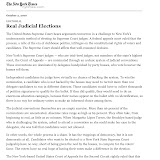
The New York Times - EDITORIAL - March 3, 2012
Taking office not long after the Sept. 11, 2001, attacks, Mayor Michael Bloomberg and Police Commissioner Raymond Kelly wisely decided to beef up the Police Department’s counterterrorism program significantly, to help federal law enforcement agencies avert another disaster. Unfortunately, they did not provide for sufficiently strong supervision of this formidable and far-flung intelligence operation — to check the well-known tendency of all such agencies, operating in secrecy and under murky rules, to abuse their powers. It appears that many thousands of law-abiding Muslim-Americans have paid a real price for that omission. A series of articles by The Associated Press has exposed constitutionally suspect surveillance of Muslims in New York, New Jersey, Long Island and beyond. Unearthed police records noticeably lack any apparent link to suspected criminal activity, or any obvious payoff for public safety. In particular, the A.P. reports revealed widespread police spying and the creation of police records containing information on Muslim people, mosques and campus groups, as well as luncheonettes, dollar stores and other legitimate businesses owned and frequented by Muslims, with no apparent reason to think anything wrong was going on. In mid-February, The A.P. disclosed that police officers systematically monitored the Web sites and blogs of Muslim student groups at N.Y.U., Columbia, Yale, Rutgers and a dozen other colleges. Documents show that an undercover agent accompanied 18 Muslim students from City College on a whitewater rafting trip in 2008. Dossier entries noted vital national security information — like the number of times they prayed.
Last week, The A.P. reported that plainclothes officers from the department’s euphemistically named Demographic Unit fanned out across Newark in 2007, snapping pictures of mosques and Muslim-owned businesses, listening to conversations, and gathering information about the makeup of mosque worshipers for an eerie 60-page internal police report stamped “NYPD Secret.” Similar reports were prepared on other Muslim neighborhoods. Newark’s mayor, Cory Booker, and the president of Rutgers University, Richard McCormick, have spoken out movingly about the wounds inflicted by these activities. Muslims in Newark and at Rutgers, they said, have become reluctant to pray openly at mosques, join in faith-based groups, or frequent Muslim hangouts for fear of being watched and possibly tarred by “guilt by association.” It is a distressing fact of life that mistreatment of Muslims does not draw nearly the protest that it should. But not just Muslims are threatened by this seemingly excessive warrantless surveillance and record-keeping. Today Muslims are the target. In the past it was protesters against the Vietnam War, civil rights activists, socialists. Tomorrow it will be another vulnerable group whose lawful behavior is blended into criminal activity. Mr. Bloomberg has reacted in the worst possible way — with disdain — to those raising legitimate questions about the surveillance program. Asking about its legality, and about whether alienating innocent Muslims is a smart or decent strategy, does not translate into being soft on terrorism, or failing to appreciate that it is a dangerous world. The mayor insists that the actions reported by The A.P. were “legal,” “appropriate” and “constitutional.” He also says the police were only “following leads.” But he has yet to explain what sort of leads, why they justify police surveillance of so many Muslims, or whether the type of surveillance depicted in the news reports continues. Under a federal court decree, it is permissible to collect information from public sources. But going to public places apparently selected on the basis of religion and recording information having nothing to do with terrorism — including religious and political views expressed in mosques and campus gatherings — is another matter. Officials like Gov. Andrew Cuomo, Senator Charles Schumer and the City Council speaker, Christine Quinn, should be urging the Police Department to be less grudging about supplying information that would aid public understanding, instead of racing to give the police a pass. We welcome last week’s statement by Attorney General Eric Holder that the Justice Department is beginning to review complaints about the N.Y.P.D.’s surveillance of Muslim and Arab communities to determine whether a full civil rights investigation is warranted. The review’s prompt completion should be a priority. Meantime, we are wondering what happened to the Michael Bloomberg who stood up for fairness and religious freedom by backing a proposed Muslim community center near ground zero. We hope that mayor re-emerges soon to restore trust.
The New York Times - EDITORIAL - March 3, 2012
Taking office not long after the Sept. 11, 2001, attacks, Mayor Michael Bloomberg and Police Commissioner Raymond Kelly wisely decided to beef up the Police Department’s counterterrorism program significantly, to help federal law enforcement agencies avert another disaster. Unfortunately, they did not provide for sufficiently strong supervision of this formidable and far-flung intelligence operation — to check the well-known tendency of all such agencies, operating in secrecy and under murky rules, to abuse their powers. It appears that many thousands of law-abiding Muslim-Americans have paid a real price for that omission. A series of articles by The Associated Press has exposed constitutionally suspect surveillance of Muslims in New York, New Jersey, Long Island and beyond. Unearthed police records noticeably lack any apparent link to suspected criminal activity, or any obvious payoff for public safety. In particular, the A.P. reports revealed widespread police spying and the creation of police records containing information on Muslim people, mosques and campus groups, as well as luncheonettes, dollar stores and other legitimate businesses owned and frequented by Muslims, with no apparent reason to think anything wrong was going on. In mid-February, The A.P. disclosed that police officers systematically monitored the Web sites and blogs of Muslim student groups at N.Y.U., Columbia, Yale, Rutgers and a dozen other colleges. Documents show that an undercover agent accompanied 18 Muslim students from City College on a whitewater rafting trip in 2008. Dossier entries noted vital national security information — like the number of times they prayed.
Last week, The A.P. reported that plainclothes officers from the department’s euphemistically named Demographic Unit fanned out across Newark in 2007, snapping pictures of mosques and Muslim-owned businesses, listening to conversations, and gathering information about the makeup of mosque worshipers for an eerie 60-page internal police report stamped “NYPD Secret.” Similar reports were prepared on other Muslim neighborhoods. Newark’s mayor, Cory Booker, and the president of Rutgers University, Richard McCormick, have spoken out movingly about the wounds inflicted by these activities. Muslims in Newark and at Rutgers, they said, have become reluctant to pray openly at mosques, join in faith-based groups, or frequent Muslim hangouts for fear of being watched and possibly tarred by “guilt by association.” It is a distressing fact of life that mistreatment of Muslims does not draw nearly the protest that it should. But not just Muslims are threatened by this seemingly excessive warrantless surveillance and record-keeping. Today Muslims are the target. In the past it was protesters against the Vietnam War, civil rights activists, socialists. Tomorrow it will be another vulnerable group whose lawful behavior is blended into criminal activity. Mr. Bloomberg has reacted in the worst possible way — with disdain — to those raising legitimate questions about the surveillance program. Asking about its legality, and about whether alienating innocent Muslims is a smart or decent strategy, does not translate into being soft on terrorism, or failing to appreciate that it is a dangerous world. The mayor insists that the actions reported by The A.P. were “legal,” “appropriate” and “constitutional.” He also says the police were only “following leads.” But he has yet to explain what sort of leads, why they justify police surveillance of so many Muslims, or whether the type of surveillance depicted in the news reports continues. Under a federal court decree, it is permissible to collect information from public sources. But going to public places apparently selected on the basis of religion and recording information having nothing to do with terrorism — including religious and political views expressed in mosques and campus gatherings — is another matter. Officials like Gov. Andrew Cuomo, Senator Charles Schumer and the City Council speaker, Christine Quinn, should be urging the Police Department to be less grudging about supplying information that would aid public understanding, instead of racing to give the police a pass. We welcome last week’s statement by Attorney General Eric Holder that the Justice Department is beginning to review complaints about the N.Y.P.D.’s surveillance of Muslim and Arab communities to determine whether a full civil rights investigation is warranted. The review’s prompt completion should be a priority. Meantime, we are wondering what happened to the Michael Bloomberg who stood up for fairness and religious freedom by backing a proposed Muslim community center near ground zero. We hope that mayor re-emerges soon to restore trust.
Tuesday, December 27, 2011
Schumer's Brother-in-Law Stirs Controversy in Federal Judicial Nomination
Short Hills resident's nomination stirs controversy
www.NorthJersey.com by Lindsey Kelleher - December 27, 2011
Short Hills resident Kevin McNulty was nominated by President Barack Obama to serve as U.S. District Court Judge for the District of New Jersey earlier this month. The nomination, announced by Sen. Frank Lautenberg (D-N.J.) and Sen. Robert Menendez (D-N.J.) Dec. 16, has recently stirred up controversy. The New York Post reported McNulty, 57, who is Sen. Charles Schumer's (D-N.Y.) brother-in-law, was nominated for this judge position at the last minute by Lautenberg so the two senators would stay politically close and connected. According to the Post article from Dec. 26, 87-year-old Lautenberg is concerned about losing his Senate seat during re-election time in 2014 because of his age. Schumer, who is influential in the Democratic Party, could stop Lautenberg from losing this position, the report continued. According to Lautenberg's spokesman Caley Gray, information in the New York Post article is untrue. "The New York Post story is complete fiction from a New York tabloid with a well-known partisan agenda. Sen. Lautenberg always maintains the highest standards in the judicial nominations process, and Kevin McNulty is one of the finest lawyers the senator has ever recommended for the bench," said Gray in a press release. Gray said in an interview with The Item of Millburn and Short Hills Dec. 27 that former federal judge John J. Gibbons - and not Schumer - recommended McNulty to Lautenberg for the judge position in 2009. According to Gray, in 2009 Lautenberg and members of his staff interviewed McNulty for this position, and he has been on Lautenberg's radar for this position since then. Gray said that McNulty is ranked as unanimously well-qualified by the American Bar Association, and that Lautenberg nominated McNulty as New Jersey's district court judge for his merits. In a press release from Sen. Lautenberg's office from October 2011, Lautenberg stated, "Mr. McNulty is an accomplished lawyer with decades of experience in public service and the private sector." Gibbons, a former Millburn resident who now lives in Maplewood, told The Item Dec. 27 that he recommended McNulty to Lautenberg. Gibbons and McNulty are partners at Gibbons P.C. Law Firm in Newark. According to Gibbons, McNulty has significant trial experiences, and has previously worked in the U.S. Attorney's Office as chief of the appellate section. "He is an excellent appellate lawyer and a fine writer," Gibbons said. "The public will benefit from his nomination." According to a biography about McNulty on the Gibbons law firm's website, he has litigated and counseled clients in a wide variety of pharmaceutical, intellectual property, commercial, criminal and appellate matters. McNulty has a B.A. from Yale University and graduated from New York University School of Law, (J.D., cum laude), in 1983. In an email to The Item, McNulty said he is unable to comment on his nomination. E-mail: kelleher@northjersey.com
www.NorthJersey.com by Lindsey Kelleher - December 27, 2011
Short Hills resident Kevin McNulty was nominated by President Barack Obama to serve as U.S. District Court Judge for the District of New Jersey earlier this month. The nomination, announced by Sen. Frank Lautenberg (D-N.J.) and Sen. Robert Menendez (D-N.J.) Dec. 16, has recently stirred up controversy. The New York Post reported McNulty, 57, who is Sen. Charles Schumer's (D-N.Y.) brother-in-law, was nominated for this judge position at the last minute by Lautenberg so the two senators would stay politically close and connected. According to the Post article from Dec. 26, 87-year-old Lautenberg is concerned about losing his Senate seat during re-election time in 2014 because of his age. Schumer, who is influential in the Democratic Party, could stop Lautenberg from losing this position, the report continued. According to Lautenberg's spokesman Caley Gray, information in the New York Post article is untrue. "The New York Post story is complete fiction from a New York tabloid with a well-known partisan agenda. Sen. Lautenberg always maintains the highest standards in the judicial nominations process, and Kevin McNulty is one of the finest lawyers the senator has ever recommended for the bench," said Gray in a press release. Gray said in an interview with The Item of Millburn and Short Hills Dec. 27 that former federal judge John J. Gibbons - and not Schumer - recommended McNulty to Lautenberg for the judge position in 2009. According to Gray, in 2009 Lautenberg and members of his staff interviewed McNulty for this position, and he has been on Lautenberg's radar for this position since then. Gray said that McNulty is ranked as unanimously well-qualified by the American Bar Association, and that Lautenberg nominated McNulty as New Jersey's district court judge for his merits. In a press release from Sen. Lautenberg's office from October 2011, Lautenberg stated, "Mr. McNulty is an accomplished lawyer with decades of experience in public service and the private sector." Gibbons, a former Millburn resident who now lives in Maplewood, told The Item Dec. 27 that he recommended McNulty to Lautenberg. Gibbons and McNulty are partners at Gibbons P.C. Law Firm in Newark. According to Gibbons, McNulty has significant trial experiences, and has previously worked in the U.S. Attorney's Office as chief of the appellate section. "He is an excellent appellate lawyer and a fine writer," Gibbons said. "The public will benefit from his nomination." According to a biography about McNulty on the Gibbons law firm's website, he has litigated and counseled clients in a wide variety of pharmaceutical, intellectual property, commercial, criminal and appellate matters. McNulty has a B.A. from Yale University and graduated from New York University School of Law, (J.D., cum laude), in 1983. In an email to The Item, McNulty said he is unable to comment on his nomination. E-mail: kelleher@northjersey.com
Sunday, December 25, 2011
Schumer Plays Santa in Federal Judgeship to Brother-In-Law
Schumer bro-in-law judge nod stuns NJ
The New York Post - EXCLUSIVE - by Josh Margolin - December 26, 2011
Sen. Charles Schumer’s brother-in-law was quietly nominated this month to a federal judgeship in New Jersey — a move that has some in the Garden State crying political foul, The Post has learned. Kevin McNulty, who is married to Schumer’s sister, Fran, was named to the US District Court by the White House late on Friday, Dec. 16. According to a boilerplate quote, President Obama believes McNulty is a “distinguished individual” who “will serve the American people with integrity and a steadfast commitment to justice.” New Jersey’s two US senators, Frank Lautenberg and Robert Menendez, followed that up with their own news release heaping praise on the nominee. What no one mentioned is that McNulty, 57, was the last-minute choice of Lautenberg, who had been leaning toward other candidates until surprisingly submitting McNulty’s name to the White House. Lautenberg and his aides have given no public explanation for the decision to go with McNulty even though the latter had never been publicly touted as a contender for the job, which carries life tenure and a $174,000-a-year salary. “No one knows why he did it,” said one person involved in the nomination process. “Everyone thinks it’s all about 2014 and Frank making sure he has Chuck in his corner.” The White House declined to comment, as did McNulty. Lautenberg’s reps denied any political motives and stressed that McNulty, who lives in upscale Short Hills, won the nod on the merits. He is a senior partner at Gibbons PC in Newark. Aides also insisted that Lautenberg was clueless about McNulty’s relationship to Schumer when he first looked at him in 2009. “It is complete fiction to suggest that there was any deal or that Kevin McNulty was brought into the process at the last minute,” said Lautenberg spokesman Caley Gray. People involved in the judicial-nomination process in New Jersey told The Post they believe the surprise nomination was a naked political maneuver by the 87-year-old Lautenberg to stay in Schumer’s good graces. Lautenberg is worried that party elders will try to push him out of his beloved Senate seat because of his advanced age — something that Schumer, one of the party’s top opinion makers and fund-raisers, would be able to stop. “McNulty came out of left field,” said another source involved in the Jersey judicial politics. “McNulty’s not a dumb guy, but people were just, like, ‘How’d that happen?’” Schumer spokesman Mike Morey said Schumer played no part in his brother-in-law’s nod. He insisted Lautenberg could never lose Schumer’s backing. “Chuck Schumer has supported Frank Lautenberg through thick and thin, both in primaries and general elections,” Morey said. “It’s laughable to think he wouldn’t support him in the future.” jmargolin@nypost.com
The New York Post - EXCLUSIVE - by Josh Margolin - December 26, 2011
Sen. Charles Schumer’s brother-in-law was quietly nominated this month to a federal judgeship in New Jersey — a move that has some in the Garden State crying political foul, The Post has learned. Kevin McNulty, who is married to Schumer’s sister, Fran, was named to the US District Court by the White House late on Friday, Dec. 16. According to a boilerplate quote, President Obama believes McNulty is a “distinguished individual” who “will serve the American people with integrity and a steadfast commitment to justice.” New Jersey’s two US senators, Frank Lautenberg and Robert Menendez, followed that up with their own news release heaping praise on the nominee. What no one mentioned is that McNulty, 57, was the last-minute choice of Lautenberg, who had been leaning toward other candidates until surprisingly submitting McNulty’s name to the White House. Lautenberg and his aides have given no public explanation for the decision to go with McNulty even though the latter had never been publicly touted as a contender for the job, which carries life tenure and a $174,000-a-year salary. “No one knows why he did it,” said one person involved in the nomination process. “Everyone thinks it’s all about 2014 and Frank making sure he has Chuck in his corner.” The White House declined to comment, as did McNulty. Lautenberg’s reps denied any political motives and stressed that McNulty, who lives in upscale Short Hills, won the nod on the merits. He is a senior partner at Gibbons PC in Newark. Aides also insisted that Lautenberg was clueless about McNulty’s relationship to Schumer when he first looked at him in 2009. “It is complete fiction to suggest that there was any deal or that Kevin McNulty was brought into the process at the last minute,” said Lautenberg spokesman Caley Gray. People involved in the judicial-nomination process in New Jersey told The Post they believe the surprise nomination was a naked political maneuver by the 87-year-old Lautenberg to stay in Schumer’s good graces. Lautenberg is worried that party elders will try to push him out of his beloved Senate seat because of his advanced age — something that Schumer, one of the party’s top opinion makers and fund-raisers, would be able to stop. “McNulty came out of left field,” said another source involved in the Jersey judicial politics. “McNulty’s not a dumb guy, but people were just, like, ‘How’d that happen?’” Schumer spokesman Mike Morey said Schumer played no part in his brother-in-law’s nod. He insisted Lautenberg could never lose Schumer’s backing. “Chuck Schumer has supported Frank Lautenberg through thick and thin, both in primaries and general elections,” Morey said. “It’s laughable to think he wouldn’t support him in the future.” jmargolin@nypost.com
Friday, December 23, 2011
More Political Chaos Keeps Federal Bench Unable to Deal with Justice
U.S. Senate Blocks Green Nomination for Western District
The New York Law Journal by John Caher - December 23, 2011
A long vacant federal judgeship in the Western District will apparently remain vacant for the time being as Congressional Republicans have blocked the nomination of Monroe County District Attorney Michael C. Green. Mr. Green yesterday said he was advised by the White House that his nomination has been returned by the Senate and will not be resubmitted. The White House confirmed that the nomination is dead. "I appreciate the fact that the president nominated me," Mr. Green said. "Certainly, I was frustrated that after three years I couldn't even get the Senate to vote on it." Mr. Green, 50, a prosecutor in Rochester for the past 25 years and the district attorney for eight years, was recommended by Democratic Senator Charles Schumer for the vacancy created in March 2009 when Judge David Larimer took senior status. Mr. Green did not seek re-election this year as the Senate Judiciary Committee advanced his nomination on June 16. White House spokesman Brandon Lepow confirmed that Mr. Green's nomination was returned to President Barack Obama by the Senate and will not be resubmitted. Mr. Lepow would not comment on why the nomination was blocked, but Mr. Schumer said in a statement that "partisan politics stood in the way." A spokeswoman for Senator Charles Grassley, an Iowa Republican on the Judiciary Committee, yesterday said problems surfaced during a background investigation of Mr. Green. "Members had concerns with his background," said spokeswoman Beth Levine. "Mr. Green knows what the committee's concerns were. There were questions that arose during the background investigation. It turns out the White House isn't re-nominating so it sounds like they had concerns as well." Mr. Green disputed Ms. Levine's statement and said the background investigation was completed before he went to, and was approved 17-1 by the Judiciary Committee. "All of the background information was before the Judiciary Committee and I got thrown a 17-1 vote, with the only 'no' vote coming from [Republican] Senator [Mike] Lee of Utah, who publicly issued a statement saying he had concerns because I had never done federal civil work," Mr. Green said. "It is unbelievable [that Mr. Grassley's office] would say that." Mr. Green said he was not given details as to why his nomination was derailed, but suggested it had to do with local politics. He said Mr. Schumer's office told him that someone in the Rochester area was attempting to undermine the nomination and got the ear of Mr. Grassley. "The only questions Grassley raised were about a local political race, a local D.A.'s race," Mr. Green said. "Why he was getting involved in that, I have no idea."
Stephen Gillers, a professor at New York University School of Law and an ethics expert, said the U.S. Department of Justice contacted him after receiving an anonymous letter alleging that Mr. Green had violated ethical standards by endorsing his first assistant as his successor in the district attorney's office while the nomination was pending. Mr. Gillers said he had never heard of Mr. Green until receiving that request. "Green's nomination got derailed because someone wrote an anonymous letter after he was confirmed [by the committee] but before the Senate voted," Mr. Gillers said in an interview. "Justice asked me if it was a legitimate criticism." Mr. Gillers said it was unclear where the anonymous letter came from or the motivation behind it. He said he reviewed the letter and a subsequent letter Mr. Grassley sent to Mr. Green raising questions about his ethics. "There are a lot of factors that go into these things," Mr. Gillers said. "It may have been intended to embarrass the president. It may have been political pay-back. And it may have been an erroneous belief that he did violate ethics. My job was to speak to the ethical issues, and I did." In a Dec. 2 letter to Mr. Grassley and Judiciary Committee Chairman Patrick Leahy, D-Vermont, Mr. Gillers said Mr. Green did nothing wrong in endorsing his assistant, Sandra Doorley. "Mr. Green endorsed one candidate only, had the support of [a] State Bar opinion that doing so was appropriate, indeed of value, and had a non-partisan basis for his endorsement," Mr. Gillers said in the letter. "His decision was ethical and compliant with the New York Rules of Professional Conduct and the Code of Conduct for U.S. Judges." Mr. Gillers said in the letter that there is "no basis to conclude" that Mr. Green endorsed Ms. Doorley to further his chances of Senate confirmation. Additionally, an issue arose locally when Mr. Green kept on the payroll for the remainder of the year five prosecutors Ms. Doorley intended to fire. It is unclear why that would be an issue, but Mr. Green said it was raised by his opponents in Congress. Mr. Green, a former Republican who switched parties to run for district attorney when his own party would not support his nomination, is highly regarded and his nomination was strongly endorsed by local attorneys. In an interview last summer with the Law Journal, Monroe County Public Defender Timothy P. Donaher, whose office butted heads with Mr. Green's office, repeatedly praised the prosecutor. "Mike, before he became D.A., was known as one of the most prepared trial prosecutors that office had ever seen," Mr. Donaher said. "I don't think anyone works harder. From a defense perspective, he is a thorough, aggressive prosecutor, but a fair guy who is always willing to listen." A local community leader said Mr. Green was instrumental in establishing a program in which drug forfeiture monies are used to support an educational/athletic/mentoring program at the local Boys and Girls Club. "Mike is incredibly committed to this community," said I.C. Shah, former chairman of the Boys and Girls Club. "He is intelligent. He is passionate. He knows the law. It is very rare to find a combination of passion, commitment, knowledge and dedication, and he has all four." Mr. Green's first boss, Rochester attorney James Morris of Morris & Morris, where he began his legal career, said Mr. Green "is a good lawyer. But he has one characteristic above all. He is scrupulously honest and highly ethical." The only open opposition to Mr. Green's appointment, at least until the issues arose in the district attorney's race, came from a minority of the American Bar Association vetting committee, which expressed concern over his lack of experience in civil practice. Mr. Green said he has not decided what he will do when his tenure as district attorney ends next week and is considering his options. "It is time to look forward," Mr. Green said. "The fact that this opportunity closes just means others become open. I am excited about those opportunities." Mr. Obama has suffered a number of setbacks in his efforts to fill judicial vacancies. Currently, 16 nominees, all of whom were approved unanimously by the Judiciary Committee, are awaiting Senate action. Earlier this month, Senate Republicans blocked the nomination of Caitlin J. Halligan for the U.S. Court of Appeals for the District of Columbia Circuit. Ms. Halligan, a former New York solicitor general, is general counsel for the Manhattan District Attorney's Office. John Caher can be contacted at jcaher@alm.com.
The New York Law Journal by John Caher - December 23, 2011
A long vacant federal judgeship in the Western District will apparently remain vacant for the time being as Congressional Republicans have blocked the nomination of Monroe County District Attorney Michael C. Green. Mr. Green yesterday said he was advised by the White House that his nomination has been returned by the Senate and will not be resubmitted. The White House confirmed that the nomination is dead. "I appreciate the fact that the president nominated me," Mr. Green said. "Certainly, I was frustrated that after three years I couldn't even get the Senate to vote on it." Mr. Green, 50, a prosecutor in Rochester for the past 25 years and the district attorney for eight years, was recommended by Democratic Senator Charles Schumer for the vacancy created in March 2009 when Judge David Larimer took senior status. Mr. Green did not seek re-election this year as the Senate Judiciary Committee advanced his nomination on June 16. White House spokesman Brandon Lepow confirmed that Mr. Green's nomination was returned to President Barack Obama by the Senate and will not be resubmitted. Mr. Lepow would not comment on why the nomination was blocked, but Mr. Schumer said in a statement that "partisan politics stood in the way." A spokeswoman for Senator Charles Grassley, an Iowa Republican on the Judiciary Committee, yesterday said problems surfaced during a background investigation of Mr. Green. "Members had concerns with his background," said spokeswoman Beth Levine. "Mr. Green knows what the committee's concerns were. There were questions that arose during the background investigation. It turns out the White House isn't re-nominating so it sounds like they had concerns as well." Mr. Green disputed Ms. Levine's statement and said the background investigation was completed before he went to, and was approved 17-1 by the Judiciary Committee. "All of the background information was before the Judiciary Committee and I got thrown a 17-1 vote, with the only 'no' vote coming from [Republican] Senator [Mike] Lee of Utah, who publicly issued a statement saying he had concerns because I had never done federal civil work," Mr. Green said. "It is unbelievable [that Mr. Grassley's office] would say that." Mr. Green said he was not given details as to why his nomination was derailed, but suggested it had to do with local politics. He said Mr. Schumer's office told him that someone in the Rochester area was attempting to undermine the nomination and got the ear of Mr. Grassley. "The only questions Grassley raised were about a local political race, a local D.A.'s race," Mr. Green said. "Why he was getting involved in that, I have no idea."
Stephen Gillers, a professor at New York University School of Law and an ethics expert, said the U.S. Department of Justice contacted him after receiving an anonymous letter alleging that Mr. Green had violated ethical standards by endorsing his first assistant as his successor in the district attorney's office while the nomination was pending. Mr. Gillers said he had never heard of Mr. Green until receiving that request. "Green's nomination got derailed because someone wrote an anonymous letter after he was confirmed [by the committee] but before the Senate voted," Mr. Gillers said in an interview. "Justice asked me if it was a legitimate criticism." Mr. Gillers said it was unclear where the anonymous letter came from or the motivation behind it. He said he reviewed the letter and a subsequent letter Mr. Grassley sent to Mr. Green raising questions about his ethics. "There are a lot of factors that go into these things," Mr. Gillers said. "It may have been intended to embarrass the president. It may have been political pay-back. And it may have been an erroneous belief that he did violate ethics. My job was to speak to the ethical issues, and I did." In a Dec. 2 letter to Mr. Grassley and Judiciary Committee Chairman Patrick Leahy, D-Vermont, Mr. Gillers said Mr. Green did nothing wrong in endorsing his assistant, Sandra Doorley. "Mr. Green endorsed one candidate only, had the support of [a] State Bar opinion that doing so was appropriate, indeed of value, and had a non-partisan basis for his endorsement," Mr. Gillers said in the letter. "His decision was ethical and compliant with the New York Rules of Professional Conduct and the Code of Conduct for U.S. Judges." Mr. Gillers said in the letter that there is "no basis to conclude" that Mr. Green endorsed Ms. Doorley to further his chances of Senate confirmation. Additionally, an issue arose locally when Mr. Green kept on the payroll for the remainder of the year five prosecutors Ms. Doorley intended to fire. It is unclear why that would be an issue, but Mr. Green said it was raised by his opponents in Congress. Mr. Green, a former Republican who switched parties to run for district attorney when his own party would not support his nomination, is highly regarded and his nomination was strongly endorsed by local attorneys. In an interview last summer with the Law Journal, Monroe County Public Defender Timothy P. Donaher, whose office butted heads with Mr. Green's office, repeatedly praised the prosecutor. "Mike, before he became D.A., was known as one of the most prepared trial prosecutors that office had ever seen," Mr. Donaher said. "I don't think anyone works harder. From a defense perspective, he is a thorough, aggressive prosecutor, but a fair guy who is always willing to listen." A local community leader said Mr. Green was instrumental in establishing a program in which drug forfeiture monies are used to support an educational/athletic/mentoring program at the local Boys and Girls Club. "Mike is incredibly committed to this community," said I.C. Shah, former chairman of the Boys and Girls Club. "He is intelligent. He is passionate. He knows the law. It is very rare to find a combination of passion, commitment, knowledge and dedication, and he has all four." Mr. Green's first boss, Rochester attorney James Morris of Morris & Morris, where he began his legal career, said Mr. Green "is a good lawyer. But he has one characteristic above all. He is scrupulously honest and highly ethical." The only open opposition to Mr. Green's appointment, at least until the issues arose in the district attorney's race, came from a minority of the American Bar Association vetting committee, which expressed concern over his lack of experience in civil practice. Mr. Green said he has not decided what he will do when his tenure as district attorney ends next week and is considering his options. "It is time to look forward," Mr. Green said. "The fact that this opportunity closes just means others become open. I am excited about those opportunities." Mr. Obama has suffered a number of setbacks in his efforts to fill judicial vacancies. Currently, 16 nominees, all of whom were approved unanimously by the Judiciary Committee, are awaiting Senate action. Earlier this month, Senate Republicans blocked the nomination of Caitlin J. Halligan for the U.S. Court of Appeals for the District of Columbia Circuit. Ms. Halligan, a former New York solicitor general, is general counsel for the Manhattan District Attorney's Office. John Caher can be contacted at jcaher@alm.com.
Saturday, December 10, 2011
Mayor Builds Legacy With Appointments of 'Highly Qualified' Civil, Family Court Judges
Bloomberg Builds Legacy With Appointments of 'Highly Qualified' Civil, Family Court Judges
The New York Law Journal by Daniel Wise - December 12, 2011
On the day before Thanksgiving, Mayor Michael R. Bloomberg carved two hours out of his schedule to interview eight candidates for Criminal and Family Court. "We are a nation of laws, and the independence of the judiciary is a bedrock of our society," Mr. Bloomberg said in an e-mail to the Law Journal. "It is a principle on which this nation was founded and essential to the success of our country. So appointing the highest quality individuals to the bench is a responsibility I take very seriously." The candidates Mr. Bloomberg selects in the next several weeks to fill vacancies on the Criminal and Family courts and for interim Civil Court positions will join 58 new judges the mayor has appointed since taking office in January 2002. With more than two years left in his third and final term, he is likely to match or surpass the 67 named by his immediate predecessor, Rudolph Giuliani, during his two terms. By now, Mr. Bloomberg has put his stamp of approval on many of the Giuliani appointments as well. In addition to his own choices, the mayor has reappointed 119 judges selected by his predecessors in the continuation of a "merit" selection process instituted by Mayor Edward I. Koch in 1978. In fact, Mr. Bloomberg has appointed or reappointed virtually all of the city's authorized Family and Criminal Court judges. His own choices represent 55 percent of the judges sitting in Criminal Court and 34 percent of those in Family Court. When reappointments are added, he has had a hand in the careers of 62 percent of the judges sitting in Criminal Court and 76 percent of those in Family Court. (Elected Civil Court judges also are assigned to sit in those courts.) Moreover, Mr. Bloomberg's influence extends beyond the courts where the state Constitution grants him appointment authority. Eighteen Bloomberg appointees have been named as acting justices in Supreme Court, where they preside over felony cases and large commercial disputes. Finally, state court administrators have named eight to supervisory positions, including Edwina Richardson-Mendelson, the current administrative judge of the city Family Court, and Barry Kamins, who oversees all criminal courts in Brooklyn. "It's a huge legacy, and he's proud of it," said Robert G.M. Keating, the vice president for strategic planning at Pace University, the vice chair of the mayor's Advisory Committee on the Judiciary. An interview with Mr. Bloomberg is the culmination of an appointment process that can take up to eight months to complete. The mayor has "followed the process to a T," said Corporation Counsel Michael A. Cardozo. In an executive order the mayor issued in March 2002, he committed himself, as did former mayors, to naming new judges only from a list of three "highly qualified" candidates nominated for each position by the 19-member advisory committee. Mr. Bloomberg's final choices are subject to a public hearing and to further screening by the New York City Bar. Elizabeth Donoghue, chair of the city bar's Judiciary Committee, said that the mayor's committee and the city bar have developed a "highly professional, very smooth relationship. They have done an excellent job advancing high-quality candidates." The advisory committee also screens candidates for reappointment, sending a single name to the mayor if it is satisfied that he or she meets its and the mayor's stringent criteria for serving on the bench.
Consumer of Legal Services
At the final interviews, Mr. Bloomberg shows an "uncanny ability" to elicit information, often plucking details from "left-field" on a resume, to help him determine whether candidates have the "intelligence and people skills" to make a good judge, said Mr. Cardozo. Mr. Cardozo said that Mr. Bloomberg often quizzes prospective judges about ideas for reforming the courts. The mayor is "very interested in 'change agents,'" said Mr. Keating. Mr. Cardozo is one of four top mayoral aides who talk to judicial candidates before Mr. Bloomberg sits down with them. The others are John Feinblatt, the mayor's criminal justice coordinator, Deputy Mayor Carol Robles-Roman and Norma Abbene, Ms. Robles-Roman's chief of staff. Mr. Bloomberg said that he relies on the advice of his aides, "particularly their views on the candidates' experiences and judgments as lawyers. But the final decision is mine, and the interview I conduct is an absolutely essential part of the decision-making process." Mr. Bloomberg's own background as a businessman represents what may be the most significant change in the way judges are appointed. Unlike his three predecessors—Mr. Giuliani, a former U.S. attorney, David N. Dinkins and Mr. Koch—Mr. Bloomberg was not trained in the law. Mr. Bloomberg approaches his appointment responsibilities as a "consumer of legal services" rather than as a lawyer, said Zachary Carter, a partner at Dorsey & Whitney who has chaired the judicial advisory committee since 2002. "In selecting judges my goal has been to appoint exceptional people of the highest quality. They must represent a wide spectrum of the legal community and of our city," Mr. Bloomberg told the city bar in 2003. They must possess uncommon wisdom, knowledge and experience. They must understand how to better serve New Yorkers, by administering justice in innovative and creative ways. They must be tough and compassionate. They must have common sense and impeccable honesty."
Mr. Bloomberg in his e-mail said, "I am not looking for someone who will agree with me on every issue presented, but rather someone who will look at the facts and the law, and then drawing on his or her experiences and knowledge, reach an independent, practical, well-reasoned judgment." The mayor's approach has translated into a more diverse crop of appointees according to some measures. For one thing, he has greatly increased the number of defense attorneys named to the bench. He also has named more women and minorities in a quest for diversity that has involved extensive outreach by advisory committee members, said Ms. Robles-Roman and others. Mayor Michael Bloomberg swears in Criminal Court judges he has reappointed during a January 2009 ceremony at the Emigrant Industrial Savings Bank Building. Carol Robles-Roman, deputy mayor for legal affairs, stands behind the mayor. Of his appointments, 34 have been for Criminal Court and 20 for Family Court. Another four are serving as interim Civil Court judges, temporary positions that often function as way stations and training grounds on the road to appointment to the other courts. All told, 30 of Mr. Bloomberg's 58 new judges have been women, 17 minorities and three openly gay. Twenty-one have been prosecutors and 20 Legal Aid attorneys. Twenty-nine have worked in the state and federal court system in some capacity. Six have served in the city Law Department and 11 in other city agencies. Twenty-six have put in time in private practice, five at the time of their appointments. They have lived in all five boroughs.
Ms. Robles-Roman said that the mayor fosters diversity of "every manner possible," whether it is racial and ethnic background, professional experience or neighborhood ties. In fact, said Mr. Carter, the advisory committee sees "lots of different combinations of skills." Ms. Robles-Roman added that the committee and mayor's aides who review its work do not pigeonhole candidates for particular courts. "We try not to say that they have to be this kind of a judge or that kind of a judge," she said. Thus, Acting Supreme Court Justice Juan M. Merchan initially received an appointment as an interim Civil Court judge stationed in Bronx Family Court and then as a full-fledged Family Court judge even though he had never practiced in that court. Justice Merchan, a former prosecutor, had what Ms. Robles-Roman calls "a rich portfolio." Senator Charles Schumer has recommended Judge Merchan for a spot on the federal district court. However, some criminal defense lawyers complain that Mr. Bloomberg's appointees are not always familiar with the way things are done in Criminal Court. "They don't know how to assess the risk posed by a defendant and fail to understand which cases are going to end up on the junk heap," said one defense attorney. The defense attorneys complain that inexperienced judges sometimes lack the ability to set appropriate bail. This has resulted in cases where bail was too high for defendants charged with minor offenses or low enough to allow dangerous suspects to be released too soon, they contend. Moreover, one member of the advisory committee suggested that recent court personnel cuts may put a premium on candidates who already know how the courts work, Family Court attorney referees, for example. Mr. Carter said that feedback from practitioners about the quality of Mr. Bloomberg's appointments has been "very, very positive," a fact that was generally confirmed by attorneys interviewed by the Law Journal. Nevertheless, some lawyers faulted the temperament of individual judges. Thus, one lawyer said of a Bloomberg appointee in Criminal Court, "it's very, very difficult to practice law in front of him; it's as if no one ever practiced law except him. He gives the prosecution and defense a hard time." Another acknowledged that the judge "is smart" but added that he is "nasty and curt when there is no reason for it."
Some of the negative comments may come from attorneys who have not obtained good results from particular judges. However, Mr. Cardozo acknowledged that "not everybody is perfect." Screeners add that they do not have a "crystal ball" with which to predict how a rookie judge will react to the challenges he or she faces when on the bench. But judges often are initially named for short terms, and must face the committee and the mayor as often as three times in three years, a frequency that provides a check on rookie mistakes and unjudicial conduct. More than half of Mr. Bloomberg's picks—33—have had to convince him that their performance merits reappointment. Mr. Cardozo said that some judges do not seek reappointment because they have reached the mandatory retirement age or are simply tired of the job. Others may see the "writing on the wall" and not bother to put in their names. Only "a few" actually have sought reappointment and been turned aside by the committee, he said. Mr. Bloomberg has made all his choices from the lists of three highly qualified candidates forwarded to him, said Desirée Kim, the committee's executive director. Nor has he denied reappointment to any candidates sent to him, though five have been given less than full terms. All five ultimately received full terms. Ms. Robles-Roman said that the mayor has had "absolutely outstanding" candidates to choose from among the 423 attorneys who have applied for judicial posts—some more than once—while he has been in office. The aspirants have had "a real commitment to and desire for public service," she said, "a personal mandate to make people's lives better." Applicants have been "superb, just superb," said Mr. Keating. However, although they say that there has been a steady stream of highly qualified candidates, officials have been troubled by the fact that many "senior public servants"—experienced lawyers holding top positions in government agencies—are not applying because they would have had to endure a huge pay cut if selected. "Judicial salaries pose a significant hurdle in our efforts to attract a broad cross-section of the legal community from which to select potential candidates," Mr. Cardozo testified at a hearing called by a commission on judicial compensation last summer. "There are many qualified practitioners whom we simply never have an opportunity to consider, individuals who wish to serve the public as judges but for whom the economic sacrifice we ask of them is simply too great." The disparity between the salaries of judges and top-level prosecutors, Legal Aid attorneys and assistant corporation counsels has widened since 1999, when judges had their last raise. Mr. Cardozo notes, for example, that the head of his office's appeals division would have to take a 20 percent pay cut to accept a judgeship. Ironically, however, there is some evidence that mayoral appointments have gotten older and, presumably, more experienced. The average age of Mr. Bloomberg's appointees has been 48, compared to 44 for Mr. Giuliani. In any case, officials hope that more candidates will come forward now that a commission has recommended that judges receive a raise. Under its proposal, the salaries of Criminal and Civil Court judges would go to $143,000 from $125,600 on April 1, 2012, and to $159,900 by 2014 unless the governor and the Legislature block the pay hikes. Family Court judges, now paid $136,700, would receive $160,000 next year, ultimately rising to $174,000.
Family Court Challenges
The 20 new judges that Mr. Bloomberg has named to Family Court "have strengthened" the bench and "made it a much better bench than it was," said Martin Guggenheim, a nationally recognized expert on the court who served on the mayor's committee. That is important, he explained, because the court is a "very difficult place to work," an overcrowded arena where judges must quickly make emotionally wrenching decisions that disproportionately affect the lives of poor minority group members. Mr. Guggenheim said that the mayor must choose judges "willing to push the city's Administration for Children's Services to move cases where children have been removed from their homes because delay is destructive of family bonds." Likewise, he said, the bench should be diversified so its judges will be more sensitive to the needs and problems of the people that come before it. Minority group members represent 35 percent of Mr. Bloomberg's appointments, twice the 18 percent of Mr. Giuliani. Moreover, while Mr. Giuliani's appointments were primarily drawn from prosecutors, Mr. Bloomberg's choices have been spread more broadly across lawyers who represented different categories of litigants. Only one of Mr. Bloomberg's 20 Family Court appointees had spent the bulk of his career as a prosecutor. Three of Mr. Bloomberg's Family Court appointees spent all, or nearly all, of their careers at the Legal Aid Society. By contrast, more than half of Mr. Giuliani's Family Court choices (13 of 22) were lawyers with extensive experience prosecuting juveniles or adults. Four of the new judges could be described as insiders, having spent most of their careers working for the court, while four others had significant experience dealing with Family Court matters. However, four of Mr. Bloomberg's choices had little previous experience in the court. Attorneys interviewed by the Law Journal gave rave reviews to several of Mr. Bloomberg's appointments to the challenging court. One lawyer gave an "A+" to Ronald H. Richter, who was appointed to Queens Family Court in January 2009 and left in September to take over the ACS. The lawyer said Mr. Richter was "very personable on the bench and highly sensitive of the rights of parents as well as the need to protect children in danger." Another called him "brilliant and progressive." A third said "he never spoke down or demonized a parent no matter how serious the abuse charges."
Judge Richardson-Mendelson was appointed to a one-year term in Queens in 2003 and to a full 10-year term a year later. She has a good understanding of "the needs of families and a lot of positive belief in the families that come before her to demonstrate the better part of themselves," said one lawyer who practices before her. Another lawyer called her implementation as administrative judge of the entire court—a job she was given by the state in 2009—of "time-certain" court dates "hugely beneficial, you no longer have to waste a day to conduct a half-hour hearing," Several lawyers also described Judge Ann-Marie Jolly, who was Judge Richardson-Mendelson's chief of staff before her appointment in 2010, as an excellent addition to the bench. One lawyer called her "amazingly respectful of lawyers and litigants and willing to go against ACS." Another said "she knows the law and is good at pushing for settlements." Judge Maria Arias, who headed a legal clinic for battered women at City University of New York School of Law also received high marks. One lawyer said she "bends over backwards to afford litigants as much opportunity as possible to make their cases." Another portrayed her "as very knowledgeable about the law and sensitive to issues of gender, race and sexual orientation." The application filled out by candidates for judgeships notes that "A judge may be required to handle emergency applications, cope with media scrutiny, issue quick decision, deal with fractious litigants, recall significant amounts of information, and otherwise respond to extremely stressful situations." It asks if they are "able to perform these tasks on your own or with reasonable accommodation." According to a few lawyers, several of the mayor's judges have been less than successful in handling "stressful situations" in Family Court, an environment well calculated to bring out a judge's impatience and short temper. For example, one lawyer described a Bloomberg appointment as "really rude to both litigants and case workers." Another said that "people are afraid of her with reason." That being said, however, the lawyer said the judge is "fair across the board." Another judge is viewed as possessing "a demeanor of impatience, cynicism and general negativity." Nevertheless, while the judge was reluctant to hold hearings, another lawyer said the judge was willing to take an individualized approach to cases.
Defense Backgrounds
In more than a dozen interviews, defense lawyers gave Mr. Bloomberg's 34 picks for the Criminal Court generally high marks. Jeffrey Lichtman, who is best known for his representation of organized crime defendants, said that most of the mayor's picks have been good, adding that the mayor's approach to picking judges is no different than his approach to running the city. "He is looking for judges with real world experience," Mr. Lichtman said, and is "more interested in the system working right than finding judges of an ideological bent." Particularly welcome has been the selection of Acting Supreme Court Justice Barry Kamins, a Brooklyn-based defense lawyer and former president of the New York City Bar. Judge Kamins is the author of the treatise "New York Search and Seizure," which one lawyer described as "a bible" that is kept close at hand by prosecutors and defense lawyers alike. Shortly after his appointment, he was designated by state administrators to manage criminal cases in Brooklyn, a position in which he drew good reviews from several attorneys. Ten of Mr. Bloomberg's appointees, or 29 percent, spent at least 60 percent of their careers doing defense work compared to 4 percent of Mr. Giuliani's selections. Conversely, 38 percent of Mr. Bloomberg's choices had spent at least 60 percent of their careers prior to appointment as prosecutors; 60 percent of Mr. Guiliani's choices had similar backgrounds. Mr. Bloomberg also has appointed more women to Criminal Court than his predecessors—44 percent of his selections. Michael Coleman, the executive director of New York County Defender Services, called Mr. Bloomberg's shift toward appointing more former defense lawyers "an extremely positive thing for the bench." "Historically," he said, "most judges have come from a law enforcement background and having a broader spectrum can only be a benefit and make for a fairer and more balanced system." But defense attorneys interviewed also praised the approach of some former prosecutors named by Mr. Bloomberg. Judge Mario Mattei, who was chief of the investigations bureau in the Staten Island District Attorney's Office for 18 years, "is a gentleman who listens and gives you time to make your argument," one lawyer said. Judge Melissa Jackson, a former veteran Brooklyn prosecutor, is the supervising judge of the Manhattan Criminal Court. A lawyer who has observed her said that she is "a brilliant judge with a sense of street smarts. You respect her decisions even when they don't go your way." However, some Criminal Court appointees have drawn the ire of attorneys who appear before them. One lawyer criticized a former longtime prosecutor for "not being actively engaged in settling cases" and "fairly bound to prosecution offers, resulting in clients languishing in jail." Another, expressing what he said was a common view, described a Bloomberg judge as "punitive to counsel and their clients." The lawyer added, "even though he dismisses cases he feels should not have been brought, he is disdainful to the prosecution and defense alike."
Depoliticizing the Process
Participants in the appointment process insist that neither political influence nor ideology have any effect on Mr. Bloomberg's picks. "You don't need a rabbi," Mr. Cardozo said. "With this mayor, it doesn't matter who you know or don't know." Mr. Giuliani was sometimes criticized for not following the advice of his committee and driving judges from the bench because their decisions did not accord with his political views. In contrast, Victor Kovner, a partner at Davis Wright Tremaine, a former corporation counsel who designed the model for the mayor's screening system, said that Mr. Bloomberg's appointments have "on the whole been totally excellent choices made on a totally non-political basis." Roger Stavis, a defense lawyer at Gallet Dreyer & Berkey who sat in on the city bar's review of the mayor's judicial candidates, said that Mr. Bloomberg's process is "insulated against political influence, and judges who had done their job conscientiously had nothing to fear about going before the mayor's committee for reappointment even if they had issued controversial decisions." Aides say that Mr. Bloomberg, a Republican-turned-independent, never asks about a candidate's party affiliation. Mr. Carter said that the advisory committee "saw a lot of people who never would have been considered" under a more political process. As a result of the mayor's attitude, Mr. Guggenheim, the former committee member, said members "were willing to say no'' when contacted by the supporters of particular candidates. Jennifer Baum, a clinical professor at St. John's University School of Law who has held a law school seat on the committee for about 20 months, said that she hears from a lot of people who are convinced that a candidates' success depends on "who you know," but she tells them "they are flat out wrong." Ms. Baum said that Mr. Bloomberg trusts the committee to sift through the qualifications of the exceptionally qualified candidates he receives. "I often forget that the mayor's office is involved at all," she said. Most of the state's judges are elected. While Mr. Bloomberg has said that there are many excellent elected judges, he has been critical of the process by which they are put on the ballot. For example, he wrote in a 2005 New York Daily News column referencing scandals in Brooklyn that a "patronage-driven" process should be replaced by one in which candidates are barred from running unless independent commissions establish that they are qualified. "We must change the farce of 'electing' judges, which bears more of a resemblance to voting in the Soviet Union than in the United States of America," he wrote. The mayor's ideas have made little headway, but he is satisfied with his choices made through the appointment process. "I think the process has worked well and has resulted in some very able and committed candidates being appointed to the bench," he said in his e-mail last week. "I think people understand that to be appointed a judge by me you don't have to have political connections, or belong to any particular party, or have a key person to support you. You don't have to be someone who is 'liberal' or 'conservative.' What you need is to be smart, practical and independent." Additional reporting by Jeff Storey. Research assistance by Laura Haring. Jeff Storey can be reached at jstorey@alm.com.
Click Here to Read Biographies of Mr. Bloomberg's Judicial Appointees.   
The New York Law Journal by Daniel Wise - December 12, 2011
On the day before Thanksgiving, Mayor Michael R. Bloomberg carved two hours out of his schedule to interview eight candidates for Criminal and Family Court. "We are a nation of laws, and the independence of the judiciary is a bedrock of our society," Mr. Bloomberg said in an e-mail to the Law Journal. "It is a principle on which this nation was founded and essential to the success of our country. So appointing the highest quality individuals to the bench is a responsibility I take very seriously." The candidates Mr. Bloomberg selects in the next several weeks to fill vacancies on the Criminal and Family courts and for interim Civil Court positions will join 58 new judges the mayor has appointed since taking office in January 2002. With more than two years left in his third and final term, he is likely to match or surpass the 67 named by his immediate predecessor, Rudolph Giuliani, during his two terms. By now, Mr. Bloomberg has put his stamp of approval on many of the Giuliani appointments as well. In addition to his own choices, the mayor has reappointed 119 judges selected by his predecessors in the continuation of a "merit" selection process instituted by Mayor Edward I. Koch in 1978. In fact, Mr. Bloomberg has appointed or reappointed virtually all of the city's authorized Family and Criminal Court judges. His own choices represent 55 percent of the judges sitting in Criminal Court and 34 percent of those in Family Court. When reappointments are added, he has had a hand in the careers of 62 percent of the judges sitting in Criminal Court and 76 percent of those in Family Court. (Elected Civil Court judges also are assigned to sit in those courts.) Moreover, Mr. Bloomberg's influence extends beyond the courts where the state Constitution grants him appointment authority. Eighteen Bloomberg appointees have been named as acting justices in Supreme Court, where they preside over felony cases and large commercial disputes. Finally, state court administrators have named eight to supervisory positions, including Edwina Richardson-Mendelson, the current administrative judge of the city Family Court, and Barry Kamins, who oversees all criminal courts in Brooklyn. "It's a huge legacy, and he's proud of it," said Robert G.M. Keating, the vice president for strategic planning at Pace University, the vice chair of the mayor's Advisory Committee on the Judiciary. An interview with Mr. Bloomberg is the culmination of an appointment process that can take up to eight months to complete. The mayor has "followed the process to a T," said Corporation Counsel Michael A. Cardozo. In an executive order the mayor issued in March 2002, he committed himself, as did former mayors, to naming new judges only from a list of three "highly qualified" candidates nominated for each position by the 19-member advisory committee. Mr. Bloomberg's final choices are subject to a public hearing and to further screening by the New York City Bar. Elizabeth Donoghue, chair of the city bar's Judiciary Committee, said that the mayor's committee and the city bar have developed a "highly professional, very smooth relationship. They have done an excellent job advancing high-quality candidates." The advisory committee also screens candidates for reappointment, sending a single name to the mayor if it is satisfied that he or she meets its and the mayor's stringent criteria for serving on the bench.
Consumer of Legal Services
At the final interviews, Mr. Bloomberg shows an "uncanny ability" to elicit information, often plucking details from "left-field" on a resume, to help him determine whether candidates have the "intelligence and people skills" to make a good judge, said Mr. Cardozo. Mr. Cardozo said that Mr. Bloomberg often quizzes prospective judges about ideas for reforming the courts. The mayor is "very interested in 'change agents,'" said Mr. Keating. Mr. Cardozo is one of four top mayoral aides who talk to judicial candidates before Mr. Bloomberg sits down with them. The others are John Feinblatt, the mayor's criminal justice coordinator, Deputy Mayor Carol Robles-Roman and Norma Abbene, Ms. Robles-Roman's chief of staff. Mr. Bloomberg said that he relies on the advice of his aides, "particularly their views on the candidates' experiences and judgments as lawyers. But the final decision is mine, and the interview I conduct is an absolutely essential part of the decision-making process." Mr. Bloomberg's own background as a businessman represents what may be the most significant change in the way judges are appointed. Unlike his three predecessors—Mr. Giuliani, a former U.S. attorney, David N. Dinkins and Mr. Koch—Mr. Bloomberg was not trained in the law. Mr. Bloomberg approaches his appointment responsibilities as a "consumer of legal services" rather than as a lawyer, said Zachary Carter, a partner at Dorsey & Whitney who has chaired the judicial advisory committee since 2002. "In selecting judges my goal has been to appoint exceptional people of the highest quality. They must represent a wide spectrum of the legal community and of our city," Mr. Bloomberg told the city bar in 2003. They must possess uncommon wisdom, knowledge and experience. They must understand how to better serve New Yorkers, by administering justice in innovative and creative ways. They must be tough and compassionate. They must have common sense and impeccable honesty."
Mr. Bloomberg in his e-mail said, "I am not looking for someone who will agree with me on every issue presented, but rather someone who will look at the facts and the law, and then drawing on his or her experiences and knowledge, reach an independent, practical, well-reasoned judgment." The mayor's approach has translated into a more diverse crop of appointees according to some measures. For one thing, he has greatly increased the number of defense attorneys named to the bench. He also has named more women and minorities in a quest for diversity that has involved extensive outreach by advisory committee members, said Ms. Robles-Roman and others. Mayor Michael Bloomberg swears in Criminal Court judges he has reappointed during a January 2009 ceremony at the Emigrant Industrial Savings Bank Building. Carol Robles-Roman, deputy mayor for legal affairs, stands behind the mayor. Of his appointments, 34 have been for Criminal Court and 20 for Family Court. Another four are serving as interim Civil Court judges, temporary positions that often function as way stations and training grounds on the road to appointment to the other courts. All told, 30 of Mr. Bloomberg's 58 new judges have been women, 17 minorities and three openly gay. Twenty-one have been prosecutors and 20 Legal Aid attorneys. Twenty-nine have worked in the state and federal court system in some capacity. Six have served in the city Law Department and 11 in other city agencies. Twenty-six have put in time in private practice, five at the time of their appointments. They have lived in all five boroughs.
Ms. Robles-Roman said that the mayor fosters diversity of "every manner possible," whether it is racial and ethnic background, professional experience or neighborhood ties. In fact, said Mr. Carter, the advisory committee sees "lots of different combinations of skills." Ms. Robles-Roman added that the committee and mayor's aides who review its work do not pigeonhole candidates for particular courts. "We try not to say that they have to be this kind of a judge or that kind of a judge," she said. Thus, Acting Supreme Court Justice Juan M. Merchan initially received an appointment as an interim Civil Court judge stationed in Bronx Family Court and then as a full-fledged Family Court judge even though he had never practiced in that court. Justice Merchan, a former prosecutor, had what Ms. Robles-Roman calls "a rich portfolio." Senator Charles Schumer has recommended Judge Merchan for a spot on the federal district court. However, some criminal defense lawyers complain that Mr. Bloomberg's appointees are not always familiar with the way things are done in Criminal Court. "They don't know how to assess the risk posed by a defendant and fail to understand which cases are going to end up on the junk heap," said one defense attorney. The defense attorneys complain that inexperienced judges sometimes lack the ability to set appropriate bail. This has resulted in cases where bail was too high for defendants charged with minor offenses or low enough to allow dangerous suspects to be released too soon, they contend. Moreover, one member of the advisory committee suggested that recent court personnel cuts may put a premium on candidates who already know how the courts work, Family Court attorney referees, for example. Mr. Carter said that feedback from practitioners about the quality of Mr. Bloomberg's appointments has been "very, very positive," a fact that was generally confirmed by attorneys interviewed by the Law Journal. Nevertheless, some lawyers faulted the temperament of individual judges. Thus, one lawyer said of a Bloomberg appointee in Criminal Court, "it's very, very difficult to practice law in front of him; it's as if no one ever practiced law except him. He gives the prosecution and defense a hard time." Another acknowledged that the judge "is smart" but added that he is "nasty and curt when there is no reason for it."
Some of the negative comments may come from attorneys who have not obtained good results from particular judges. However, Mr. Cardozo acknowledged that "not everybody is perfect." Screeners add that they do not have a "crystal ball" with which to predict how a rookie judge will react to the challenges he or she faces when on the bench. But judges often are initially named for short terms, and must face the committee and the mayor as often as three times in three years, a frequency that provides a check on rookie mistakes and unjudicial conduct. More than half of Mr. Bloomberg's picks—33—have had to convince him that their performance merits reappointment. Mr. Cardozo said that some judges do not seek reappointment because they have reached the mandatory retirement age or are simply tired of the job. Others may see the "writing on the wall" and not bother to put in their names. Only "a few" actually have sought reappointment and been turned aside by the committee, he said. Mr. Bloomberg has made all his choices from the lists of three highly qualified candidates forwarded to him, said Desirée Kim, the committee's executive director. Nor has he denied reappointment to any candidates sent to him, though five have been given less than full terms. All five ultimately received full terms. Ms. Robles-Roman said that the mayor has had "absolutely outstanding" candidates to choose from among the 423 attorneys who have applied for judicial posts—some more than once—while he has been in office. The aspirants have had "a real commitment to and desire for public service," she said, "a personal mandate to make people's lives better." Applicants have been "superb, just superb," said Mr. Keating. However, although they say that there has been a steady stream of highly qualified candidates, officials have been troubled by the fact that many "senior public servants"—experienced lawyers holding top positions in government agencies—are not applying because they would have had to endure a huge pay cut if selected. "Judicial salaries pose a significant hurdle in our efforts to attract a broad cross-section of the legal community from which to select potential candidates," Mr. Cardozo testified at a hearing called by a commission on judicial compensation last summer. "There are many qualified practitioners whom we simply never have an opportunity to consider, individuals who wish to serve the public as judges but for whom the economic sacrifice we ask of them is simply too great." The disparity between the salaries of judges and top-level prosecutors, Legal Aid attorneys and assistant corporation counsels has widened since 1999, when judges had their last raise. Mr. Cardozo notes, for example, that the head of his office's appeals division would have to take a 20 percent pay cut to accept a judgeship. Ironically, however, there is some evidence that mayoral appointments have gotten older and, presumably, more experienced. The average age of Mr. Bloomberg's appointees has been 48, compared to 44 for Mr. Giuliani. In any case, officials hope that more candidates will come forward now that a commission has recommended that judges receive a raise. Under its proposal, the salaries of Criminal and Civil Court judges would go to $143,000 from $125,600 on April 1, 2012, and to $159,900 by 2014 unless the governor and the Legislature block the pay hikes. Family Court judges, now paid $136,700, would receive $160,000 next year, ultimately rising to $174,000.
Family Court Challenges
The 20 new judges that Mr. Bloomberg has named to Family Court "have strengthened" the bench and "made it a much better bench than it was," said Martin Guggenheim, a nationally recognized expert on the court who served on the mayor's committee. That is important, he explained, because the court is a "very difficult place to work," an overcrowded arena where judges must quickly make emotionally wrenching decisions that disproportionately affect the lives of poor minority group members. Mr. Guggenheim said that the mayor must choose judges "willing to push the city's Administration for Children's Services to move cases where children have been removed from their homes because delay is destructive of family bonds." Likewise, he said, the bench should be diversified so its judges will be more sensitive to the needs and problems of the people that come before it. Minority group members represent 35 percent of Mr. Bloomberg's appointments, twice the 18 percent of Mr. Giuliani. Moreover, while Mr. Giuliani's appointments were primarily drawn from prosecutors, Mr. Bloomberg's choices have been spread more broadly across lawyers who represented different categories of litigants. Only one of Mr. Bloomberg's 20 Family Court appointees had spent the bulk of his career as a prosecutor. Three of Mr. Bloomberg's Family Court appointees spent all, or nearly all, of their careers at the Legal Aid Society. By contrast, more than half of Mr. Giuliani's Family Court choices (13 of 22) were lawyers with extensive experience prosecuting juveniles or adults. Four of the new judges could be described as insiders, having spent most of their careers working for the court, while four others had significant experience dealing with Family Court matters. However, four of Mr. Bloomberg's choices had little previous experience in the court. Attorneys interviewed by the Law Journal gave rave reviews to several of Mr. Bloomberg's appointments to the challenging court. One lawyer gave an "A+" to Ronald H. Richter, who was appointed to Queens Family Court in January 2009 and left in September to take over the ACS. The lawyer said Mr. Richter was "very personable on the bench and highly sensitive of the rights of parents as well as the need to protect children in danger." Another called him "brilliant and progressive." A third said "he never spoke down or demonized a parent no matter how serious the abuse charges."
Judge Richardson-Mendelson was appointed to a one-year term in Queens in 2003 and to a full 10-year term a year later. She has a good understanding of "the needs of families and a lot of positive belief in the families that come before her to demonstrate the better part of themselves," said one lawyer who practices before her. Another lawyer called her implementation as administrative judge of the entire court—a job she was given by the state in 2009—of "time-certain" court dates "hugely beneficial, you no longer have to waste a day to conduct a half-hour hearing," Several lawyers also described Judge Ann-Marie Jolly, who was Judge Richardson-Mendelson's chief of staff before her appointment in 2010, as an excellent addition to the bench. One lawyer called her "amazingly respectful of lawyers and litigants and willing to go against ACS." Another said "she knows the law and is good at pushing for settlements." Judge Maria Arias, who headed a legal clinic for battered women at City University of New York School of Law also received high marks. One lawyer said she "bends over backwards to afford litigants as much opportunity as possible to make their cases." Another portrayed her "as very knowledgeable about the law and sensitive to issues of gender, race and sexual orientation." The application filled out by candidates for judgeships notes that "A judge may be required to handle emergency applications, cope with media scrutiny, issue quick decision, deal with fractious litigants, recall significant amounts of information, and otherwise respond to extremely stressful situations." It asks if they are "able to perform these tasks on your own or with reasonable accommodation." According to a few lawyers, several of the mayor's judges have been less than successful in handling "stressful situations" in Family Court, an environment well calculated to bring out a judge's impatience and short temper. For example, one lawyer described a Bloomberg appointment as "really rude to both litigants and case workers." Another said that "people are afraid of her with reason." That being said, however, the lawyer said the judge is "fair across the board." Another judge is viewed as possessing "a demeanor of impatience, cynicism and general negativity." Nevertheless, while the judge was reluctant to hold hearings, another lawyer said the judge was willing to take an individualized approach to cases.
Defense Backgrounds
In more than a dozen interviews, defense lawyers gave Mr. Bloomberg's 34 picks for the Criminal Court generally high marks. Jeffrey Lichtman, who is best known for his representation of organized crime defendants, said that most of the mayor's picks have been good, adding that the mayor's approach to picking judges is no different than his approach to running the city. "He is looking for judges with real world experience," Mr. Lichtman said, and is "more interested in the system working right than finding judges of an ideological bent." Particularly welcome has been the selection of Acting Supreme Court Justice Barry Kamins, a Brooklyn-based defense lawyer and former president of the New York City Bar. Judge Kamins is the author of the treatise "New York Search and Seizure," which one lawyer described as "a bible" that is kept close at hand by prosecutors and defense lawyers alike. Shortly after his appointment, he was designated by state administrators to manage criminal cases in Brooklyn, a position in which he drew good reviews from several attorneys. Ten of Mr. Bloomberg's appointees, or 29 percent, spent at least 60 percent of their careers doing defense work compared to 4 percent of Mr. Giuliani's selections. Conversely, 38 percent of Mr. Bloomberg's choices had spent at least 60 percent of their careers prior to appointment as prosecutors; 60 percent of Mr. Guiliani's choices had similar backgrounds. Mr. Bloomberg also has appointed more women to Criminal Court than his predecessors—44 percent of his selections. Michael Coleman, the executive director of New York County Defender Services, called Mr. Bloomberg's shift toward appointing more former defense lawyers "an extremely positive thing for the bench." "Historically," he said, "most judges have come from a law enforcement background and having a broader spectrum can only be a benefit and make for a fairer and more balanced system." But defense attorneys interviewed also praised the approach of some former prosecutors named by Mr. Bloomberg. Judge Mario Mattei, who was chief of the investigations bureau in the Staten Island District Attorney's Office for 18 years, "is a gentleman who listens and gives you time to make your argument," one lawyer said. Judge Melissa Jackson, a former veteran Brooklyn prosecutor, is the supervising judge of the Manhattan Criminal Court. A lawyer who has observed her said that she is "a brilliant judge with a sense of street smarts. You respect her decisions even when they don't go your way." However, some Criminal Court appointees have drawn the ire of attorneys who appear before them. One lawyer criticized a former longtime prosecutor for "not being actively engaged in settling cases" and "fairly bound to prosecution offers, resulting in clients languishing in jail." Another, expressing what he said was a common view, described a Bloomberg judge as "punitive to counsel and their clients." The lawyer added, "even though he dismisses cases he feels should not have been brought, he is disdainful to the prosecution and defense alike."
Depoliticizing the Process
Participants in the appointment process insist that neither political influence nor ideology have any effect on Mr. Bloomberg's picks. "You don't need a rabbi," Mr. Cardozo said. "With this mayor, it doesn't matter who you know or don't know." Mr. Giuliani was sometimes criticized for not following the advice of his committee and driving judges from the bench because their decisions did not accord with his political views. In contrast, Victor Kovner, a partner at Davis Wright Tremaine, a former corporation counsel who designed the model for the mayor's screening system, said that Mr. Bloomberg's appointments have "on the whole been totally excellent choices made on a totally non-political basis." Roger Stavis, a defense lawyer at Gallet Dreyer & Berkey who sat in on the city bar's review of the mayor's judicial candidates, said that Mr. Bloomberg's process is "insulated against political influence, and judges who had done their job conscientiously had nothing to fear about going before the mayor's committee for reappointment even if they had issued controversial decisions." Aides say that Mr. Bloomberg, a Republican-turned-independent, never asks about a candidate's party affiliation. Mr. Carter said that the advisory committee "saw a lot of people who never would have been considered" under a more political process. As a result of the mayor's attitude, Mr. Guggenheim, the former committee member, said members "were willing to say no'' when contacted by the supporters of particular candidates. Jennifer Baum, a clinical professor at St. John's University School of Law who has held a law school seat on the committee for about 20 months, said that she hears from a lot of people who are convinced that a candidates' success depends on "who you know," but she tells them "they are flat out wrong." Ms. Baum said that Mr. Bloomberg trusts the committee to sift through the qualifications of the exceptionally qualified candidates he receives. "I often forget that the mayor's office is involved at all," she said. Most of the state's judges are elected. While Mr. Bloomberg has said that there are many excellent elected judges, he has been critical of the process by which they are put on the ballot. For example, he wrote in a 2005 New York Daily News column referencing scandals in Brooklyn that a "patronage-driven" process should be replaced by one in which candidates are barred from running unless independent commissions establish that they are qualified. "We must change the farce of 'electing' judges, which bears more of a resemblance to voting in the Soviet Union than in the United States of America," he wrote. The mayor's ideas have made little headway, but he is satisfied with his choices made through the appointment process. "I think the process has worked well and has resulted in some very able and committed candidates being appointed to the bench," he said in his e-mail last week. "I think people understand that to be appointed a judge by me you don't have to have political connections, or belong to any particular party, or have a key person to support you. You don't have to be someone who is 'liberal' or 'conservative.' What you need is to be smart, practical and independent." Additional reporting by Jeff Storey. Research assistance by Laura Haring. Jeff Storey can be reached at jstorey@alm.com.
Click Here to Read Biographies of Mr. Bloomberg's Judicial Appointees.   
Sunday, June 19, 2011
Lawless Retaliation Alive and Well for Ignoring Double Standards
Staten Island Conservatives endorse Democrat Michael Ryan to run vs. GOP D.A. Donovan this fall
The Staten Island Advance by Tom Wrobleski - June 17, 2011 - www.silive.com
STATEN ISLAND, N.Y. -- In a stunning upset that is being chalked up to Conservative Borough President James Molinaro's long feud with GOP District Attorney Daniel Donovan, Staten Island Conservatives last night endorsed Democrat Michael Ryan to run against Donovan this fall. The outcome sparked a scalding new rupture, this one between Molinaro and former GOP Borough President Guy Molinari, Donovan's campaign chairman, who said the new rift "is never going to be healed." "I've been disappointed in Molinaro before, but this is the last straw," Molinari said of his friend and political ally of 40 years. "To keep this vendetta going is ridiculous." Molinaro was Molinari's Borough Hall deputy and congressional chief of staff. "I'm not taking it anymore," said Molinari. "I haven't been comfortable with him for a number of years." Molinaro, who did not attend the convention, could not be reached for comment. The secret-ballot vote, which went 30-23 in Ryan's favor with six abstentions, left Conservatives in stunned silence at their county convention in The Road House, Sunnyside. "Clearly, it's political," said Conservative chairman Carmine Ragucci, who said he was surprised by the outcome. In a stunning move, Molinaro's Conservatives snub Donovan in favor of Democrat Michael Ryan. Molinari charges that the Ryan selection was steeped in Molinaro's long-running feud with the D.A. Conservatives were so stunned that they counted the paper ballots three times before announcing the result. Ragucci said it was hard to fathom that the party was endorsing "a liberal Democrat." Ryan, who lost to Donovan four years ago, favors gay marriage, abortion rights and other issues that are anathema to Conservatives. "For our party, it doesn't look good," Ragucci said.
SHOW OF SUPPORT
"A lot of these people know Jim Molinaro," said one committee member. "Some are his friends and family members. They did this to show they support Jim." The committee also includes top members of Molinaro's Borough Hall staff as well as his longtime companion, Joan Cusack. Molinaro had said in recent weeks that he would not lobby behind the scenes to secure the endorsement for Ryan, but members of the Donovan camp remained wary. "He laid low," one said last night. "This is so unnecessary." Donovan had been endorsed by the borough party in both his prior races for district attorney. He declined to comment last night, but has previously said he is confident he can win without the Conservative line. Donovan, who was first elected in 2003, also could gather petition signatures to launch an opportunity-to-ballot effort to snag the endorsement, an arduous process that is rarely successful. While Molinaro has prided himself on being politically pragmatic in backing Democrats in the past, including U.S. Sen. Charles Schumer, Gov. Andrew Cuomo and former Rep. Michael McMahon, the Ryan endorsement is seen as grounded in personal animosity. An off-Island Conservative said, "The county committee is controlled by Jimmy Molinaro. Staten Island Conservatives are more and more an adjunct of the Democratic Party." State Conservative chairman Michael Long, whose party backed Donovan in his 2010 bid for state attorney general, could not be reached for comment.
FALLING OUT
Donovan was Molinaro's deputy borough president, but the two fell out after Donovan in 2007 called for a special prosecutor in a case involving Molinaro's grandson. The case, which occurred amidst Donovan's first re-election bid, resulted in the younger Molinaro's being sentenced to jail time, sparking Molinaro's enmity. The two no longer speak, and Molinaro that year urged Conservatives in a full-page ad in the Advance and in a personal letter to vote for Ryan, even though Donovan was the Conservative candidate. Donovan won that election with 68 percent of the vote. Molinari said it was wrong of Molinaro to expect Donovan to breach the ethics of his office in the case. Donovan was Molinari's Borough Hall chief of staff. "Is Molinaro going to put his ethics alongside Dan Donovan's?" he said. "I'd like to see the people vote on that." Molinari said that Molinaro was in office "because of me." "If this is how he wants to go out, that's his problem," said Molinari. "We'll see you in the street." After interviewing both candidates earlier this week, the borough party's executive committee last night backed Donovan over Ryan by 8-4, with three abstentions. But the result was far different on the convention floor, despite a speech in Donovan's favor from Daniel Master Sr., a founder of the state Conservative Party and one of the organization's most revered figures. "I'm shocked by the vote," Master Sr. said afterward. When asked if he thought the feud was behind the endorsement, he said, "I don't know. But if that's what it solely came down to, I'm sad." Master's son, Daniel Jr., also a Conservative, is Donovan's chief assistant district attorney. In nominating Donovan, Master Sr. said, "Why abandon Dan Donovan, a true conservative?"
"This should be a shoo-in," he said. He called Ryan "a liberal Democrat defense attorney" who is "not qualified" to be district attorney. "He is certainly not a conservative," said Master Sr. Realtor Fran Reali also spoke in Donovan's favor. Realtor George Wonica Jr. nominated Ryan from the floor, saying Ryan had "worked very well with the community" and was "a well respected attorney." Arriving at The Road House after the vote, Ryan said he was "honored and humbled" by the endorsement. "This is not about one party, but about what's best for Staten Island," he told the Advance. "The Conservative Party recognizes that I'm the best person moving forward to lead the office." The Conservative line is a boost to Ryan's candidacy and also deprives Donovan of a spot where Democrats, notoriously reluctant to vote on the GOP line, can vote for him. Ragucci said he still believes that rank-and-file Conservatives will vote for Donovan. There are 4,395 registered Conservatives in the county, according to the state Board of Elections. Incoming Republican chairman Robert Scamardella said Republicans will "double down on their efforts to get an extraordinary prosecutor re-elected." The borough Independence and Working Families parties have not yet made an endorsement in the race. blog.silive.com/politics/
The Staten Island Advance by Tom Wrobleski - June 17, 2011 - www.silive.com
STATEN ISLAND, N.Y. -- In a stunning upset that is being chalked up to Conservative Borough President James Molinaro's long feud with GOP District Attorney Daniel Donovan, Staten Island Conservatives last night endorsed Democrat Michael Ryan to run against Donovan this fall. The outcome sparked a scalding new rupture, this one between Molinaro and former GOP Borough President Guy Molinari, Donovan's campaign chairman, who said the new rift "is never going to be healed." "I've been disappointed in Molinaro before, but this is the last straw," Molinari said of his friend and political ally of 40 years. "To keep this vendetta going is ridiculous." Molinaro was Molinari's Borough Hall deputy and congressional chief of staff. "I'm not taking it anymore," said Molinari. "I haven't been comfortable with him for a number of years." Molinaro, who did not attend the convention, could not be reached for comment. The secret-ballot vote, which went 30-23 in Ryan's favor with six abstentions, left Conservatives in stunned silence at their county convention in The Road House, Sunnyside. "Clearly, it's political," said Conservative chairman Carmine Ragucci, who said he was surprised by the outcome. In a stunning move, Molinaro's Conservatives snub Donovan in favor of Democrat Michael Ryan. Molinari charges that the Ryan selection was steeped in Molinaro's long-running feud with the D.A. Conservatives were so stunned that they counted the paper ballots three times before announcing the result. Ragucci said it was hard to fathom that the party was endorsing "a liberal Democrat." Ryan, who lost to Donovan four years ago, favors gay marriage, abortion rights and other issues that are anathema to Conservatives. "For our party, it doesn't look good," Ragucci said.
SHOW OF SUPPORT
"A lot of these people know Jim Molinaro," said one committee member. "Some are his friends and family members. They did this to show they support Jim." The committee also includes top members of Molinaro's Borough Hall staff as well as his longtime companion, Joan Cusack. Molinaro had said in recent weeks that he would not lobby behind the scenes to secure the endorsement for Ryan, but members of the Donovan camp remained wary. "He laid low," one said last night. "This is so unnecessary." Donovan had been endorsed by the borough party in both his prior races for district attorney. He declined to comment last night, but has previously said he is confident he can win without the Conservative line. Donovan, who was first elected in 2003, also could gather petition signatures to launch an opportunity-to-ballot effort to snag the endorsement, an arduous process that is rarely successful. While Molinaro has prided himself on being politically pragmatic in backing Democrats in the past, including U.S. Sen. Charles Schumer, Gov. Andrew Cuomo and former Rep. Michael McMahon, the Ryan endorsement is seen as grounded in personal animosity. An off-Island Conservative said, "The county committee is controlled by Jimmy Molinaro. Staten Island Conservatives are more and more an adjunct of the Democratic Party." State Conservative chairman Michael Long, whose party backed Donovan in his 2010 bid for state attorney general, could not be reached for comment.
FALLING OUT
Donovan was Molinaro's deputy borough president, but the two fell out after Donovan in 2007 called for a special prosecutor in a case involving Molinaro's grandson. The case, which occurred amidst Donovan's first re-election bid, resulted in the younger Molinaro's being sentenced to jail time, sparking Molinaro's enmity. The two no longer speak, and Molinaro that year urged Conservatives in a full-page ad in the Advance and in a personal letter to vote for Ryan, even though Donovan was the Conservative candidate. Donovan won that election with 68 percent of the vote. Molinari said it was wrong of Molinaro to expect Donovan to breach the ethics of his office in the case. Donovan was Molinari's Borough Hall chief of staff. "Is Molinaro going to put his ethics alongside Dan Donovan's?" he said. "I'd like to see the people vote on that." Molinari said that Molinaro was in office "because of me." "If this is how he wants to go out, that's his problem," said Molinari. "We'll see you in the street." After interviewing both candidates earlier this week, the borough party's executive committee last night backed Donovan over Ryan by 8-4, with three abstentions. But the result was far different on the convention floor, despite a speech in Donovan's favor from Daniel Master Sr., a founder of the state Conservative Party and one of the organization's most revered figures. "I'm shocked by the vote," Master Sr. said afterward. When asked if he thought the feud was behind the endorsement, he said, "I don't know. But if that's what it solely came down to, I'm sad." Master's son, Daniel Jr., also a Conservative, is Donovan's chief assistant district attorney. In nominating Donovan, Master Sr. said, "Why abandon Dan Donovan, a true conservative?"
"This should be a shoo-in," he said. He called Ryan "a liberal Democrat defense attorney" who is "not qualified" to be district attorney. "He is certainly not a conservative," said Master Sr. Realtor Fran Reali also spoke in Donovan's favor. Realtor George Wonica Jr. nominated Ryan from the floor, saying Ryan had "worked very well with the community" and was "a well respected attorney." Arriving at The Road House after the vote, Ryan said he was "honored and humbled" by the endorsement. "This is not about one party, but about what's best for Staten Island," he told the Advance. "The Conservative Party recognizes that I'm the best person moving forward to lead the office." The Conservative line is a boost to Ryan's candidacy and also deprives Donovan of a spot where Democrats, notoriously reluctant to vote on the GOP line, can vote for him. Ragucci said he still believes that rank-and-file Conservatives will vote for Donovan. There are 4,395 registered Conservatives in the county, according to the state Board of Elections. Incoming Republican chairman Robert Scamardella said Republicans will "double down on their efforts to get an extraordinary prosecutor re-elected." The borough Independence and Working Families parties have not yet made an endorsement in the race. blog.silive.com/politics/
Tuesday, May 10, 2011
Fed Probers Digging Deeper
Fed probers demand Qns. pol's pork files
The New York Post by Fredric U. Dicker - May 9, 2011
Federal probers are focusing on a Queens senator under inves tigation for steering hundreds of thousands of public dollars to not-for-profit groups with ties to her family and friends. Sen. Shirley Huntley, a Democrat, received a federal subpoena seeking records and documents related to her obtaining more than $400,000 for the nonprofits through the Legislature's notorious "member item" system of government earmarks, a source familiar with the situation told The Post. The federal subpoena came on top of a probe that included the issuance of state subpoenas by Attorney General Eric Schneiderman, first reported by The Post in March, of possible violations involving the Huntley-connected nonprofits. State government insiders and law-enforcement sources said the Manhattan and Brooklyn district US attorneys' offices have broad probes of Senate members including Huntley under way. The probes focus on fraudulent distribution of member-item monies, the aborted Aqueduct/AEG casino contract in 2010 involving then-Gov. David Paterson and then-Senate Democratic leaders John Sampson of Brooklyn and Malcolm Smith of Queens, and, of course, charges of individual bribe taking by lawmakers like those brought in March by federal prosecutors against Sen. Carl Kruger (D-Brooklyn). Insiders said the investigations appear to be accelerating at the same time Gov. Cuomo is struggling to get the Legislature to pass a sweeping ethics-reform law requiring lawmakers to fully disclose their outside incomes and the names of their clients. "The feds are all over the Senate. They're looking at Aqueduct, they're looking at Huntley and other senators, and they are working at a steady pace," said a law-enforcement insider. "I wouldn't expect any new big developments for at least several more months." A Senate Democratic spokesman, Austin Shafran, referred questions to Huntley's lawyer, Mark Pollard, who did not return calls for comment.
With runaway gasoline prices, a hobbled economy and a Middle East crisis to deal with in Washington, US Sen. Charles Schumer recently weighed in on what he must consider an even more important issue: unfair toll charges on state highways. The publicity-craving Democrat held a press conference dealing with what is legally Cuomo's concern without even a blush, and the governor's office was clearly unhappy, even while remaining tight-lipped. A top Cuomo aide, asked about the appropriateness of Schumer's concern, remained conspicuously silent.
Senate Democrats are rejecting the claim of gadfly Democratic megamillionaire William Samuels, another notorious publicity hound who funds a purported reform group called the New Roosevelt Initiative, that Cuomo didn't do enough to help them keep the majority in last fall's election. "Senate Democrats disavow and disagree with any notion that the governor didn't work hard for us during the campaigns," said a top Senate Democrat. "The question is, 'Who is Samuels speaking for?' because it sure isn't Senate Democrats, who want to partner with the governor." Samuels, son of 1974 Democratic gubernatorial hopeful and one-time OTB chief Howard "Howie the Horse" Samuels, also delivered on upstate's YNN what has to be the most bizarre claim of the year as he insisted Spitzer was more of a government reformer than is Cuomo. Spitzer -- who unleashed the State Police against a Republican foe, signed an ethics "reform" bill that made Albany's corruption worse, engaged in illegal banking transactions and patronized at least one prostitute -- was, in fact, the most crooked New York governor in modern times, the record clearly shows. fredric.dicker@nypost.com
The New York Post by Fredric U. Dicker - May 9, 2011
Federal probers are focusing on a Queens senator under inves tigation for steering hundreds of thousands of public dollars to not-for-profit groups with ties to her family and friends. Sen. Shirley Huntley, a Democrat, received a federal subpoena seeking records and documents related to her obtaining more than $400,000 for the nonprofits through the Legislature's notorious "member item" system of government earmarks, a source familiar with the situation told The Post. The federal subpoena came on top of a probe that included the issuance of state subpoenas by Attorney General Eric Schneiderman, first reported by The Post in March, of possible violations involving the Huntley-connected nonprofits. State government insiders and law-enforcement sources said the Manhattan and Brooklyn district US attorneys' offices have broad probes of Senate members including Huntley under way. The probes focus on fraudulent distribution of member-item monies, the aborted Aqueduct/AEG casino contract in 2010 involving then-Gov. David Paterson and then-Senate Democratic leaders John Sampson of Brooklyn and Malcolm Smith of Queens, and, of course, charges of individual bribe taking by lawmakers like those brought in March by federal prosecutors against Sen. Carl Kruger (D-Brooklyn). Insiders said the investigations appear to be accelerating at the same time Gov. Cuomo is struggling to get the Legislature to pass a sweeping ethics-reform law requiring lawmakers to fully disclose their outside incomes and the names of their clients. "The feds are all over the Senate. They're looking at Aqueduct, they're looking at Huntley and other senators, and they are working at a steady pace," said a law-enforcement insider. "I wouldn't expect any new big developments for at least several more months." A Senate Democratic spokesman, Austin Shafran, referred questions to Huntley's lawyer, Mark Pollard, who did not return calls for comment.
With runaway gasoline prices, a hobbled economy and a Middle East crisis to deal with in Washington, US Sen. Charles Schumer recently weighed in on what he must consider an even more important issue: unfair toll charges on state highways. The publicity-craving Democrat held a press conference dealing with what is legally Cuomo's concern without even a blush, and the governor's office was clearly unhappy, even while remaining tight-lipped. A top Cuomo aide, asked about the appropriateness of Schumer's concern, remained conspicuously silent.
Senate Democrats are rejecting the claim of gadfly Democratic megamillionaire William Samuels, another notorious publicity hound who funds a purported reform group called the New Roosevelt Initiative, that Cuomo didn't do enough to help them keep the majority in last fall's election. "Senate Democrats disavow and disagree with any notion that the governor didn't work hard for us during the campaigns," said a top Senate Democrat. "The question is, 'Who is Samuels speaking for?' because it sure isn't Senate Democrats, who want to partner with the governor." Samuels, son of 1974 Democratic gubernatorial hopeful and one-time OTB chief Howard "Howie the Horse" Samuels, also delivered on upstate's YNN what has to be the most bizarre claim of the year as he insisted Spitzer was more of a government reformer than is Cuomo. Spitzer -- who unleashed the State Police against a Republican foe, signed an ethics "reform" bill that made Albany's corruption worse, engaged in illegal banking transactions and patronized at least one prostitute -- was, in fact, the most crooked New York governor in modern times, the record clearly shows. fredric.dicker@nypost.com
Friday, April 23, 2010
Schumer Quiet On New York's Corruption
Friend to Wall Street, Schumer Is Suddenly Quiet
The New York Times by CARL HULSE - April 23,2010
WASHINGTON, D.C. — Senator Charles E. Schumer of New York has long been known as one of Wall Street’s best friends on Capitol Hill, but there are apparently limits to that friendship. After years of being a go-to guy for the elite of high finance, Mr. Schumer has embraced new legislation that would put constraints on his hometown’s leading industry. The stance has put him at odds with Mayor Michael R. Bloomberg, caused consternation among his allies at the investment houses and led to suggestions that he was putting political ambition ahead of protecting New York’s interests. “There are some on Wall Street who want me to say Wall Street right or wrong, and I’m not going to do it,” Mr. Schumer said in interview on Thursday, a few hours after Democrats brought their overhaul of financial rules to the floor. “Clearly they did a lot of things wrong,” he said. “Too many Wall Street firms had no one looking over their shoulder, and they went off the deep end.” Mr. Schumer acknowledges that his evolution on the issue has not been without some anguish as he navigates gingerly between the financial patrons he has mined for millions in campaign donations for himself and his party, and constituents who were hurt by the economic collapse. Normally among the most visible and audible of Democrats, Mr. Schumer has taken an uncharacteristically low profile on the touchy subject, a strategy that somewhat boomeranged when it drew some tabloid heat in New York, as well as a criticism from Mr. Bloomberg. An outspoken defender of the financial industry, Mr. Bloomberg has opposed imposing new costs on or limiting the size of banks, in part out of concern that undercutting Wall Street’s profitability could eat into the city’s tax revenues. The mayor expected Mr. Schumer to join him in backing Wall Street, and when he did not, Mr. Bloomberg used private meetings, including one on April 12 with Senator Mitch McConnell of Kentucky, the Republican leader, to express frustration with Mr. Schumer’s position.
Mr. Schumer said he was caught off guard by reports of the friction since the mayor had not mentioned it to him, sparking an air-clearing phone conversation between the men on Wednesday. “He said, ‘I don’t want to get in a fight with this’ and I said neither do I, but you have to tell me — I may agree, I may disagree — which parts of this bill are good in your opinion, and which are detrimental to New York,” Mr. Schumer recounted. He said their respective staffs are now trying to identify the trouble spots. The mayor’s rebuke also stirred some resentment among other members of the New York Congressional delegation, who at a private meeting Thursday made their views known to a representative of the mayor’s office. Aides insist that Mr. Schumer and Mr. Bloomberg remain friendly and they expect no lasting repercussions from the dust-up. Mr. Schumer’s wife, Iris, served as a commissioner in the Bloomberg administration until 2007, and the couple is known to dine with Mr. Bloomberg and his companion, Diana L. Taylor. But with the legislation now heading toward a showdown in the Senate, Wall Street has been left to defend itself with little public help from Mr. Schumer, who has long been among the top recipients of campaign donations from the financial services industry.
Beyond his concerns with the substance of the issue, Mr. Schumer also has to balance pressure from a crucial constituency at home against national political trends. With Senator Harry Reid of Nevada, the majority leader, facing a tough re-election fight this year, Mr. Schumer is often mentioned by Democrats as a possible successor as party leader. In the current climate being seen as too close to Wall Street would not be an advantage. Mr. Schumer said any suggestion that a leadership contest was a driving factor in his thinking is “bunk,” saying he does not expect one since he anticipates Mr. Reid will win. “This is about doing the right thing for the country and doing the right thing for New York. Period,” he said. Mr. Schumer said he had used his influence as the third-ranking Democrat in the Senate and his senior membership on the Banking Committee to help draw up balanced legislation that seeks to correct flaws in the regulation of the financial industry while avoiding a legislative response that was punitive or vindictive. Colleagues give him credit for applying his expertise on what is a complicated subject. “He understands that world very well,” said Senator Christopher Dodd, Democrat of Connecticut and chairman of the Banking Committee. “He understands the importance of getting a structure in place that works. He knows these people, he knows these institutions and he understands the importance of reform.” “The last thing we want to do is put these people out of business,” Mr. Dodd said.
Even as Mr. Schumer has become a staunch supporter of the Democratic bill in his public comments on the issue he seems to prefer criticizing Republicans to criticizing Wall Street. While Mr. Reid, the majority leader, used a news conference Thursday to lash out at the “endless greed” on Wall Street, and the No. 2 Democrat, Richard J. Durbin of Illinois, said, “Wall Street and many big banks got away with murder,” Mr. Schumer took aim at Republicans, accusing them of spreading lies about the Democratic legislation. “It’s time for Republicans to step up to the plate and do the right thing,” he said. Mr. Schumer said he was comfortable with where he found himself on the Wall Street bill. “In instances when you have difficult terrain,” he said, “follow your internal gyroscope and have a thick skin for the criticisms and it will all work out.”
Michael Barbaro contributed reporting from New York.
The New York Times by CARL HULSE - April 23,2010
WASHINGTON, D.C. — Senator Charles E. Schumer of New York has long been known as one of Wall Street’s best friends on Capitol Hill, but there are apparently limits to that friendship. After years of being a go-to guy for the elite of high finance, Mr. Schumer has embraced new legislation that would put constraints on his hometown’s leading industry. The stance has put him at odds with Mayor Michael R. Bloomberg, caused consternation among his allies at the investment houses and led to suggestions that he was putting political ambition ahead of protecting New York’s interests. “There are some on Wall Street who want me to say Wall Street right or wrong, and I’m not going to do it,” Mr. Schumer said in interview on Thursday, a few hours after Democrats brought their overhaul of financial rules to the floor. “Clearly they did a lot of things wrong,” he said. “Too many Wall Street firms had no one looking over their shoulder, and they went off the deep end.” Mr. Schumer acknowledges that his evolution on the issue has not been without some anguish as he navigates gingerly between the financial patrons he has mined for millions in campaign donations for himself and his party, and constituents who were hurt by the economic collapse. Normally among the most visible and audible of Democrats, Mr. Schumer has taken an uncharacteristically low profile on the touchy subject, a strategy that somewhat boomeranged when it drew some tabloid heat in New York, as well as a criticism from Mr. Bloomberg. An outspoken defender of the financial industry, Mr. Bloomberg has opposed imposing new costs on or limiting the size of banks, in part out of concern that undercutting Wall Street’s profitability could eat into the city’s tax revenues. The mayor expected Mr. Schumer to join him in backing Wall Street, and when he did not, Mr. Bloomberg used private meetings, including one on April 12 with Senator Mitch McConnell of Kentucky, the Republican leader, to express frustration with Mr. Schumer’s position.
Mr. Schumer said he was caught off guard by reports of the friction since the mayor had not mentioned it to him, sparking an air-clearing phone conversation between the men on Wednesday. “He said, ‘I don’t want to get in a fight with this’ and I said neither do I, but you have to tell me — I may agree, I may disagree — which parts of this bill are good in your opinion, and which are detrimental to New York,” Mr. Schumer recounted. He said their respective staffs are now trying to identify the trouble spots. The mayor’s rebuke also stirred some resentment among other members of the New York Congressional delegation, who at a private meeting Thursday made their views known to a representative of the mayor’s office. Aides insist that Mr. Schumer and Mr. Bloomberg remain friendly and they expect no lasting repercussions from the dust-up. Mr. Schumer’s wife, Iris, served as a commissioner in the Bloomberg administration until 2007, and the couple is known to dine with Mr. Bloomberg and his companion, Diana L. Taylor. But with the legislation now heading toward a showdown in the Senate, Wall Street has been left to defend itself with little public help from Mr. Schumer, who has long been among the top recipients of campaign donations from the financial services industry.
Beyond his concerns with the substance of the issue, Mr. Schumer also has to balance pressure from a crucial constituency at home against national political trends. With Senator Harry Reid of Nevada, the majority leader, facing a tough re-election fight this year, Mr. Schumer is often mentioned by Democrats as a possible successor as party leader. In the current climate being seen as too close to Wall Street would not be an advantage. Mr. Schumer said any suggestion that a leadership contest was a driving factor in his thinking is “bunk,” saying he does not expect one since he anticipates Mr. Reid will win. “This is about doing the right thing for the country and doing the right thing for New York. Period,” he said. Mr. Schumer said he had used his influence as the third-ranking Democrat in the Senate and his senior membership on the Banking Committee to help draw up balanced legislation that seeks to correct flaws in the regulation of the financial industry while avoiding a legislative response that was punitive or vindictive. Colleagues give him credit for applying his expertise on what is a complicated subject. “He understands that world very well,” said Senator Christopher Dodd, Democrat of Connecticut and chairman of the Banking Committee. “He understands the importance of getting a structure in place that works. He knows these people, he knows these institutions and he understands the importance of reform.” “The last thing we want to do is put these people out of business,” Mr. Dodd said.
Even as Mr. Schumer has become a staunch supporter of the Democratic bill in his public comments on the issue he seems to prefer criticizing Republicans to criticizing Wall Street. While Mr. Reid, the majority leader, used a news conference Thursday to lash out at the “endless greed” on Wall Street, and the No. 2 Democrat, Richard J. Durbin of Illinois, said, “Wall Street and many big banks got away with murder,” Mr. Schumer took aim at Republicans, accusing them of spreading lies about the Democratic legislation. “It’s time for Republicans to step up to the plate and do the right thing,” he said. Mr. Schumer said he was comfortable with where he found himself on the Wall Street bill. “In instances when you have difficult terrain,” he said, “follow your internal gyroscope and have a thick skin for the criticisms and it will all work out.”
Michael Barbaro contributed reporting from New York.
Monday, February 15, 2010
Hope for the Judiciary: Bharara Targets Political Corruption
Stamping out political corruption a top priority for U.S. Attorney Preet Bharara
The New York Daily News by Alison Gendar, James Gordon Meek and Larry - February 14, 2010
Just six months into the job, U.S. Attorney Preet Bharara vows to stamp out political corruption in wake of Larry Seabrook's 13-count indictment.
In U.S. Attorney Preet Bharara's view of history, corruption was invented around the same time as fire and the wheel. "Unscrupulous cavemen no doubt fleeced unsuspecting Neanderthals out of clubs and animal skins when the opportunity arose," the prosecutor observed drolly last November. The crimes evolved along with the species, as Bharara knows only too well. Just six months into the job, the prosecutor is making corruption a top priority - targeting public servants and the private sector. Last week's 13-count indictment of City Councilman Larry Seabrook (D-Bronx) was the latest salvo from Bharara, an Obama nominee sworn in Aug. 13, 2009. "In my office, we have a thriving and successful public corruption unit," Bharara said in a speech this month. "At the moment, business is not slow. "This is vitally important work, in my view." The new head of the Southern District, considered the most prestigious post among U.S. attorneys, took a circuitous route to his spacious lower Manhattan office.
Bharara, 40, is a naturalized American citizen born in India. His father grew up in a small village, living in a home without plumbing, and came to America "with only a few dollars in his pocket and a hope in his heart that we would have a better life," Bharara said at his swearing-in ceremony. He was an infant when his family settled in suburban New Jersey. Bharara graduated magna cum laude from Harvard in 1990, earning a Columbia Law School degree three years later. He went into private practice after a short stint with Mark Green's campaign for public advocate. Bharara became a Southern District prosecutor in 2000, spending the next five years prosecuting cases involving securities fraud, organized crime and drugs. But he really made his bones as counsel to Sen. Chuck Schumer (D-N.Y.), spearheading the probe of ex-Attorney General Alberto Gonzales' politicization of the Justice Department. Gonzales resigned in disgrace over the investigation into the Bush administration's 2006 firings of nine U.S. attorneys. Bharara persuaded his mentor and ex-Southern District boss, former Deputy Attorney General Jim Comey, to provide dramatic testimony against Gonzales. Comey recounted how Gonzales - then White House counsel - tried to persuade hospitalized Attorney General John Ashcroft to sign off on warrantless spying. Comey, as acting attorney general, had refused; Gonzales unsuccessfully pressed Ashcroft, recovering from painful surgery, to overrule him. Bharara is married with three kids, and made a point of thanking his wife when he was sworn in. "If anyone has ever had a more supportive partner in life, I'm not aware of it," he said. Befitting of a Jersey guy, Bharara is also a Bruce Springsteen fan - often playing The Boss' music in his office while working long hours as an assistant U.S. attorney. Bharara now heads the office of more than 450 people, including more than 200 assistant U.S. attorneys. He oversees an annual budget of $50 million. And he intends to direct those resources against white collar crooks, Wall Street schemers and crooked politicians. Their motives, he believes, remain unchanged since the Stone Age. "Greed, gullibility and things of value are the basic elements of financial fraud," he said. "History tells us that these ingredients have existed for millennia." agendar@nydailynews.com
The New York Daily News by Alison Gendar, James Gordon Meek and Larry - February 14, 2010
Just six months into the job, U.S. Attorney Preet Bharara vows to stamp out political corruption in wake of Larry Seabrook's 13-count indictment.
In U.S. Attorney Preet Bharara's view of history, corruption was invented around the same time as fire and the wheel. "Unscrupulous cavemen no doubt fleeced unsuspecting Neanderthals out of clubs and animal skins when the opportunity arose," the prosecutor observed drolly last November. The crimes evolved along with the species, as Bharara knows only too well. Just six months into the job, the prosecutor is making corruption a top priority - targeting public servants and the private sector. Last week's 13-count indictment of City Councilman Larry Seabrook (D-Bronx) was the latest salvo from Bharara, an Obama nominee sworn in Aug. 13, 2009. "In my office, we have a thriving and successful public corruption unit," Bharara said in a speech this month. "At the moment, business is not slow. "This is vitally important work, in my view." The new head of the Southern District, considered the most prestigious post among U.S. attorneys, took a circuitous route to his spacious lower Manhattan office.
Bharara, 40, is a naturalized American citizen born in India. His father grew up in a small village, living in a home without plumbing, and came to America "with only a few dollars in his pocket and a hope in his heart that we would have a better life," Bharara said at his swearing-in ceremony. He was an infant when his family settled in suburban New Jersey. Bharara graduated magna cum laude from Harvard in 1990, earning a Columbia Law School degree three years later. He went into private practice after a short stint with Mark Green's campaign for public advocate. Bharara became a Southern District prosecutor in 2000, spending the next five years prosecuting cases involving securities fraud, organized crime and drugs. But he really made his bones as counsel to Sen. Chuck Schumer (D-N.Y.), spearheading the probe of ex-Attorney General Alberto Gonzales' politicization of the Justice Department. Gonzales resigned in disgrace over the investigation into the Bush administration's 2006 firings of nine U.S. attorneys. Bharara persuaded his mentor and ex-Southern District boss, former Deputy Attorney General Jim Comey, to provide dramatic testimony against Gonzales. Comey recounted how Gonzales - then White House counsel - tried to persuade hospitalized Attorney General John Ashcroft to sign off on warrantless spying. Comey, as acting attorney general, had refused; Gonzales unsuccessfully pressed Ashcroft, recovering from painful surgery, to overrule him. Bharara is married with three kids, and made a point of thanking his wife when he was sworn in. "If anyone has ever had a more supportive partner in life, I'm not aware of it," he said. Befitting of a Jersey guy, Bharara is also a Bruce Springsteen fan - often playing The Boss' music in his office while working long hours as an assistant U.S. attorney. Bharara now heads the office of more than 450 people, including more than 200 assistant U.S. attorneys. He oversees an annual budget of $50 million. And he intends to direct those resources against white collar crooks, Wall Street schemers and crooked politicians. Their motives, he believes, remain unchanged since the Stone Age. "Greed, gullibility and things of value are the basic elements of financial fraud," he said. "History tells us that these ingredients have existed for millennia." agendar@nydailynews.com
Tuesday, August 18, 2009
Boyd M. Johnson, III Appointed NY #2 Fed
U.S. attorney in NY names Spitzer prosecutor top deputy
Reuters by Jonathan Stempel - August 17, 2009
NEW YORK (Reuters) - Preet Bharara, the new U.S. attorney for the Southern District of New York, on Monday elevated several prosecutors to senior positions, after he earlier this month took over one of the nation's top law enforcement jobs. Boyd Johnson, who handled a probe of a prostitution ring used by former New York Governor Eliot Spitzer, was named deputy U.S. attorney, the office's No. 2 official. Johnson was previously chief of the office's public corruption and international narcotics and trafficking units, and joined the office in 1999. Four people pleaded guilty in connection with the prostitution ring, known as Emperors Club VIP. Spitzer was not charged, but resigned as governor last year after his name surfaced in the scandal. Raymond Lohier was named chief of the criminal division's securities and commodities fraud task force. He was previously deputy chief of that unit, and oversaw the narcotics unit. Lohier was among those involved in the prosecution of Marc Dreier, a lawyer sentenced last month to 20 years in prison for a $400 million investment fund fraud. Miriam Rocah was named chief of the criminal division's organized crime unit. Previously, she was deputy chief of that unit and the narcotics unit. She joined the office in 2001. Daniel Stein, who joined the office in 2003, was named chief of the criminal division's public corruption unit. He previously worked in that unit as well as in the international narcotics trafficking unit.
In a statement, Bharara said: "These exceptional attorneys have distinguished themselves as fair, tenacious and respected prosecutors." Bharara is a former chief counsel to Sen. Charles Schumer, a New York Democrat, and helped oversee a congressional investigation into the Bush administration's firing of eight U.S. attorneys in 2006. Lev Dassin had been acting U.S. attorney for the Southern District of New York since late last year. Dassin left the office this month, a spokeswoman for the office said, and it was not immediately clear what his future plans were. The office handles federal cases in Manhattan, Bronx and six other counties in southeast New York state. Its case load has in recent months included convicted swindler Bernard Madoff and his $65 billion Ponzi scheme. Among Bharara's predecessors as U.S. attorney are Robert Morgenthau, now the Manhattan district attorney, and Rudolph Giuliani, who later became mayor of New York City and a Republican candidate for U.S. president. (Reporting by Jonathan Stempel, Editing by Tim Dobbyn)
The Man Behind the Spitzer Prosecution: Boyd M. Johnson III
First thing’s first this morning: A big LB shout-out to the SDNY prosecutors. We’ve been so wrapped up with Spitzer’s fancy defense team, Don Buchwald’s assignment of the century, and, courtesy of the NY Post, this morning’s revelation that “Kristen” sports a belly tattoo that reads “tutela valui” (”fair value” in Latin), that we forgot all about the government lawyers working the other side of what might be the most high-profile prostitution bust of all time. Thanks to LB colleague Amir Efrati, we can shine a light on Boyd M. Johnson III, the head of the public-corruption unit at the Manhattan U.S. attorney’s office, which last week brought the case against four defendants on prostitution and money-laundering charges. Johnson, 40, prosecuted a number of high-profile international drug figures — such as Afghan heroin kingpin Baz Mohammad — before being appointed to jump-start the public-corruption unit in 2006, the report says. Incidentally, the same unit was once run by Michele Hirshman, the Paul Weiss partner who’s now representing Spitzer.
As a former chief of the international narcotics-trafficking unit of the U.S. attorney’s office and in his current role, Johnson developed close ties to FBI agents, including those in the agency’s public-corruption squad in New York, known as C14, which investigated the prostitution ring. Those relationships are important because agents can bring cases to prosecutors in multiple districts. Johnson, a married father of two, is a Connecticut native who graduated from Hamilton College and Cornell Law School. He joined Gibson Dunn in the mid-1990’s after a federal-judicial clerkship in California. Randy Mastro, a Gibson Dunn partner and the former deputy mayor under Rudy Giuliani, supervised Johnson as an associate, and says that, when the “young star” was considering a move to the U.S. attorney’s office, he tried to convince him to stay by telling him he had a good chance of making partner. He says Johnson responded that being a prosecutor “is just something I really want to do.” Mastro added: “He’s a very affable guy, but don’t let that affability fool you — he’s a very tenacious, determined litigator.”
Reuters by Jonathan Stempel - August 17, 2009
NEW YORK (Reuters) - Preet Bharara, the new U.S. attorney for the Southern District of New York, on Monday elevated several prosecutors to senior positions, after he earlier this month took over one of the nation's top law enforcement jobs. Boyd Johnson, who handled a probe of a prostitution ring used by former New York Governor Eliot Spitzer, was named deputy U.S. attorney, the office's No. 2 official. Johnson was previously chief of the office's public corruption and international narcotics and trafficking units, and joined the office in 1999. Four people pleaded guilty in connection with the prostitution ring, known as Emperors Club VIP. Spitzer was not charged, but resigned as governor last year after his name surfaced in the scandal. Raymond Lohier was named chief of the criminal division's securities and commodities fraud task force. He was previously deputy chief of that unit, and oversaw the narcotics unit. Lohier was among those involved in the prosecution of Marc Dreier, a lawyer sentenced last month to 20 years in prison for a $400 million investment fund fraud. Miriam Rocah was named chief of the criminal division's organized crime unit. Previously, she was deputy chief of that unit and the narcotics unit. She joined the office in 2001. Daniel Stein, who joined the office in 2003, was named chief of the criminal division's public corruption unit. He previously worked in that unit as well as in the international narcotics trafficking unit.
In a statement, Bharara said: "These exceptional attorneys have distinguished themselves as fair, tenacious and respected prosecutors." Bharara is a former chief counsel to Sen. Charles Schumer, a New York Democrat, and helped oversee a congressional investigation into the Bush administration's firing of eight U.S. attorneys in 2006. Lev Dassin had been acting U.S. attorney for the Southern District of New York since late last year. Dassin left the office this month, a spokeswoman for the office said, and it was not immediately clear what his future plans were. The office handles federal cases in Manhattan, Bronx and six other counties in southeast New York state. Its case load has in recent months included convicted swindler Bernard Madoff and his $65 billion Ponzi scheme. Among Bharara's predecessors as U.S. attorney are Robert Morgenthau, now the Manhattan district attorney, and Rudolph Giuliani, who later became mayor of New York City and a Republican candidate for U.S. president. (Reporting by Jonathan Stempel, Editing by Tim Dobbyn)
**********
The Wall Street Journal Blog - March 14, 2008
First thing’s first this morning: A big LB shout-out to the SDNY prosecutors. We’ve been so wrapped up with Spitzer’s fancy defense team, Don Buchwald’s assignment of the century, and, courtesy of the NY Post, this morning’s revelation that “Kristen” sports a belly tattoo that reads “tutela valui” (”fair value” in Latin), that we forgot all about the government lawyers working the other side of what might be the most high-profile prostitution bust of all time. Thanks to LB colleague Amir Efrati, we can shine a light on Boyd M. Johnson III, the head of the public-corruption unit at the Manhattan U.S. attorney’s office, which last week brought the case against four defendants on prostitution and money-laundering charges. Johnson, 40, prosecuted a number of high-profile international drug figures — such as Afghan heroin kingpin Baz Mohammad — before being appointed to jump-start the public-corruption unit in 2006, the report says. Incidentally, the same unit was once run by Michele Hirshman, the Paul Weiss partner who’s now representing Spitzer.
As a former chief of the international narcotics-trafficking unit of the U.S. attorney’s office and in his current role, Johnson developed close ties to FBI agents, including those in the agency’s public-corruption squad in New York, known as C14, which investigated the prostitution ring. Those relationships are important because agents can bring cases to prosecutors in multiple districts. Johnson, a married father of two, is a Connecticut native who graduated from Hamilton College and Cornell Law School. He joined Gibson Dunn in the mid-1990’s after a federal-judicial clerkship in California. Randy Mastro, a Gibson Dunn partner and the former deputy mayor under Rudy Giuliani, supervised Johnson as an associate, and says that, when the “young star” was considering a move to the U.S. attorney’s office, he tried to convince him to stay by telling him he had a good chance of making partner. He says Johnson responded that being a prosecutor “is just something I really want to do.” Mastro added: “He’s a very affable guy, but don’t let that affability fool you — he’s a very tenacious, determined litigator.”
Tuesday, August 11, 2009
New Top Manhattan Fed, Preet Bharara, Ready to Rock
Bharara Confirmed As U.S. Attorney
The New York Law Journal by Mark Hamblett - News In Brief - August 11, 2009
Preetinder S. Bharara was confirmed Friday by the U.S. Senate as the next U.S. attorney for the Southern District of New York. Mr. Bharara, 40, is a veteran of the Southern District who worked as chief counsel to U.S. Senator Charles E. Schumer, D-N.Y., and headed the Senate Judiciary Committee investigation into whether the firings of U.S. attorneys in several districts by the Bush administration were politically motivated. Mr. Bharara served as a prosecutor in the Southern District from 2000 to 2005, working in the general crimes, narcotics and organized crime/terrorism units. He follows in the footsteps of Michael L. Garcia, who served in the post from 2005 until Dec. 1, 2008, and veteran prosecutor Lev Dassin, who has served as acting U.S. attorney since December. The Senate went into recess last week without taking action on President Obama's nomination of Loretta Lynch, a partner at Hogan & Hartson, as the next U.S. attorney in the Eastern District, where she served as the district's top prosecutor from 1999 to 2001. — Mark Hamblett
MAN IN THE NEWS | PREET BHARARA
The New York Law Journal by Mark Hamblett - News In Brief - August 11, 2009
Preetinder S. Bharara was confirmed Friday by the U.S. Senate as the next U.S. attorney for the Southern District of New York. Mr. Bharara, 40, is a veteran of the Southern District who worked as chief counsel to U.S. Senator Charles E. Schumer, D-N.Y., and headed the Senate Judiciary Committee investigation into whether the firings of U.S. attorneys in several districts by the Bush administration were politically motivated. Mr. Bharara served as a prosecutor in the Southern District from 2000 to 2005, working in the general crimes, narcotics and organized crime/terrorism units. He follows in the footsteps of Michael L. Garcia, who served in the post from 2005 until Dec. 1, 2008, and veteran prosecutor Lev Dassin, who has served as acting U.S. attorney since December. The Senate went into recess last week without taking action on President Obama's nomination of Loretta Lynch, a partner at Hogan & Hartson, as the next U.S. attorney in the Eastern District, where she served as the district's top prosecutor from 1999 to 2001. — Mark Hamblett
Here's The New York Times on Bharara:
For Manhattan’s Next U.S. Attorney, Politics and Prosecution Don’t Mix
He worked for one of the most partisan Democratic senators in Washington, and a few years ago helped to uncover political maneuverings by the Justice Department in the administration of President George W. Bush. But perhaps the most telling aspect about Preet Bharara, the next United States attorney in Manhattan, may be how he managed to win the trust and respect of even those who might have been his natural opponents. Mr. Bharara, who served as the chief counsel to Senator Charles E. Schumer of New York, played a major role in the Senate Judiciary Committee’s investigation into the firings of United States attorneys around the country. As he took sworn testimony from witnesses, handled the issuance of subpoenas and negotiated with administration officials over the production of documents and other materials, he drew praise for his evenhanded approach. He even won over one fired prosecutor, David C. Iglesias of New Mexico, a Republican who said he had wavered over whether to testify voluntarily before the panel, fearing that it would degenerate into a “partisan circus.” But after their conversations, Mr. Iglesias said, he concluded that Mr. Bharara was approaching the investigation like a prosecutor, not a politician. “It gave me a lot of assurance," Mr. Iglesias said. “He completely understood what was at stake here.” A key factor, Mr. Iglesias added, was that Mr. Bharara had formerly worked as a prosecutor in the United States attorney’s office in Manhattan, an office with a reputation for independence and nonpartisanship.
Now, Mr. Bharara, 40, will be asked to carry on that tradition. On Friday, the Senate confirmed him to be the next United States attorney for the Southern District of New York. Although he declined to comment for this article, he spoke last year about his role in the Senate inquiry and his feelings that a line between federal prosecutors and politics had been crossed. “You’re talking about the Department of Justice,” he said, “that employs 100,000 people, that used to be led by Bobby Kennedy, that a lot of people in America look to.” IN his new post, Mr. Bharara will oversee more than 200 lawyers who handle some of the country’s most prominent cases, like the prosecution of Bernard L. Madoff for his multibillion-dollar Ponzi scheme.
As a naturalized American citizen from India, Mr. Bharara also brings a diversity of background to the post And while recent United States attorneys in Manhattan have come directly from prosecutors’ jobs, Mr. Bharara’s background on Capitol Hill will serve him well, said Daniel C. Richman, a law professor at Columbia University and a former Southern District prosecutor. “He contributes things that we’ve not seen before,” Professor Richman said. “He’s thought hard about what a U.S. attorney’s place should be within a broader federal enforcement system and the train wrecks that can develop when unthinking or ill-thinking bureaucrats tamper with that. Preetinder S. Bharara was born in Ferozepur, India, and he was an infant when his parents immigrated to the United States in 1970. He grew up in Monmouth County, N.J., and graduated from Harvard in 1990 and Columbia Law School in 1993. That summer, he worked for several weeks as a volunteer in Mark Green’s campaign for public advocate, occasionally driving the candidate to campaign events. He has reflected on his roots and the improbable journey his family took to get to this country. His father, a Sikh, and his mother, who was Hindu, were born in what is now Pakistan, before India and Pakistan were separate countries. In the violent migration that occurred after the 1947 partition, his father and mother both moved to the Indian side, with their families losing property and most of their possessions, Mr. Bharara has said.
His wife’s father, a Muslim, also moved, from the Indian side into Pakistan, also losing his home “and much, much more,” as Mr. Bharara put it. And his wife’s mother was born in Palestine, after her father, who was Jewish, escaped with his family from Nazi Germany. “Four different families, practicing four different faiths — all compelled to flee a half century ago because of their religion,” Mr. Bharara said in a speech to the South Asian Bar Association of New York in 2007. “It also means,” he joked, “that even when my wife fasts for Yom Kippur, and my father-in-law fasts for Ramadan, I get to stuff my face with samosas all day.” In 2000, after about six years in private practice, Mr. Bharara became a Southern District prosecutor, first under Mary Jo White, and later under James B. Comey. For five years, he prosecuted organized crime, narcotics and securities fraud, among other crimes. One major case, with dozens of defendants, involved Chinese organized crime. He was a hard worker who had a self-deprecating wit and stayed cool under pressure, according to former associates. “Preet was one of those guys in the office who everyone wanted to try a case with,” said Christopher P. Conniff, a prosecutor at the time.
IN 2005, Mr. Bharara became Senator Schumer’s chief counsel. Former colleagues described him as a skilled staff member in a political caldron where Democrats were often negotiating among themselves as much as they were with Republicans. “He does have an incredible manner and ability to work with others,” said the New Jersey attorney general, Anne Milgram, who in 2005 served as counsel to Jon S. Corzine, then a United States senator, and got to know Mr. Bharara through their work on judiciary issues. “He never carries himself like he’s the smartest guy in the room, even though he often is,” she added. Mr. Bharara said in a speech in 2007, “Party affiliation can’t tell you whether to indict a case, whether to plead it out, or how to try it. His approach has allowed him to remain close to people with whom he otherwise disagrees sharply. One friend from college, Viet D. Dinh, who served as an assistant attorney general in the George W. Bush administration and now teaches law at Georgetown University, said, “To this day I cannot find a single big political philosophical issue upon which Preet and I agree, but I can’t imagine two other people trusting each other implicitly the way Preet and I do.”
During the Judiciary Committee’s investigation into the prosecutor firings, Mr. Bharara was aided by his background as a federal prosecutor in Manhattan. “To the extent that Preet was the driving force of the investigation, it was conducted in a completely fair, thorough and professional manner,” said Michael M. Purpura, a former Southern District colleague who was a senior lawyer in the Bush Justice Department and later an associate White House counsel. The investigation, along with a separate inquiry by the House Judiciary Committee, culminated in the 2007 resignation of Attorney GeneralAlberto R. Gonzales.Mr. Bharara, in a bar association talk last year, said that the investigation’s focus had been not only on whether there had been violations of law, but also on whether “the great traditions of the department were violated. He added, “The more that was uncovered, the more it seemed clear that there was politicization,” not only in how United States attorneys were being fired or hired, but even at the lowest level — “the line level,” as he put it — “where there should never be any politics at all.”
Thursday, May 21, 2009
Obama Nominates Bharara As Manhattan U.S. Attorney
Obama Nominates Bharara As Manhattan U.S. Attorney
The New York Law Journal by Mark Hamblett, NEW IN BRIEF- May 18, 2009
President Barack Obama Friday nominated Preet Bharara to be the next U.S. Attorney for the Southern District of New York. The 40-year-old Mr. Bharara is chief counsel to New York Senator Charles Schumer. He served as a prosecutor in the Southern District from 2000 to 2005, working in the general crimes, narcotics and organized crime/terrorism units. Mr. Bharara’s nomination was one of six U.S. attorney nominations by the White House, including Paul Fishman, a partner at Friedman, Kaplan Seiler & Adelman in Newark, for the District of New Jersey. If confirmed by the Senate, Mr. Bharara would fill the post now held by Acting U.S. Attorney Lev Dassin. There have been no nominations in New York’s other three districts , but Mr. Schumer has recommended Hogan & Hartson partner Loretta Lynch to return as the top prosecutor in the Eastern District, where she served form 1999 to 2001, and federal prosecutors Richard Hartunian and William Hocheul for the Northern and Western Districts respectfully.
The New York Law Journal by Mark Hamblett, NEW IN BRIEF- May 18, 2009
President Barack Obama Friday nominated Preet Bharara to be the next U.S. Attorney for the Southern District of New York. The 40-year-old Mr. Bharara is chief counsel to New York Senator Charles Schumer. He served as a prosecutor in the Southern District from 2000 to 2005, working in the general crimes, narcotics and organized crime/terrorism units. Mr. Bharara’s nomination was one of six U.S. attorney nominations by the White House, including Paul Fishman, a partner at Friedman, Kaplan Seiler & Adelman in Newark, for the District of New Jersey. If confirmed by the Senate, Mr. Bharara would fill the post now held by Acting U.S. Attorney Lev Dassin. There have been no nominations in New York’s other three districts , but Mr. Schumer has recommended Hogan & Hartson partner Loretta Lynch to return as the top prosecutor in the Eastern District, where she served form 1999 to 2001, and federal prosecutors Richard Hartunian and William Hocheul for the Northern and Western Districts respectfully.
Friday, May 15, 2009
Hacks Hold On, Oppose Governor's Corruption Clean-Up
Counsel Defends Integrity Head; No Members Step Down
The New York Law Journal by By Joel Stashenko - May 15, 2009
ALBANY, NEW YORK - Herbert Teitelbaum, executive director of the state Commission on Public Integrity, and Robert Hermann, a figure in the Spitzer administration, were at one time as close as the "Odd Couple," and their familiarity led to Mr. Hermann inadvertently seeing sensitive information about a commission investigation of Mr. Spitzer's inner circle, an attorney for the commission contended yesterday. State Inspector General Joseph Fisch this week reported that Mr. Teitelbaum improperly leaked information to Mr. Hermann about the commission's investigation of whether aides to former Governor Eliot Spitzer misused State Police resources to discredit a political rival, state Senate Majority Leader Joseph Bruno. Zachary W. Carter of Dorsey & Whitney, pro bono attorney for the commission, argued that Mr. Hermann was a "dear friend" and former law partner of Mr. Teitelbaum and that the two chatted frequently and often had dinner together when both were working in Albany. "They were like Oscar and Felix, that's how often they talked on the phone," Mr. Carter said. "They were two older guys who were up in Albany with nothing else to do."
During one of Mr. Hermann's visits to Mr. Teitelbaum's apartment, Mr. Carter said Mr. Hermann saw notes made on a yellow pad by Mr. Teitelbaum about the commission referring former Spitzer communications director Darren Dopp to the Albany County district attorney's office for a possible perjury prosecution. "He saw this on a pad and goes off and reports this" to Lloyd Constantine, Mr. Spitzer's counsel, and other top advisers to the former governor, said Mr. Carter in an interview yesterday. As to the source of the information, Mr. Hermann testified to the inspector general that he told Mr. Constantine, "I had come upon it from Herb." According to Mr. Fisch's report, Mr. Hermann told the investigators the "yellow pad" story. Mr. Hermann said he had seen words including "inconsistencies" and the "district attorney" and put "two and two together," knowing from media reports that Mr. Dopp had just been in to give testimony before Mr. Teitelbaum.
Mr. Fisch's report concluded that Mr. Hermann told Mr. Constantine and other Spitzer aides more than he could glean from notes on a pad. The information included a legal analysis of the implications to the commission's investigation that was similar to one prepared a week earlier for Mr. Teitelbaum by Meave Tooher, commission counsel, according to the inspector general's report. Mr. Carter also defended the contacts Mr. Teitelbaum had with Mr. Hermann soon after the commission launched its investigation in 2007. Mr. Teitelbaum was trying to use Mr. Hermann to get documents released voluntarily that the Spitzer administration was reluctant to turn over and, in general, to move the in-vestigation along, Mr. Carter said. "He was saying [to Mr. Hermann], 'Listen, I know you are friendly with these guys. Enough already,'" Mr. Carter said. "Not only is that not improper, it is admirable." Mr. Hermann was head of the Governor's Office of Regulatory Reform at the time of the alleged leaks. He now works for state Senate Democrats and did not return calls for comment. Mr. Teitelbaum remained on the job yesterday, as did all members of the commission.
No Resignations
On Wednesday, Governor David A. Paterson called for the six gubernatorial appointees on the commission to step down, and he urged the other political leaders in Albany with selections to the commission to urge their designees to do the same. Mr. Paterson said it was necessary to give his newly named chairman of the commission, Michael G. Cherkasky, a "fresh start" at the embattled agency (NYLJ, May 14). "They are not resigning," Mr. Carter said yesterday. "There is no basis for them to resign."
Members of the Commission on Public Integrity
• Daniel R. Alonso, partner, Kaye Scholer, appointed by then-Governor Eliot Spitzer, term expires October 2012
• Virginia M. Apuzzo, former president of the Civil Service Commission, appointed by Assembly Speaker Sheldon Silver, term expires November 2009
• John M. Brickman, partner, Ackerman, Levine, Cullen, Brickman & Limmer, appoint-ed by Comptroller Thomas DiNapoli, term expires October 2011
• Andrew G. Celli Jr., partner, Emery Celli Brinckerhoff & Abady, appointed by Mr. Spitzer, term expires October 2010
• Chairman Michael G. Cherkasky, president and CEO of U.S. Investigations Services, appointed by Governor David A. Paterson, term expires October 2009.
• Richard D. Emery, partner, Emery Celli Brinckerhoff & Abady, appointed by then-Senate Minority Leader Malcolm Smith, term expires November 2012
• Daniel J. French, partner, French-Alcott, appointed by Attorney General Andrew M. Cuomo, term expires October 2009
• Robert J. Giuffra Jr., partner, Sullivan & Cromwell, appointed by Mr. Spitzer, term expired October 2008, serving as a holdover until Mr. Paterson makes a new appointment.
• David L. Gruenberg, solo practitioner, Troy, appointed by then-Senate Majority Leader Joseph Bruno, term expires November 2011
• James P. King, former Court of Claims judge, appointed by Mr. Spitzer, term expires October 2012
• Howard A. Levine, former state Court of Appeals judge, appointed by Mr. Spitzer, term expires October 2011
• Loretta E. Lynch, partner, Hogan & Hartson, appointed by Mr. Spitzer, term expires November 2012
• John T. Mitchell, of counsel, Tobin and Dempf, appointed by then-Assembly Minority Leader James Tedisco, term expires November 2012
The New York Law Journal by By Joel Stashenko - May 15, 2009
ALBANY, NEW YORK - Herbert Teitelbaum, executive director of the state Commission on Public Integrity, and Robert Hermann, a figure in the Spitzer administration, were at one time as close as the "Odd Couple," and their familiarity led to Mr. Hermann inadvertently seeing sensitive information about a commission investigation of Mr. Spitzer's inner circle, an attorney for the commission contended yesterday. State Inspector General Joseph Fisch this week reported that Mr. Teitelbaum improperly leaked information to Mr. Hermann about the commission's investigation of whether aides to former Governor Eliot Spitzer misused State Police resources to discredit a political rival, state Senate Majority Leader Joseph Bruno. Zachary W. Carter of Dorsey & Whitney, pro bono attorney for the commission, argued that Mr. Hermann was a "dear friend" and former law partner of Mr. Teitelbaum and that the two chatted frequently and often had dinner together when both were working in Albany. "They were like Oscar and Felix, that's how often they talked on the phone," Mr. Carter said. "They were two older guys who were up in Albany with nothing else to do."
During one of Mr. Hermann's visits to Mr. Teitelbaum's apartment, Mr. Carter said Mr. Hermann saw notes made on a yellow pad by Mr. Teitelbaum about the commission referring former Spitzer communications director Darren Dopp to the Albany County district attorney's office for a possible perjury prosecution. "He saw this on a pad and goes off and reports this" to Lloyd Constantine, Mr. Spitzer's counsel, and other top advisers to the former governor, said Mr. Carter in an interview yesterday. As to the source of the information, Mr. Hermann testified to the inspector general that he told Mr. Constantine, "I had come upon it from Herb." According to Mr. Fisch's report, Mr. Hermann told the investigators the "yellow pad" story. Mr. Hermann said he had seen words including "inconsistencies" and the "district attorney" and put "two and two together," knowing from media reports that Mr. Dopp had just been in to give testimony before Mr. Teitelbaum.
Mr. Fisch's report concluded that Mr. Hermann told Mr. Constantine and other Spitzer aides more than he could glean from notes on a pad. The information included a legal analysis of the implications to the commission's investigation that was similar to one prepared a week earlier for Mr. Teitelbaum by Meave Tooher, commission counsel, according to the inspector general's report. Mr. Carter also defended the contacts Mr. Teitelbaum had with Mr. Hermann soon after the commission launched its investigation in 2007. Mr. Teitelbaum was trying to use Mr. Hermann to get documents released voluntarily that the Spitzer administration was reluctant to turn over and, in general, to move the in-vestigation along, Mr. Carter said. "He was saying [to Mr. Hermann], 'Listen, I know you are friendly with these guys. Enough already,'" Mr. Carter said. "Not only is that not improper, it is admirable." Mr. Hermann was head of the Governor's Office of Regulatory Reform at the time of the alleged leaks. He now works for state Senate Democrats and did not return calls for comment. Mr. Teitelbaum remained on the job yesterday, as did all members of the commission.
No Resignations
On Wednesday, Governor David A. Paterson called for the six gubernatorial appointees on the commission to step down, and he urged the other political leaders in Albany with selections to the commission to urge their designees to do the same. Mr. Paterson said it was necessary to give his newly named chairman of the commission, Michael G. Cherkasky, a "fresh start" at the embattled agency (NYLJ, May 14). "They are not resigning," Mr. Carter said yesterday. "There is no basis for them to resign."
Members of the Commission on Public Integrity
• Daniel R. Alonso, partner, Kaye Scholer, appointed by then-Governor Eliot Spitzer, term expires October 2012
• Virginia M. Apuzzo, former president of the Civil Service Commission, appointed by Assembly Speaker Sheldon Silver, term expires November 2009
• John M. Brickman, partner, Ackerman, Levine, Cullen, Brickman & Limmer, appoint-ed by Comptroller Thomas DiNapoli, term expires October 2011
• Andrew G. Celli Jr., partner, Emery Celli Brinckerhoff & Abady, appointed by Mr. Spitzer, term expires October 2010
• Chairman Michael G. Cherkasky, president and CEO of U.S. Investigations Services, appointed by Governor David A. Paterson, term expires October 2009.
• Richard D. Emery, partner, Emery Celli Brinckerhoff & Abady, appointed by then-Senate Minority Leader Malcolm Smith, term expires November 2012
• Daniel J. French, partner, French-Alcott, appointed by Attorney General Andrew M. Cuomo, term expires October 2009
• Robert J. Giuffra Jr., partner, Sullivan & Cromwell, appointed by Mr. Spitzer, term expired October 2008, serving as a holdover until Mr. Paterson makes a new appointment.
• David L. Gruenberg, solo practitioner, Troy, appointed by then-Senate Majority Leader Joseph Bruno, term expires November 2011
• James P. King, former Court of Claims judge, appointed by Mr. Spitzer, term expires October 2012
• Howard A. Levine, former state Court of Appeals judge, appointed by Mr. Spitzer, term expires October 2011
• Loretta E. Lynch, partner, Hogan & Hartson, appointed by Mr. Spitzer, term expires November 2012
• John T. Mitchell, of counsel, Tobin and Dempf, appointed by then-Assembly Minority Leader James Tedisco, term expires November 2012
Other Albany leaders did not comply with Mr. Paterson's request. State Senate Majority Leader Malcolm Smith, D-Queens, said he has "total confidence" in Richard Emery, Mr. Smith's appointee to the commission. State Assembly Minority Leader Brian Kolb, R-Canandaigua, said the Assembly Republican's appointee to the commission, John T. Mitchell, has "outstanding legal credentials and a commitment to ethics and integrity" and should remain on the panel. After an appearance yesterday in Manhattan, Mr. Paterson said he was "very surprised" that the commissioners were not stepping aside voluntarily. "I frankly was surprised and shocked that I am getting this reaction," Mr. Paterson told reporters. Mr. Paterson equated his call for the commissioners' resignations to the letters of resignation he required all commissioners and other agency heads to give him when he succeeded Mr. Spitzer in 2008. Mr. Paterson accepted only a handful of the letters then and said yesterday that some commission members could "quite validly be reappointed." Mr. Paterson said he will study the structure of the board and propose changes if he concludes it contributed to the misconduct that Mr. Fisch reported on Wednesday. Mr. Fisch's report was critical of conversations that Loretta E. Lynch, until Wednesday the acting chairwoman of the commission, had with the inspector general in the weeks leading up to the release of the report.
Ms. Lynch made "strained and specious" attacks on Mr. Constantine and repeatedly called into question his veracity as a witness, according to the report. She also attempted to "distance" Mr. Teitelbaum as the source of the leaked information despite the evidence gathered to the contrary, the report said. Ms. Lynch, a partner at Hogan & Hartson, has been recommended as U.S. Attorney for the Eastern District of New York by U.S. Sen. Charles Schumer (NYLJ, May 6). Ms. Lynch held the post from 1999 to 2001. Mr. Paterson said yesterday he did not believe Ms. Lynch's work on the public integrity commission should affect her candidacy for the Eastern District post, calling her an "outstanding prosecutor who I think would serve well." Neither Mr. Schumer's office nor Ms. Lynch returned calls seeking comment yesterday. Also yesterday, the former chairman of the commission, John D. Feerick, released a statement about Mr. Fisch's report. Mr. Feerick was said by the inspector general to have been aware of evidence of possibly improper conduct by Mr. Teitelbaum but did not question the executive director strenuously or push for a formal commission investigation before Mr. Feerick resigned from the commission in January. "I did my work with the commission and as its chair to the best of my ability and with honesty and integrity," Mr. Feerick said. "I am proud of the work done by the commission and was privileged to serve with a distinguished group of commissioners, consisting of prominent public servants, Republicans and Democrats, among them former United States' attorneys and judges, all of whom had volunteered their time at great personal sacrifice." Joel.Stashenko@incisivemedia.com
Ms. Lynch made "strained and specious" attacks on Mr. Constantine and repeatedly called into question his veracity as a witness, according to the report. She also attempted to "distance" Mr. Teitelbaum as the source of the leaked information despite the evidence gathered to the contrary, the report said. Ms. Lynch, a partner at Hogan & Hartson, has been recommended as U.S. Attorney for the Eastern District of New York by U.S. Sen. Charles Schumer (NYLJ, May 6). Ms. Lynch held the post from 1999 to 2001. Mr. Paterson said yesterday he did not believe Ms. Lynch's work on the public integrity commission should affect her candidacy for the Eastern District post, calling her an "outstanding prosecutor who I think would serve well." Neither Mr. Schumer's office nor Ms. Lynch returned calls seeking comment yesterday. Also yesterday, the former chairman of the commission, John D. Feerick, released a statement about Mr. Fisch's report. Mr. Feerick was said by the inspector general to have been aware of evidence of possibly improper conduct by Mr. Teitelbaum but did not question the executive director strenuously or push for a formal commission investigation before Mr. Feerick resigned from the commission in January. "I did my work with the commission and as its chair to the best of my ability and with honesty and integrity," Mr. Feerick said. "I am proud of the work done by the commission and was privileged to serve with a distinguished group of commissioners, consisting of prominent public servants, Republicans and Democrats, among them former United States' attorneys and judges, all of whom had volunteered their time at great personal sacrifice." Joel.Stashenko@incisivemedia.com
Wednesday, May 6, 2009
Schumer's Picks to Clean Up Public Corruption
NY Partner Urged to Take Encore As U.S. Attorney by Schumer
The New York Law Journal by Mark Fass - May 6, 2009
U.S. Senator Charles E. Schumer announced yesterday that he has recommended Loretta Lynch to be the next U.S. attorney for the Eastern District of New York. Ms. Lynch (pictured), who turns 50 later this month, previously held the post from 1999 to 2001, under President Bill Clinton. She is now a partner at Hogan & Hartson, specializing in commercial litigation, white-collar criminal defense and corporate compliance issues. Although the senator's recommendation does not guarantee Ms. Lynch's appointment, President Barack Obama is likely to follow the endorsement of a senior, home-state senator, particularly given Mr. Schumer's status as a ranking member of the Senate Judiciary Committee. In a press release announcing the recommendation, Mr. Schumer said, "Loretta's tremendous experience and steadfast commitment to justice make her the ideal candidate to lead the U.S. Attorney's office in the Eastern District of New York. She is brilliant, dedicated, and fair and her commitment to, and experience in, the Eastern District is simply without parallel."
Mr. Schumer yesterday also announced his recommendations for U.S. attorney in the Western and Northern districts. Richard Hartunian, 48, the senator's choice to head the Northern District, which centers on Albany, has worked as an assistant U.S. attorney in that office for 11 years. He is the Northern District's narcotics supervisor and organized crime drug enforcement task force coordinator. Prior to joining the Northern District, Mr. Hartunian was an assistant district attorney in Albany. William Hochul, 50, the nominee for U.S. Attorney for the Western District, which includes Buffalo and Rochester, joined the office in 1991. He heads the office's national security division. In February, the senator recommended his own chief counsel, Preet Bharara, as U.S. attorney for the Southern District. The nominees must now be interviewed and vetted by the Obama administration and approved by the Senate.
Ms. Lynch's nomination came as a surprise to the odds-makers handicapping the anticipated replacement of the interim U.S. attorney, Benton J. Campbell. Most short lists included Mr. Campbell; former Eastern District prosecutors Jim Walden, who is a litigation partner at Gibson, Dunn & Crutcher; Eric Corngold, now the state's executive deputy attorney general for economic justice; and current criminal division chief Greg Andres. Recently, Nassau County District Attorney Kathleen Rice was rumored to be the senator's preference. Numerous sources said yesterday that Mr. Schumer was disappointed when President George W. Bush asked Ms. Lynch to resign as U.S. attorney in 2001 and saw this as his first chance to re-seat her. A spokesman for the senator said Ms. Lynch had previously served on his informal selection committee for U.S. attorney's openings, but not for the present one. In 11 years at the Eastern District U.S. Attorney's Office, Ms. Lynch worked her way up from a line prosecutor, where she focused on narcotics and violent crimes, to the head of the office, one of the most prestigious and influential federal prosecutor's offices in the country. While in the Eastern District, Ms. Lynch served as lead prosecutor in a series of trials alleging public corruption in Brookhaven, Long Island. She also served on the prosecution team in United States v. Volpe, the civil rights action against several New York City police officers for the sexual assault of Abner Louima.
Ms. Lynch is a 1981 graduate of Harvard College and a 1984 graduate of Harvard Law School. Zachary W. Carter, who preceded Ms. Lynch as U.S. attorney for the Eastern District and appointed her his chief assistant, called her nomination an "excellent" decision. "First of all, she's actually served in the position," said Mr. Carter, now a partner at Dorsey & Whitney. "She served quite ably in that position. She is a known quantity. Before she was U.S. attorney she had been the head of the Long Island division of the Eastern District office, which by itself would probably be one of the 10 largest U.S. attorneys' offices in the country, and acquitted herself very well in that position." With an authorized head count of 180 assistant U.S. attorneys, the Eastern District ranks as one of the largest federal prosecutor's offices in the country. It covers Brooklyn, Queens, Staten Island and Long Island, with offices in Brooklyn and Central Islip. Ms. Lynch did not return a call for comment.
The New York Law Journal by Mark Fass - May 6, 2009
U.S. Senator Charles E. Schumer announced yesterday that he has recommended Loretta Lynch to be the next U.S. attorney for the Eastern District of New York. Ms. Lynch (pictured), who turns 50 later this month, previously held the post from 1999 to 2001, under President Bill Clinton. She is now a partner at Hogan & Hartson, specializing in commercial litigation, white-collar criminal defense and corporate compliance issues. Although the senator's recommendation does not guarantee Ms. Lynch's appointment, President Barack Obama is likely to follow the endorsement of a senior, home-state senator, particularly given Mr. Schumer's status as a ranking member of the Senate Judiciary Committee. In a press release announcing the recommendation, Mr. Schumer said, "Loretta's tremendous experience and steadfast commitment to justice make her the ideal candidate to lead the U.S. Attorney's office in the Eastern District of New York. She is brilliant, dedicated, and fair and her commitment to, and experience in, the Eastern District is simply without parallel."
Mr. Schumer yesterday also announced his recommendations for U.S. attorney in the Western and Northern districts. Richard Hartunian, 48, the senator's choice to head the Northern District, which centers on Albany, has worked as an assistant U.S. attorney in that office for 11 years. He is the Northern District's narcotics supervisor and organized crime drug enforcement task force coordinator. Prior to joining the Northern District, Mr. Hartunian was an assistant district attorney in Albany. William Hochul, 50, the nominee for U.S. Attorney for the Western District, which includes Buffalo and Rochester, joined the office in 1991. He heads the office's national security division. In February, the senator recommended his own chief counsel, Preet Bharara, as U.S. attorney for the Southern District. The nominees must now be interviewed and vetted by the Obama administration and approved by the Senate.
Ms. Lynch's nomination came as a surprise to the odds-makers handicapping the anticipated replacement of the interim U.S. attorney, Benton J. Campbell. Most short lists included Mr. Campbell; former Eastern District prosecutors Jim Walden, who is a litigation partner at Gibson, Dunn & Crutcher; Eric Corngold, now the state's executive deputy attorney general for economic justice; and current criminal division chief Greg Andres. Recently, Nassau County District Attorney Kathleen Rice was rumored to be the senator's preference. Numerous sources said yesterday that Mr. Schumer was disappointed when President George W. Bush asked Ms. Lynch to resign as U.S. attorney in 2001 and saw this as his first chance to re-seat her. A spokesman for the senator said Ms. Lynch had previously served on his informal selection committee for U.S. attorney's openings, but not for the present one. In 11 years at the Eastern District U.S. Attorney's Office, Ms. Lynch worked her way up from a line prosecutor, where she focused on narcotics and violent crimes, to the head of the office, one of the most prestigious and influential federal prosecutor's offices in the country. While in the Eastern District, Ms. Lynch served as lead prosecutor in a series of trials alleging public corruption in Brookhaven, Long Island. She also served on the prosecution team in United States v. Volpe, the civil rights action against several New York City police officers for the sexual assault of Abner Louima.
Ms. Lynch is a 1981 graduate of Harvard College and a 1984 graduate of Harvard Law School. Zachary W. Carter, who preceded Ms. Lynch as U.S. attorney for the Eastern District and appointed her his chief assistant, called her nomination an "excellent" decision. "First of all, she's actually served in the position," said Mr. Carter, now a partner at Dorsey & Whitney. "She served quite ably in that position. She is a known quantity. Before she was U.S. attorney she had been the head of the Long Island division of the Eastern District office, which by itself would probably be one of the 10 largest U.S. attorneys' offices in the country, and acquitted herself very well in that position." With an authorized head count of 180 assistant U.S. attorneys, the Eastern District ranks as one of the largest federal prosecutor's offices in the country. It covers Brooklyn, Queens, Staten Island and Long Island, with offices in Brooklyn and Central Islip. Ms. Lynch did not return a call for comment.
Subscribe to:
Comments (Atom)


 Posts
Posts