Angry judge delays Annabi, Jereis corruption trial until 2012
The Journal News by Jonathan Bandler - May 17, 2011
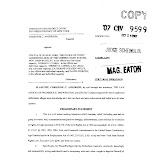
An angry federal judge lashed out at prosecutors Tuesday as she was forced to delay next month's start of a Yonkers corruption trial until next year. The trial of former Yonkers Councilwoman Sandy Annabi and her cousin, former city Republican chairman Zehy Jereis, on bribery, conspiracy and other charges was to have started June 20. But a new grand jury indictment against the pair obtained yesterday by the U.S. Attorney's Office forced the change because Annabi's lawyer, William Aronwald, had an overseas trip planned for the coming weeks and would not have enough time to review the new charges. U.S. District Judge Colleen McMahon blamed the assistant U.S. attorneys, Jason Halperin and Perry Carbone, for the late charges, particularly because they mostly mirror the original ones and could have been brought months ago, she argued. "This looks like a sandbag. I don't blame Mr. Aronwald for feeling sandbagged," McMahon told Halperin, adding later, "I have a great deal of respect for you. But this stinks. It smells." Annabi, Jereis and politically connected lawyer Anthony Mangone were first charged in January 2010 following a four-year federal probe into the City Council's approval of the $660 million Ridge Hill project — for which Annabi changed her vote after initially opposing the development. Mangone pleaded guilty in November, admitting that he gave Jereis thousands of dollars to pass along to Annabi so that she would change her vote on another development, the so-called Longfellow School project, which was never built. Halperin said the new indictment does not change the prosecution's theory of the case. But Aronwald said the "allegations are substantially changed" because they extend by two years the period of time when the alleged conspiracy between Annabi and Jereis was ongoing. The prosecution contends that Jereis effectively had Annabi on retainer, plying her with more than $160,000 over the years, in the hope that when needed she would do his bidding — and that she did so on the Ridge Hill and Longfellow votes. But the defense has complained that the retainer reference was a late addition by prosecutors once the defense had impressed upon them that the relationship between Annabi and Jereis was always a social one and never political; a distinction that could be significant in considering whether the money given Annabi could be construed as a bribe. McMahon said the trial would have to be postponed at least until early next year because she has several trials scheduled through December. Halperin said it was never the prosecutors' intention to disrespect the court or "sandbag" the defense. Jereis' lawyer, Anthony Siano, would not comment, other than to say "Mr. Jereis intends to vigorously defend this case."
Wednesday, May 18, 2011


Court OK's Lawyer's Ripping Off Client- No Jail Time
Disbarred Bronxville lawyer sentenced for stealing from client
The Journal News - May 10, 2011
A disbarred Bronxville lawyer was sentenced today to five years probation for stealing $82,000 from a former client. Timothy Quinn, 75, who lives in Greenwich, Conn., pleaded guilty last year to second-degree grand larceny. He has paid $40,000 in restitution and must pay an additional $796 a month until the debt is covered. Quinn, whose law office was at 65 Pondfield Road, stole the money from a Harrison man who had hired Quinn to help sell his home at 12 Bradford Ave. Quinn accepted an $82,000 down payment in July 2008 from a couple buying the home that was intended for his client. When the Harrison man went to collect the deposit at the closing two months later, Quinn had already spent it. He pleaded guilty on June 15. The sentencing was postponed several times so Quinn could come up with the $40,000 lump-sum restitution that was part of his plea deal. At the sentencing in Westchester County Court, Acting State Supreme Court Justice Richard Molea noted that the victim, who had been a friend of Quinn, was more interested in getting his money than seeing Quinn serve jail time. Quinn must reimburse the New York State Lawyers Fund for Client Protection, which covered his client’s losses. Quinn was disbarred in August.
Tuesday, May 17, 2011
Fumbling Pfau Slows Lippman's Corrupt Courts
Cuts Could Stall Sluggish Courts at Every Turn
The New York Times by William Glaberson - May 15, 2011
Extensive budget cutbacks being rolled out in New York State’s courts are expected to add new delays to practically every facet of the judicial process, from the moment a suspect is brought in to be charged until the case is heard in court, and onward into appeals. The hours of special weekend arraignment courts in New York City will be reduced by nearly half, prompting fears that some suspects will have to be released if they are not brought before a judge within 24 hours, as required by law. The cutbacks, which also apply to civil courts, are being felt throughout the state, the result of a comparatively lean $132.5 billion budget that has affected areas including education, health care and prisons. In the courts, $170 million has been pared from the judicial budget of more than $2 billion, affecting a system that is already overburdened with a huge caseload. Even a special program meant to reduce the backlog by hiring retired judges to hear thousands of cases will largely cease to exist. Officials will also eliminate many sessions of small claims courts in New York City and shrink the number of potential jurors called for all kinds of cases. About 350 court employees, including clerks and court lawyers, are to be laid off on Wednesday, following about 75 layoffs in the court system’s administrative offices earlier this spring. “Delays are going to be more built into everything we do, unfortunately,” said the state’s chief administrative judge, Ann Pfau, who has been working with her staff to implement the cutbacks. “If you are waiting for a trial, the trial that is ahead of you is going to take longer to complete.” The culture of the courts may well be altered in subtle ways; eliminated a few weeks ago, for example, was the free lunch given to deliberating jurors. The money for judges’ law books is also being slashed. Judge Pfau and other judges and administrators find themselves in the same position as court officials across the country who have seen their budgets slashed. According to the National Center for State Courts, 29 state court systems are experiencing budget reductions this year, with at least five — Georgia, Maine, Nevada, Oklahoma and Oregon — seeing reductions of 10 percent or more. At least 15 states have reduced the hours their courts operate, the center says. The most striking change in New York State is the reduction in hours for courts that handle more than 1,800 criminal arraignments in New York City on weekends. Weekend arraignment court in Queens, for example, had been open from 9 a.m. to 1 a.m.; beginning next month it will be open from noon to 9:30 p.m. Because of the requirement that those arrested appear in court within 24 hours, some critics fear that there may not be enough time to process everyone in the system and that courts will have to free people charged with crimes. Steven Banks, the attorney-in-chief at the Legal Aid Society, said his office filed successful challenges years ago when people were held for longer than a day without arraignment. He said his lawyers would be carefully monitoring whether people are “languishing in jail for longer periods of time than they should” once the weekend hours have been reduced. Judge Pfau acknowledged that limiting the hours of weekend arraignment courts was a major step. She said court administrators would monitor the situation “hour by hour and day by day.” She added: “I would be less than honest if I said we weren’t nervous about this. There are very fundamental rights at stake.” Taken together, the changes are certain to increase the dreariness of New York institutions so known for bleakness that they have been used on television for years as classic, scuffed city courts. Funds were cut by half for courthouse child care centers created so parents could focus on their cases without wriggling children in courtrooms. Judge Pfau said that when court officials learned in March how severely their budget had been cut in Albany, they decided their top priority was to keep courts open. But she acknowledged that for a judicial system made sluggish by more than 4.7 million new cases a year, the public was likely to experience disruptions. In much of New York City, small claims courts, which are often populated by those who work full-time jobs, will have night sessions reduced from four to one night a week. The big cut in the state court budget came after Gov. Andrew M. Cuomo criticized the judiciary’s $2.7 billion budget proposal this winter for “not participating” in his efforts to make sharp cuts in state expenditures. Court administrators responded by proposing a $100 million cut and appeared stunned when the governor and the Legislature reached a budget deal in March that slashed their budget by $170 million. Court officials said it was hard to predict the effects of many of the changes on the flow of daily court business. Because of high caseloads in many courts, about 300 retired judges have been working for $300 a day conducting hearings. One of the cutbacks was to halt most of those payments, pushing some of those cases back into the system. In the city’s courts, judges and lawyers have been musing in recent days about how any change in the complicated engine of the judiciary might cause a hiccup. The elimination of free lunches for jurors during deliberations could well be one of those hiccups, several judges said. The state will save not only the fees for ham-and-cheese sandwiches, but also the costs of having court officers guard jury rooms during lunch hour. The jurors will instead be lining up along with everyone else in luncheonettes outside the courts, and then going through security to get back to their seats. Several weeks into the no-free-lunch policy, it was not yet clear whether sending jurors out for lunch would prove a new bottleneck in the system. Douglas E. McKeon, the administrative judge for civil matters in State Supreme Court in the Bronx, said it was certainly easier to be sure jurors were on time and ready to resume deliberations after lunch when they were guarded and fed by officers. “Frankly,” Justice McKeon said, “one has to figure whether it’s cost effective.” Dennis W. Quirk, the president of the New York State Court Officers Association, said there would be many unanticipated effects of the budget cutting in the courts. His members’ overtime has been one of the main targets of court officials. Mr. Quirk said court officers kept the courts that handle family emergencies and criminal cases functioning as long as was necessary to get their work done. With most courtrooms now shutting down at 4:30 p.m. because of the cutbacks, it will not take long for there to be paralyzing consequences, he predicted. “Within two or three months, the system’s going to come to a halt,” Mr. Quirk said. Fern A. Fisher, the deputy chief administrative judge in charge of the New York City courts, conceded that there were likely to be delays, like longer waits for child-support orders. But she said, “We will continue to provide justice.”
Legal Fees Rule, Ethics Be Damned
Skelos dummies up on law-cash ethics
The New York Post by Fredric U. Dicker - May 16, 2011
The state's most powerful Republi can is refusing to reveal whether he's earning legal fees from clients who do business with the state, a practice Gov. Cuomo says could involve conflicts of interest or even bribery. Senate Majority Leader Dean Skelos, over a four-day period, repeatedly ducked and dodged after The Post asked the simple question of whether he's representing legal clients who have business before state government. The Nassau County-based Skelos, who works for Ruskin Moscou Faltischek, a major Long Island law firm that represents dozens of powerful businesses before state agencies, voluntarily revealed last year that he was paid as much as $250,000 in private legal fees in 2009, when he was Senate minority leader. But now that he's majority leader, he won't say how much he was paid in 2010 or how much he's been paid this year -- when he holds a far more powerful position. Skelos also refuses to name his clients. Cuomo is aggressively seeking legislation to force Skelos and other lawmakers to disclose the names of all clients who have business before the state. Skelos is widely seen as determined to kill the measure. Cuomo and good-government groups warn that a form of bribery is possible as long as special-interest groups can funnel large legal fees to lawmakers who control legislation in which they have an interest. "The question is: Who do your legislators work for?" Cuomo said last week, in part with Skelos in mind. "You have a right to know. I want sweeping ethics reform that will require disclosure of clients legislators represent before the state and [require them to] disclose how much they get paid." Assembly Speaker Sheldon Silver (D-Manhattan), another powerful legislator with an active private law practice, told The Post he was prepared to disclose what Skelos would not. Silver said he could declare "unequivocally" that he does not represent any clients -- individual, business or corporate -- with Albany business. "I represent nobody who does business with the state. Unequivocally, no," said Silver, who earns an undisclosed income -- estimated by some at $1 million a year -- from the personal-injury law firm Weitz & Luxenberg. Meanwhile, eyebrows were raised at the Capitol when it was revealed that David Lewis, Skelos' $140,000-a-year "part-time" counsel, was representing disgraced ex-Sen. Vincent Leibell, who was sentenced Friday to 21 months in federal prison after admitting he had accepted kickbacks, engaged in tax evasion and sought to influence a grand jury. "The Senate Republicans send one of their highest-paid lawyers to defend public corruption while Gov. Cuomo is working to clean it up," charged Senate Democratic spokesman Austin Shafran. Skelos spokeswoman Kelly Cummings called Lewis "a trusted aide and superb attorney who has the energy necessary to serve the majority leader, as well as to maintain a well-respected outside law practice." fredric.dicker@nypost.com
Monday, May 16, 2011
Newspaper Gets Wish to Depose Pfau and 7 Judges Under Oath
New York Post's Bid to Depose Judges in Libel Suit Upheld
The New York Law Journal by Daniel Wise - May 16, 2011
Over the objections of the state court system, eight judges, including Chief Administrative Judge Ann Pfau, have been ordered to comply with subpoenas served by the New York Post requiring the judges to be deposed. The Post is seeking the judges' testimony as part of its defense of a defamation suit brought by Brooklyn Justice Francois A. Rivera who claims he was maligned in four articles published by the Post, which reported in October 2005 that the judge was under investigation by the Brooklyn District Attorney's Office for allegedly paying $50,000 to buy a Democratic nomination to the Supreme Court. Justice Milton A. Tingling in Rivera v. NYP Holdings, 114858/06, said the judges are required to answer questions under oath regarding the truth of the Post articles and the extent of injury they caused to Justice Rivera's reputation. The Office of Court Administration, which moved to quash the subpoenas as overbroad and seeking opinion and conjecture rather than fact, "is not at the moment inclined to appeal" the April 12 ruling, said OCA Counsel John W. McConnell. Mr. McConnell added, "we will closely monitor the depositions and take necessary steps to insure that our judges are appropriately represented." Justice Tingling specifically noted that, while he was requiring compliance with the subpoenas, the judges and others who received third-party subpoenas are not constrained from asserting privilege as a basis for not answering questions when they are deposed. The Post articles were published several weeks after then-Assemblyman Clarence Norman, who at the time was head of the Democratic party in Brooklyn, was convicted for campaign-finance violations. With Brooklyn District Attorney Charles J. Hynes pressing Mr. Norman to divulge information about candidates paying bribes to obtain nominations for judgeships in Brooklyn, the Post reported that Justice Rivera had testified before a grand jury about other "alleged dirty jurists" after being "given an immunity deal." The articles said that Justice Rivera was one of as many as 10 judges "targeted" with paying bribes to receive Democratic nominations to the bench, which meant that their elections were virtually assured in overwhelmingly Democratic Brooklyn. The Post reported that Justice Rivera had "allegedly bought his seat for $50,000" when he ran for election in 1996. One of the articles also stated that the state Commission on Judicial Conduct was looking into allegations that Justice Rivera had stated he was from Brooklyn when he ran for the judgeship when he actually lived in Queens. Justice Rivera, who sits on the bench in Brooklyn, has never been charged with a crime by the Brooklyn District Attorney's Office and has never been publicly sanctioned by the conduct commission. Until a public sanction is issued, commission proceedings are confidential.
Basis for Testimony
In addition to Judge Pfau, the judges who have received subpoenas are Appellate Division, Second Department Justice Ariel Belen; and Brooklyn Supreme Court Justices David Schmidt, Michael L. Pesce, Arthur M. Schack, Yvonne Lewis, Leon Ruchelsman and Brooklyn Surrogate Margarita López Torres. Justice Tingling rejected OCA's challenge that the subpoenas were overbroad and seeking opinion, finding that Justices Belen, Ruchelsman and Surrogate López Torres could provide testimony relevant to the truth of statements. The remaining judges, he further ruled, could offer testimony relevant to any damage to Justice Rivera's reputation. The subpoena issued to Judge Pfau seeks information on whether the articles played a role in her decision not to promote Justice Rivera to two posts he sought. Justice Tingling said that Justice Rivera is entitled to inquire whether she considered the Post reports when she chose Justice Belen over Justice Rivera for the posts of administrative judge in charge of civil cases in Brooklyn Supreme Court and on the Appellate Term in Brooklyn. Also, he noted that Justice Rivera had testified that he and Justice Belen became judges the same way and that Justice Belen "has information about the D.A.'s investigation into Brooklyn judges." Justice Rivera had not mentioned Surrogate López Torres at his deposition. Nonetheless, Justice Tingling found that as the plaintiff in New York State Board of Elections v. López Torres, 552 U.S. 196 (2008), which unsuccessfully challenged New York's convention system for nominating Supreme Court justices, Surrogate López Torres is "intimately familiar with the workings of the Brooklyn political system" and can provide information about "who would have received Rivera's alleged $50,000 bribe." The Post had also issued a subpoena to the Brooklyn District Attorney's Office seeking the minutes of Justice Rivera's grand jury testimony. Justice Tingling quashed that subpoena, observing that "the confidentiality of Grand Jury proceedings, carefully cultivated and culled throughout our jurisprudential history, would be negatively impacted by the release of Grand Jury testimony in a private defamation suit." Justice Tingling similarly wrote that the records of the judicial conduct commission are immune from compelled disclosure because confidentiality is the "cornerstone" of the commission's operations. However, he noted that both the Post and conduct commission had withdrawn their motions regarding the enforceability of that subpoena, leaving the issue for another day.
Earlier Ruling
More than two years ago, Justice Tingling had disallowed interrogatories issued by the Post which would have required Justice Rivera to disclose whether he had been questioned by the conduct commission or if he had testified before a grand jury. That ruling, however, was reversed by the Appellate Division, First Department, in an unsigned, two-paragraph decision in June 2009. The panel said a "liberal" construction should be given to the Post in defining the range of its discovery. Specifically, the panel held that the information sought from Justice Rivera concerning his dealings with the grand jury and commission is "sufficiently material and relevant to the defense of the action to warrant disclosure." In the wake of the First Department's ruling, the Post served 29 subpoenas on third parties and sought documents directly from the district attorney's office and the commission. The Post is the only party so far to file a notice of appeal of Justice Tingling's most recent decision. One of the Post's lawyers, Katherine M. Bolger of Hogin Lovells, said her client intends to appeal the decision to quash the subpoena for grand jury minutes. Stuart A. Blander, of Heller Horowitz & Feit, who represents Justice Rivera, declined to comment on whether his client would appeal the portion of the judge's ruling allowing the third-party depositions to proceed. He did state, however, that no depositions have been scheduled. In the meantime, Justice Tingling directed the two sides to attend a conference scheduled for today. Daniel Wise can be reached at dwise@alm.com.
How Some New York Judges Come To Be
Vito pal's 23G mystery gig
The New York Post by Aaron Short - May 15, 2011
It pays to be a friend of the Democratic Party.
The politically connected consigliere of Brooklyn Democratic boss Vito Lopez earned $23,000 for a 10-week job with the state Senate last year, but no one remembers seeing him show up at the office. Now he's running to be a county Supreme Court judge -- which carries a $136,700 salary -- with Lopez's backing. Lopez's longtime legal eagle, Carl Landicino, collected paychecks last spring as a "special counsel" advising Senate Democrats. But his colleagues insist they never saw Landicino once or discussed assignments. "There was a desk with a piece of paper on it with his name taped on it," said a source, who worked in the office of majority counsel. Landicino referred questions on the lucrative gig to his former supervisor, Shelley Mayer. "Call the state Senate to find out exactly what I was doing," said Landicino. "I'm not going to play a role in explaining what I was doing." A spokesman for Senate Democrats said Landicino performed legal services for the conference but he was not familiar with his specific duties. Mayer, who is no longer working with the state Senate, did not return calls.
CLICK HERE TO SEE RELATED STORY, "Att'ys $cratch Back of Judge Wannabes"
Sunday, May 15, 2011
The Enemy Within: Lawyer Wore Body Mic
The enemy within
The New York Post by Kaja Whitehouse - May 15, 2011
Spilling insider tips over the phone has become taboo on Wall Street, thanks to Manhattan US Attorney Preet Bharara's aggressive campaign against insider-trading and his unanimous, headline-grabbing legal win this week against hedge-fund titan Raj Rajaratnam -- a case which trotted out a whopping 46 wiretaps to convict the one-time billionaire. But if Wall Street traders think Preet has wheeled out all his weapons, they'd better think again. The next insider trading trial -- focusing on three small-fry traders and starting tomorrow -- could have Wall Streeters watching their backs both on and off the phone. That's because in order to bring the next case, centering on the three partners of a start-up hedge fund called Incremental Capital, the government used surveillance techniques more common to cop shows than the trading floor -- namely, body wires and hidden video cams. In addition to thousands of wiretapped calls, the FBI also collected evidence from at least four different people who recorded face-to-face conversations with various defendants in the case, according to court records and people familiar with the case. In fact, there's a good chance that if Bharara didn't go all "Sopranos" on the Wall Street crowd, then the feds would never have hooked the big fish, Galleon founder Rajaratnam, whose famous wiretaps came as a result of the probe into this next group of defendants. Former Galleon trader David Slaine -- who kicked off the FBI's wider insider-trading probe, "Perfect Hedge," by recording conversations of fellow former Galleon trader Craig Drimal -- wore both a body wire and a hidden video camera to collect evidence for the feds starting back in 2007.
Another trader, Franz Tudor, wore a body wire for up to a year while working with the defendants in 2008, sources said. Also sporting body mics were Brien Santarlas, a lawyer with the Manhattan law firm Ropes & Gray, and Gautham Shankar, another trader. In November 2009, right after Rajaratnam's arrest, Santarles recorded his Ropes & Gray buddy Arthur Cutillo telling him to destroy a prepaid cell Santarlas used to talk to another defendant, prosecutors said. "Just take a walk outside and break it into pieces, and throw one piece in one garbage can and another one two blocks down the road. That's what I did," Cutillo said. How much, if any, of the body wires and secret videos will be entered into evidence by prosecutors in the upcoming trial remains unclear. Court documents suggest that some of the body wires, in fact, will be used by the defense to shore up their case against the government's allegation. The government says the three defendants to be placed on the hot seat this week -- Zvi Goffer, the founder of Incremental; his brother Emanuel Goffer; and his partner Michael Kimelman -- were engaged in a scheme to trade on illegal tips based on information they got from two Ropes & Gray lawyers, who have already pleaded guilty. Jury selection in the case starts tomorrow.
Ken Springer, a former FBI agent, says body wires, and even hidden videos, are more common FBI tools because they don't require a court order, as wiretaps do. So long as "one party is aware of it," they are considered consensual recordings, he said. While more common for the FBI to use, the use of wires -- and the publicity surrounding the government's use of wires by seemingly innocent colleagues that this trial is likely to generate -- is sure to amp up the jitters of some Wall Street traders even more. With all the hullabaloo over wiretaps, some stock pickers "may feel more comfortable talking in person," said Springer. But they would be mistaken. For example, months before the first wiretap for insider trading was ever approved, Slaine recorded his trader pal Craig Drimal saying he had just met with his source, whom the feds now point to as Zvi Goffer. During the September 2007 meeting, Drimal said the source was getting intel about a private equity deal from lawyers, adding that "he did not know why the lawyer was risking his career and possibly 'jail' by providing such information," prosecutors allege. The following August, Slaine recorded a meeting with Drimal and the other defendants on the premise that he was going to invest several million dollars in their hedge fund, Incremental. At the meeting, Slaine pressed them to identify their sources, to which Goffer allegedly said Slaine's not knowing would be "better for everybody." Kimelman allegedly joked about the information coming from a guy fixing a pothole, the feds say. During the trial, prosecutors are expected to say Goffer, 34, is at the center of the alleged conspiracy to pay lawyers for insider tips. When the married father of two was arrested in 2009, he hit the headlines with the nickname "Octopussy," a reference to the James Bond flick, because of his many sources. But people close to Goffer says he never heard the nickname before his arrest, and was put off by it. They blame the handle on Drimal, who called him that in one of his wiretapped calls, which then made it into the Securities and Exchange Commission's civil complaint, which was filed alongside the criminal complaint. Despite the resounding victory in the Rajaratnam case -- and even the chance that potentially embarrassing conversations will be played in court for the world to hear -- the trio don't appear to be backing away from the fight. A spokesman for Kimelman said his client "is as committed as ever, as is his defense team, in establishing his innocence and exonerating him at trial." Earlier last week, the 40-year-old former lawyer demanded that federal judge Richard Sullivan let the jury know that he rejected a sweet, no-jail plea deal to prove his innocence. The judge on Friday rejected Kimelman's request, saying the defendant didn't make his request in a timely manner. Kimelman's lawyer, Michael Sommer, said Kimelman passed on the deal "despite the possibility that, if convicted at trial, he could be sentenced to a period of imprisonment," because he believes he's innocent.
Wire we talkin’?
If traders hate US Attorney Preet Bahara using wiretaps to gather insider-trading evidence, then they will absolutely dread how the lawman gathered evidence for his next case, starting tomorrow — he went “Sopranos” on Wall Street and got traders to secretly record and videotape friends talking about criminal acts.
kwhitehouse@nypost.com
The New York Post by Kaja Whitehouse - May 15, 2011
Spilling insider tips over the phone has become taboo on Wall Street, thanks to Manhattan US Attorney Preet Bharara's aggressive campaign against insider-trading and his unanimous, headline-grabbing legal win this week against hedge-fund titan Raj Rajaratnam -- a case which trotted out a whopping 46 wiretaps to convict the one-time billionaire. But if Wall Street traders think Preet has wheeled out all his weapons, they'd better think again. The next insider trading trial -- focusing on three small-fry traders and starting tomorrow -- could have Wall Streeters watching their backs both on and off the phone. That's because in order to bring the next case, centering on the three partners of a start-up hedge fund called Incremental Capital, the government used surveillance techniques more common to cop shows than the trading floor -- namely, body wires and hidden video cams. In addition to thousands of wiretapped calls, the FBI also collected evidence from at least four different people who recorded face-to-face conversations with various defendants in the case, according to court records and people familiar with the case. In fact, there's a good chance that if Bharara didn't go all "Sopranos" on the Wall Street crowd, then the feds would never have hooked the big fish, Galleon founder Rajaratnam, whose famous wiretaps came as a result of the probe into this next group of defendants. Former Galleon trader David Slaine -- who kicked off the FBI's wider insider-trading probe, "Perfect Hedge," by recording conversations of fellow former Galleon trader Craig Drimal -- wore both a body wire and a hidden video camera to collect evidence for the feds starting back in 2007.
Another trader, Franz Tudor, wore a body wire for up to a year while working with the defendants in 2008, sources said. Also sporting body mics were Brien Santarlas, a lawyer with the Manhattan law firm Ropes & Gray, and Gautham Shankar, another trader. In November 2009, right after Rajaratnam's arrest, Santarles recorded his Ropes & Gray buddy Arthur Cutillo telling him to destroy a prepaid cell Santarlas used to talk to another defendant, prosecutors said. "Just take a walk outside and break it into pieces, and throw one piece in one garbage can and another one two blocks down the road. That's what I did," Cutillo said. How much, if any, of the body wires and secret videos will be entered into evidence by prosecutors in the upcoming trial remains unclear. Court documents suggest that some of the body wires, in fact, will be used by the defense to shore up their case against the government's allegation. The government says the three defendants to be placed on the hot seat this week -- Zvi Goffer, the founder of Incremental; his brother Emanuel Goffer; and his partner Michael Kimelman -- were engaged in a scheme to trade on illegal tips based on information they got from two Ropes & Gray lawyers, who have already pleaded guilty. Jury selection in the case starts tomorrow.
Ken Springer, a former FBI agent, says body wires, and even hidden videos, are more common FBI tools because they don't require a court order, as wiretaps do. So long as "one party is aware of it," they are considered consensual recordings, he said. While more common for the FBI to use, the use of wires -- and the publicity surrounding the government's use of wires by seemingly innocent colleagues that this trial is likely to generate -- is sure to amp up the jitters of some Wall Street traders even more. With all the hullabaloo over wiretaps, some stock pickers "may feel more comfortable talking in person," said Springer. But they would be mistaken. For example, months before the first wiretap for insider trading was ever approved, Slaine recorded his trader pal Craig Drimal saying he had just met with his source, whom the feds now point to as Zvi Goffer. During the September 2007 meeting, Drimal said the source was getting intel about a private equity deal from lawyers, adding that "he did not know why the lawyer was risking his career and possibly 'jail' by providing such information," prosecutors allege. The following August, Slaine recorded a meeting with Drimal and the other defendants on the premise that he was going to invest several million dollars in their hedge fund, Incremental. At the meeting, Slaine pressed them to identify their sources, to which Goffer allegedly said Slaine's not knowing would be "better for everybody." Kimelman allegedly joked about the information coming from a guy fixing a pothole, the feds say. During the trial, prosecutors are expected to say Goffer, 34, is at the center of the alleged conspiracy to pay lawyers for insider tips. When the married father of two was arrested in 2009, he hit the headlines with the nickname "Octopussy," a reference to the James Bond flick, because of his many sources. But people close to Goffer says he never heard the nickname before his arrest, and was put off by it. They blame the handle on Drimal, who called him that in one of his wiretapped calls, which then made it into the Securities and Exchange Commission's civil complaint, which was filed alongside the criminal complaint. Despite the resounding victory in the Rajaratnam case -- and even the chance that potentially embarrassing conversations will be played in court for the world to hear -- the trio don't appear to be backing away from the fight. A spokesman for Kimelman said his client "is as committed as ever, as is his defense team, in establishing his innocence and exonerating him at trial." Earlier last week, the 40-year-old former lawyer demanded that federal judge Richard Sullivan let the jury know that he rejected a sweet, no-jail plea deal to prove his innocence. The judge on Friday rejected Kimelman's request, saying the defendant didn't make his request in a timely manner. Kimelman's lawyer, Michael Sommer, said Kimelman passed on the deal "despite the possibility that, if convicted at trial, he could be sentenced to a period of imprisonment," because he believes he's innocent.
Wire we talkin’?
If traders hate US Attorney Preet Bahara using wiretaps to gather insider-trading evidence, then they will absolutely dread how the lawman gathered evidence for his next case, starting tomorrow — he went “Sopranos” on Wall Street and got traders to secretly record and videotape friends talking about criminal acts.
- Emanuel (The Younger) Goffer, 32 - Ex-Galleon securities trader - Facing 25 years.
- Zvi (Octopussy) Goffer, 34 - Ex-Galleon trader - Was seen taking notes during Raj’s trial.
- Michael (No Plea) Kimelman, 40 - Ex-Galleon securities trader - Turned down no jail plea agreement.
kwhitehouse@nypost.com
Thursday, May 12, 2011
But What Did Corrupt Lawyers Know....
U.S. Wins Convictions in Inside Trading Case
The New York Law Journal by Mark Hamblett - May 11, 2011
Devastating wiretap evidence and the testimony of cooperating witnesses led a Southern District jury yesterday to convict Raj Rajaratnam on all counts in the Galleon Group hedge fund insider trading scandal. A two-month trial and marathon deliberations climaxed with Mr. Rajaratnam being found guilty of five conspiracies and nine substantive counts of securities fraud for trading on, and passing along, material non-public information about more than a dozen companies. Mr. Rajaratnam faces a prison term under the advisory U.S. Sentencing Guidelines of 15 1/2 to 19 1/2 years when he is sentenced by Judge Richard Holwell on July 29, but the judge has the discretion to go above that range based on a number of factors, including the amount of money involved. Mr. Rajaratnam, 53, sat motionless as the verdict was read and was somber as court was adjourned. The verdict was a huge win for the prosecution team of Assistant U.S. Attorneys Reed Brodsky, Jonathan Streeter and Andrew Michaelson and represents the culmination of a wide-ranging insider trading sweep that has netted 21 guilty pleas to date from persons in some way connected to the Galleon case. The convictions yesterday were secured with the testimony of cooperating witnesses who pleaded guilty to their roles in the scandal bolstered by the first large-scale use of wiretaps in an insider trading case. Prosecutors relied on both to prove the one-time billionaire made more than $63 million in illegal trades based on material non-public information on Goldman Sachs, Intel, Akamai and other companies through tips from consultants, company board members and other insiders. The voice of Mr. Rajaratnam was heard on a series of tapes played for the jury during trial and replayed several times during deliberations that began on April 25. The jurors heard still more tapes after they were forced to begin deliberations anew on May 4 when Judge Holwell dismissed a juror for medical reasons and replaced her with an alternate. Mr. Rajaratnam was defended by John Dowd, a partner with Akin Gump Strauss Hauer & Feld. Mr. Dowd argued without success that his client was either trading on information that was already in public circulation or was not material. His attempt to attack the cooperating witnesses as self-dealing liars apparently fell on deaf ears. One of the biggest fights came pretrial, as Mr. Dowd fought in vain to persuade Judge Holwell to bar the wiretaps in evidence because insider trading is not explicitly listed as one of the predicate crimes in the federal wiretap law (NYLJ, Nov. 26, 2010). Yesterday, Mr. Dowd made clear that the use of the wiretaps in evidence will be a major issue when the case moves to the U.S. Court of Appeals for the Second Circuit. After the verdict, as Mr. Streeter was arguing for Mr. Rajaratnam to be jailed immediately, he spoke of the difficulty of prosecuting a hedge fund insider trading case and said the "necessity of the wiretaps" was proved out at trial. "I don't think it's a close question whether the wiretaps were appropriately" deployed in this case, Mr. Streeter said. Judge Holwell denied the prosecution's request and said Mr. Rajaratnam would not be remanded pending sentencing but instead will remain under home detention. Mr. Rajaratnam, who was also represented by Terence J. Lynam, William E. White, James E. Sherry and Michael Starr of Akin Gump, will be wearing an electronic monitoring bracelet as he awaits sentencing. Southern District U.S. Attorney Preet Bharara issued a statement, saying that his office has charged 47 people with insider trading crimes and that Mr. Rajaratnam is the 35th conviction. "Unlawful insider trading should be offensive to everyone who believes in, and relies on, the market," he said. "We will continue to pursue and prosecute those who believe they are above the law and too smart to get caught."
Power of Wiretaps
Trial observers and legal experts say it is not easy to obtain convictions on insider trading cases. "It was an impressive performance by the U.S. Attorney's office in terms of taking a very complicated set of facts and breaking it down and making it understandable for the jury," said Gregory Little, a partner at White & Case and a former trial attorney with the Securities and Exchange Commission. "It's also a credit to the jury that they seemed to work very hard to understand all that evidence." Mr. Little and other experts said that, aside from the defendant's notoriety and the use of wiretaps, this was, in essence, a garden-variety insider trading case. But the successful use of wiretaps, they said, should pave the way for stepped up enforcement efforts against a crime that is difficult to prove. "This was not a novel legal theory but it certainly was a novel case," said Artur Davis, a partner at SNR Denton in Washington, D.C., who is a former federal prosecutor and former congressman from Alabama and member of the House Judiciary Committee. "The use of electronic surveillance was imported from mob world, narcotics world and political corruption world." "Insider trading cases have historically been built on trading patterns and statements of defendant co-conspirators, so they were more or less circumstantial cases or swearing contests," he said in an interview. "It's not just the power of the tapes in this case. The use of tapes here is going to inform government investigations in the future. Prosecutors will probably be prodded to use electronic surveillance and informants even more aggressively." Mr. Little agreed, saying the conviction "sends a potent reminder to Wall Street, hedge fund traders and executives involved in U.S. capital markets that there are many ways for authorities to uncover illegal activity, including telephone conversations." "Careless communications about confidential information could alter careers and ruin reputations," Mr. Little said. Judge Holwell told the jury of eight women and four men after the verdict that their deliberations "should remain secret." Some judges, but by no means all, commonly caution juries that they do not have to speak to the press, saying they are free to do so but that it might not be wise. In any event, the jury indicated in a note that it did not wish to discuss its deliberations or what led to the complete sweep on all counts. But there was little doubt that the tapes of phone conversations were critical as the jury heard some of the tapes three or four times between trial, Mr. Brodsky's closing argument, and during deliberations. They heard McKinsey & Co. director Anil Kumar, who pleaded guilty and testified for the government, tell Mr. Rajaratnam in 2008 that McKinsey client Advanced Micro Devices Inc. and ATI Technologies Inc. had "shaken hands" on a deal. Mr. Rajaratnam responded, "I'm buying," and he moved from 1 million shares on Aug. 14 to 11 million shares days later. The jurors heard the voices of Rajiv Goel, a former executive at Intel, and Galleon portfolio manager Adam Smith, both of whom pleaded guilty and testified for the government; and they heard the voice of former Galleon employee and stock trader Roomy Khan, who pleaded guilty but was kept on the sidelines at trial as the government elected not to call her as a witness. And several times the jury heard the raspy voice of hedge fund trader Danielle Chiesi of New Castle Funds, who called Mr. Rajaratnam "baby" as she phoned for advice and swapped information with the Galleon Group founder in advance of an AMD deal. "Do you think in this environment, I know everyone is being investigated, do you think I could buy it here, honestly?" Ms. Chiesi asks amid the financial meltdown of 2008. The jury heard her say she is "a little nervous" about being investigated "because there are assholes in this world. Because every hedge fund is going to go out of business…and they're jealous." Mr. Rajaratnam is heard on the tape advising Ms. Chiesi, who pleaded guilty but did not cooperate with prosecutors, on how to mask trades based on inside information on AMD by using a buy-sell pattern, telling her "What I would do is buy a million shares and sell 500,000 shares." The prosecution effectively presented evidence concerning Rajat Gupta, a Goldman Sachs board member who allegedly fed Mr. Rajaratnam tips in 2008 on information he received the second he emerged from two board meetings. First, Mr. Gupta reported that Warren Buffett and Berkshire Hathaway were throwing Goldman a $5 billion lifeline and, later, that the company was about to announce it had lost $2 a share. Prosecutors matched phone records, taped conversations between Mr. Rajaratnam and employees and records of stock trades to show that Mr. Rajaratnam accumulated shares immediately after the Buffett meeting and shorted the stock immediately after the meeting on negative earnings news. Goldman chief executive Lloyd Blankfein testified at trial as to the material non-public nature of the board information and said that, if Mr. Gupta had indeed tipped off Mr. Rajaratnam, it would be a violation of Goldman policy. After the verdict, Mr. Rajaratnam and his lawyers took the elevators down from Judge Holwell's 17th floor courtroom at 500 Pearl St. and emerged on the Worth Street side of the building to fight their way though a large scrum of television, radio and print reporters and cameras and climb into a waiting car. Before leaving, Mr. Dowd told the media, "We started out with 37 stocks and we're down to 14 so the score is 23-14 in favor of the defense. We'll see you at the Second Circuit" As the defendant and his lawyers moved toward the car, Messrs. Brodsky, Streeter and Mr. Michaelson emerged from the courthouse. Mr. Brodsky was grinning broadly as Mr. Streeter said the prosecutors had no comment and would instead speak though a press release from Mr. Bharara. He then nodded toward Mr. Brodsky and said, "That smile says it all." Mark Hamblett can be reached at mhamblett@alm.com.
Wednesday, May 11, 2011
Lawyer Brags About Getting Away With DWI
'DWI' prosecutor's 'drunken boast'
The New York Post by Kirstan Conley and Bob Fredericks - May 11, 2011
The Bronx prosecutor busted for drunk driving on the Major Deegan bragged to cops that a top boss in her office took care of her previous DWI -- and would make this one disappear, too, The Post has learned. "Call Nestor; he'll take care of this. He took care of it the last time," a stumbling, slurring Jennifer Troiano told officers during her arrest last August, a police source said yesterday. She was referring to Nestor Ferreiro Jr., chief of narcotics in the Bronx DA's Office, the source said. Internal Affairs cops are investigating the alleged free pass, and last week hauled at least two of the arresting officers in the August bust in for questioning. "They were asked specifically if she said anything about the previous incident in which she allegedly got off, and why they didn't report that she tried to get out of the arrest that night," a police source said. "They're trying to figure out if somebody gave her a break." A spokesman for Bronx DA Robert Johnson said Ferreiro claims he didn't do anything to bail out Troiano, 34, in the August bust, or help her avoid a potential felony DWI in December 2009. "He has not advocated to the police on her behalf on either her August 2010 arrest or any other matter," spokesman Steven Reed said. Troiano, a six-year veteran, was picked up on suspicion of drunken driving in 2009 after leaving a holiday party for narcotics detectives. Ferreiro threw a party that year for his bureau at the former Jet Set Café -- a Bronx dance club where DJ's spin reggaeton and salsa. Troiano refused a Breathalyzer test and was brought to the 44th Precinct, where word got around about where she worked, the source said. Somebody was called, and the charge went away, he said. When an allegedly drunk Troiano called Ferreiro after the August crash, he told her to tell her boss about the bust, not him, Reed said. Ferreiro has worked for the Bronx DA for 29 years, and earned $175,000 in 2009, records show. His wife, Cari Ferreiro, also works for the DA as director of litigation training in Johnson's office, earning about $143,000 in 2009. Troiano has kept her job, although she has been transferred to the appeals division, and is no longer trying cases. She has declined comment. Her lawyer, Howard Weiswasser, denied there was any incident in 2009, and predicted she'd be cleared in the 2010 case. Her next court date is June 23. The revelation came as the DA and IAB are investigating a department-wide ticket-fixing scandal. As many as 40 or more cops could face criminal charges for fixing tickets for friends and family, sources said, and 500 could face disciplinary action. kirstan.conley@nypost.com
Tuesday, May 10, 2011
Fed Probers Digging Deeper
Fed probers demand Qns. pol's pork files
The New York Post by Fredric U. Dicker - May 9, 2011
Federal probers are focusing on a Queens senator under inves tigation for steering hundreds of thousands of public dollars to not-for-profit groups with ties to her family and friends. Sen. Shirley Huntley, a Democrat, received a federal subpoena seeking records and documents related to her obtaining more than $400,000 for the nonprofits through the Legislature's notorious "member item" system of government earmarks, a source familiar with the situation told The Post. The federal subpoena came on top of a probe that included the issuance of state subpoenas by Attorney General Eric Schneiderman, first reported by The Post in March, of possible violations involving the Huntley-connected nonprofits. State government insiders and law-enforcement sources said the Manhattan and Brooklyn district US attorneys' offices have broad probes of Senate members including Huntley under way. The probes focus on fraudulent distribution of member-item monies, the aborted Aqueduct/AEG casino contract in 2010 involving then-Gov. David Paterson and then-Senate Democratic leaders John Sampson of Brooklyn and Malcolm Smith of Queens, and, of course, charges of individual bribe taking by lawmakers like those brought in March by federal prosecutors against Sen. Carl Kruger (D-Brooklyn). Insiders said the investigations appear to be accelerating at the same time Gov. Cuomo is struggling to get the Legislature to pass a sweeping ethics-reform law requiring lawmakers to fully disclose their outside incomes and the names of their clients. "The feds are all over the Senate. They're looking at Aqueduct, they're looking at Huntley and other senators, and they are working at a steady pace," said a law-enforcement insider. "I wouldn't expect any new big developments for at least several more months." A Senate Democratic spokesman, Austin Shafran, referred questions to Huntley's lawyer, Mark Pollard, who did not return calls for comment.
With runaway gasoline prices, a hobbled economy and a Middle East crisis to deal with in Washington, US Sen. Charles Schumer recently weighed in on what he must consider an even more important issue: unfair toll charges on state highways. The publicity-craving Democrat held a press conference dealing with what is legally Cuomo's concern without even a blush, and the governor's office was clearly unhappy, even while remaining tight-lipped. A top Cuomo aide, asked about the appropriateness of Schumer's concern, remained conspicuously silent.
Senate Democrats are rejecting the claim of gadfly Democratic megamillionaire William Samuels, another notorious publicity hound who funds a purported reform group called the New Roosevelt Initiative, that Cuomo didn't do enough to help them keep the majority in last fall's election. "Senate Democrats disavow and disagree with any notion that the governor didn't work hard for us during the campaigns," said a top Senate Democrat. "The question is, 'Who is Samuels speaking for?' because it sure isn't Senate Democrats, who want to partner with the governor." Samuels, son of 1974 Democratic gubernatorial hopeful and one-time OTB chief Howard "Howie the Horse" Samuels, also delivered on upstate's YNN what has to be the most bizarre claim of the year as he insisted Spitzer was more of a government reformer than is Cuomo. Spitzer -- who unleashed the State Police against a Republican foe, signed an ethics "reform" bill that made Albany's corruption worse, engaged in illegal banking transactions and patronized at least one prostitute -- was, in fact, the most crooked New York governor in modern times, the record clearly shows. fredric.dicker@nypost.com
Monday, May 9, 2011
County Judge Arrested on Suspicion of Domestic Violence
Solano County judge arrested on suspicion of domestic violence
The Associated Press - April 12, 2011
VALLEJO, CA (AP) -- Police say a Solano County judge has been arrested on suspicion of domestic violence. Vallejo police Sgt. Jeff Bassett said Solano County Superior Court Judge Robert Bowers was arrested early Monday in his vehicle after police received a complaint from his wife late Sunday night. Bassett told the Vallejo Times-Herald that Bowers' wife suffered "a minor, but visible injury." Bowers, 51, was booked in the Solano County Jail and posted $25,000 bail. The newspaper reports Bowers was at work on Monday but spent much of the day in his chambers as another judge handled his cases. Bowers' attorney, Daniel Russo, denied the allegations and said the judge's reputation has been damaged. Bowers is scheduled for arraignment on May 2 in Solano County Superior Court in Vallejo. He was appointed to the bench in 2003.
Sunday, May 8, 2011
DWI Prosecutor's Appealing Move
'DWI' prosecutor's appealing move
The New York Post by Jamie Schram and Kirstan Conley - May 8, 2011
The Bronx DA shipped a scandal-scarred prosecutor to the appeals bureau to keep her out of the limelight as an NYPD ticket-fixing scandal unfolds -- and her drunken-driving case is resolved, sources said yesterday. A spokesman for DA Robert Johnson declined to specify why authorities moved Jennifer Troiano, 34, who earns more than $67,000 a year and was handling 75 cases in the Arson, Auto, Economic Crime Bureau. "[There was] no cut in pay," spokesman Steven Reed said. "It's not a demotion." Troiano was busted last August when she was allegedly found drunk after an accident. She's also been under investigation for a December 2009 incident in which an alleged DWI charge disappeared after someone pulled strings on her behalf, sources have said.
*****RELATED STORIES:
Saturday, May 7, 2011
Controversial Judge Resigns to Run for District Attorney
Judge resigns to run for DA
The Albany Times Union by Carol Demare - May 5, 2011
Says he can better serve Columbia County in the job he once held
HUDSON, NY -- After 16 years on the bench, Columbia County Judge Paul Czajka announced Thursday he has resigned so he can run for district attorney in November, a position he previously held for seven years. Czajka, 57, of Livingston, was elected the county's DA in 1987 and held the post until his election as county judge in 1994. A Republican, Czajka said his resignation, which took effect Wednesday, was "a decision I did not take lightly." "I fervently believe, however, that I can better serve the unfortunate victims of crimes, our citizens, and the taxpayers of Columbia County as our district attorney," he said. District Attorney Beth Cozzolino, also a Republican, succeeded Czajka in 1995, having been his chief assistant district attorney during his tenure. She easily won three elections. Cozzolino did not return a call Thursday in response to whether she intends to seek a fourth four-year term. If she does, it could mean a primary race in September. Czajka said he will seek the endorsement of the County Republican, Independence and Conservative parties' committees. He has four years remaining on his second 10-year judicial term. Gov. Andrew Cuomo could appoint someone to the judgeship. That person would have to run in November or the governor could decide to leave it vacant until the election. A graduate of the University at Albany and Western New England College School of Law, Czajka said, "If I've learned nothing else during my career in law enforcement and the judicial systems of Columbia County, it is that the single most important position in the country for implementation of justice is that of district attorney."
Friday, May 6, 2011
Focus on Past Attorney-Prosecutors
With conviction tossed, '92 Mt. Vernon slay to be retried as manslaughter case
The Journal News by Rebecca Baker - May 6, 2011
A Mount Vernon man whose manslaughter conviction for a 1992 fatal shooting was thrown out this year has pleaded not guilty to that charge, as prosecutors seek to convict him again in the slaying. Louis Hairston spent 18 years in prison before a judge overturned his conviction upon learning that the prosecutor in the case withheld evidence that could have exonerated him. Hairston has been free without bail since January; he lives in Pennsylvania with his mother. Acting state Supreme Court Justice Richard Molea denied prosecutors' request to set bail at his arraignment Thursday. The Westchester County District Attorney's Office is pursuing a retrial. Because Hairston was not originally charged with manslaughter, prosecutors had to present the charge to a grand jury, which indicted him. Hairston is accused of killing 16-year-old Andre Frank, a junior at Mount Vernon High School, during a street fight in February 1992. Hairston was said to have fired a handgun during the melee, hitting Frank in the abdomen. The death of Frank, a popular athlete in Mount Vernon, sparked an uproar in the community that was fueled by accusations that his slaying was not investigated thoroughly. A Westchester County jury convicted him of first-degree manslaughter as a lesser-included charge, and second-degree weapon possession on Oct. 14, 1992. He was sentenced to 12 1/2 to 25 years in prison. He was 18. In reversing the conviction, acting state Supreme Court Justice Susan Capeci criticized the now-retired prosecutor, George Bolen, for suppressing two police reports that he was required by law to turn over to the defense. Bolen was one of the county's top homicide prosecutors at the time. Hairston was Bolen's second high-profile homicide case to be overturned. Bolen also prosecuted Jeffrey Deskovic, who was freed in 2006 — a month after Bolen retired. Deskovic spent 16 years in prison for a Peekskill murder he did not commit. Deskovic, then 16, falsely confessed to a 1989 slaying of a classmate, even though no physical evidence tied him to the crime. Police charged Hairston and two teenage brothers with murder for their roles in the Frank shooting. But a city judge dropped the charges against the brothers and prosecutors never pursued a case against them. Hairston was prosecuted under District Attorney Carl Vergari. Janet DiFiore is the current district attorney.
Thursday, May 5, 2011
Lippman's Workers Brace for Pink Slips, Demotions
New York's court workers brace for hundreds of pink slips, demotions
The Journal News by Rebecca Baker - May 5, 2011
Hundreds of court employees across the state will get pink slips and demotion notices in less than two weeks, as court officials seek to cut $170 million in the wake of state funding cuts. The 400 to 500 planned layoffs, plus an unknown number of downgrades, will be part of the largest decrease in court services in nearly 20 years. Courthouses have already been ordered to close a half-hour early, at 4:30 p.m., and more than a dozen court-funded programs have been reduced or suspended to cover the 6.3 percent funding loss. The layoffs, to be announced May 18, have lawyers concerned that fewer court officers, clerks and other staff will slow the wheels of justice even more. "These cuts are going to affect us in ways that we never thought of," said Mayo Bartlett, a criminal defense lawyer in White Plains. "It's going to make everything less efficient." The first round of pink slips, issued two weeks ago, took effect Wednesday. The state Office of Court Administration, which oversees all court operations, laid off 74 central staff members, saving about $6 million in salaries and benefits. The layoffs will mean fewer people to audit local courts and update databases, among other services. Which other jobs are on the chopping block remain a mystery. OCA will not discuss proposed staff reductions, and an OCA spokesman told The Journal News that the agency would delay releasing the planned layoffs.
The OCA has denied part of a Freedom of Information Law request from the newspaper seeking the layoff plan for the 9th Judicial District, which covers Westchester, Rockland, Putnam, Dutchess and Orange counties. An agency lawyer said the report was exempt from disclosure because it contained "deliberative, pre-decisional information and subjective opinions and recommendations." The newspaper plans to appeal. OCA did release payroll records for the 1,116 court employees in the 9th District, as well as a letter sent April 4 to district administrative judges with guidelines for reducing staff. The newspaper had requested both. Judge Lawrence Marks, OCA's administrative director, sent each executive a list of staff titles and an amount of money that needed to be cut. He told them to cut the positions, without identifying the employees, and the human resources department would follow civil service rules to determine who to reassign, demote or lay off. In his memo, Marks directed the judges not to eliminate entire categories of staff, but to cut each category "as evenly as possible." Legal and secretarial employees who were hired by or assigned directly to judges were safe from layoffs. As a final note, he told the district administrative judges not to discuss their layoff recommendations. "It is critically important that your workforce reduction plans remain confidential during this period as there will be speculation and anxiety among employees that can negatively impact morale," he wrote. In a telephone interview, Marks said more than 90 percent of the court's budget is personnel and that that's where a majority of the cuts needed to be. He said the layoffs and demotions would save tens of thousands of dollars and be the bulk of the $170 million reduction. "Until we know exactly who will be laid off, we won't know what the savings are," he said. "It's a very complicated process." A spokesman for the Civil Service Employees Association, which represents the broadest cross-section of the more than 15,000 court employees, including law and part clerks, reporters, analysts, interpreters and office assistants, said it's difficult to predict the fallout without knowing where the cuts will fall. "If you're dealing with front-line employees that literally are making the system work day in and day out under more difficult circumstances than the public realized, you're going to have a challenge," Steve Madarasz said. "State cuts affect real services provided by real people in real communities." Lynne S. Hilowitz, a New City lawyer who is president of the Rockland County Bar Association, said cutting court staff will have a big effect on people's access to justice. Longer lines to get into court and to process paperwork in city, county and state courts are among the predicted impacts of fewer court officers and clerks. Village and town courts, whose employees work for the municipality, are not directly affected. To compensate for the cuts, Hilowitz said, the Rockland bar is promoting its referral service, by which people can pay $50 for a half-hour meeting with an attorney to get advice on a potential case. She also said that, as of June 1, lawyers in Rockland will be able to file court documents online, except in matrimonial and surrogate courts. The bar association is also encouraging lawyers to act as moderators to reduce judges' caseloads. "All aspects of government are being cut; the courts are no exception," she said. "People are going to have to adjust." But Bartlett, who represents defendants in the Westchester County Courthouse daily, said the cuts could require defendants and crime victims to make more court appearances, causing them to lose pay or possibly their jobs. "The state is going to end up bearing the costs in a different way," he said. "At the end of the day, it'll be a small cost savings that will cost everyone else."
Additional Facts
Cutting court programs - In addition to the hundreds of expected layoffs, New York court officials have slashed or suspended funding for several court-related programs:
• Reducing funding for courthouse child-care centers. Savings: $1 million
• Reducing grants to town and village courts for technology upgrades and improved services. Savings: $2.5 million
• Eliminating 275 of 300 judicial hearing officers, with the remaining 25 working only in family and municipal courts. Savings: $5 million to $6 million
• Cutting small claims court in New York City from four nights to one night a week. Savings: $2 million
• Reassigning staff at the Judicial Institute at Pace Law School in White Plains and directing judges to take training programs online. Savings: To be determined.
• Suspending parent education programs for parents going through divorce. Savings: $750,000.
• Suspending the Lawyers Assistance Trust, which helps attorneys with alcohol and substance-abuse problems. Savings: $500,000
Source: state Office of Court Administration
Lawyers as Whistleblowers
Lawyers as Whistleblowers
The New York Law Journal by Howard W. Goldstein - May 5, 2011
Last month, the Internal Revenue Service made the first whistleblower payment in the four-year history of its whistleblower program. 1 While word of the $4.5 million payout spread like wildfire, whistleblower rewards are hardly new. Nearly 150 years ago, Congress enacted the False Claims Act (FCA), in part to incentivize private parties to bring qui tam suits on behalf of the U.S. government for violating the Act. The incentive to those parties, known as relators, was the ability to reap a payment of one half of all monies recovered,2 an award reduced to a 30 percent maximum (plus reasonable costs and fees) under the 1986 FCA amendments.3 Similarly, under the proposed Dodd-Frank Act regulations, whistleblowers will reap up to 30 percent of the damages. But lawyers beware: a recent decision in the Southern District of New York, United States ex rel. Fair Laboratory Practices Associates v. Quest Diagnostics Incorporated,4 makes clear that lawyers, while not specifically barred from being relators, will typically be prohibited from bringing qui tam actions against their former clients.
The Facts
Relator Fair Laboratory Practices Associates (FLPA) commenced a $1 billion qui tam suit in the Southern District in June 2005, alleging that Quest Diagnostics Incorporated and Unilab Corporation violated the Federal Anti-Kickback Act by engaging in a so-called pull-through scheme whereby they charged customers below cost rates in exchange for referrals of Medicare and Medicaid reimbursable lab tests.5 Andrew Baker, Richard Michaelson and Mark Bibi, all former employees of Unilab, formed FLPA to bring the qui tam action. Baker served as CEO of Unilab from 1993 through 1996; Michaelson was CFO from 1993 to 1996, and then director until 1997; Bibi was Unilab's general counsel from 1993 until Spring 2000 and the only lawyer that Unilab employed.6 Around 1997, Unilab raised its below-cost prices nearer to cost, which negatively impacted not only Unilab's customer base and profits, but, ultimately, Baker's tenure as CEO. Nonetheless, Baker's successor continued to raise prices.7 In 1999, Kelso & Co. acquired Unilab through a leveraged buyout for $5.85 per share and installed yet another CEO. The new CEO allegedly reinstituted Unilab's former pull-through scheme.8 lso around this time, the Office of the Inspector General of the Department of Health and Human Services (OIG), issued Advisory Opinion 99-13, which stated that, when companies such as Unilab offered prices below cost, the OIG would infer the existence of a pull-through scheme.9 Bibi apparently investigated this letter, but was later "frozen out" from giving advice on compliance matters to Unilab. Bibi left Unilab in March 2000 and joined Baker and Michaelson at Life Sciences Research, Incorporated.10 In 2003, Kelso sold Unilab to Quest for about $26.50 per share, an over $20 increase since Kelso's 1999 acquisition. The surge in stock price intrigued Baker. In response to his inquiries, he learned that the new CEO had reinstituted the pull-through scheme, which increased profits. Baker and Bibi further confirmed Quest and Unilab's intentions to continue their pull-through schemes with other sources.11 Armed with the belief that Unilab and Quest were defrauding the government, Baker asked Michaelson and Bibi to join him as relators.12 Bibi reviewed the then governing New York Code of Professional Conduct and the American Bar Association (ABA) Model Rules of Professional Conduct and concluded that he could act as a relator in the action against his former client and disclose information learned while he was general counsel of Unilab.13
The Court's Opinion
Quest and Unilab moved to dismiss the action, claiming that state ethics rules prohibited both Bibi's participation as a relator and his disclosure of confidential information. The court granted the motion, noting that the FCA did not preempt state ethics rules and holding that Bibi's prior representation of Unilab barred his participation in the qui tam action.14 New York Code of Professional Responsibility DR 5-108(A) prohibited an attorney from representing "another person in the same or substantially related matter in which that person's interests are materially adverse to the interests of the [attorney's] former client," and from using "any confidences of the former client except as permitted by DR 4-101."15 In response to the motion to dismiss, FLPA argued that Bibi's client had been Quest's subsidiary, Unilab, and action against Quest alone would not violate DR 5-108(A). Going further, it argued that the rule did not even apply to Bibi, because he was merely a relator and not counsel of record. The court found neither argument persuasive. Judge Robert P. Patterson dealt with the corporate family conflict issue in a footnote and in a paragraph discussing the remedy. He concluded that a Quest-only action would be materially adverse to Unilab, since monetary damages against Quest would harm Unilab, Quest's wholly-owned subsidiary.16 Regarding FLPA's argument that it was not representing another party (and thus did not trigger DR 5-108), the court found that DR 5-108 applied and that a plaintiff in a qui tam action represents the U.S. government. Because DR 5-108 clearly prevented Bibi from serving as counsel of record in the qui tam action, the rule likewise barred him from participating as a relator on behalf of the government. Judge Patterson noted that a contrary holding "would allow counsel to skirt the protections afforded to clients under DR 5-108 by simply hiring outside counsel to represent them in any action substantially related and materially adverse to a former representation."17 The court then addressed Bibi's use of Unilab's confidential information, which the relators justified under the intention to commit a crime exception to maintaining client confidences contained in DR 4-101(c)(3). That rule permitted (but did not require) an attorney to reveal "[t]he intention of a client to commit a crime and the information necessary to prevent the crime. . . ."18 The court found that Bibi could have reasonably believed Quest and Unilab intended to commit a crime in 2005, when FLPA instigated the action. But disclosure of client confidences learned prior to that time, going back to 1996, were not necessary to prevent the crime in 2005. Because DR 4-101 applied only to future crimes, it did not allow an attorney to act as a whistleblower for a client's past crimes. Judge Patterson therefore concluded that even if DR 5-108 did not bar Bibi's participation as relator, dismissal was warranted because his disclosures of client confidences were improper.19 Finally, Judge Patterson concluded that disqualification of Bibi alone could not guarantee that the remaining relators would not use the wrongly disclosed information in their suit, and that allowing the case to proceed "would allow Baker and Michaelson to profit from Bibi's breaches of Unilab's disclosures."20 Indeed, FLPA stood to profit as much as $300 million, or 30 percent of the $1 billion alleged damages.21 Disqualification of FLPA's counsel was further necessary to shield Quest and Unilab from the improper use of their confidential information.22
Preemption?
The first legal question faced by Judge Patterson was whether the FCA's interest in encouraging whistleblowers preempted state ethics rules governing attorneys. Relying on Second Circuit precedent,23 Judge Patterson noted that when interpretation of a state ethics rule conflicts with federal interests, "a federal court interpreting that rule must do so in a way that balances the varying federal interests at stake."24 Judge Patterson identified two federal interests: encouraging qui tam actions and "the government's interest in preserving the attorney-client privilege."25 He held that neither interest warranted a finding that the state ethics rules governing an attorney's obligation to preserve client confidences were inapplicable, and therefore applied the applicable state rules. Interestingly, the Securities and Exchange Commission's (SEC) proposed regulations under the Dodd-Frank Act appear to reflect the same deference to the rules governing client confidentiality. Under the SEC's proposed regulations, to avoid conflict between incentivized whistleblowing and the protections for confidential communications, attorneys who learn of a client's violations will not be permitted to bring a private action to avenge the client's wrongdoing,26 unless the applicable state rules permit disclosure.27 This is a markedly different approach to confidentiality than the approach of the SEC's 2003 rules implementing Sarbanes-Oxley, which specifically permitted disclosure of confidential information to the SEC without regard to state ethics rules: "Where the standards of a state or other United States jurisdiction where an attorney is admitted or practices conflict with [SEC standards of professional conduct], this part shall govern."28
Corporate Family Adversity
Judge Patterson concluded that Bibi, the former general counsel to Unilab, had a disabling conflict because a possible adverse verdict against Quest would have a materially adverse economic impact on Unilab. While this conclusion is not necessarily incorrect, relegation of this issue to a footnote understates the complexity of determining whether adversity to one member of a corporate family creates adversity to other family members.29 According to the ABA, "the Model Rules of Professional Conduct do not prohibit a lawyer from representing a party adverse to a particular corporation merely because the lawyer . . . represents, in an unrelated matter, another corporation that . . . is owned by it. . . ."30 Not one year ago, in GSI Commerce Solutions, Inc. v. BabyCenter, L.L.C., the Second Circuit, deciding a similar issue of first impression, noted: "we agree with the ABA that [corporate] affiliates should not be considered a single entity for conflicts purposes based solely on the fact that one entity is a wholly owned subsidiary of the other. . . ." In GSI, the Second Circuit considered the degree of the subsidiary's reliance on the parent corporation for administrative matters, the sharing of an in-house legal department, the overlap in management control between the two affiliates, and the financial interdependence of the parent and subsidiary. Based on these facts, the court concluded in that case that a law firm, representing a parent corporation in another matter, could not be counsel in a law suit against its subsidiary.31 In a 2007 ethics opinion, the New York City Bar Association (City Bar) determined that a "nuanced and fact-specific approach to corporate-family conflicts is necessary." Such approach includes consideration of whether the affiliate is a de facto current client, the risk of the responsibilities to one client materially limiting the representation of the other, and knowledge of client confidences that might preclude representation. The city bar identified adverse economic impact as just one of many concerns. Like GSI, the opinion suggested factors such as sharing of corporate personnel or offices, noting that finding an adverse relationship will depend on how closely the corporate affiliates are intertwined.32 The record in Quest reveals no examination of operational commonality, administrative matters or any other non-financial factors. Moreover, the financial interdependence between Quest and Unilab seems to have been assumed. At oral argument, relator's counsel contended that Quest and Unilab had "not put in a shred of factual information to support" their claim that a substantial monetary judgment against Quest would adversely affect Unilab.33 If that in fact was the case, and if the other factors indicated a fair degree of subsidiary independence, the conflict of Bibi pursuing a Quest-only case is not self-evident.
Conclusion
As the Quest case suggests, attorneys contemplating disclosure of client confidences should think long and hard about the consequences. While sunlight is generally the best disinfectant, it also burns from time to time. The New York Rules of Professional Conduct are particularly protective of client confidences,34 and those lawyers practicing in New York should therefore take extra care when deciding whether to disclose, let alone attempt to collect on, client misconduct. .
Howard W. Goldstein is a partner at Fried, Frank, Harris, Shriver & Jacobson. Kathleen R. Fitzpatrick, an associate at the firm, assisted in the preparation of this article.
Endnotes:
1. Ashby Jones, "After Four Years, the IRS (Finally!) Makes a Whistleblower Payment, WALL STREET J. L. BLOG, April 8, 2011, http://blogs.wsj.com/law/2011/04/08/after-four-years-the-irs-finally-makes-a-whistleblower-payment; Daily Mail Reporter, "Encourage Others to Squeal': IRS awards $4.5m to accountant after tip off in first ever whistleblower award, DAILY MAIL ONLINE, April 8, 2011, www.dailymail.co.uk/news/article-1374938/IRS-gives-4-5m-accountant-tip-whistleblower-award.html.
2. S. Rep. 99-345, at 8, 10 (1986), reprinted in 1986 U.S.C.C.A.N. 5266, 5273, 5275; see 31 U.S.C. § 3730.
3. See 31 U.S.C. § 3730(d).
4. United States ex rel. Fair Lab. Practices Assocs. v. Quest Diagnostics Inc., 05-Civ-5393, 2011 WL 1330542 (S.D.N.Y. Apr. 5, 2011).
5. Id., at *1-*2; see Amended Complaint, Quest, 05-Civ-5393, ¶ 147 (S.D.N.Y. Nov. 18, 2009). The Second Amended Complaint (SAC), which is the subject of Quest and Unilab's motion to dismiss is currently filed under seal, as are the parties' moving papers
6. Quest, 2011 WL 1330542, at *1.
7. Id. at *2.
8. Id.
9. Id. at *3; see also Letter from OIG to [Redacted], dated Nov. 30, 1999, regarding "OIG Advisory Opinion No. 99-13," available at http://oig.hhs.gov/fraud/docs/advisoryopinions/1999/ao99_13.htm.
10. See Quest, 2011 WL 1330542, at *3. Because part of the opinion is redacted, Bibi's exact actions are unknown.
11. Id. at *3-*4.
12. Id. at *4.
13. See id.
14. Id. at *5-*7
15. N.Y. Code of Prof'l Responsibility 5-108(A) (2007). The Court, in its opinion, relies on the former New York Code of Professional Responsibility, which was in place when FLPA brought the action and Bibi revealed the confidential information in question. Analysis under the New York Rules of Professional Conduct, enacted April 1, 2009 and amended January 28, 2011, would likely yield similar results. Compare N.Y. Code of Prof'l Responsibility DR 4-101, 5-108 (2007) with N.Y. R. Prof'l Conduct 1.6, 1.9 (2011).
16. Quest, 2011 WL 1330542, at *5-*7, *6 n.13.
17. Id. *7-*8
18. N.Y. Code of Prof'l Responsibility 4-101(B)(3).
19. Quest, 2011 WL 1330542, at *9-*10.
20. Id. at *12, *14.
21. See 31 U.S.C. § 3730(d)(1), (2).
22. Quest, 2011 WL 1330542, at *13
23. See Grievance Comm. For the S.D.N.Y. v. Simels, 48 F.3d 640 (2d. Cir. 1995).
24. Quest, 2011 WL 1330542, at *6 (quoting Simels, 48 F.3d 640, 646 (2d. Cir. 1995)).
25. Id. at *6.
26. See Securities & Exchange Commission, Proposed Rules for Implementing the Whistleblower Provisions of Section 21F of the Securities Exchange Act of 1934, 20 (November 3, 2010), available at http://www.sec.gov/rules/proposed/2010/34-63237.pdf ("Compliance with the federal securities laws is promoted when individuals, corporate officers, and others consult with counsel about potential violations, and the attorney-client privilege furthers such consultation. This important benefit could be undermined if the whistleblower award program created monetary incentives for counsel to disclose information about potential securities violations that they learned of through privileged communications.").
27. Id. The SEC carves out an exception to this rule, "where the attorney is permitted to disclose the substance of a communication that would be otherwise privileged." Id.
28. 17 C.F.R. § 205.1; see 17 C.F.R. § 205.3(b); (d)(2).
29. See, e.g., GSI Commerce Solutions Inc. v. BabyCenter, L.L.C., 618 F.3d 204 (2d Cir. 2010); Discotrade v. Wyeth-Ayerst Int'l, Inc., 200 F. Supp. 2d 355 (S.D.N.Y. 2002); Ass'n of the Bar of the City of New York Comm. on Prof'l & Judicial Ethics (City Bar), Formal Op. 2007-3 (2007); ABA Comm. on Ethics & Prof'l Responsibility, Formal Op. 95-390 (1995).
30. ABA Comm. on Ethics & Prof'l Responsibility, Formal Op. 95-390 (1995).
31. GSI Commerce Solutions, Inc., 618 F.3d at 210-12.
32. City Bar, Formal Op. 2007-3.
33. Transcript, Quest, 05-Civ-5393, 86:16-20 (S.D.N.Y. Dec. 15, 2010).
34. See, e.g., N.Y. R. Prof'l Conduct 1.13(c).
Wednesday, May 4, 2011
Governor Cuomo Names Court Screening Panel Appointments
Cuomo Names Screening Panel Appointments
The New York Law Journal by Daniel Wise - May 4, 2011
Governor Andrew M. Cuomo has announced his picks for the judicial screening panels of the four departments of the Appellate Division and the Court of Claims, subject to state Senate confirmation. Each panel has 13 members; the governor names five to each department committee and 10 to the Court of Claims panel. The remaining members are chosen by the chief judge; the attorney general; the department's presiding justices; and the majority and minority leaders of the Assembly and Senate.
The chairs of each committee are named by the governor. They are Abby Milstein of Constantine Cannon, First Department; Douglas W. Dunham of Skadden, Arps, Slate, Meagher & Flom, Second Department; Henry M. Greenberg of Greenberg Traurig, Third Department; Juanita Perez Williams, Syracuse's corporation counsel, Fourth Department; and Eric Corngold of Friedman, Kaplan, Seiler & Adelman, Court of Claims. None of the other officials have announced their committee choices. A full list of Mr. Cuomo's appointments appears below.
First Department
Second Department
Third Department
Fourth Department
State
The New York Law Journal by Daniel Wise - May 4, 2011
Governor Andrew M. Cuomo has announced his picks for the judicial screening panels of the four departments of the Appellate Division and the Court of Claims, subject to state Senate confirmation. Each panel has 13 members; the governor names five to each department committee and 10 to the Court of Claims panel. The remaining members are chosen by the chief judge; the attorney general; the department's presiding justices; and the majority and minority leaders of the Assembly and Senate.
The chairs of each committee are named by the governor. They are Abby Milstein of Constantine Cannon, First Department; Douglas W. Dunham of Skadden, Arps, Slate, Meagher & Flom, Second Department; Henry M. Greenberg of Greenberg Traurig, Third Department; Juanita Perez Williams, Syracuse's corporation counsel, Fourth Department; and Eric Corngold of Friedman, Kaplan, Seiler & Adelman, Court of Claims. None of the other officials have announced their committee choices. A full list of Mr. Cuomo's appointments appears below.
First Department
- Chair: Abby Milstein, partner, Constantine Cannon
- Robert Stephan Cohen, partner, Cohen Lans
- Kenneth P. Thompson, partner, Thompson Wigdor & Gilly
- Maria T. Vullo, partner, Paul Weiss Rifkind Wharton & Garrison
- Mark C. Zauderer, partner, Flemming Zulack Williamson Zauderer
Second Department
- Chair: Douglas W. Dunham, counsel, Skadden Arps Slate Meagher & Flom
- Nicholas A. Gravante Jr., administrative partner and general counsel, Boies Schiller & Flexner
- Benedict P. Morelli, partner, Morelli Ratner
- Lynn A. Neils, partner, Mayer Brown
- Jenny Rivera, professor, City University of New York School of Law
Third Department
- Chair: Henry M. Greenberg, shareholder, Greenberg Traurig
- William Dreyer, partner, Dreyer Boyajian
- Lisa Ghartey, assistant attorney general, Office of the Attorney General
- Ross D. Levi, executive director, Empire State Pride Agenda
- Theresa B. Marangas, partner, Wilson Elser Moskowitz Edelman & Dicker
Fourth Department
- Chair: Juanita Perez Williams, corporation counsel, City of Syracuse
- John V. Elmore, senior trial counsel and managing attorney, Brown Chiari
- Kenneth A. Manning, partner, Phillips Lytle
- Makau W. Mutua, dean, University at Buffalo Law School
- Anne Beltz Rimmler, partner, Paul William Beltz
State
- Chair: Eric Corngold, partner, Friedman Kaplan Seiler & Adelman;
- Bennett Capers, associate dean for intellectual life and associate professor, Hofstra University School of Law
- Douglas W. Dunham, counsel, Skadden Arps Slate Meagher & Flom
- John V. Elmore, senior trial counsel and managing attorney, Brown Chiari
- Henry M. Greenberg, shareholder, Greenberg Traurig
- Theresa B. Marangas, partner, Wilson Elser Moskowitz Edelman & Dicker
- Abby Milstein, partner, Constantine Cannon
- Benedict P. Morelli, partner, Morelli Ratner
- Kenneth P. Thompson, partner, Thompson Wigdor & Gilly
- Juanita Perez Williams, corporation counsel, City of Syracuse
Lawyer Admits Helping Launder $19 Million
Starr lawyer's launder plea
The New York Post by Bruce Golding - May 3, 2011
A conniving lawyer -- who repeatedly broke down crying after getting busted -- took a plea deal to conspiring with crooked money manager Kenneth Starr. Former Winston & Strawn partner Jonathan Bristol, 55, admitted he helped launder nearly $19 million he knew Starr had stolen from his wealthy clients.
*************RELATED BACKGROUND STORY:
Former Winston & Strawn Lawyer Set to Plead in Starr Ponzi Case
The Wall Street Journal - March 8, 2011
The big fish has fallen. Now it appears that the Number 2 fish is ready to submit to his own fate. Prosecutors said in court Monday that former Winston & Strawn partner Jonathan Bristol is set to plead guilty to criminal charges stemming from his role in financier Kenneth Starr’s $30 million Ponzi scheme. Last week, Starr was sentenced to more than seven years in prison after pleading guilty to a host of crimes, including wire fraud and money laundering. Click here for our post on that; here for a post from last summer on Starr. Click here for the American Lawyer’s story on the Bristol developments; here for the New York Law Journal story. According to the NYLJ, a federal prosecutor told Manhattan federal district court judge Deborah Batts that an agreement in principle has been reached in the case against Bristol. Bristol was charged in December with laundering more than $20 million through his attorney escrow accounts for Starr. An SEC civil suit against Bristol alleges that Bristol served as counsel to Starr and his financial firms since at least 2007. Bristol’s attorney, Susan Kellman, could not be reached for comment. Judge Batts set a May 2 deadline for a possible plea by Bristol.
Tuesday, May 3, 2011
Chief Judge Highlights Some Of His Failures
State’s Chief Judge Pledges More Aid for Poor in Courts
The New York Times by Thomas Kaplan - May 2, 2011
ALBANY, NY — New York’s chief judge, Jonathan Lippman, on Monday called the state’s routine failure to provide lawyers for poor criminal defendants being arraigned in local courts a problem that “can no longer be tolerated,” and pledged to remedy the situation within a year. Judge Lippman, in a speech at the State Court of Appeals, said too many New Yorkers were needlessly spending nights in jail after appearing without legal counsel at criminal arraignments in small-town and village courthouses. He vowed that the state would spend $10 million in an effort to improve the availability of legal defense provided to the poor. “The arraignment and pretrial jailing of defendants who are not represented by counsel is a fundamental failure that can no longer be tolerated in a modern, principled society governed by the rule of law,” Judge Lippman said. The grant disbursement will be the first major initiative of the State Office of Indigent Legal Services, created last year by Gov. David A. Paterson and the State Legislature with the charge of improving the quality of legal representation provided to indigent defendants. The office will ask counties to propose low-cost ways to finance the legal defense work, like centralizing arraignments or allowing lawyers to consult with defendants by telephone or computer. State judicial officials said that they did not know the percentage of criminal defendants who lacked lawyers at their first appearances in court, but that they believed that such situations were widespread upstate. The director of the Office of Indigent Legal Services, William Leahy, said some public defenders in rural areas first learn whom they will represent by checking with local jails each morning to see who was locked up overnight. Judge Lippman said that within a year he hoped to make it rare for criminal defendants to lack counsel at their first court appearances. But he acknowledged that that timeline was ambitious, given that officials had called for overhauling the town and village court system for decades with limited success. Derek P. Champagne, the Franklin County district attorney and the president of the District Attorneys Association of the State of New York, said he was cautiously optimistic about the initiative. He noted that in many cases it was difficult even for prosecutors to attend arraignments in rural areas. “I completely agree with the principle,” he said. “But in practicality, I think it’s something that needs an awful lot of research and an awful lot of money.”
Monday, May 2, 2011
Great News: Attorney Alcohol and Drug Abuse Problems to Increase
Budget Slices Support for Lawyers Facing Drug, Alcohol Abuse
The New York Law Journal by Joel Stashenko - May 2, 2011
ALBANY, NY - The court system has eliminated all funding for a program that helps lawyers cope with alcohol and drug abuse problems. According to its website, the New York State Lawyer Assistance Trust was established in 2001 by Chief Judge Judith Kaye and Chief Administrative Judge Jonathan Lippman as "a permanent entity that brings statewide resources and awareness to the prevention and treatment of alcohol and substance abuse among lawyers, judges and law students." The courts have appropriated money for the trust in every year since, for a total of $1.3 million. Its grants are funneled through the New York City Bar and other local bar groups. But the program has come to seem less "permanent" with the court system facing substantial budget cuts. Governor Andrew M. Cuomo and the state Legislature have ordered the Judiciary to reduce the 2011-12 budget by $170 million, $70 million more than the Judiciary had proposed. Court administrators have cut or suspended a whole range of programs from children's centers in the courts to judicial hearing officers. And they are preparing to announce another round of layoffs on May 18. The trust's website now includes the following notice: "As of May 2011, the NYLAT Grant Program has been suspended, as no funding has been made available in the state budgeting process. Check back on this site in April 2012 to learn whether the program has been re-activated." Patricia Spataro of the New York State Bar Association, a member of the trust, said in an interview on Friday that her group and others hope to make up the state funding to continue to provide the services. The Office of Court Administration had no comment on the elimination of the program. Ms. Spataro said the state bar will continue to run a confidential toll-free line for lawyers in distress at 1-800-244-0569. Impetus for establishment of the trust came from a task force appointed by Judge Kaye in 1999, which officials called the first systematic effort by the court system to gauge the extent of the problem within the legal profession. That group, which was chaired by former Court of Appeals Judge Joseph W. Bellacosa, cited a study showing that 18 percent to 25 percent of the lawyers studied were dependent on alcohol. Various studies, including one by the state bar, have shown that lawyers are among the professionals with the highest risk of developing dependence on alcohol or drugs due to work-life pressures (NYLJ, April 9, 2009). Supreme Court Justice Vincent J. Reilly Jr. of Schenectady County, the current chair of the trust, did not return a call for comment. Joel Stashenko can be contacted at jstashenko@alm.com.
Sunday, May 1, 2011
Law Day, U.S.A.
Law Day, U.S.A.
From Wikipedia, the free encyclopedia - May 1, 2011
Observed by United States - May 1st
On May 1 the United States celebrates Law Day, U.S.A.. It is meant to reflect on the role of law in the foundation of the country and to recognize its importance for society. Long before President Dwight D. Eisenhower declared it, May 1st was May Day. A day to remember the struggles of workers who were killed or oppressed in their fight for better wages and working conditions. Counter to this, Eisenhower proclaimed May 1 (Previously known as May Day or International Workers' Day) would now be known as Law Day, U.S.A. in 1958.[1] Its observance was later codified into law by Public Law 87-20 on April 7, 1961.[2] In contrast, most countries celebrate May Day on the same date, as it is designated Labour Day or International Workers Day. Law Day, U.S.A., along with Loyalty Day, was created to counterbalance these celebrations, which were perceived as communist. On February 5, 1958, President Eisenhower recognized the first Law Day when he proclaimed that henceforth May 1 of each year would be Law Day. He stated “In a very real sense, the world no longer has a choice between force and law. If civilization is to survive it must choose the rule of law.” Now, many local bars and legal education associations, such as the Florida Law Related Education Association and the New York State Bar Association, use Law Day as a legal education tool, particularly for students. Like Earth Day, Law Day is not a government holiday. In fact, few outside the legal community in the United States are even aware of the existence of Law Day. To celebrate Law Day, some local bar associations hold a luncheon, featuring speakers who discuss topics such as justice or the liberties provided for by the United States Constitution. Also, attorneys might visit schools and talk to students about the American legal system. 36 U.S.C. § 113 states, in part:[4]. Law Day, U.S.A., is a special day of celebration by the people of the United States— (1) in appreciation of their liberties and the reaffirmation of their loyalty to the United States and of their rededication to the ideals of equality and justice under law in their relations with each other and with other countries; and (2) for the cultivation of the respect for law that is so vital to the democratic way of life.
Subscribe to:
Posts (Atom)


 Posts