MLK said: "Injustice Anywhere is a Threat to Justice Everywhere"

End Corruption in the Courts!

Court employee, judge or citizen - Report Corruption in any Court Today !! As of June 15, 2016, we've received over 142,500 tips...KEEP THEM COMING !! Email: CorruptCourts@gmail.com

Wednesday, February 16, 2011

Federal Lawsuit Alleges Misconduct by Prosecutors

Lawsuit Alleges Misconduct by Brooklyn Prosecutors
The Wall Street Journal by Sean Gardiner - February 16, 2011

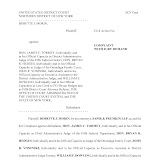
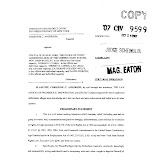
A man who spent 16 years in prison for the murder of a Brooklyn rabbi has filed a wrongful conviction lawsuit alleging “blatantly illegal investigative tactics” were used by the Brooklyn District Attorney’s office to secure his conviction. Last June, Jabbar Collins was released from prison when prosecutors told a federal court judge that they were abandoning their efforts to retry him for the 1994 murder of Rabbi Abram Pollack. The district attorney vacated the murder conviction in May when evidence surfaced that one of the witnesses who implicated Collins had temporarily recanted, and prosecutors failed to inform Collins’s trial lawyer of it. The story of how Collins managed to overturn his murder conviction while in prison was the subject of a front-page Wall Street Journal article in December [SEE BELOW]. On Wednesday, Collins and his attorney, Joel Rudin, filed the lawsuit in Brooklyn federal court naming the city, Brooklyn prosecutor Michael Vecchione and eight other prosecutors and detectives as defendants. Jerry Schmetterer, a spokesman for the district attorney’s office, declined to comment. Vecchione led the prosecution during the original Collins murder trial in 1995. Much of the lawsuit concerns Vecchione’s alleged conduct during the murder investigation and that trial. At a hearing in 2010 on a possible retrial for Collins, a witness testified that Vecchione threatened to hit him over the head with a coffee table when he refused to cooperate. Among a long list of allegations of misconduct is a new charge that several notarized or sworn affirmations and affidavits purportedly signed by Vecchione were forged by a paralegal. Vecchione denied at Collins’s state appeal in 2006 that any witness ever recanted or “had to be threatened or forced to testify.” He also swore that claims authorities had either coerced witnesses or failed to turn over potentially exculpatory information “are, without exception, untrue.” At that time, Brooklyn District Attorney Charles Hynes said, “Michael Vecchione is not guilty of any misconduct.”

The lawsuit claims that Vecchione’s case against Collins began to “evaporate” in the beginning of 1995: One witness recanted his statement; another said he saw Collins running from the shooting and called 911 but there was no recording of that call; and the third witness had fled to Puerto Rico in violation of his probation, according to the complaint. According to the lawsuit, Vecchione employed illegal tactics to coerce his witnesses to give false statements and testify. The lawsuit claims that one of Vecchione’s forged sworn statements was used to gain an order that allowed him to force a witness to be taken to his office against his will. It alleges that the witness was jailed as way to coerce him into making false statements and giving false testimony. The lawsuit claims that Collins subsequent attempts to obtain records were improperly blocked by the Brooklyn Attorney’s office. Collins, who became well versed in public records laws while incarcerated, obtained exculpatory evidence — in one instance by admittedly posing as a prosecutor’s investigator during a recorded phone call. The lawsuit also accuses Hynes, the Brooklyn D.A., of failing to provide proper training and failing to discipline prosecutors who withheld evidence potentially favorable to the defense. “His deliberate indifference to such violations created an ‘anything goes’ atmosphere that caused such violations to continue, including in (Collins’) case,” the lawsuit states.

********************************BACKGROUND/RELATED STORY:

A Solitary Jailhouse Lawyer Argues His Way Out of Prison
The Wall Street Journal by Sean Gardiner - December 24, 2010

Each morning for 5,546 days, Jabbar Collins knew exactly what he'd wear when he awoke: a dark-green shirt with matching dark-green pants. The prison greenies of a convicted murderer, he says, were "overly starched in the beginning, but as time wore on, and after repeated washes, they were worn and dull, like so many other things on the inside." Today, Jabbar Collins works as a paralegal at the Law Offices of Joel B. Rudin in Manhattan. But for 15 years, he sat in prison, convicted of the 1994 murder of Rabbi Abraham Pollack. Mr. Collins, who maintained his innocence, spent much of those 15 years in a computerless prison law library. For most of those 15 years, Mr. Collins, who maintained his innocence, knew the only way his wardrobe would change was if he did something that's indescribably rare. He'd have to lawyer himself out of jail. There was no crusading journalist, no nonprofit group taking up his cause, just Inmate 95A2646, a high-school dropout from Brooklyn, alone in a computerless prison law library. "'Needle in a haystack' doesn't communicate it exactly. Is it more like lightning striking your house?" says Adele Bernard, who runs the Post-Conviction Project at Pace Law School in New York, which investigates claims of wrongful conviction. "It's so unbelievably hard…that it's almost impossible to come up with something that captures that." Mr. Collins pried documents from wary prosecutors, tracked down reluctant witnesses and persuaded them, at least once through trickery, to reveal what allegedly went on before and at the trial where he was convicted of the high-profile 1994 murder of Rabbi Abraham Pollack. The improbable result of that decade-and-a-half struggle was evident on a recent morning in a Midtown Manhattan skyscraper. Mr. Collins sat in a small office he now shares, wearing one of the eight dark suits he owns, a white shirt with French cuffs, a blue-and-gray striped tie and a pair of expensive wingtips. "Every day is beautiful" now, he said, smiling. "I don't have a bad day anymore. I think that my worst bad day out of prison will be better than my greatest good day in prison."


After more than 15 years behind bars and now free after getting his murder conviction overturned, Jabbar Collins starts his day like so many other New Yorkers: He takes the subway to his job in Manhattan. WSJ's Jason Bellini reports. On March 13, 1995, as Mr. Collins was led by officers through a side door of a Brooklyn courtroom to a holding cell, his mother let loose a wailing sound that he'd "never heard before or since." Her son had just been convicted of murder. He was 22, a father of three and facing at least 34 2/3 years behind bars. Three witnesses had implicated him in the midday shooting of Mr. Pollack as the rabbi collected rent in a building at 126 Graham Avenue in the Williamsburg section of Brooklyn. Mr. Collins said he was home getting a haircut at the time. To that point in his life, Mr. Collins had been drifting. His father died when he was 12 and his mother worked two jobs while also studying nursing. Under-supervised, he skipped school often, smoked a lot of pot and fathered the first of his children when he was 15. When he was 16, he was arrested for a robbery. He says he was just waiting outside the store where a robbery took place. Mr. Collins accepted a youthful-offender adjudication under which he got probation and the arrest could eventually be purged. Mr. Collins later obtained a general-equivalency diploma and took some classes at Long Island University. He was trying to transfer to John Jay College of Criminal Justice when he was arrested for Mr. Pollack's murder. During his trial, Mr. Collins recalls being mystified. "I felt like a child," he says, "everyone talking over my head." But hearing his mother wailing as he was taken away suddenly cleared his head. "You have a life of misery ahead of you," he remembers telling himself. "The only way you're going to get out is to become your own lawyer."

On returning to Rikers Island, the city jail complex, Mr. Collins headed to the law library. There and later at Green Haven prison north of the city, he spent most of his free time in law libraries, pouring himself into legal books: "Federal Rules of Criminal Procedure," "McKinney's Consolidated Laws of New York," "The Legal Research Manual." A thick text for paralegals called "Case Analysis and Fundamentals of Legal Writing" became his bible. He devoted two months to mastering the intricacies of federal and state law on access to public records. Jabbar Collins achieved the rare feat of lawyering himself out of prison, 15 years after he was convicted of murdering a rabbi in Brooklyn, N.Y. Here are some of those involved. Michael Vecchione denied any witnesses were rewarded or pressured. Adrian Diaz testified at trial he saw Collins with a gun. When Collins much later called him, posing as a D.A. investigator, Diaz talked about his route to becoming a witness. Edwin Oliva testified at trial that Collins had said he planned to rob the rabbi. When Collins wrote to Oliva years later, Oliva wrote back describing what lay behind his testimony. Angel Santos testified at trial he had called 911 and said he saw Collins run past. His voice didn't seem to Collins to match any voices on the 911 tape. Joel Rudin helped Collins after his own 10-year legal effort. His first request for trial records under New York's Freedom of Information Law, in July 1995, was denied. He would go on to file six more requests, five more appeals and a lawsuit before a judge gave him some of the records over two years later. Finally succeeding in a request, gaining 239 pages of documents and 94 audio tapes, emboldened him. "It kind of refilled the tanks," he says, "gave me the confidence to fight on."

Over time, Mr. Collins would file a dizzying number of records requests. If they were denied, he appealed. If he lost, he'd add his requests to those he prepared for other inmates. "The mosaic of intelligence gathering," Mr. Collins calls this. "You collect one item at a time and you add to the picture piece by piece until you create what is a stunning mosaic of what really happened." He picked away at his case for eight years, but by the fall of 2003 he had hit a wall. That's when he carried out a ruse to trick Adrian Diaz, who had testified to seeing Mr. Collins tuck a gun in his waistband after the murder, into talking to him. "I became Kevin Beekman, district attorney's investigator, for about 25 minutes," Mr. Collins says. The fictitious Mr. Beekman said he needed to recreate documents lost in the Sept. 11, 2001, World Trade Center attack. When Mr. Diaz agreed to talk about his testimony, Mr. Collins routed the call through a phone in his mother's home so it could be recorded. Mr. Diaz said that before the trial, he had gone to Puerto Rico, in violation of his probation for marijuana possession. He agreed to return and testify against Mr. Collins, he said, only after prosecutors promised they would make sure his probation wasn't revoked. That account, which Mr. Diaz later attested to in a signed affidavit, wasn't provided by prosecutors to Mr. Collins's defense counsel, who could have used it to undermine the witness by showing he was given an incentive to testify.

In 2005 Mr. Collins wrote to another witness, Edwin Oliva, who had testified that before the murder, Mr. Collins said he was going to rob the rabbi. "I really need to know what happened between you and the District Attorney's Office," Mr. Collins wrote. "I always knew I was going to hear from you sooner or later," Mr. Oliva wrote back. "And to tell you the truth, I am glad you wrote, now once and for all I can settle the record." Mr. Oliva wrote that he had been arrested a few weeks after the Pollack murder for a robbery he pulled in the building. He said the police asked about the rabbi's killing and he told them all he knew was that Mr. Collins had been arrested. Detectives threatened to charge Mr. Oliva as an accessory, he wrote, and then made up a statement implicating Mr. Collins. Mr. Oliva wrote that he was so strung out and sleepy from a month-long run of "smoking & sniffin' dope" that he signed the statement, adding he "didn't even know what...I was signing." But now, Mr. Oliva added, he wanted to help Mr. Collins, "because I know you got a rotten deal." Mr. Oliva granted access to his records. They included a Legal Aid document that referenced, without elaborating, a "deal" being discussed between the judge, a prosecutor and Mr. Oliva's attorney. Mr. Oliva was allowed to plead to a lesser felony than he had been indicted for. He received a sentence of up to three years. The other charge could have kept him in prison longer.

At the trial, lead prosecutor Michael Vecchione stated that no key witnesses had received anything for testifying. "Oliva's motive is simple," the prosecutor said. "Just like all the rest of the witnesses, he saw something, he heard something, someone asked him about it, and he is telling what he saw and he is telling what he heard. Nothing else." Mr. Vecchione declined requests for comment. Mr. Collins, though a skilled jailhouse lawyer who helped many other inmates, could take his own appeal only so far without help. In late 2005, after 10 years working alone, he contacted Joel Rudin, a civil-rights attorney known for winning what was then the largest wrongful-conviction settlement in New York, $5 million. "I was amazed" at Mr. Collins's file, Mr. Rudin says. "I've never seen anything like this. There was so much documentation." As the lawyer began reworking the appeal, Mr. Collins gathered another piece of his mosaic. He obtained a tape of calls to 911 after the killing. A witness had testified he called 911 and told of seeing Mr. Collins run past. But when Mr. Collins listened to the tape of 911 calls, none of the voices sounded like what he recalled this witness sounding like at the trial. Mr. Collins obtained a tape of a prosecution interview with this witness, Angel Santos. He hired a voice expert to compare the interview tape with the tape of people calling 911. No matches. Mr. Santos and the other two main witnesses, Messrs. Diaz and Oliva, couldn't be reached for comment. Michael Harrison, Mr. Collins's court-appointed trial lawyer, said he couldn't remember whether he ever received the 911 tape because it was so long ago.

In March 2006, Mr. Rudin asked a state judge to overturn Mr. Collins's murder conviction on the grounds of newly discovered information the defense should have been given. Mr. Vecchione, the prosecutor, swore that claims authorities had either coerced witnesses or failed to turn over potentially exculpatory information "are, without exception, untrue." Then the roof crashed down. Learning of Mr. Collins's impersonation of an investigator, state Justice Robert Holdman dismissed the appeal, declaring it to be "wholly without merit, conclusory, incredible, unsubstantiated, and, in significant part, to be predicated on a foundation of fraud." For good measure, he barred Mr. Collins from filing future requests for information. "Just devastating," Mr. Collins says. "This had been my life's work for the last 10 years." He didn't have the luxury of wallowing. State law allows only 30 days to appeal such a ruling. As he wrote his appeal, he couldn't keep out his bitterness, and Mr. Rudin had to redo it. The state appeal failed.

In what amounted to their last shot, they filed a motion in federal court in Brooklyn seeking to overturn the conviction based on prosecutors' "knowing presentation, at trial, of false or misleading testimony" and withholding of evidence that might have been used to discredit the main witnesses. This March, after two years of legal wrangling, federal Judge Dora Irizarry approved Mr. Rudin's request for additional material from prosecutors. Information Mr. Collins had spent more than a decade trying to get his hands on suddenly began pouring in. One document concerned Mr. Oliva, the witness who wrote that under police pressure he signed a statement implicating Mr. Collins in the murder, even though he knew nothing about it. The document suggested that as the murder trial neared, Mr. Oliva had balked at cooperating. It said his work release for a robbery conviction was revoked "after he failed to cooperate with D.A.'s office regarding a homicide." Other newly discovered information suggested Mr. Oliva had briefly recanted his statement implicating Mr. Collins. A prosecutor preparing to fight Mr. Collins's appeal learned this from a retired detective, who said that Mr. Oliva recanted, then changed his mind again and stuck to his statement after the detective and several prosecutors spoke with him at the Brooklyn D.A.'s office. This prosecutor turned that information over to Judge Irizarry, acknowledging it should have been provided to Mr. Collins's murder-trial defense. (Mr. Vecchione had denied at Mr. Collins's state appeal that any witness ever recanted or "had to be threatened or forced to testify.") Four days before a scheduled hearing in Judge Irizarry's federal court, the D.A.'s office offered to reduce the charge against Mr. Collins to manslaughter, allowing his immediate release. Mr. Collins rejected the offer.

Later the same day, prosecutors informed the court that they wouldn't fight Mr. Collins's effort to overturn his conviction, but said they planned to retry him. A retrial would move the case back to state court, a venue where prosecutors had known nothing but success against Mr. Collins. Mr. Rudin, desperate to keep the case in federal court, persuaded Judge Irizarry to hold a rare hearing on whether the D.A. should be barred from retrying Mr. Collins because its misconduct had been so pervasive. The hearing's first witness was Mr. Santos, the man who had testified about making a 911 call after the murder, but whose voice didn't seem to match any of the voices on the 911 tape. Mr. Santos told the hearing that in the period when the murder occurred, he was using drugs "every day. Twenty-four hours." He said that as the murder trial neared a year later, he told Mr. Vecchione he didn't want to testify, but Mr. Vecchione began "yelling at me and telling me he was going to hit me over the head with some coffee table." He said he was threatened with prosecution, then locked up for a week as a material witness. When he agreed to testify, he said, he was taken from jail to a Holiday Inn, which he described as "paradise."

The federal hearing was due to resume a week later with testimony from Mr. Vecchione and other prosecutors. Instead, the D.A.'s office gave up. It said its decision was "based upon the weaknesses that now exist with the witnesses," but added that its "position, then and now, was that we believe in this defendant's guilt." Judge Irizarry was not pleased. "It's really sad that the D.A.'s office persists in standing firm and saying they did nothing wrong here," she said. "It is, indeed, sad." Judge Irizarry declined to be interviewed; the judge who turned down Mr. Collins's state appeal didn't return a call seeking comment. Brooklyn D.A. Charles Hynes stood firm. "Michael Vecchione is not guilty of any misconduct," Mr. Hynes said at the time. He, Mr. Vecchione—who is now chief of the rackets division—and a spokesman for the D.A.'s office all declined to comment, citing likely litigation by Mr. Collins. Mr. Collins walked out of prison on June 9, to an emotional welcome from his family. He has had many Rip Van Winkle moments. Swipe cards have replaced tokens on the subway; coffee shops called Starbucks are everywhere; there are these devices called iPhones. But some things haven't changed. Mr. Collins is back in a law library. His attorney, Mr. Rudin, has hired him as a paralegal. Mr. Collins is first concentrating on his own case. He has filed "notices of claim" announcing an intention to sue the city and state for $60 million. As a paralegal, he can't give legal advice to the many inmates who have written seeking it. He hopes one day to change that, by becoming an attorney. Write to Sean Gardiner at sean.gardiner@wsj.com

CLICK HERE TO SEE VIDEO

Tuesday, February 15, 2011

Court Reform Can Only Begin When Ethics Overseers Are Not Corrupt

Bold Step for Fair Courts in New York
The New York Times - EDITORIAL - February 14, 2011

New York’s chief judge, Jonathan Lippman, is taking on the problem of money in judicial elections. At his urging, a state judicial board is proposing to bar more than 700 elected judges from hearing cases involving any lawyer or party who contributed $2,500 or more to the judge’s campaign in the preceding two years. The beauty of the proposed rule, which is scheduled to be announced on Tuesday in Judge Lippman’s State of the Judiciary address, is that it will make the disqualification or recusal decision a routine, administrative matter. The rule, which is expected to go into effect after a 60-day comment period, still needs some fine-tuning. As currently written, it would be easy for special interests to game the system by making contributions to judges they want to avoid in order to force their disqualification from hearing their cases. That should be addressed with a provision allowing opposing counsel to waive a judge’s disqualification. Thought also must be given to how to handle independent campaign expenditures on behalf of a judge’s candidacy. These pose the same conflict issue as direct contributions to candidates. Members of New York’s highest court — the Court of Appeals, on which Judge Lippman presides — are chosen by a merit appointment system. Because of that, the state has been spared the multimillion-dollar judicial campaigns that have become all too common in states that elect their most powerful judges. The money levels may be lower in New York, but the problem is still there. In races for the State Supreme Court, New York’s highest trial court, about a third of the candidates spend more than $75,000 on their campaigns — with many contributors giving $2,500 or more. In a 2008 Democratic primary for Surrogate’s Court in Manhattan, the three candidates together raised nearly $900,000. The new rule is an important step toward ensuring the impartiality of New York’s courts. Judge Lippman cannot stop here. He should also push for a bar on judges doling out receiverships and other lucrative court assignments to favored donors.

Monday, February 14, 2011

New York's Unlawful Legal System Has Just About Hit Bottom

A Legal Manual for an Apocalyptic New York
The New York Times by William Glaberson - February 14, 2011

Major disasters like terrorist attacks and mass epidemics raise confounding issues for rescuers, doctors and government officials. They also pose bewildering legal questions, including some that may be painful to consider, like how the courts would decide who gets life-saving medicine if there are more victims than supplies. But courts, like fire departments and homicide detectives, exist in part for gruesome what-ifs. So this month, an official state legal manual was published in New York to serve as a guide for judges and lawyers who could face grim questions in another terrorist attack, a major radiological or chemical contamination or a widespread epidemic. Quarantines. The closing of businesses. Mass evacuations. Warrantless searches of homes. The slaughter of infected animals and the seizing of property. When laws can be suspended and whether infectious people can be isolated against their will or subjected to mandatory treatment. It is all there, in dry legalese, in the manual, published by the state court system and the state bar association. The most startling legal realities are handled with lawyerly understatement. It notes that the government has broad power to declare a state of emergency. “Once having done so,” it continues, “local authorities may establish curfews, quarantine wide areas, close businesses, restrict public assemblies and, under certain circumstances, suspend local ordinances.”

Ronald P. Younkins, the chief of operations for the state court system, said the book’s preparation was similar to other steps the New York courts had taken to plan for emergencies, including stockpiling respirators and latex gloves. Like such manuals in other states, Mr. Younkins said, it is intended to give judges and lawyers a place to turn in an emergency because the maze of state and federal laws — some decades or centuries old — can be difficult to decipher. For judges, the manual may well be their only refresher on the case of Mary Mallon, “Typhoid Mary,” who was isolated on an East River island from 1915 until her death in 1938. “It is a very grim read,” Mr. Younkins said. “This is for potentially very grim situations in which difficult decisions have to be made.” Published with the disarmingly bland title “New York State Public Health Legal Manual,” the doomsday book does not proclaim new law but, rather, describes existing law and gives lawyers and judges ways of analyzing any number of frightening situations. The manual provides a catalog of potential terrorism nightmares, like smallpox, anthrax or botulism episodes. It notes that courts have recognized far more rights over the past century or so than existed at the time of Typhoid Mary’s troubles. It details procedures for assuring that people affected by emergency rules get hearings and lawyers. It mentions that in the event of an attack, officials can control traffic, communications and utilities. If they expect an attack, it says, they can compel mass evacuations. But the guide also presents a sober rendition of what the realities might be in dire times. The suspension of laws, it says, is subject to constitutional rights. But then it adds, “This should not prove to be an obstacle, because federal and state constitutional restraints permit expeditious actions in emergency situations.” When there is not enough medicine for everyone in an emergency, it notes, there is no clear legal guidepost. It suggests legal decisions would most likely involve an analysis that “balances the obligation to save the greatest number of lives against the obligation to care for each single patient,” perhaps giving preference to those with the best chance to survive. It points out, though, that elderly and disabled people might have a legal claim if they are discriminated against at such moments of crisis.

Donna Lieberman, the executive director of the New York Civil Liberties Union, said the 88-page book reminded her of the CliffsNotes pamphlets that have helped generations of 11th graders get through Macbeth. “Needless to say, this makes me a little nervous,” she said, adding that the legal issues the book raised were “nuanced, thorny and difficult, and hard to capture in CliffsNotes.” In separate forewords, the state’s chief judge, Jonathan Lippman, and the bar association’s president, Stephen P. Younger, say public-health threats are more apparent than ever, so the legal questions ought to be considered now, not during an emergency. If nothing else, the book is intensely practical, giving lawyers and judges a way to get through what would quite likely be chaotic days. After mentioning that houses or businesses can be commandeered to shelter victims or serve as medical dispensaries, it continues that “violations of individual property rights, if actionable, would generally be sorted out after the need for such actions has ended.” The court system posted an electronic copy of the book on its Web site on Thursday, and the bar association is selling bound copies for $18 to the public. The book was edited by Michael Colodner, the former counsel to the state’s Office of Court Administration. In its matter-of-fact way, it conjures an image of the courts muddling through in an apocalyptic city. But it makes clear that it is in just such circumstances that it may be more important than ever for the courts to remain open to grapple with the legal questions created by the emergency itself. Without mentioning that judges and other court officials themselves may be among the dead or injured, the manual says that when there is a shortage of court personnel, administrators can take any number of steps to keep the courts operating. It says they can hold multiple proceedings before a single judge, change rules of procedure and give priority to cases arising out of the emergency. And it provides chilling instructions on how to proceed with cases in the midst of outbreaks of contagious disease. The stockpiled gloves and respirators “already available at many courthouses,” it says, may be necessary. But the image of an infected New Yorker surrounded by a masked judge, lawyers and court officers was a miserable one even for this gruesome guide. “The wearing of respirators by the multiple participants in a courtroom setting, would no doubt be disruptive,” the manual notes. One alternative, it suggests, is that the infected person be required to wear a respirator. Another: “Isolating an infectious litigant in a separate room with an audio-visual connection to the courtroom.” In Brooklyn one day last week, the administrative judge of the criminal courts, Barry Kamins, listened as parts of the manual were read to him, including the section about everyone wearing masks in the courtroom. “I’m trying to imagine several people in a courtroom wearing that,” Justice Kamins said. “It’s hard to put yourself in that situation.” But, he said, the city’s courts have already been through a lot, including the aftermath of the Sept. 11 attacks. Swine flu brought respirators to some courtrooms, as people worried about infection. Defendants who bite and scratch sometimes arrive in court in chains and are forced to wear gloves. “It’s almost surreal, but you just go forward,” Justice Kamins said, which is how he said judges would most likely respond if the scene in the courts was even more surreal.

Sunday, February 13, 2011

Proud New York- The Best Ponzi Scheme Attorneys Anywhere

Following Wextrust Ponzi Execs Guilty Pleas, Malpractice Suits Readied Against Lawyers in New York and Other States Who Aided the $250 Million Fraud Scam - February 13, 2011

Evidence Also Shows Lawyers Failed to Stop Conspiracy By Wextrust Scam and Chicago’s Broadway Bank to Hide Bad Loans And Defraud State and Federal Regulators

Late last week, PREET BHARARA, the United States Attorney for the Southern District of New York, announced that JOSEPH SHERESHEVSKY, a principal and chief operating officer of WexTrust Capital, LLC, a Chicago based money lender, had pleaded guilty to three felony counts for masterminding the international Ponzi scheme that took hundreds of millions from unsuspecting investors. SHERESHEVSKY pled guilty before U.S. District Judge DENNY CHIN in New York City, who earlier took a plea on similar charges by the former Wextrust president, Steven Byers. The plea agreements come some 18 months after the Securities and Exchange Commission had Judge Chin seize Wextrust and put it in the hands of a receiver. An ensuing search by court appointed lawyers and forensic accountants has revealed that nearly all the $250 million raised from investors has disappeared as the company pursued mortgage fraud and other illegal operations. Also, a New Jersey court case involving two Chicago banks filed as an outgrowth of the Ponzi scheme has turned up evidence linking Wextrust to bank fraud. It’s been discovered that the Wextrust chief execs conspired with officers of Broadway Bank also of Chicago to hide millions in bad loans from state and federal bank regulators. In the end, both Wextrust and Broadway failed, and the bank was sold to MB Financial Bank, that’s now being sued. Other reports are circulating that additional law suits are being readied in New York and several other states, including New Jersey, Virginia and Illinois, as victims of the combined Ponzi scheme and bank fraud prepare to sue for damages they incurred. The liability estimated in the hundreds of millions extends beyond Wextrust and Broadway to the teams of lawyers, accountants and executives, who either knew about the fraud and looked the other way, or should have known and didn’t look, as they closed on bogus deals valued in excess of $400 million.

The legal claims of the victims should be a bonanza for lawyers specializing in attorney and accounting malpractice. The Madoff case- the grand daddy of all Ponzis - has recently headed down a similar path, going after banks, financial advisors, lawyers and accountants—all of whom are figured to have known or should have known that Bernie was a multi billion dollar bamboozler. In the case of the Wextrust scam, company executives cheated hundreds of victims out of millions of dollars by repeatedly lying to them about what their money was being used for, and then covering up those lies with more lies. But, they couldn’t and wouldn’t have succeeded if just one or two of the hundred plus lawyers or accountants employed to review the deals had done their job properly, picked up on the fraud, and called in the feds. As an example, Wextrust and Broadway closed a series of deals through dozens of Westrust companies operating in New York, but no lawyer ever discovered (or tried to discover) that not one of the companies was registered to do business in the state. Since no one looked, there were no calls from lawyers or accountants to shut down the Wextrust operation. The feds finally were tipped off by a Wextrust senior exec, who saw the end coming and pulled the plug on the Ponzi operation he had helped to run. He turned on his co-execs and became a government snitch. The bank fraud scam should also have been reported. According to information recently disclosed in the New Jersey case, back in 2007, when Wextrust was desperately looking for money to survive, they went to Broadway Bank, which was having its own problems. Seems that Broadway’s loan business was heading south as local press reports raised continuing questions of mob ties to the lending operations. Broadway’s president Dimitri Giannoulias, whose brother last year was defeated in a bid for President Obama’s old Senate seat, wanted to get the bad loans off the books to avoid a possible takeover by the FDIC. In at least one case, Giannoulias sold a defaulted loan to a hotel in Atlantic City to the Wextrust group for a note. Problem with the transaction was the fact that Wextrust was without funds and insolvent, making its note worthless. Plus there was a quid pro quo. Seems that Wextrust wanted Broadway to fund another loan in New York, which Broadway said it would do --if -- Wextrust bought the defunct hotel mortgage for the worthless note. The Wextrust insolvency should have been discovered by lawyers and accountants working on the deals. The fraudulent loan swap deals worked at the time, and brought in hundreds of thousands of dollars in fees to keep Wextrust afloat –as it turned out only for about nine moths. Then the sky fell in.

In August ’08, the lead Wextrust execs were arrested by the feds, the company was sued by the SEC as a Ponzi operation, and then taken over by a receiver. And by April of last year, Broadway Bank went under, and was scooped up for a cents on the dollar bid by MB Financial Bank, another Chicago lender that recently has made a business of buying up failed banks. It has picked up six over the last two years. According to reports, this is all part of an effort by MB to expand by taking advantage of bank failures. It has surfaced that MB directors have cooked up a plan to grow rapidly through bargain purchases of a bunch of defunct banks seized by the FDIC. Reportedly, the directors’ next move will be to sell MB to a national bank like Chase, Citi or Wells Fargo, before heading off into the sunset with golden parachute checks in their pockets. But MB’s get rich quick plan has drawn the attention of other lawyers. They are looking into the actions of MB and additional banks that are picking up failed lenders and their so-called toxic mortgage loans for next to nothing, and then suing to collect top dollar returns from the borrowers. So, this means that borrowers, who were at first defrauded by operators like the Wextrust scammers and Broadway Bank, now are having to fight off collection suits by the likes of MB, looking to turn their no cost debt purchases into windfall profits. One lawyer reviewing the situation says that the actions of MB are in certain ways far worse than Wextrust. "Look, the Wextrust officials are out right white collar criminals, who caused lots of damage. But banks such as MB should have their bank licenses pulled by the Controller of the Currency. They use a suit and a tie, rather than a mask and a gun to pull off their scam. They buy up fraudulent loans at no or little cost, and then have their law firms to sue to get top dollar returns plus interest and penalties from borrowers - or they move in to seize the properties, and sell them off to the highest bidder, pocketing even greater profits. Such high end bunko operations ought to cause banks such as MB to be sanctioned, or better still, closed down." There have been calls for fed regulators and House and Senate committees to expose this bank profiteering. MB was contacted for comment, but refused to meet or speak on the record.

Saturday, February 12, 2011

Court Spokesman Bookstaver Uses Comedy in Slap at Mayor

In the New York Land of One-Phone-Call-Justice, and the Home of THE FIX, David Bookstaver has impressed many with his ability to keep a straight face while saying, "Our system is founded on an independent judiciary. It's clear that no judge can interfere with another judge's ongoing case."

Mr. Bookstaver made the statement in response to Mayor Michael Bloomberg's comment that Judge Lippman should "step in and fix the [court] system."

**************************************Here's the Full Article:

Mayor takes to the radio to blast judge
The New York Law Journal by Noeleen Walder - February 1, 2011

Mayor Michael R. Bloomberg used his weekly radio broadcast Friday morning to sound off against Manhattan Supreme Court Justice Emily Jane Goodman's decision to block the city from laying off several deputy sheriffs, which the mayor complained could cost taxpayers more than $1 million annually. Appearing on "The John Gambling Show With Mayor Mike" on WOR 710 AM, Mr. Bloomberg criticized a ruling issued Thursday night by Justice Goodman, in which she granted a temporary restraining order barring the city from "laying off, displacing, discharging, or demoting any New York City Sheriffs" or taking any retaliatory action against members of the New York City Deputy Sheriffs' Association. Davis v. City of New York, 100722/11. The judge scheduled a preliminary injunction hearing for Feb. 10. The mayor's remarks highlighted the city's growing dissatisfaction with rulings by Justice Goodman. The mayor said on the show that Justice Goodman had no legal basis to second guess the decision by city Finance Commissioner David N. Frankel to lay off nine deputy sheriffs and demote three. "In the meantime, we're going to waste…over a million dollars a year just because this judge decides to step in, [and] says, 'Oh I feel sorry for those people.' What about the taxpayers?" the mayor said. Mr. Bloomberg also faulted Justice Goodman for failing to make the sheriffs' association post a bond that would enable the city to recoup its lost funds should it ultimately prevail in the case. In a statement issued Thursday night after the ruling, Mr. Frankel said the judge had "clearly overstepped the court's authority." "[S]ubstituting her judgment for what is clearly an executive prerogative does enormous damage to our ability to manage the Department in an efficient manner that preserves the Sheriff's mission at an appropriate cost to taxpayers," Mr. Frankel added. The mayor told his radio audience Friday that "the trouble is we've got a trial judge like this who makes decisions that the appellate courts don't step in to reverse right away." He called on Chief Judge Jonathan Lippman, whom he called a "pretty good guy," to "step in and fix this system so this doesn't happen or we're going to start laying off people." In an interview, Justice Goodman said that "no litigant has a right to come to judge shop and I think attacks on judges are unfortunate and may have the effect on some people of interfering with judicial independence." On Friday, Justice Helen Freedman of the Appellate Division, First Department, denied the city's motion to vacate Justice Goodman's ruling, or in the alternative, require that the petitioners post a bond. Justice Freedman also denied the city's request that the case be reassigned. "Expedited decision upon submission is urged," she wrote on Friday.

History of Complaints

This in not the first time the city has been upset with Justice Goodman. In papers filed with the First Department, it accused the judge of dragging her feet in two other cases involving the city, including one litigation in which it took 14 months to get a ruling that New York City's 2008 rent regulations were improper, a move Mr. Bloomberg said forced 300,000 landlords to recalculate rents. In another case concerning a challenge to a development project in Brooklyn, the city said Justice Goodman issued a temporary restraining order, which has now been outstanding for 13 months, and has refused to enable the city to obtain a bond (NYLJ, May 24, 2010). In the interview, Justice Goodman said that case, Broadway Triangle Community Coalition v. Bloomberg, 112799/09, is stayed because there is an ongoing federal investigation. She said in complicated matters like the rent case, "We probably got papers from the floor to the ceiling." In a subsequent e-mail, Justice Goodman said that during the rent case her law assistant "had major spinal surgery and could not work/could not be seated in a chair for a considerable period of time; I had asked the administration for more help and that was denied." She added, "On a personal basis, my mother was dying."

Ronald E. Kliegerman of Kliegerman & Joseph, who represented the sheriffs' association, said in an interview that it was inappropriate for the city to comment on cases it had pending before Justice Goodman. According to an Article 78 petition filed by the association, the decision to lay off nine sheriffs and demote three others "was made in large part by a new commissioner without any background in law enforcement or public safety." Mr. Frankel took office in September 2009. "The City is attempting to trade public safety for dollars, notwithstanding its obligation to protect and act in the best interests of its citizens," the sheriffs' association argued in its petition. The city in its appellate papers said that when the parties appeared before Justice Goodman on Thursday, Law Department attorneys told her the layoff proposal was meant to affect cost savings. The judge commented that deputy sheriffs frequently appear in her courtroom, and "suggested the NYPD would need to allocate resources to perform the functions now being performed by" the sheriffs, the city said in court papers. After granting the sheriffs' associations' request for a temporary restraining order, the judge instructed counsel to arrange a conference call to discuss the issue of a bond. "When counsel for the parties called chambers this morning at approximately 9:15 a.m., no one answered the phone," the city claimed.

In the interview, Justice Goodman said that the parties came in the midst of her motion day and she could not drop everything to consider the bond issue. "We have about 700 cases. For one case to jump the other cases is not equal justice for everybody," the judge explained, adding that she wanted to have time to read the city's papers before considering whether to require a bond. The attorneys might have been calling chambers on Friday morning, she said, but she explained that she went directly to her courtroom for a trial and her secretary was out sick, as well as her law clerk. "What can I say if no one answered the phone at this moment?" Judge Goodman said. Her law clerk eventually arrived and arranged for a phone conference with the parties for later in the day, the judge said. Late Friday, after Justice Freedman had ruled against the city, Justice Goodman rejected the request for a bond, saying that CPLR 6313, which governs TROs, did not require one. In any case, she said that the city had not substantiated its damages claim.

In an interview on Friday before that ruling, Corporation Counsel Michael A. Cardozo acknowledged that "judges have a very hard job." There's no question that "we shouldn't have to answer in court," he said. However, given that Justice Goodman took a "very, very long time to enter a decision to the city's detriment" in the other two cases, he said one of his "grave concerns is that this TRO might last for a very long time," which would cost the city $4,045 a day. The judge's decision to put off until Feb. 10 arguments on the preliminary injunction "compounds the problem," he said. Justice Goodman reached the mandatory retirement age of 70 last year, but court administrators certificated her to remain on the bench until Dec. 31, 2012 (NYLJ, Jan. 7). Mr. Cardozo said he told the Office of Court Administration that he opposed her recertification. Mr. Cardozo said he also has discussed with court officials "the more general problem of…injunctions being entered in this fashion." There are judges who have entered temporary restraining orders without a bond that "also last a long time," he said. This would not happen in the federal system, where a movant must post a bond before a temporary restraining order is issued and the order lasts only 14 days unless the court finds good cause to extend the period, Mr. Cardozo said. The city has proposed legislation that would bring the CPLR provisions on temporary restraining orders and injunctions in line with the federal rules, he said. David Bookstaver, an OCA spokesman, said that as a courtesy, Mr. Cardozo had forwarded the proposed legislation "to us for review." But he added that this is an issue for the Legislature, not the courts. Responding to Mr. Bloomberg's comment that Judge Lippman should "step in and fix the system," Mr. Bookstaver said, "Our system is founded on an independent judiciary. It's clear that no judge can interfere with another judge's ongoing case." Senior Counsels William S. Frankel and Fay Ng handled the case for the Law Department. Noeleen G. Walder can be reached at nwalder@alm.com.

Friday, February 11, 2011

More Evidence of Not Addressing Ethics Complaints For the Connected

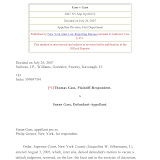
Matter of Barbara
2011 NY Slip Op 01023, Decided on February 8, 2011, Appellate Division, Second Department -Per Curiam. Published by New York State Law Reporting Bureau pursuant to Judiciary Law § 431. This opinion is uncorrected and subject to revision before publication in the Official Reports.

Decided on February 8, 2011 - SUPREME COURT OF THE STATE OF NEW YORK, APPELLATE DIVISION : SECOND JUDICIAL DEPARTMENT - WILLIAM F. MASTRO, J.P., REINALDO E. RIVERA, MARK C. DILLON, THOMAS A. DICKERSON, JJ. - 2009-10255

[*1]In the Matter of Dominick A. Barbara, an attorney and counselor-at-law. Grievance Committee for the Tenth Judicial District, petitioner; Dominick A. Barbara, respondent. (Attorney Registration No. 1487958)

DISCIPLINARY proceeding instituted by the Grievance Committee for the Tenth Judicial District. The respondent was admitted to the Bar at a term of the Appellate Division of the Supreme Court in the Second Judicial Department on February 24, 1971. By decision and order on application of this Court dated February 3, 2010, the Grievance Committee was authorized to institute and prosecute a disciplinary proceeding against the respondent and the issues raised were referred to the Honorable Michael F. Mullen, as Special Referee to hear and report.

Robert A. Green, Hauppauge, N.Y. (Michael Fuchs of counsel), for petitioner. Moran Karamouzis LLP, Rockville Centre, N.Y. (Grace D. Moran of counsel), for respondent.

OPINION & ORDER - PER CURIAM.The Grievance Committee for the Tenth Judicial District (hereinafter the Grievance Committee) served the respondent with a petition dated November 17, 2009, containing five charges of professional misconduct. Charge five was withdrawn by the Grievance Committee following the hearing. After a preliminary conference on March 30, 2010, and a hearing on April 15, 2010, the Special Referee sustained the four remaining charges of professional misconduct. The Grievance Committee now moves to confirm the Special Referee's report and impose such discipline as the Court deems just and proper. The respondent's counsel has submitted an affirmation in response seeking to disaffirm the Special Referee's report with respect to charge two and to afford appropriate weight to the evidence of mitigation.

Charge one alleges that the respondent failed to forward to his client in a domestic relations matter a written, itemized bill on a regular basis, at least every 60 days, in violation of 22 NYCRR 1400.2. The respondent was retained by Louis Rubino on or about September 24, 2004, to represent him in a domestic relations matter pending in the Supreme Court, Suffolk County. The respondent received the sum of $40,000 for his representation of Mr. Rubino in that matter. Mr. Rubino discharged the respondent in or about May 2005. During his representation, the respondent [*2]failed to issue written, itemized bills for legal services to Mr. Rubino on a regular basis.

Charge two alleges that the respondent failed to adequately supervise the conduct of attorneys and non-attorneys in his law firm, in violation of Code of Professional Responsibility DR 1-104(c) and (d)(2) (22 NYCRR 1200.5[c], [d][2]) . During the time in which he represented Mr. Rubino, the respondent was the only named partner in his firm and had supervisory authority over other lawyers and non-lawyers in the firm. Each attorney in the respondent's firm was responsible for maintaining time sheets on the matters to which they were assigned and for forwarding completed time sheets to the firm's bookkeeper to prepare billing statements. The bookkeeper was responsible for forwarding client billing statements to the individual attorneys responsible for the matter to review and approve. The attorney responsible for each matter was responsible for reviewing and approving the billing statement and returning it to the bookkeeper. After receiving the billing statement back from the attorney, the bookkeeper was responsible for forwarding it to the client. In the exercise of reasonable management or supervisory authority, the respondent knew or should have known that the firm's procedures were not being followed by all attorneys and non-attorneys in the firm with respect to billing statements for Mr. Rubino.

Charge three alleges that the respondent failed to refund that portion of a legal fee paid in advance which had not been earned, after being discharged by the client, in violation of Code of Professional Responsibility DR 2-110(a)(3) (22 NYCRR 1200.15[a][3]). On or about May 11, 2006, the respondent was retained to represent Laura Gunther in a matrimonial action and was paid a retainer in the sum of $10,000. Although Ms. Gunther made several requests for a return of the balance of the unused retainer, the respondent failed to comply. Thereafter, by letter dated July 30, 2007, the respondent and his associate, Cindy Prusinowski, were advised that Christopher Cassar was now representing Ms. Gunther. The letter stated that the matrimonial action had been discontinued, that the respondent's services were no longer needed, and requested a refund of the balance of the retainer in the sum of $7,482.50. Although the respondent's firm received that letter, it failed to respond. A duplicate letter, marked "Second Request" and dated August 21, 2007, was mailed to the respondent and Ms. Prusinowski. Although that letter was also received, the respondent's firm failed to respond or to issue the requested refund. By check dated April 3, 2008, the respondent's firm issued a refund to Ms. Gunther in the sum of $7,122.50, the balance of the retainer. During the period from May 11, 2006, through April 3, 2008, the respondent was the only named partner in his firm and was responsible for the conduct of attorneys and non-attorneys in the firm.

Charge four alleges that the respondent engaged in conduct that adversely reflects on his fitness as a lawyer by failing to adequately communicate with his client or her new counsel, in violation of Code of Professional Responsibility DR 1-102(a)(7) (22 NYCRR 1200.3[a][7]), based on the factual allegations of charge three. Based on the evidence adduced and the respondent's admissions, the Special Referee properly sustained the four remaining charges of the petition. Accordingly, the Grievance Committee's motion to confirm the Special Referee's report is granted.

In determining an appropriate measure of discipline to impose, the Grievance Committee takes note of the respondent's extensive disciplinary history. Between August 17, 1988, and October 1, 2009, the respondent received nine Letters of Caution, nine Admonitions, and two Advisements. Eight of those Admonitions were issued on December 7, 2007, for separate complaints. Some of these Grievance Committee-level sanctions were issued for professional misconduct identical to the charges in the instant proceeding. For example, six of the Admonitions were for inadequate supervision, and for failing to properly bill clients in domestic relations matters. One Admonition involved the respondent's failure to promptly refund a retainer balance. The respondent was also issued two Letters of Caution for failing to adequately cooperate with a client's replacement counsel. The respondent attempts to mitigate his disciplinary history by noting that most of the complaints which led to an avalanche of Grievance Committee sanctions were caused by his health problems, compounded by the sabotage of his law practice by disloyal associates. The respondent contends that he had no opportunity to amend his office procedures following the Admonitions inasmuch as the other complaints, including those underlying this proceeding, were already filed. He [*3]proudly points out that in all his years of practice, he was only the subject of two malpractice claims which were dismissed in their early stages. The respondent emphasizes the remedial efforts he has undertaken to improve his office, such as downsizing and hiring an administrative assistant, and the lack of substantial harm to clients. He asks the Court to take note of his commitment to rehabilitation and sobriety, his remorse, his complete cooperation, his strong public service record, and the character letters attesting to his integrity, competence, and dedication to his clients. Balancing the respondent's disciplinary history with the remedial efforts undertaken and the mitigation proffered, the respondent is suspended from the practice of law for a period of 18 months. MASTRO, J.P., RIVERA, DILLON and DICKERSON, JJ., concur.

ORDERED that the respondent, Dominick A. Barbara, is suspended from the practice of law for a period of 18 months commencing March 10, 2011, and continuing until further order of this Court; the respondent shall not apply for reinstatement earlier than March 9, 2012, and in such application, the respondent shall furnish satisfactory proof that during said period he (1) refrained from practicing or attempting to practice law, (2) fully complied with this opinion and order and with the terms and provisions of the written rules governing the conduct of disbarred, suspended, and resigned attorneys (see 22 NYCRR 691.10), (3) complied with the applicable continuing legal education requirements of 22 NYCRR 691.11(c)(2), and (4) otherwise properly conducted himself; and it is further,

ORDERED that pursuant to Judiciary Law § 90, during the period of suspension and until the further order of this Court, the respondent, Dominick A. Barbara, shall desist and refrain from (l) practicing law in any form, either as principal or agent, clerk, or employee of another, (2) appearing as an attorney or counselor-at-law before any court, Judge, Justice, board, commission, or other public authority, (3) giving to another an opinion as to the law or its application or any advice in relation thereto, and (4) holding himself out in any way as an attorney and counselor-at-law; and it is further,

ORDERED that if the respondent, Dominick A. Barbara, has been issued a secure pass by the Office of Court Administration, it shall be returned forthwith to the issuing agency and the respondent shall certify to the same in his affidavit of compliance pursuant to 22 NYCRR 691.10(f).

ENTER: Matthew G. Kiernan, Clerk of the Court

------------------------------------------------------- RELATED STORY:

Joey lawyer suspended
The New York Post by Dan Mangan - February 11, 2011

Long Island lawyer Dominic Barbara is headed for the bench -- but not the judicial kind. Barbara, whose clients have included Joey Buttafuoco, Jessica Hahn and Michael Lohan, has been suspended from practicing law for 18 months for four counts of "professional misconduct," The Post has learned. Tuesday's damning decision by a panel of state appellate judges came after the jurists noted that Barbara had an "avalanche" of Grievance Committee sanctions levied against him since 1988 -- among them nine "letters of caution," nine admonitions and two advisements. In one of the cases that led to the blustery, burly barrister's ban -- which begins March 10 -- Barbara failed to regularly issue written, itemized bills to a client who had paid him $40,000. In the other, he failed for nearly a year to refund a client the more than $7,000 retainer balance she was owed after she hired a new lawyer. Barbara, 64, blamed health problems and "sabotage" of his law practice by disloyal associates.


--------------------------------------------------------- BACKGROUND STORY:


Long Island's Flashy Lawyer Dominic Barbara Arrested Over Divorce Spat
WPIX by Mike Graham and Rob Hoell - May 5, 2011
Police say he approached his ex-wife violating order of protection

GLEN COVE, N.Y. (WPIX) - Matrimonial attorney Dominic Barbara, who made headlines for representing infamous clients like Joey Buttafuoco, is now the subject of a scandal himself. The flamboyant lawyer was arrested Tuesday after he approached his ex-wife in a bagel shop in Glen Cove Sunday morning, violating an order of protection, police said. Barbara, 64, has been charged with criminal contempt after he allegedly sat down with his ex-wife Leslie while she was having coffee with a friend. Leslie Barbara told Newsday that her ex-husband brought a police officer with him and demanded she be arrested for stalking him. But the tables were turned two days later when Barbara was taken into custody. While in Glen Cove court Wednesday to finalize living arrangements over a posh home the two share, Barbara became agitated. At one point Judge Richard McCord ordered Barbara to stop staring at his ex-wife. "Stop staring at her, you are making me nervous," said McCord. "This is a sensitive matter, you're expressing emotions. I don't want it to explode into anything more than that." This is not the first public tête-à-tête between the two. Back in November 2008, Leslie was charged with second-degree menacing after Dominic claimed she threw a plate of spaghetti at his head. Those charges were later dropped. Late Wednesday both parties issued the following statement: "Dominic Barbara and Leslie Barbara reached an agreement. We feel this ends any issues between us, and the courts will not have to hear from us again." However, criminal charges are pending regarding the order of protection. (www.WPIX.COM)

Thursday, February 10, 2011

Pfau Defends Lippman's Corrupt Financial Foolery

Pfau Defends Judiciary's Proposed Budget
The New York Law Journal by Joel Stashenko - February 10, 2011

ALBANY, NY - Rebutting a suggestion that the state courts had shown "blatant disregard" of Governor Andrew M. Cuomo's efforts to slow state spending, Chief Administrative Judge Ann Pfau warned legislators yesterday that the courts would face widespread disruptions if required to accept the 10 percent in cuts imposed by Mr. Cuomo on the agencies he controls. "We have tried to be as prudent as possible because we take very seriously what is going on in New York and…to be as fiscally careful while we continue to provide justice," Judge Pfau said at a joint Senate-Assembly hearing on the Judiciary's proposed 2011-12 budget. "We have a fundamental, constitutional duty to provide justice to the people of New York." The Judiciary is seeking to spend $2.7 billion in the year that begins April 1, a $50 million increase—or 1.7 percent—over this year. But Judge Pfau argued that the Judiciary's operating budget—the portion the court system controls—would fall by .02 percent. She said the overall increase was due to higher salary and pension fund payments to employees, spending on which court administrators have no say. Mr. Cuomo's budget calls for $133 billion in spending, a 2.7 percent reduction, and for almost 10,000 layoffs. He criticized the Judiciary in his budget message for "not participating" in his efforts to close a $10 billion gap in the 2011-2112 fiscal year (NYLJ, Feb. 2). The court budget does not project any layoffs, although Judge Pfau pointed out that there are 1,000 fewer nonjudicial employees than there were two years ago, due to last year's early retirements. She added that savings have been achieved though limiting overtime, banning non-essential travel, restricting equipment purchases and increasing the use of the Internet for remote training.

She told legislators that "thousands" of layoffs would result if the courts were forced to make further cuts of the magnitude sought by Mr. Cuomo. After the hearing, Judge Pfau told reporters that perhaps 2,000 to 2,500 layoffs would be necessary, from a workforce of 15,000. In other states, cuts like that have forced the closure of courts one day a week or one day a month or have trimmed daily hours, she said. "If we could possibly do what the governor asked, the repercussions for the citizens is they would see closed courthouses," Judge Pfau told reporters. "And while there is a budget process to work this out, to try to resolve this, to see where we end up, to go into the budget process agreeing to abandon our constitutional responsibility is not something we think we can do." Although lawmakers probed for additional cuts yesterday in quizzing Judge Pfau, they adopted a respectful tone toward the court system. "With all due respect," Assemblyman James Hayes, R-Williamsville, said before arguing that the proposed reductions in the Judiciary's operating budget are inadequate in light of the state's budget woes. "It doesn't come anywhere near what the governor has asked everyone else in the state, every other operations in state government, it doesn't even come close," said Mr. Hayes, the ranking Republican on the Assembly's Ways and Means Committee. "I'm wondering if you see that as a problem just in terms of the collaboration, where we're separate branches of government, but certainly we all go through the same budget process, in terms of the blatant disregard for the governor's call." Judge Pfau responded, "When the governor has said to us he would like us to cut 10 percent, we are talking about cutting thousands of employees. There is no way I can cut thousands of employees without shutting down the courts. … You would be shutting down the citywide courts of New York City, that's the volume [of 10 percent cuts] we're talking about, Family and Civil and Criminal courts. Or [I could] shut down the Sixth, Seventh and Eighth Judicial districts."

More Cuts Sought

However, Senator John DeFrancisco, R-Syracuse, the chairman of the Senate Finance Committee, asked Judge Pfau whether smaller but significant savings could be achieved by scaling back non-essential programs that were instituted in better fiscal times. The senator asked specifically about the potential for savings within the child-care programs offered to litigants in Family Court. Mr. DeFrancisco also wondered if the judicial training institute at Pace Law School could be cut. He requested a list of programs not crucial to the core mission of keeping the courts open that could be cut to save money, and for statutory changes the Legislature could make to help costs. Judge Pfau said she would provide that.

Senator John Bonacic, R-Mount Hope, chairman of the Judiciary Committee, inquired whether Mr. Cuomo's promotion of consolidating state and local government entities could work to cut the costs of the courts. Judge Pfau said a consolidation of the court system, which would require amendments to the state Constitution, could create significant savings. But the process would take at least until 2013 and, as Judge Pfau noted, would have to be approved twice by a Legislature that has shown little interest in court consolidation in recent years. Senator Michael Nozzolio, R-Seneca Falls, said he would like a better accounting of per-judge spending. Judge Pfau said budgeting for the court system is not as easy as for the Legislature because judges only have up to two employees assigned specifically to them, with the bulk of workers assigned by judicial district administrators to where they are needed most. Judge Pfau said she would work with the Legislature to make the process more "transparent." Assemblywoman Helene Weinstein, D-Brooklyn, praised Judge Pfau and Chief Judge Jonathan Lippman for juggling resources to keep courts open. "The New York courts have been open every day" while courts in some states "close their doors on certain days," Ms. Weinstein said. Assemblyman Rory I. Lancman, D-Queens, a practicing attorney, said that many litigants cannot afford a lawyer but are ill-equipped to represent themselves in foreclosure, consumer credit and child-support cases. Judge Pfau said one reason the decline in the Judiciary's operating budget is not higher is because the court system is intent on including $25 million in new funding for civil legal services for the poor and $11 million to reduce the workload of attorneys assigned in New York City to represent children in Family Court. "I urge you to stand firm," Mr. Lancman told Judge Pfau of the Judiciary's budget. Mr. Bonacic questioned the wisdom of spending $23 million on a project to renovate an Albany building to create living quarters for Court of Appeals judges when they are in session. The former Centennial Hall also would house the Law Reporting Bureau (NYLJ, May 12, 2009). Judge Pfau said the money, which has all been committed, was appropriated for the project starting in the mid-2000s, when the economy was in better shape. The living quarters are scheduled to open in 2012. "If we were going to make this decision today, certainly this is not the decision we would make," she conceded to reporters after the hearing. Representatives of several organizations spoke in support of the proposed budget. They included representatives of the New York State Bar Association; Legal Services of New York City; the Fund for Modern Courts; the Legal Aid Society of New York; the New York City Bar; the Correctional Association of New York; the Empire Justice Center; and the New York State Defenders Association. The Legislature and governor are now free to make changes in the Judiciary budget, which was proposed late last year. Mr. Cuomo is bound legally to forward it as is to the Legislature as part of the 2011-12 executive budget, which he did on Feb. 1. Joel Stashenko can be contacted at jstashenko@alm.com.

Wednesday, February 9, 2011

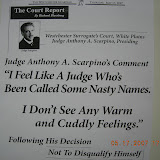
Corrupt Judge Scarpino and Corrupt Attorney Frank Streng in the News

Malcolm X Trove Hidden During Feud
The New York Times by John Eligon - February 8, 2011

A feud over the estate of Betty Shabazz, the widow of Malcolm X, has created divisions among the couple’s six daughters and has resulted in something none of them had intended: keeping part of their father’s legacy from the public. The daughters have traded accusations of irresponsibility, mental incapacity and fiscal mismanagement of the estate, which is worth about $1.4 million. But the greater value may reside in a trove of unpublished works from Malcolm X and Dr. Shabazz. As the dispute drags on in Westchester County Surrogate’s Court, efforts to publish the works have been thwarted by the daughters’ bickering; all must sign off on any plan to sell and release the material, which includes four journals that Malcolm X kept during trips to Africa and the Middle East in 1964, a year before his assassination. The battle represents the latest turn in the complex journey of a family that has come to define the struggle and pride of blacks in America. The clash also underscores the difficulty of preserving the legacy of a prominent figure, especially when it requires uniting competing personalities and visions. Dr. Shabazz died in 1997, three weeks after suffering extensive burns in a house fire set by one of her grandsons. No will was found, even though some believed that one had existed. The matter of her estate moved to Surrogate’s Court, where proceedings often take years. But the Shabazz family’s fight has gone on for more than a decade, prolonged by disputes over what to do with the potentially valuable relics of the parents, as well as objections to the various accountings of the estate’s assets. A lawyer appointed by the Westchester court to represent one of the daughters, Malikah Shabazz, has accused the two daughters assigned to administer the estate, Ilyasah and Malaak Shabazz, and their former lawyer of spending estate money on themselves while allowing property and other estate assets to languish and a tax bill to skyrocket. Their failure to account for money and property in the estate has made it difficult to work out the specifics of any licensing pacts, said Malikah Shabazz’s lawyer, Lori Anne Douglass. Dr. Shabazz “worked very hard to try to leave her daughters in a better position,” Ms. Douglass said. “They did not get their inheritance. This estate made money for years. What happened?” But L. Londell McMillan, the current lawyer for Ilyasah and Malaak Shabazz, blamed Ms. Douglass for prolonging the estate dispute and delaying a publishing deal. Mr. McMillan said she “has poisoned the well and attempted to prevent the matter from closing and Malikah from communicating and cooperating.” It is nothing new for siblings to bicker over their parents’ estate or any number of other issues. But the Shabazz family has been faced with unusual challenges. Some of the daughters witnessed their father’s assassination in the Audubon Ballroom in Washington Heights more than four decades ago. Then came the death of their mother at age 61 after the fire, set by Dr. Shabazz’s grandson Malcolm, who was 12 at the time. Heartache and tension within the family followed. “My recollection is that there were a lot of problems in this family, to put it mildly,” said Frank W. Streng, a lawyer who represented Malikah Shabazz in 2002.

Sprinkled throughout letters and e-mails filed in Surrogate’s Court are references by the sisters’ lawyers to the siblings’ tense relationship. The first public indication of problems with the estate began in 2002, after a collection of Malcolm X items turned up at Butterfields, the San Francisco auction house. Malikah Shabazz was accused of taking some of her father’s unpublished writings — including letters, speeches and journals — to Florida without permission. She allegedly placed the items in storage but allowed her bill to go unpaid, and her father’s work wound up at auction. The estate had to pay more than $300,000 to get the items back, Joseph Fleming, the former lawyer for Ilyasah and Malaak Shabazz, wrote in a court petition in 2004. The Schomburg Center for Research in Black Culture in Harlem paid more than $400,000 in 2003 to borrow the collection for 75 years, and the center is currently the only place where the works can be viewed. In a petition attached to the accounting, Mr. Fleming questioned Malikah Shabazz’s mental capacity and blamed her for losing potential licensing deals. That petition eventually led to the appointment in 2007 of Ms. Douglass as Ms. Shabazz’s guardian ad litem, someone who represents a person’s interests in court but may not make decisions on the person’s behalf. Two years later, Ms. Douglass issued a 30-page report accusing Ilyasah and Malaak Shabazz of misappropriating assets, citing examples like the women’s advancing shares of their inheritance to their sisters and prepaying themselves commissions even when their lawyers advised against it. The estate’s tax bill, meanwhile, more than doubled over the years because of penalties and interest. At more than $2 million, the bill is now greater than the tangible value of the estate, according to an accounting filed last year by Mr. McMillan. Ilyasah and Malaak Shabazz are not guilty of anything “other than, perhaps, giving the lawyers and accountants too much authority,” Mr. McMillan said, “under circumstances when their pain and suffering was at an all-time high.” Despite their past disagreements over what to do with the estate, all the sisters other than Malikah Shabazz are now on the same page, Mr. McMillan added.
Mr. McMillan did not make Ilyasah and Malaak Shabazz available for comment. Malikah Shabazz could not be reached for comment, but in a letter to the judge last year, she wrote that she had been subject to “overly dramatic bullying” to compel her to agree to a settlement, suggesting that “every bit of everything has been taken from my daughter and I.” But, she added, she did not “plan to at any time participate in any so-called settlements, or negotiations.” One example of how difficult negotiations have become was the inability of the administrators, Ilyasah and Malaak Shabazz, to produce an uncontested accounting of the estate’s assets. After Malikah Shabazz requested an accounting nearly a decade ago, it took two years and a contempt order from Judge Anthony A. Scarpino Jr. of Surrogate’s Court to get the administrators to produce one, which has since been revised at least four times. Ms. Douglass said that because the administrators did not perform an inventory of Dr. Shabazz’s belongings shortly after her death, it would be impossible to determine if anything had gone missing since then. While many items were destroyed in the fire that killed Dr. Shabazz, Mr. McMillan said, the property in her estate had been inventoried. He suggested that there was material that would provide new glimpses into Dr. Shabazz’s life, but would not confirm if that included a manuscript of an autobiography that Dr. Shabazz had told a friend, Leroy Wilson Jr., a trusts and estates lawyer, she was working on. The overall inventory will be included in a final accounting in the coming months, as will proof of every transaction over the life of the estate, Mr. McMillan said. The lawyer said he hoped that would be enough to persuade opponents to close out the estate and to move forward with publishing deals. “We’ll be able to have these very important works curated and presented to the public worldwide,” Mr. McMillan said, “with the dignity and integrity that Malcolm X and Dr. Betty Shabazz deserve.”

More on Corrupt Surrogate Judge Anthony A. Scarpino, Jr. and his pals:

Corrupt Westchester Judge Scarpino OK with Convicted Felon as Trust Fiduciary


Tuesday, February 8, 2011

NY Post EDITORIAL: Lippman's Secret Ambition to Run Luxury Hotel

How suites it is
The New York Post - EDITORIAL - February 8, 2011

Who knew that New York Chief Judge Jonathan Lippman's secret ambition was to run a luxury hotel? As The Post's Brendan Scott reported yesterday, the judges on New York's highest court will soon be moving into their own top-drawer residence suites atop an Albany building undergoing a $23 million, taxpayer-financed renovation. Judges who live outside of commuting distance (five of the seven on the Court of Appeals) receive a per diem reimbursement to cover hotel costs when the COA is in session -- which is just 66 days out of the year. That costs some $34,000 a year. Which isn't good enough for the judges; according to the Office of Court Administration, they need private crash pads for "security" reasons. First approved (unsurprisingly) by then-Chief Judge Judith Kaye back in 2006, the renovation -- which also includes space for a 30-person office -- did not begin until August 2009. Last fall, with the state mired in recession and then-Gov. David Paterson poised to lay off hundreds of state employees, the oblivious Lippman put in for some $1 million in decorating upgrades. Like $368,800 in cherry-wood furniture. And $49,915 in Carrera marble tile. Plus personal refrigerators and microwaves for each justice. Not to mention a $400,000 "museum." The building itself will feature stained-glass skylights and a mural of the Zodiac. No wonder Gov. Cuomo took a public swipe at Lippman for refusing to abide by the 10 percent spending cut he asked for from all agencies during this "time of unprecedented financial hardship." The Office of Court Administration submitted a $2.7 billion budget request -- more than $50 million above last year's. State Comptroller Tom DiNapoli actually nixed about half of Lippman's upgrades -- although the marble tiles and the cherry furniture remain. Indeed, it's estimated that the renovation will pay for itself -- sometime around the year 2095. At which point it will be time to start all over.

NY Daily News EDITORIAL: Judge the Judges in Open Court

Judge them in open court: Legislature should open Commission on Judicial Conduct proceedings to view
The New York Daily News - EDITORIAL - February 7, 2011

It's time to open New York judges' hearings to the public. Some New York judges seem to believe they don't get a fair shake from the agency that polices their actions on the bench. There is one way to find out for sure: The Legislature should open Commission on Judicial Conduct proceedings to view. All its hearings should be public once the panel has found grounds to vote charges against a judge. The commission supports openness, as does every court-watching organization in the state. Only the judges balk at lifting the secrecy that bars the panel from releasing any information except a final order of discipline. Despite this protection, judges complained that the commission has too much power to act against them. They got the ear of the New York County Lawyers Association, which in turn got the attention of the state bar association. Ever friendly to its judicial brethren, the association is asking Albany to give judges consideration beyond the wildest dreams of due process. Its proposals include requiring the commission to give judges early notice of probes, as well as almost full access to the work of investigators. The group also calls for limits on the panel's power to expand probes and for taxpayers to bankroll expenses judges incur in defending themselves. These are not worth a moment's thought. But opening the process to sunlight after the commission has filed charges - a step ignored by the association - would enhance confidence that judges and the public alike are being treated justly.

Monday, February 7, 2011

Kids For Cash Judge Trial For Kickbacks To Begin

Former Pa. judge to go on trial in kickbacks case
The Assocaited Press by MICHAEL RUBINKAM - February 6, 2011

ALLENTOWN, Pa. (AP) — Kids in Luzerne County had a powerful incentive to stay out of the courtroom of Mark Ciavarella, a fearsome, zero-tolerance judge who tossed youths into juvenile detention even when their crimes didn't warrant it. Ciavarella ordered a 13-year-old boy to spend 48 terrifying days in a private jail for throwing a piece of steak at his mother's boyfriend during an argument. An honor roll student who had never been in trouble before was sent to the same jail, PA Child Care, because she gave the middle finger to a police officer. A girl who accidentally set her house ablaze while playing with a lighter languished in PA Child Care for more than a month — forced to shower naked in front of male guards, she says, and prohibited from hugging her family during rare visits. She was only 10 years old. PA Child Care's beds were filled with young offenders who didn't belong there, prosecutors allege, because its owner was paying kickbacks to Ciavarella. On Monday, the disgraced former judge will stand trial in one of the biggest courtroom scandals in U.S. history — a $2.8 million bribery scheme known as "kids for cash." A state panel that investigated the scandal called Ciavarella "Dickensian" in his treatment of juvenile offenders and said that he reigned over juvenile court in a "harsh, autocratic and arbitrary" manner. The ex-judge has said he didn't believe he was breaking the law. Hillary Transue, 19, plans to watch the trial from afar. Now a college sophomore in New Hampshire, Transue appeared in Ciavarella's courtroom in 2007 and spent a month in a wilderness camp for building a MySpace page that lampooned her assistant principal. She did not have an attorney when she went before Ciavarella, nor was she told of her right to one.

Whatever Ciavarella's fate, she said, the important thing is that he no longer wields any power. Ciavarella and another implicated judge, Michael Conahan, left the bench shortly after being charged in January 2009. "I don't care if he's away for seven minutes or seven years," she said. "The man's reputation is destroyed, and he's never going to do this to children again." Ciavarella's attorney declined comment. Court documents outline a scheme in which Conahan, then Luzerne County's president judge, forced the county-run juvenile detention center to close in 2002 and helped PA Child Care LLC, a company owned by his friend, secure contracts worth tens of millions of dollars to house youth offenders at its new facility outside Wilkes-Barre. Ciavarella, who presided over juvenile court, sent youths to PA Child Care and to a sister facility in western Pennsylvania while he was taking payments from the owner and the builder of the facilities, prosecutors said. He ran his courtroom with "complete disregard for the constitutional rights of the juveniles," in the words of the Pennsylvania Supreme Court, including the right to legal counsel and the right to intelligently enter a plea. Megan, whose last name is being withheld by The Associated Press, was perhaps the youngest defendant to appear in Ciavarella's courtroom. At age 10, she had set fire to a piece of paper in her bedroom. She thought she put it out, but the paper smoldered and eventually set her room ablaze. No one was hurt. Though the landlord didn't want to press charges and Megan had no history of delinquency, Ciavarella claimed she committed arson and sent her to PA Child Care. She left the courtroom in handcuffs and shackles.

In an interview with AP, Megan said she was forced to shower naked in front of two or three men her first morning at the facility. She said she assumed they were guards. She said they told her it was a "one-time" requirement. "It made me feel really uncomfortable and nervous and shaking because I didn't want anybody to see me naked, and I was really shy," she said. Megan cried herself to sleep almost every night she was in the detention center. After she got out, classmates teased her mercilessly. She dropped out of school and enrolled in a cyberschool. The trauma has turned a normal, quiet 10-year-old into an angry and withdrawn young woman of 16 going on 17. She's been diagnosed with anorexia. She has also cut herself, as recently as two months ago. Megan said she wants Ciavarella to be sent to prison. "He deserves it. Because now my life, I can't describe it. I've become really depressed all the time. I do things I really shouldn't be doing," she said. "I just want a good therapist, but there are none around there. I'm always so sad." Ciavarella has vigorously denied the allegation that he sent children to PA Child Care in exchange for money.

Testifying in 2009 in an unrelated proceeding, he said he considered the payments he took to be a "finder's fee" for helping to secure county business for PA Child Care. "I did not consider what I did to be illegal," Ciavarella said. "I was told it was legal money. I was told it was something that I was entitled to. And for that reason, I did not have a problem with where that money went or how it came to me." Ciavarella and Conahan initially pleaded guilty in February 2009 to honest services fraud and tax evasion in a deal with federal prosecutors that called for a sentence of 87 months in prison. But their plea deals were rejected by Senior U.S. District Judge Edward M. Kosik, who ruled they had failed to accept responsibility for their actions. A federal grand jury in Harrisburg subsequently returned a 48-count racketeering indictment against the judges. Conahan pleaded guilty to a single racketeering charge last year and awaits sentencing. The scandal sent shockwaves through Pennsylvania's court system. The Supreme Court overturned thousands of juvenile convictions issued by Ciavarella. The Interbranch Commission on Juvenile Justice, a panel created by then-Gov. Ed Rendell and the Legislature to investigate the scandal, uncovered a breakdown of state oversight and "serious and chronic malfunction" within Luzerne County's juvenile court system. The commission issued dozens of recommendations last May, from reforming the board that disciplines wayward judges to ensuring that juveniles have access to lawyers to reducing or eliminating the use of shackling in juvenile courtrooms. But change has been slow.

A bill that would have mandated legal counsel for juvenile defendants passed the Senate last year but died in the House. The sponsor, Republican Sen. Lisa Baker, plans to reintroduce the legislation as part of a broader package of juvenile justice reforms. "We need to put these protections into law. I don't want us to fall into the trap that the crisis is passed and that this isn't going to happen again," she said. Youth advocates accuse the Legislature of dragging its feet. "There was an implicit promise that the state was committed to reforming the system and certainly addressing the specific issues that gave rise to the scandal in Luzerne," said Marsha Levick, co-founder and chief counsel of the Philadelphia-based Juvenile Law Center, which blew the whistle on Ciavarella's harsh treatment of juveniles years before he was charged. "In terms of things the Legislature had a firm ability to control, there's been no forward movement." The Pennsylvania court system, meanwhile, is working on procedural changes that would presume all juveniles to be indigent for purposes of appointing counsel; reduce the use of courtroom shackling; clarify the role of prosecutors in juvenile courts; and enhance victims' rights. The Supreme Court must approve the new rules. John Cleland, a semi-retired state appeals judge who chaired the now-defunct interbranch commission, said he's satisfied that progress is being made. "I wouldn't go so far as to say that anything we've done would prevent a person with a criminal bent from manipulating the system," he said. "But I think it's also true that the safeguards have been enhanced. They're not foolproof, but they are better."

******************************************* RECENTLY RELATED STORY:


NATIONAL BRIEFING | MID-ATLANTIC; Pennsylvania: Cases Dropped

The Associated Press - January 26, 2010

Blog Archive

See Video of Senator John L. Sampson's 1st Hearing on Court 'Ethics' Corruption

The first hearing, held in Albany on June 8, 2009 hearing is on two videos:


               Video of 1st Hearing on Court 'Ethics' Corruption
               The June 8, 2009 hearing is on two videos:
         
               CLICK HERE TO SEE Part 1
               CLICK HERE TO SEE Part 2
Add to Technorati Favorites