Supreme task for Silver
New York Daily News EDITORIAL
Friday, January 18th 2008
The U.S. Supreme Court has unanimously ruled that political bosses have a constitutional power to handpick New York's judges in a rigged process that makes a mockery of democracy. But that doesn't make the system right, smart or fair.
And the court knew it. Holding his nose, Justice John Paul Stevens, joined by David Souter, recalled a maxim of Thurgood Marshall: "The Constitution does not prohibit legislatures from enacting stupid laws."
And Justices Stephen Breyer and Anthony Kennedy issued what amounted to a challenge to the Legislature: "If New York statutes for nominating and electing judges do not produce both the perception and the reality of a system committed to the highest ideals of the law, they ought to be changed and to be changed now."
Exactly. And Assembly Speaker Sheldon Silver, a prime obstacle to reform, must respond.
The bosses rule who gets on the bench because the Legislature has made it practically impossible for anyone who is not connected to make it onto the general election ballot. A tortuous process involves collecting thousands of signatures for the election of dozens of delegates to a party convention. Outsiders need not apply.
Party organizations are loath to surrender their hold over slots on New York's trial court, called the Supreme Court. The bosses reward the faithful, often putting loyalty over quality and always denying the public a meaningful say in the voting booth.
There's a sure path to reform. Like aspirants for other types of judgeships and offices like governor and mayor, candidates should be able to gather a reasonable number of petitions and run in open party primaries. The winners would appear on the general election ballot.
Short of that, a commission led by former Fordham Law School Dean John Feerick called in 2006 for making it easier for candidates to elect convention delegates. The panel also said the parties should be required to let insurgents address conventions.
It's weak tea. But it may be the best the public can hope for, given that Silver regularly serves as a delegate to the rigged judicial conventions.
The state Senate has already voted to dump conventions in favor of open primaries. Brooklyn Assemblywoman Helene Weinstein, who chairs the judiciary committee, says she wants reform of the conventions along the lines of the Feerick plan.
Silver has said for years that he wouldn't take a stand while the matter was before the courts. Well, Mr. Speaker, the courts are done, and it's back to you.
A presidential duty
At last, decency has prevailed. The federal government has recognized the sacrifice of a volunteer firefighter who died in the World Trade Center rubble.
Glenn Winuk was an emergency medical technician, an associate member of the Jericho, L.I., department and a full-time attorney. He was working at his firm downtown when the planes hit. Carrying a medical bag, he raced to Ground Zero and ran into the south tower. His body was found next to those of city firefighters.
Winuk's parents applied for death benefits under the Justice Department's Public Safety Officers' Benefits Program, a fund set up for rescue workers killed in the line of duty. The feds denied the claim, arguing callously that an associate member of a volunteer force didn't qualify.
The Winuk family was forced to appeal and to sue and to appeal some more. Even though the fund had awarded benefits to survivors of retired firefighters. Even though Winuk is listed on the New York State and national firefighter memorials. Even though a plaque at Engine 10/Ladder 10 honoring the 343 FDNY members killed on 9/11 - paid for by Winuk's law firm - is dedicated to his memory.
Finally, pressured by lawyer Andrew Maloney, the feds did the right thing. They stopped stonewalling. Winuk's parents are in line for a $250,000 benefit.
They are owed more. In 2005, President Bush awarded posthumous Medals of Valor to the survivors of 442 firefighters, police officers and other rescuers who died on 9/11. He should now do the same in honor of Glenn Winuk.
No second helping
There are many astounding things in the story of former Police Officer Paul Soto.
First is that the NYPD hired a guy who was 5-feet-7 and 250 pounds. Second is that the department kept a cop on the payroll after he gained so much weight he couldn't chase a perp. Third is that the NYPD had on its roster of desk-bound personnel an officer who grew to 300 pounds - and has since ballooned to 500. Fourth is that the city's benefits are so generous that the retirement system granted Soto, 40, a half-pay-for-life disability pension on the ground he had become morbidly obese.
And, topping the list, Soto had the gall to fight for a three-quarter-pay, tax-free pension, contending that he suffered a line-of-duty disability when he fell in the office. One word sums it all up: gluttony.
Friday, January 18, 2008


Thursday, January 17, 2008
NYLJ on Fixed Judicial Election Decision (MORE, CLICK HERE)
State's Judicial Election System Is Upheld
by Daniel Wise and Joel Stashenko
The New York Law Journal - January 17, 2008
The U.S. Supreme Court yesterday unanimously upheld the constitutionality of New York state's convention system for nominating Supreme Court justices.
Although four justices, in two separate concurring opinions, expressed strong reservations about the wisdom of the 86-year-old process, the Court held that, while New York's system might be unfair, it is not unconstitutional.
The Court's majority opinion, written by Justice Antonin Scalia and joined by seven of the Court's eight other justices, said that traditional electoral practice "gives no hint of even the existence, much less the content, of a constitutional requirement for a 'fair shot' at party nomination."
Indeed, Justice Scalia wrote, "Party conventions, with their attendant 'smoke-filled rooms' and domination by party leaders, have long been an accepted manner of selecting party candidates."
The outcome had been widely anticipated after oral argument in October, when justices from both the conservative and liberal wings of the Court expressed skepticism about the challenge mounted by the Brennan Center for Justice (NYLJ, Oct. 4, 2007).
The ruling ends two years of excruciating uncertainty since Eastern District Judge John Gleeson held that New York's system was so unwieldy that it violated the First Amendment associational and ballot-access rights of state Supreme Court candidates who lacked the backing of party leaders, and of party members wishing to vote for those insurgents.
Eight months later, the U.S. Court of Appeals for the Second Circuit unanimously affirmed Judge Gleeson's preliminary injunction, which ordered New York to hold primaries for the selection of Supreme Court candidates unless the Legislature devised some other solution. The decision has been pending U.S. Supreme Court review.
Before the Court agreed to review the case last February, there had been a burst of political activity as state's leaders sought to forge a legislative fix (NYLJ, Jan. 26, 2007).
But in an interview yesterday, Senator John DeFrancisco, R-Syracuse, chairman of the Senate Judiciary Committee, said the high court's ruling will make it "much more difficult" to change the system since both parties "no doubt" want the current system to continue.
Helene Weinstein, D-Brooklyn, chairwoman of the Assembly's Judiciary Committee, agreed that without a mandate from the Court to change an unconstitutional nominating convention system, the prospects of the Legislature making substantial alterations are remote.
Nonetheless, she said, lawmakers should focus on recommendations for improving the convention system made nearly two years ago by a task force chaired by former Fordham University School of Law Dean John D. Feerick (NYLJ, Feb. 7, 2006).
Disruption Feared
Because of concern over the disruption that would be caused if incumbent Supreme Court candidates were forced to run in primaries this year, the Association of the Supreme Court Justices of the State of New York on Tuesday filed a motion with Judge Gleeson seeking an order that would have kept the convention system in place for this year no matter the outcome of the U.S. Supreme Court's ruling in New York State Board of Elections v. López Torres, 06-766.
Yesterday's ruling rendered that application moot, and the association's president, Queens Justice Joseph Golia (See Profile), called the decision a great relief for the 21 incumbent Supreme Court justices who will have to stand for re-election this fall. As sitting judges, he said, they would have faced "great difficulties in raising funds and participating in other political activities necessary to win a primary."
Brooklyn Justice Ariel E. Belen (See Profile), who was appointed to the Appellate Division, Second Department, on Tuesday, called the ruling "a great relief to myself and four other Brooklyn justices" who are up for re-election this year.
"We would have been at an obvious disadvantage" running against opponents who had started their campaigns earlier and "hampered by our status as sitting judges," he added.
Andrew J. Rossman, one of the two lawyers who defended the convention system before the Supreme Court in October, said in a statement that the ruling is "a complete vindication of New York's method of judicial selection which for nearly a century has produced one of the nation's leading judiciaries."
The other lawyer who defended New York's system before the Court, former U.S. Solicitor General Theodore B. Olson, now a partner at Gibson, Dunn & Crutcher in Washington, D.C., was traveling yesterday and unavailable for comment.
Frederick A.O. Schwarz Jr., a former city corporation counsel who argued the case for the challengers, suggested in a written statement, that the U.S. Supreme Court's ruling may not be the final word.
Mr. Schwarz, a former litigation partner at Cravath Swaine & Moore who is now senior counsel at the Brennan Center, said "further litigation options" are being considered. In the meantime, Mr. Schwarz called upon civic, bar and political leaders to demand "legislation that will end the closed process, which for too long, undermined public confidence in New York's courts."
James Sample, also an attorney at the Brennan Center, said one option would be to pursue the equal protection claims Judge Gleeson did not address in his ruling upon the plaintiff's motion for a preliminary injunction.
Corporation Counsel Michael A. Cardozo weighed in yesterday, saying "We are very disappointed in the Court's decision." He added in a written statement, "There is nothing in the Court's ruling that prevents the adoption of legislation that would vastly improve New York State's present method of electing judges. We will continue to push to secure passage of such legislation."
Brooklyn Surrogate Margarita López Torres (See Profile), the lead plaintiff in the case, asserted in a statement that the two concurring opinions "make clear" that the U.S. Supreme Court's decision should not "by any means be read as endorsing New York's flawed system."
Professor Nathaniel Persily, an election law expert at Columbia Law School, called the Court's "unanimous ruling in favor of party autonomy a pretty significant blow to good government groups."
Unique System
The Brennan Center suit argued that New York's system barred political outsiders by its cumbersome requirements. For instance, to field a slate of convention delegates in New York's 12 judicial districts an outsider would have to collect anywhere from 4,500 to 12,000 petition signatures in 37 days.
New York is the only state to use a convention system to nominate judicial candidates though 33 states provide for the election of at least some of their judges.
The Brennan Center offered Surrogate López Torres as Exhibit A. She had won countywide elections first for Civil Court in 2002 and then for Surrogate's Court in 2005, but could not secure a Supreme Court nomination without support from her party's leaders.
She claimed she lost their support because she had refused to hire people they had recommended to be her law secretary.
Judge Gleeson made extensive findings of fact, accepting the plaintiffs' claims that the system was rigged against insurgent candidates, and the Second Circuit affirmed, holding that New York's system "through a Byzantine and onerous network of nominating phase regulations employed in areas of one party rule has transformed a de jure election into a de facto appointment."
The Second Circuit, in an opinion by Justice Chester J. Straub, ruled that the First Amendment gives insurgent candidates and voters alike a "realistic opportunity to participate in [a political party's] nominating process."
However, Justice Scalia wrote, the challengers' position, adopted by the lower courts, boiled down to "nothing more than that the party leadership has more widespread support than a candidate not supported by the leadership."
The challengers, he concluded, "are in no position to rely on the right that the First Amendment confers on political parties to structure their internal process and select the candidate of the party's choosing."
Election Questioned
Justice Anthony M. Kennedy, the only member of the Court not to sign Justice Scalia's opinion, concurred in the judgment but wrote separately to raise concerns about whether the process of electing judges is "consistent with the perception and the reality of judicial independence and judicial excellence." But, he also stated, that in his view the Court's analysis "is correct in important respects."
"If New York's statutes for nominating and electing judges do not produce both the reality and perception of a system committed to the highest ideals of law, they ought to be changed and changed now," though, Justice Kennedy added, the López Torres suit does not permit us to invoke the Constitution in order to intervene.
Justice Stephen G. Breyer signed onto the portion of Justice Kennedy's opinion that addressed the tension between electing judges and the need to preserve the independence of the judiciary.
Justice John Paul Stevens also wrote a separate one-paragraph concurrence, which was joined by Justice David H. Souter, in which he cautioned, "I think it appropriate to emphasize the distinction between constitutionality and wise policy."
To anchor his point, Justice Stevens recalled former Supreme Court Justice Thurgood Marshall having said on "numerous occasions" that "the Constitution does not prohibit legislatures from enacting stupid laws."
- Daniel Wise can be reached at dwise@alm.com. Joel Stashenko can be reached at jstashenko@alm.com.
by Daniel Wise and Joel Stashenko
The New York Law Journal - January 17, 2008
The U.S. Supreme Court yesterday unanimously upheld the constitutionality of New York state's convention system for nominating Supreme Court justices.
Although four justices, in two separate concurring opinions, expressed strong reservations about the wisdom of the 86-year-old process, the Court held that, while New York's system might be unfair, it is not unconstitutional.
The Court's majority opinion, written by Justice Antonin Scalia and joined by seven of the Court's eight other justices, said that traditional electoral practice "gives no hint of even the existence, much less the content, of a constitutional requirement for a 'fair shot' at party nomination."
Indeed, Justice Scalia wrote, "Party conventions, with their attendant 'smoke-filled rooms' and domination by party leaders, have long been an accepted manner of selecting party candidates."
The outcome had been widely anticipated after oral argument in October, when justices from both the conservative and liberal wings of the Court expressed skepticism about the challenge mounted by the Brennan Center for Justice (NYLJ, Oct. 4, 2007).
The ruling ends two years of excruciating uncertainty since Eastern District Judge John Gleeson held that New York's system was so unwieldy that it violated the First Amendment associational and ballot-access rights of state Supreme Court candidates who lacked the backing of party leaders, and of party members wishing to vote for those insurgents.
Eight months later, the U.S. Court of Appeals for the Second Circuit unanimously affirmed Judge Gleeson's preliminary injunction, which ordered New York to hold primaries for the selection of Supreme Court candidates unless the Legislature devised some other solution. The decision has been pending U.S. Supreme Court review.
Before the Court agreed to review the case last February, there had been a burst of political activity as state's leaders sought to forge a legislative fix (NYLJ, Jan. 26, 2007).
But in an interview yesterday, Senator John DeFrancisco, R-Syracuse, chairman of the Senate Judiciary Committee, said the high court's ruling will make it "much more difficult" to change the system since both parties "no doubt" want the current system to continue.
Helene Weinstein, D-Brooklyn, chairwoman of the Assembly's Judiciary Committee, agreed that without a mandate from the Court to change an unconstitutional nominating convention system, the prospects of the Legislature making substantial alterations are remote.
Nonetheless, she said, lawmakers should focus on recommendations for improving the convention system made nearly two years ago by a task force chaired by former Fordham University School of Law Dean John D. Feerick (NYLJ, Feb. 7, 2006).
Disruption Feared
Because of concern over the disruption that would be caused if incumbent Supreme Court candidates were forced to run in primaries this year, the Association of the Supreme Court Justices of the State of New York on Tuesday filed a motion with Judge Gleeson seeking an order that would have kept the convention system in place for this year no matter the outcome of the U.S. Supreme Court's ruling in New York State Board of Elections v. López Torres, 06-766.
Yesterday's ruling rendered that application moot, and the association's president, Queens Justice Joseph Golia (See Profile), called the decision a great relief for the 21 incumbent Supreme Court justices who will have to stand for re-election this fall. As sitting judges, he said, they would have faced "great difficulties in raising funds and participating in other political activities necessary to win a primary."
Brooklyn Justice Ariel E. Belen (See Profile), who was appointed to the Appellate Division, Second Department, on Tuesday, called the ruling "a great relief to myself and four other Brooklyn justices" who are up for re-election this year.
"We would have been at an obvious disadvantage" running against opponents who had started their campaigns earlier and "hampered by our status as sitting judges," he added.
Andrew J. Rossman, one of the two lawyers who defended the convention system before the Supreme Court in October, said in a statement that the ruling is "a complete vindication of New York's method of judicial selection which for nearly a century has produced one of the nation's leading judiciaries."
The other lawyer who defended New York's system before the Court, former U.S. Solicitor General Theodore B. Olson, now a partner at Gibson, Dunn & Crutcher in Washington, D.C., was traveling yesterday and unavailable for comment.
Frederick A.O. Schwarz Jr., a former city corporation counsel who argued the case for the challengers, suggested in a written statement, that the U.S. Supreme Court's ruling may not be the final word.
Mr. Schwarz, a former litigation partner at Cravath Swaine & Moore who is now senior counsel at the Brennan Center, said "further litigation options" are being considered. In the meantime, Mr. Schwarz called upon civic, bar and political leaders to demand "legislation that will end the closed process, which for too long, undermined public confidence in New York's courts."
James Sample, also an attorney at the Brennan Center, said one option would be to pursue the equal protection claims Judge Gleeson did not address in his ruling upon the plaintiff's motion for a preliminary injunction.
Corporation Counsel Michael A. Cardozo weighed in yesterday, saying "We are very disappointed in the Court's decision." He added in a written statement, "There is nothing in the Court's ruling that prevents the adoption of legislation that would vastly improve New York State's present method of electing judges. We will continue to push to secure passage of such legislation."
Brooklyn Surrogate Margarita López Torres (See Profile), the lead plaintiff in the case, asserted in a statement that the two concurring opinions "make clear" that the U.S. Supreme Court's decision should not "by any means be read as endorsing New York's flawed system."
Professor Nathaniel Persily, an election law expert at Columbia Law School, called the Court's "unanimous ruling in favor of party autonomy a pretty significant blow to good government groups."
Unique System
The Brennan Center suit argued that New York's system barred political outsiders by its cumbersome requirements. For instance, to field a slate of convention delegates in New York's 12 judicial districts an outsider would have to collect anywhere from 4,500 to 12,000 petition signatures in 37 days.
New York is the only state to use a convention system to nominate judicial candidates though 33 states provide for the election of at least some of their judges.
The Brennan Center offered Surrogate López Torres as Exhibit A. She had won countywide elections first for Civil Court in 2002 and then for Surrogate's Court in 2005, but could not secure a Supreme Court nomination without support from her party's leaders.
She claimed she lost their support because she had refused to hire people they had recommended to be her law secretary.
Judge Gleeson made extensive findings of fact, accepting the plaintiffs' claims that the system was rigged against insurgent candidates, and the Second Circuit affirmed, holding that New York's system "through a Byzantine and onerous network of nominating phase regulations employed in areas of one party rule has transformed a de jure election into a de facto appointment."
The Second Circuit, in an opinion by Justice Chester J. Straub, ruled that the First Amendment gives insurgent candidates and voters alike a "realistic opportunity to participate in [a political party's] nominating process."
However, Justice Scalia wrote, the challengers' position, adopted by the lower courts, boiled down to "nothing more than that the party leadership has more widespread support than a candidate not supported by the leadership."
The challengers, he concluded, "are in no position to rely on the right that the First Amendment confers on political parties to structure their internal process and select the candidate of the party's choosing."
Election Questioned
Justice Anthony M. Kennedy, the only member of the Court not to sign Justice Scalia's opinion, concurred in the judgment but wrote separately to raise concerns about whether the process of electing judges is "consistent with the perception and the reality of judicial independence and judicial excellence." But, he also stated, that in his view the Court's analysis "is correct in important respects."
"If New York's statutes for nominating and electing judges do not produce both the reality and perception of a system committed to the highest ideals of law, they ought to be changed and changed now," though, Justice Kennedy added, the López Torres suit does not permit us to invoke the Constitution in order to intervene.
Justice Stephen G. Breyer signed onto the portion of Justice Kennedy's opinion that addressed the tension between electing judges and the need to preserve the independence of the judiciary.
Justice John Paul Stevens also wrote a separate one-paragraph concurrence, which was joined by Justice David H. Souter, in which he cautioned, "I think it appropriate to emphasize the distinction between constitutionality and wise policy."
To anchor his point, Justice Stevens recalled former Supreme Court Justice Thurgood Marshall having said on "numerous occasions" that "the Constitution does not prohibit legislatures from enacting stupid laws."
- Daniel Wise can be reached at dwise@alm.com. Joel Stashenko can be reached at jstashenko@alm.com.
U.S. Supreme Court: Fixed Judicial Elections OK in NY (MORE, CLICK HERE)
A Defeat for Judicial Reform
The New York Times - EDITORIAL
January 17, 2008
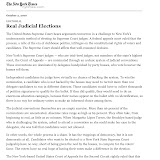
By upholding New York’s machine-dominated system for selecting judges, the Supreme Court has dealt another setback to voters. The court has once again allowed political bosses to rig elections in ways that deny voters a meaningful role. New York’s political power brokers are no doubt cheering, but they should not be allowed to triumph. Even if New York’s method of selecting judges is constitutional, it remains unfair and undemocratic. It needs to be replaced.
New York State Supreme Court justices — who despite their titles are trial-level judges — are selected through a byzantine process. Primary voters select judicial delegates, who then meet in party conventions to choose their nominees. The conventions are generally controlled by political bosses, who often steer the nominations to candidates who deliver patronage back to the party machine. It’s a disgraceful way to choose judges. They are supposed to be above politics.
It’s also a system that makes the voters almost irrelevant. At the polls, they have to choose among judicial delegate slates — when there are competing slates at all — filled with unfamiliar names. It is a far cry from an actual party primary in which voters are allowed to choose among competing judicial candidates. The New York-based United States Court of Appeals for the Second Circuit, in ruling against the system, declared that it unacceptably burdened the constitutional rights of both candidates and voters.
The Supreme Court, unfortunately, disagreed. Justice Antonin Scalia, writing for the majority, dismissed the idea that the right of association requires a process by which voters have a meaningful opportunity to affect an election’s outcome. The ruling is consistent with the court’s recent decisions upholding the right of political bosses to gerrymander political districts. These days, the only election complaints that seem to move the court are ones by corporations and wealthy individuals who object to limits on their ability to spend on elections.
Four justices, in concurring opinions, cast doubt on the wisdom of New York’s method of choosing judges. Justices Anthony Kennedy and Stephen Breyer noted that if the rules “do not produce both the perception and the reality of a system committed to the highest ideals of the law, they ought to be changed and to be changed now.” Justices John Paul Stevens and David Souter quoted Thurgood Marshall: “The Constitution does not prohibit legislatures from enacting stupid laws.”
A stupid — and undemocratic — law is precisely what New York has. Now that the cudgel of a court order has been removed, we hope the Legislature will summon the wisdom and integrity to fix the system voluntarily.
The odds of that happening are long, since the powers that be in the Legislature are the same ones that profit from the current corrupt system. It is, however, a cause that everyone who cares about a qualified and independent judiciary needs to keep fighting.
The New York Times - EDITORIAL
January 17, 2008
By upholding New York’s machine-dominated system for selecting judges, the Supreme Court has dealt another setback to voters. The court has once again allowed political bosses to rig elections in ways that deny voters a meaningful role. New York’s political power brokers are no doubt cheering, but they should not be allowed to triumph. Even if New York’s method of selecting judges is constitutional, it remains unfair and undemocratic. It needs to be replaced.
New York State Supreme Court justices — who despite their titles are trial-level judges — are selected through a byzantine process. Primary voters select judicial delegates, who then meet in party conventions to choose their nominees. The conventions are generally controlled by political bosses, who often steer the nominations to candidates who deliver patronage back to the party machine. It’s a disgraceful way to choose judges. They are supposed to be above politics.
It’s also a system that makes the voters almost irrelevant. At the polls, they have to choose among judicial delegate slates — when there are competing slates at all — filled with unfamiliar names. It is a far cry from an actual party primary in which voters are allowed to choose among competing judicial candidates. The New York-based United States Court of Appeals for the Second Circuit, in ruling against the system, declared that it unacceptably burdened the constitutional rights of both candidates and voters.
The Supreme Court, unfortunately, disagreed. Justice Antonin Scalia, writing for the majority, dismissed the idea that the right of association requires a process by which voters have a meaningful opportunity to affect an election’s outcome. The ruling is consistent with the court’s recent decisions upholding the right of political bosses to gerrymander political districts. These days, the only election complaints that seem to move the court are ones by corporations and wealthy individuals who object to limits on their ability to spend on elections.
Four justices, in concurring opinions, cast doubt on the wisdom of New York’s method of choosing judges. Justices Anthony Kennedy and Stephen Breyer noted that if the rules “do not produce both the perception and the reality of a system committed to the highest ideals of the law, they ought to be changed and to be changed now.” Justices John Paul Stevens and David Souter quoted Thurgood Marshall: “The Constitution does not prohibit legislatures from enacting stupid laws.”
A stupid — and undemocratic — law is precisely what New York has. Now that the cudgel of a court order has been removed, we hope the Legislature will summon the wisdom and integrity to fix the system voluntarily.
The odds of that happening are long, since the powers that be in the Legislature are the same ones that profit from the current corrupt system. It is, however, a cause that everyone who cares about a qualified and independent judiciary needs to keep fighting.
Wednesday, January 16, 2008
New York Post: Idiot Jumper, Idiot Judge (MORE, CLICK HERE)
IDIOT JUMPER, IDIOT JUDGE
New York Post EDITORIAL
January 16, 2008 -- Dumb judges beget dumb lawsuits.
The dumb jurist du jour is state Su preme Court Justice Michael Ambrecht, who last January threw out reckless-endangerment charges against moron parachutist Jeb Corliss.
Because no specific law prohibits parachuting from the Empire State Building - and because Corliss was a trained jumper - he did nothing illegal in trying the stunt in April 2006, Ambrecht ruled.
New York Post EDITORIAL
January 16, 2008 -- Dumb judges beget dumb lawsuits.
The dumb jurist du jour is state Su preme Court Justice Michael Ambrecht, who last January threw out reckless-endangerment charges against moron parachutist Jeb Corliss.
Because no specific law prohibits parachuting from the Empire State Building - and because Corliss was a trained jumper - he did nothing illegal in trying the stunt in April 2006, Ambrecht ruled.
Never mind that Corliss could've seriously injured someone on the ground (or worse) had his parachute failed. Or that he could have landed in the middle of traffic. Or . . . the list could go on.
It's called reckless endangerment - and it's a broad charge for a reason. As it was, Corliss did injure one security officer as he fought with guards who subdued him seconds before his jump.
Not that that mattered to Ambrecht, whose ruling opened the door for countless potential copycats. And now, it appears, a lawsuit.
Corliss filed a $30 million claim against the Empire State Building yesterday, arguing that the guards who prevented his jump not only caused him "severe emotional distress" but endangered his life as well. And why not - if, as Ambrecht ruled, Corliss was completely within his rights to try the stunt?
Fortunately, common sense may yet win out. A four-judge appeals panel last week heard arguments from the Manhattan DA's office urging it to reinstate the charges against Corliss.
Here's hoping it does. Corliss' recklessness should earn him 30 days in Rikers, not a litigation jackpot.
And, in justice, Judge Ambrecht should be sitting right beside him. Sad to say, stupidity isn't a crime.
Cheers for Federal Judge for Knowing When to Recuse (MORE, CLICK HERE)
JUDGE OUT OF B'KLYN ARENA WAR
By RICH CALDER - The New York Post
January 16, 2008 -- A Brooklyn federal judge has removed himself from hearing an appeal on a lawsuit opposing the borough's $4 billion Atlantic Yards project, after admitting in court that he once responded favorably to the controversial plan through a promotional mailer.
Judge Edward Korman was replaced last week on the three-member panel hearing an appeal of a lower-court decision that rejected a suit to block the state's use of eminent domain to acquire private land for developer Bruce Ratner's 22-acre project.
The plan would bring an NBA arena for Ratner's Nets, who would move there from New Jersey, and 16 skyscrapers stretching from Downtown Brooklyn to Prospect Heights.
Project opponents said they believe the mailer was a glossy flier sent out to about 300,000 homes a couple of years ago. Those who sent back a card attached reading, "Yes! I Support Atlantic Yards and the Jobs, Housing, and Open Space it Will Create," received vouchers for two free tickets to a Nets game.
Korman did not return a phone message, but Matthew Brinckerhoff, the opponents' lawyer, said, "I have no reason to doubt" Korman would have voted fairly.
By RICH CALDER - The New York Post
January 16, 2008 -- A Brooklyn federal judge has removed himself from hearing an appeal on a lawsuit opposing the borough's $4 billion Atlantic Yards project, after admitting in court that he once responded favorably to the controversial plan through a promotional mailer.
Judge Edward Korman was replaced last week on the three-member panel hearing an appeal of a lower-court decision that rejected a suit to block the state's use of eminent domain to acquire private land for developer Bruce Ratner's 22-acre project.
The plan would bring an NBA arena for Ratner's Nets, who would move there from New Jersey, and 16 skyscrapers stretching from Downtown Brooklyn to Prospect Heights.
Project opponents said they believe the mailer was a glossy flier sent out to about 300,000 homes a couple of years ago. Those who sent back a card attached reading, "Yes! I Support Atlantic Yards and the Jobs, Housing, and Open Space it Will Create," received vouchers for two free tickets to a Nets game.
Korman did not return a phone message, but Matthew Brinckerhoff, the opponents' lawyer, said, "I have no reason to doubt" Korman would have voted fairly.
Monday, January 14, 2008
New York Ethics Scandal Grows to Third Related Federal Case (MORE, CLICK HERE)
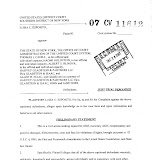
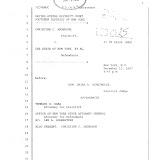
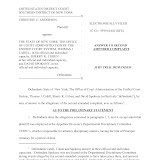
U.S. Federal District Court Judge Shira A. Scheindlin has now approved a third related case in the New York attorney ethics scandal. The latest ruling, entered Monday, January 14, 2008, is Esposito v. The State of New York. (SDNY 07cv11612)
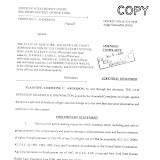
The Esposito case joins Anderson v. The State of New York, which unearthed the apparent long-held practice of cover-ups and whitewashing of complaints against favored attorneys at the Manhattan based attorney Departmental Disciplinary Committee.
The Esposito ruling follows the January 11, 2008 announcement that the 1.5 Billion dollar Iviewit lawsuit, known throughout the world in technical, intellectual property circles as "Patentgate," had also been ruled by Judge Scheindlin as related to the Ethics Scandal. (SDNY Bernstein v. Appellate Division First Department Departmental Disciplinary Committee)
Other filings attempting to be designated by Judge Scheindlin as 'related' to the ethics scandal are expected soon.
Federal Magistrate Judge Douglas F. Eaton has also been assigned to all three cases.
Stay tuned....more to come soon....This is History is the making: Tammany Hall II
CLICK HERE TO SEE THE ESPOSITO STORY
The Esposito case joins Anderson v. The State of New York, which unearthed the apparent long-held practice of cover-ups and whitewashing of complaints against favored attorneys at the Manhattan based attorney Departmental Disciplinary Committee.
The Esposito ruling follows the January 11, 2008 announcement that the 1.5 Billion dollar Iviewit lawsuit, known throughout the world in technical, intellectual property circles as "Patentgate," had also been ruled by Judge Scheindlin as related to the Ethics Scandal. (SDNY Bernstein v. Appellate Division First Department Departmental Disciplinary Committee)
Other filings attempting to be designated by Judge Scheindlin as 'related' to the ethics scandal are expected soon.
Federal Magistrate Judge Douglas F. Eaton has also been assigned to all three cases.
Stay tuned....more to come soon....This is History is the making: Tammany Hall II
CLICK HERE TO SEE THE ESPOSITO STORY
Saturday, January 12, 2008
Lawyers Offer People's Law School (MORE, CLICK HERE)
Trial Lawyers Offer People's Law School
New York Lawyer - January 11, 2008
CASPER, Wyo. (AP) -- Here's a way to learn about the law without getting arrested. The Wyoming Trial Lawyers Association is hosting a series of six-week courses called the People's Law School.
Practicing attorneys teach the courses. They include a traffic investigator, a prosecutor, a criminal defense attorney, a family attorney and a trusts and estates attorney. The classes will be held at Casper College on Wednesdays, starting next week.
Casper attorney Michael Shickich said nearly everyone will come in contact with the legal system at some point in their lives. He said the purpose of the program is to teach people about that system so they're not blindsided.
New York Lawyer - January 11, 2008
CASPER, Wyo. (AP) -- Here's a way to learn about the law without getting arrested. The Wyoming Trial Lawyers Association is hosting a series of six-week courses called the People's Law School.
Practicing attorneys teach the courses. They include a traffic investigator, a prosecutor, a criminal defense attorney, a family attorney and a trusts and estates attorney. The classes will be held at Casper College on Wednesdays, starting next week.
Casper attorney Michael Shickich said nearly everyone will come in contact with the legal system at some point in their lives. He said the purpose of the program is to teach people about that system so they're not blindsided.
Friday, January 11, 2008
NY Federal Judge: Ethics Scandal Cases Related
On Thursday, January 10, 2008, U.S. Federal District Court Judge Shira A. Scheindlin directed that the 1.5 Billion dollar Iviewit “patentgate” case, filed in the U.S. District Court for the Southern District of New York on December 12, 2007, be assigned to her court.
Judge Scheindlin accepted the Iviewit lawsuit, Bernstein v. Appellate Division First Department Departmental Disciplinary Committee, as related to the pending New York attorney ethics scandal case, Anderson v. The State of New York.
Judge Scheindlin accepted the Iviewit lawsuit, Bernstein v. Appellate Division First Department Departmental Disciplinary Committee, as related to the pending New York attorney ethics scandal case, Anderson v. The State of New York.
Allegations of covering-up and whitewashing complaints against favored attorneys find both cases seeking the appointment of a federal monitor to take over New York’s statewide attorney ethics committees. A third lawsuit, filed December 28, 2007, is currently under review by Judge Scheindlin to be designated as an associated case in the state ethics scandal, Tammany Hall II.
Federal Magistrate Judge Douglas F. Eaton has also been assigned to both the Anderson and Iviewit matters.
In another order, signed January 9, 2008, Judge Scheindlin directed U.S. Marshals to serve the Iviewit lawsuit on the listed defendants.
Thursday, January 10, 2008
Spitzer Ignores Court Issues In State of the State Message (MORE, CLICK HERE)
Spitzer Ignores Court Issues In State of the State Message
by Joel Stashenko - January 10, 2008 - The New York Law Journal
ALBANY - Governor Eliot Spitzer ignored the courts and criminal justice yesterday in a State of the State speech focused on jobs, education and, seemingly, patching up his fractured relationship with state lawmakers.
The second-year governor conceded during a joint session of the Legislature that "our differences often attracted more attention than our agreements" during a rocky 2007. The year ended with Senate Republicans subpoenaing the governor's office for documents related to a political dirty tricks scandal against Majority Leader Joseph Bruno.
"I understand that sometimes my talk, perhaps, is a little too plain, too direct," the governor said.
But he told legislators that turning around upstate New York's economy, in part through high-technology research and businesses, is a daunting challenge that can be accomplished only with cooperation between the governor and the Legislature and between Democrats and Republicans.
"Join me in good faith," Mr. Spitzer said. "I will meet you with an open hand, an open door, and an open mind."
Material related to the speech is available at www.ny.gov/governor/sos/.
In his first State of the State speech a year ago, Mr. Spitzer mentioned his support for Chief Judge Judith S. Kaye's plan to reconfigure the nine trial-level courts into three tiers, calling New York's court system the "most complex and costly" in the country. He also said he would push for creation of a merit selection system for state judges (NYLJ, Jan. 4, 2007).
Mr. Spitzer eventually sent legislation on both court consolidation and merit selection to the Legislature, but it was late in the 2007 regular session and neither bill passed. By that time, relations between Mr. Spitzer and the Senate, in particular, had deteriorated to the point where legislators never acted on a host of bills they were negotiating with the governor.
Chief Administrative Judge Ann Pfau, who attended yesterday's speech, said no mention of issues of the highest priority to the judiciary does not mean Mr. Spitzer has abandoned his support. The governor is well aware of the urgency with which state judges want their first pay raise since 1999, she said in an interview.
"He has said publicly that he wants to get this done as part of the budget process and we are expecting that is what he will do," Judge Pfau said. "We would hope to see it in the budget."
Mr. Spitzer is scheduled to present his proposed 2008-09 state budget for the fiscal year beginning April 1, on Jan. 22.
Jennifer Givner, a spokeswoman for Mr. Spitzer, said the governor cannot mention every issue he supports in a 27-page speech and that he has not changed his positions on the judiciary-related items he endorsed in 2007.
As far as judges' pay is concerned, "the governor remains committed to the judicial pay raise," Ms. Givner said yesterday.
The Committee for an Independent Public Defense Commission said it was also awaiting Mr. Spitzer's budget proposal to see if he recommends an initial $6 million in funding for a statewide indigent defense office.
The committee's chairman, Michael Whiteman of Whiteman Osterman & Hanna in Albany, said he was "deeply disappointed" that Mr. Spitzer made no mention yesterday of an indigent defense office. Mr. Spitzer endorsed the concept in the 2006 campaign, but has since been publicly silent about the issue.
"Governor Spitzer missed a golden opportunity to put New York on the road to living up to its professed commitment to equal justice by omitting from his annual message any mention of a state takeover of the state's failed, woeful county-based system of public defense services," Mr. Whiteman said in a statement.
Conciliatory Tone
Mr. Spitzer did announce a plan yesterday to designate 200 state troopers to work side by side with local police officers in high-crime areas. And, while calling the sub-prime lending crisis a national problem, the governor told legislators he would send them a bill to amend the state's foreclosure laws to provide more protections to homeowners.
"We can continue to press banks to agree to mass modification of loans," Mr. Spitzer said. "And we can assure that our court system is not being used to treat homeowners unfairly."
Attorney General Andrew M. Cuomo said in statement after the speech that he was eager to work with Mr. Spitzer's office on solutions to the mortgage crisis.
Mr. Spitzer, whose characterization of himself as a "steamroller" in 2007 hardened attitudes about him in the Legislature, was conciliatory toward lawmakers at several points. He singled out several for their work on individual issues, including two members of Mr. Bruno's Republican majority in the Senate, George Maziarz of Niagara Falls and Dale Volker of Erie County.
"I think this tone that we heard today is more consistent with the Eliot Spitzer that I've known over the long haul," said Comptroller Thomas P. DiNapoli, a former assemblyman from Long Island. "I certainly hope that everyone in the Capitol will meet him halfway with an open mind and an open hand . . . I think he set the right tone."
Mr. Spitzer's lieutenant governor, David Paterson, said Mr. Spitzer sought advice from Republican legislators when formulating several initiatives in his speech, such as a plan to build a $4 billion endowment at the State University of New York.
"I think he is trying to reach out," Mr. Paterson said in an interview. "I think that all of us have self-examined."
Mr. Bruno, R-Brunswick, missed yesterday's speech due to the death Monday of his wife of 57 years, Barbara. Mr. Spitzer asked for a moment of silence for Mrs. Bruno at the beginning of his address. Mr. Bruno had no public comment on the speech.
- Joel Stashenko can be reached at jstashenko@alm.com.
by Joel Stashenko - January 10, 2008 - The New York Law Journal
ALBANY - Governor Eliot Spitzer ignored the courts and criminal justice yesterday in a State of the State speech focused on jobs, education and, seemingly, patching up his fractured relationship with state lawmakers.
The second-year governor conceded during a joint session of the Legislature that "our differences often attracted more attention than our agreements" during a rocky 2007. The year ended with Senate Republicans subpoenaing the governor's office for documents related to a political dirty tricks scandal against Majority Leader Joseph Bruno.
"I understand that sometimes my talk, perhaps, is a little too plain, too direct," the governor said.
But he told legislators that turning around upstate New York's economy, in part through high-technology research and businesses, is a daunting challenge that can be accomplished only with cooperation between the governor and the Legislature and between Democrats and Republicans.
"Join me in good faith," Mr. Spitzer said. "I will meet you with an open hand, an open door, and an open mind."
Material related to the speech is available at www.ny.gov/governor/sos/.
In his first State of the State speech a year ago, Mr. Spitzer mentioned his support for Chief Judge Judith S. Kaye's plan to reconfigure the nine trial-level courts into three tiers, calling New York's court system the "most complex and costly" in the country. He also said he would push for creation of a merit selection system for state judges (NYLJ, Jan. 4, 2007).
Mr. Spitzer eventually sent legislation on both court consolidation and merit selection to the Legislature, but it was late in the 2007 regular session and neither bill passed. By that time, relations between Mr. Spitzer and the Senate, in particular, had deteriorated to the point where legislators never acted on a host of bills they were negotiating with the governor.
Chief Administrative Judge Ann Pfau, who attended yesterday's speech, said no mention of issues of the highest priority to the judiciary does not mean Mr. Spitzer has abandoned his support. The governor is well aware of the urgency with which state judges want their first pay raise since 1999, she said in an interview.
"He has said publicly that he wants to get this done as part of the budget process and we are expecting that is what he will do," Judge Pfau said. "We would hope to see it in the budget."
Mr. Spitzer is scheduled to present his proposed 2008-09 state budget for the fiscal year beginning April 1, on Jan. 22.
Jennifer Givner, a spokeswoman for Mr. Spitzer, said the governor cannot mention every issue he supports in a 27-page speech and that he has not changed his positions on the judiciary-related items he endorsed in 2007.
As far as judges' pay is concerned, "the governor remains committed to the judicial pay raise," Ms. Givner said yesterday.
The Committee for an Independent Public Defense Commission said it was also awaiting Mr. Spitzer's budget proposal to see if he recommends an initial $6 million in funding for a statewide indigent defense office.
The committee's chairman, Michael Whiteman of Whiteman Osterman & Hanna in Albany, said he was "deeply disappointed" that Mr. Spitzer made no mention yesterday of an indigent defense office. Mr. Spitzer endorsed the concept in the 2006 campaign, but has since been publicly silent about the issue.
"Governor Spitzer missed a golden opportunity to put New York on the road to living up to its professed commitment to equal justice by omitting from his annual message any mention of a state takeover of the state's failed, woeful county-based system of public defense services," Mr. Whiteman said in a statement.
Conciliatory Tone
Mr. Spitzer did announce a plan yesterday to designate 200 state troopers to work side by side with local police officers in high-crime areas. And, while calling the sub-prime lending crisis a national problem, the governor told legislators he would send them a bill to amend the state's foreclosure laws to provide more protections to homeowners.
"We can continue to press banks to agree to mass modification of loans," Mr. Spitzer said. "And we can assure that our court system is not being used to treat homeowners unfairly."
Attorney General Andrew M. Cuomo said in statement after the speech that he was eager to work with Mr. Spitzer's office on solutions to the mortgage crisis.
Mr. Spitzer, whose characterization of himself as a "steamroller" in 2007 hardened attitudes about him in the Legislature, was conciliatory toward lawmakers at several points. He singled out several for their work on individual issues, including two members of Mr. Bruno's Republican majority in the Senate, George Maziarz of Niagara Falls and Dale Volker of Erie County.
"I think this tone that we heard today is more consistent with the Eliot Spitzer that I've known over the long haul," said Comptroller Thomas P. DiNapoli, a former assemblyman from Long Island. "I certainly hope that everyone in the Capitol will meet him halfway with an open mind and an open hand . . . I think he set the right tone."
Mr. Spitzer's lieutenant governor, David Paterson, said Mr. Spitzer sought advice from Republican legislators when formulating several initiatives in his speech, such as a plan to build a $4 billion endowment at the State University of New York.
"I think he is trying to reach out," Mr. Paterson said in an interview. "I think that all of us have self-examined."
Mr. Bruno, R-Brunswick, missed yesterday's speech due to the death Monday of his wife of 57 years, Barbara. Mr. Spitzer asked for a moment of silence for Mrs. Bruno at the beginning of his address. Mr. Bruno had no public comment on the speech.
- Joel Stashenko can be reached at jstashenko@alm.com.
Tuesday, January 8, 2008
Partner Must Face Charges Over Wiretapping Billionaire's Ex (MORE, CLICK HERE)
Partner Must Face Charges Over Wiretapping Billionaire's Ex
New York Lawyer - January 8, 2008
By Amanda Bronstad - The National Law Journal
LOS ANGELES — A federal judge in Los Angeles has rejected two motions seeking to dismiss charges against lawyer Terry Christensen in the government's wiretapping and racketeering case against private investigator Anthony Pellicano.
The rulings, which were issued last month, were unsealed and provided to the public on Monday.
For more than two years, federal prosecutors have pursued charges against more than a dozen individuals with links to Pellicano, a celebrity sleuth frequently hired by lawyers on behalf of clients. Christensen, the only lawyer indicted as part of the wiretapping probe, is accused of paying at least $100,000 to Pellicano, who illegally wiretapped the phones of Lisa Bonder Kerkorian, the ex-wife of billionaire Kirk Kerkorian, during a child custody dispute six years ago. He is currently a partner at Los Angeles-based Christensen, Glaser, Fink, Jacobs, Weil & Shapiro.
In one motion, Christensen had sought to dismiss the charges against him because investigators illegally submitted audio recordings that were supposed to be protected under attorney-client privilege. Those audio recordings were obtained during a search of Pellicano's office and include a conversation between Christensen and Pellicano.
Alternatively, he sought to toss the audio recordings from the case.
U.S. District Judge Dale Fischer, for the Central District of California, refused to dismiss the charges on those grounds, noting that investigators still have a case based on related non-privileged information. But she agreed to conduct an in camera review of the audio recordings to determine if they are privileged.
The motion is the only one to seek dismissal based on attorney-client privilege issues.
Terree Bowers, a partner in the Los Angeles office of Howrey, who represents Christensen, said he has appealed the ruling to the 9th U.S. Circuit Court of Appeals. He declined to comment further.
In the second ruling, Fischer rejected a request brought by Christensen and Pellicano to conduct a Franks hearing in relation to a search warrant.
"Obviously, we're very pleased with the judge's rulings on these two motions," said Thom Mrozek, a spokesman for the U.S. Attorney's Office for the Central District of California.
Last month, Fischer rejected six related motions to dismiss the indictment.
New York Lawyer - January 8, 2008
By Amanda Bronstad - The National Law Journal
LOS ANGELES — A federal judge in Los Angeles has rejected two motions seeking to dismiss charges against lawyer Terry Christensen in the government's wiretapping and racketeering case against private investigator Anthony Pellicano.
The rulings, which were issued last month, were unsealed and provided to the public on Monday.
For more than two years, federal prosecutors have pursued charges against more than a dozen individuals with links to Pellicano, a celebrity sleuth frequently hired by lawyers on behalf of clients. Christensen, the only lawyer indicted as part of the wiretapping probe, is accused of paying at least $100,000 to Pellicano, who illegally wiretapped the phones of Lisa Bonder Kerkorian, the ex-wife of billionaire Kirk Kerkorian, during a child custody dispute six years ago. He is currently a partner at Los Angeles-based Christensen, Glaser, Fink, Jacobs, Weil & Shapiro.
In one motion, Christensen had sought to dismiss the charges against him because investigators illegally submitted audio recordings that were supposed to be protected under attorney-client privilege. Those audio recordings were obtained during a search of Pellicano's office and include a conversation between Christensen and Pellicano.
Alternatively, he sought to toss the audio recordings from the case.
U.S. District Judge Dale Fischer, for the Central District of California, refused to dismiss the charges on those grounds, noting that investigators still have a case based on related non-privileged information. But she agreed to conduct an in camera review of the audio recordings to determine if they are privileged.
The motion is the only one to seek dismissal based on attorney-client privilege issues.
Terree Bowers, a partner in the Los Angeles office of Howrey, who represents Christensen, said he has appealed the ruling to the 9th U.S. Circuit Court of Appeals. He declined to comment further.
In the second ruling, Fischer rejected a request brought by Christensen and Pellicano to conduct a Franks hearing in relation to a search warrant.
"Obviously, we're very pleased with the judge's rulings on these two motions," said Thom Mrozek, a spokesman for the U.S. Attorney's Office for the Central District of California.
Last month, Fischer rejected six related motions to dismiss the indictment.
Six Lawyers Sanctioned for "Monumental" Discovery Violations, Face Ethics Probe (MORE, CLICK HERE)
Six Lawyers Sanctioned for "Monumental" Discovery Violations, Face Ethics Probe
New York Lawyer - January 8, 2008
By Zusha Elinson and Dan Levine - The Recorder
Six attorneys in the Qualcomm Inc. discovery fiasco were sanctioned Monday for "monumental" discovery violations and referred to the State Bar of California for possible discipline.
Day Casebeer Madrid & Batchelder attorneys James Batchelder, Adam Bier, Kevin Leung, Christian Mammen and Lee Patch, and Heller Ehrman's Stanley Young were sanctioned and harshly criticized by U.S. Magistrate Judge Barbara Major in a 42-page order. The ruling follows a patent infringement trial Qualcomm had brought against Broadcom Corp.
The attorneys "assisted Qualcomm in committing this incredible discovery violation by intentionally hiding or recklessly ignoring relevant documents, ignoring or rejecting numerous warning signs that Qualcomm's document search was inadequate, and blindly accepting Qualcomm's unsupported assurances that its document search was adequate," Major wrote.
The judge also sanctioned Qualcomm for intentionally withholding "tens of thousands of e-mails." Qualcomm will have to pay Broadcom's $8.5 million attorney fees -- though that award mirrors a sanction already imposed by another judge.
The long-awaited ruling closes a chapter on the Qualcomm discovery saga and passes the baton to the State Bar of California for further investigation. Attorneys across the country have watched the case evolve as a cautionary tale of discovery violations even when highly respected litigators are on the case.
Lawrence Keeshan, a partner at Heller Ehrman, said the firm is pleased that the court did not sanction other Heller attorneys involved in the case. "However, we believe the sanctions imposed on Stanley Young are unwarranted," Keeshan said. "This is especially true as Mr. Young did not have the opportunity to tell his full story to the court, because he was prevented from doing so by the attorney-client privilege."
William Boggs, the DLA Piper partner who serves as Qualcomm's corporate counsel, said the company is considering its options, including further appeal.
Said Broadcom vice president of IP litigation David Rosmann, "I don't think anybody can look at this and feel happy."
New York Lawyer - January 8, 2008
By Zusha Elinson and Dan Levine - The Recorder
Six attorneys in the Qualcomm Inc. discovery fiasco were sanctioned Monday for "monumental" discovery violations and referred to the State Bar of California for possible discipline.
Day Casebeer Madrid & Batchelder attorneys James Batchelder, Adam Bier, Kevin Leung, Christian Mammen and Lee Patch, and Heller Ehrman's Stanley Young were sanctioned and harshly criticized by U.S. Magistrate Judge Barbara Major in a 42-page order. The ruling follows a patent infringement trial Qualcomm had brought against Broadcom Corp.
The attorneys "assisted Qualcomm in committing this incredible discovery violation by intentionally hiding or recklessly ignoring relevant documents, ignoring or rejecting numerous warning signs that Qualcomm's document search was inadequate, and blindly accepting Qualcomm's unsupported assurances that its document search was adequate," Major wrote.
The judge also sanctioned Qualcomm for intentionally withholding "tens of thousands of e-mails." Qualcomm will have to pay Broadcom's $8.5 million attorney fees -- though that award mirrors a sanction already imposed by another judge.
The long-awaited ruling closes a chapter on the Qualcomm discovery saga and passes the baton to the State Bar of California for further investigation. Attorneys across the country have watched the case evolve as a cautionary tale of discovery violations even when highly respected litigators are on the case.
Lawrence Keeshan, a partner at Heller Ehrman, said the firm is pleased that the court did not sanction other Heller attorneys involved in the case. "However, we believe the sanctions imposed on Stanley Young are unwarranted," Keeshan said. "This is especially true as Mr. Young did not have the opportunity to tell his full story to the court, because he was prevented from doing so by the attorney-client privilege."
William Boggs, the DLA Piper partner who serves as Qualcomm's corporate counsel, said the company is considering its options, including further appeal.
Said Broadcom vice president of IP litigation David Rosmann, "I don't think anybody can look at this and feel happy."
Monday, January 7, 2008
Judge Suspended for Dual Role as Jurist and Lawyer (MORE, CLICK HERE)
I Object! I Sustain Me!: Local Judge Suspended for Dual Role as Jurist and Lawyer in Three Cases
New York Lawyer - News Watch - January 7, 2008
By Douglas S. Malan - The Connecticut Law Tribune
Richard J. Guliani's 16-year term as probate judge for the District of Portland included his handling three cases in which he served not only as judge but also as attorney. This conflict of interest earned Guliani a six-month suspension from practicing law, starting Dec. 10 and running through June 5.
Guliani admitted wrongdoing in August, nearly one year after he had served a 30-day suspension for failing to communicate with a client regarding an irrevocable trust worth more than $100,000.
His term as probate judge ended in January 2007 after he declined to seek re-election.
Judge James J. Lawlor, the state's probate court administrator, filed the grievance after Guliani's successor in Portland, Stephen E. Kinsella, discovered Guliani's unethical behavior when reviewing a matter involving the late Vincent W. Olson's estate, which remains open.
"It was a huge disappointment to me," Lawlor said. "We still have outstanding issues" because of Guliani's misconduct.
Kinsella found that in 1998, Guliani represented Olson's daughter, Shirley, who was executrix of the estate. Guliani granted the daughter real estate from her father's will without "a finding that it was in the best interests of the parties" involved, according to the determination of probable causeby the Middletown Judicial District grievance panel.
In the Olson case, Guliani ruled that his $15,000 in legal fees were "presumptively reasonable."
He based the figure on a fee schedule that stated the reasonable fee for the work he performed "would be an amount not more than 4.5 percent of the gross taxable estate."
"This schedule is used by some Probate Courts to determine if fiduciary and legal fees claimed in an estate are reasonable and not subject to further question or inquiry by a Probate Court," he explained to Olson in a November 1998 letter.
The local grievance panel also determined that Guliani used the probate court office for his own private practice. Letterhead for Guliani's law firm that he used in correspondence with Olson includes a telephone and fax number that connects to the probate court offices in Portland.
Lawlor also charged, and the grievance panel confirmed, that Guliani involved himself in two other files as both attorney and judge. These included an estate for which he improperly rescinded an admission of the will to probate and an estate for which he served as witness to a will and had a claim filed for $650 in legal services.
Guliani, who was admitted to the bar in 1977, did not respond to a message left on his answering machine seeking comment.
His disciplinary history includes three reprimands in 2004 for failing to pay fees associated with real estate closings and failing to respond to a grievance.
Guliani did not respond to Lawlor's complaint but did sign his name last August to the presentment order that led to his suspension.
Lawlor said recent legislation has empowered his office to remove cases to other judges if he determines it necessary, though he does not have the power to sanction judges.
"We have more ability to intercede and ensure that services are being delivered properly," Lawlor said.
Portland attorney George A. Law was appointed trustee for Guliani's clients. He filed a motion in late December asking the court for guidance in handling the matter because Guliani has failed to communicate or cooperate with him.
New York Lawyer - News Watch - January 7, 2008
By Douglas S. Malan - The Connecticut Law Tribune
Richard J. Guliani's 16-year term as probate judge for the District of Portland included his handling three cases in which he served not only as judge but also as attorney. This conflict of interest earned Guliani a six-month suspension from practicing law, starting Dec. 10 and running through June 5.
Guliani admitted wrongdoing in August, nearly one year after he had served a 30-day suspension for failing to communicate with a client regarding an irrevocable trust worth more than $100,000.
His term as probate judge ended in January 2007 after he declined to seek re-election.
Judge James J. Lawlor, the state's probate court administrator, filed the grievance after Guliani's successor in Portland, Stephen E. Kinsella, discovered Guliani's unethical behavior when reviewing a matter involving the late Vincent W. Olson's estate, which remains open.
"It was a huge disappointment to me," Lawlor said. "We still have outstanding issues" because of Guliani's misconduct.
Kinsella found that in 1998, Guliani represented Olson's daughter, Shirley, who was executrix of the estate. Guliani granted the daughter real estate from her father's will without "a finding that it was in the best interests of the parties" involved, according to the determination of probable causeby the Middletown Judicial District grievance panel.
In the Olson case, Guliani ruled that his $15,000 in legal fees were "presumptively reasonable."
He based the figure on a fee schedule that stated the reasonable fee for the work he performed "would be an amount not more than 4.5 percent of the gross taxable estate."
"This schedule is used by some Probate Courts to determine if fiduciary and legal fees claimed in an estate are reasonable and not subject to further question or inquiry by a Probate Court," he explained to Olson in a November 1998 letter.
The local grievance panel also determined that Guliani used the probate court office for his own private practice. Letterhead for Guliani's law firm that he used in correspondence with Olson includes a telephone and fax number that connects to the probate court offices in Portland.
Lawlor also charged, and the grievance panel confirmed, that Guliani involved himself in two other files as both attorney and judge. These included an estate for which he improperly rescinded an admission of the will to probate and an estate for which he served as witness to a will and had a claim filed for $650 in legal services.
Guliani, who was admitted to the bar in 1977, did not respond to a message left on his answering machine seeking comment.
His disciplinary history includes three reprimands in 2004 for failing to pay fees associated with real estate closings and failing to respond to a grievance.
Guliani did not respond to Lawlor's complaint but did sign his name last August to the presentment order that led to his suspension.
Lawlor said recent legislation has empowered his office to remove cases to other judges if he determines it necessary, though he does not have the power to sanction judges.
"We have more ability to intercede and ensure that services are being delivered properly," Lawlor said.
Portland attorney George A. Law was appointed trustee for Guliani's clients. He filed a motion in late December asking the court for guidance in handling the matter because Guliani has failed to communicate or cooperate with him.
Sunday, January 6, 2008
The Integrity-less State of New York (MORE, CLICK HERE)
A recent New York Post Editorial:
COMMISSION FOR SALE
January 2, 2008 -- Forget integrity - do Gov. Spitzer and his supposedly "independent" Public Integrity Commission have any shame?
As The Post's Fredric U. Dicker reported Monday, Commission Executive Director Herbert Teitelbaum recently accepted a $15,000 pay hike - and promptly scurried off to a 21/2-week vacation in South America.
Teitelbaum's near-11 percent raise comes only months after his appointment to the panel - and right in the middle of his commission's unprecedented investigation into the governor's role in his office's Dirty Tricks Scandal.
That's a problem.
Let's be clear: Teitelbaum's commission is currently engaged in an investigation that could have dramatic consequences for Spitzer and his entire administration.
If, after months of denial but little forthrightness, the governor is found to have had any foreknowledge of his aides' plot to use the State Police to dig up dirt on a political rival, he stands to lose a lot more than just the public trust. (Which has long since vanished, anyway.)
The commission, to put it mildly, must not only be above reproach, it must appear to be above reproach.
Under the circumstances, a 15-cent raise would be inappropriate, let alone $15,000.
The commission, to be sure, makes much of its "independence" from the executive chamber; it was Commission Chairman John Feerick, not Spitzer himself, who technically approved the raise.
But that independence is looking more and more like a sad charade. Seven of the 13 commissioners are Spitzer appointees, and Teitelbaum himself has close ties to the Spitzer administration.
Which, needless to say, makes it all the more incumbent upon Feerick, Teitelbaum and - ultimately - Spitzer himself to prove that nobody at the commission is pulling any punches in this investigation.
An extra 15-grand from the Spitzer-administered state treasury sure doesn't help.
This is not to accuse the gov of attempting to buy off his investigators - as New Yorkers have already seen, Spitzer has a range of other weapons at his disposal when it comes to stonewalling probes.
But that neither Spitzer, Feerick nor Teitelbaum see any problem with such a raise speaks volumes to the seriousness (or lack thereof) with which they take the commission's probe.
Or are they really that morally obtuse?
Could it be that they just don't care?
Either way, it's a pretty good indication that the entire investigation was never meant to be more than a farce, to begin with.
And that makes Teitelbaum's entire $155,000 salary little more than a giant waste of taxpayer money.
Not to mention, grounds for a much longer vacation.
COMMISSION FOR SALE
January 2, 2008 -- Forget integrity - do Gov. Spitzer and his supposedly "independent" Public Integrity Commission have any shame?
As The Post's Fredric U. Dicker reported Monday, Commission Executive Director Herbert Teitelbaum recently accepted a $15,000 pay hike - and promptly scurried off to a 21/2-week vacation in South America.
Teitelbaum's near-11 percent raise comes only months after his appointment to the panel - and right in the middle of his commission's unprecedented investigation into the governor's role in his office's Dirty Tricks Scandal.
That's a problem.
Let's be clear: Teitelbaum's commission is currently engaged in an investigation that could have dramatic consequences for Spitzer and his entire administration.
If, after months of denial but little forthrightness, the governor is found to have had any foreknowledge of his aides' plot to use the State Police to dig up dirt on a political rival, he stands to lose a lot more than just the public trust. (Which has long since vanished, anyway.)
The commission, to put it mildly, must not only be above reproach, it must appear to be above reproach.
Under the circumstances, a 15-cent raise would be inappropriate, let alone $15,000.
The commission, to be sure, makes much of its "independence" from the executive chamber; it was Commission Chairman John Feerick, not Spitzer himself, who technically approved the raise.
But that independence is looking more and more like a sad charade. Seven of the 13 commissioners are Spitzer appointees, and Teitelbaum himself has close ties to the Spitzer administration.
Which, needless to say, makes it all the more incumbent upon Feerick, Teitelbaum and - ultimately - Spitzer himself to prove that nobody at the commission is pulling any punches in this investigation.
An extra 15-grand from the Spitzer-administered state treasury sure doesn't help.
This is not to accuse the gov of attempting to buy off his investigators - as New Yorkers have already seen, Spitzer has a range of other weapons at his disposal when it comes to stonewalling probes.
But that neither Spitzer, Feerick nor Teitelbaum see any problem with such a raise speaks volumes to the seriousness (or lack thereof) with which they take the commission's probe.
Or are they really that morally obtuse?
Could it be that they just don't care?
Either way, it's a pretty good indication that the entire investigation was never meant to be more than a farce, to begin with.
And that makes Teitelbaum's entire $155,000 salary little more than a giant waste of taxpayer money.
Not to mention, grounds for a much longer vacation.
Saturday, January 5, 2008
Hint of Justice: Brooke Astor Judge Scarpino Reverses Self (MORE, CLICK HERE)
DELAY IN ASTOR ESTATE OF WAR
By DAREH GREGORIAN - The New York Post
January 5, 2008 -- After Manhattan prosecutors won a delay, the battle over Brooke Astor's $190 million estate is on ice until at least May.
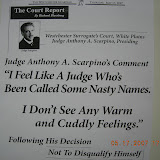
Citing the pending criminal case against the philanthropist's son, Westchester Surrogate's Court Judge Anthony Scarpino issued a stay yesterday.
Manhattan prosecutors say Anthony Marshall, 83, abused his mom's mental frailty to help himself to millions of her dollars and coerce her into leaving him more in her will.
Witnesses were to start testifying Monday in the civil-court fight over which will is legitimate. Scarpino ordered this week that the earliest scheduled depositions go forward. The new ruling reverses that decision.
The parties are due back before Scarpino on May 7.
By DAREH GREGORIAN - The New York Post
January 5, 2008 -- After Manhattan prosecutors won a delay, the battle over Brooke Astor's $190 million estate is on ice until at least May.
Citing the pending criminal case against the philanthropist's son, Westchester Surrogate's Court Judge Anthony Scarpino issued a stay yesterday.
Manhattan prosecutors say Anthony Marshall, 83, abused his mom's mental frailty to help himself to millions of her dollars and coerce her into leaving him more in her will.
Witnesses were to start testifying Monday in the civil-court fight over which will is legitimate. Scarpino ordered this week that the earliest scheduled depositions go forward. The new ruling reverses that decision.
The parties are due back before Scarpino on May 7.
New York DA Blasted for "Flagrant" Flouting of Ethics, Fairness (MORE, CLICK HERE)
NY DA Blasted for "Flagrant" Flouting of Ethics, Fairness
New York Lawyer - January 4, 2008
By Noeleen G. Walder - New York Law Journal
An appellate court has sharply criticized the Bronx District Attorney's Office for a "flagrant violation...of [its] constitutional and ethical obligations" to turn over matter favorable to the defense pursuant to Brady v. Maryland, 373 U.S. 83 (1963).
The Appellate Division, First Department, in People v. Garcia, 1085, 1086, last week ruled unanimously that Pedro Garcia and his wife, Betzayda Melendez, must be given a new trial on charges that they kidnapped a 13-year-old girl and forced her to board a flight to Puerto Rico.
The defendants were tried in absentia by a jury. In 2002, they were sentenced to 20 years in prison for second-degree kidnapping and endangering the welfare of a minor. They have been incarcerated for more than six years. Their convictions were vacated on Nov. 2, 2006, by Bronx County Supreme Court Justice Steven Lloyd Barrett, but the district attorney's office appealed.
The First Department agreed with Justice Barrett that "the prosecution wilfully suppressed evidence, in their possession, from flight attendants that contradicted the complainant's claim that she created a disturbance and vociferously protested to the attendants that she was being taken against her will by defendant Melendez on a flight to Puerto Rico."
The First Department panel said, "it is disquieting that the People's brief refers to this failure to disclose 'an arguable lapse of preferred practice.' This was a flagrant violation by the prosecutor of his constitutional and ethical obligations."
According to the unsigned decision, which was published in the Law Journal on Dec. 31, 2007, page 33, each of the attendants on the flight to Puerto Rico had informed the prosecutor before the trial that there had been no disturbance on the plane. The court said this information was clearly favorable to the defendants as "it was inconsistent with a fundamental aspect of the People's case" — that the girl had "actively resisted" after being "physically restrained" and forced onto the flight.
And the panel suggested that the availability of the evidence could have made a big difference to the outcome. The flight attendants' testimony would have offered a "markedly different account of the events on the airplane, and would have significantly impeached the complainant's credibility," the court wrote.
In this regard, it adopted the opinion of Justice Barrett, who wrote in vacating the verdict that "this meaningful impeachment evidence may well have proven determinative to the evaluation of a case in which serious doubts coexisted with the chilling accusations and in which the key witness' credibility was under attack."
Mr. Garcia was the superintendent of the building in which the girl lived. The First Department noted that the trial court found details of the girl's testimony "baffling," including the absence of ransom demands, her captivity in the same building as her parents, and the fact that the boiler room where she allegedly was kept had no locks and "could be opened quite easily from the inside."
The case was prosecuted by Assistant District Attorney Scott David Staton. Steven Reed, a spokesman for the district attorney’s office, said that Mr. Staton has since left the office for reasons unconnected with the case.
In an e-mailed statement yesterday, Bronx District Attorney Robert T. Johnson said, "While we certainly agree that all of the details should have been turned over, it is significant that the names of the airline witnesses were disclosed to, known to, and available to the defense."
However, the First Department specifically rejected this argument, noting that the prosecution only disclosed the flight attendants' names, without providing contact information or the type of information the attendants possessed. The names also were "buried in a voluminous amount of discovery provided shortly before trial, and were not identified as Brady material," the court wrote.
While one of the flight attendants was identified as a potential witness, the panel found it "irrelevant" whether defense attorneys "could have discovered or should have known" that the attendants' testimony would contradict the prosecution's version of events. According to the ruling, the prosecution had an independent obligation to disclose that fact.
Even "more disturbing" was the prosecution's use of the suppressed evidence at summation, the decision said.
One of the defense attorneys argued that the fact that none of the attendants had testified supported an inference that they would have contradicted the prosecutions.
In response, Mr. Staton asked the jury, "Who else do we have, airport security, airplane stewardess? Why weren't there people brought in?" He suggested that "this is a conspiracy of passivity. No one gets involved, no one wants to be bothered."
The appellate panel agreed with Justice Barrett that this argument was "most charitably, disingenuous."
Joining in the decision were Justices David B. Saxe, David Friedman, George D. Marlow, Joseph P. Sullivan, and James M. McGuire.
Sara Gurwitch of the Office of the Appellate Defender, who represented Mr. Garcia, said in an interview that the prosecution's conduct had been "outrageous" and "shocking."
Robert S. Dean and David J. Klem of the Center for Appellate Litigation represented Ms. Melendez.
Lawrence H. Cunningham handled the appeal for the Bronx district attorney. Mr. Reed said the agency is reviewing the case to see if it will retry the two defendants.
New York Lawyer - January 4, 2008
By Noeleen G. Walder - New York Law Journal
An appellate court has sharply criticized the Bronx District Attorney's Office for a "flagrant violation...of [its] constitutional and ethical obligations" to turn over matter favorable to the defense pursuant to Brady v. Maryland, 373 U.S. 83 (1963).
The Appellate Division, First Department, in People v. Garcia, 1085, 1086, last week ruled unanimously that Pedro Garcia and his wife, Betzayda Melendez, must be given a new trial on charges that they kidnapped a 13-year-old girl and forced her to board a flight to Puerto Rico.
The defendants were tried in absentia by a jury. In 2002, they were sentenced to 20 years in prison for second-degree kidnapping and endangering the welfare of a minor. They have been incarcerated for more than six years. Their convictions were vacated on Nov. 2, 2006, by Bronx County Supreme Court Justice Steven Lloyd Barrett, but the district attorney's office appealed.
The First Department agreed with Justice Barrett that "the prosecution wilfully suppressed evidence, in their possession, from flight attendants that contradicted the complainant's claim that she created a disturbance and vociferously protested to the attendants that she was being taken against her will by defendant Melendez on a flight to Puerto Rico."
The First Department panel said, "it is disquieting that the People's brief refers to this failure to disclose 'an arguable lapse of preferred practice.' This was a flagrant violation by the prosecutor of his constitutional and ethical obligations."
According to the unsigned decision, which was published in the Law Journal on Dec. 31, 2007, page 33, each of the attendants on the flight to Puerto Rico had informed the prosecutor before the trial that there had been no disturbance on the plane. The court said this information was clearly favorable to the defendants as "it was inconsistent with a fundamental aspect of the People's case" — that the girl had "actively resisted" after being "physically restrained" and forced onto the flight.
And the panel suggested that the availability of the evidence could have made a big difference to the outcome. The flight attendants' testimony would have offered a "markedly different account of the events on the airplane, and would have significantly impeached the complainant's credibility," the court wrote.
In this regard, it adopted the opinion of Justice Barrett, who wrote in vacating the verdict that "this meaningful impeachment evidence may well have proven determinative to the evaluation of a case in which serious doubts coexisted with the chilling accusations and in which the key witness' credibility was under attack."
Mr. Garcia was the superintendent of the building in which the girl lived. The First Department noted that the trial court found details of the girl's testimony "baffling," including the absence of ransom demands, her captivity in the same building as her parents, and the fact that the boiler room where she allegedly was kept had no locks and "could be opened quite easily from the inside."
The case was prosecuted by Assistant District Attorney Scott David Staton. Steven Reed, a spokesman for the district attorney’s office, said that Mr. Staton has since left the office for reasons unconnected with the case.
In an e-mailed statement yesterday, Bronx District Attorney Robert T. Johnson said, "While we certainly agree that all of the details should have been turned over, it is significant that the names of the airline witnesses were disclosed to, known to, and available to the defense."
However, the First Department specifically rejected this argument, noting that the prosecution only disclosed the flight attendants' names, without providing contact information or the type of information the attendants possessed. The names also were "buried in a voluminous amount of discovery provided shortly before trial, and were not identified as Brady material," the court wrote.
While one of the flight attendants was identified as a potential witness, the panel found it "irrelevant" whether defense attorneys "could have discovered or should have known" that the attendants' testimony would contradict the prosecution's version of events. According to the ruling, the prosecution had an independent obligation to disclose that fact.
Even "more disturbing" was the prosecution's use of the suppressed evidence at summation, the decision said.
One of the defense attorneys argued that the fact that none of the attendants had testified supported an inference that they would have contradicted the prosecutions.
In response, Mr. Staton asked the jury, "Who else do we have, airport security, airplane stewardess? Why weren't there people brought in?" He suggested that "this is a conspiracy of passivity. No one gets involved, no one wants to be bothered."
The appellate panel agreed with Justice Barrett that this argument was "most charitably, disingenuous."
Joining in the decision were Justices David B. Saxe, David Friedman, George D. Marlow, Joseph P. Sullivan, and James M. McGuire.
Sara Gurwitch of the Office of the Appellate Defender, who represented Mr. Garcia, said in an interview that the prosecution's conduct had been "outrageous" and "shocking."
Robert S. Dean and David J. Klem of the Center for Appellate Litigation represented Ms. Melendez.
Lawrence H. Cunningham handled the appeal for the Bronx district attorney. Mr. Reed said the agency is reviewing the case to see if it will retry the two defendants.
Friday, January 4, 2008
Assistant Queens DA Probed in Mob Plea (MORE, CLICK HERE)
Assistant Qns. DA Probed in Mob Plea
The New York Post - Friday, January 4, 2008
By PHILIP MESSING, IKIMULISA LIVINGSTON and JEANE MacINTOSH
January 4, 2008 -- A veteran Queens prosecutor is the target of a corruption probe after a mob-tied coke dealer said he was offered a sweetheart plea deal in exchange for hiring the official's purported boyfriend as a lawyer, sources told The Post.
Assistant District Attorney Barbara Wilkanowski allegedly offered reputed Genovese associate Joseph Bonelli a no-jail deal on two cases - including a drug-sale rap for which he faced up to 25 years in prison - if he hired her boyfriend, Manhattan lawyer Robert Kelly, to defend him.
"She approached Bonelli through a friend of a friend and offered her assistance," said a source familiar with the case. Bonelli, 26, had been arrested for selling cocaine in July 2006 and was arrested on a weapon charge two months later.
He did hire Kelly for his defense - but the lawyer recently pulled out of the case, citing illness.
Bonelli, who pleaded guilty to both sets of charges on Dec. 26 but hasn't been sentenced, recently went to Wilkanowski's bosses with his claim.
"The representation that the ADA made . . . obviously was not coming to fruition," a court source said. A rep for Queens DA Richard Brown said that Wilkanowski, 45, was put on leave Dec. 17 and that Bonelli's claims were "being investigated."
Wilkanowski could not be reached for comment yesterday. A source close to her insisted Wilkanowski "has no involvement in the Bonelli case at all." Neither Kelly nor his recently hired defense lawyer, Marvin Ruskin, returned calls.
Additional reporting by Lorena Mongelli - philip.messing@nypost.com
The New York Post - Friday, January 4, 2008
By PHILIP MESSING, IKIMULISA LIVINGSTON and JEANE MacINTOSH
January 4, 2008 -- A veteran Queens prosecutor is the target of a corruption probe after a mob-tied coke dealer said he was offered a sweetheart plea deal in exchange for hiring the official's purported boyfriend as a lawyer, sources told The Post.
Assistant District Attorney Barbara Wilkanowski allegedly offered reputed Genovese associate Joseph Bonelli a no-jail deal on two cases - including a drug-sale rap for which he faced up to 25 years in prison - if he hired her boyfriend, Manhattan lawyer Robert Kelly, to defend him.
"She approached Bonelli through a friend of a friend and offered her assistance," said a source familiar with the case. Bonelli, 26, had been arrested for selling cocaine in July 2006 and was arrested on a weapon charge two months later.
He did hire Kelly for his defense - but the lawyer recently pulled out of the case, citing illness.
Bonelli, who pleaded guilty to both sets of charges on Dec. 26 but hasn't been sentenced, recently went to Wilkanowski's bosses with his claim.
"The representation that the ADA made . . . obviously was not coming to fruition," a court source said. A rep for Queens DA Richard Brown said that Wilkanowski, 45, was put on leave Dec. 17 and that Bonelli's claims were "being investigated."
Wilkanowski could not be reached for comment yesterday. A source close to her insisted Wilkanowski "has no involvement in the Bonelli case at all." Neither Kelly nor his recently hired defense lawyer, Marvin Ruskin, returned calls.
Additional reporting by Lorena Mongelli - philip.messing@nypost.com
NYS Courts: To Hell With Ethics, We Want More Money (MORE, CLICK HERE)
Kaye Proposes New Measure To Boost Pay of State Judges
By Joel Stashenko - January 4, 2008 - The New York Law Journal
ALBANY — A new judicial pay raise proposal offered yesterday by Chief Judge Judith S. Kaye would surrender some ground on retroactivity while tying future increases to salaries and cost-of-living adjustments given to federal judges.
The legislation would provide for retroactive raises for state judges to Jan. 1, 2007. Previous proposals by the chief judge, most recently in the judiciary’s budget plan for the 2008-09 fiscal year, provided for retroactivity to April 1, 2005 — a time frame that was seen as an increasingly hard sell in Albany as the delay over passage of a judicial pay bill has dragged on.
In a cover letter accompanying the proposed bill, Chief Judge Kaye did ask that the Legislature at least consider the April 1, 2005, retroactivity date.
Chief Administrative Judge Ann Pfau said yesterday the new proposal is styled on a judicial pay raise bill approved by the Senate last month (NYLJ, Dec. 14, 2007). Its filing, even before the Legislature has begun its 2008 session, is timed to reaffirm that pay remains the overarching issue for the judiciary, she said.
"For us, this is our total priority legislation," Judge Pfau said yesterday in an interview. "Time can't pass. This has to be done now. We are in our tenth year without a salary increase, longer than judges in any state in the country. When adjusted for cost of living, our judges' salaries are second to last in the country."
The legislation would provide for an immediate raise for state Supreme Court justices from $136,700 to $165,200, the current salary of federal district court judges. Other state court judges would get increases based on percentages of Supreme Court justices' salaries.
The bill would also create a commission, with members to be appointed by the Legislature and the chief judge, to set future salary increases every four years.
A "default" mechanism in the legislation would decree that state judges get future increases in equal proportion to those received by federal district court judges. Judge Pfau said that would include both base salary increases and cost-of-living adjustments that federal, but not state, judges receive.
Federal judges will get cost-of-living increases of about 2.5 percent by mid-January under legislation signed by President George Bush.
Also, U.S. Supreme Court Chief Justice John G. Roberts Jr. has been lobbying Congress to raise federal court judges' salaries significantly. The House Judiciary Committee approved a bill last month to increase the salary of federal district court judges to $218,000 and the Senate Judiciary Committee was considering a similar measure when Congress adjourned until this month.
The last significant pay increase for federal judges was a 25 percent hike passed in 1989. Congress has approved cost-of-living increases for the federal judges six of the last 14 years. New York state judges received their last raise in January 1999.
State Senator John DeFrancisco, R-Syracuse, who chairs the Senate's Judiciary Committee, said he favors the idea of a bipartisan commission setting future judicial salary increases. But he said that he does not support automatically increasing judges' pay based on raises federal judges may get.
"I just think it would make more sense that we have a process where there is periodic review of these raises by someone who is controlled by the state of New York," Mr. DeFrancisco said. "We should never, I don't think, be in a position to be bound by something some other government, federal or state, thinks is best. We are abdicating our responsibility."
Albany 'Poker Game'
Kathryn Grant Madigan, president of the New York State Bar Association, is among those who said they are worried that by not being resolved before the arrival of 2008, the question of judicial pay raises has now become subject to horse trading over the next state budget and to election-year politicking. All 212 seats in the Legislature are up for election this November, and sentiment among lawmakers is high for a legislative pay raise.
"Our biggest concern is that if this doesn't happen in the relative near term, this could have to wait until after the fall elections," Ms. Madigan said.
The state bar has put a judicial pay raise at the top of its list of 2008 legislative priorities.
Neither judges nor state legislators have gotten raises since 1999. Traditionally, their pay has gone up at the same time. Also, the Legislature historically has not raised its own pay until after a November election and before the start of a new legislative session.
Mr. DeFrancisco blamed the failure of the Assembly to take up either of the judicial pay raise bills passed by the Senate last year for causing the issue to linger unresolved. He said that means a judicial pay bill is unlikely to pass until the next state budget is adopted this spring, at the earliest.
"It is back in the hopper with every other issue," Mr. DeFrancisco said. "I think that is precisely why the Assembly didn't come back, because the governor wants it as one of his chips in the never-ending poker game of Albany."
Governor Eliot Spitzer has told court administrators he wants a judicial pay increase as part of the next budget, Judge Pfau said.
Assembly Speaker Sheldon Silver, D-Manhattan, also has said he favors a judicial pay raise, but did not bring the Senate bills to a vote in his chamber. Privately, Assembly Democrats say they are opposed to a judicial pay raise unless legislators, who make a base salary of $79,500 a year, get one as well.
The Legislature meets in a joint session on Jan. 9 and begins its legislative work for the year on Jan. 14.
Judge Pfau estimated that the pay raise bill would cost $47.4 million, covering the cost of the increases retroactively to Jan. 1, 2007, through the end of the current 2007-08 fiscal year.
The judiciary continues to hold out the threat of suing the governor and the Legislature to get higher pay, according to Judge Pfau.
"It's something of last resort," she said yesterday. "We want to focus on getting this done."
Yesterday in Trenton, N.J., appropriations committees sent a bill to the floors of the New Jersey Legislature that would raise the pay of judges in that state. For judges of the Superior Court, the state's main trial-level court, pay would increase to $165,000 a year from $149,000, if the legislation becomes law.
— Joel Stashenko can be reached at jstashenko@alm.com.
By Joel Stashenko - January 4, 2008 - The New York Law Journal
ALBANY — A new judicial pay raise proposal offered yesterday by Chief Judge Judith S. Kaye would surrender some ground on retroactivity while tying future increases to salaries and cost-of-living adjustments given to federal judges.
The legislation would provide for retroactive raises for state judges to Jan. 1, 2007. Previous proposals by the chief judge, most recently in the judiciary’s budget plan for the 2008-09 fiscal year, provided for retroactivity to April 1, 2005 — a time frame that was seen as an increasingly hard sell in Albany as the delay over passage of a judicial pay bill has dragged on.
In a cover letter accompanying the proposed bill, Chief Judge Kaye did ask that the Legislature at least consider the April 1, 2005, retroactivity date.
Chief Administrative Judge Ann Pfau said yesterday the new proposal is styled on a judicial pay raise bill approved by the Senate last month (NYLJ, Dec. 14, 2007). Its filing, even before the Legislature has begun its 2008 session, is timed to reaffirm that pay remains the overarching issue for the judiciary, she said.
"For us, this is our total priority legislation," Judge Pfau said yesterday in an interview. "Time can't pass. This has to be done now. We are in our tenth year without a salary increase, longer than judges in any state in the country. When adjusted for cost of living, our judges' salaries are second to last in the country."
The legislation would provide for an immediate raise for state Supreme Court justices from $136,700 to $165,200, the current salary of federal district court judges. Other state court judges would get increases based on percentages of Supreme Court justices' salaries.
The bill would also create a commission, with members to be appointed by the Legislature and the chief judge, to set future salary increases every four years.
A "default" mechanism in the legislation would decree that state judges get future increases in equal proportion to those received by federal district court judges. Judge Pfau said that would include both base salary increases and cost-of-living adjustments that federal, but not state, judges receive.
Federal judges will get cost-of-living increases of about 2.5 percent by mid-January under legislation signed by President George Bush.
Also, U.S. Supreme Court Chief Justice John G. Roberts Jr. has been lobbying Congress to raise federal court judges' salaries significantly. The House Judiciary Committee approved a bill last month to increase the salary of federal district court judges to $218,000 and the Senate Judiciary Committee was considering a similar measure when Congress adjourned until this month.
The last significant pay increase for federal judges was a 25 percent hike passed in 1989. Congress has approved cost-of-living increases for the federal judges six of the last 14 years. New York state judges received their last raise in January 1999.
State Senator John DeFrancisco, R-Syracuse, who chairs the Senate's Judiciary Committee, said he favors the idea of a bipartisan commission setting future judicial salary increases. But he said that he does not support automatically increasing judges' pay based on raises federal judges may get.
"I just think it would make more sense that we have a process where there is periodic review of these raises by someone who is controlled by the state of New York," Mr. DeFrancisco said. "We should never, I don't think, be in a position to be bound by something some other government, federal or state, thinks is best. We are abdicating our responsibility."
Albany 'Poker Game'
Kathryn Grant Madigan, president of the New York State Bar Association, is among those who said they are worried that by not being resolved before the arrival of 2008, the question of judicial pay raises has now become subject to horse trading over the next state budget and to election-year politicking. All 212 seats in the Legislature are up for election this November, and sentiment among lawmakers is high for a legislative pay raise.
"Our biggest concern is that if this doesn't happen in the relative near term, this could have to wait until after the fall elections," Ms. Madigan said.
The state bar has put a judicial pay raise at the top of its list of 2008 legislative priorities.
Neither judges nor state legislators have gotten raises since 1999. Traditionally, their pay has gone up at the same time. Also, the Legislature historically has not raised its own pay until after a November election and before the start of a new legislative session.
Mr. DeFrancisco blamed the failure of the Assembly to take up either of the judicial pay raise bills passed by the Senate last year for causing the issue to linger unresolved. He said that means a judicial pay bill is unlikely to pass until the next state budget is adopted this spring, at the earliest.
"It is back in the hopper with every other issue," Mr. DeFrancisco said. "I think that is precisely why the Assembly didn't come back, because the governor wants it as one of his chips in the never-ending poker game of Albany."
Governor Eliot Spitzer has told court administrators he wants a judicial pay increase as part of the next budget, Judge Pfau said.
Assembly Speaker Sheldon Silver, D-Manhattan, also has said he favors a judicial pay raise, but did not bring the Senate bills to a vote in his chamber. Privately, Assembly Democrats say they are opposed to a judicial pay raise unless legislators, who make a base salary of $79,500 a year, get one as well.
The Legislature meets in a joint session on Jan. 9 and begins its legislative work for the year on Jan. 14.
Judge Pfau estimated that the pay raise bill would cost $47.4 million, covering the cost of the increases retroactively to Jan. 1, 2007, through the end of the current 2007-08 fiscal year.
The judiciary continues to hold out the threat of suing the governor and the Legislature to get higher pay, according to Judge Pfau.
"It's something of last resort," she said yesterday. "We want to focus on getting this done."
Yesterday in Trenton, N.J., appropriations committees sent a bill to the floors of the New Jersey Legislature that would raise the pay of judges in that state. For judges of the Superior Court, the state's main trial-level court, pay would increase to $165,000 a year from $149,000, if the legislation becomes law.
— Joel Stashenko can be reached at jstashenko@alm.com.
Thursday, January 3, 2008
Surrogate Scarpino Orders More Astor Legal Fees, Ignores DA Morganthau (MORE, CLICK HERE)
Click Here To See related Scarpino story:
ASTOR JUDGE DISREGARDS PLEA BY DA
By DAREH GREGORIAN
January 3, 2008 -- A judge has ordered depositions in the battle over Brooke Astor's $190 million estate to go forward, despite Manhattan prosecutors' request the case be put on ice until criminal charges against her son are resolved.
The prosecutors are concerned that the son, Anthony Marshall, might find out too much about their case if the depositions go forward.
In a ruling made public yesterday, Westchester Surrogate Court Judge Anthony Scarpino ordered Astor's former lawyer Henry Christensen to be deposed Monday, and two of his former colleagues to answer questions under oath before the end of the month.
The Manhattan District Attorney's Office had sent Scarpino a letter requesting he halt all depositions and document production pending the outcome of its case against Marshall, who they charge took advantage of his mom's failing mental health to grab her millions.
Scarpino's ruling didn't mention the letter from prosecutors, but did deny a bid from Christensen's lawyer to delay his deposition.
Scarpino noted that Christensen drew up Astor's wills, and all sides involved in the big-bucks dispute agree his testimony will be key to determining which of her wills he enforces - and how many of her millions will go to charity.
dareh.gregorian@nypost.com CLICK HERE TO SEE RELATED SCARPINO STORY
By DAREH GREGORIAN
January 3, 2008 -- A judge has ordered depositions in the battle over Brooke Astor's $190 million estate to go forward, despite Manhattan prosecutors' request the case be put on ice until criminal charges against her son are resolved.
The prosecutors are concerned that the son, Anthony Marshall, might find out too much about their case if the depositions go forward.
In a ruling made public yesterday, Westchester Surrogate Court Judge Anthony Scarpino ordered Astor's former lawyer Henry Christensen to be deposed Monday, and two of his former colleagues to answer questions under oath before the end of the month.
The Manhattan District Attorney's Office had sent Scarpino a letter requesting he halt all depositions and document production pending the outcome of its case against Marshall, who they charge took advantage of his mom's failing mental health to grab her millions.
Scarpino's ruling didn't mention the letter from prosecutors, but did deny a bid from Christensen's lawyer to delay his deposition.
Scarpino noted that Christensen drew up Astor's wills, and all sides involved in the big-bucks dispute agree his testimony will be key to determining which of her wills he enforces - and how many of her millions will go to charity.
dareh.gregorian@nypost.com CLICK HERE TO SEE RELATED SCARPINO STORY
Disbarred NY Attorney, Seeking His "Dignity," Gets His License Back (MORE, CLICK HERE)
by Anthony Lin - New York Lawyer - January 2, 2008
The Appellate Division, First Department, has reinstated a lawyer who was disbarred after pleading guilty in 1998 to engaging in a 13-year scheme by which he paid bribes to insurance adjusters to expedite the settlement of his personal injury cases.
A 4-1 majority of Justices Richard T. Andria, David B. Saxe, Eugene Nardelli and Bernard J. Malone said that Thomas J. Culhane had expressed genuine remorse for his actions and noted that, despite the length of his professional misconduct, he had been lawabiding in other aspects of his life.
The court also said in the Matter of the Application of Thomas J. Culhane, M-1907, that it was taking into account testimony by Mr. Culhane that he has no intention to return to the practice of law but merely sought to "regain some measure of dignity."
In dissent, Justice James M. McGuire said the length of Mr. Culhane's scheme and his persistent claims that no one was "hurt" by his actions should weigh against his reinstatement as a lawyer. The dissenting judge also said Mr. Culhane's stated intent not to practice law should not be considered because he is "free to change his mind."
The Appellate Division, First Department, has reinstated a lawyer who was disbarred after pleading guilty in 1998 to engaging in a 13-year scheme by which he paid bribes to insurance adjusters to expedite the settlement of his personal injury cases.
A 4-1 majority of Justices Richard T. Andria, David B. Saxe, Eugene Nardelli and Bernard J. Malone said that Thomas J. Culhane had expressed genuine remorse for his actions and noted that, despite the length of his professional misconduct, he had been lawabiding in other aspects of his life.
The court also said in the Matter of the Application of Thomas J. Culhane, M-1907, that it was taking into account testimony by Mr. Culhane that he has no intention to return to the practice of law but merely sought to "regain some measure of dignity."
In dissent, Justice James M. McGuire said the length of Mr. Culhane's scheme and his persistent claims that no one was "hurt" by his actions should weigh against his reinstatement as a lawyer. The dissenting judge also said Mr. Culhane's stated intent not to practice law should not be considered because he is "free to change his mind."
Two Former Judges Headed to Prison for Taking Bribes (MORE, CLICK HERE)
By Holbrook Mohr - The Associated Press -New York Lawyer - December 31, 2007
JACKSON, Miss. (AP) — Two former judges report to federal prison Thursday to begin serving lengthy sentences for their roles in a judicial bribery scandal that entangled one of the state's most prominent plaintiffs attorneys.
Former Circuit Judge John Whitfield and former Chancery Judge Wes Teel, both of Harrison County on the Mississippi coast, were convicted in March of bribery and mail fraud.
Whitfield, 45, was sentenced to more than nine years. Teel, 57, was sentenced to almost six years.
Paul Minor, who was convicted of bribing the judges, is already serving an 11-year sentence in a federal prison in Pensacola, Fla. The 61-year-old Minor was once considered among the top trial lawyers in Mississippi, amassing a fortune from tobacco, asbestos and other litigation.
Prosecutors say Minor orchestrated a complicated scheme in which he guaranteed loans for the judges, then used cash and third parties in an attempt to conceal the fact that Minor paid off the loans. The judges were convicted of giving Minor's clients favorable rulings in civil cases in exchange for the money.
The men were all sentenced in September, but U.S. District Judge Henry T. Wingate allowed the former judges to report to prison after Christmas so they could get their affairs in order.
Minor had violated the terms of his pretrial bond, including for alleged excessive drinking, and was already behind bars at the time of his conviction.
It was not clear Wednesday where Whitfield and Teel will serve their time. Mike Truman, a spokesman for the Federal Bureau of Prisons, said that information would not be made public until the two were processed into a facility.
"Once they arrive at their destination, then we can report it," Truman said.
Whitfield will report to prison Thursday at 9 a.m., said his attorney Michael Crosby.
"He really didn't want to say the location before he gets there," Crosby said. "He has expressed how much it means for all the prayers that have come in. He's going to get through this."
Teel's attorney did not immediately respond to a message left Wednesday.
Teel had requested to serve his time in west Florida or south Alabama. However, it appears from court documents that Teel could, at least temporarily, be headed for a facility in Georgia.
Teel asked to remain free during his appeal, in part, because his "initial assignment" to a prison in Atlanta would make it difficult for his family to visit, according to a court order dated Dec. 21. The request for an appeal bond was denied.
Teel's son, Ryan Michael Teel, a former jailer who is serving a life sentence for the 2006 beating death of an inmate in Harrison County, is also serving time in the federal prison in Atlanta.
The Atlanta facility is a maximum security prison with a "satellite camp" for lower security inmates, Truman said.
Truman said it is possible for two members of the same family to be housed in the same facility, "but it depends on the security needs of each one."
The father and son probably won't spend time in the same area of the facility; Wes Teel likely will classified as a lower security level inmate than his son, who was convicted of a violent crime.
The severity of the crime, history of violence and the length of sentence are among several factors considered when placing federal inmates, Truman said.
Minor and the former judges are appealing their convictions. They claim to be the victims of a politically charged investigation by a Republican controlled Justice Department that wanted to bring an end to Minor's financial support of Democratic candidates.
Prosecutors, however, say the jurors made a sound decision in finding the men guilty at the end of a second, three-month trial. The first trial in 2005 ended with the acquittal of Mississippi Supreme Court Justice Oliver Diaz Jr. The jurors couldn't come to a decision on some of the charges against the other defendants in that first trial and Diaz was the only one cleared of all charges. Diaz has since returned to the bench.
JACKSON, Miss. (AP) — Two former judges report to federal prison Thursday to begin serving lengthy sentences for their roles in a judicial bribery scandal that entangled one of the state's most prominent plaintiffs attorneys.
Former Circuit Judge John Whitfield and former Chancery Judge Wes Teel, both of Harrison County on the Mississippi coast, were convicted in March of bribery and mail fraud.
Whitfield, 45, was sentenced to more than nine years. Teel, 57, was sentenced to almost six years.
Paul Minor, who was convicted of bribing the judges, is already serving an 11-year sentence in a federal prison in Pensacola, Fla. The 61-year-old Minor was once considered among the top trial lawyers in Mississippi, amassing a fortune from tobacco, asbestos and other litigation.
Prosecutors say Minor orchestrated a complicated scheme in which he guaranteed loans for the judges, then used cash and third parties in an attempt to conceal the fact that Minor paid off the loans. The judges were convicted of giving Minor's clients favorable rulings in civil cases in exchange for the money.
The men were all sentenced in September, but U.S. District Judge Henry T. Wingate allowed the former judges to report to prison after Christmas so they could get their affairs in order.
Minor had violated the terms of his pretrial bond, including for alleged excessive drinking, and was already behind bars at the time of his conviction.
It was not clear Wednesday where Whitfield and Teel will serve their time. Mike Truman, a spokesman for the Federal Bureau of Prisons, said that information would not be made public until the two were processed into a facility.
"Once they arrive at their destination, then we can report it," Truman said.
Whitfield will report to prison Thursday at 9 a.m., said his attorney Michael Crosby.
"He really didn't want to say the location before he gets there," Crosby said. "He has expressed how much it means for all the prayers that have come in. He's going to get through this."
Teel's attorney did not immediately respond to a message left Wednesday.
Teel had requested to serve his time in west Florida or south Alabama. However, it appears from court documents that Teel could, at least temporarily, be headed for a facility in Georgia.
Teel asked to remain free during his appeal, in part, because his "initial assignment" to a prison in Atlanta would make it difficult for his family to visit, according to a court order dated Dec. 21. The request for an appeal bond was denied.
Teel's son, Ryan Michael Teel, a former jailer who is serving a life sentence for the 2006 beating death of an inmate in Harrison County, is also serving time in the federal prison in Atlanta.
The Atlanta facility is a maximum security prison with a "satellite camp" for lower security inmates, Truman said.
Truman said it is possible for two members of the same family to be housed in the same facility, "but it depends on the security needs of each one."
The father and son probably won't spend time in the same area of the facility; Wes Teel likely will classified as a lower security level inmate than his son, who was convicted of a violent crime.
The severity of the crime, history of violence and the length of sentence are among several factors considered when placing federal inmates, Truman said.
Minor and the former judges are appealing their convictions. They claim to be the victims of a politically charged investigation by a Republican controlled Justice Department that wanted to bring an end to Minor's financial support of Democratic candidates.
Prosecutors, however, say the jurors made a sound decision in finding the men guilty at the end of a second, three-month trial. The first trial in 2005 ended with the acquittal of Mississippi Supreme Court Justice Oliver Diaz Jr. The jurors couldn't come to a decision on some of the charges against the other defendants in that first trial and Diaz was the only one cleared of all charges. Diaz has since returned to the bench.
Lawyer Charged With Bribing Judge Invokes Client Privilege (MORE, CLICK HERE)
Famed Litigator Facing Charges of Bribing Judge Invokes Client Privilege
New York Lawyer - January 2, 2008
By Michael Kunzelman - The Associated Press
A powerful Mississippi lawyer charged with trying to bribe a judge is seeking to block State Farm Fire and Casualty Co. from questioning him under oath for one of the hundreds of lawsuits his firm filed against the insurer after Hurricane Katrina.
Last month, a federal magistrate ruled that attorney Richard "Dickie" Scruggs can be questioned about his work with two sisters who gave him reams of internal State Farm records while they were helping the company adjust Katrina claims.
On Thursday, Scruggs asked a different federal judge in Gulfport, Miss., to overrule that Dec. 12 ruling by U.S. Magistrate Robert Walker.
In court papers, a lawyer for Scruggs argues that forcing him to submit to a deposition by State Farm attorneys would violate the confidentiality of his attorney-client relationship with Cori and Kerri Rigsby of Ocean Springs, Miss.
State Farm also wants to question Scruggs' son and law partner, Zach, about his involvement with the Rigsby sisters, who were employed by a company that contracted with State Farm after the Aug. 29, 2005, hurricane.
"Depositions of opposing counsel, such as the ones ordered by Magistrate Walker, have been regularly criticized for disrupting the adversarial system and lowering the standards of the legal profession," wrote John Keker, one of Scruggs' attorneys.
Keker also argues that a deposition would interfere with Scruggs' defense in a pair of criminal cases he faces in north Mississippi and Alabama.
Scruggs was charged with criminal contempt after a federal judge in Birmingham, Ala., ruled he willfully violated a court order to return the documents given to him by the Rigsby sisters.
Also, on Nov. 28, a grand jury in Oxford, Miss., indicted Richard Scruggs, his son and three others on charges they tried to bribe a state judge for a favorable ruling in a dispute over $26.5 million in fees from a mass settlement of Katrina cases against State Farm.
A trial for the judicial bribery case is scheduled for Feb. 25.
"Rather than submitting to unnecessary depositions," Keker wrote, "the Scruggses need to devote their attention to their defenses in that case as well as the criminal contempt case. These depositions unnecessarily and unduly intrude upon their ability to work on those cases."
In court papers filed Friday, Keker said he and other defense attorneys are still waiting for prosecutors to share key evidence in the judicial bribery case.
Prosecutors videotaped conversations between Judge Henry Lackey and attorney Timothy Balducci, who allegedly tried to bribe Lackey on Richard Scruggs' behalf. Balducci already has pleaded guilty to conspiracy in the case and is cooperating with investigators.
The FBI also wiretapped phones used by Balducci and Steven Patterson, a former state auditor who worked with Balducci and is charged with trying to bribe Lackey. Keker is seeking copies of recordings from both wiretaps.
In the meantime, U.S. District Judge L.T. Senter Jr. hasn't immediately ruled on Scruggs' bid to reverse Walker's ruling.
State Farm spokesman Fraser Engerman said Scruggs' deposition shouldn't be delayed.
"A federal judge has already turned down a similar motion by him, and the interests of justice require that the events leading up to this civil litigation be fully known," Engerman added.
Scruggs, who made hundreds of millions of dollars from his work on a landmark settlement with tobacco companies in the mid-1990s, filed hundreds of lawsuits against insurers for refusing to pay for damage to homes from Katrina.
The Rigsby sisters, who worked for E.A. Renfroe and Co. Inc., a claims adjusting firm, were hired by Scruggs as consultants -- and paid $150,000 apiece -- after they leaked him thousands of pages of State Farm documents.
The sisters also are named as plaintiffs in a so-called "whistleblower" suit that Scruggs filed against insurers, accusing the companies of fraudulently overbilling the federal government for Katrina's flood damage.
New York Lawyer - January 2, 2008
By Michael Kunzelman - The Associated Press
A powerful Mississippi lawyer charged with trying to bribe a judge is seeking to block State Farm Fire and Casualty Co. from questioning him under oath for one of the hundreds of lawsuits his firm filed against the insurer after Hurricane Katrina.
Last month, a federal magistrate ruled that attorney Richard "Dickie" Scruggs can be questioned about his work with two sisters who gave him reams of internal State Farm records while they were helping the company adjust Katrina claims.
On Thursday, Scruggs asked a different federal judge in Gulfport, Miss., to overrule that Dec. 12 ruling by U.S. Magistrate Robert Walker.
In court papers, a lawyer for Scruggs argues that forcing him to submit to a deposition by State Farm attorneys would violate the confidentiality of his attorney-client relationship with Cori and Kerri Rigsby of Ocean Springs, Miss.
State Farm also wants to question Scruggs' son and law partner, Zach, about his involvement with the Rigsby sisters, who were employed by a company that contracted with State Farm after the Aug. 29, 2005, hurricane.
"Depositions of opposing counsel, such as the ones ordered by Magistrate Walker, have been regularly criticized for disrupting the adversarial system and lowering the standards of the legal profession," wrote John Keker, one of Scruggs' attorneys.
Keker also argues that a deposition would interfere with Scruggs' defense in a pair of criminal cases he faces in north Mississippi and Alabama.
Scruggs was charged with criminal contempt after a federal judge in Birmingham, Ala., ruled he willfully violated a court order to return the documents given to him by the Rigsby sisters.
Also, on Nov. 28, a grand jury in Oxford, Miss., indicted Richard Scruggs, his son and three others on charges they tried to bribe a state judge for a favorable ruling in a dispute over $26.5 million in fees from a mass settlement of Katrina cases against State Farm.
A trial for the judicial bribery case is scheduled for Feb. 25.
"Rather than submitting to unnecessary depositions," Keker wrote, "the Scruggses need to devote their attention to their defenses in that case as well as the criminal contempt case. These depositions unnecessarily and unduly intrude upon their ability to work on those cases."
In court papers filed Friday, Keker said he and other defense attorneys are still waiting for prosecutors to share key evidence in the judicial bribery case.
Prosecutors videotaped conversations between Judge Henry Lackey and attorney Timothy Balducci, who allegedly tried to bribe Lackey on Richard Scruggs' behalf. Balducci already has pleaded guilty to conspiracy in the case and is cooperating with investigators.
The FBI also wiretapped phones used by Balducci and Steven Patterson, a former state auditor who worked with Balducci and is charged with trying to bribe Lackey. Keker is seeking copies of recordings from both wiretaps.
In the meantime, U.S. District Judge L.T. Senter Jr. hasn't immediately ruled on Scruggs' bid to reverse Walker's ruling.
State Farm spokesman Fraser Engerman said Scruggs' deposition shouldn't be delayed.
"A federal judge has already turned down a similar motion by him, and the interests of justice require that the events leading up to this civil litigation be fully known," Engerman added.
Scruggs, who made hundreds of millions of dollars from his work on a landmark settlement with tobacco companies in the mid-1990s, filed hundreds of lawsuits against insurers for refusing to pay for damage to homes from Katrina.
The Rigsby sisters, who worked for E.A. Renfroe and Co. Inc., a claims adjusting firm, were hired by Scruggs as consultants -- and paid $150,000 apiece -- after they leaked him thousands of pages of State Farm documents.
The sisters also are named as plaintiffs in a so-called "whistleblower" suit that Scruggs filed against insurers, accusing the companies of fraudulently overbilling the federal government for Katrina's flood damage.
Memo to Texas: Conflicts of Interest Don't Exist in New York (MORE, CLICK HERE)
Top NY Firm, Two Partners Hit With Malpractice Suit
New York Lawyer - December 31, 2007
By John Council - Texas Lawyer
A Dallas businessman has sued Weil, Gotshal & Manges, alleging that the firm and two of its partners took advantage of him as a client by lessening his interest in a deal while he was undergoing treatment for cancer.
In David M. Radman, et al. v. Richard M. Boyd, et al., Radman -- individually and as trustee of the DMR Trust -- and CU Commercial Services LLC allege that the firm and two of its Dallas partners, Michael A. Saslaw and Robert C. Feldman, conspired with Radman's then-business partner and others to reduce Radman's interest in a proposed acquisition of a Dallas-based credit union subsidiary.
In his Dec. 12 petition filed in the 160th District Court in Dallas, Radman also names as defendants his business partner, Richard M. Boyd; Dallas-based Texans Credit Union; TCU's president and CEO, David Addison; Texans Commercial Capital LLC; and Credit Union Liquidity Services LLC.
Radman's petition also alleges the following against Weil, Saslaw and Feldman: breach of contract, breach of fiduciary duty, fraud, negligent misrepresentation, professional malpractice, violation of the Texas Deceptive Trade Practices Act, conversion, tortious interference with existing and prospective contracts and civil conspiracy to commit harm.
He asserts various other causes of action against the other defendants.
Glenn West, managing partner of Weil Gotshal's Dallas office, says the allegations in Radman's petition are without merit and the firm and its lawyers have done nothing wrong.
"The facts are simply not as alleged," West says. "We're confident when the actual facts are presented, it will be clear that the firm acted appropriately under the given circumstances."
In his original petition, Radman alleges the following: Radman entered into a business partnership, referred to as R&B, with Boyd in the summer of 2006 to pursue opportunities in the credit union industry. One of the proposed transactions was the acquisition of an 80.1 percent interest in Texans Commercial Capital, a commercial real estate finance subsidiary of Texans Credit Union.
Radman and Boyd approached Saslaw and Feldman about representing them in the proposed spinoff of TCC from TCU in the fall of 2006.
On Nov. 13, 2006, Feldman sent CU Commercial Services an engagement letter, to the attention of Radman and Boyd. The letter stated that Weil would represent CUCS with respect to the acquisition. The petition alleges Radman founded and ran CUCS, in addition to serving as trustee for the trust that owns CUCS.
In numerous documents Weil exchanged with Radman and Boyd, the firm referred to the men as partners and to their intention to share benefits of the partnership equally.
On behalf of CUCS, Radman, acting as president and CEO, signed the engagement letter on Nov. 28, 2006 -- an engagement he alleges no one sought to terminate. The petition claims that "[t]he Weil lawyers proposed various structures for the transaction that would allow the R&B partnership to acquire TCC in the spin-off from TCU and discussed the potential business structures that the R&B partnership might take if organized as a separate business entity." Weil advised and consulted with both men regarding the TCC transaction.
In the fall of 2006, Radman experienced a relapse and metastasis of melanoma, a form of cancer, with which he had been first diagnosed in 2004. Before undergoing treatment at the M.D. Anderson Cancer Center in Houston, Radman and Boyd instructed the Weil lawyers to organize an entity called "R&B Capital," which would be a partnership between the two men to carry on the business partnership in acquiring TCC. Radman alleges the Weil lawyers never completed the business partnership agreement.
When Radman was able to re-engage fully in his business affairs after recovering from cancer treatments in March 2007, he learned that the proposed structure of the TCC acquisition had been "radically" altered, he alleges in the petition. Instead of sharing equally in the TCC acquisition through R&B, Boyd, acting in concert with Weil and TCU's Addison, restructured the deal, proposing that Radman would receive a 5 percent ownership share of the company, options to receive another 2.5 percent and $250,000 as an arrangement fee "for brokering what the Defendants were characterizing as a deal between TCU and Boyd."
Boyd hired a different firm to organize two other businesses with Boyd as sole principal, promising to admit Radman to both but failing to do so, the petition continues.
Months later, when Radman rejected an offer from Boyd and TCU to accept the new proposal, "Addison, Boyd and the companies that they controlled" excluded Radman from the transaction entirely, Radman alleges.
"Our belief was that whatever their [Weil and Boyd's] motivations were, they took the opportunity when he was not able to focus on this to go another route," says Tom Melsheimer, a partner in the Dallas office of Fish & Richardson who represents Radman. "Certainly from looking at the facts objectively, he goes in for treatment in Houston, and he comes back to find a very different world."
The transaction was completed in October or November 2007, Melsheimer says. Had Radman received his equal share of the deal, his share of the company would have been worth $28.6 million, he alleges in his petition. Instead, Radman received nothing, Melsheimer says.
Radman's petition alleges that he requested his CUCS' client file, a request that went unfulfilled.
He further claims that, "the Weil defendants withheld the requested information because they have represented the interests of Boyd with respect to the TCC Transaction and related matters to the exclusion of, and in conflict with, the interests of their clients Radman and/or CUCS. ... Radman and/or CUCS have not consented, and do not consent, to the Weil Defendants' representation of Boyd's interests in conflict with, or to the exclusion of their interests in any way."
Saslaw and Feldman did not return telephone calls seeking comment. Neither did Boyd, Addison or Jeanine Cardena, Texans Credit Union's in-house counsel. No answer to the petition had been filed as of press time on Dec. 27.
West says Weil did not use Radman's illness as a way to take advantage of him. "It's my understanding that the first time we knew anything about that was when we read it in the petition," West says.
Additionally, West says that Radman ended his attorney-client relationship with Weil in April 2007 and hired another lawyer, David Rex, a partner in the Dallas office of Jackson Walker, to represent him before the transaction was completed. Rex did not return a telephone call seeking comment.
"The fact that Mr. Radman was separately represented at all relevant times is a pivotal fact," West says.
But Melsheimer says Radman retained Rex for advice on the tax implications that the proposed acquisition would have on Radman's family trust.
Melsheimer say Radman believed Weil represented him during the transaction.
"Then they turn around and represent a client who's adverse to another client. You just can't do that," Melsheimer alleges, citing Rule 1.06 of the Texas Disciplinary Rules of Professional Conduct.
Under that rule, a lawyer cannot represent a client in a substantially related matter in which the client's interests are directly adverse to the interests of another of the lawyer's clients.
"And No. 2, they can't represent another client adverse to his interest without his express wavier, which he never gave," Melsheimer says. "This is not complicated ethics law. This is pretty basic."
"We began representing Boyd alone after April," West says. "And we believe that we had all necessary consents to do that."
CONFLICTS RULES
Linda Eads, a law professor who teaches professional responsibility at Southern Methodist University's Dedman School of Law, says the case likely will boil down to a parsing of Rule 1.06, which governs conflicts of interest.
Under Section D of that rule, a lawyer representing multiple parties in a matter shall not "thereafter represent any of such parties in a dispute among the parties arising out of the matter, unless prior consent is obtained from all such parties to the dispute."
"If there's a falling out between the two, the lawyer can't pick between them, without permission from both of them," Eads says.
If a firm's lawyers learn anything from a former client that they could use against him in the course of representing a current client, the firm and its lawyers have a conflict, Eads says.
The information "doesn't even have to be secret. It is defined as anything you learn in the course of representation. It's wide-ranging," Eads says. "If you have that information and you would use it in the conflicting representation, then you have problems."
New York Lawyer - December 31, 2007
By John Council - Texas Lawyer
A Dallas businessman has sued Weil, Gotshal & Manges, alleging that the firm and two of its partners took advantage of him as a client by lessening his interest in a deal while he was undergoing treatment for cancer.
In David M. Radman, et al. v. Richard M. Boyd, et al., Radman -- individually and as trustee of the DMR Trust -- and CU Commercial Services LLC allege that the firm and two of its Dallas partners, Michael A. Saslaw and Robert C. Feldman, conspired with Radman's then-business partner and others to reduce Radman's interest in a proposed acquisition of a Dallas-based credit union subsidiary.
In his Dec. 12 petition filed in the 160th District Court in Dallas, Radman also names as defendants his business partner, Richard M. Boyd; Dallas-based Texans Credit Union; TCU's president and CEO, David Addison; Texans Commercial Capital LLC; and Credit Union Liquidity Services LLC.
Radman's petition also alleges the following against Weil, Saslaw and Feldman: breach of contract, breach of fiduciary duty, fraud, negligent misrepresentation, professional malpractice, violation of the Texas Deceptive Trade Practices Act, conversion, tortious interference with existing and prospective contracts and civil conspiracy to commit harm.
He asserts various other causes of action against the other defendants.
Glenn West, managing partner of Weil Gotshal's Dallas office, says the allegations in Radman's petition are without merit and the firm and its lawyers have done nothing wrong.
"The facts are simply not as alleged," West says. "We're confident when the actual facts are presented, it will be clear that the firm acted appropriately under the given circumstances."
In his original petition, Radman alleges the following: Radman entered into a business partnership, referred to as R&B, with Boyd in the summer of 2006 to pursue opportunities in the credit union industry. One of the proposed transactions was the acquisition of an 80.1 percent interest in Texans Commercial Capital, a commercial real estate finance subsidiary of Texans Credit Union.
Radman and Boyd approached Saslaw and Feldman about representing them in the proposed spinoff of TCC from TCU in the fall of 2006.
On Nov. 13, 2006, Feldman sent CU Commercial Services an engagement letter, to the attention of Radman and Boyd. The letter stated that Weil would represent CUCS with respect to the acquisition. The petition alleges Radman founded and ran CUCS, in addition to serving as trustee for the trust that owns CUCS.
In numerous documents Weil exchanged with Radman and Boyd, the firm referred to the men as partners and to their intention to share benefits of the partnership equally.
On behalf of CUCS, Radman, acting as president and CEO, signed the engagement letter on Nov. 28, 2006 -- an engagement he alleges no one sought to terminate. The petition claims that "[t]he Weil lawyers proposed various structures for the transaction that would allow the R&B partnership to acquire TCC in the spin-off from TCU and discussed the potential business structures that the R&B partnership might take if organized as a separate business entity." Weil advised and consulted with both men regarding the TCC transaction.
In the fall of 2006, Radman experienced a relapse and metastasis of melanoma, a form of cancer, with which he had been first diagnosed in 2004. Before undergoing treatment at the M.D. Anderson Cancer Center in Houston, Radman and Boyd instructed the Weil lawyers to organize an entity called "R&B Capital," which would be a partnership between the two men to carry on the business partnership in acquiring TCC. Radman alleges the Weil lawyers never completed the business partnership agreement.
When Radman was able to re-engage fully in his business affairs after recovering from cancer treatments in March 2007, he learned that the proposed structure of the TCC acquisition had been "radically" altered, he alleges in the petition. Instead of sharing equally in the TCC acquisition through R&B, Boyd, acting in concert with Weil and TCU's Addison, restructured the deal, proposing that Radman would receive a 5 percent ownership share of the company, options to receive another 2.5 percent and $250,000 as an arrangement fee "for brokering what the Defendants were characterizing as a deal between TCU and Boyd."
Boyd hired a different firm to organize two other businesses with Boyd as sole principal, promising to admit Radman to both but failing to do so, the petition continues.
Months later, when Radman rejected an offer from Boyd and TCU to accept the new proposal, "Addison, Boyd and the companies that they controlled" excluded Radman from the transaction entirely, Radman alleges.
"Our belief was that whatever their [Weil and Boyd's] motivations were, they took the opportunity when he was not able to focus on this to go another route," says Tom Melsheimer, a partner in the Dallas office of Fish & Richardson who represents Radman. "Certainly from looking at the facts objectively, he goes in for treatment in Houston, and he comes back to find a very different world."
The transaction was completed in October or November 2007, Melsheimer says. Had Radman received his equal share of the deal, his share of the company would have been worth $28.6 million, he alleges in his petition. Instead, Radman received nothing, Melsheimer says.
Radman's petition alleges that he requested his CUCS' client file, a request that went unfulfilled.
He further claims that, "the Weil defendants withheld the requested information because they have represented the interests of Boyd with respect to the TCC Transaction and related matters to the exclusion of, and in conflict with, the interests of their clients Radman and/or CUCS. ... Radman and/or CUCS have not consented, and do not consent, to the Weil Defendants' representation of Boyd's interests in conflict with, or to the exclusion of their interests in any way."
Saslaw and Feldman did not return telephone calls seeking comment. Neither did Boyd, Addison or Jeanine Cardena, Texans Credit Union's in-house counsel. No answer to the petition had been filed as of press time on Dec. 27.
West says Weil did not use Radman's illness as a way to take advantage of him. "It's my understanding that the first time we knew anything about that was when we read it in the petition," West says.
Additionally, West says that Radman ended his attorney-client relationship with Weil in April 2007 and hired another lawyer, David Rex, a partner in the Dallas office of Jackson Walker, to represent him before the transaction was completed. Rex did not return a telephone call seeking comment.
"The fact that Mr. Radman was separately represented at all relevant times is a pivotal fact," West says.
But Melsheimer says Radman retained Rex for advice on the tax implications that the proposed acquisition would have on Radman's family trust.
Melsheimer say Radman believed Weil represented him during the transaction.
"Then they turn around and represent a client who's adverse to another client. You just can't do that," Melsheimer alleges, citing Rule 1.06 of the Texas Disciplinary Rules of Professional Conduct.
Under that rule, a lawyer cannot represent a client in a substantially related matter in which the client's interests are directly adverse to the interests of another of the lawyer's clients.
"And No. 2, they can't represent another client adverse to his interest without his express wavier, which he never gave," Melsheimer says. "This is not complicated ethics law. This is pretty basic."
"We began representing Boyd alone after April," West says. "And we believe that we had all necessary consents to do that."
CONFLICTS RULES
Linda Eads, a law professor who teaches professional responsibility at Southern Methodist University's Dedman School of Law, says the case likely will boil down to a parsing of Rule 1.06, which governs conflicts of interest.
Under Section D of that rule, a lawyer representing multiple parties in a matter shall not "thereafter represent any of such parties in a dispute among the parties arising out of the matter, unless prior consent is obtained from all such parties to the dispute."
"If there's a falling out between the two, the lawyer can't pick between them, without permission from both of them," Eads says.
If a firm's lawyers learn anything from a former client that they could use against him in the course of representing a current client, the firm and its lawyers have a conflict, Eads says.
The information "doesn't even have to be secret. It is defined as anything you learn in the course of representation. It's wide-ranging," Eads says. "If you have that information and you would use it in the conflicting representation, then you have problems."
Wednesday, January 2, 2008
Spitzer Fills Two Vacancies On First Department Bench (MORE, CLICK HERE)
Spitzer Fills Two Vacancies On First Department Bench
By Joel Stashenko and Daniel Wise
January 2, 2008
ALBANY—Governor Eliot Spitzer's appointment of Manhattan Supreme Court Justices Karla Moskowitz (See Profile) and Rolando T. Acosta (See Profile) to the Appellate Division, First Department, is seen as the first step toward significant change in the composition of not only the First Department, but the Third as well.
Mr. Spitzer announced on New Year's Eve that Justices Moskowitz and Acosta will fill openings in the First Department created by the retirement of Justice Joseph P. Sullivan (NYLJ, Nov. 2) and the addition of a new judgeship.
In a statement, the governor called both new Appellate Division justices "superb lawyers and jurists." Both judges said through Mr. Spitzer's office that they were honored to join the First Department bench.
Neither judge could be reached for comment Monday.
Justice Moskowitz has been a Supreme Court justice since 1992 and sits in the Commercial Division in Manhattan. She was formerly a Civil Court judge in Manhattan. In 2001-02, she was president of the National Association of Women Judges.
Justice Acosta has been a Supreme Court justice since 2003. A former Civil Court judge, he was designated in 2001 as an acting Supreme Court justice to preside over the Harlem Community Justice Center, a court that handles family law and civil cases.
Both Justices Moskowitz and Acosta are graduates of Columbia Law School.
Mr. Spitzer's selections are in keeping with his expected emphasis on promoting more women and minorities to the appellate bench. (NYLJ, Dec. 24).
His predecessor, George E. Pataki, appointed only four women, two blacks and two Hispanics to the First and Second department benches in his 12 years as governor. One of those appointees, now-U.S. District Court Judge Sandra L. Townes, is black and a woman and she is included in both of those categories.
Justices Moskowitz and Acosta will join Angela M. Mazzarelli, Milton L. Williams, Luis A. Gonzalez and Peter Tom as minority or female members on the First Department bench.
Changes in the composition of the First and Third departments are seen, ultimately, as being interrelated.
Two current First Department judges, Bernard J. Malone Jr. and E. Michael Kavanagh, are Third Department residents who are candidates for two of the four openings on the Albany-based appellate court.
Should Mr. Spitzer shift Justices Malone and Kavanagh closer to home — the two judges have been splitting their time between the First and Third departments since November — that would create two other openings in the First Department.
In addition, Justice George D. Marlow is leaving the First Department at the end of January to resume hearing cases in Dutchess County Supreme Court and to run a new statewide ethics education initiative (NYLJ, Oct. 17).
Along with Justices Moskowitz and Acosta, sources said Mr. Spitzer and his counsel, David M. Nocenti, interviewed six other candidates for openings in the First Department: Manhattan Justices Sheila Abdus-Salaam, Leland G. DeGrasse, Helen E. Freedman and Bronx Justices John A. Barone, Dianne T. Renwick and Nelson S. Roman (NYLJ, Dec. 28).
Two new judgeships have also been created in the Third Department. Justices D. Bruce Crew III and Carl J. Mugglin stepped down at year's end after reaching the court's mandatory retirement age to account for the other two vacancies on the Albany court.
Mr. Spitzer also has four openings to fill in the Second Department within the next month following the election defeat of Justice Robert W. Schmidt, the mandatory retirements of Justices Gabriel M. Krausman and Gloria Goldstein and the resignation, effective Feb. 4, of Justice Stephen G. Crane (NYLJ, Nov. 2).
The first round of Mr. Spitzer's appointments Monday concerned just the two First Department openings. Mr. Spitzer will make further appointments in the coming days, his spokeswoman Jennifer Givner said Monday.
The governor is choosing from lists of candidates found highly qualified by screening panels in the First, Second and Third departments. There are no openings in the Fourth Department.
Both Justices Moskowitz and Acosta will make $144,000 a year in the Appellate Division, $7,300 more than they were paid as Supreme Court justices. Mr. Spitzer's selections are not subject to confirmation by the state Senate.
— Joel Stashenko can be reached at jstashenko@alm.com. Daniel Wise can be reached at dwise@alm.com.
By Joel Stashenko and Daniel Wise
January 2, 2008
ALBANY—Governor Eliot Spitzer's appointment of Manhattan Supreme Court Justices Karla Moskowitz (See Profile) and Rolando T. Acosta (See Profile) to the Appellate Division, First Department, is seen as the first step toward significant change in the composition of not only the First Department, but the Third as well.
Mr. Spitzer announced on New Year's Eve that Justices Moskowitz and Acosta will fill openings in the First Department created by the retirement of Justice Joseph P. Sullivan (NYLJ, Nov. 2) and the addition of a new judgeship.
In a statement, the governor called both new Appellate Division justices "superb lawyers and jurists." Both judges said through Mr. Spitzer's office that they were honored to join the First Department bench.
Neither judge could be reached for comment Monday.
Justice Moskowitz has been a Supreme Court justice since 1992 and sits in the Commercial Division in Manhattan. She was formerly a Civil Court judge in Manhattan. In 2001-02, she was president of the National Association of Women Judges.
Justice Acosta has been a Supreme Court justice since 2003. A former Civil Court judge, he was designated in 2001 as an acting Supreme Court justice to preside over the Harlem Community Justice Center, a court that handles family law and civil cases.
Both Justices Moskowitz and Acosta are graduates of Columbia Law School.
Mr. Spitzer's selections are in keeping with his expected emphasis on promoting more women and minorities to the appellate bench. (NYLJ, Dec. 24).
His predecessor, George E. Pataki, appointed only four women, two blacks and two Hispanics to the First and Second department benches in his 12 years as governor. One of those appointees, now-U.S. District Court Judge Sandra L. Townes, is black and a woman and she is included in both of those categories.
Justices Moskowitz and Acosta will join Angela M. Mazzarelli, Milton L. Williams, Luis A. Gonzalez and Peter Tom as minority or female members on the First Department bench.
Changes in the composition of the First and Third departments are seen, ultimately, as being interrelated.
Two current First Department judges, Bernard J. Malone Jr. and E. Michael Kavanagh, are Third Department residents who are candidates for two of the four openings on the Albany-based appellate court.
Should Mr. Spitzer shift Justices Malone and Kavanagh closer to home — the two judges have been splitting their time between the First and Third departments since November — that would create two other openings in the First Department.
In addition, Justice George D. Marlow is leaving the First Department at the end of January to resume hearing cases in Dutchess County Supreme Court and to run a new statewide ethics education initiative (NYLJ, Oct. 17).
Along with Justices Moskowitz and Acosta, sources said Mr. Spitzer and his counsel, David M. Nocenti, interviewed six other candidates for openings in the First Department: Manhattan Justices Sheila Abdus-Salaam, Leland G. DeGrasse, Helen E. Freedman and Bronx Justices John A. Barone, Dianne T. Renwick and Nelson S. Roman (NYLJ, Dec. 28).
Two new judgeships have also been created in the Third Department. Justices D. Bruce Crew III and Carl J. Mugglin stepped down at year's end after reaching the court's mandatory retirement age to account for the other two vacancies on the Albany court.
Mr. Spitzer also has four openings to fill in the Second Department within the next month following the election defeat of Justice Robert W. Schmidt, the mandatory retirements of Justices Gabriel M. Krausman and Gloria Goldstein and the resignation, effective Feb. 4, of Justice Stephen G. Crane (NYLJ, Nov. 2).
The first round of Mr. Spitzer's appointments Monday concerned just the two First Department openings. Mr. Spitzer will make further appointments in the coming days, his spokeswoman Jennifer Givner said Monday.
The governor is choosing from lists of candidates found highly qualified by screening panels in the First, Second and Third departments. There are no openings in the Fourth Department.
Both Justices Moskowitz and Acosta will make $144,000 a year in the Appellate Division, $7,300 more than they were paid as Supreme Court justices. Mr. Spitzer's selections are not subject to confirmation by the state Senate.
— Joel Stashenko can be reached at jstashenko@alm.com. Daniel Wise can be reached at dwise@alm.com.
Tuesday, January 1, 2008
New York Times: NY Judicial Election Process is a SHAM (MORE, CLICK HERE)
It will be a happy, happy Year if the corruptive judicial election process in New York, and as discussed in a New York Times October 2, 2007 Editorial, is finally addressed. That editorial is worth repeating, and rereading.........MORE.......
Real Judicial Elections
The New York Times - Editorial
October 2, 2007
The United States Supreme Court hears arguments tomorrow in a challenge to New York’s undemocratic method of electing its Supreme Court judges. A federal appeals court ruled that the process, a relic of the era of clubhouse politics, infringes on the constitutional rights of voters and candidates. The Supreme Court should affirm that well-reasoned decision.
New York’s Supreme Court judges — who are trial-level judges, not members of the state’s highest court, the Court of Appeals — are nominated through an archaic system of judicial conventions. These conventions are dominated by delegates handpicked by party bosses, who vote however the bosses tell them.
Independent candidates for judge have virtually no chance of bucking the system. To win the nomination, a candidate who is not backed by the bosses may need to recruit more than 100 delegate candidates to run in different districts. Those candidates would have to collect thousands of petition signatures to qualify for the ballot. If they did qualify, they would need to do an enormous education campaign, because their names appear on the ballot with no identification, so there is no way for ordinary voters to make an informed choice among them.
The judicial conventions themselves are an empty exercise. More than 96 percent of the nominations are uncontested. Absentee rates range as high as 69 percent. They often take, from beginning to end, as little as 20 minutes. When Margarita López Torres, the Brooklyn-based judge who is challenging the system, asked to attend a convention so she could make her case to the delegates, she was told that candidates were not allowed.
In other words, the whole process is a sham. It has the trappings of democracy, but it is not democratic at all. Candidates who want to be elected to a New York State Supreme Court judgeship have no way, short of being given the nod by the bosses, to compete for the voters’ favor. The voters have no real hope of having their votes make a difference in the election.
The New York-based United States Court of Appeals for the Second Circuit rightly ruled that this system of non-elections infringed on the First Amendment’s guarantee of freedom of association because it denied candidates and voters “a realistic opportunity to participate in the nominating process.”
In defending the system, New York State argues that the role of political parties in elections must be respected. In this case, however, it is New York State’s law that is trampling on the parties — unless you consider party membership confined to the back room. The law forces the parties to choose their judicial nominees through a Byzantine system that ensures that their actual members, the voters, do no more than rubber-stamp the decisions that are actually left up to the party bosses.
An expert witness for the defendants in this case conceded that New York’s system of selecting judges was “designed” so “the political leadership of the party is going to designate the party’s candidates.” That might work well for the bosses, but it is bad for democracy and inconsistent with the political rights guaranteed by the First Amendment.
Real Judicial Elections
The New York Times - Editorial
October 2, 2007
The United States Supreme Court hears arguments tomorrow in a challenge to New York’s undemocratic method of electing its Supreme Court judges. A federal appeals court ruled that the process, a relic of the era of clubhouse politics, infringes on the constitutional rights of voters and candidates. The Supreme Court should affirm that well-reasoned decision.
New York’s Supreme Court judges — who are trial-level judges, not members of the state’s highest court, the Court of Appeals — are nominated through an archaic system of judicial conventions. These conventions are dominated by delegates handpicked by party bosses, who vote however the bosses tell them.
Independent candidates for judge have virtually no chance of bucking the system. To win the nomination, a candidate who is not backed by the bosses may need to recruit more than 100 delegate candidates to run in different districts. Those candidates would have to collect thousands of petition signatures to qualify for the ballot. If they did qualify, they would need to do an enormous education campaign, because their names appear on the ballot with no identification, so there is no way for ordinary voters to make an informed choice among them.
The judicial conventions themselves are an empty exercise. More than 96 percent of the nominations are uncontested. Absentee rates range as high as 69 percent. They often take, from beginning to end, as little as 20 minutes. When Margarita López Torres, the Brooklyn-based judge who is challenging the system, asked to attend a convention so she could make her case to the delegates, she was told that candidates were not allowed.
In other words, the whole process is a sham. It has the trappings of democracy, but it is not democratic at all. Candidates who want to be elected to a New York State Supreme Court judgeship have no way, short of being given the nod by the bosses, to compete for the voters’ favor. The voters have no real hope of having their votes make a difference in the election.
The New York-based United States Court of Appeals for the Second Circuit rightly ruled that this system of non-elections infringed on the First Amendment’s guarantee of freedom of association because it denied candidates and voters “a realistic opportunity to participate in the nominating process.”
In defending the system, New York State argues that the role of political parties in elections must be respected. In this case, however, it is New York State’s law that is trampling on the parties — unless you consider party membership confined to the back room. The law forces the parties to choose their judicial nominees through a Byzantine system that ensures that their actual members, the voters, do no more than rubber-stamp the decisions that are actually left up to the party bosses.
An expert witness for the defendants in this case conceded that New York’s system of selecting judges was “designed” so “the political leadership of the party is going to designate the party’s candidates.” That might work well for the bosses, but it is bad for democracy and inconsistent with the political rights guaranteed by the First Amendment.
Former Public Defender Disbarred (MORE, CLICK HERE)
By Joel Stashenko
New York Law Journal - News Watch
Washington County's former public defender has been disbarred for a range of misconduct, including failure to pay child support and the alleged conversion of more than $12,000 from an escrow account for personal expenses. The Appellate Division, Third Department, last week concluded unanimously that Joseph H. Oswald's "very serious professional misconduct . . . warrants his disbarment, especially his conversion of client funds and willful failure to obey a Family Court order."
Mr. Oswald, 52, was suspended in October on the recommendation of the Committee on Professional Standards. In April, he was ordered to spend 15 days in jail for failing to pay some $11,000 in child support. In October, he was charged with third-degree grand larceny for allegedly converting more than $12,000 in Medicaid funds for a client to his personal use. The charge is still pending.
Mr. Oswald, who was most recently in private practice in Salem, was public defender in Washington County between 2002 and 2005 and an assistant public defender for a decade before that. The court noted last week that Mr. Oswald attributed his behavior to "personal issues."
Mr. Oswald was represented by his father, Henry P. Oswald, who did not return a call for comment.
New York Law Journal - News Watch
Washington County's former public defender has been disbarred for a range of misconduct, including failure to pay child support and the alleged conversion of more than $12,000 from an escrow account for personal expenses. The Appellate Division, Third Department, last week concluded unanimously that Joseph H. Oswald's "very serious professional misconduct . . . warrants his disbarment, especially his conversion of client funds and willful failure to obey a Family Court order."
Mr. Oswald, 52, was suspended in October on the recommendation of the Committee on Professional Standards. In April, he was ordered to spend 15 days in jail for failing to pay some $11,000 in child support. In October, he was charged with third-degree grand larceny for allegedly converting more than $12,000 in Medicaid funds for a client to his personal use. The charge is still pending.
Mr. Oswald, who was most recently in private practice in Salem, was public defender in Washington County between 2002 and 2005 and an assistant public defender for a decade before that. The court noted last week that Mr. Oswald attributed his behavior to "personal issues."
Mr. Oswald was represented by his father, Henry P. Oswald, who did not return a call for comment.
Subscribe to:
Posts (Atom)


 Posts
Posts