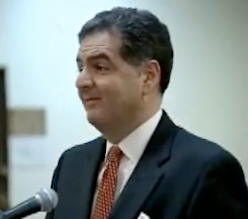
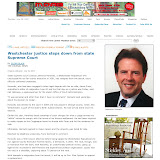
Barry Ginsberg has been named as general counsel to the state Commission on Public Integrity.
New York Lawyer - December 17, 2007
By Joel Stashenko
Mr. Ginsberg, who will earn $140,000 a year, has most recently been an assistant district attorney in Manhattan. In two stints in the office - from 1987 to 1994 and from 2003 to the present - Mr. Ginsberg has been senior investigative counsel in the Rackets Bureau, chief of the Labor Racketeering Unit and an attorney in the Major Offense Career Criminal Program.
In between, Mr. Ginsberg served as counsel to several investigative and consulting firms.
The Commission on Public Integrity was formed earlier this year by the merger of the Temporary State Commission on Lobbying and the state Ethics Commission.
Monday, December 17, 2007


NY Lawyer Destroyed Kiddie Porn Evidence (MORE, CLICK HERE)
Local Lawyer Who Destroyed Evidence in Kiddie Porn Case Spared Prison Time
New York Lawyer - December 17, 2007
By John Christoffersen
The Associated Press
BRIDGEPORT, Conn. -- A lawyer was spared prison time Monday for destroying a computer containing child pornography that was evidence in an investigation at a prominent Greenwich church.
U.S. District Judge Alan H. Nevas sentenced Philip Russell to six months of home confinement, a $25,000 fine and 240 hours of community service.
"I'm very relieved and very happy this case is behind me," Russell said outside court.
He pleaded guilty in September to one count of misprision of a felony, which means he had knowledge of a felony but didn't report it.
Russell, a former attorney for Christ Church in Greenwich, was charged with obstructing an FBI investigation that led to the conviction of the church's music director, Robert Tate, for possessing child pornography.
Former President George H.W. Bush attended the church while growing up and funeral services for his parents were held there.
Russell acknowledged he destroyed the computer, but said he did not expect an investigation. A prosecutor said Russell knew an investigation was likely, noting that Russell gave Tate the name of a criminal defense lawyer.
New York Lawyer - December 17, 2007
By John Christoffersen
The Associated Press
BRIDGEPORT, Conn. -- A lawyer was spared prison time Monday for destroying a computer containing child pornography that was evidence in an investigation at a prominent Greenwich church.
U.S. District Judge Alan H. Nevas sentenced Philip Russell to six months of home confinement, a $25,000 fine and 240 hours of community service.
"I'm very relieved and very happy this case is behind me," Russell said outside court.
He pleaded guilty in September to one count of misprision of a felony, which means he had knowledge of a felony but didn't report it.
Russell, a former attorney for Christ Church in Greenwich, was charged with obstructing an FBI investigation that led to the conviction of the church's music director, Robert Tate, for possessing child pornography.
Former President George H.W. Bush attended the church while growing up and funeral services for his parents were held there.
Russell acknowledged he destroyed the computer, but said he did not expect an investigation. A prosecutor said Russell knew an investigation was likely, noting that Russell gave Tate the name of a criminal defense lawyer.
Sunday, December 16, 2007
NYLJ on OCA Attempt to Clean Up DDC Corruption (MORE, CLICK HERE)
NYLJ (New York Law Journal) + OCA (NY State Office of Court Administration) + DDC (1st Dept., Appellate Division Departmental Disciplinary Committee) + Friedberg + Reardon = ????? - MORE........
Friedberg, Reardon Named To Discipline Unit Positions
BY DANIEL WISE
New York Law Journal - Thursday, December 13, 2007 - Page 1, col. 4
PRESIDING Justice Jonathan Lippman yesterday announced the appointments of a new chairman and a chief counsel for the Appellate Division, First Department's disciplinary committee.
The new chairman of the 58-member committee is Roy L. Reardon, a partner at Simpson Thacher & Bartlett who has served in different capacities on the committee for more than a decade.
Alan W. Friedberg, the deputy administrator of the Commission on Judicial Conduct, will succeed Thomas J. Cahill, who had been committee's chief counsel in charge of its 23-lawyer staff since 1998. "Roy Reardon brings a distinguished career and widespread respect and credibility throughout the bar to the leadership of the committee," Justice Lippman said.
Mr. Friedberg, a prosecutor at the conduct commission for 29 years, brings "a proven record in the field of professional discipline and will make a first-rate chief counsel," Justice Lippman added.
Mr. Reardon was appointed to a three-year term as chairman, an unpaid position. He succeeds Paul J. Currari, a partner at Kaye Scholer and a former Southern District US. attorney who is required to step down at the end of the year after serving a maximum of six years, five of them as chairman.
The disciplinary committee has jurisdiction over 78,000 lawyers practicing in Manhattan and the Bronx, and receives about 3,500 complaints a year charging lawyers with misconduct.
The New York City office of the judicial conduct commission, which Mr. Friedberg heads as deputy administrator, receives about 750 complaints a year against judges sitting in the metropolitan area.
Mr. Friedberg will receive a slight increase in annual salary when he assumes his new duties in early January, to $126,764 from $125,000.
Lawyers in the professional, field yesterday praised the new appointments, saying they would bring new energy to the office. Several lawyers said the prior chief counsel, Mr. Cahill, had not had experience in lawyer misconduct work before his appointment and had left the operation of his office to subordinates.
Mr. Cahill's resignation as chief counsel was announced over the summer (NYLJ, July 23). Mr. Cahill, 76, however, had agreed to stay on until a successor was chosen and left his post two weeks ago.
One lawyer said that under Mr. Cahill there was "no real oversight and, with no one pushing, morale dropped and bickering among staff developed."
Another lawyer with a professional discipline practice said that Mr. Cahill "brought a lot of integrity and candor to the job but maybe not a lot of energy."
Two lawyers pointedly said that two highly respected lawyers - Sherry K. Cohen, the committee's first deputy counsel, and Andral Bratton - had run the office's day-to-day operations. The fact that Justice Lippman bypassed the two reflected that he "wanted fresh blood," said one.
Mr. Cahill said in an interview yesterday that the office during his tenure "performed better than it ever had."
"I believe the court and the bar as a whole have been very pleased with our accomplishments," he said.
Mr. Curran, the outgoing committee chairman, said that Mr. Cahill had done a terrific job and had "brought the case load down."
Both Mr. Cahill and Ms. Cohen were named in a lawsuit brought by a former committee staff attorney charging that complaints against some attorneys were whitewashed (NYLJ, Oct. 30). Justice Lippman said the lawsuit had nothing to do with the personnel moves at the disciplinary committee.
Michael S. Ross, who specializes in professional discipline work, called Mr. Reardon "a giant in the profession who has handled many sensitive matters for attorneys and law firms."
Mr. Ross added that over the years he had many dealings with Mr. Friedberg, who "brought honesty and integrity to every issue and both the committee and its staff will benefit from that."
Other lawyers described Mr. Friedberg as "apolitical" and able to bring "excellent judgment" to the chief counsel post.
Mr. Friedberg, 59, worked at the New York City Board of Education before joining the commission staff in 1978.
He rose through the conduct commission ranks to the number two position. Among the high-profile judicial misconduct cases he handled was the removal of former Brooklyn Surrogate Michael Feinberg for awarding excessive attorney's fees to his personal and political friend, Louis R. Rosenthal, whom he had appointed counsel to the Brooklyn public administrator.
Mr. Friedberg also handled the case that resulted in the removal of Queens Supreme Court Justice Laura Blackburne, for allowing a prisoner to use the stairway at the rear of her courtroom to avoid arrest by a police officer who had come to her courtroom with a warrant.
Friedberg, Reardon Named To Discipline Unit Positions
BY DANIEL WISE
New York Law Journal - Thursday, December 13, 2007 - Page 1, col. 4
PRESIDING Justice Jonathan Lippman yesterday announced the appointments of a new chairman and a chief counsel for the Appellate Division, First Department's disciplinary committee.
The new chairman of the 58-member committee is Roy L. Reardon, a partner at Simpson Thacher & Bartlett who has served in different capacities on the committee for more than a decade.
Alan W. Friedberg, the deputy administrator of the Commission on Judicial Conduct, will succeed Thomas J. Cahill, who had been committee's chief counsel in charge of its 23-lawyer staff since 1998. "Roy Reardon brings a distinguished career and widespread respect and credibility throughout the bar to the leadership of the committee," Justice Lippman said.
Mr. Friedberg, a prosecutor at the conduct commission for 29 years, brings "a proven record in the field of professional discipline and will make a first-rate chief counsel," Justice Lippman added.
Mr. Reardon was appointed to a three-year term as chairman, an unpaid position. He succeeds Paul J. Currari, a partner at Kaye Scholer and a former Southern District US. attorney who is required to step down at the end of the year after serving a maximum of six years, five of them as chairman.
The disciplinary committee has jurisdiction over 78,000 lawyers practicing in Manhattan and the Bronx, and receives about 3,500 complaints a year charging lawyers with misconduct.
The New York City office of the judicial conduct commission, which Mr. Friedberg heads as deputy administrator, receives about 750 complaints a year against judges sitting in the metropolitan area.
Mr. Friedberg will receive a slight increase in annual salary when he assumes his new duties in early January, to $126,764 from $125,000.
Lawyers in the professional, field yesterday praised the new appointments, saying they would bring new energy to the office. Several lawyers said the prior chief counsel, Mr. Cahill, had not had experience in lawyer misconduct work before his appointment and had left the operation of his office to subordinates.
Mr. Cahill's resignation as chief counsel was announced over the summer (NYLJ, July 23). Mr. Cahill, 76, however, had agreed to stay on until a successor was chosen and left his post two weeks ago.
One lawyer said that under Mr. Cahill there was "no real oversight and, with no one pushing, morale dropped and bickering among staff developed."
Another lawyer with a professional discipline practice said that Mr. Cahill "brought a lot of integrity and candor to the job but maybe not a lot of energy."
Two lawyers pointedly said that two highly respected lawyers - Sherry K. Cohen, the committee's first deputy counsel, and Andral Bratton - had run the office's day-to-day operations. The fact that Justice Lippman bypassed the two reflected that he "wanted fresh blood," said one.
Mr. Cahill said in an interview yesterday that the office during his tenure "performed better than it ever had."
"I believe the court and the bar as a whole have been very pleased with our accomplishments," he said.
Mr. Curran, the outgoing committee chairman, said that Mr. Cahill had done a terrific job and had "brought the case load down."
Both Mr. Cahill and Ms. Cohen were named in a lawsuit brought by a former committee staff attorney charging that complaints against some attorneys were whitewashed (NYLJ, Oct. 30). Justice Lippman said the lawsuit had nothing to do with the personnel moves at the disciplinary committee.
Michael S. Ross, who specializes in professional discipline work, called Mr. Reardon "a giant in the profession who has handled many sensitive matters for attorneys and law firms."
Mr. Ross added that over the years he had many dealings with Mr. Friedberg, who "brought honesty and integrity to every issue and both the committee and its staff will benefit from that."
Other lawyers described Mr. Friedberg as "apolitical" and able to bring "excellent judgment" to the chief counsel post.
Mr. Friedberg, 59, worked at the New York City Board of Education before joining the commission staff in 1978.
He rose through the conduct commission ranks to the number two position. Among the high-profile judicial misconduct cases he handled was the removal of former Brooklyn Surrogate Michael Feinberg for awarding excessive attorney's fees to his personal and political friend, Louis R. Rosenthal, whom he had appointed counsel to the Brooklyn public administrator.
Mr. Friedberg also handled the case that resulted in the removal of Queens Supreme Court Justice Laura Blackburne, for allowing a prisoner to use the stairway at the rear of her courtroom to avoid arrest by a police officer who had come to her courtroom with a warrant.
Saturday, December 15, 2007
Judicial Respect is Earned (MORE, CLICK HERE)
From The New York Law Journal
Perspective: Human Rights And Respect for Judges
by Barry Kamins
12-10-2007
December 10 is not a holiday in this country, but it is a vitally important day around the world. On Dec. 10, 1948, the United Nations adopted the Universal Declaration of Human Rights. Ever since then, Dec. 10, Human Rights Day, reminds us of the importance of valuing human rights and how essential human rights are to world preservation. It should also remind us of the importance of the judiciary, and of respect for judges.
The third "Whereas clause" in the declaration proclaims:
Whereas it is essential, if man is not to be compelled to have recourse, as a last resort, to rebellion against tyranny and oppression, that human rights should be protected by the rule of law.
Article 8 of the Declaration provides that:
Everyone has the right to an effective remedy by the competent national tribunals for acts violating the fundamental rights granted him by the constitution or by law.
These provisions underscore what we lawyers know, that human rights only have meaning when protected by an independent judiciary, whose role is respected by the other branches of government. Courts have no power to enforce their decisions, and depend upon a supportive and respectful legislature, and particularly executive, to give their decisions force. Indeed, courts have little power even to control their composition, and rely on the other branches to place jurists on the bench who will apply the law to the facts of a case in an independent manner.
The failure of both of these prongs is on display in Pakistan. President Pervez Musharraf, fearing a Supreme Court decision undoing his election to a new term, removed and detained the entire Supreme Court. Protests by lawyers and judges led to thousands more being detained. He then appointed his own Supreme Court which, not surprisingly, validated the election. That court remains seated in Pakistan, providing little comfort to Pakistanis that their human rights will be preserved.
In the United States, our executive and legislative branches have largely accepted the bargain struck in Philadelphia in 1787, understanding the importance of both maintaining the composition of the bench and following the courts' judgments. There is a third aspect to maintaining the judicial branch as a co-equal branch of government, and that is maintaining respect for the judiciary, so that it retains that respect in the eyes of the public it serves. If that respect is undermined, the public will challenge the basis of the judiciary's authority and the credibility of its decisions, and support for the rule of law can be undermined.
It is this third underpinning of the judicial branch, basic respect for its authority and its actions, that has been eroded in recent years. The erosion can be seen on a number of fronts. Efforts in Congress continue to strip the courts of jurisdiction to hear cases. Two recently passed laws, the Detainee Treatment Act and the Military Commissions Act, purport to remove the authority of judges to hear habeas challenges brought by foreigners labeled by the president as "enemy combatants."
The ability to obtain habeas corpus relief is a bulwark in the defense of human rights, and thus the elimination of this remedy forcefully shows how limiting the judicial branch can in turn curb the availability of human rights. In a similar vein, the federal sentencing guidelines, a creature of the other branches of government, sharply reduced the discretion of judges in sentencing. The U.S. Supreme Court recently found these guidelines not mandatory (United States v. Booker, 543 U.S. 220 (2005)); it remains to be seen whether Congress and the executive will move to reimpose them.
Beyond the institutional constraints being imposed, individual judges are being vilified regarding decisions they make. And strong efforts were made in South Dakota, fortunately beaten back, to subject judges to removal and possible jail time for making decisions considered invalid by a non-judicial commission (the so-called "Jail for Judges" initiative). The threat remains of similar campaigns in other states.
But disrespect for the judiciary can also take subtler forms. Both the federal and state judiciary have seen their salaries erode in recent years as compared with the general cost of living and what is earned by others in the legal profession.
In New York State, nine years have passed since judges received their last increase. A judicial pay increase seems to be a pawn in an intricate game being played by the Legislature and governor. In this game, those branches hold all the game pieces; judges have no leverage. As a result of the wait, and the mounting frustration, morale among New York's judges is low, and the public can see both the lack of respect in which these branches hold the judiciary, and the level of dependence that judges have on the other branches for their livelihood. We risk losing good judges and having potentially excellent jurists turn away from a judicial career.
It often happens that Human Rights Day occurs each year right about the time the Legislature convenes in an end-of-year session, generally to take care of unfinished business. So it is that later this week the Senate and Assembly are due to return to Albany. This is an excellent time to provide the long-past-due salary increase that our state's judges deserve. This action would convey respect for a deserving judiciary that we count upon to preserve our rights and to do justice. In a turbulent world, we must bolster our judiciary to encourage it to remain the firm protector of human rights and the rule of law that it must be in a civilized society.
Barry Kamins is president of the New York City Bar Association and a member of Flamhaft Levy Kamins Hirsch & Rendeiro
Perspective: Human Rights And Respect for Judges
by Barry Kamins
12-10-2007
December 10 is not a holiday in this country, but it is a vitally important day around the world. On Dec. 10, 1948, the United Nations adopted the Universal Declaration of Human Rights. Ever since then, Dec. 10, Human Rights Day, reminds us of the importance of valuing human rights and how essential human rights are to world preservation. It should also remind us of the importance of the judiciary, and of respect for judges.
The third "Whereas clause" in the declaration proclaims:
Whereas it is essential, if man is not to be compelled to have recourse, as a last resort, to rebellion against tyranny and oppression, that human rights should be protected by the rule of law.
Article 8 of the Declaration provides that:
Everyone has the right to an effective remedy by the competent national tribunals for acts violating the fundamental rights granted him by the constitution or by law.
These provisions underscore what we lawyers know, that human rights only have meaning when protected by an independent judiciary, whose role is respected by the other branches of government. Courts have no power to enforce their decisions, and depend upon a supportive and respectful legislature, and particularly executive, to give their decisions force. Indeed, courts have little power even to control their composition, and rely on the other branches to place jurists on the bench who will apply the law to the facts of a case in an independent manner.
The failure of both of these prongs is on display in Pakistan. President Pervez Musharraf, fearing a Supreme Court decision undoing his election to a new term, removed and detained the entire Supreme Court. Protests by lawyers and judges led to thousands more being detained. He then appointed his own Supreme Court which, not surprisingly, validated the election. That court remains seated in Pakistan, providing little comfort to Pakistanis that their human rights will be preserved.
In the United States, our executive and legislative branches have largely accepted the bargain struck in Philadelphia in 1787, understanding the importance of both maintaining the composition of the bench and following the courts' judgments. There is a third aspect to maintaining the judicial branch as a co-equal branch of government, and that is maintaining respect for the judiciary, so that it retains that respect in the eyes of the public it serves. If that respect is undermined, the public will challenge the basis of the judiciary's authority and the credibility of its decisions, and support for the rule of law can be undermined.
It is this third underpinning of the judicial branch, basic respect for its authority and its actions, that has been eroded in recent years. The erosion can be seen on a number of fronts. Efforts in Congress continue to strip the courts of jurisdiction to hear cases. Two recently passed laws, the Detainee Treatment Act and the Military Commissions Act, purport to remove the authority of judges to hear habeas challenges brought by foreigners labeled by the president as "enemy combatants."
The ability to obtain habeas corpus relief is a bulwark in the defense of human rights, and thus the elimination of this remedy forcefully shows how limiting the judicial branch can in turn curb the availability of human rights. In a similar vein, the federal sentencing guidelines, a creature of the other branches of government, sharply reduced the discretion of judges in sentencing. The U.S. Supreme Court recently found these guidelines not mandatory (United States v. Booker, 543 U.S. 220 (2005)); it remains to be seen whether Congress and the executive will move to reimpose them.
Beyond the institutional constraints being imposed, individual judges are being vilified regarding decisions they make. And strong efforts were made in South Dakota, fortunately beaten back, to subject judges to removal and possible jail time for making decisions considered invalid by a non-judicial commission (the so-called "Jail for Judges" initiative). The threat remains of similar campaigns in other states.
But disrespect for the judiciary can also take subtler forms. Both the federal and state judiciary have seen their salaries erode in recent years as compared with the general cost of living and what is earned by others in the legal profession.
In New York State, nine years have passed since judges received their last increase. A judicial pay increase seems to be a pawn in an intricate game being played by the Legislature and governor. In this game, those branches hold all the game pieces; judges have no leverage. As a result of the wait, and the mounting frustration, morale among New York's judges is low, and the public can see both the lack of respect in which these branches hold the judiciary, and the level of dependence that judges have on the other branches for their livelihood. We risk losing good judges and having potentially excellent jurists turn away from a judicial career.
It often happens that Human Rights Day occurs each year right about the time the Legislature convenes in an end-of-year session, generally to take care of unfinished business. So it is that later this week the Senate and Assembly are due to return to Albany. This is an excellent time to provide the long-past-due salary increase that our state's judges deserve. This action would convey respect for a deserving judiciary that we count upon to preserve our rights and to do justice. In a turbulent world, we must bolster our judiciary to encourage it to remain the firm protector of human rights and the rule of law that it must be in a civilized society.
Barry Kamins is president of the New York City Bar Association and a member of Flamhaft Levy Kamins Hirsch & Rendeiro
The Scandal of Connecticut's Probate Courts (MORE, CLICK HERE)
"The Scandal of Connecticut's Probate Courts," Statement of Prof. John H. Langbein to Conn. Legislature Committee
Professor John H. Langbein
Sterling Professor of Law and Legal History - Yale Law School
Testimony to Connecticut Legislature Committee on Program
Review and Investigations, Hartford, CT. October, 2005
I appreciate the opportunity to appear before the Committee to speak about the problems of Connecticut's probate courts. I specialize in trust, estate, and probate law. I have taught, written, and served as a legislative drafter in the probate field for more than three decades. I am a fellow of the American College of Trust and Estate Counsel and a member of the International Academy of Trust and Estate Law. I serve as one of Connecticut's Commissioners on Uniform State Laws. For the Uniform Law Commission, I was the reporter and principal drafter of the Uniform Prudent Investor Act, which governs fiduciary investing in Connecticut and most other states. For the American Law Institute, I serve as Associate Reporter for the Restatement (Third) of Property: Wills and Other Donative Transfers (Vol. 1, 1999; Vol. 2, 2003, Vol. 3, in preparation).
"Don't Die in Connecticut"
When citizens of our state ask me about Connecticut probate, I give this simple advice: Try not to die in Connecticut. If you are a person of means, you should--late in life--establish your domicile in some place such as Florida or Maine or Arizona that has a responsible probate system. You can still own a Connecticut home and spend plenty of time here. Indeed, if you place title to your Connecticut home in a Florida trust, your trustee can even transfer the house after your death without going through Connecticut probate.
I am not the only person who gives such advice. If you go for a drive in Connecticut's affluent towns and suburbs in the summer and fall, you'll see all the grey-haired drivers sporting their Florida license plates. Some of these people would leave even if they did not fear Connecticut probate, in order to escape our state income tax and our winter weather. But for many, I am certain, the final straw that causes them to change domicile is the prospect of having their estates ripped off in Connecticut's probate courts. By encouraging these people to leave our state, Connecticut probate causes the state to lose the income tax and other tax revenue that goes where they go.
Connecticut probate is a national scandal. Our bad reputation is long standing. More than 50 years ago, in 1949, Professor Thomas Atkinson of NYU, then the leading American authority on the field, wrote that "Connecticut is just about at the bottom of the list so far as its probate court system is concerned." (59 Yale L.J. at 1409 n. 59 (1950).)
I move in national trust and estate circles, where Connecticut probate is routinely discussed as a disgrace. For estate planning professionals and law professors, Connecticut is the poster child for how not to organize probate courts.
The Five Core Failings
There are five major (and deeply interconnected) structural flaws in Connecticut probate:
(1) the wasteful multiplicity of our probate courts;
(2) the use of persons who are not legally trained to serve as judges;
(3) the corruption that inheres in having lawyers sit as judges part-time, while they continue to practice law;
(4) the perverse incentives of Connecticut's probate court fee system, which rewards the probate judges for inflicting makework on estates; and
(5) the sustained, self-serving opposition that the probate judges have mounted to protect their turf and fight off benign national trends and standards in probate procedure that would reduce expense for our citizens.
I will discuss each.
Waste
Connecticut has 123 separate probate courts, with 123 probate judges, 123 separate offices, 123 separate budgets, 123 separate staffs. A few of the courts operate full time, most do not. Some in fact operate only a few hours a week, although the judges and the staffs obtain such perks of full-time employment as full health insurance. Maintaining these 123 courts and staffs is hugely wasteful, especially the many that sit idle much of the week.
In Essex, for example, whose population is 6,730, I am told that the part-time probate judge takes down about $58,000 in compensation plus full heath insurance.
Nobody has done a careful study of how many probate courts our state really needs, but my starting estimate is about one-tenth the number we have. A dozen courts rather than ten dozen, staffed with professional judges and operating full time, would do a far better job at a fraction of the cost.
Connecticut probate is horribly expensive. Filing fees and subsequent charges are far higher than elsewhere. Recently, the probate courts extended their fees to nonprobate transfers such as life insurance and joint tenancy, for which, by definition, no probate services are needed. The reason our citizens suffer these voracious fees is quite simple: Our citizens are being made to feed ten times more probate courts and probate judges than they need.
Amateur Judges
Connecticut law does not require probate judges to be legally trained, even though probate judges make legal decisions that affect the property and liberty of our citizens. These judges decide who owns the property of a decedent, they decide whether to strip a citizen of his or her liberty by declaring the citizen incompetent. Such powers ought not to be in the hands of persons who lack legal training. If you exercise the power to take away somebody's liberty or property, you should have a strong command of the complex substantive and procedural rules that are meant to govern such decisions.
Indeed, it is far from clear that Connecticut probate could withstand constitutional scrutiny on this ground under the Due Process clause of the U.S. Constitution. When liberty and property are at stake, the state has an obligation to operate under procedures commensurate with the seriousness of the affected interests. See, e.g., Mathews v. Eldridge, 424 U.S. 319 (1976).
Connecticut's reliance on nonlawyer judges contributes directly to the wastefulness of our probate procedure. It is the source of the Duplicate Trial rule, that is, the rule that allows appeal de novo to the Superior Court. In this way, Connecticut allows a litigant who is determined to have a contested probate matter heard by a professional judge to do so, but only after making that person pay for two full trials.
Part-Time Judges
Fortunately, many of our probate judges are legally trained. Unfortunately, most of those are part-timers who practice law when they are not serving as judges. The result is rampant conflict-of-interest and cronyism. If you are the probate judge in Bethany on Monday and I am the probate judge in Woodbridge on Tuesday, and we each practice law before each other, or our partners practice there, abuse is invited. I am reluctant to rule against you or your partner, because I know that you could rule unfavorably against the case that my partner or I am handling before you. The danger of favoritism in such circumstances is ever present.
The solution is obvious. Judges should be required to be full-time officers of justice, legally trained, but forbidden to practice law or to be partners in law firms. We do not need 123 full-time probate judges. Thus, achieving proper professionalization of our probate courts is intimately connected to reducing the number of these courts.
The Fee System
The worst feature of Connecticut's probate courts is the fee system. These courts are run on the same principle as a Popeye's Chicken franchise or a Midas Muffler store: The proprietor gets paid by the amount of business he or she can drum up. If you run a Popeye's outlet, the more chicken you sell, the more money you make. If you run a Connecticut probate franchise, you are also an entrepreneur who can maximize your fee income by making estates engage in needless filings and seek needless approvals. The more work you impose on estates that don't need it, the more money you make. The more paperwork the judge orders up, the more money finds its way into the judge's pocket. The sad truth is that much of what goes on in Connecticut probate courts can only be called a shakedown. Our procedures invite judges to extort money from the estates of decedents by insisting upon needless court filings and court approvals.
The perverse financial incentives that pervade our probate system are a disgrace. Goal Number One of probate reform in Connecticut should be to sever the link between court proceedings and profit. Any system of judicial procedure that compensates judges or court officers for stirring up more work is wrong.
Fighting Reform
We know exactly how to fix probate procedure in the United States. The Uniform Law Commission worked out the reform model in the 1960s, when it brought together leading judges, legislators, and scholars to draft the Uniform Probate Code. The Code calls for full time professional judges, upgraded to the level of the court of general jurisdiction, and the Code reforms probate procedure by eliminating makework. The Code is in effect in many states, from Maine to Hawaii.
The essential procedural reform in the Code is the rule that estate administration need not be subjected to detailed court supervision unless an interested party petitions for such supervision. The Code reflects the understanding that most executors or administrators are trustworthy family members or professional fiduciaries who can administer estates faithfully without detailed and costly court supervision. The Code makes unsupervised administration the norm, while preserving the option for any mistrustful or aggrieved party to remove the estate from that track and insist upon judicial supervision.
For four decades many Connecticut probate judges have used their considerable political influence to keep our state from moving in this direction. The reason is simple: They want the fees. Our corrupt system of franchise-style probate courts has given the judges a powerful vested interest in preventing reforms that would lower costs and speed probate procedure.
Tarnishing Connecticut Justice
One of the saddest features of Connecticut's corrupt probate system is that it tarnishes the whole of the state's system of justice. In truth, apart from probate, Connecticut has what is surely one of the finest civil justice systems in the United States. The trial and appellate benches are staffed with able judges, selected largely on merit, who have developed a splendid reputation for trustworthy judicial administration.
The obvious solution to our probate mess, when you have superior courts as good as ours, and probate courts as disgraceful as ours, is to abolish the probate court and merge it into a specialized division of the superior court. That solution, widely followed in other states, is what the Uniform Probate Code has long recommended.
Professor John H. Langbein
Sterling Professor of Law and Legal History - Yale Law School
Testimony to Connecticut Legislature Committee on Program
Review and Investigations, Hartford, CT. October, 2005
I appreciate the opportunity to appear before the Committee to speak about the problems of Connecticut's probate courts. I specialize in trust, estate, and probate law. I have taught, written, and served as a legislative drafter in the probate field for more than three decades. I am a fellow of the American College of Trust and Estate Counsel and a member of the International Academy of Trust and Estate Law. I serve as one of Connecticut's Commissioners on Uniform State Laws. For the Uniform Law Commission, I was the reporter and principal drafter of the Uniform Prudent Investor Act, which governs fiduciary investing in Connecticut and most other states. For the American Law Institute, I serve as Associate Reporter for the Restatement (Third) of Property: Wills and Other Donative Transfers (Vol. 1, 1999; Vol. 2, 2003, Vol. 3, in preparation).
"Don't Die in Connecticut"
When citizens of our state ask me about Connecticut probate, I give this simple advice: Try not to die in Connecticut. If you are a person of means, you should--late in life--establish your domicile in some place such as Florida or Maine or Arizona that has a responsible probate system. You can still own a Connecticut home and spend plenty of time here. Indeed, if you place title to your Connecticut home in a Florida trust, your trustee can even transfer the house after your death without going through Connecticut probate.
I am not the only person who gives such advice. If you go for a drive in Connecticut's affluent towns and suburbs in the summer and fall, you'll see all the grey-haired drivers sporting their Florida license plates. Some of these people would leave even if they did not fear Connecticut probate, in order to escape our state income tax and our winter weather. But for many, I am certain, the final straw that causes them to change domicile is the prospect of having their estates ripped off in Connecticut's probate courts. By encouraging these people to leave our state, Connecticut probate causes the state to lose the income tax and other tax revenue that goes where they go.
Connecticut probate is a national scandal. Our bad reputation is long standing. More than 50 years ago, in 1949, Professor Thomas Atkinson of NYU, then the leading American authority on the field, wrote that "Connecticut is just about at the bottom of the list so far as its probate court system is concerned." (59 Yale L.J. at 1409 n. 59 (1950).)
I move in national trust and estate circles, where Connecticut probate is routinely discussed as a disgrace. For estate planning professionals and law professors, Connecticut is the poster child for how not to organize probate courts.
The Five Core Failings
There are five major (and deeply interconnected) structural flaws in Connecticut probate:
(1) the wasteful multiplicity of our probate courts;
(2) the use of persons who are not legally trained to serve as judges;
(3) the corruption that inheres in having lawyers sit as judges part-time, while they continue to practice law;
(4) the perverse incentives of Connecticut's probate court fee system, which rewards the probate judges for inflicting makework on estates; and
(5) the sustained, self-serving opposition that the probate judges have mounted to protect their turf and fight off benign national trends and standards in probate procedure that would reduce expense for our citizens.
I will discuss each.
Waste
Connecticut has 123 separate probate courts, with 123 probate judges, 123 separate offices, 123 separate budgets, 123 separate staffs. A few of the courts operate full time, most do not. Some in fact operate only a few hours a week, although the judges and the staffs obtain such perks of full-time employment as full health insurance. Maintaining these 123 courts and staffs is hugely wasteful, especially the many that sit idle much of the week.
In Essex, for example, whose population is 6,730, I am told that the part-time probate judge takes down about $58,000 in compensation plus full heath insurance.
Nobody has done a careful study of how many probate courts our state really needs, but my starting estimate is about one-tenth the number we have. A dozen courts rather than ten dozen, staffed with professional judges and operating full time, would do a far better job at a fraction of the cost.
Connecticut probate is horribly expensive. Filing fees and subsequent charges are far higher than elsewhere. Recently, the probate courts extended their fees to nonprobate transfers such as life insurance and joint tenancy, for which, by definition, no probate services are needed. The reason our citizens suffer these voracious fees is quite simple: Our citizens are being made to feed ten times more probate courts and probate judges than they need.
Amateur Judges
Connecticut law does not require probate judges to be legally trained, even though probate judges make legal decisions that affect the property and liberty of our citizens. These judges decide who owns the property of a decedent, they decide whether to strip a citizen of his or her liberty by declaring the citizen incompetent. Such powers ought not to be in the hands of persons who lack legal training. If you exercise the power to take away somebody's liberty or property, you should have a strong command of the complex substantive and procedural rules that are meant to govern such decisions.
Indeed, it is far from clear that Connecticut probate could withstand constitutional scrutiny on this ground under the Due Process clause of the U.S. Constitution. When liberty and property are at stake, the state has an obligation to operate under procedures commensurate with the seriousness of the affected interests. See, e.g., Mathews v. Eldridge, 424 U.S. 319 (1976).
Connecticut's reliance on nonlawyer judges contributes directly to the wastefulness of our probate procedure. It is the source of the Duplicate Trial rule, that is, the rule that allows appeal de novo to the Superior Court. In this way, Connecticut allows a litigant who is determined to have a contested probate matter heard by a professional judge to do so, but only after making that person pay for two full trials.
Part-Time Judges
Fortunately, many of our probate judges are legally trained. Unfortunately, most of those are part-timers who practice law when they are not serving as judges. The result is rampant conflict-of-interest and cronyism. If you are the probate judge in Bethany on Monday and I am the probate judge in Woodbridge on Tuesday, and we each practice law before each other, or our partners practice there, abuse is invited. I am reluctant to rule against you or your partner, because I know that you could rule unfavorably against the case that my partner or I am handling before you. The danger of favoritism in such circumstances is ever present.
The solution is obvious. Judges should be required to be full-time officers of justice, legally trained, but forbidden to practice law or to be partners in law firms. We do not need 123 full-time probate judges. Thus, achieving proper professionalization of our probate courts is intimately connected to reducing the number of these courts.
The Fee System
The worst feature of Connecticut's probate courts is the fee system. These courts are run on the same principle as a Popeye's Chicken franchise or a Midas Muffler store: The proprietor gets paid by the amount of business he or she can drum up. If you run a Popeye's outlet, the more chicken you sell, the more money you make. If you run a Connecticut probate franchise, you are also an entrepreneur who can maximize your fee income by making estates engage in needless filings and seek needless approvals. The more work you impose on estates that don't need it, the more money you make. The more paperwork the judge orders up, the more money finds its way into the judge's pocket. The sad truth is that much of what goes on in Connecticut probate courts can only be called a shakedown. Our procedures invite judges to extort money from the estates of decedents by insisting upon needless court filings and court approvals.
The perverse financial incentives that pervade our probate system are a disgrace. Goal Number One of probate reform in Connecticut should be to sever the link between court proceedings and profit. Any system of judicial procedure that compensates judges or court officers for stirring up more work is wrong.
Fighting Reform
We know exactly how to fix probate procedure in the United States. The Uniform Law Commission worked out the reform model in the 1960s, when it brought together leading judges, legislators, and scholars to draft the Uniform Probate Code. The Code calls for full time professional judges, upgraded to the level of the court of general jurisdiction, and the Code reforms probate procedure by eliminating makework. The Code is in effect in many states, from Maine to Hawaii.
The essential procedural reform in the Code is the rule that estate administration need not be subjected to detailed court supervision unless an interested party petitions for such supervision. The Code reflects the understanding that most executors or administrators are trustworthy family members or professional fiduciaries who can administer estates faithfully without detailed and costly court supervision. The Code makes unsupervised administration the norm, while preserving the option for any mistrustful or aggrieved party to remove the estate from that track and insist upon judicial supervision.
For four decades many Connecticut probate judges have used their considerable political influence to keep our state from moving in this direction. The reason is simple: They want the fees. Our corrupt system of franchise-style probate courts has given the judges a powerful vested interest in preventing reforms that would lower costs and speed probate procedure.
Tarnishing Connecticut Justice
One of the saddest features of Connecticut's corrupt probate system is that it tarnishes the whole of the state's system of justice. In truth, apart from probate, Connecticut has what is surely one of the finest civil justice systems in the United States. The trial and appellate benches are staffed with able judges, selected largely on merit, who have developed a splendid reputation for trustworthy judicial administration.
The obvious solution to our probate mess, when you have superior courts as good as ours, and probate courts as disgraceful as ours, is to abolish the probate court and merge it into a specialized division of the superior court. That solution, widely followed in other states, is what the Uniform Probate Code has long recommended.
Friday, December 14, 2007
Alan Friedberg Replaces Tom Cahill at 1st Dept. Disciplinary Committee (MORE, CLICK HERE)
Alan W. Friedberg, the now-former deputy administrator of the Commission on Judicial Conduct has left the 12th floor at 61 Broadway to take over as Chief Counsel of the 2nd floor mess in the Appellate Division, First Department, Departmental Disciplinary Committee left by the disgraced former chief Thomas J. Cahill. UPDATED AT 5PM, SEE PRESS RELEASE...
PRESS RELEASE
Communications Office: David Bookstaver, Director
Kali Holloway, Deputy Director (212) 428-2500
Date: Dec. 12, 2007 - www.nycourts.gov/press
New Appointments to Disciplinary Committee of the Appellate Division, First Department Announced
NEW YORK – Presiding Justice Jonathan Lippman today announced two significant appointments to the Departmental Disciplinary Committee of the Appellate Division, First Judicial Department: Roy L. Reardon, of the law firm of Simpson Thacher and Bartlett, as Chairperson, and Alan W. Friedberg as Chief Counsel.
“We are extremely fortunate to have two stellar appointees to name to these vital positions,” said Presiding Justice Lippman. “Roy L. Reardon brings to his new role invaluable credibility and expertise as well as more than five decades experience as a litigator, arbitrator and mediator. The range and depth of his experience gained during his distinguished legal career make him the ideal candidate for this position and the court is so pleased that he has accepted this appointment. He has been a stalwart on the DDC for many years and I am certain that under his leadership, the Committee will continue to thrive. Alan W. Friedberg’s prior work with the New York State Commission on Judicial Conduct, his great knowledge, proven skills, work ethic and commitment to the highest ethical standards render him extremely well prepared to serve as Chief Counsel. I am confident that he will be a tremendous asset to the Disciplinary Committee and the New York State court system.”
Roy L. Reardon joined Simpson Thacher and Bartlett after earning his law degree at St. John’s University Law School. In his more than 50 years with the firm, his areas of specialty have grown to include commercial law, professional responsibility, product liability, antitrust, securities law, arbitration and mediation. Mr. Reardon is a former member of the Simpson Thacher Management Committee and is a former Chairperson of the firm’s Litigation Department. He is a Special Master in the Appellate Division, First Department and Special Counsel to the Policy Committee, Disciplinary Committee, Appellate Division, First Department.
Alan W. Friedberg is presently the Deputy Administrator in charge of the New York City Office of the New York State Commission on Judicial Conduct. After receiving his Juris Doctorate degree from Brooklyn Law School and his Master of Laws degree in Criminal Justice at New York University School of Law, Mr. Friedberg began his career as a staff attorney at the New York City Board of Education. Prior to his current position at the Commission, he served as a staff attorney, Senior Attorney and Chief Attorney.
Web page updated: December 14, 2007 - www.NYCOURTS.gov
PRESS RELEASE
Communications Office: David Bookstaver, Director
Kali Holloway, Deputy Director (212) 428-2500
Date: Dec. 12, 2007 - www.nycourts.gov/press
New Appointments to Disciplinary Committee of the Appellate Division, First Department Announced
NEW YORK – Presiding Justice Jonathan Lippman today announced two significant appointments to the Departmental Disciplinary Committee of the Appellate Division, First Judicial Department: Roy L. Reardon, of the law firm of Simpson Thacher and Bartlett, as Chairperson, and Alan W. Friedberg as Chief Counsel.
“We are extremely fortunate to have two stellar appointees to name to these vital positions,” said Presiding Justice Lippman. “Roy L. Reardon brings to his new role invaluable credibility and expertise as well as more than five decades experience as a litigator, arbitrator and mediator. The range and depth of his experience gained during his distinguished legal career make him the ideal candidate for this position and the court is so pleased that he has accepted this appointment. He has been a stalwart on the DDC for many years and I am certain that under his leadership, the Committee will continue to thrive. Alan W. Friedberg’s prior work with the New York State Commission on Judicial Conduct, his great knowledge, proven skills, work ethic and commitment to the highest ethical standards render him extremely well prepared to serve as Chief Counsel. I am confident that he will be a tremendous asset to the Disciplinary Committee and the New York State court system.”
Roy L. Reardon joined Simpson Thacher and Bartlett after earning his law degree at St. John’s University Law School. In his more than 50 years with the firm, his areas of specialty have grown to include commercial law, professional responsibility, product liability, antitrust, securities law, arbitration and mediation. Mr. Reardon is a former member of the Simpson Thacher Management Committee and is a former Chairperson of the firm’s Litigation Department. He is a Special Master in the Appellate Division, First Department and Special Counsel to the Policy Committee, Disciplinary Committee, Appellate Division, First Department.
Alan W. Friedberg is presently the Deputy Administrator in charge of the New York City Office of the New York State Commission on Judicial Conduct. After receiving his Juris Doctorate degree from Brooklyn Law School and his Master of Laws degree in Criminal Justice at New York University School of Law, Mr. Friedberg began his career as a staff attorney at the New York City Board of Education. Prior to his current position at the Commission, he served as a staff attorney, Senior Attorney and Chief Attorney.
Web page updated: December 14, 2007 - www.NYCOURTS.gov
Thursday, December 13, 2007
Ethics Scandal Hearing Greeted With $1.5 Billion Dollar Lawsuit (MORE, CLICK HERE)
Tammany Hall II, Public Corruption Scandal Grows – by $1.5 Billion
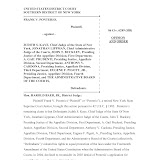
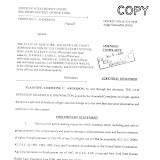
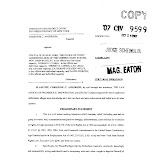
A federal court-ordered hearing in the New York State Ethics Scandal Case (Anderson v. State of New York 07cv 9599) was held in Courtroom 15C of the United States Courthouse at 500 Pearl Street in Manhattan on Wednesday, December 12, 2007 before U.S. District Court Judge Shira A. Scheindlin.
Numerous reports confirm the hearing quickly turned extraordinary.
Federal Judge Scheindlin first read into the record a list of 8 different people from around the world who had copied the court on various correspondence concerning the New York Ethics Scandal and their support for the appointment of a federal monitor.
An author of one of the letters, P. Stephen Lamont of Iviewit, immediately advised the court that he was withdrawing his copying of his letter to the court in light of an associated federal complaint filed shortly before the hearing.
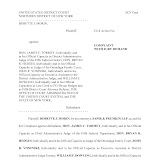
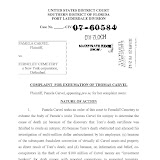
A court law clerk then handed Judge Scheindlin a copy of the just-filed complaint, Bernstein v. 1st Dept. Disciplinary Committee, et al. (S.D.N.Y 07cv 11196, filed December 12, 2007)
The $1.5 Billion Dollar Bernstein complaint alleges widespread public corruption in the handling of ethics complaints involving fraud and stolen U.S Patents by various New York law firms and attorneys. The action by Bernstein has been marked as an associated case to the Anderson lawsuit since both matters concern allegations of Ethics Committee Public Corruption and, additionally, both cases seek the appointment of a federal monitor over New York State ethics committees.
Bernstein’s allegations, and known as "Patentgate" are currently under review by numerous U.S. Senators, the U.S. Congress, the United States Patent and Trademark Office and the FBI’s watchdog unit, the Office of Professional Responsibility in Washington, D.C.
The defense counsel in the Anderson matter, a Lee Alan Adlerstein from the New York State Attorney General’s office, attempted to categorize the Anderson case as a simple wrongful termination action, but the Judge did not see it that way-- and said so.
“This case is not a garden variety…it’s a whistleblower…there is that aspect to it…," said Judge Scheindlin.
Informed sources reveal that at least one more associated federal complaint will be filed soon, along with other various filings that will pull together serious allegations of ethics related public corruption from every corner of New York State.
Stay tuned to this story: Tammany Hall II – this is history, albeit ugly, in the making…
And we’ll be posting the One and one-half Billion dollar Patentgate lawsuit soon!
A federal court-ordered hearing in the New York State Ethics Scandal Case (Anderson v. State of New York 07cv 9599) was held in Courtroom 15C of the United States Courthouse at 500 Pearl Street in Manhattan on Wednesday, December 12, 2007 before U.S. District Court Judge Shira A. Scheindlin.
Numerous reports confirm the hearing quickly turned extraordinary.
Federal Judge Scheindlin first read into the record a list of 8 different people from around the world who had copied the court on various correspondence concerning the New York Ethics Scandal and their support for the appointment of a federal monitor.
An author of one of the letters, P. Stephen Lamont of Iviewit, immediately advised the court that he was withdrawing his copying of his letter to the court in light of an associated federal complaint filed shortly before the hearing.
A court law clerk then handed Judge Scheindlin a copy of the just-filed complaint, Bernstein v. 1st Dept. Disciplinary Committee, et al. (S.D.N.Y 07cv 11196, filed December 12, 2007)
The $1.5 Billion Dollar Bernstein complaint alleges widespread public corruption in the handling of ethics complaints involving fraud and stolen U.S Patents by various New York law firms and attorneys. The action by Bernstein has been marked as an associated case to the Anderson lawsuit since both matters concern allegations of Ethics Committee Public Corruption and, additionally, both cases seek the appointment of a federal monitor over New York State ethics committees.
Bernstein’s allegations, and known as "Patentgate" are currently under review by numerous U.S. Senators, the U.S. Congress, the United States Patent and Trademark Office and the FBI’s watchdog unit, the Office of Professional Responsibility in Washington, D.C.
The defense counsel in the Anderson matter, a Lee Alan Adlerstein from the New York State Attorney General’s office, attempted to categorize the Anderson case as a simple wrongful termination action, but the Judge did not see it that way-- and said so.
“This case is not a garden variety…it’s a whistleblower…there is that aspect to it…," said Judge Scheindlin.
Informed sources reveal that at least one more associated federal complaint will be filed soon, along with other various filings that will pull together serious allegations of ethics related public corruption from every corner of New York State.
Stay tuned to this story: Tammany Hall II – this is history, albeit ugly, in the making…
And we’ll be posting the One and one-half Billion dollar Patentgate lawsuit soon!
Wednesday, December 12, 2007
Attorney General Cuomo Shines Light on Corrupt Rats (MORE, CLICK HERE)
New York State Attorney General Andrew Cuomo's "Project Sunlight" is a very welcomed event in the Empire State. Check out www.sunlightny.com and see the following New York Times editorial:
Editorial
New York Times
December 6, 2007
There’s Sunlight in Albany?
So seldom is there good news out of New York’s state capital that when something like the new Project Sunlight Web site emerges, the instinct is to wonder how soon before the forces of darkness will try to kill it. Until they do, the new site from Attorney General Andrew Cuomo’s office gives ordinary New Yorkers the ability to see information about their state that should have been easily accessible in the first place.
Over the years, New York’s lawmakers have found increasingly artful ways to make it hard for anybody outside the capital to know what they’re doing. Campaign records were kept in different counties. One governor listed donors by their first names. More recently, data about which legislator doled out which goodie to the home district — from a ball field to a cheese museum — was given out strictly on a need-to-know basis. And when journalists finally took legislative leaders to court to get these lists of “member items” the information was released in ways that blocked most computers from using it. The rule was that any “public information” had to be extremely difficult for the public to get — in most cases, one had to file a Freedom of Information request and start knitting a very large sweater.
If that changes with this new Sunlight Web site, it is because Mr. Cuomo had the foresight to pick Blair Horner, one of Albany’s best activists, to take on the project. Mr. Horner and his team have attempted to knit campaign finance data to lobbying data to legislative data. They have included information about contracts and corporations and charities. In theory, that means a member of the public could look up a bill or a contract, and see which lawmaker pushed it, which lobbying firm helped and how much campaign money was involved.
At this point, the site is just a start. The public is invited to ask for more data, and already we can see that it should include information from authorities, those quasi-public agencies that work quasi-underground. The ethics filings of state legislators should be on the site, as should the comptroller’s payouts for management fees for the state pension.
More transparency can only help, although the old guard won’t see it that way. As Mr. Cuomo argues correctly, it is only by revealing “the good, the bad and the ugly” that New Yorkers will start believing that somebody is telling them the truth about how their state really works. Project Sunlight is at: www.sunlightny.com.
Tuesday, December 11, 2007
GREAT New York Daily News Editorial (MORE, CLICK HERE)
New York Daily News Editorial - Monday, December 10th 2007,
Sunlight, as Supreme Court Justice Louis Brandeis famously wrote, is "the best of disinfectants." And a lot more of it is shining on Albany's germy recesses these days thanks to Attorney General Andrew Cuomo.
Cuomo's Project Sunlight - a Web site devoted to connecting the dots between money and politics in Albany - went online last week. For the first time, New Yorkers can easily look up political donations to individual state politicians, legislation they have sponsored and who lobbied on the matters. With a few mouse clicks, you can also find out how much pork-barrel spending they are doling out, and to whom.
The site (sunlightny.com) marks a sharp break with the Capitol's culture of evasiveness. And, of course, there is far more to make public. First among the materials must be the pols' personal financial disclosure forms.
Cuomo says these are coming, and that's good, because the public will see how disgracefully little New York's part-time legislators require themselves to reveal about how much money they make and how they make it.
Assembly Speaker Sheldon Silver is "of counsel" to a major personal-injury law firm - and that's about all you can find out - while blocking tort reform. Senate Majority Leader Joe Bruno ran a consulting business and has a job with a money management company that invests for labor unions. What does Bruno do for both enterprises? Beats us. But we know he mingled his private interests with his public duties to the point that the FBI opened an investigation.
Secrecy is such a tradition in Albany that, two years ago, Bruno and Silver went to court in a failed attempt to avoid identifying which lawmakers requested which pork-barrel grants. Now, Cuomo and Blair Horner, who for years was New York's top public-interest watchdog as head of NYPIRG, have put the same data at everyone's fingertips.
(Compare how much money Silver and Bruno throw around with the slices your own legislators bring home. You'll be amazed at the disparity.)
To their credit, Silver and Bruno backed Project Sunlight with a $701,000 appropriation. It's money very well spent. Let the sun shine in.
...and for judges
Justice Duane Hart of the Queens Supreme Court has been in trouble with the state Commission on Judicial Conduct for a year, and he may lose his gavel. The charges against him include being rude and intemperate in an argument with court officers, wrongly threatening to hold in contempt and jail a lawyer and attempting to steer witness testimony in the commission proceedings. Hart says his actions do not rise to misconduct.
We know all this only because Hart, in an exceedingly rare move, asked that the proceedings be open to the public - which they were last week.
Open proceedings against jurists occur in less than 1% of commission cases, and only at the behest of the accused. This, despite the citizenry's right to know how - of all people - those who sit in solemn judgment conduct themselves.
Once a formal charge is brought against a judge, the process should automatically be open. That is in the public interest, and the law should be changed to ensure same. The commission itself has long wanted its work to be public, but the Legislature insists on secrecy.
Judges - at least some of them - deserve positions of honor. The public deserves to know the details when someone allegedly sullies that honor. And, the judges themselves should be seeking the light, as Hart did.
Victims of Corruption and Chief Judge Losing Patience (MORE, CLICK HERE)
NY's Chief Judge, at "End of My Patience," Says She'll Sue Over Judges' Pay
New York Lawyer
December 11, 2007
By The Associated Press
Chief Judge Judith S. Kaye says she may file a lawsuit next month if state lawmakers end a planned December session without voting to give raises to New York's judges.
She said she expects lawmakers to return to Albany in mid-December. If they fail then to hike New York's judicial salaries, which are the 48th lowest in the nation, the chief judge said she may sue the state.
"I so don't want to do that," Chief Judge Kaye told The Associated Press. "I've been a lawyer for 45 years, and I know the pluses and minuses of litigation. To me it is a last resort, but I've come just about to the end of my patience. If they don't do it now, they'll come back in an election year, and nobody wants to talk about raises in an election year."
Governor Eliot Spitzer's office did not reply to numerous messages seeking comment on the dispute.
The sticking point has been that salary hikes for lawmakers and judges have historically been linked, and Mr. Spitzer has balked at increasing the lawmakers' pay.
The chief judge said lawmakers' failure to vote on a pay hike during the past nine years is effectively, given the rate of inflation, a pay cut and an intrusion on judicial independence, and therefore illegal.
The chief judge first raised the possibility of filing a suit on behalf of the Judiciary in April. She has since said repeatedly that while legal action remains an option, it would be a last resort if the Legislature and governor fail to act voluntarily to boost judges' pay.
Meanwhile, two lawsuits have been filed, one on behalf of individual judges and the other with the support of several judges' associations.
This is How Some NY Judges get "Paid" (MORE, CLICK HERE)
PRESS RELEASE FROM U.S. DEPARTMENT OF JUSTICE
FOR IMMEDIATE RELEASE AT
FRIDAY, DECEMBER 7, 2007 (202) 514-2007
WWW.USDOJ.GOV TDD (202) 514-1888
FORMER CONGRESSIONAL CHIEF OF STAFF PLEADS GUILTY TO HONEST SERVICES FRAUD CONSPIRACY
WASHINGTON – Russell James Caso, Jr., 34, of Rockville, Md., a former Chief of Staff to a Member of the U.S. House of Representatives (Representative A), pleaded guilty today to conspiracy to commit honest services wire fraud, the Justice Department announced today.
Caso’s guilty plea was taken before U.S. District Judge Henry H. Kennedy, Jr. Caso faces up to five years in prison and a fine of $250,000. A sentencing date has not been set.
According to the evidence presented by the government at today’s plea hearing, Caso served as a Chief of Staff from 2005 until 2007. His guilty plea stems from his relationship with a firm (Firm A) that had a stated mission of helping American businesses to operate in Russia and facilitating the flow of trade between the United States and Russia .
Firm A sought to submit its proposals to various Executive Branch agencies seeking federal funding for these efforts. Firm A's General Secretary met frequently with and sought official action from Caso, Representative A, and Representative A's staff, including their assistance in obtaining funding for the proposals.
In or about April and May 2005, Firm A's General Secretary paid Caso’s wife $1500 to edit written drafts of its proposals.
After being paid for editing the proposals, Caso’s wife received and deposited three more checks from Firm A totaling $17,500: a check dated May 27, 2005, in the amount of $2,500; a check dated July 21, 2005, in the amount of $10,000; and a check dated Aug. 25, 2005, in the amount of $5,000. Caso knew that his wife did very little additional work in return for this money, and that the market value of the additional work that his wife ultimately performed for Firm A was far below $17,500.
In the middle of 2005, roughly contemporaneous with the payments that his wife was receiving from Firm A, Caso organized meetings in which Representative A and Caso made presentations to various Executive Branch agencies, including to high-level officials in the Departments of State and Energy and the National Security Council. Representative A and Caso argued that Firm A’s proposals should be federally funded.
As Representative A's Chief of Staff, Caso was required to submit annual financial disclosure statements, listing, among other things, the source of any income earned by his wife. On the disclosure statement for 2005, Caso intentionally failed to disclose that his wife received any payments from Firm A, even though he knew that he was required to do so. One reason for this non-disclosure was that Caso knew that his wife's financial relationship with Firm A created a personal conflict of interest because Firm A was seeking his help to obtain federal funding.
Caso is cooperating with the Justice Department’s ongoing investigation.
In announcing today’s guilty plea, U.S. Attorney Jeffrey A. Taylor, the Justice Department, Federal Bureau of Investigation, and Internal Revenue Service thanked FBI Special Agents Robert Schwinger, Julie Shields, and Michelle Rankin, and IRS Special Agent Randolph Gregory for the outstanding work that they performed on the case. They also praised the efforts of the prosecutors assigned to the case: Assistant U.S. Attorney Howard Sklamberg and former Assistant U.S. Attorney Jeannie Rhee, DOJ Trial Attorneys Jennifer Shasky Calvery and Gregory C.J. Lisa of the Justice Department’s Organized Crime & Racketeering Section, Trial Attorney Armando O. Bonilla and former Trial Attorney Natashia Tidwell of the Justice Department’s Public Integrity Section.
(RED emphasis added by ExposeCorruptCourts)
NY Judge Defends His Conduct (MORE, CLICK HERE)
NY Judge Defends His Conduct in Rare Public Hearing
By Mark Fass
New York Law Journal
December 7, 2007
One day after Queens Supreme Court Justice Duane A. Hart unsuccessfully petitioned the federal court to stay misconduct proceedings against him, he asked the nine sitting members of the Commission on Judicial Conduct to spare his job.
Charged by the commission with six separate acts of misconduct, including threatening to place an attorney in jail for failing to move forward with a case and asking an attorney with a case pending before him to testify on his behalf at a previous misconduct hearing, Justice Hart yesterday contended that any errors he may have made did not rise to the level of sanctionable misconduct.
In the future, he assured the commission, he would likely handle similar situations differently.
"If I get into a situation like that, I won't hold them in contempt like that," Justice Hart said. "If I had it to do over again, I might not contact [the attorney]."
The hearing marked only the ninth time in the approximately 700 misconduct hearings over the last 30 years that a judge has waived confidentiality and allowed the public into what is usually a confidential hearing, according to the commission's administrator, Robert H. Tembeckjian.
At issue was whether the commission should confirm the findings of referee Felice K. Shea, a former Manhattan Supreme Court justice, who found that the commission's attorneys had established five of their claims against Justice Hart in their entirety, and the sixth in part.
Counsel for each side was allotted 30 minutes, and Justice Hart was given another 10 to argue on his own behalf.
The commission's attorney, Jean Joyce, opened the proceedings by stating that Justice Hart's "pattern of retaliatory conduct," such as his threats of contempt and his purported dismissal of a case because the attorney disobeyed him and moved for mistrial, merited his removal from the bench.
"A judge like this is not going to change," Ms. Joyce said. "He wants to blame everyone else."
The commission previously had voted to censure Justice Hart for abusing his summary contempt power, a recommendation that was upheld by the state Court of Appeals.
Justice Hart's counsel, Lawton Squires of Herzfeld & Rubin, hewed to a narrow theme: His client may have made "errors of judgment," but his mistakes were not sanctionable.
"He could have done a lot of things differently," Mr. Squires said. He could have made more complete disclosures about a conflict of interest. He could have had his own counsel contact the attorney he wanted to testify on his behalf. But, Mr. Squires added, "I don't think anything rises to the level of misconduct."
The committee members focused much of Ms. Joyce's 30 minutes on the first claim, that the judge's threat to hold attorney Barry Myrvold in contempt and jail him for failing to pick a jury in a drawn-out medical malpractice case, constituted sanctionable misconduct.
The most vocal member of the panel, attorney Richard D. Emery, asked whether Justice Hart's actions constituted only a mistake, and not misconduct.
"Misconduct and legal error often coincide," replied Ms. Joyce.
A day removed from the federal court's refusal to stay the proceedings on the grounds they were tainted by commission chairman Raoul Felder's "racial bias," race entered the arguments only implicitly, during the heated discussion of Charge VI, which centered on Justice Hart's allegedly belligerent refusal to pass through a metal detector when visiting the Queens Family Court with his mother.
The questions of the four commission members who hold judicial office, implied that they perceived the incident as an abuse of judicial power. The 11-member commission has one vacancy, and Mr. Felder was absent for "personal reasons" that, according to Mr. Felder, had nothing to do with Justice Hart's motion.
"Why is he trying to be better than anyone else?" asked Thomas A. Klonick, town justice for the Town of Perinton, who ran the proceedings in Mr. Felder's absence.
Justice Karen K. Peters of the Appellate Division, Third Department, asked Mr. Squires why his client decided to pick a battle with court security. The judge noted that security often presumed she was "only a wife," but that she opted to ignore it.
Mr. Squires, who like Justice Hart is black, replied, "As I got older and more mature, [I decided] those battles aren't worth fighting. But it doesn't rise to the level of misconduct."
The proceedings were not without moments of levity, usually emanating from Justice Hart himself, who often flashed looks of disbelief towards the press, particularly when Mr. Squires refused to let the judge interrupt the attorney during his 30 minutes on the stand.
Justice Hart also opened his own 10-minute allotment by telling the commission, "I can say, I've had better birthdays than today."
At least one member called out, "Happy birthday."
The commission will finalize its decision at its next meeting, on Jan. 29.
By Mark Fass
New York Law Journal
December 7, 2007
One day after Queens Supreme Court Justice Duane A. Hart unsuccessfully petitioned the federal court to stay misconduct proceedings against him, he asked the nine sitting members of the Commission on Judicial Conduct to spare his job.
Charged by the commission with six separate acts of misconduct, including threatening to place an attorney in jail for failing to move forward with a case and asking an attorney with a case pending before him to testify on his behalf at a previous misconduct hearing, Justice Hart yesterday contended that any errors he may have made did not rise to the level of sanctionable misconduct.
In the future, he assured the commission, he would likely handle similar situations differently.
"If I get into a situation like that, I won't hold them in contempt like that," Justice Hart said. "If I had it to do over again, I might not contact [the attorney]."
The hearing marked only the ninth time in the approximately 700 misconduct hearings over the last 30 years that a judge has waived confidentiality and allowed the public into what is usually a confidential hearing, according to the commission's administrator, Robert H. Tembeckjian.
At issue was whether the commission should confirm the findings of referee Felice K. Shea, a former Manhattan Supreme Court justice, who found that the commission's attorneys had established five of their claims against Justice Hart in their entirety, and the sixth in part.
Counsel for each side was allotted 30 minutes, and Justice Hart was given another 10 to argue on his own behalf.
The commission's attorney, Jean Joyce, opened the proceedings by stating that Justice Hart's "pattern of retaliatory conduct," such as his threats of contempt and his purported dismissal of a case because the attorney disobeyed him and moved for mistrial, merited his removal from the bench.
"A judge like this is not going to change," Ms. Joyce said. "He wants to blame everyone else."
The commission previously had voted to censure Justice Hart for abusing his summary contempt power, a recommendation that was upheld by the state Court of Appeals.
Justice Hart's counsel, Lawton Squires of Herzfeld & Rubin, hewed to a narrow theme: His client may have made "errors of judgment," but his mistakes were not sanctionable.
"He could have done a lot of things differently," Mr. Squires said. He could have made more complete disclosures about a conflict of interest. He could have had his own counsel contact the attorney he wanted to testify on his behalf. But, Mr. Squires added, "I don't think anything rises to the level of misconduct."
The committee members focused much of Ms. Joyce's 30 minutes on the first claim, that the judge's threat to hold attorney Barry Myrvold in contempt and jail him for failing to pick a jury in a drawn-out medical malpractice case, constituted sanctionable misconduct.
The most vocal member of the panel, attorney Richard D. Emery, asked whether Justice Hart's actions constituted only a mistake, and not misconduct.
"Misconduct and legal error often coincide," replied Ms. Joyce.
A day removed from the federal court's refusal to stay the proceedings on the grounds they were tainted by commission chairman Raoul Felder's "racial bias," race entered the arguments only implicitly, during the heated discussion of Charge VI, which centered on Justice Hart's allegedly belligerent refusal to pass through a metal detector when visiting the Queens Family Court with his mother.
The questions of the four commission members who hold judicial office, implied that they perceived the incident as an abuse of judicial power. The 11-member commission has one vacancy, and Mr. Felder was absent for "personal reasons" that, according to Mr. Felder, had nothing to do with Justice Hart's motion.
"Why is he trying to be better than anyone else?" asked Thomas A. Klonick, town justice for the Town of Perinton, who ran the proceedings in Mr. Felder's absence.
Justice Karen K. Peters of the Appellate Division, Third Department, asked Mr. Squires why his client decided to pick a battle with court security. The judge noted that security often presumed she was "only a wife," but that she opted to ignore it.
Mr. Squires, who like Justice Hart is black, replied, "As I got older and more mature, [I decided] those battles aren't worth fighting. But it doesn't rise to the level of misconduct."
The proceedings were not without moments of levity, usually emanating from Justice Hart himself, who often flashed looks of disbelief towards the press, particularly when Mr. Squires refused to let the judge interrupt the attorney during his 30 minutes on the stand.
Justice Hart also opened his own 10-minute allotment by telling the commission, "I can say, I've had better birthdays than today."
At least one member called out, "Happy birthday."
The commission will finalize its decision at its next meeting, on Jan. 29.
More on Milberg Weiss (MORE, CLICK HERE)
Judge Rips One NY Firm for Greed, Another for a Possible Conflict
New York Lawyer - December 5, 2007
By Zusha Elinson - The Recorder
Milberg Weiss can't seem to shake the shadow of its criminal probe.
In an order rejecting a class action settlement in a securities case, San Francisco Chief District Judge Vaughn Walker ripped the firm for asking for too much money. He also cited the firm's pending criminal charges at length in a discussion about whether the plaintiffs lawyers were really protecting the interests of the class.
The ruling came Friday in In Re Chiron Corporation Securities Litigation, in which plaintiffs accused the drug company of not disclosing facts about its failure to bring a flu vaccine to market in 2003 and 2004.
A settlement agreement of $30 million plus interest was reached in March between the plaintiffs and the drug company, which is represented by Skadden, Arps, Slate, Meagher & Flom. Walker denied Milberg's motion for preliminary settlement approval in his ruling and has set a case management conference for Dec. 20.
Milberg Weiss has been dogged by a criminal probe into allegations that the firm paid kickbacks to lead plaintiffs in major class actions. William Lerach and other former partners have pleaded guilty, though the Milberg Weiss firm and name partner Melvyn Weiss have pleaded not guilty and are fighting the charges.
In 2004, Milberg Weiss Bershad Hynes & Lerach split into two firms, then known as Lerach Coughlin Stoia & Robbins in San Diego and Milberg Weiss Bershad & Schulman in New York.
In the Chiron case, the plaintiffs lawyers sought $7.5 million -- a 25 percent cut of the settlement -- but Walker said it was too much. Walker wrote that when calculating the firm's hours using typical hourly fees, Milberg's request amounts to a multiplier of eight or even 10. The normal multiplier for class counsel, Walker wrote, is between one and four.
"Class Counsel need to justify both the application of a multiplier and its level as much as they need to show that their hourly rates are in line with competitive norms," Walker wrote.
The judge further questioned whether the lead plaintiff -- International Union of Operating Engineers Local No. 825 Pension Fund -- was an adequate class representative because, he wrote, by approving the big fee for the lawyers, it didn't appear to be trying to maximize recovery for the class.
Finally, Walker raised the criminal probe as a factor in considering the settlement agreement.
"It is against this tableau common to all class action settlement proposals that the criminal charges against lead counsel pose a concern here, because the kickback arrangements alleged criminally are that lead counsel gave the paid plaintiffs a greater interest in maximizing the amount of attorneys fees awarded to lead counsel than in maximizing the net recovery to absent class members," he wrote.
Defense lawyers were not immune from Walker's pen, either. Walker wrote that because Skadden is representing Lerach Coughlin in connection with the criminal probes, "the court is troubled whether Skadden, Arps is able to probe the adequacy of lead plaintiff and/or lead counsel lest a rigorous challenge uncover problems that might be traced back to Lerach Coughlin."
James Lyons, a Skadden lawyer on the case, would not comment on the ruling, but said that Skadden had worked for certain Lerach Coughlin lawyers but not the plaintiffs firm.
"Skadden has represented some individuals at Lerach Coughlin, none of whom had any involvement in the [Chiron] case, and we did not represent the Lerach Coughlin firm," he said Tuesday.
Patrick Coughlin, name partner at Coughlin Stoia Geller Rudman & Robbins -- the Lerach Coughlin firm's new name -- said that his firm, though an offshoot of Milberg Weiss, was not class counsel on the case.
"Whatever he does to Milberg, I feel sorry for them, but it has nothing to do with us," Coughlin said.
A Milberg Weiss attorney declined to comment on the ruling. Walker is known for his skepticism of securities class actions and has had disagreements with the firm before.
New York Lawyer - December 5, 2007
By Zusha Elinson - The Recorder
Milberg Weiss can't seem to shake the shadow of its criminal probe.
In an order rejecting a class action settlement in a securities case, San Francisco Chief District Judge Vaughn Walker ripped the firm for asking for too much money. He also cited the firm's pending criminal charges at length in a discussion about whether the plaintiffs lawyers were really protecting the interests of the class.
The ruling came Friday in In Re Chiron Corporation Securities Litigation, in which plaintiffs accused the drug company of not disclosing facts about its failure to bring a flu vaccine to market in 2003 and 2004.
A settlement agreement of $30 million plus interest was reached in March between the plaintiffs and the drug company, which is represented by Skadden, Arps, Slate, Meagher & Flom. Walker denied Milberg's motion for preliminary settlement approval in his ruling and has set a case management conference for Dec. 20.
Milberg Weiss has been dogged by a criminal probe into allegations that the firm paid kickbacks to lead plaintiffs in major class actions. William Lerach and other former partners have pleaded guilty, though the Milberg Weiss firm and name partner Melvyn Weiss have pleaded not guilty and are fighting the charges.
In 2004, Milberg Weiss Bershad Hynes & Lerach split into two firms, then known as Lerach Coughlin Stoia & Robbins in San Diego and Milberg Weiss Bershad & Schulman in New York.
In the Chiron case, the plaintiffs lawyers sought $7.5 million -- a 25 percent cut of the settlement -- but Walker said it was too much. Walker wrote that when calculating the firm's hours using typical hourly fees, Milberg's request amounts to a multiplier of eight or even 10. The normal multiplier for class counsel, Walker wrote, is between one and four.
"Class Counsel need to justify both the application of a multiplier and its level as much as they need to show that their hourly rates are in line with competitive norms," Walker wrote.
The judge further questioned whether the lead plaintiff -- International Union of Operating Engineers Local No. 825 Pension Fund -- was an adequate class representative because, he wrote, by approving the big fee for the lawyers, it didn't appear to be trying to maximize recovery for the class.
Finally, Walker raised the criminal probe as a factor in considering the settlement agreement.
"It is against this tableau common to all class action settlement proposals that the criminal charges against lead counsel pose a concern here, because the kickback arrangements alleged criminally are that lead counsel gave the paid plaintiffs a greater interest in maximizing the amount of attorneys fees awarded to lead counsel than in maximizing the net recovery to absent class members," he wrote.
Defense lawyers were not immune from Walker's pen, either. Walker wrote that because Skadden is representing Lerach Coughlin in connection with the criminal probes, "the court is troubled whether Skadden, Arps is able to probe the adequacy of lead plaintiff and/or lead counsel lest a rigorous challenge uncover problems that might be traced back to Lerach Coughlin."
James Lyons, a Skadden lawyer on the case, would not comment on the ruling, but said that Skadden had worked for certain Lerach Coughlin lawyers but not the plaintiffs firm.
"Skadden has represented some individuals at Lerach Coughlin, none of whom had any involvement in the [Chiron] case, and we did not represent the Lerach Coughlin firm," he said Tuesday.
Patrick Coughlin, name partner at Coughlin Stoia Geller Rudman & Robbins -- the Lerach Coughlin firm's new name -- said that his firm, though an offshoot of Milberg Weiss, was not class counsel on the case.
"Whatever he does to Milberg, I feel sorry for them, but it has nothing to do with us," Coughlin said.
A Milberg Weiss attorney declined to comment on the ruling. Walker is known for his skepticism of securities class actions and has had disagreements with the firm before.
Monday, December 10, 2007
Federal Judge Orders Ethics Scandal Hearing
United States District Court Judge, Shira A. Scheindlin, has issued a federal court order requiring that all parties appear in her court at the U.S. Courthouse at 500 Pearl Street in Manhattan on Wednesday, December 12, 2007. MORE ON THIS TUESDAY.....
Sunday, December 9, 2007
Bribing Judges a National Problem (MORE, CLICK HERE)
Court Intrigue for the King of Torts
By NELSON D. SCHWARTZ
Clarksdale, Miss.
The New York Times
December 9, 2007
EVER since Richard Scruggs was indicted on federal conspiracy and bribery charges about two weeks ago, legal eagles have asked whether a renowned lawyer who earned a reputation as the “King of Torts” would really risk his reputation, his freedom, his wealth and, of course, his career, by offering $50,000 to sway a judge in a relatively small squabble over fees.
One clue may be found in this town, nestled amid cotton fields and country crossroads made famous in the music of the legendary blues singer Robert Johnson A Clarksdale lawyer, Charles M. Merkel Jr., spent more than a decade battling Mr. Scruggs in two fee disputes and says he still bears scars from the fight.
“It’s scorched earth with Dickie Scruggs,” says Mr. Merkel, sitting in a wood-paneled office featuring duck-hunting memorabilia and two framed checks representing about $17 million in payments that Mr. Scruggs had to disgorge to Mr. Merkel’s client — a lawyer named Alwyn Luckey who argued that Mr. Scruggs shortchanged him for work he performed on asbestos cases that made Mr. Scruggs rich.
Mr. Merkel and prosecutors say that the Luckey case foreshadowed some of Mr. Scruggs’ woes in the current bribery case. “As far as whether he’s guilty, I can’t say,” Mr. Merkel concedes. “But I’m not surprised, because he’s willing to use any means to an end. And it irks the hell out of me when Scruggs skates on the edge and makes the profession look bad.”
According to an official investigating the Scruggs case who asked not to be identified because he was not authorized to discuss it publicly, federal prosecutors have asked the Justice Department’s Public Integrity Section to examine whether Mr. Scruggs has engaged in multiple bribery attempts of local judges. A spokeswoman for the Justice Department declined to comment publicly on the case. The case is also likely to fuel further debate over the merits of lucrative class-action lawsuits.
Even if Mr. Merkel turns out to be wrong, the indictment casts a different kind of spotlight on Mr. Scruggs, who cultivated the image of a smooth Southern lawyer capable of winning huge verdicts on behalf of smokers and, most recently, victims of Hurricane Katrina. Indeed, Mr. Scruggs was a key character in “The Insider,” the 1999 film that detailed how he helped win a $248 billion settlement from the tobacco industry.
Estimates of how much Mr. Scruggs and his partners stand to eventually collect from the tobacco settlement reach north of $1 billion. He is one of Mississippi’s richest men, with a black Porsche Cayenne that is a familiar sight in Courthouse Square in nearby Oxford, where his firm is located.
But Mr. Scruggs still fought hard this year against the accusations of John Griffin Jones, a Jackson, Miss., lawyer who worked alongside Mr. Scruggs in his suit against State Farm Insurance after Katrina. Mr. Jones, saying he was cheated out of his fair share of a $26.5 million settlement, sued in state court. Then, on Nov. 28, Mr. Scruggs was indicted with four other men, including his son Zachary Scruggs, who is a lawyer in his firm. They are accused of attempting to bribe Judge Henry L. Lackey, who was overseeing Mr. Jones’s suit.
To make matters worse for Mr. Scruggs, one of the four, Timothy R. Balducci, on Tuesday pleaded guilty to a bribery charge in the case and has agreed to cooperate with federal prosecutors investigating Mr. Scruggs. Mr. Balducci’s conversations were taped, and he is expected to testify when the case goes to trial next year. Judge Lackey informed the United States attorney’s office about Mr. Balducci’s offer shortly after he was approached last spring.
Mr. Scruggs and others indicted in the case each face up to 75 years in jail and $1.5 million in fines if convicted. Mr. Scruggs’s lead lawyer, John Keker, says his client is innocent. “We’re looking forward to a fight,” he says. “Dick Scruggs is a fine man, and he doesn’t deserve this.” Through Mr. Keker, Mr. Scruggs declined to comment.
Zachary Scruggs referred questions to his lawyer, Anthony L. Farese. “He’s certainly innocent of these charges,” Mr. Farese said of his client. “We look forward to receiving discovery from the government and proceeding to trial.”
NORMALLY, Mr. Merkel’s criticism of his longtime adversary might be considered trash talk between members of the famously incestuous Mississippi bar. After all, both men graduated from college and law school at Ole Miss within a few years of each other, and have often engaged in legal battles.
But with Mr. Scruggs under indictment, it is likely that federal prosecutors will closely watch his earlier fee disputes with Mr. Merkel’s clients. That’s because Mr. Balducci served as one of Mr. Scruggs’s lawyers in those battles, representing him when Mr. Merkel deposed Mr. Scruggs in the matter three years ago.
Mr. Keker is already trying to distance his client from Mr. Balducci. “I don’t think they’re close at all — he’s a wannabe,” Mr. Keker said of Mr. Balducci.
Mr. Farese toes a similar line. “It’s a situation Tim Balducci did alone,” he said. “After he got apprehended, he decided to twist and turn things around and implicate others that were not involved.”
But the indictment indicates that federal prosecutors reject those points of view. And local lawyers like Mr. Merkel loudly dispute Mr. Keker’s contention that his client was not on familiar terms with Mr. Balducci. “He’s a lot closer to Scruggs than Scruggs would like to portray now,” Mr. Merkel says. “Balducci made part of the closing arguments in one of my cases, and they sat at the same table. When I was negotiating with them, it was generally with Balducci.”
According to the local official investigating the Scruggs case who requested anonymity, federal prosecutors plan to look at the long legal battle between Mr. Scruggs and Mr. Merkel for other evidence of wrongdoing. And the Justice Department’s Public Integrity unit, which investigates corruption of public officials at the local, state and federal levels, has sent lawyers from Washington to Mississippi to check out additional leads.
“There are widespread investigations in progress,” the local official added. “You need additional resources to fan out and cover these investigations that may be spinoffs, with the potential of other bribes being paid.”
Local prosecutors say they are aware of Mr. Merkel’s criticisms of Mr. Scruggs and say they take his account of Mr. Scruggs’s “scorched-earth” tactics seriously. At the same time, they are studying the implications of one of Mr. Balducci’s boasts that was recorded during his conversations with Judge Lackey.
“The only person in the world outside of me and you that has discussed this is me and Dick,” Mr. Balducci told Judge Lackey, according to the indictment. “We, uh, like I say, it ain’t but three people in this world that know anything about this ... and two of them are sitting here, and the other one, uh, being Scruggs. ... He and I, um, how shall I say, for over the last five or six years there, there are bodies buried that, that you know, that he and I know where.”
WITH its Southern-fried dialogue, country lawyers and charges of small-town malfeasance, the indictment of Dickie Scruggs has all the trappings of a pulp fiction novel. Yet the case has ramifications far beyond Mississippi. It comes at a crucial time in the long-running clash between trial lawyers and corporate America over class-action lawsuits. Corporations have long sought to limit such cases and, at a minimum, put a cap on the settlements, which can be billions of dollars.
Tort reform is likely to be an issue in the coming presidential election; the Democratic presidential candidate John Edwards has been criticized over his record as a trial lawyer before entering politics.
Supporters of tort reform, like Lisa A. Rickard, president of the U.S. Chamber Institute for Legal Reform, a nonprofit advocacy group, are crowing that Mr. Scruggs’s indictment proves what she and other critics of trial lawyers have been arguing all along. She says she plans to use the case as an example of “plaintiffs’ lawyers gone wild,” adding that “where there is smoke, there is most often fire.”
In October, another top trial lawyer, William S. Lerach, pleaded guilty to a federal conspiracy charge, and his former firm, Millberg Weiss, has been charged with paying witnesses to join their class-action lawsuits. And on the same day last week that Mr. Balducci was pleading guilty in Oxford, a Miami trial lawyer named Louis Robles was sentenced to 15 years in prison for stealing more than $13 million from clients he had represented in asbestos cases.
Other observers, like Joseph A. Grundfest, a professor at Stanford Law School, agree that the high-profile prosecutions come at a bad time for trial lawyers, especially with companies like Merck taking a harder line in recent suits over deaths linked to its drug Vioxx and with judges insisting that liability cases be tried individually, rather than as easier-to-negotiate mass claims.
“Ironically, it’s very similar to allegations they make against C.E.O.’s and corporate chieftains trying to squeeze an extra nickel out of the process,” Professor Grundfest said of the Scruggs case. “Isn’t that what these guys have done, too?”
Advocates for trial lawyers argue that the plaintiffs’ bar helps keep corporations honest. “Americans know that insurance companies, drug makers, banks and other powerful corporations should treat them fairly — and they know they don’t,” said Kathleen Flynn Peterson, president of the American Association for Justice, which represents trial lawyers. “No amount of slick talk from those that want to brand trial attorneys as villains in the effort to take away people’s rights is going to be successful.”
These broader legal disputes are likely to echo loudly in Mississippi when the Scruggs case comes to trial. Already, Mr. Scruggs’s lawyers are privately suggesting he was singled out for prosecution because of his success suing big companies, while saying that with pro-business Republicans running the White House, the Justice Department and the local federal prosecutor’s office, trial lawyers like Mr. Scruggs are tempting targets.
Mr. Scruggs has been a major political donor, especially to the Democratic Party. Although he has given to some Republican candidates and is a brother-in-law of Senator Trent Lott, Republican of Mississippi, Mr. Scruggs recently contributed $300,000 to Democracy for America, an independent group that supports liberal political candidates.
He has also donated about $100,000 to the Democratic Party’s congressional re-election committees since 2000, according to CQ MoneyLine, which tracks political contributions. Mr. Scruggs had been scheduled to play host to a fund-raiser for Senator Hillary Rodham Clinton at his Oxford home next Saturday, but that was canceled after the indictment.
MR. SCRUGGS, 61, grew up in Mississippi. Before becoming a lawyer, he was a fighter pilot in the Navy. He initially practiced bankruptcy law in Pascagoula, but in the 1980s he began representing local shipyard workers suffering from the effects of asbestos.
In the mid-1990s, he helped create a novel legal strategy when he took on the tobacco industry with his friend Michael Moore, then the attorney general of Mississippi. Rather than suing on behalf of individual smokers, Mississippi and other states sued the tobacco industry to recover Medicaid payments for treating tobacco-related diseases. After obtaining internal industry documents, Mr. Scruggs helped force the industry to settle with the states for $248 billion.
He moved to Oxford from Pascagoula after his home on the Gulf Coast was destroyed by Hurricane Katrina, along with the nearby residence of Senator Lott.
Mr. Scruggs’s own boasting about his ability to win verdicts from sympathetic small-town juries and judges will offer plenty of fodder for critics when his case goes to trial. What tort reform supporters call “judicial hellholes” — venues considered perilous for corporate defendants — Mr. Scruggs calls “magic jurisdictions.”
These are places, he said at a Prudential Securities conference in 2002, “where the judiciary is elected with verdict money. The trial lawyers have established relationships with the judges that are elected.” In these places, he added, “the cases are not won in the courtroom. They’re won on the back roads long before the case goes to trial.”
That kind of talk enrages local lawyers like Grady F. Tollison Jr., who represents the plaintiff in the lawsuit against Mr. Scruggs that led to the bribery accusation. Mr. Tollison looks and acts every inch the dignified country lawyer with his white shirt, suspenders and gold-and-pearl cufflinks. But an edge creeps into his voice when he describes Mr. Scruggs.
“The word that jumps to my mind is ‘hubris,’” said Mr. Tollison, sitting in his office in Oxford, just across Courthouse Square from Mr. Scruggs’s firm. “He’s had a consistent pattern of violating his fiduciary duties to partners in these legal ventures,” Mr. Tollison said. “I know the lawyers in Oxford, Tupelo and Clarksdale, and most everybody is very congenial. But Dickey’s had difficulties with lawyers and fees in the past.”
Working the political and legal machinery in Mississippi isn’t new to Mr. Scruggs. In his deposition with Mr. Merkel in 2004, he discussed some $10 million in payments he made to P. L. Blake, a onetime college football star in Mississippi. After running into financial troubles, Mr. Blake became a political consultant for Mr. Scruggs, helping his boss navigate the back rooms of state politics and tobacco litigation.
In the deposition, where he was represented by Mr. Balducci, Mr. Scruggs praised Mr. Blake for keeping “his ear to the ground politically in this state and in the South generally, and he has been extremely helpful in keeping me apprised of that type activity.” Mr. Blake could not be reached for comment.
When Mr. Merkel further pressed Mr. Scruggs about Mr. Blake’s services, Mr. Scruggs elaborated: “He has numerous connections — in terms — when I say connections, I don’t mean that in a sinister way, I mean he just has a lot — he knows an awful lot of people in the political realm. And he — depending on the stage of tobacco litigation proceedings was keeping his ear to the ground, prying, checking. I mean, I never asked who or what or all that.”
The New York Times Company
By NELSON D. SCHWARTZ
Clarksdale, Miss.
The New York Times
December 9, 2007
EVER since Richard Scruggs was indicted on federal conspiracy and bribery charges about two weeks ago, legal eagles have asked whether a renowned lawyer who earned a reputation as the “King of Torts” would really risk his reputation, his freedom, his wealth and, of course, his career, by offering $50,000 to sway a judge in a relatively small squabble over fees.
One clue may be found in this town, nestled amid cotton fields and country crossroads made famous in the music of the legendary blues singer Robert Johnson A Clarksdale lawyer, Charles M. Merkel Jr., spent more than a decade battling Mr. Scruggs in two fee disputes and says he still bears scars from the fight.
“It’s scorched earth with Dickie Scruggs,” says Mr. Merkel, sitting in a wood-paneled office featuring duck-hunting memorabilia and two framed checks representing about $17 million in payments that Mr. Scruggs had to disgorge to Mr. Merkel’s client — a lawyer named Alwyn Luckey who argued that Mr. Scruggs shortchanged him for work he performed on asbestos cases that made Mr. Scruggs rich.
Mr. Merkel and prosecutors say that the Luckey case foreshadowed some of Mr. Scruggs’ woes in the current bribery case. “As far as whether he’s guilty, I can’t say,” Mr. Merkel concedes. “But I’m not surprised, because he’s willing to use any means to an end. And it irks the hell out of me when Scruggs skates on the edge and makes the profession look bad.”
According to an official investigating the Scruggs case who asked not to be identified because he was not authorized to discuss it publicly, federal prosecutors have asked the Justice Department’s Public Integrity Section to examine whether Mr. Scruggs has engaged in multiple bribery attempts of local judges. A spokeswoman for the Justice Department declined to comment publicly on the case. The case is also likely to fuel further debate over the merits of lucrative class-action lawsuits.
Even if Mr. Merkel turns out to be wrong, the indictment casts a different kind of spotlight on Mr. Scruggs, who cultivated the image of a smooth Southern lawyer capable of winning huge verdicts on behalf of smokers and, most recently, victims of Hurricane Katrina. Indeed, Mr. Scruggs was a key character in “The Insider,” the 1999 film that detailed how he helped win a $248 billion settlement from the tobacco industry.
Estimates of how much Mr. Scruggs and his partners stand to eventually collect from the tobacco settlement reach north of $1 billion. He is one of Mississippi’s richest men, with a black Porsche Cayenne that is a familiar sight in Courthouse Square in nearby Oxford, where his firm is located.
But Mr. Scruggs still fought hard this year against the accusations of John Griffin Jones, a Jackson, Miss., lawyer who worked alongside Mr. Scruggs in his suit against State Farm Insurance after Katrina. Mr. Jones, saying he was cheated out of his fair share of a $26.5 million settlement, sued in state court. Then, on Nov. 28, Mr. Scruggs was indicted with four other men, including his son Zachary Scruggs, who is a lawyer in his firm. They are accused of attempting to bribe Judge Henry L. Lackey, who was overseeing Mr. Jones’s suit.
To make matters worse for Mr. Scruggs, one of the four, Timothy R. Balducci, on Tuesday pleaded guilty to a bribery charge in the case and has agreed to cooperate with federal prosecutors investigating Mr. Scruggs. Mr. Balducci’s conversations were taped, and he is expected to testify when the case goes to trial next year. Judge Lackey informed the United States attorney’s office about Mr. Balducci’s offer shortly after he was approached last spring.
Mr. Scruggs and others indicted in the case each face up to 75 years in jail and $1.5 million in fines if convicted. Mr. Scruggs’s lead lawyer, John Keker, says his client is innocent. “We’re looking forward to a fight,” he says. “Dick Scruggs is a fine man, and he doesn’t deserve this.” Through Mr. Keker, Mr. Scruggs declined to comment.
Zachary Scruggs referred questions to his lawyer, Anthony L. Farese. “He’s certainly innocent of these charges,” Mr. Farese said of his client. “We look forward to receiving discovery from the government and proceeding to trial.”
NORMALLY, Mr. Merkel’s criticism of his longtime adversary might be considered trash talk between members of the famously incestuous Mississippi bar. After all, both men graduated from college and law school at Ole Miss within a few years of each other, and have often engaged in legal battles.
But with Mr. Scruggs under indictment, it is likely that federal prosecutors will closely watch his earlier fee disputes with Mr. Merkel’s clients. That’s because Mr. Balducci served as one of Mr. Scruggs’s lawyers in those battles, representing him when Mr. Merkel deposed Mr. Scruggs in the matter three years ago.
Mr. Keker is already trying to distance his client from Mr. Balducci. “I don’t think they’re close at all — he’s a wannabe,” Mr. Keker said of Mr. Balducci.
Mr. Farese toes a similar line. “It’s a situation Tim Balducci did alone,” he said. “After he got apprehended, he decided to twist and turn things around and implicate others that were not involved.”
But the indictment indicates that federal prosecutors reject those points of view. And local lawyers like Mr. Merkel loudly dispute Mr. Keker’s contention that his client was not on familiar terms with Mr. Balducci. “He’s a lot closer to Scruggs than Scruggs would like to portray now,” Mr. Merkel says. “Balducci made part of the closing arguments in one of my cases, and they sat at the same table. When I was negotiating with them, it was generally with Balducci.”
According to the local official investigating the Scruggs case who requested anonymity, federal prosecutors plan to look at the long legal battle between Mr. Scruggs and Mr. Merkel for other evidence of wrongdoing. And the Justice Department’s Public Integrity unit, which investigates corruption of public officials at the local, state and federal levels, has sent lawyers from Washington to Mississippi to check out additional leads.
“There are widespread investigations in progress,” the local official added. “You need additional resources to fan out and cover these investigations that may be spinoffs, with the potential of other bribes being paid.”
Local prosecutors say they are aware of Mr. Merkel’s criticisms of Mr. Scruggs and say they take his account of Mr. Scruggs’s “scorched-earth” tactics seriously. At the same time, they are studying the implications of one of Mr. Balducci’s boasts that was recorded during his conversations with Judge Lackey.
“The only person in the world outside of me and you that has discussed this is me and Dick,” Mr. Balducci told Judge Lackey, according to the indictment. “We, uh, like I say, it ain’t but three people in this world that know anything about this ... and two of them are sitting here, and the other one, uh, being Scruggs. ... He and I, um, how shall I say, for over the last five or six years there, there are bodies buried that, that you know, that he and I know where.”
WITH its Southern-fried dialogue, country lawyers and charges of small-town malfeasance, the indictment of Dickie Scruggs has all the trappings of a pulp fiction novel. Yet the case has ramifications far beyond Mississippi. It comes at a crucial time in the long-running clash between trial lawyers and corporate America over class-action lawsuits. Corporations have long sought to limit such cases and, at a minimum, put a cap on the settlements, which can be billions of dollars.
Tort reform is likely to be an issue in the coming presidential election; the Democratic presidential candidate John Edwards has been criticized over his record as a trial lawyer before entering politics.
Supporters of tort reform, like Lisa A. Rickard, president of the U.S. Chamber Institute for Legal Reform, a nonprofit advocacy group, are crowing that Mr. Scruggs’s indictment proves what she and other critics of trial lawyers have been arguing all along. She says she plans to use the case as an example of “plaintiffs’ lawyers gone wild,” adding that “where there is smoke, there is most often fire.”
In October, another top trial lawyer, William S. Lerach, pleaded guilty to a federal conspiracy charge, and his former firm, Millberg Weiss, has been charged with paying witnesses to join their class-action lawsuits. And on the same day last week that Mr. Balducci was pleading guilty in Oxford, a Miami trial lawyer named Louis Robles was sentenced to 15 years in prison for stealing more than $13 million from clients he had represented in asbestos cases.
Other observers, like Joseph A. Grundfest, a professor at Stanford Law School, agree that the high-profile prosecutions come at a bad time for trial lawyers, especially with companies like Merck taking a harder line in recent suits over deaths linked to its drug Vioxx and with judges insisting that liability cases be tried individually, rather than as easier-to-negotiate mass claims.
“Ironically, it’s very similar to allegations they make against C.E.O.’s and corporate chieftains trying to squeeze an extra nickel out of the process,” Professor Grundfest said of the Scruggs case. “Isn’t that what these guys have done, too?”
Advocates for trial lawyers argue that the plaintiffs’ bar helps keep corporations honest. “Americans know that insurance companies, drug makers, banks and other powerful corporations should treat them fairly — and they know they don’t,” said Kathleen Flynn Peterson, president of the American Association for Justice, which represents trial lawyers. “No amount of slick talk from those that want to brand trial attorneys as villains in the effort to take away people’s rights is going to be successful.”
These broader legal disputes are likely to echo loudly in Mississippi when the Scruggs case comes to trial. Already, Mr. Scruggs’s lawyers are privately suggesting he was singled out for prosecution because of his success suing big companies, while saying that with pro-business Republicans running the White House, the Justice Department and the local federal prosecutor’s office, trial lawyers like Mr. Scruggs are tempting targets.
Mr. Scruggs has been a major political donor, especially to the Democratic Party. Although he has given to some Republican candidates and is a brother-in-law of Senator Trent Lott, Republican of Mississippi, Mr. Scruggs recently contributed $300,000 to Democracy for America, an independent group that supports liberal political candidates.
He has also donated about $100,000 to the Democratic Party’s congressional re-election committees since 2000, according to CQ MoneyLine, which tracks political contributions. Mr. Scruggs had been scheduled to play host to a fund-raiser for Senator Hillary Rodham Clinton at his Oxford home next Saturday, but that was canceled after the indictment.
MR. SCRUGGS, 61, grew up in Mississippi. Before becoming a lawyer, he was a fighter pilot in the Navy. He initially practiced bankruptcy law in Pascagoula, but in the 1980s he began representing local shipyard workers suffering from the effects of asbestos.
In the mid-1990s, he helped create a novel legal strategy when he took on the tobacco industry with his friend Michael Moore, then the attorney general of Mississippi. Rather than suing on behalf of individual smokers, Mississippi and other states sued the tobacco industry to recover Medicaid payments for treating tobacco-related diseases. After obtaining internal industry documents, Mr. Scruggs helped force the industry to settle with the states for $248 billion.
He moved to Oxford from Pascagoula after his home on the Gulf Coast was destroyed by Hurricane Katrina, along with the nearby residence of Senator Lott.
Mr. Scruggs’s own boasting about his ability to win verdicts from sympathetic small-town juries and judges will offer plenty of fodder for critics when his case goes to trial. What tort reform supporters call “judicial hellholes” — venues considered perilous for corporate defendants — Mr. Scruggs calls “magic jurisdictions.”
These are places, he said at a Prudential Securities conference in 2002, “where the judiciary is elected with verdict money. The trial lawyers have established relationships with the judges that are elected.” In these places, he added, “the cases are not won in the courtroom. They’re won on the back roads long before the case goes to trial.”
That kind of talk enrages local lawyers like Grady F. Tollison Jr., who represents the plaintiff in the lawsuit against Mr. Scruggs that led to the bribery accusation. Mr. Tollison looks and acts every inch the dignified country lawyer with his white shirt, suspenders and gold-and-pearl cufflinks. But an edge creeps into his voice when he describes Mr. Scruggs.
“The word that jumps to my mind is ‘hubris,’” said Mr. Tollison, sitting in his office in Oxford, just across Courthouse Square from Mr. Scruggs’s firm. “He’s had a consistent pattern of violating his fiduciary duties to partners in these legal ventures,” Mr. Tollison said. “I know the lawyers in Oxford, Tupelo and Clarksdale, and most everybody is very congenial. But Dickey’s had difficulties with lawyers and fees in the past.”
Working the political and legal machinery in Mississippi isn’t new to Mr. Scruggs. In his deposition with Mr. Merkel in 2004, he discussed some $10 million in payments he made to P. L. Blake, a onetime college football star in Mississippi. After running into financial troubles, Mr. Blake became a political consultant for Mr. Scruggs, helping his boss navigate the back rooms of state politics and tobacco litigation.
In the deposition, where he was represented by Mr. Balducci, Mr. Scruggs praised Mr. Blake for keeping “his ear to the ground politically in this state and in the South generally, and he has been extremely helpful in keeping me apprised of that type activity.” Mr. Blake could not be reached for comment.
When Mr. Merkel further pressed Mr. Scruggs about Mr. Blake’s services, Mr. Scruggs elaborated: “He has numerous connections — in terms — when I say connections, I don’t mean that in a sinister way, I mean he just has a lot — he knows an awful lot of people in the political realm. And he — depending on the stage of tobacco litigation proceedings was keeping his ear to the ground, prying, checking. I mean, I never asked who or what or all that.”
The New York Times Company
Saturday, December 8, 2007
Attorney Get 15 Years in Prison for Bilking Elderly Clients Out Of $13 Million (MORE, CLICK HERE)
Attorney Get 15 Years in Prison for Bilking Elderly Clients Out Of $13 Million
New York Lawyer
December 7, 2007
By John Pacenti - Daily Business Review
MIAMI -- Saying he would mete out a longer sentence if he could, U.S. District Court Judge Alan Gold handed down the strictest prison sentence possible under federal guidelines -- 15 years -- for one-time high-flying Miami attorney Louis S. Robles for bilking elderly clients out of more than $13 million.
Gold had previously rejected a plea deal worked out for Robles by the U.S. Attorney's office that would have resulted in 10 years behind bars for the 59-year-old lawyer, saying it was too lenient.
Besides serving 15 years in prison, Gold ordered Robles to pay $13.5 million in restitution and work 900 hours of community service in a nursing home. He must also relinquish his law license for good.
The attorney represented more than 7,000 asbestos clients from the late 1980s through February 2003. Federal prosecutors said he operated an elaborate Ponzi scheme. Clients -- many elderly and dying -- would not be paid until he misappropriated money from other clients. Nearly 4,400 clients were defrauded, the government said.
Robles pleaded guilty to three counts of mail fraud on Sept. 17 for misappropriating settlements in asbestos lawsuits, defrauding thousands of clients nationwide. He paid little or nothing to clients while living in the lap of luxury with two full-time servants, a private plane and a waterfront mansion on Key Biscayne.
The lawyer "abused the special trust that his clients placed in him," U.S. Attorney R. Alexander Acosta said in a statement late Tuesday. "Robles sought out clients who were dying and cheated them out of millions of dollars, so that he could finance his own extravagant lifestyle."
New York Lawyer
December 7, 2007
By John Pacenti - Daily Business Review
MIAMI -- Saying he would mete out a longer sentence if he could, U.S. District Court Judge Alan Gold handed down the strictest prison sentence possible under federal guidelines -- 15 years -- for one-time high-flying Miami attorney Louis S. Robles for bilking elderly clients out of more than $13 million.
Gold had previously rejected a plea deal worked out for Robles by the U.S. Attorney's office that would have resulted in 10 years behind bars for the 59-year-old lawyer, saying it was too lenient.
Besides serving 15 years in prison, Gold ordered Robles to pay $13.5 million in restitution and work 900 hours of community service in a nursing home. He must also relinquish his law license for good.
The attorney represented more than 7,000 asbestos clients from the late 1980s through February 2003. Federal prosecutors said he operated an elaborate Ponzi scheme. Clients -- many elderly and dying -- would not be paid until he misappropriated money from other clients. Nearly 4,400 clients were defrauded, the government said.
Robles pleaded guilty to three counts of mail fraud on Sept. 17 for misappropriating settlements in asbestos lawsuits, defrauding thousands of clients nationwide. He paid little or nothing to clients while living in the lap of luxury with two full-time servants, a private plane and a waterfront mansion on Key Biscayne.
The lawyer "abused the special trust that his clients placed in him," U.S. Attorney R. Alexander Acosta said in a statement late Tuesday. "Robles sought out clients who were dying and cheated them out of millions of dollars, so that he could finance his own extravagant lifestyle."
Friday, December 7, 2007
NY Judge Defends His Conduct in Rare Public Hearing (MORE, CLICK HERE)
NY Judge Defends His Conduct in Rare Public Hearing
New York Lawyer
December 7, 2007
By Mark Fass
New York Law Journal
One day after Queens Supreme Court Justice Duane A. Hart unsuccessfully petitioned the federal court to stay misconduct proceedings against him, he asked the nine sitting members of the Commission on Judicial Conduct to spare his job.
Charged by the commission with six separate acts of misconduct, including threatening to place an attorney in jail for failing to move forward with a case and asking an attorney with a case pending before him to testify on his behalf at a previous misconduct hearing, Justice Hart yesterday contended that any errors he may have made did not rise to the level of sanctionable misconduct.
In the future, he assured the commission, he would likely handle similar situations differently.
"If I get into a situation like that, I won't hold them in contempt like that," Justice Hart said. "If I had it to do over again, I might not contact [the attorney]."
The hearing marked only the ninth time in the approximately 700 misconduct hearings over the last 30 years that a judge has waived confidentiality and allowed the public into what is usually a confidential hearing, according to the commission's administrator, Robert H. Tembeckjian.
At issue was whether the commission should confirm the findings of referee Felice K. Shea, a former Manhattan Supreme Court justice, who found that the commission's attorneys had established five of their claims against Justice Hart in their entirety, and the sixth in part.
Counsel for each side was allotted 30 minutes, and Justice Hart was given another 10 to argue on his own behalf.
The commission's attorney, Jean Joyce, opened the proceedings by stating that Justice Hart's "pattern of retaliatory conduct," such as his threats of contempt and his purported dismissal of a case because the attorney disobeyed him and moved for mistrial, merited his removal from the bench.
"A judge like this is not going to change," Ms. Joyce said. "He wants to blame everyone else."
The commission previously had voted to censure Justice Hart for abusing his summary contempt power, a recommendation that was upheld by the state Court of Appeals.
Justice Hart's counsel, Lawton Squires of Herzfeld & Rubin, hewed to a narrow theme: His client may have made "errors of judgment," but his mistakes were not sanctionable.
"He could have done a lot of things differently," Mr. Squires said. He could have made more complete disclosures about a conflict of interest. He could have had his own counsel contact the attorney he wanted to testify on his behalf. But, Mr. Squires added, "I don't think anything rises to the level of misconduct."
The committee members focused much of Ms. Joyce's 30 minutes on the first claim, that the judge's threat to hold attorney Barry Myrvold in contempt and jail him for failing to pick a jury in a drawn-out medical malpractice case, constituted sanctionable misconduct.
The most vocal member of the panel, attorney Richard D. Emery, asked whether Justice Hart's actions constituted only a mistake, and not misconduct.
"Misconduct and legal error often coincide," replied Ms. Joyce.
A day removed from the federal court's refusal to stay the proceedings on the grounds they were tainted by commission chairman Raoul Felder's "racial bias," race entered the arguments only implicitly, during the heated discussion of Charge VI, which centered on Justice Hart's allegedly belligerent refusal to pass through a metal detector when visiting the Queens Family Court with his mother.
The questions of the four commission members who hold judicial office, implied that they perceived the incident as an abuse of judicial power. The 11-member commission has one vacancy, and Mr. Felder was absent for "personal reasons" that, according to Mr. Felder, had nothing to do with Justice Hart's motion.
"Why is he trying to be better than anyone else?" asked Thomas A. Klonick, town justice for the Town of Perinton, who ran the proceedings in Mr. Felder's absence.
Justice Karen K. Peters of the Appellate Division, Third Department, asked Mr. Squires why his client decided to pick a battle with court security. The judge noted that security often presumed she was "only a wife," but that she opted to ignore it.
Mr. Squires, who like Justice Hart is black, replied, "As I got older and more mature, [I decided] those battles aren't worth fighting. But it doesn't rise to the level of misconduct."
The proceedings were not without moments of levity, usually emanating from Justice Hart himself, who often flashed looks of disbelief towards the press, particularly when Mr. Squires refused to let the judge interrupt the attorney during his 30 minutes on the stand.
Justice Hart also opened his own 10-minute allotment by telling the commission, "I can say, I've had better birthdays than today."
At least one member called out, "Happy birthday."
The commission will finalize its decision at its next meeting, on Jan. 29.
Thursday, December 6, 2007
More Insight Into The Commission on Judicial Conduct (MORE, CLICK HERE)
Black NY Judge Can't Derail Misconduct Charges He Calls Tainted by Famous Lawyer's "Racial Bias"
New York Lawyer -News Watch
December 6, 2007
By Mark Fass
New York Law Journal
A black state judge who argued that a pending disciplinary action against him was tainted by the "racial bias" of Raoul L. Felder, chairman of the Commission on Judicial Conduct, lost his bid in federal court yesterday to enjoin the proceedings.
Eastern District Judge Nicholas G. Garaufis ruled that Queens Supreme Court Justice Duane A. Hart failed to satisfy the elements of a preliminary injunction and that state court is the appropriate forum for his claim.
"State courts adjudicate federal rights every day of the week," Judge Garaufis said. "I'm sure Justice Hart is aware of that."
The judge stated he will issue a written decision shortly, in Hart v. Felder, 07-cv-5045.
The commission's proceedings against Justice Hart on six misconduct claims will therefore go forward tomorrow afternoon at the commission's lower Manhattan office.
The commission previously voted to censure Justice Hart for abusing his summary contempt power, a recommendation that was upheld by the state Court of Appeals.
The allegations set forth in the commission's latest complaint include falsely accusing an attorney of extortion, failing to disclose a personal relationship with a defense attorney who appeared in his court and belligerently attempting to help his mother circumvent security at Queens Family Court.
Justice Hart's eleventh-hour attempt to block the disciplinary proceedings came in the form of an order to show cause, filed in the District Court yesterday morning and heard by Judge Garaufis yesterday afternoon.
Justice Hart's attorney, Peter S. Gordon, argued that Mr. Felder's open hostility toward blacks and affirmative action affected the commission's decision to charge Justice Hart.
"The reason we are here," Mr. Gordon told Judge Garaufis, "is the racial bias" in "Schmucks!: Our Favorite Fakes, Frauds, Lowlifes, Liars, the Armed and Dangerous, and Good Guys Gone Bad," the book Mr. Felder cowrote with comedian Jackie Mason.
Among the many controversial sentiments expressed by Mr. Felder in "Schmucks," which was released earlier this year, is that "nothing is more insidious than affirmative action." The book earned Mr. Felder a barrage of rebukes, including a unanimous vote of "no confidence" by his fellow members of the judicial conduct commission (NYLJ, April 16).
Commission attorneys Alan W. Friedberg and Jean Joyce and Assistant Attorney General Jane Goldberg offered several defenses. The matter was moot, they argued, as Mr. Felder had already withdrawn from the proceedings. Mr. Felder is only one member of the commission, and Justice Hart failed to demonstrate the requisite "irreparable harm," they added.
Judge Garaufis agreed, noting that state law "avails Justice Hart of the state court to adjudicate [his] claims of racial bias." To grant the motion, Judge Garaufis added, would "fly in the face of" precedent.
Justice Hart's motion marked the second time a judge cited Mr. Felder's book in contesting a misconduct proceeding, according to the commission's administrator and counsel, Robert H. Tembeckjian. Because that proceeding had a confidential disposition, Mr. Tembeckjian declined to elaborate.
The charges also mark Justice Hart's second appearance before the conduct commission. In 2005, the commission unanimously voted to censure him for holding a plaintiff in contempt for his attorney's insistence that an incident in a parking lot involving the plaintiff and Justice Hart be placed on the record. The Court of Appeals upheld the censure last year, with all seven judges agreeing he was guilty of misconduct but two saying that the penalty was too severe.
In the earlier case, the Court of Appeals majority said it was influenced by Justice Hart's failure to show remorse for his actions.
At yesterday's hearing, Mr. Gordon contended that Mr. Felder's concurring opinion in the 2005 proceedings further evidenced Mr. Felder's bias against Justice Hart.
In 2005, Mr. Felder wrote that Justice Hart "punished the litigant because his attorney sought to make a record and, indeed, he tried to dictate what the attorney should place on the record . . . Compounding this misconduct are respondent's conflicting testimony and his complete lack of contrition, or even recognition of his misconduct."
'Nothing to Do With Me'
In an interview yesterday, Mr. Felder said his views of Justice Hart have "nothing to do with race."
"Judge Hart's problem is that [the original censure] was confirmed by the Court of Appeals," Mr. Felder said. "Judge Hart is Judge Hart's problem. It has nothing to do with me."
Mr. Felder also said he withdrew from the present proceedings for personal reasons, not because of Justice Hart's claims, noting that he mailed notice of his withdrawal two days before Justice Hart filed his motion.
Mr. Felder's term on the commission is scheduled to expire on March 31 of next year.
Complaints pending before the commission are not made public unless confidentiality is waived by the judge, which Justice Hart has not done. However, the judge attached the complaint to his order to show cause, which is a public document.
Among the more serious charges against the judge in the complaint is that he falsely accused attorney Michael Flomenhaft of extortion.
Reached by phone yesterday, Mr. Flomenhaft said Justice Hart refused to adjourn a medical malpractice case, notwithstanding his forewarning of scheduling conflicts, unless Mr. Flomenhaft paid the court $5,000 per day.
"When I refused, he dismissed the case," Mr. Flomenhaft said. "He agreed to vacate the dismissal if I paid the defendant $10,000 in fines."
Mr. Flomenhaft said that he subsequently filed a grievance against Justice Hart, who then accused him of extortion.
The complaint also charges that Justice Hart failed to disclose a "social and professional relationship" with defense attorney Helmut Borchert, and that he failed to disqualify himself from cases involving Mr. Borchert notwithstanding the attorney's legal representation of the judge's sister, as well as his "treat[ing]" the judge "on several occasions" to baseball tickets.
The final charge relates to an incident involving the judge, his mother and a metal detector.
In October 2004, "while accompanying his mother to Queens Family Court for a support proceeding in which she was a party, respondent flashed a shield to court officers providing security services in the courthouse lobby, loudly announced that he was a judge, spoke condescendingly to Court Officer Jose Estrella and Lieutenant Kevin Hanzieh and refused to pass through or permit his mother to pass through a magnetometer."
Justice Hart did not return a call to his chambers seeking comment.
"We're disappointed by the decision and we're going to move on with our case," said his attorney, Mr. Gordon of Queens-based Gordon & Gordon. Judge Garaufis "did give us leave to renew later on should there be irreparable harm."
New York Lawyer -News Watch
December 6, 2007
By Mark Fass
New York Law Journal
A black state judge who argued that a pending disciplinary action against him was tainted by the "racial bias" of Raoul L. Felder, chairman of the Commission on Judicial Conduct, lost his bid in federal court yesterday to enjoin the proceedings.
Eastern District Judge Nicholas G. Garaufis ruled that Queens Supreme Court Justice Duane A. Hart failed to satisfy the elements of a preliminary injunction and that state court is the appropriate forum for his claim.
"State courts adjudicate federal rights every day of the week," Judge Garaufis said. "I'm sure Justice Hart is aware of that."
The judge stated he will issue a written decision shortly, in Hart v. Felder, 07-cv-5045.
The commission's proceedings against Justice Hart on six misconduct claims will therefore go forward tomorrow afternoon at the commission's lower Manhattan office.
The commission previously voted to censure Justice Hart for abusing his summary contempt power, a recommendation that was upheld by the state Court of Appeals.
The allegations set forth in the commission's latest complaint include falsely accusing an attorney of extortion, failing to disclose a personal relationship with a defense attorney who appeared in his court and belligerently attempting to help his mother circumvent security at Queens Family Court.
Justice Hart's eleventh-hour attempt to block the disciplinary proceedings came in the form of an order to show cause, filed in the District Court yesterday morning and heard by Judge Garaufis yesterday afternoon.
Justice Hart's attorney, Peter S. Gordon, argued that Mr. Felder's open hostility toward blacks and affirmative action affected the commission's decision to charge Justice Hart.
"The reason we are here," Mr. Gordon told Judge Garaufis, "is the racial bias" in "Schmucks!: Our Favorite Fakes, Frauds, Lowlifes, Liars, the Armed and Dangerous, and Good Guys Gone Bad," the book Mr. Felder cowrote with comedian Jackie Mason.
Among the many controversial sentiments expressed by Mr. Felder in "Schmucks," which was released earlier this year, is that "nothing is more insidious than affirmative action." The book earned Mr. Felder a barrage of rebukes, including a unanimous vote of "no confidence" by his fellow members of the judicial conduct commission (NYLJ, April 16).
Commission attorneys Alan W. Friedberg and Jean Joyce and Assistant Attorney General Jane Goldberg offered several defenses. The matter was moot, they argued, as Mr. Felder had already withdrawn from the proceedings. Mr. Felder is only one member of the commission, and Justice Hart failed to demonstrate the requisite "irreparable harm," they added.
Judge Garaufis agreed, noting that state law "avails Justice Hart of the state court to adjudicate [his] claims of racial bias." To grant the motion, Judge Garaufis added, would "fly in the face of" precedent.
Justice Hart's motion marked the second time a judge cited Mr. Felder's book in contesting a misconduct proceeding, according to the commission's administrator and counsel, Robert H. Tembeckjian. Because that proceeding had a confidential disposition, Mr. Tembeckjian declined to elaborate.
The charges also mark Justice Hart's second appearance before the conduct commission. In 2005, the commission unanimously voted to censure him for holding a plaintiff in contempt for his attorney's insistence that an incident in a parking lot involving the plaintiff and Justice Hart be placed on the record. The Court of Appeals upheld the censure last year, with all seven judges agreeing he was guilty of misconduct but two saying that the penalty was too severe.
In the earlier case, the Court of Appeals majority said it was influenced by Justice Hart's failure to show remorse for his actions.
At yesterday's hearing, Mr. Gordon contended that Mr. Felder's concurring opinion in the 2005 proceedings further evidenced Mr. Felder's bias against Justice Hart.
In 2005, Mr. Felder wrote that Justice Hart "punished the litigant because his attorney sought to make a record and, indeed, he tried to dictate what the attorney should place on the record . . . Compounding this misconduct are respondent's conflicting testimony and his complete lack of contrition, or even recognition of his misconduct."
'Nothing to Do With Me'
In an interview yesterday, Mr. Felder said his views of Justice Hart have "nothing to do with race."
"Judge Hart's problem is that [the original censure] was confirmed by the Court of Appeals," Mr. Felder said. "Judge Hart is Judge Hart's problem. It has nothing to do with me."
Mr. Felder also said he withdrew from the present proceedings for personal reasons, not because of Justice Hart's claims, noting that he mailed notice of his withdrawal two days before Justice Hart filed his motion.
Mr. Felder's term on the commission is scheduled to expire on March 31 of next year.
Complaints pending before the commission are not made public unless confidentiality is waived by the judge, which Justice Hart has not done. However, the judge attached the complaint to his order to show cause, which is a public document.
Among the more serious charges against the judge in the complaint is that he falsely accused attorney Michael Flomenhaft of extortion.
Reached by phone yesterday, Mr. Flomenhaft said Justice Hart refused to adjourn a medical malpractice case, notwithstanding his forewarning of scheduling conflicts, unless Mr. Flomenhaft paid the court $5,000 per day.
"When I refused, he dismissed the case," Mr. Flomenhaft said. "He agreed to vacate the dismissal if I paid the defendant $10,000 in fines."
Mr. Flomenhaft said that he subsequently filed a grievance against Justice Hart, who then accused him of extortion.
The complaint also charges that Justice Hart failed to disclose a "social and professional relationship" with defense attorney Helmut Borchert, and that he failed to disqualify himself from cases involving Mr. Borchert notwithstanding the attorney's legal representation of the judge's sister, as well as his "treat[ing]" the judge "on several occasions" to baseball tickets.
The final charge relates to an incident involving the judge, his mother and a metal detector.
In October 2004, "while accompanying his mother to Queens Family Court for a support proceeding in which she was a party, respondent flashed a shield to court officers providing security services in the courthouse lobby, loudly announced that he was a judge, spoke condescendingly to Court Officer Jose Estrella and Lieutenant Kevin Hanzieh and refused to pass through or permit his mother to pass through a magnetometer."
Justice Hart did not return a call to his chambers seeking comment.
"We're disappointed by the decision and we're going to move on with our case," said his attorney, Mr. Gordon of Queens-based Gordon & Gordon. Judge Garaufis "did give us leave to renew later on should there be irreparable harm."
A Judge’s ‘Inexplicable Madness’ Over a Cellphone...(MORE, CLICK HERE)
A Judge’s ‘Inexplicable Madness’ Over a Cellphone
The New York Times - News Briefs
November 27, 2007
By Danny Hakim
The next time you pass through the city court system in Niagara Falls, N.Y., remember to turn your cellphone off.
Today, the Commission on Judicial Conduct recommended the removal of a judge in Niagara Falls City Court who had what the commission’s chairman, Raoul L. Felder, called, “two hours of inexplicable madness” when a cellphone rang in his courtroom.
Specifically, on the morning of March 11, 2005, the judge, Robert M. Restaino, was presiding over a slate of domestic violence cases when he heard a phone ring in his courtroom. He told the roughly 70 people in the courtroom, according to the commission’s report, that “every single person is going to jail in this courtroom” unless the phone was turned over.
He continued: “If anybody believes I’m kidding, ask some of the folks that have been here for a while. You are all going.”
Security officers attempted to find the phone, but failed, while an officer was posted at the door.
After a brief recess, Judge Restaino returned to the bench and asked the defendant who had been standing before him when the phone rang — from the back of the room — and if he knew whose phone it was.
“No,” the defendant, Reginald Jones, said. “I was up here.”
Nonetheless, the judge scrapped plans to release Mr. Jones, set bail at $1,500 and sent him into custody. He was the first of 46 defendants to be sent into custody because of what could be called the case of the ringing cellphone.” The judge opined at length about his frustration over the phone.
“This troubles me more than any of you people can understand,” Judge Restaino said, adding: “This person, whoever he or she may be, doesn’t have a whole lot of concern. Let’s see how much concern they have when they are sitting in the back there with all the rest of you. Ultimately, when you go back there to be booked, you got to surrender what you got on you. One way or another we’re going to get our hands on something.”
One defendant, according to the report, told the judge, “This is not fair to the rest of us.” To which the judge replied, “I know it isn’t.”
Another told the judge, “This ain’t right.” The judge responded: “You’re right, it ain’t right. Ain’t right at all.”
The commission said that Judge Restaino acted “without any semblance of a lawful basis,” behaved like a “petty tyrant” and said his conduct “transcended poor judgment.”
Mr. Felder, the chairman — who is best known as a celebrity divorce lawyer — was the lone dissenter; he voted instead to censure the judge.
Wednesday, December 5, 2007
State Brief Defends Restrictions on Ads; Argues Commercial Speech Can Be Limited (CLICK HERE FOR STORY)
State Brief Defends Restrictions on Ads Argues Commercial Speech Can Be Limited
By Joel Stashenko
The New York Law Journal
December 4, 2007
ALBANY - A Northern District federal judge failed to recognize the limits the U.S. Supreme Court has placed on commercial free speech when he ruled that most of New York state's new restrictions on attorney advertisements are unconstitutional, the state is arguing on appeal.
Promotional activities that the guidelines seek to prohibit are not protected by the First Amendment and U.S. Judge Frederick J. Scullin "erred" when he found them unconstitutional, the Attorney General's Office contends in its brief to the U.S. Court of Appeals for the Second Circuit.
The ad restrictions were challenged by a Syracuse lawyer, his firm Alexander & Catalano, and a public advocacy group. The Second Circuit has tentatively scheduled oral arguments for March to hear an appeal of Judge Scullin's determination.
The ad guidelines imposed starting Feb. 1, 2007, seek to bar flamboyant promotional techniques such as lawyers referring to themselves as "heavy hitters" or other monikers that suggest an ability to deliver special results. Other prohibitions struck down by Judge Scullin barred active clients from giving testimonials,
portrayals of judges and the use of Internet pop-up ads on Web sites other than the firm's own site (NYLJ, July 24).
The brief before the Second Circuit defending the ad guidelines, written by Assistant Solicitor General Owen Demuth, also asks that a permanent injunction issued by Judge Scullin in July prohibiting enforcement of the allegedly constitutionally infirm sections be lifted.
In reaching his determination, Judge Scullin relied heavily on Central Hudson Gas & Elec. Corp. v. Public Serv. Commn. Of N.Y., 447 U.S. 557, 566 (1980). In it, the U.S. Supreme Court for the first time introduced a four-prong test to determine if the regulation of commercial speech was permissible.
Judge Scullin found the New York lawyer ad guidelines violated the first of the four prongs, which recognizes First Amendment protections for commercial speech that does not concern unlawful activity and is not misleading. In doing so, Judge Scullin rejected the arguments by state attorneys that the new ad rules reached only "irrelevant, unverifiable and noninformational advertising material" that is not
protected by the First Amendment.
Mr. Demuth argues that Judge Scullin "overlooked" the First Amendment's role regarding commercial free speech. In the realm of lawyer advertising, that role has been to protect "truthful and verifiable information" that will allow consumers to make informed decisions when seeking an attorney, the state argued.
"New York's attorney advertising rules do not restrict the flow of this information," Mr. Demuth wrote. "Instead, they target only advertising that impedes informed decision-making by interjecting distorted imagery, unverifiable slogans, exaggerated dramatizations and other misleading gimmicks, none of which communicate facts helpful to choosing a lawyer."
The brief cited a long list of U.S. Supreme Court rulings that the state contended have all stood for the basic proposition that states' attorney advertising regulations should promote the dissemination of "truthful," "factual" and "nonmisleading" information about attorneys.
"It [the Supreme Court] has never held that puffery, dramatizations, exaggerations, unverifiable statements of opinion, slogans, or promises, absurd portrayals, extreme use of humor, appeals to emotions, fears or prejudices, special effects, nicknames, or other techniques in attorney advertisements unrelated to rational decisions
about selection of counsel are protected commercial speech," the state argued.
Mr. Demuth also took issue with Judge Scullin's criticism that the state failed to produce quantitative data supporting its arguments of the need for the ad rules. The U.S. Supreme Courts and several circuits have found grounds for striking down restrictions on speech in the absence of such empirical data, relying instead on "history, consensus and 'simple common sense,'" the state argued, citing Florida
Bar v. Went For It, 515 U.S. 618, 628 (1995).
The advertising rules stemmed from recommendations by a New York State Bar Association task force (NYLJ, Oct. 2, 2006). After months of sometimes-impassioned public debate, the amended rules were adopted in January 2007 by the presiding justices of the Appellate Division(NYLJ, Jan. 5).
They were challenged in the Northern District the day they went into effect by James L. Alexander, his Syracuse personal-injury firm, Alexander & Catalano, and Public Citizen, a Washington, D.C.-based public advocacy group founded by Ralph Nader.
Judge Scullin's ruling did uphold a guideline prohibiting attorneys from soliciting clients for personal injury and wrongful death cases for 30 days following an accident. He also did not strike down new rules governing lawyers' uses of domain names. Lawyers are prohibited from using domain names that suggest that they can obtain a result for clients, like "showmethemoney.com," otherwise prohibited by the
advertising rules.
Solicitation Moratorium
The plaintiffs are appealing the parts of Judge Scullin's ruling that upheld guidelines. The plaintiffs' papers are due Jan. 2 and the Second Circuit has tentatively scheduled oral arguments for the week of March 17, according to Public Citizen attorney Gregory Beck.
Mr. Beck said his arguments will focus on the solicitation moratorium called for in the guidelines. According to Mr. Beck, the forced period of refraining from solicitation creates the absurd situation where an attorney cannot be retained by a client who seeks out the attorney, and it also calls into question the legality of clients finding attorneys during the proscribed time period thanks solely to
information on lawyers' Web sites.
Mr. Beck said in a telephone interview yesterday that the state's arguments before the Second Circuit track the contention state attorneys made, largely unsuccessfully, before Judge Scullin.
"The state takes a leap from false and misleading advertising to advertising that they claim is not informative," Mr. Beck said. "In my opinion, there is a big difference between advertising that is false and advertising that is not informative. The problem is, who decides what is informative?"
Alexander & Catalano is a mainstay on Syracuse-area television and radio stations. Among its television advertisements are ones where the partners are shown dwarfing landmark buildings in downtown Syracuse and where lawyers for the firm are shown at blinding speed as they supposedly respond to clients' cases.
The firm also dubs itself "The Heavy Hitters" on its Web site.
- Joel Stashenko can be reached at jstashenko@alm.com.
Subscribe to:
Posts (Atom)


 Posts
Posts